Friday, July 3, 2015

THYME Magazine: The America I Know

Citizen Journalism with a Better Flavor

THYME1002
Volume X, Issue II, Photo: Flag Pipes by Xaver Wilhelmy

The America I Know

I cannot watch the scene in Sound of Music where Christopher Plummer sings "Edelweiss" without feeling great emotion. Plummer, portraying Captain Georg Ludwig Ritter von Trapp, responds to the Anschluss (the German occupation of Austria in 1938) by singing it as a love song for his country. No doubt, many of us can identify with Captain von Trapp these days.

But a friend shared this incredible little video with me. It is a great reminder of who we are as a people.

Boatlift: An Untold Tale 
of 9/11 Resilience


"A hero is a man who does what he can." -- Romain Rolland

Wednesday, July 1, 2015

THYME Magazine: Restoring All Things

Citizen Journalism with a Better Flavor

thyme1001A
Volume X, Issue I

Giving Marriage to the World
Once Again

Warren Cole Smith and John Stonestreet write in their book: Restoring All Things, that: "G-d did not begin the world with a government or even a church. He started it with a wedding. That's also how it will end. In Genesis we find Adam and Eve, and in Revelation we celebrate the restoration of all things with the wedding feast of the Lamb: the consumation of history and the final and everlasting coming together of Christ and His Church."

They continue: "Marriage was built into the fabric of this world from the very beginning of time. Through marriage, G-d provided the basic building block of all civilizations, establishing the context within which future generations would be procreated and preserved. In other words, marriage matters."

Pointing out that statistics generally paint a pretty bleak picture of the state of marriage today, Smith and Stonestreet dig deeper. The much touted study that shows the divorce rate the same within the church as for those who do not identify with any church counts pretty much everyone who identifies themselves as Christian in the second group.

Among those who actually attend church regularly, there is a significant drop in the divorce rate, falling from about half to 38%. Among those who actively practice their faith, the rate drops to less than 20%. Clearly the more thorough investigation shows a different picture of the impact of Faith in marriage.

If that's true, then why all the bad press?," the authors ask. "The answer is... a bad press!" Sociologist Bradly Wright studied the Barna data more exhaustively and concluded that the media: "are quick to paint gloomy pictures of Christians because these negative stereotypes reinforce their own ideologies and sell well."

But Christian media and Christian celebrity authors also are quick to promote these sorts of stereotypes because, again, they sell well. 'They'll find the worst statistics, and tell them in the first chapter, and then spend the next eight chapters telling you how to fix the problem.' It's a strategy that sells books and fills seminars, but it also misrepresents Christianity and the many Christians who, by following Biblical principles, are seeing good fruit in their married lives."

The problem is that the true story is that of transformation and redemption. G-d fearing people elevated the place of women, children and family from that of their Pagan neighbors. History tells us as much. The Apostle Paul, often painted by secularists as having low opinion of women, actually treasured the fellowship of his colleagues in both tentmaking and the Gospel: Priscilla and Aquilla. This couple is mentioned by name seven times in his writing, noting that they TOGETHER were instrumental in instructing Apollos in the Faith. [1.]

The very real power of redemption is seen in the stories of countless couples who have tasted it in their own lives. The world needs to hear our stories.

Tuesday, June 23, 2015

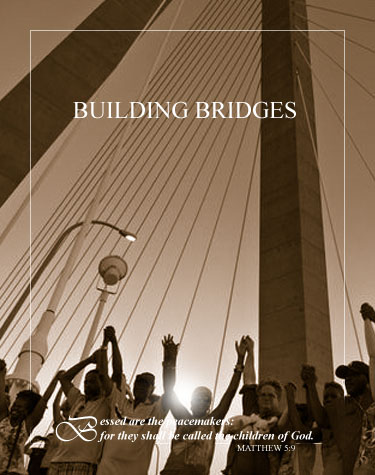
THYME Magazine: Building Bridges

Citizen Journalism with a Better Flavor

THYMECharestonSC
Volume IX, Issue XXV

Building Bridges

One of my favorite scenes in the movie: 'Remember the Titans' is the one where Gerry Bertier and Julius Campbell realize that they are indeed brothers. Though they are of different cultures in segregated Virginia, they come together as teammates and develop bonds that are far deeper. The film is one we should perhaps dust off in these difficult days and pause as well at the scene where the team runs at dawn to the battlefields of Gettysburg.Coach Herman Boone speaks:

Anybody know what this place is? This is Gettysburg. This is where they fought the Battle of Gettysburg. Fifty thousand men died right here on this field, fightin' the same fight that we're still fightin' amongst ourselves today.

This green field right here was painted red, bubblin' with the blood of young boys, smoke and hot lead pourin' right through their bodies. Listen to their souls, men:

I killed my brother with malice in my heart. Hatred destroyed my family.'

You listen. And you take a lesson from the dead. If we don't come together, right now, on this hallowed ground, we too will be destroyed -- just like they were. I don't care if you like each other or not. But you will respect each other. And maybe -- I don't know -- maybe we'll learn to play this game like men."

Indeed, upon learning of the death of the Reverend Honorable Clementa C. Pinckney and eight of his congregation, I read his biography on the church website. I grieved a brother. The man and I held dear the same things. He died loving the people of G-d and building the Unseen Kingdom. Reverend Pinckney and his little circle were co-laborers in my most cherished work.

Surely that would be a brief thought, only to be lost in the onslaught of politicized news to come in the days to follow.

But I had made a fatal miscalculation. I underestimated the G-d that Reverend Pinckney and I serve (the present tense in intentional, for I believe he stands in the Presence of our shared Master today). To know the true greatness of a man, look at his pupils! As the members of the congregation who had just lost loved ones at the hands of a depraved gunman stepped forward to extend forgiveness to him, I recognized the hand of the Divine in their lives.

As thousands lined the Arthur Ravenel Jr. Bridge, arms and hands joined,to remember and pray; the Divine was at work! Dr. Henry Blackaby tells us to look for G-d at work and join him in that work. That call is clear today.
_______________________________________________
Special Book Section Continues Tomorrow:

THYME Magazine will continue to present the SPECIAL BOOK SECTION: Pontifus, The Bridge Builder's Tale in Three Parts. Many of the subjects and ideas presented in the book first appeared in THYME. Please do enjoy the weekly presentation of each new chapter. THYME will resume its regular format in the Fall.Until then, enjoy the book and spend some time making a difference in someone's life.

BannerforDinner

Special Book Section

Five weeks ago we began the serial presentation of "Pontifus, The Bridge Builder's Tale in Three Parts." [1.] This week we present the fifth chapter of the first book: "Dinner Stop at the End of the World" Here [click to read]. This special book section will continue through the Summer. The full publication of THYME will resume in the Fall.

Friday, June 19, 2015

THYME Magazine: Finding Imago Dei

Citizen Journalism with a Better Flavor

PinkneyTHYME
Volume IX, Issue XXIV

Finding Imago Dei

Therefore said he unto them, The harvest truly is great, but the labourers are few: pray ye therefore the Lord of the harvest, that he would send forth labourers into his harvest." -- Luke 10:2

From the Pastor's Page of Emmanuel AME Church:

The Reverend Honorable Clementa C. Pinckney was born July 30, 1973 the son of Mr. John Pinckney and the late Theopia Stevenson Pinckney of Ridgeland, South Carolina. He was educated in the public schools of Jasper County. He is a magna cum laude graduate of Allen University with a degree in Business Administration. While there, Reverend Pinckney served as freshman class president, student body president, and senior class president. Ebony Magazine recognized Rev. Pinckney as one the "Top College Students in America". During his junior year, he received a Princeton University's Woodrow Wilson Summer Research Fellowship in the fields of public policy and international affairs. He received a graduate fellowship to the University of South Carolina where he earned a Master's degree in public administration. He completed a Master's of Divinity from the Lutheran Theological Southern Seminary.

Rev. Pinckney answered the call to preach at the age of thirteen and received his first appointment to pastor at the age of eighteen. He has served the following charges: Young's Chapel-Irmo, The Port Royal Circuit, Mount Horr-Yonges Island, Presiding Elder of the Wateree District and Campbell Chapel, Bluffton. He serves as the pastor of historic Mother Emanuel A.M.E. in Charleston, South Carolina.

Rev. Pinckney was elected to the South Carolina House of Representatives in 1996 at the age of twenty-three. In 2000, he was elected to the State Senate at the age of twenty-seven. He is one of the youngest persons and the youngest African-American in South Carolina to be elected to the State Legislature. He represents Jasper, Beaufort, Charleston, Colleton, and Hampton Counties. His committee assignments include Senate Finance, Banking and Insurance, Transportation, Medical Affairs and Corrections and Penology. Washington Post columnist, David Broder, called Rev. Pinckney a "political spirit lifter for suprisingly not becoming cynical about politics."

Rev. Pinckney has served in other capacities in the state to include a college trustee and corporate board member. In May 2010, he delivered the Commencement Address for the Lutheran Theological Southern Seminary. He and his wife Jennifer have two children - Eliana and Malana.
 _______________________________________________

No doubt, Reverend Pinckney has heard the Master's commendation: "Well done, good and faithful servant," as he stepped into his eternal home, but his life well lived instructs us even in the wake of his death.

My friend Chris Lassiter writes: "Some of my friends use Facebook (and the internet) for pure comedy. Others use it to weigh in on important social issues. If you use it to weigh in on issues, please don't ignore the horrible shooting at Emanuel AME Church in Charleston because the racial implications can be uncomfortable. We've 'gotta' talk."

Indeed Chris, we do. I had decided to take a break from blogging this Summer and simply serialize my book, but your challenge is important. Reverend Pinckney lived the life I look for for my stories. He answered G-d's call at a young age and has already done far more with his short years than I have with mine. I pray for young people I know who have also answered the call... their lives are not that different from that of Reverend Pinckney's, so when I actually got to know something of the man through reading his biography, I was shaken. I know people like him. His death diminishes something I hold dear.

Not only must we pick up the torch of our fallen brother in ministry but we must renew our commitment to see IMAGO DEI, the Image of the Divine, in each person we encounter in our daily lives. In fact, as Reverend Picnkney was being brutally murdered, I was sitting in OUR Pastor's Bible study as we discussed just that... that G-d would have us see His Image in our fellows. We must see and celebrate the Divine Beauty in each person and see them as someone G-d loves extravagantly! Can we love as Christ loves? That would leave no room for our blindness and prejudice.

Wednesday, May 27, 2015

THYME Magazine:

Citizen Journalism with a Better Flavor

THYME0923
Volume IX, Issue XXIII

Recently I had to take my car to the shop before heading out to one of my part-time jobs. Walking to work in the morning light, I passed the First Presbyterian Church and the Temple House of Israel. The play of light and flowers seemed to be a blessing directly from the hand of the Divine! It was indeed a wonderful time to reflect on the blessings that He has given! In addition to opportunities to work and create, He gives the joy of family and friends. The happy opportunity to bless family (while you have a choice of reading options, my wife only has one husband, my children only one father), makes my decision to take a break from creating new content for the weekly magazine a sound one.

Yesterday, painting the safety gate on the porch of my daughter's new house, built by the other grandfather and beautified by my brush, it was a joy to contribute to the safety and goodness of a grandchild's life. I write this not as instruction to anyone but myself, but perhaps to explain why one like me is compelled to put down the tools occasionally and simply live life. Writing is a good thing, but living and investing in those dear to you is better. The next few months will be full of that, I pray. Building for the future is not always a high-visibility activity.

THYME Magazine will continue to present the SPECIAL BOOK SECTION: Pontifus, The Bridge Builder's Tale in Three Parts. Many of the subjects and ideas presented in the book first appeared in THYME. Please do enjoy the weekly presentation of each new chapter. THYME will resume its regular format in the Fall.Until then, enjoy the book and spend some time making a difference in someone's life.

BannerforDinner

Special Book Section

Three weeks ago we began the serial presentation of "Pontifus, The Bridge Builder's Tale in Three Parts." [1.] This week we present the fifth chapter of the first book: "Dinner Stop at the End of the World" Here [click to read]. This special book section will continue through the Summer. The full publication of THYME will resume in the Fall.

churchflowers
First Presbyterian Church, Staunton, Virginia.
Photo by Bob Kirchman

Thursday, April 16, 2015

THYME Magazine: Binyamin Netanyahu's Speech

Citizen Journalism with a Better Flavor

THYMEnetanyahu
Volume IX, Issue XVII (Page Two)

Holocaust Remembrance Day 
Address by PM Netanyahu at Yad Vashem 15/04/2015

[Translation]

Seventy years ago, the bells of freedom rang out across the free world. The horrific nightmare that had engulfed all humanity in blood had come to an end in Europe. But the day the Nazis were vanquished was not only a day of relief and jubilation. It was also a day of great sorrow for our nation, and a day of reflection for the world’s leaders. Leaders of modern countries realized that it was a propitious time to establish a new world order based on defending liberty, eradicating evil and opposing oppression. They articulated the most important lesson of World War II: democracies must not turn a blind eye to the aspirations of tyrannous regimes to expand. A conciliatory attitude toward these regimes only increases their propensity for aggression. And if such aggression is not stopped in time, humanity might find itself in a much bloodier battle.

In the years before World War II, the free world tried to appease the Nazi regime, to gain its trust, to curry its favor through gestures. There were those who warned that this concessionary policy would only whet Hitler’s appetite, but these warnings were ignored due to the natural human desire for calm at all costs. And indeed, the price was exacted not long after, and it was too heavy to bear – six million of our people were slaughtered in the Holocaust, and millions of others were killed in this terrible inferno.

When the war ended, the conclusion was clear: there is no room for weakness when facing tyrannous regimes that send their murderous tentacles in every direction. Only by standing firm and adhering to the values of liberty and tolerance can we ensure the future of humankind. There are many around the world who claim that the lessons learned then are still valid today. They affirm: “Never again!” They declare: “We will not turn a blind eye to the expansionist intentions of a violent tyranny.” They promise: “We will oppose evil as soon as it begins.” But as long as these announcements are not backed by practical actions – they are meaningless. Did the world really learn a lesson from the inconceivable universal and Jewish tragedy of last century? I wish I could stand here and tell you that the answer to this was yes.

Today, ever more threats challenge human civilization. Radical Islamist forces are flooding the Middle East, destroying remnants of the past, torturing the helpless, murdering innocents. They hope to establish caliphates, more than one, like in the Middle Ages. At the same time, the extremist regime in Iran is oppressing its people; it is rushing forward and submerging the Middle East in blood and suffering – in Yemen, in Syria, in Lebanon, in Iraq, in Gaza and across the border of the Golan Heights.

Just as the Nazis aspired to crush civilization and to establish a “master race” to replace it and control the world while annihilating the Jewish people, so too does Iran strive to gain control over the region, from which it would spread further, with the explicit intent of obliterating the Jewish state. Iran is advancing in two tracks: the first is in developing the ability to arm itself with nuclear weapons and stockpile ballistic missiles; and the second – exporting the Khomeinist revolution to many countries by widely using terrorism and taking over large parts of the Middle East. Everything is out in the open – it is all taking place in broad daylight, in front of the cameras. And yet, the blindness is immense.

For, behold, darkness shall cover the earth, and gross darkness the peoples,” said the Prophet Isaiah. The determination and lessons that were acquired through blood seventy years ago are now dissipating, and the darkness and fog of denying reality are taking their place. The bad deal that is being made with Iran demonstrates that the historic lesson has not been internalized. The West is yielding in the face of Iran’s aggressive actions. Instead of demanding a significant dismantling of the nuclear program in Iran – a country that clearly states its plans to exterminate six million Jews here and elsewhere, to eradicate many countries and many regimes – the superpowers back down. They are leaving Iran with its nuclear capabilities intact, and even allowing it to expand them later on, regardless of Iran’s actions in the Middle East and around the world.

As the civilized world is lulled into slumber on a bed of illusions, the rulers of Iran continue to encourage subversion and terrorism and disseminate destruction and death. The superpowers turn a deaf ear to the crowds in Iran shouting: “Death to America; Death to Israel.” They turn a blind eye to the executions of those who oppose the regime and of members of minority populations. And they hold their peace in the face of the massive arming of terrorist organizations. At most, they make a halfhearted statement for the record.

I have heard that in honor of Holocaust Remembrance Day a competition with prizes is soon to take place in Tehran with participants from 56 countries. It is a Holocaust denial cartoon competition. Will we hear protests? At best, a minor condemnation might be heard; that will minimally fulfill their obligation.

Distinguished guests, Israeli citizens and representatives of other countries, The bubble of this illusion is going to burst. Democratic governments made a critical mistake before World War II, and we are convinced – and I must say that many of our neighbors are too – that they are making a grave mistake now too. It is possible that this partnership with many of our neighbors, the partnership in identifying threats, will be the foundation for the partnership to forge a better, safer and more peaceful future in our region. Meanwhile, we will not flinch. We will continue to insist on the truth, and we will do everything we can to open the eyes that are shut.

I do not want to mislead anyone. We have tests ahead of us. We are in the midst of a great battle against the enervation, the weakness, the denial of reality – we will stand with our full force.

While there are those who refuse to understand our position, there are many others who identify with us. But even if we are compelled to stand alone, we will not be afraid. In any scenario, in any situation, we will safeguard our right, we will maintain our ability, we will keep our resolve to defend ourselves.

Seventy years ago we were war refugees, powerless and voiceless. Today we express what we have to say, and we are determined to safeguard our existence and our future. It is our duty to fight those who wish to destroy us, not to bow down to them or to downplay reality. We will not allow the State of Israel to be a passing episode in the history of our people.

Distinguished guests, Today in my office I met an 85-year-old Holocaust survivor, Abraham Niederhoffer. Abraham was born in Romania. When he was 12 years old he witnessed the brutal murder of his relatives by a Romanian soldier. He was taken on a cattle train to Ukraine, where he survived the Holocaust. Due to the persistent refusal of the communist authorities in Romania to permit his emigration, he only came to Israel in 1969. Here he worked as an engineer and supervisor, contributing to the building of the country. He told me his story with great emotion, so much so that he had to pause several times. At the end of the meeting, he beseeched me, “Prime Minister,” he said, “it is your duty to prevent another Holocaust.” And I responded: “That is exactly how I see my responsibility. That is exactly how I see my responsibility.”

Seven decades ago, the survivors emerged from the camps, from the forests, from the March of Death, battered and bruised with nothing but the tattered clothes on their backs. Upon their release, the prisoners of the camps from all nations were asked by the Allied soldiers where each one wished to go. The Poles returned to Poland; the Russians returned to Russia; the Hungarians – to Hungary; the Ukrainians – to Ukraine. But a great many of them had nowhere to return to. They stood hopeless, because they did not have their own country.

Today, we have our own country – a flourishing and modern country; a country that rests on the heritage of our forefathers and stands at the vanguard of global knowledge; a country that disseminates a great light; a country that has taken charge of its destiny. Seventy years after the valleys of death, we revere the living, the vibrant, the creative, the flourishing. Israel breaks ground on every front of modernization – in science, medicine, technology, agriculture, education and culture. And we do this not only for our people. We do this for the benefit of all humanity. This is what our existence is based upon – on our commitment to the safety and future of Israel, on the deference to our heritage, and on the unity of a nation in which a vast life force shines. The nation of Israel, which has arisen from the hellfire, is ready for any challenge.

Shake thyself from the dust; put on thy beautiful garments, my people.” The eternal nation has shaken itself from the dust, returned home, stood tall, established an outstanding country and an outstanding army, the Israel Defense Force, in which our brave and courageous sons and daughters serve.

We will remember those who were murdered, we will guarantee life.

Tuesday, March 3, 2015

THYME Magazine: Binyamin Netanyahu's Speech

Citizen Journalism with a Better Flavor

THYMEnetanyahu
Volume IX, Issue IX (Page Two)


P. M. Netanyahu's Full Speech. Provided by Phillip Pasmanick.

P. M. Netanyahu's Address
 Transcript of the Address to Congress: 03/03/2015

I want to thank Speaker of the House John Boehner, President Pro Tem Senator Orrin Hatch, Senator Minority — Majority Leader Mitch McConnell, House Minority Leader Nancy Pelosi, and House Majority Leader Kevin McCarthy.

I also want to acknowledge Senator, Democratic Leader Harry Reid. Harry, it’s good to see you back on your feet.

I guess it’s true what they say; you can’t keep a good man down.

My friends, I’m deeply humbled by the opportunity to speak for a third time before the most important legislative body in the world, the U.S. Congress.

I want to thank you all for being here today. I know that my speech has been the subject of much controversy. I deeply regret that some perceive my being here as political. That was never my intention.

I want to thank you, Democrats and Republicans, for your common support for Israel, year after year, decade after decade.

I know that no matter on which side of the aisle you sit, you stand with Israel.

The remarkable alliance between Israel and the United States has always been above politics. It must always remain above politics.

Because America and Israel, we share a common destiny, the destiny of promised lands that cherish freedom and offer hope. Israel is grateful for the support of American — of America’s people and of America’s presidents, from Harry Truman to Barack Obama.

We appreciate all that President Obama has done for Israel.

Now, some of that is widely known.

Some of that is widely known, like strengthening security cooperation and intelligence sharing, opposing anti-Israel resolutions at the U.N.

Some of what the president has done for Israel is less well- known.

I called him in 2010 when we had the Carmel forest fire, and he immediately agreed to respond to my request for urgent aid.

In 2011, we had our embassy in Cairo under siege, and again, he provided vital assistance at the crucial moment.

Or his support for more missile interceptors during our operation last summer when we took on Hamas terrorists.

In each of those moments, I called the president, and he was there.

And some of what the president has done for Israel might never be known, because it touches on some of the most sensitive and strategic issues that arise between an American president and an Israeli prime minister.

But I know it, and I will always be grateful to President Obama for that support.

And Israel is grateful to you, the American Congress, for your support, for supporting us in so many ways, especially in generous military assistance and missile defense, including Iron Dome.

Last summer, millions of Israelis were protected from thousands of Hamas rockets because this capital dome helped build our Iron Dome.

Thank you, America. Thank you for everything you’ve done for Israel.

My friends, I’ve come here today because, as prime minister of Israel, I feel a profound obligation to speak to you about an issue that could well threaten the survival of my country and the future of my people: Iran’s quest for nuclear weapons.

hamantaschen
Hamantaschen, or 'Haman's Hat' cookies celebrate the heroism of Esther.

We’re an ancient people. In our nearly 4,000 years of history, many have tried repeatedly to destroy the Jewish people. Tomorrow night, on the Jewish holiday of Purim, we’ll read the Book of Esther. We’ll read of a powerful Persian viceroy named Haman, who plotted to destroy the Jewish people some 2,500 years ago. But a courageous Jewish woman, Queen Esther, exposed the plot and gave for the Jewish people the right to defend themselves against their enemies.

The plot was foiled. Our people were saved.

Today the Jewish people face another attempt by yet another Persian potentate to destroy us. Iran’s Supreme Leader Ayatollah Khamenei spews the oldest hatred, the oldest hatred of anti-Semitism with the newest technology. He tweets that Israel must be annihilated — he tweets. You know, in Iran, there isn’t exactly free Internet. But he tweets in English that Israel must be destroyed.

For those who believe that Iran threatens the Jewish state, but not the Jewish people, listen to Hassan Nasrallah, the leader of Hezbollah, Iran’s chief terrorist proxy. He said: If all the Jews gather in Israel, it will save us the trouble of chasing them down around the world.

But Iran’s regime is not merely a Jewish problem, any more than the Nazi regime was merely a Jewish problem. The 6 million Jews murdered by the Nazis were but a fraction of the 60 million people killed in World War II. So, too, Iran’s regime poses a grave threat, not only to Israel, but also the peace of the entire world. To understand just how dangerous Iran would be with nuclear weapons, we must fully understand the nature of the regime.

The people of Iran are very talented people. They’re heirs to one of the world’s great civilizations. But in 1979, they were hijacked by religious zealots — religious zealots who imposed on them immediately a dark and brutal dictatorship.

That year, the zealots drafted a constitution, a new one for Iran. It directed the revolutionary guards not only to protect Iran’s borders, but also to fulfill the ideological mission of jihad. The regime’s founder, Ayatollah Khomeini, exhorted his followers to “export the revolution throughout the world.”

I’m standing here in Washington, D.C. and the difference is so stark. America’s founding document promises life, liberty and the pursuit of happiness. Iran’s founding document pledges death, tyranny, and the pursuit of jihad. And as states are collapsing across the Middle East, Iran is charging into the void to do just that.

Iran’s goons in Gaza, its lackeys in Lebanon, its revolutionary guards on the Golan Heights are clutching Israel with three tentacles of terror. Backed by Iran, Assad is slaughtering Syrians. Back by Iran, Shiite militias are rampaging through Iraq. Back by Iran, Houthis are seizing control of Yemen, threatening the strategic straits at the mouth of the Red Sea. Along with the Straits of Hormuz, that would give Iran a second choke-point on the world’s oil supply.

Just last week, near Hormuz, Iran carried out a military exercise blowing up a mock U.S. aircraft carrier. That’s just last week, while they’re having nuclear talks with the United States. But unfortunately, for the last 36 years, Iran’s attacks against the United States have been anything but mock. And the targets have been all too real.

Iran took dozens of Americans hostage in Tehran, murdered hundreds of American soldiers, Marines, in Beirut, and was responsible for killing and maiming thousands of American service men and women in Iraq and Afghanistan.

Beyond the Middle East, Iran attacks America and its allies through its global terror network. It blew up the Jewish community center and the Israeli embassy in Buenos Aires. It helped Al Qaida bomb U.S. embassies in Africa. It even attempted to assassinate the Saudi ambassador, right here in Washington, D.C.

In the Middle East, Iran now dominates four Arab capitals, Baghdad, Damascus, Beirut and Sanaa. And if Iran’s aggression is left unchecked, more will surely follow.

So, at a time when many hope that Iran will join the community of nations, Iran is busy gobbling up the nations.

We must all stand together to stop Iran’s march of conquest, subjugation and terror.

Now, two years ago, we were told to give President Rouhani and Foreign Minister Zarif a chance to bring change and moderation to Iran. Some change! Some moderation!

Rouhani’s government hangs gays, persecutes Christians, jails journalists and executes even more prisoners than before.

Last year, the same Zarif who charms Western diplomats laid a wreath at the grave of Imad Mughniyeh. Imad Mughniyeh is the terrorist mastermind who spilled more American blood than any other terrorist besides Osama bin Laden. I’d like to see someone ask him a question about that.

Iran’s regime is as radical as ever, its cries of “Death to America,” that same America that it calls the “Great Satan,” as loud as ever.

Now, this shouldn’t be surprising, because the ideology of Iran’s revolutionary regime is deeply rooted in militant Islam, and that’s why this regime will always be an enemy of America.

Don’t be fooled. The battle between Iran and ISIS doesn’t turn Iran into a friend of America.

Iran and ISIS are competing for the crown of militant Islam. One calls itself the Islamic Republic. The other calls itself the Islamic State. Both want to impose a militant Islamic empire first on the region and then on the entire world. They just disagree among themselves who will be the ruler of that empire.

In this deadly game of thrones, there’s no place for America or for Israel, no peace for Christians, Jews or Muslims who don’t share the Islamist medieval creed, no rights for women, no freedom for anyone.

So when it comes to Iran and ISIS, the enemy of your enemy is your enemy.

The difference is that ISIS is armed with butcher knives, captured weapons and YouTube, whereas Iran could soon be armed with intercontinental ballistic missiles and nuclear bombs. We must always remember — I’ll say it one more time — the greatest dangers facing our world is the marriage of militant Islam with nuclear weapons. To defeat ISIS and let Iran get nuclear weapons would be to win the battle, but lose the war. We can’t let that happen.

But that, my friends, is exactly what could happen, if the deal now being negotiated is accepted by Iran. That deal will not prevent Iran from developing nuclear weapons. It would all but guarantee that Iran gets those weapons, lots of them.

Let me explain why. While the final deal has not yet been signed, certain elements of any potential deal are now a matter of public record. You don’t need intelligence agencies and secret information to know this. You can Google it.

Absent a dramatic change, we know for sure that any deal with Iran will include two major concessions to Iran.

The first major concession would leave Iran with a vast nuclear infrastructure, providing it with a short break-out time to the bomb. Break-out time is the time it takes to amass enough weapons-grade uranium or plutonium for a nuclear bomb.

According to the deal, not a single nuclear facility would be demolished. Thousands of centrifuges used to enrich uranium would be left spinning. Thousands more would be temporarily disconnected, but not destroyed.

Because Iran’s nuclear program would be left largely intact, Iran’s break-out time would be very short — about a year by U.S. assessment, even shorter by Israel’s.

And if — if Iran’s work on advanced centrifuges, faster and faster centrifuges, is not stopped, that break-out time could still be shorter, a lot shorter.

True, certain restrictions would be imposed on Iran’s nuclear program and Iran’s adherence to those restrictions would be supervised by international inspectors. But here’s the problem. You see, inspectors document violations; they don’t stop them.

Inspectors knew when North Korea broke to the bomb, but that didn’t stop anything. North Korea turned off the cameras, kicked out the inspectors. Within a few years, it got the bomb.

Now, we’re warned that within five years North Korea could have an arsenal of 100 nuclear bombs.

Like North Korea, Iran, too, has defied international inspectors. It’s done that on at least three separate occasions — 2005, 2006, 2010. Like North Korea, Iran broke the locks, shut off the cameras.

Now, I know this is not gonna come a shock — as a shock to any of you, but Iran not only defies inspectors, it also plays a pretty good game of hide-and-cheat with them.

The U.N.’s nuclear watchdog agency, the IAEA, said again yesterday that Iran still refuses to come clean about its military nuclear program. Iran was also caught — caught twice, not once, twice — operating secret nuclear facilities in Natanz and Qom, facilities that inspectors didn’t even know existed.

Right now, Iran could be hiding nuclear facilities that we don’t know about, the U.S. and Israel. As the former head of inspections for the IAEA said in 2013, he said, “If there’s no undeclared installation today in Iran, it will be the first time in 20 years that it doesn’t have one.” Iran has proven time and again that it cannot be trusted. And that’s why the first major concession is a source of great concern. It leaves Iran with a vast nuclear infrastructure and relies on inspectors to prevent a breakout. That concession creates a real danger that Iran could get to the bomb by violating the deal.

But the second major concession creates an even greater danger that Iran could get to the bomb by keeping the deal. Because virtually all the restrictions on Iran’s nuclear program will automatically expire in about a decade.

Now, a decade may seem like a long time in political life, but it’s the blink of an eye in the life of a nation. It’s a blink of an eye in the life of our children. We all have a responsibility to consider what will happen when Iran’s nuclear capabilities are virtually unrestricted and all the sanctions will have been lifted. Iran would then be free to build a huge nuclear capacity that could product many, many nuclear bombs.

Iran’s Supreme Leader says that openly. He says, Iran plans to have 190,000 centrifuges, not 6,000 or even the 19,000 that Iran has today, but 10 times that amount — 190,000 centrifuges enriching uranium. With this massive capacity, Iran could make the fuel for an entire nuclear arsenal and this in a matter of weeks, once it makes that decision.

My long-time friend, John Kerry, Secretary of State, confirmed last week that Iran could legitimately possess that massive centrifuge capacity when the deal expires.

Now I want you to think about that. The foremost sponsor of global terrorism could be weeks away from having enough enriched uranium for an entire arsenal of nuclear weapons and this with full international legitimacy.

And by the way, if Iran’s Intercontinental Ballistic Missile program is not part of the deal, and so far, Iran refuses to even put it on the negotiating table. Well, Iran could have the means to deliver that nuclear arsenal to the far-reach corners of the earth, including to every part of the United States.

So you see, my friends, this deal has two major concessions: one, leaving Iran with a vast nuclear program and two, lifting the restrictions on that program in about a decade. That’s why this deal is so bad. It doesn’t block Iran’s path to the bomb; it paves Iran’s path to the bomb.

So why would anyone make this deal? Because they hope that Iran will change for the better in the coming years, or they believe that the alternative to this deal is worse?

Well, I disagree. I don’t believe that Iran’s radical regime will change for the better after this deal. This regime has been in power for 36 years, and its voracious appetite for aggression grows with each passing year. This deal would wet appetite — would only wet Iran’s appetite for more.

Would Iran be less aggressive when sanctions are removed and its economy is stronger? If Iran is gobbling up four countries right now while it’s under sanctions, how many more countries will Iran devour when sanctions are lifted? Would Iran fund less terrorism when it has mountains of cash with which to fund more terrorism?

Why should Iran’s radical regime change for the better when it can enjoy the best of both world’s: aggression abroad, prosperity at home?

This is a question that everyone asks in our region. Israel’s neighbors — Iran’s neighbors know that Iran will become even more aggressive and sponsor even more terrorism when its economy is unshackled and it’s been given a clear path to the bomb.

And many of these neighbors say they’ll respond by racing to get nuclear weapons of their own. So this deal won’t change Iran for the better; it will only change the Middle East for the worse. A deal that’s supposed to prevent nuclear proliferation would instead spark a nuclear arms race in the most dangerous part of the planet.

This deal won’t be a farewell to arms. It would be a farewell to arms control. And the Middle East would soon be crisscrossed by nuclear tripwires. A region where small skirmishes can trigger big wars would turn into a nuclear tinderbox.

If anyone thinks — if anyone thinks this deal kicks the can down the road, think again. When we get down that road, we’ll face a much more dangerous Iran, a Middle East littered with nuclear bombs and a countdown to a potential nuclear nightmare.

Ladies and gentlemen, I’ve come here today to tell you we don’t have to bet the security of the world on the hope that Iran will change for the better. We don’t have to gamble with our future and with our children’s future.

We can insist that restrictions on Iran’s nuclear program not be lifted for as long as Iran continues its aggression in the region and in the world.

bibi
Prime Minister Binyamin Netanyahu. P. Pasmanick

Before lifting those restrictions, the world should demand that Iran do three things. First, stop its aggression against its neighbors in the Middle East. Second…

Second, stop supporting terrorism around the world.

And third, stop threatening to annihilate my country, Israel, the one and only Jewish state.

Thank you.

If the world powers are not prepared to insist that Iran change its behavior before a deal is signed, at the very least they should insist that Iran change its behavior before a deal expires.

If Iran changes its behavior, the restrictions would be lifted. If Iran doesn’t change its behavior, the restrictions should not be lifted.

If Iran wants to be treated like a normal country, let it act like a normal country.

My friends, what about the argument that there’s no alternative to this deal, that Iran’s nuclear know-how cannot be erased, that its nuclear program is so advanced that the best we can do is delay the inevitable, which is essentially what the proposed deal seeks to do?

Well, nuclear know-how without nuclear infrastructure doesn’t get you very much. A racecar driver without a car can’t drive. A pilot without a plan can’t fly. Without thousands of centrifuges, tons of enriched uranium or heavy water facilities, Iran can’t make nuclear weapons.

Iran’s nuclear program can be rolled back well-beyond the current proposal by insisting on a better deal and keeping up the pressure on a very vulnerable regime, especially given the recent collapse in the price of oil.

Now, if Iran threatens to walk away from the table — and this often happens in a Persian bazaar — call their bluff. They’ll be back, because they need the deal a lot more than you do.

And by maintaining the pressure on Iran and on those who do business with Iran, you have the power to make them need it even more.

My friends, for over a year, we’ve been told that no deal is better than a bad deal. Well, this is a bad deal. It’s a very bad deal. We’re better off without it.

Now we’re being told that the only alternative to this bad deal is war. That’s just not true.

The alternative to this bad deal is a much better deal.

A better deal that doesn’t leave Iran with a vast nuclear infrastructure and such a short break-out time. A better deal that keeps the restrictions on Iran’s nuclear program in place until Iran’s aggression ends.

A better deal that won’t give Iran an easy path to the bomb. A better deal that Israel and its neighbors may not like, but with which we could live, literally. And no country…

… no country has a greater stake — no country has a greater stake than Israel in a good deal that peacefully removes this threat.

Ladies and gentlemen, history has placed us at a fateful crossroads. We must now choose between two paths. One path leads to a bad deal that will at best curtail Iran’s nuclear ambitions for a while, but it will inexorably lead to a nuclear-armed Iran whose unbridled aggression will inevitably lead to war.

The second path, however difficult, could lead to a much better deal, that would prevent a nuclear-armed Iran, a nuclearized Middle East and the horrific consequences of both to all of humanity.

You don’t have to read Robert Frost to know. You have to live life to know that the difficult path is usually the one less traveled, but it will make all the difference for the future of my country, the security of the Middle East and the peace of the world, the peace, we all desire.

My friend, standing up to Iran is not easy. Standing up to dark and murderous regimes never is. With us today is Holocaust survivor and Nobel Prize winner Elie Wiesel.

Elie, your life and work inspires to give meaning to the words, “never again.”

And I wish I could promise you, Elie, that the lessons of history have been learned. I can only urge the leaders of the world not to repeat the mistakes of the past.

Not to sacrifice the future for the present; not to ignore aggression in the hopes of gaining an illusory peace.

But I can guarantee you this, the days when the Jewish people remained passive in the face of genocidal enemies, those days are over.

We are no longer scattered among the nations, powerless to defend ourselves. We restored our sovereignty in our ancient home. And the soldiers who defend our home have boundless courage. For the first time in 100 generations, we, the Jewish people, can defend ourselves.

This is why — this is why, as a prime minister of Israel, I can promise you one more thing: Even if Israel has to stand alone, Israel will stand.

But I know that Israel does not stand alone. I know that America stands with Israel.

I know that you stand with Israel.

You stand with Israel, because you know that the story of Israel is not only the story of the Jewish people but of the human spirit that refuses again and again to succumb to history’s horrors.

Moses
Image of Moses referenced by the Prime Minister. Architect of the Capitol.

Facing me right up there in the gallery, overlooking all of us in this (inaudible) chamber is the image of Moses. Moses led our people from slavery to the gates of the Promised Land.

And before the people of Israel entered the land of Israel, Moses gave us a message that has steeled our resolve for thousands of years. I leave you with his message today, (SPEAKING IN HEBREW), “Be strong and resolute, neither fear nor dread them.”

My friends, may Israel and America always stand together, strong and resolute. May we neither fear nor dread the challenges ahead. May we face the future with confidence, strength and hope.

May G-d bless the state of Israel and may G-d bless the United States of America. [1.]

Return to THYME Frontpage [click to read]

congress
Congress listens to the Prime Minister. P. Pasmanick.