Wednesday, May 17, 2017

Case for Vision, The Reckless Engineer, Phantasies

Citizen Journalism with a Better Flavor

Phantasies16
Volume XII, Issue XXII

Phantasies
By George MacDonald, Chapter 16

Ev'n the Styx, which ninefold her infoldeth
Hems not Ceres' daughter in its flow;
But she grasps the apple--ever holdeth
Her, sad Orcus, down below."
~ Johann Christoph Friedrich von Schiller, "Das Ideal und das Leben".

Ever as I sang, the veil was uplifted; ever as I sang, the signs of life grew; till, when the eyes dawned upon me, it was with that sunrise of splendour which my feeble song attempted to re-imbody.

The wonder is, that I was not altogether overcome, but was able to complete my song as the unseen veil continued to rise. This ability came solely from the state of mental elevation in which I found myself. Only because uplifted in song, was I able to endure the blaze of the dawn. But I cannot tell whether she looked more of statue or more of woman; she seemed removed into that region of phantasy where all is intensely vivid, but nothing clearly defined. At last, as I sang of her descending hair, the glow of soul faded away, like a dying sunset. A lamp within had been extinguished, and the house of life shone blank in a winter morn. She was a statue once more--but visible, and that was much gained. Yet the revulsion from hope and fruition was such, that, unable to restrain myself, I sprang to her, and, in defiance of the law of the place, flung my arms around her, as if I would tear her from the grasp of a visible Death, and lifted her from the pedestal down to my heart. But no sooner had her feet ceased to be in contact with the black pedestal, than she shuddered and trembled all over; then, writhing from my arms, before I could tighten their hold, she sprang into the corridor, with the reproachful cry, "You should not have touched me!" darted behind one of the exterior pillars of the circle, and disappeared. I followed almost as fast; but ere I could reach the pillar, the sound of a closing door, the saddest of all sounds sometimes, fell on my ear; and, arriving at the spot where she had vanished, I saw, lighted by a pale yellow lamp which hung above it, a heavy, rough door, altogether unlike any others I had seen in the palace; for they were all of ebony, or ivory, or covered with silver-plates, or of some odorous wood, and very ornate; whereas this seemed of old oak, with heavy nails and iron studs. Notwithstanding the precipitation of my pursuit, I could not help reading, in silver letters beneath the lamp:

No one enters here without the leave of the Queen."

But what was the Queen to me, when I followed my white lady? I dashed the door to the wall and sprang through. Lo! I stood on a waste windy hill. Great stones like tombstones stood all about me. No door, no palace was to be seen. A white figure gleamed past me, wringing her hands, and crying, "Ah! you should have sung to me; you should have sung to me!" and disappeared behind one of the stones. I followed. A cold gust of wind met me from behind the stone; and when I looked, I saw nothing but a great hole in the earth, into which I could find no way of entering. Had she fallen in? I could not tell. I must wait for the daylight. I sat down and wept, for there was no help.
(to be continued) 
THYME0707
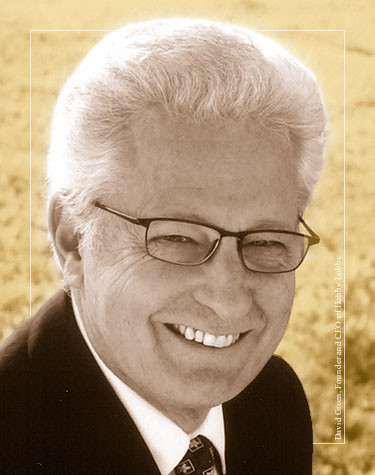
David Green.

A Case for Vision IV

A not so recent buzz on social media was one to the effect that Hobby Lobby was planning to close stores in response to the Obamacare insurance contraceptive/abortificant mandate. The rumor was not new. The company is actively fighting this regulatory infringement upon its right of conscience. Founder and CEO David Green was quick to respond to the news piece in which he is reported to have announced the downsizing [1.]. Actually Mr. Green said that the company had plans to build 30 or more new stores this year. Doing the news involves checking facts and we found Mr. Green's actual statement in a report issued in conjunction with receiving an award from a major university this past April [2]. The reasons for the award actually spoke volumes about the life and vision of David Green. From the news articles it would appear that Mr. Green was quietly doing what CEOs all do, just running his company to make a profit, when all of a sudden he became the object of Federal regulation. The fact of the matter is that David Green's work itself springs from, and is dedicated to, a higher vision.

Dr. Henry Smith, President of Indiana Wesleyan University said in conferring the honor: "I am excited to announce that Dr. David Green, founder and CEO of Hobby Lobby Creative Centers, has accepted our invitation to the Society of World Changers as our 2013 inductee. David Green is a business leader, an entrepreneur, a philanthropist, an author, a patron of scholarship and culture but above everything else, he is a servant of Christ like any one of us, a saved sinner dependent upon the grace of God and the guidance of the Holy Spirit. He attributes any success he has had to his trust in G-d, and acknowledges that G-d has used that success as a platform to minister to the world. IWU recognized David Green and his achievements previously through the conferral of an honorary doctorate in 1999."[3.]

FORBES notes: "There are very few members of The Forbes 400 who bring religion to work. Most notable are Chick-fil-A's Truett Cathy and Forever 21's Jin Sook and Do Won Chang, born-again Christians who keep Bibles in their office and print John 3:16 on the bottom of each shopping bag. More typical is Warren Buffett, who admits to being agnostic. Green joined Buffett’s Giving Pledge in 2010: His public letter doing so quotes 2 Corinthians ('Each of you should give what you have decided in your heart to give, not reluctantly or under compulsion, for God loves a cheerful giver'). And that's about all that Buffett and Green have in common philanthropically." Green has a vision to change the world and it plays itself out in the way he conducts his business. He does not see any part of his life as outside of G-d's oversight: "You can't have a belief system on Sunday and not live it the other six days."[4.]

Green is the son of a preacher who's small congregations in Oklahoma barely supported their family. He wore hand-me-down clothes and ate many a meatless meal with his siblings. His five siblings all became pastors (or pastors' wives). Green took "the road less travelled," struggling through school and eventually becoming a stock boy in a general store. FORBES says of him: "Green spent most of his time sweeping floors and unloading boxes for 60 cents an hour, but he fell in love with the romantic idea of buying something for 10 cents and selling it for 20." He served in the Air Force Reserve, and was working as a manager at TG andY stores when he borrowed $600.00 to buy some picture frame making equipment. He and his wife Barbara and another manager literally started the business working on his kitchen table. Their first product was miniature picture frames which they began selling in 1970. In 1972 they opened their first 300 square foot retail location.

Green credits the bead buying craze of the hippies for growing his business to the point that he was able to quit his day job and open a larger store in 1975. Barbara was not thrilled. Those days he was doing about $100,000 in sales and TG andY was doing two billion. Today Hobby Lobby makes well over three billion dollars annually. He speaks candidly of the businesses' struggles and near failure. In 1985 the business was overleveraged and struggling under the weight of bad inventory decisions. Green says of that time: "It was a pride problem, and I had to get rid of it. It's sort of like God says to me, because I was arrogant, 'I'm going to let you have it by yourself.'" Green prayed, worked hard, cut costs and negotiated with his creditors. In the end his perserverance paid off and the company not only survived, but thrived.

Hobby Lobby stores close on Sundays to allow staff time to worship and enjoy time with family. He starts employees well above minimum wage and sees the company's profitability as a gift from G-d. He has given much to further the work of the Gospel and Christian education. Green says: "I want to know that I have affected people for eternity. I believe I am. I believe once someone knows Christ as their personal savior, I've affected eternity. I matter 10 billion years from now." Dr. Henry Smith says of him: "We thank God for David Green's example precisely for that reason: because he sees his wealth as God's possession rather than allowing himself to be possessed by it; because he judges himself by the standards of Heaven and not of earth; and because he recognizes that his own efforts are in vain unless he trusts and depends upon the Holy Spirit." [5.]

A Vision For Work and the World

Let thy work appear unto thy servants, and thy glory unto their children. And let the beauty of the Lord our God be upon us: and establish thou the work of our hands upon us; yea, the work of our hands establish thou it." -- Psalm 90:16-17

I am reading The Poverty of Nations, A Sustainable Solution [click to read] by Wayne Grudem and Barry Asmus. It examines the reasons successful nations are successful and how successful nations can forget the roots of their success and fall into decline. Like Alvin Schmidt's Under the Influence [click to read], the book does not hide the influence of Biblical principles in advancing the state of humanity. As many in the academy and the media today criticize free markets, Grudem and Asmus point out that the flaws are not necessarily a flaw in free markets, but in human morality. If a people have no moral barrier to it, markets will indeed deliver drugs, slaves and a host of evils, but that is not necessarily a fault of a free market. Indeed the attempts of government to control such evils will inevitably cost far more than imagined and have far less effect on curtailing the evils than proponents of such action desire. Thus the authors show how the Rule of Law, Respect for Property and Good Leadership are all essential for national prosperity... these things being rooted in values presented in the Bible.

Markets, influenced by morality, are actually quite fertile for creativity. When the slave trade was ended in England by William Wilberforce, the initial result was the economic decline of the port of Bristol. Creativity responded to the need as Isambard Kingdom Brunel built the Great Western Railway and steamships to link Bristol to America. The heart of George Müller ministered to Bristol's cast off children, but it was possible largely due to the creativity that linked Bristol to the economic pulse of the world. In fact, Grudem and Asmus point out that a wonderful coming together of talents and resources occurs in markets that requires no huge agency of oversight. In a simple little story called I Pencil, the beauty of this phenomenon is wonderfully illustrated.

 
I Pencil.

"No single person on the earth could make a pencil without the help of countless others."

Read, Leonard E., "I, Pencil: My Family Tree as told to Leonard E. Read." [click to read] 1999. Library of Economics and Liberty. 5 February 2014.
Reckless-Engineer

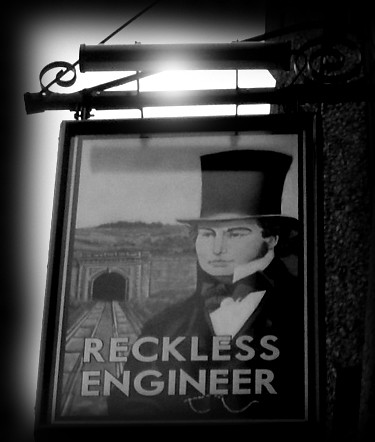
The Reckless Engineer
Short Story by Bob Kirchman (continued)

I am opposed to the laying down of rules or conditions to be observed in the construction of bridges lest the progress of improvement tomorrow might be embarrassed or shackled by recording or registering as law the prejudices or errors of today.”
-- Isambard K. Brunel

Sunday/Monday dawned early. Hannah greeted John and Alana at Zimmerman headquarters. “Elizabeth will be here in a bit,” she said. “Long night with the bridge seals!” A bleary-eyed Rupert popped out of his office: “How was dinner?” he asked.

Quite nice,” Alana responded, “And how did the work go on the seal problem?”

Zimmerman explained the seal problem… it seems that sustained temperatures combined with heavier stressed connections was taking more of a toll on them than anticipated. “Say John, you’re a materials guy. Would you look at this tech brief and when you get back here this Fall, would you like to have a go at it?”

Does that mean we’ve been accepted for the program then?” He responded. “Sure. Let me read this tonight. My thesis was on something similar with flexible pipe couplings. Maybe we can find a way to take some of the stress off of the seal itself in the meantime.”

I like that,” said Rupert. “Most guys just start wanting to remake the seal material straight off. You seem to have another tack. Tell me more.”

Well, sir, it seems the problem is exacerbated by the movement in the bridge. If we could add some sort of a stiffener, we could spread the stress better. I mean, you seem to be experiencing very localized failures at places the bridge moves more than others.”

So, in the minutes before Elizabeth arrived, the young couple had sketched out a pretty interesting clamping system that would spread the flexing evenly along the length of the span. Zimmerman was visibly impressed. “Hey, we could talk about this with your team tomorrow if you’d like.” Alana said. “That is, if you wouldn’t mind.”

When Elizabeth arrived, the congratulations were officially offered. Alana and John would sign on as mentees for their first year. They would be given accommodations and a small stipend until their year-end review, when they would likely be looking at $100K in petrodollars each per year starting salary. Of course, if the seal relief system played out, they would be receiving a bonus for that. Zimmerman, who had seen plenty of his ideas taken by employers with no attribution, had no problem sharing the glory when his own team, even the mentees, made valuable contributions.

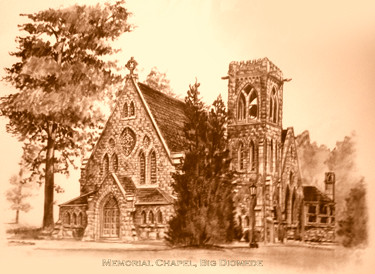
But now it was time to head over out to Big Diomede, a half-hour drive West on the bridge. Elizabeth drove John and Alana across the span… but she spoke little. She was tired, sure, but clearly something was on her mind. “I’ve never seen someone get accepted so quickly,” she mused quietly. “You know, John, you remind me of…” she caught herself and was silent for the remainder of the trip. It seemed a long half-hour indeed and when the car finally reached the Big Diomede site, everyone was relieved when Mrs. Greene greeted them. She had worked with Elizabeth in the creation of the Biosphere and sure enough, the renderings of the proposed complex were stunning. It was something out of another Century so far as its craftsmanship and execution. The parsonage was the only building built so far, but it was simple and beautiful; quite a contrast to the prefabricated world of Wales. A lone tree, freshly planted, graced the yard. Nearby there was a footer where stonemasons were laying the first course of a more substantial building. Elizabeth pointed to a painting of a gothic chapel… “A memorial to a man who lost his life in the service of the Zimmerman Organization,” said Mrs. Greene. “The chapel will be home to our church here.”
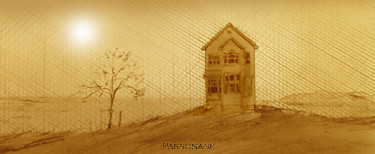
Parsonage

The biosphere was a fascinating place. Artificial sun-spectrum lighting was being installed along the bars of the geodesic dome which had ionized panels that could be clear for natural light but could be clouded to reflect the light from the lamps down. Huge rigs were drilling down to provide thermal heating. Nursery workers were planting quick growing shrubbery to provide air refreshment inside.

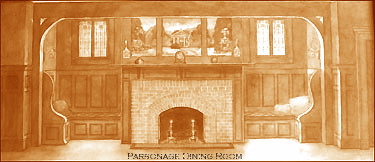
At lunchtime, the Greene’s again hosted what Mrs. Greene referred to as ‘Elevensies.’ This time in their newly finished dining room. “Tell me about the man who the chapel memorializes,” Alana said to Kris Greene as John and Elizabeth were in deep discussion of geothermal piping following their delicious lunch. “Oh,” said Kris, “I myself never knew him… but I understand he was a close friend of Rupert’s. They were working on the Great Western Road alignment in Siberia, I think, when…” Elizabeth interrupted: “I think we’d better get on with our tour now. Thank you, Kris, for your warm hospitality.”

Back at Wales, Elizabeth was summoned by her cell phone… the bridge never ceased to call on her keepers, it seemed. She apologized for her demeanor. “Rough day, it has been,” she said. Hannah was there, eager to show the young couple some of the photos on the wall in the lobby. “Here is the place where we were drilling for oil, but Rupert discovered that the people were all sick for lack of water. Well, he threw a curve-ball into the calculations for the lateral drill. When it gushed not oil, but fresh water, his crew groaned at his ‘mistake,’ but when he capped it the people had a good and steady supply of safe water. Everyone here sort of goes along with the legend that he’s a real cheapskate… but you did see the beginnings of the Big Diomede Chapel, didn’t you. That is not a shabby piece of work at all.”
Dalton
Rendering by Lola Dalton, 1914, the Author's Grandmother.

Alana spoke: “Do you mind if I ask you, ah, about Mrs. O’Malley; what is it that is troubling her? When we were accepted, I mean, it seemed she has some great reservations or something. Look, we don’t want to come here if you have any doubt that is sincerely based.” Hannah thoughtfully replied: “This is not the time or place, but please come to my place tonight and we’ll talk further. My husband is in the ‘lower 48’ representing our interests in Washington, a thankless part of his job. I’ll be glad when he’s done, but in the meantime it would be wonderful to have some company!”

We don’t say his name here,” Hannah said softly… “Rupert’s colleague who died in the Taiga, but it is clear that he… and his daughter Elizabeth, see the resemblance. He was young, reckless and would go to the ends of the earth… but he had a young family. I would imagine Elizabeth sees her father performing penance, if you will, for the death of his trusted friend. Oh, don’t sweat that. I’ve reviewed your qualifications. You are more than what we require in every way, but I think you will have to deal with the fact that Rupert sees in you an unfinished life. He’s not going to go easy on you, mind you, his granddaughter is the apple of his eye, but he rode her harder than the rest of them. I do not think Elizabeth’s unspoken fears are rational, but fears seldom are.”

So, what shall we do?,” Alana asked.

I don’t know, really, but I suspect that in time this will prove to be a good thing. You came here prepared to be patient, and the present situation requires plenty of that. Elizabeth is quite protective of her father, and I think she has good reason, but she is fair minded. I think you will prove yourself in the end and you will find her a lovely person to work with. In the meantime, I think it best to avoid discussion of a certain unfortunate occurrence… and of Rupert’s attempt to remember it.”

Rupert Zimmerman awoke that night screaming. He came to himself in a cold sweat and got up and checked the lock on his door. His was the top apartment in the condominiums over the workspaces and Elizabeth and Martin were directly below. He hoped he hadn’t disturbed them, but he knew full well that he had. He didn’t know that Hannah’s apartment, though it was further away, allowed her to be disturbed as well. Rupert Zimmerman was a man who professed no need for the Divine… but in the endless night, as Rupert raised the blinds in the hopes that the midnight sun would free him from his prison, his daughter, son-in-law and his devoted assistant prayed to the God Rupert spurned. Back in Virginia, Pat couldn’t sleep. Rupert weighed heavily on her mind. Thirty miles away from Wales, as a new day began at the end of the world, a young woman took her husband’s hand to pray as well: “I’m concerned for Elizabeth’s father.” She prayed. Though Zimmerman would have scoffed at the very notion, his friends that moment were speaking in unison to that God, pleading for the deliverance that only He could give.

If we must have heroes and wars wherein to make them, there is no war so brilliant as a war with the wrong, no hero so fit to be sung, as he who has gained the bloodless VICTORY of truth and mercy."
-- I. K. Brunel

(the Reckless Engineer is the Prelude to PONTIFUS [6.])
Copyright © 2017, The Kirchman Studio, all rights reserved 
mC

PONTIFUS, The Bridge Builder's Tale
[click to read]

The History of Serial Fiction

Serials have existed in fiction for a very long time. Books were expensive back in the 19th century, so they were printed in installments in order to keep the price low. Charles Dickens, often heralded as one of the greatest early self-publishers, was also one of the most successful writers of serialized fiction. Another big name, Alexandre Dumas, was a very prolific serial novelist, publishing both The Count of Monte Cristo and The Three Musketeers in serial format. In fact, serialization worked so well, it was considered the way to go by popular authors during the time." -- Samantha Warren

THYME Magazine presents, in serial form, the story of a man who challenged the proposition that something he wanted to achieve was "impossible." Based on history, depicted in the future, Pontifus is a tale of human triumph in the face of challenges such as face us today. (read more)
StraitWaySun
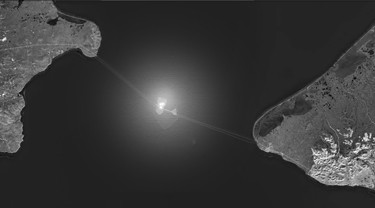
Sunlight reflects from the biosphere domes of Big Diomede in this photograph of the Bering Strait Bridge from space.
bridgedesign001
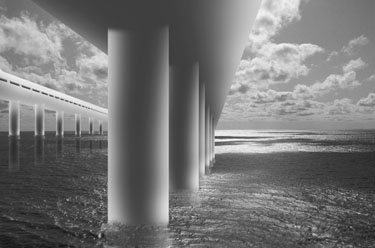
The twin spans of the Bering Strait Bridge. The original span (closest) is the Charles Alton Ellis Memorial Bridge. The second span is the Joseph Baermann Strauss Memorial Bridge.

EllisandStrauss_bw_WEB
The twin spans stretching to the West and Asia.

A2_Opens__WEB
Alaska A2.

Copyright © 2017, The Kirchman Studio, all rights reserved

New 'Old' Architecture
The Inspiration for the Buildings of Big Diomede
chapel
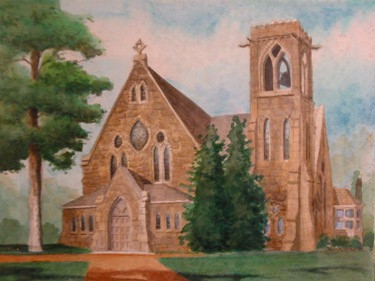
The Church on Big Diomede is based on my painting of the University of Virginia Chapel.

stairwellwindow
My Grandmother, Lola Dalton Carpenter, designed this window for a stairwell in 1914. I carried it into the Twenty-first Century as a window at the College on Big Diomede.

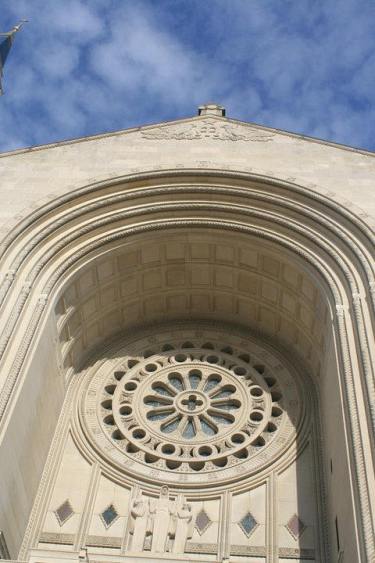
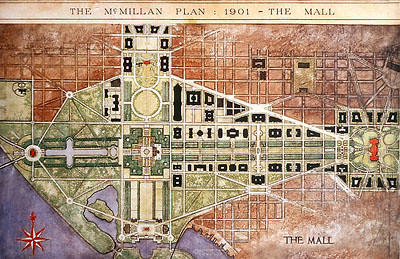
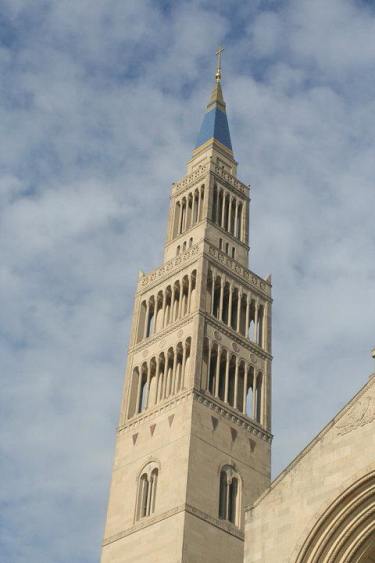
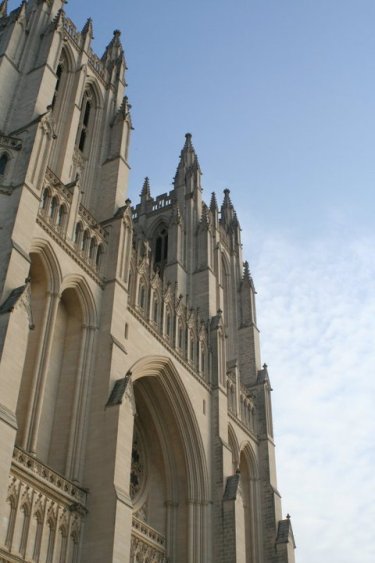
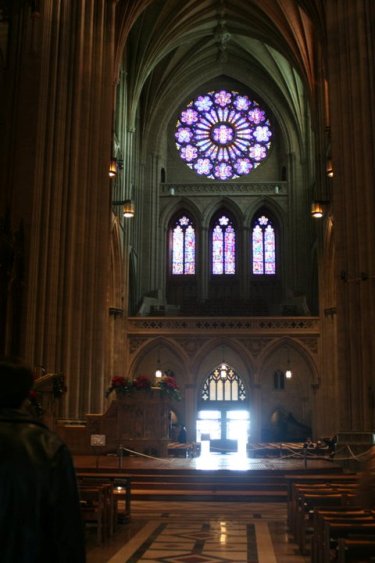
At the turn of the Century, as the Twentieth Century began, the great world's fairs presented a vision of civic architecture for America's young cities. A beautiful classicism prevailed, inspired by the model of Greek and Roman architecture. As the McMillan Plan transformed Washington DC into a very beautiful city, it put in place a sort of architectural order. The civic buildings of the metropolis all followed the form of Greek and Roman architecture. The great Cathedral and Catholic shrine rose in Gothic and Byzantine forms, thus creating a wonderful order for religious architecture as distinctive.

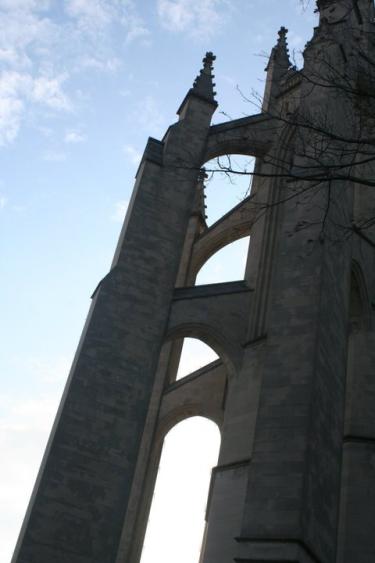
For Big Diomede, it seemed appropriate to again visit the past for ordering the future. Thus I returned to classicism for the College and Gothic for the Chapel, the precedent being Thomas Jefferson's University of Virginia... a beautiful campus in the Palladian style. Jefferson omitted a place of worship, perhaps by design, but in the 1880's a chapel Designed by Baltimore architect and University alumnus Charles Emmet Cassell was erected. The chapel’s materials, site, and style signify it as a Christian building in contrast to the Academical Village. Upon the chapel’s dedication, Professor Maximilian Schele de Vere proclaimed that while the Rotunda represented “in cold though classic beauty the outlines of a pagan temple,” the chapel aspired to Heaven with its “pointed window” and “flying buttress.”

In 1980 I was married to my beautiful wife in that chapel, about a century after it was first proposed. Thus that building is very special to me. The Zimmerman Stone Mountain Proposal Story is the story of my own proposal! Yes, the Divine sent a Storm! We like to think it would have happened anyway, without the Heavenly pyrotechnics, but it remains a great story.

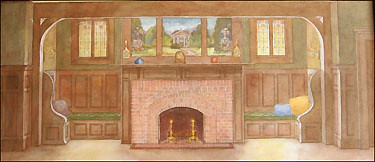
Grandma's window and Inglenook found their way into the story simply because the images fit the mission, and I love them. She was a student at the Maryland Institute in 1914 and produced most of her work in those years. She married O. F. Carpenter, a successful Madison businessman and painted as an avocation until her eyesight failed in the 1970's. Lola Dalton Carpenter was extremely talented and had studied fashion design. In a later part of the story, yet to be told, a nod to Kris' efforts in this discipline is really a shout to Grandma, who all of us credit with our own creative impulses. My cousin in Oregon is an incredible photographer. My own children are very good too. We all thank Lola Dalton Carpenter for blazing the creative path for us!
ingelnookrendering
My Grandmother, Lola Dalton Carpenter, designed this ingelnook in 1914. Of course, it was exactly the look I wanted for Kris' house on Big Diomede.

house
I added the chalk drawings in front of one of my renderings to create the exterior.
Copyright © 2017, The Kirchman Studio, all rights reserved

'Appaloosa Spring'
Photo by Bob Kirchman

Appaloosa Spring

Emerging Hollyhocks
Photos by Bob Kirchman

Emerging HOllyhocks

Emerging HOllyhocks

Emerging HOllyhocks
Photos by Bob Kirchman

The Springhill Hollyhocks are a legacy of Kristina Elaine Greer's Great Great Grandmother, who first planted them in her yard. [7.] Even though her house has long since been replaced by a gas station, the hollyhocks emerge every Spring and in Summer they bless the community near Gypsy Hill Park in Staunton, Virginia with brilliant colored flowers!

What the Church is Doing Right
[click to read]

But the fruit of the Spirit is love, joy, peace, longsuffering, gentleness, goodness, faith, Meekness, temperance: against such there is no law.” -- Galatians 5: 22, 23

Now concerning spiritual gifts, brethren, I would not have you ignorant. Ye know that when ye were Gentiles ye were led away unto those dumb idols, howsoever ye might be led. Wherefore I make known unto you, that no man speaking in the Spirit of God saith, Jesus is anathema; and no man can say, Jesus is Lord, but in the Holy Spirit.

Now there are diversities of gifts, but the same Spirit. And there are diversities of ministrations, and the same Lord. And there are diversities of workings, but the same God, who worketh all things in all. But to each one is given the manifestation of the Spirit to profit withal. For to one is given through the Spirit the word of wisdom; and to another the word of knowledge, according to the same Spirit: to another faith, in the same Spirit; and to another gifts of healings, in the one Spirit; and to another workings of miracles; and to another prophecy; and to another discernings of spirits: to another divers kinds of tongues; and to another the interpretation of tongues: but all these worketh the one and the same Spirit, dividing to each one severally even as he will.

For as the body is one, and hath many members, and all the members of the body, being many, are one body; so also is Christ. For in one Spirit were we all baptized into one body, whether Jews or Greeks, whether bond or free; and were all made to drink of one Spirit. For the body is not one member, but many. If the foot shall say, Because I am not the hand, I am not of the body; it is not therefore not of the body. And if the ear shall say, Because I am not the eye, I am not of the body; it is not therefore not of the body. If the whole body were an eye, where were the hearing? If the whole were hearing, where were the smelling? But now hath God set the members each one of them in the body, even as it pleased him. And if they were all one member, where were the body? But now they are many members, but one body. And the eye cannot say to the hand, I have no need of thee: or again the head to the feet, I have no need of you. Nay, much rather, those members of the body which seem to be more feeble are necessary: and those parts of the body, which we think to be less honorable, upon these we bestow more abundant honor; and our uncomely parts have more abundant comeliness; whereas our comely parts have no need: but God tempered the body together, giving more abundant honor to that part which lacked; that there should be no schism in the body; but that the members should have the same care one for another. And whether one member suffereth, all the members suffer with it; or one member is honored, all the members rejoice with it. Now ye are the body of Christ, and severally members thereof. And God hath set some in the church, first apostles, secondly prophets, thirdly teachers, then miracles, then gifts of healings, helps, governments, divers kinds of tongues. Are all apostles? are all prophets? are all teachers? are all workers of miracles? have all gifts of healings? do all speak with tongues? do all interpret? But desire earnestly the greater gifts. And moreover a most excellent way show I unto you.” – 1 Corinthians 12 (read more)

Debra Goldstone: Ask Isaiah



STROBELBANNER

Wednesday, May 10, 2017

Case for Vision, The Reckless Engineer, Phantasies

Citizen Journalism with a Better Flavor

Phantasies15
Volume XII, Issue XXI

Phantasies
By George MacDonald, Chapter 15

Alexander: "When will you finish Campaspe?"
Apelles: "Never finish: for always in absolute
beauty there is somewhat above art."
~ from John Lyly's play, "Campaspe".

And now, what song should I sing to unveil my Isis, if indeed she was present unseen? I hurried away to the white hall of Phantasy, heedless of the innumerable forms of beauty that crowded my way: these might cross my eyes, but the unseen filled my brain. I wandered long, up and down the silent space: no songs came. My soul was not still enough for songs. Only in the silence and darkness of the soul's night, do those stars of the inward firmament sink to its lower surface from the singing realms beyond, and shine upon the conscious spirit. Here all effort was unavailing. If they came not, they could not be found.

Next night, it was just the same. I walked through the red glimmer of the silent hall; but lonely as there I walked, as lonely trod my soul up and down the halls of the brain. At last I entered one of the statue-halls. The dance had just commenced, and I was delighted to find that I was free of their assembly. I walked on till I came to the sacred corner. There I found the pedestal just as I had left it, with the faint glimmer as of white feet still resting on the dead black. As soon as I saw it, I seemed to feel a presence which longed to become visible; and, as it were, called to me to gift it with self-manifestation, that it might shine on me. The power of song came to me. But the moment my voice, though I sang low and soft, stirred the air of the hall, the dancers started; the quick interweaving crowd shook, lost its form, divided; each figure sprang to its pedestal, and stood, a self-evolving life no more, but a rigid, life-like, marble shape, with the whole form composed into the expression of a single state or act. Silence rolled like a spiritual thunder through the grand space. My song had ceased, scared at its own influences. But I saw in the hand of one of the statues close by me, a harp whose chords yet quivered. I remembered that as she bounded past me, her harp had brushed against my arm; so the spell of the marble had not infolded it. I sprang to her, and with a gesture of entreaty, laid my hand on the harp. The marble hand, probably from its contact with the uncharmed harp, had strength enough to relax its hold, and yield the harp to me. No other motion indicated life. Instinctively I struck the chords and sang. And not to break upon the record of my song, I mention here, that as I sang the first four lines, the loveliest feet became clear upon the black pedestal; and ever as I sang, it was as if a veil were being lifted up from before the form, but an invisible veil, so that the statue appeared to grow before me, not so much by evolution, as by infinitesimal degrees of added height. And, while I sang, I did not feel that I stood by a statue, as indeed it appeared to be, but that a real woman-soul was revealing itself by successive stages of imbodiment, and consequent manifestation and expression.

Feet of beauty, firmly planting
Arches white on rosy heel!
Whence the life-spring, throbbing, panting,
Pulses upward to reveal!
Fairest things know least despising;
Foot and earth meet tenderly:
'Tis the woman, resting, rising
Upward to sublimity,
Rise the limbs, sedately sloping,
Strong and gentle, full and free;
Soft and slow, like certain hoping,
Drawing nigh the broad firm knee.
Up to speech! As up to roses
Pants the life from leaf to flower,
So each blending change discloses,
Nearer still, expression's power.

Lo! fair sweeps, white surges, twining
Up and outward fearlessly!
Temple columns, close combining,
Lift a holy mystery.
Heart of mine! what strange surprises
Mount aloft on such a stair!
Some great vision upward rises,
Curving, bending, floating fair.

Bands and sweeps, and hill and hollow
Lead my fascinated eye;
Some apocalypse will follow,
Some new world of deity.
Zoned unseen, and outward swelling,
With new thoughts and wonders rife,
Queenly majesty foretelling,
See the expanding house of life!

Sudden heaving, unforbidden
Sighs eternal, still the same--
Mounts of snow have summits hidden
In the mists of uttered flame.
But the spirit, dawning nearly
Finds no speech for earnest pain;
Finds a soundless sighing merely--
Builds its stairs, and mounts again.

Heart, the queen, with secret hoping,
Sendeth out her waiting pair;
Hands, blind hands, half blindly groping,
Half inclasping visions rare;
And the great arms, heartways bending;
Might of Beauty, drawing home
There returning, and re-blending,
Where from roots of love they roam.

Build thy slopes of radiance beamy
Spirit, fair with womanhood!
Tower thy precipice, white-gleamy,
Climb unto the hour of good.
Dumb space will be rent asunder,
Now the shining column stands
Ready to be crowned with wonder
By the builder's joyous hands.

All the lines abroad are spreading,
Like a fountain's falling race.
Lo, the chin, first feature, treading,
Airy foot to rest the face!
Speech is nigh; oh, see the blushing,
Sweet approach of lip and breath!
Round the mouth dim silence, hushing,
Waits to die ecstatic death.

Span across in treble curving,
Bow of promise, upper lip!
Set them free, with gracious swerving;
Let the wing-words float and dip.
Dumb art Thou? O Love immortal,
More than words thy speech must be;
Childless yet the tender portal
Of the home of melody.

Now the nostrils open fearless,
Proud in calm unconsciousness,
Sure it must be something peerless
That the great Pan would express!
Deepens, crowds some meaning tender,
In the pure, dear lady-face.
Lo, a blinding burst of splendour!--
'Tis the free soul's issuing grace.

Two calm lakes of molten glory
Circling round unfathomed deeps!
Lightning-flashes, transitory,
Cross the gulfs where darkness sleeps.
This the gate, at last, of gladness,
To the outward striving me:
In a rain of light and sadness,
Out its loves and longings flee!

With a presence I am smitten
Dumb, with a foreknown surprise;
Presence greater yet than written
Even in the glorious eyes.
Through the gulfs, with inward gazes,
I may look till I am lost;
Wandering deep in spirit-mazes,
In a sea without a coast.

Windows open to the glorious!
Time and space, oh, far beyond!
Woman, ah! thou art victorious,
And I perish, overfond.
Springs aloft the yet Unspoken
In the forehead's endless grace,
Full of silences unbroken;
Infinite, unfeatured face.

Domes above, the mount of wonder;
Height and hollow wrapt in night;
Hiding in its caverns under
Woman-nations in their might.
Passing forms, the highest Human
Faints away to the Divine
Features none, of man or woman,
Can unveil the holiest shine.

Sideways, grooved porches only
Visible to passing eye,
Stand the silent, doorless, lonely
Entrance-gates of melody.
But all sounds fly in as boldly,
Groan and song, and kiss and cry
At their galleries, lifted coldly,
Darkly, 'twixt the earth and sky.

Beauty, thou art spent, thou knowest
So, in faint, half-glad despair,
From the summit thou o'erflowest
In a fall of torrent hair;
Hiding what thou hast created
In a half-transparent shroud:
Thus, with glory soft-abated,
Shines the moon through vapoury cloud.
(to be continued)

Unipege
Unipege. Photo by bob Kirchman

Ripples in Ramsey's Draft
Photos by Bob Kirchman

Ramsey's Draft

Ramsey's Draft

Ramsey's Draft

Alike, A Short Film
Daniel Martínez, Lara and Rafa Cano Méndez


THYME0706
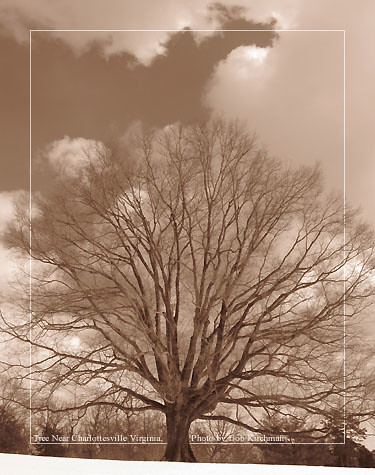
Oak Tree, Charlottesville, Virginia.

A Case for Vision III

You may nave noticed that THYME has long departed from being a simple parody of the 'other' weekly news magazine. The reason is twofold. First of all. it became a bit sophomoric to parody a magazine that asks on its cover: "Is God Dead?" Lately they've 'discovered' that the same question can be asked of truth. Journalism seems to have lost its way. That is why we love the new movie based on the investigations of Lee Strobel, The Case for Christ. Second, the times demand a more serious approach. We are confronted today by very real problems. If we can draw from history and the voice of experience, we must do so. The political class and the media seem intent on silencing certain voices in the debate. It is those very voices, may I suggest, that we need most to listen to. The country today seems intent on allowing itself to crumble. Noble virtues are denigrated while the vague goal of 'self actualization' has become the subject of ardent pursuit. Relativism is the rule and 'tolerance' the supreme virtue. Clearly we are a nation in distress. Looking back into history, can we find evidence that we as a people have faced similar peril? If so, what lessons might we learn to help us in the struggle for America today? Consider the condition of the nation in the turbulent time following the Revolution.

As the Eighteenth Century drew to a close there were almost a million new settlers to the West of the Blue Ridge Mountains. In 1803, France sold the Louisiana Purchase to the young nation and Thomas Jefferson, essentially doubling the size of the United States. Lewis and Clark's reports of this vast land would only serve to further fuel the drive for Westward expansion. While the future looked bright for the country, the future of the Christian Faith seemed to be one of slowly diminishing light. Church attendance was dropping off. New ideas from Europe challenged the narrative of Faith and it looked like the influence of Faith would fade, even as the New World filled itself. An Episcopal preacher in the Carolinas said: "How many thousands . . . never saw, much less read, or ever heard a Chapter of the Bible! How many Ten thousands who never were baptized or heard a Sermon! And thrice Ten thousand, who never heard of the Name of Christ, save in Curses . . . ! Lamentable! Lamentable is the situation of these people." Though the land was rich in promise, the spiritual condition of her people was quite impoverished. Immorality and vice abounded as settlement continued. Though no national media paraded it, the dark side of human nature reigned in many remote places. In the wilds of Kentucky, in what would become Logan County, there was a place called Rogues' Harbor. The Digital History of North Carolina describes it as follows: "Here many refugees from almost all parts of the Union fled to escape justice or punishment. . . . It was a desperate state of society. Murderers, horse-thieves, highway robbers, and counterfeiters fled there, until they combined and actually formed a majority." -North Carolina Digital History

But something happened in the very fabric of our nation about that time that would shape our future and chart our course well into the Centuries to follow. There was still much immorality and vice to be found, but in 1799 a Prebyterian minister wrote: "We have heard from different parts the glad tidings of the outpourings of the Spirit, and of times of refreshing from the presence of the Lord. . . . From the East, from the West, and from the South, have these joyful tidings reached our ears." The Second Great Awakening came to life as men like James McGready brought the message of Hope and Redemption to the frontier. McGready did not fear to enter places like Rogues' Harbor to speak of: "Heaven and its glories, Hell and its torments." In 1796, McGready was Pastoring three churches in Southwestern Kentucky. In what can only be attributed to a mighty move of the Spirit of G-d, hundreds of people at a time were finding a new and refreshed Faith across the frontier in camp meetings and revivals. In the South and the West. Barton W. Stone was the Presbyterian Pastor of the Cane Ridge and Concord churches, northeast of Lexington, Kentucky. Stone observed McGready's work in Logan County and laid plans for a similar meeting for August 1801 at Cane Ridge. Over 10,000 people attended that meeting. Some estimates put the crowd as high as 25,000. The flames of revival were spreading, leaping now into Tennessee!

Stone observed that Presbyterians, Baptists and Methodists were all joined together at this great meeting, singing the same songs and experiencing the same Spirit! "The rough, violent, irreligious frontier, which many felt threatened to undo the morals of the new nation, was being tamed by the Lamb of God." In the East, a similar manifestation of the Spirit of G-d was taking place. Though many prayed for revival, the rise of Universalists, Unitarians and Deists in the region had denied the basic teachings of Christianity and dulled the impact of Faith. Jonathan Edward's Grandson Timothy Dwight observed of the period during and after the Revolution as follows: "The profanation of the Sabbath . . . profaneness of language, drunkenness, gambling, and lewdness, were exceedingly increased; and, what is less commonly remarked, but is not less mischievous, than any of them, a light, vain method of thinking, concerning sacred things, a cold, contemptuous indifference toward every moral and religious subject." But the fires of Revival were stirring in the East. Though this movement was quieter in some respects, it's deep roots would manifest themselves in cultural reform. The abolitionist movement, for example, would come out of this renewed mind. Pastor Alvan Hyde wrote: ". . . A marvelous work was begun, and it bore the most decisive marks of being God’s work. So great was the excitement, though not yet known abroad, that into whatever section of the town I now went, the people in that immediate neighborhood, would leave their worldly employments, at any hour of the day, and soon fill a large room. . . . All our religious meetings were very much thronged, and yet were never noisy or irregular. . . . They were characterized with a stillness and solemnity, which, l believe, have rarely been witnessed. . . . To the praise of sovereign grace, l may add, that the work continued, with great regularity and little abatement, nearly eighteen months."

And Jesus went about all the cities and villages, teaching in their synagogues, and preaching the gospel of the kingdom, and healing every sickness and every disease among the people. But when he saw the multitudes, he was moved with compassion on them, because they fainted, and were scattered abroad, as sheep having no shepherd. Then saith he unto his disciples, The harvest truly is plenteous, but the labourers are few; Pray ye therefore the Lord of the harvest, that he will send forth labourers into his harvest." -- Matthew 9:35-38 

As thousands embraced Faith, this Scripture became a reality for the American churches. The Baptists ordained lay ministers to meet the needs of the growing church in the young nation. The Methodists created the institution of the Circuit Rider. Young ministers would literally cover a 'circuit' of churches, riding on horseback from community to community. They were mostly young and single, and had to be in pretty good health. They would be out on the circuit for weeks at a time, perhaps returning to the same community every five weeks or so. They would often come upon a family new to the frontier bringing in the harvest or doing chores and join in as a means of building relationships for the spread of the Gospel. Often the young minister would find a warm welcome and spend the night with the family. He would return on a regular basis and hold services. A congregation might begin to form and build a temporary meeting place, often a 'brush arbor,' which was a simple pole structure covered with brush. Today there are many little churches that have placed a more permanent building in place of the brush arbor. They may still bear the name of the family that provided the land and materials for the first congregation.

Indeed the seeds had been planted for a movement of G-d that would minister to the nation through a terrible Civil War and well into a Century where America would be thrust into the world's great conflicts. Revival came to the colleges, beginning in Virginia's Hampton Sidney College and even occurring at places like Yale. Men like Charles Finney and D. L. Moody would continue to preach the Gospel, adapting their methods to minister to the nation that grew in the Nineteenth Century, but the message remained the same. Eventually America would become a great sender of missionaries into the world. The Gospel would go forth to touch millions and in doing so would bring hope and purpose in many places around the globe.

In one of my childhood books is the story of a Methodist Pastor who arrives at a new parsonage and with his children plants a tree. The tradition of that Faith is that ministers will move on to new pastorates, so the man is planting a tree that he himself will never sit in the shade of. It is clearly an act of kindness intended to bless a family like his that will follow... in the far distant future. I love that story because it is a planting of hope and belief that looks beyond the here and now. It is a remnant of that far-looking faith that once long ago stood face to face with America's endless frontier.

THYMEsmith
Photos by Bob Kirchman.

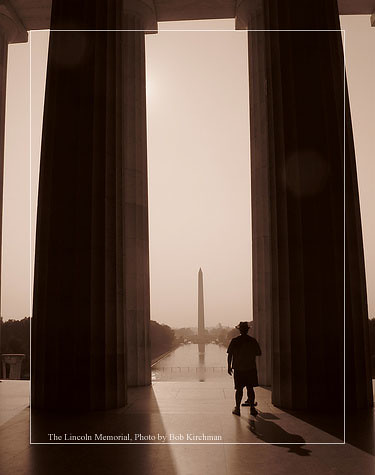
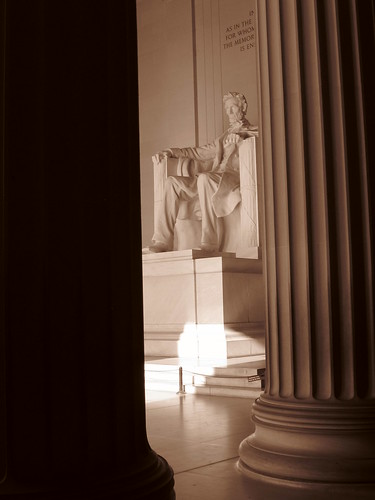
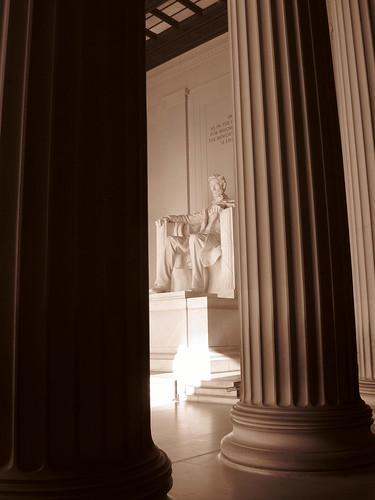
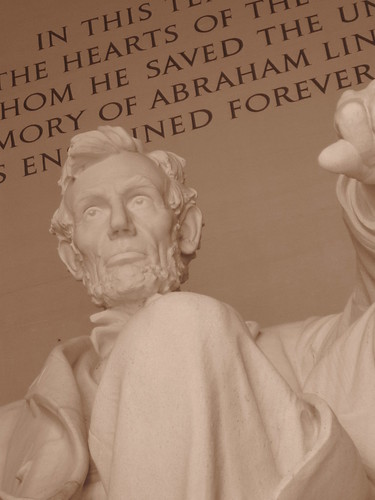
Inspiration: The Lincoln Memorial

Frank Capra's film: Mr. Smith Goes to Washington [click to view] includes some very powerful and moving scenes shot at the Lincoln Memorial. Here are presented some of my own photos taken one morning at the memorial which are reminiscent of and inspired by Capra's keen eye.

Lincoln Memorial

Lincoln Memorial

Lincoln Memorial

Lincoln Memorial

Lincoln Memorial

Lincoln's Gettysburg Address
(19 NOVEMBER 1863)

Fourscore and seven years ago our fathers brought forth on this continent, a new nation, conceived in Liberty, and dedicated to the proposition that all men are created equal.

Now we are engaged in a great civil war, testing whether that nation, or any nation so conceived and so dedicated, can long endure. We are met on a great battle-field of that war. We have come to dedicate a portion of that field, as a final resting place for those who here gave their lives that that nation might live. It is altogether fitting and proper that we should do this.

But, in a larger sense, we can not dedicate-we can not consecrate-we can not hallow-this ground. The brave men, living and dead, who struggled here, have consecrated it, far above our poor power to add or detract. The world will little note, nor long remember what we say here, but it can never forget what they did here. It is for us the living, rather, to be dedicated here to the unfinished work which they who fought here have thus far so nobly advanced. It is rather for us to be here dedicated to the great task remaining before us-that from these honored dead we take increased devotion to that cause for which they gave the last full measure of devotion-that we here highly resolve that these dead shall not have died in vain-that this nation, under G-d, shall have a new birth of freedom-and that government of the people, by the people, for the people shall not perish from the earth.

The Words of Wycliff
By James Renwick Manship

Honest Abe in his Gettysburg Address "stole" the words of the Rev. John Wycliffe, known as the Morning Star of the Reformation, from the General Prologue to the first translation of the Holy Bible into the English language, in the Year of Our Lord Jesus 1385.

The wise words of Wycliffe were "The BIBLE is for the government of the people, by the people and for the people." Honest Abe Lincoln left out the MOST important word of Wycliffe's wise words, that is the BIBLE.

Reckless-Engineer

The Reckless Engineer
Short Story by Bob Kirchman (continued)

All of the Reckless Engineer has gone And where now does heart and soul beat in the city sky?”
 -- Coast, ‘The Reckless Engineer’

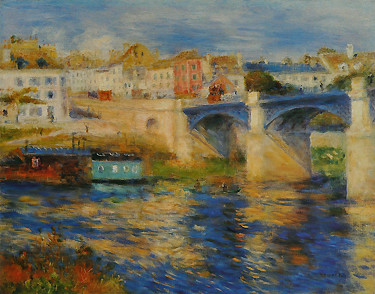
Pierre-Auguste_Renoir_-_Le_Pont_de_Chatou
Le Pont de Chatou, Pierre Auguste Renoir

A bridge is a complex machine… or perhaps more like a living organism in that it moves and needs to be constantly renewed,” Rupert said as the little group entered the service stairway down into one of the great span’s floating piers. “In the Twentieth Century, great public works were authorized, heavily funded by the U. S. Federal government. In fact, they had a 90% match to 10% state funds. They did think of maintenance, it was supposed to have been funded by fuel taxes… but with the initial outlay for the bridges being so relatively cheap, it became all too easy for politicians to divert the funds that were supposed to be allocated for ongoing maintenance.

Fifty years after the great interstate highways were begun, an appalling percentage of the bridges on it were in questionable condition. Some of them actually failed outright.”

Alana and John soaked in the vast history of modern bridge building. Surely it was comforting to know that the operators of this bridge had learned some lessons from the past. Their tour had begun on the next morning… Saturday, but since they were on the International Date Line, the designation on operations calendars was Saturday/Sunday. Zimmerman had met them at the operations tower, beginning with the scores of monitor screens that allowed operations technicians to watch over the workings of Zimmerman’s ‘Darling Bridge,’ as he called it. That was a reference to Brunel’s affection for the Clifton Gorge span more than an infatuation of Rupert’s however.

Where is Hannah?” Alana asked? “Oh,” said Rupert, “She’s off today, but I suspect we’ll see her when we stop for lunch at the Big Diomede site.” I think she was going to paint landscapes with Mrs. Greene after church there today if the weather was nice.”

Sure enough, after a morning of ascending and descending into towers, piers and passageways, the entourage emerged on the large island in the middle of the strait to a balmy afternoon. The brief tundra flower explosion was brightly covering the wild plateau of Big Diomede and there overlooking the colorful display and the sea beyond, two women stood at easels painting en plein air. They looked like a Renoir painting themselves standing upon the verdant island. The wildness of this place dwarfed even the massive biosphere dome under construction. There was a raw beauty to this place and the timeless figures who painted it only added to its mystique. Under the freshly constructed dome a small lone house rose. Workmen were putting the finishing touches on it.

Rather than eat at the service plaza, I thought we’d prepare a nice picnic supper,” Mrs. Greene said after introductions. They were soon joined by Reverend Greene and Elizabeth Zimmerman O’Malley, Rupert’s daughter. It seemed like a fine Southern ‘dinner on the grounds,’ which indeed it was the remnants of, as it was Sunday on Big Diomede and the little church that met in the service plaza meeting room had indeed enjoyed such a feast earlier in the day. It was like a warm breeze from another Century… indeed even the driven Zimmerman seemed to slow down for it. John was impressed: “I did not expect food like I grew up on in… SIBERIA!” he exclaimed as he enjoyed a portion of macaroni and cheese that gained him a scornful glance from Alana, the health nut. But even she was obviously reveling in a bit of home so far from home.

Tomorrow I will give you the full tour.” Said Elizabeth, but today we will continue on with the inner workings of the great bridge. “Tonight,” Hannah said, “I would love for you to be my dinner guests at my condo in Wales. Would you?”

The day ended with the sun low in the sky and the last descent into a bridge pier where Rupert opened a hatch. His granddaughter smiled: “You’re showing them the fishing spot!” she happily exclaimed. Indeed they found rods and a small catwalk outside the hatch where they cast for some nice ocean fish. “We’ll cook them up at Hannah’s place,” Rupert said. “But I’m afraid I won’t be able to join you as this blasted cell phone is now giving me the message that we have an issue with the bridge seals in sector 217. I’m afraid I’ll have to set up a work zone tonight.

Indeed the dinner group shrunk to John, Alana, Elizabeth and Hannah. As they gathered in her condominium, Elizabeth took a call. The work on the seals was going badly. She excused herself. “My father will kill himself for his ‘darling bridge’ if I don’t go out to take some of the load off. Thankfully some of his senior guys have his back and call me like this.”

Tell me about the biosphere,” said Alana. “I just KNOW there is a story behind it.” Hannah looked about, walked over to her door and locked it. Slowly and deliberately she began: “When Mr. Z started this project, he was a pretty brash, no nonsense sort of ruthless industrialist. He ‘reaped where others sowed’ if you know what I mean. There is something you guys need to know about him. You’re in the program by the way, just don’t breath a word to HIM. I know though… I saw the look of satisfaction on his face when we met the relamping crew on the bridge. Alana, when you did not hesitate to climb up with the bulb… the man was one short, remember… you sealed your fate. I daresay the offer will be coming tomorrow.”

Hannah continued:

Zimmerman is a tough old bird, he fought in the battle of Anchorage and all, but when he began this great work people began to see another side of him. There was a young engineer and surveyor that he took under his wing. They went out to Siberia to lay out the road and discovered that it was like the Wild West out there. Trucks that broke down or wrecked by the side of the road were left there. After the local bandits looted them they set them on fire. Rusted and burning hulks were everywhere.

By the time you could get a recovery truck out there, the deed had already been done. The bandits would pull a driver out of his truck if it stopped out there and kill him.

Well, Mr. Z and this other young man were camped out there with plenty of guards… or so they thought, when they were ambushed and kidnapped. The bandits managed to pick off their security people. They took Mr. Z and his friend captive, knowing there would be big ransom money. When they missed Elizabeth’s frantic response and thought the money was being stalled, they took the young man away. That was the last time Mr. Z saw him alive.

The ransom money finally came and Mr. Z. was returned. When he returned to Wales he immediately organized a group of Alaska National Guard and they travelled back disguised as a road crew. When they got back to the site of the ambush, they discovered that the body of the younger man had been found in a cheap motel room in a trailer motel that was… well… not a nice place. The body was stripped and smelled of vodka. Rupert er I mean Mr. Z knew the man never drank. He was enraged that the perpetrators would sink to creating a sordid story. Zimmerman knew the man’s wife and children.

That was the only time I ever saw Rupert cry, and he wept unashamedly. I knew then that a man I had thought so cold and aloof loved deeply. He could be moved to tears by the loss of a cherished colleague.

He composed himself pretty quickly, however. His men could not get the local authorities to help them find the killers so in the end, in his great anger, he ordered everyone out of the motel buildings at gunpoint and soaked the place with petrol. Then he burned it to the ground. He returned to Wales visibly shaken but back to his old aloof self. He set up a trust for his friend’s widow and children and spoke at the memorial service of his fine service. But he was holding something inside that he couldn’t let go.

The flashbacks returned from his war days. Everyone thinks the reason he’s estranged from his wife Pat is that she doesn’t like cold places. The truth is he wakes up screaming… and he won’t seek help for it. He visits her regularly in Virginia but the truth is HE doesn’t want her here when he falls apart. He won’t let go of his anger and sorrow. I fear it is going to kill him one day!

The biosphere you saw today… its more than an environmental experiment… It is largely the creation of Elizabeth, but you must know that it is Rupert’s true ‘darling’ in that he sees it as an antidote to the “Hell on Wheels” he found across the strait. He claims to have no faith… that pretty much went away in his childhood he says. He ‘survived’ indoctrination by the ‘Sisters of Mercy.’ He says they showed none.

But he knew that his biosphere would be nothing more than glass and steel if it did not have some sort of a soul. That is why he convinced the Greenes to come up here. If you didn’t notice before, see how he lets down his guard in their hospitality. Tomorrow you must see the renderings Elizabeth and Mrs. Greene have prepared for the biosphere. These are not the works of one who merely desires austere efficiency.

I really don’t know why I am telling you all this, but I sense that you may indeed be in a position to help him. He allows Elizabeth and his granddaughter to come closer, but I feel like he’s a clock wound too tight… and working in two concurrent times, I fear he’s going to break!”
(to be continued) 
© 2017 The Kirchman Studio, All rights reserved.

Renoir_web
Summer Landscape, Pierre Auguste Renoir

STROBELBANNER

Wednesday, May 3, 2017

A Case for Vision, Ask Isaiah, William Carey

Citizen Journalism with a Better Flavor

Phantasies14
Volume XII, Issue XX

Phantasies
By George MacDonald, Chapter 14

Your gallery
Ha we pass'd through, not without much content
In many singularities; but we saw not
That which my daughter came to look upon,
The state of her mother."
~ from William Shakespeare's Winter's Tale.

It seemed to me strange, that all this time I had heard no music in the fairy palace. I was convinced there must be music in it, but that my sense was as yet too gross to receive the influence of those mysterious motions that beget sound. Sometimes I felt sure, from the way the few figures of which I got such transitory glimpses passed me, or glided into vacancy before me, that they were moving to the law of music; and, in fact, several times I fancied for a moment that I heard a few wondrous tones coming I knew not whence. But they did not last long enough to convince me that I had heard them with the bodily sense. Such as they were, however, they took strange liberties with me, causing me to burst suddenly into tears, of which there was no presence to make me ashamed, or casting me into a kind of trance of speechless delight, which, passing as suddenly, left me faint and longing for more.

Now, on an evening, before I had been a week in the palace, I was wandering through one lighted arcade and corridor after another. At length I arrived, through a door that closed behind me, in another vast hall of the palace. It was filled with a subdued crimson light; by which I saw that slender pillars of black, built close to walls of white marble, rose to a great height, and then, dividing into innumerable divergent arches, supported a roof, like the walls, of white marble, upon which the arches intersected intricately, forming a fretting of black upon the white, like the network of a skeleton-leaf. The floor was black.

Between several pairs of the pillars upon every side, the place of the wall behind was occupied by a crimson curtain of thick silk, hanging in heavy and rich folds. Behind each of these curtains burned a powerful light, and these were the sources of the glow that filled the hall. A peculiar delicious odour pervaded the place. As soon as I entered, the old inspiration seemed to return to me, for I felt a strong impulse to sing; or rather, it seemed as if some one else was singing a song in my soul, which wanted to come forth at my lips, imbodied in my breath. But I kept silence; and feeling somewhat overcome by the red light and the perfume, as well as by the emotion within me, and seeing at one end of the hall a great crimson chair, more like a throne than a chair, beside a table of white marble, I went to it, and, throwing myself in it, gave myself up to a succession of images of bewildering beauty, which passed before my inward eye, in a long and occasionally crowded train. Here I sat for hours, I suppose; till, returning somewhat to myself, I saw that the red light had paled away, and felt a cool gentle breath gliding over my forehead. I rose and left the hall with unsteady steps, finding my way with some difficulty to my own chamber, and faintly remembering, as I went, that only in the marble cave, before I found the sleeping statue, had I ever had a similar experience.

After this, I repaired every morning to the same hall; where I sometimes sat in the chair and dreamed deliciously, and sometimes walked up and down over the black floor. Sometimes I acted within myself a whole drama, during one of these perambulations; sometimes walked deliberately through the whole epic of a tale; sometimes ventured to sing a song, though with a shrinking fear of I knew not what. I was astonished at the beauty of my own voice as it rang through the place, or rather crept undulating, like a serpent of sound, along the walls and roof of this superb music-hall. Entrancing verses arose within me as of their own accord, chanting themselves to their own melodies, and requiring no addition of music to satisfy the inward sense. But, ever in the pauses of these, when the singing mood was upon me, I seemed to hear something like the distant sound of multitudes of dancers, and felt as if it was the unheard music, moving their rhythmic motion, that within me blossomed in verse and song. I felt, too, that could I but see the dance, I should, from the harmony of complicated movements, not of the dancers in relation to each other merely, but of each dancer individually in the manifested plastic power that moved the consenting harmonious form, understand the whole of the music on the billows of which they floated and swung.

At length, one night, suddenly, when this feeling of dancing came upon me, I bethought me of lifting one of the crimson curtains, and looking if, perchance, behind it there might not be hid some other mystery, which might at least remove a step further the bewilderment of the present one. Nor was I altogether disappointed. I walked to one of the magnificent draperies, lifted a corner, and peeped in. There, burned a great, crimson, globe-shaped light, high in the cubical centre of another hall, which might be larger or less than that in which I stood, for its dimensions were not easily perceived, seeing that floor and roof and walls were entirely of black marble.

The roof was supported by the same arrangement of pillars radiating in arches, as that of the first hall; only, here, the pillars and arches were of dark red. But what absorbed my delighted gaze, was an innumerable assembly of white marble statues, of every form, and in multitudinous posture, filling the hall throughout. These stood, in the ruddy glow of the great lamp, upon pedestals of jet black. Around the lamp shone in golden letters, plainly legible from where I stood, the two words--

TOUCH NOT!

There was in all this, however, no solution to the sound of dancing; and now I was aware that the influence on my mind had ceased. I did not go in that evening, for I was weary and faint, but I hoarded up the expectation of entering, as of a great coming joy.

Next night I walked, as on the preceding, through the hall. My mind was filled with pictures and songs, and therewith so much absorbed, that I did not for some time think of looking within the curtain I had last night lifted. When the thought of doing so occurred to me first, I happened to be within a few yards of it. I became conscious, at the same moment, that the sound of dancing had been for some time in my ears. I approached the curtain quickly, and, lifting it, entered the black hall. Everything was still as death. I should have concluded that the sound must have proceeded from some other more distant quarter, which conclusion its faintness would, in ordinary circumstances, have necessitated from the first; but there was a something about the statues that caused me still to remain in doubt. As I said, each stood perfectly still upon its black pedestal: but there was about every one a certain air, not of motion, but as if it had just ceased from movement; as if the rest were not altogether of the marbly stillness of thousands of years. It was as if the peculiar atmosphere of each had yet a kind of invisible tremulousness; as if its agitated wavelets had not yet subsided into a perfect calm. I had the suspicion that they had anticipated my appearance, and had sprung, each, from the living joy of the dance, to the death-silence and blackness of its isolated pedestal, just before I entered. I walked across the central hall to the curtain opposite the one I had lifted, and, entering there, found all the appearances similar; only that the statues were different, and differently grouped. Neither did they produce on my mind that impression--of motion just expired, which I had experienced from the others. I found that behind every one of the crimson curtains was a similar hall, similarly lighted, and similarly occupied.

The next night, I did not allow my thoughts to be absorbed as before with inward images, but crept stealthily along to the furthest curtain in the hall, from behind which, likewise, I had formerly seemed to hear the sound of dancing. I drew aside its edge as suddenly as I could, and, looking in, saw that the utmost stillness pervaded the vast place. I walked in, and passed through it to the other end.

There I found that it communicated with a circular corridor, divided from it only by two rows of red columns. This corridor, which was black, with red niches holding statues, ran entirely about the statue-halls, forming a communication between the further ends of them all; further, that is, as regards the central hall of white whence they all diverged like radii, finding their circumference in the corridor.

Round this corridor I now went, entering all the halls, of which there were twelve, and finding them all similarly constructed, but filled with quite various statues, of what seemed both ancient and modern sculpture. After I had simply walked through them, I found myself sufficiently tired to long for rest, and went to my own room.

In the night I dreamed that, walking close by one of the curtains, I was suddenly seized with the desire to enter, and darted in. This time I was too quick for them. All the statues were in motion, statues no longer, but men and women--all shapes of beauty that ever sprang from the brain of the sculptor, mingled in the convolutions of a complicated dance. Passing through them to the further end, I almost started from my sleep on beholding, not taking part in the dance with the others, nor seemingly endued with life like them, but standing in marble coldness and rigidity upon a black pedestal in the extreme left corner--my lady of the cave; the marble beauty who sprang from her tomb or her cradle at the call of my songs. While I gazed in speechless astonishment and admiration, a dark shadow, descending from above like the curtain of a stage, gradually hid her entirely from my view. I felt with a shudder that this shadow was perchance my missing demon, whom I had not seen for days. I awoke with a stifled cry.

Of course, the next evening I began my journey through the halls (for I knew not to which my dream had carried me), in the hope of proving the dream to be a true one, by discovering my marble beauty upon her black pedestal. At length, on reaching the tenth hall, I thought I recognised some of the forms I had seen dancing in my dream; and to my bewilderment, when I arrived at the extreme corner on the left, there stood, the only one I had yet seen, a vacant pedestal. It was exactly in the position occupied, in my dream, by the pedestal on which the white lady stood. Hope beat violently in my heart.

Now," said I to myself, "if yet another part of the dream would but come true, and I should succeed in surprising these forms in their nightly dance; it might be the rest would follow, and I should see on the pedestal my marble queen. Then surely if my songs sufficed to give her life before, when she lay in the bonds of alabaster, much more would they be sufficient then to give her volition and motion, when she alone of assembled crowds of marble forms, would be standing rigid and cold."

But the difficulty was, to surprise the dancers. I had found that a premeditated attempt at surprise, though executed with the utmost care and rapidity, was of no avail. And, in my dream, it was effected by a sudden thought suddenly executed. I saw, therefore, that there was no plan of operation offering any probability of success, but this: to allow my mind to be occupied with other thoughts, as I wandered around the great centre-hall; and so wait till the impulse to enter one of the others should happen to arise in me just at the moment when I was close to one of the crimson curtains. For I hoped that if I entered any one of the twelve halls at the right moment, that would as it were give me the right of entrance to all the others, seeing they all had communication behind. I would not diminish the hope of the right chance, by supposing it necessary that a desire to enter should awake within me, precisely when I was close to the curtains of the tenth hall.

At first the impulses to see recurred so continually, in spite of the crowded imagery that kept passing through my mind, that they formed too nearly a continuous chain, for the hope that any one of them would succeed as a surprise. But as I persisted in banishing them, they recurred less and less often; and after two or three, at considerable intervals, had come when the spot where I happened to be was unsuitable, the hope strengthened, that soon one might arise just at the right moment; namely, when, in walking round the hall, I should be close to one of the curtains.

At length the right moment and the impulse coincided. I darted into the ninth hall. It was full of the most exquisite moving forms. The whole space wavered and swam with the involutions of an intricate dance. It seemed to break suddenly as I entered, and all made one or two bounds towards their pedestals; but, apparently on finding that they were thoroughly overtaken, they returned to their employment (for it seemed with them earnest enough to be called such) without further heeding me. Somewhat impeded by the floating crowd, I made what haste I could towards the bottom of the hall; whence, entering the corridor, I turned towards the tenth. I soon arrived at the corner I wanted to reach, for the corridor was comparatively empty; but, although the dancers here, after a little confusion, altogether disregarded my presence, I was dismayed at beholding, even yet, a vacant pedestal. But I had a conviction that she was near me. And as I looked at the pedestal, I thought I saw upon it, vaguely revealed as if through overlapping folds of drapery, the indistinct outlines of white feet. Yet there was no sign of drapery or concealing shadow whatever. But I remembered the descending shadow in my dream. And I hoped still in the power of my songs; thinking that what could dispel alabaster, might likewise be capable of dispelling what concealed my beauty now, even if it were the demon whose darkness had overshadowed all my life.
(to be continued)

A Case for Vision II

THYME0705a
William Carey.

Sing, O barren, thou that didst not bear; break forth into singing, and cry aloud, thou that didst not travail with child: for more are the children of the desolate than the children of the married wife, saith the Lord.

Enlarge the place of thy tent, and let them stretch forth the curtains of thine habitations: spare not, lengthen thy cords, and strengthen thy stakes;

For thou shalt break forth on the right hand and on the left; and thy seed shall inherit the Gentiles, and make the desolate cities to be inhabited.

Fear not; for thou shalt not be ashamed: neither be thou confounded; for thou shalt not be put to shame: for thou shalt forget the shame of thy youth, and shalt not remember the reproach of thy widowhood any more.

For thy Maker is thine husband; the Lord of hosts is his name; and thy Redeemer the Holy One of Israel; The God of the whole earth shall he be called." -- Isaiah 54:1-5

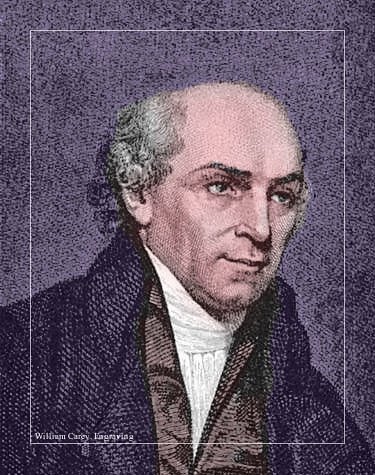
William Carey

For three hundred years following the Reformation, many church leaders neglected the command of Christ to reach the nations. Towards the end of the Eighteenth Century, a newly ordained Baptist leader in England spoke to challenge this misapplication of the doctrine of election. "Young man, sit down! You are an enthusiast. When God pleases to convert the heathen, he'll do it without consulting you or me," said an older minister. The young man's name was William Carey. He was a cobbler by trade, but his calling would take him far beyond the walls of his little cobbler's shop. Carey's vision, you see, was as wide as the map of the world that he hung on his shop's wall. Gathering some like-minded friends, he began to pray for the fulfillment of his vision.

Carey admired the work of the Moravians [click to read], who at one point were one of the foremost sending congregations, planting churches around the world. They even founded churches among America's Cherokee Nation. Dismayed by his own denomination's lack of zeal for such work, he penned An Enquiry Into The Obligations Of Christians To Use Means For The Conversion Of The Heathens. Seeing the Great Commission as applying to the church of his day, he said: "Multitudes sit at ease and give themselves no concern about the far greater part of their fellow sinners, who to this day, are lost in ignorance and idolatry."

In 1792, Carey organized a missionary society and called for his fellow believers to: "Expect great things from God; attempt great things for God!" Few men today would have the patience and tenacity of Carey who said: "I can plod, I can persevere to any definite pursuit." Carey offered to become the first missionary of his society to the great subcontinent of India, offering to go if his friends back home would "hold the ropes." After a fourteen month journey and many personal tragedies, Carey labored on for seven years before he saw his first convert, Krishna Pal. Two months later he published his first Bengali New Testament. He and his colleagues would go on to publish translations of the entire Bible in Bengali, Oriya, Marathi, Hindi, Assamese, and Sanskrit, as well as hundreds of lesser used dialects.

Carey was instrumental in significant social reform in India. His work and advocacy resulted in the abolition of infanticide, widow burning (sati), and assisted suicide. Thus did a man's love for his Saviour result in the affirmation of Imago Dei in a whole new part of the world. When William Carey died, he had served the people of  India for 41 years!

When Isaiah wrote the book that bears his name, Israel had forgotten the G-d given mission to be a light to the nations. Losing sight of this important purpose, the people sank into idolatry and pleasure-seeking. Every generation faces the very real danger of missing the great calling. Ours is no exception. Pastor Bruce Hankee related the story of Carey to his congregation, challenging us to program our lives for G-d's purpose through an understanding of Isaiah 54:1-5. He challenged us to enlarge our capacity for G-d's purpose, as Carey did. Ephesians 3:19 exhorts us: "And to know the love of Christ, which passeth knowledge, that ye might be filled with all the fulness of God." Indeed this is a great reason to expand our tent, that we might contain more of the love of G-d for our fellows! In lengthening our cords, we are expanding our influence. Just as a cobbler in the middle of England became a major pioneer in world missions, we too can have a greater influence if we will persevere in the pursuit of a great vision.

Counterpoint to Coruscant
Two Arguments Set in Stone for a Low Profile Capital

Basilica_w
The Basilica of the National Shrine of the Immaculate Conception... Photo by Kristina Elaine Greer.

basilica002_w
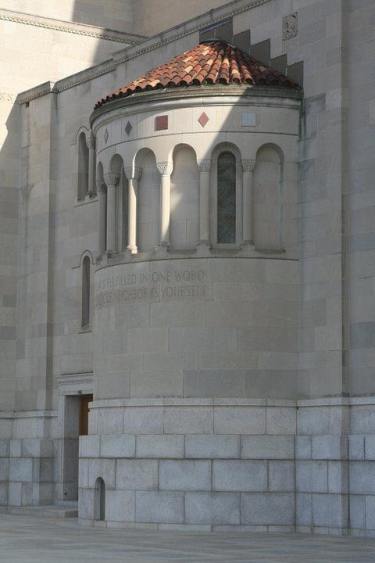
...is a fine example of Byzantine-Romanesque architecture. Photo by Kristina Elaine Greer.

The Shrine and the Cathedral

One unique distinctive of the city of Washington is its relatively low profile. The capital of the greatest nation on the face of the Earth is a city without skyscrapers. New York and Chicago, the great engines of finance and commerce, thrust their architectural presence into the sky while the nation's capital's relatively modest scale defers to iconic buildings that speak of the history and aspirations of her people.

It is widely believed that the legislation controlling building heights was put in place to make sure the Washington Monument would remain the tallest building in the city. The actual legislation has to do with the height of buildings in relation to the width of the streets they occupy.

The Height of Buildings Act of 1910 restricts all buildings in Washington D.C. to being no higher than the width of the adjacent street plus 20 feet. A building on a street that is 130 feet wide can only be 150 feet tall. To be taller than the 555 foot Washington Monument without violating this law, a building would need to be on a street that is over 535 feet wide.

The result is a city who's outlying neighborhoods open to vistas of splendid shrines and cathedrals. Her Northern neighborhoods are crowned by two architectural treasures: the National Cathedral and the the Basilica of the National Shrine of the Immaculate Conception.

Pierre Charles L'Enfant's original vision for the city, based on the palace and garden of Versailles, lends itself well to a garden city punctuated by such fine monuments. The gothic National cathedral brings to mind the great churches of Europe.

McMillan_Plan
The McMillan Plan.

Pierre Charles L'Enfant's "Plan of the Federal City,” drawn in 1792,set aside a prominent site for a "great church for national purposes." Today the National Portrait Gallery stands in that place. It was not until 1891 that a meeting was held to renew plans for a National Cathedral. L’Enfant’s grand plan gave way to the Nineteenth Century growth of the city. Train tracks ran across what would become the National Mall.

At the beginning of the Twentieth Century, The United States Senate Park Commission was formed. Known as the McMillan Commission, it was named for its chairman, Senator James McMillan of Michigan. Some of the greatest American architects, landscape architects, and urban planners of the day served on the McMillan Commission, including Daniel Burnham, Frederick Law Olmsted, Jr., Charles F. McKim, and Augustus Saint-Gaudens. The Washington DC that we know today, with it’s inspiring vistas, cherry trees and reflecting pools is largely the product of this commission.

In 1902 the commission’s plan was published. Building on the work of L’Enfant, and inspired by the Cities Beautiful Movement, a grand but beautifully scaled Washington began to take shape. In her Northern reaches, plans for two beautiful houses of worship were also taking shape.

Frederick Bodley, known for his fine church designs in England, led the team designing the Cathedral Church of Saint Peter and Saint Paul for the Episcopal Diocese of Washington. [1.] Construction began in 1907. After World War I, Philip Hubert Frohman, an American architect, took over the supervision of the work. Construction of the National Cathedral went on for most of the Twentieth Century. As good stonemasons became harder to find, work was speeded up. Then a program to train stone masons was established on the Cathedral grounds. The Gothic cathedral features beautiful bas relief sculptures of the Creation and a gargoyle that resembles French President Charles DeGaulle! A statue of Darth Vader [2.] is up there as well, sculpted by Jay Hall Carpenter and Patrick J. Plunkett. The building was completed in 1990.

Today the cathedral is a prominent feature of the Northwest Quadrant of the city.

Bishop Thomas Joseph Shahan, the fourth rector of the Catholic University of America envisioned the construction of a national shrine to commemorate the Immaculate Conception in the country's capital. [3.] He took his appeal to Pope Pius X on August 15, 1913. The Pope was excited by Shahan’s vision and Catholic University donated land on its campus in the Northeast Quadrant of the city.

Architects Maginnis and Walsh of Boston first proposed a gothic building as well, but Bishop Shahan wanted the shrine to be bold, glorious and unique. A Byzantine-Romanesque design was chosen. The archbishop of Baltimore, Cardinal James Gibbons, blessed the foundation stone on September 23, 1920.

The Great Depression halted construction, as did the Second World War. In 1953 construction resumed and continued through the Twentieth Century. There are still mosaics remaining to be completed in the great dome, but the building is essentially complete. The Basilica of the National Shrine of the Immaculate Conception rises above the grey buildings of Catholic University as a prominent feature of the cityscape.

Thus two great architectural testimonies of faith hold their place in the profile of our nation’s capital. Neither is supported by federal monies but the presence of both stands as a reminder that: “Behold, the nations are as a drop of a bucket, and are counted as the small dust of the balance: behold, he taketh up the isles as a very little thing.” -- Isaiah 40:15

tower_w
Tower... Photo by Kristina Elaine Greer.

turret_w
...and tile of the National Shrine. Photo by Kristina Elaine Greer.

cathedral001_w
The National Cathedral. Photo by Kristina Elaine Greer.

cathedralrose_w
Rose window in the cathedral. Photo by Kristina Elaine Greer.

buttress_w
Flying buttresses of the cathedral. Photo by Kristina Elaine Greer.

The Reckless Engineer
short Story by Bob Kirchman (continued)

Reckless-Engineer

You built the railroads from the West
You built the ships from iron ore and
All of your bridges never rest
But without love they're nothing more”
-- Coast, ‘The Reckless Engineer’

375px-Rain_Steam_and_Speed_the_Great_Western_Railway
Rain, Steam and Speed - The Great Western Railway, by J. M. W. Turner. 1843

John and Alana (for that is the young couple’s names) arrived early the next morning at the offices of the Zimmerman Organization high in a tower overlooking the Strait. They were ushered into the reception area by a lovely young lady who had a distinct sparkle in her mischievous green eyes. “Hello, I’m Hannah,” she greeted them. “Mr. Zimmerman will be with you momentarily, but would you like some coffee?” “Uh, sure,” the young couple responded as Rupert’s receptionist zipped around the corner of her ample desk, grabbed a tray and dispensed their choices of beverage and placed it on a table by their chairs.

Please excuse my zipping about. My ‘Bionic’ leggings are being retuned today so I’m back in the chair for a bit. If you’d like, we could show you a bit of the research lab before you take the grand tour.” Alana’s eyes grew wide. “I’ve heard many amazing things about the lab. I would LOVE to see it!” She remembered the wonderful story of how Alexander Graham Bell had begun his research with the effort to give sound to the deaf. Here in the remotest part of the world, his legacy continued. “The lady who developed the assistive leggings and I work closely together,” said Hannah. “What is really cool is how they are truly assistive. They do nothing FOR me, but rather provide a little extra steam and steadiness to MY walking. You will see some amazing things happening here… artificial sight for the blind, direct transfer of sound to nerves, and a whole new level of prosthetics.”

We would love to see as much as you are willing to show us,” said John, “We are in no great hurry to venture off into Siberia.

Good,” because we have three days worth of tour if you’d like it!”

This is what I call the ‘Labyrinth of Exile’” Zimmerman began as they walked through the tower’s endless corridors. “It’s named after a biography of Theodor Herzl, Father of the modern state of Israel, from where many of our brightest researchers hail from.” Indeed the small nation was well represented, as was most of the rest of the world in the serious faces that greeted them over the course of the next three hours. Zimmerman was clearly delighted to introduce every one of them, like the cherished family he considered them to be. “Don’t make the mistake of thinking me any less than the tough old bird you’ve heard me to be. I crack the whip around here!” “Yes Papa, you do,” said a young woman in white coveralls and a hard hat. She had slipped up behind them, placing herself deliberately behind the old man’s back… he feigned displeasure at her looking over his shoulder, but his face betrayed a deep love for the young lady.

Well, I suppose you should meet my GRANDDAUGHTER,” he said somewhat in a feigned disparaging way. “She will be with us tomorrow when we tour the great bridge, but today I wonder if she would be willing to show you our design rooms?”

On the boards were two great designs for covered entrances to the great bridge. If the bridge was spare and functional, the approach covers were anything but. They were drawn in the style of Santiago Calatrava, the great bridge architect. Zimmerman called them “Paddington Station” and “Temple Meade” after the great trainsheds of Nineteenth Century designer Isambard Kingdom Brunel. “We sort of specialize in ‘reckless engineering’ here,” he said. Zimmerman’s granddaughter chimed in: “Calatrava’s genius was that he saw the design disciplines as one and that the wonder of living things could guide you in it. Papa sent me to study under him for a while.”

Calatrava built bridges, buildings, even children’s toys, but his mind was the same in all of these disciplines. Nature, if you were quiet and observed it, was your true teacher.”
(to be continued) 
© 2017 The Kirchman Studio, All rights reserved.

SLR2060_WALES
Bering Strait Bridge Complex at Wales. Enlarge [click to view full size]
'Paddington Station' is visible at the bottom of the image... the covered roadway approach to the Bering Strait Bridge. It is named for the famous covered train platforms in London designed by Isambard Kingdom Brunel.

IMG_9192
Web. Photo by Bob Kirchman.

IMG_8604
Queen Anne's Lace. Photo by Bob Kirchman.

IMG_7237
Bumblebee Flight. Photo by Bob Kirchman.

Michael Goldstone: Ask Isaiah
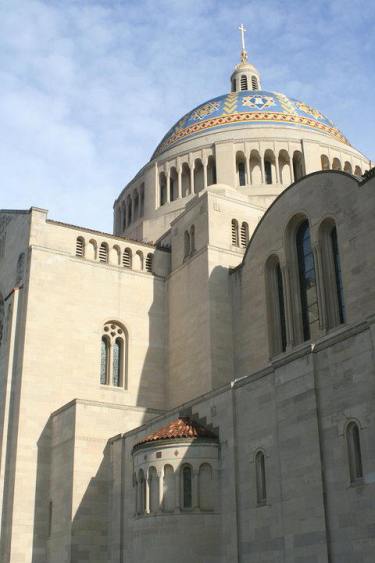


A Day for Creative Wonder

Red Chairs
'Red Chairs.' Painting by Bob Kirchman

Painting en Plein Air in Staunton
A Day of Creative Celebration

It was a day that dawned slightly overcast as I headed to town to 'stake out' our painting location. I knew it would be a hot one and I was going to be joined by my student, high school senior Savhanna Herndon and Lilly, a seven-year old who was one of Grace Christian School's best young artists. My concern was that the students have a great experience. The Ox Eye Vineyards tasting room seemed ideal, offering plenty of shade and interesting architecture. We set to work and shared color on our palates as we each tackled our respective painting. I must confess I dispensed with the easel and carried my canvass around as I interacted with the students. I painted what I would consider a good 'demonstration' canvas.

Savhanna chose a rich flower bed on the side of the Ox Eye building and she really started flowing with the project. She'd bought a bunch of new tubes of paint, heavy on what we call the 'Laney Colors,' so named for my last wonderful studio assistant who had pushed us 'brighter' in the renderings. (I was trained in a period which was far more muted and pastel). Savhanna was joying in the profusion of flowers that allowed her to play with happy color. We had arrived early in the morning so the archway area was open. I flitted between Lilly and Savhanna as I observed, and answered questions, but I kept at my own view so as to avoid 'hovering.' It was a good day.

Still, I felt like there wasn't much to my little painting until the staff of Ox Eye set out those wonderful little red tables and chairs! At that point I 'borrowed' some of Savhanna's bright colors and washed the atmospheric perspective. Getting better!, then I quickly rendered the tables and chairs with red, straight out of the tube from Savhanna's palate. Now I was getting somewhere! Suddenly focus and composition intersected in a joyous harmony. I was not expecting it! It was a beautiful day!

Flowers at Ox Eye
'Flowers at Ox Eye.' Painting by Savhanna Herndon.

IMG_0379
Lilly's Painting of Sunspots across the street.

Savhanna
Savhanna Herndon, after a good morning's work!

Bob_web
Yes, I painted this standing up. Photo by Susan Kiers

'Over the Bridge'
'Bridge Day' in Staunton, Virginia


Bridge Day

Bridge Day

Bridge Day
'Bridge Day' was happening as we painted, a celebration of the restoration of the Sears Hill Pedestrian Bridge across the Buckingham Branch Railroad in downtown Staunton. Photos by Bob Kirchman

Off to La La Land
Musical with a Message for Our Time

Director Damien Chazelle unleashes an old-school, tour de force musical, proving that original, Oscar-worthy moviemaking—without R-rated gratuity—is actually still possible in Tinseltown." -- Plugged In

My lovely wife and I finished off the day watching the musical La La Land. It quickly ended up on our: "we need to own this DVD" list. Start with the fact that we both enjoy the old great musicals from Rodgers and Hammerstien and this modern day take off on that style is enjoyable in its own right. But where the old musicals often were fairly light on the story and heavy on the lavish numbers, La La Land had a great story to tell as well. The story is that of Sebastian (Ryan Gosling) and Mia (Emma Stone). He is a struggling keyboard artist and she is an aspiring actor. They meet in an awkward manner and their most decidedly unromantic beginnings are the beginnings of a sweet tale of love, creative aspiration, and  collaboration.

It was fascinating to see how movie critics found things about the film to lambaste, such as Sebastian's love of traditional Jazz and his conflicts as he takes up playing in a Fusion band in order to move forward. While real music buffs might find it wanting in substance, the 'short explaination' offered by Sebastian is good enough for most of us. That and Mia's endless frustration in casting calls was actually quite a good build up to a tale about the tensions in a creative life. The fact is, for two creative people who've done Marriage Encounter, the film sparked some wonderful communication. I learned something.

We creatives often get so caught up in that which drives us that we become real jerks... especially with those we love the most. That is painful truth number one in this film as Sebastian, newly fired for not playing the required sets at his restaurant gig, leaves in a huff, smashing into Mia, who will eventually go on to become his greatest encourager. The themes of creative drive, love and encouragement, and sacrifice for another person make this a worthy movie indeed. Sebastian's narcissism created some good 'ouch' moments for me. Real sacrifice, it turns out, is not in the heroic selfless decision so much as in the daily 'dying to self' that makes life with another person rich. Indeed, there is a 'replay' moment near the end of the film that makes this clear.

Life itself is awkward. The film makes that clear, and I think anyone who's really loved and lived, and been the recipient of loving encouragement, will certainly find themselves in this story.


CS_Lewis_Banner