Wednesday, May 16, 2018

Faith and Beauty, Wonder, Bezalel and Oholiab

windowTHYME
Volume XIV, Issue XIX

Faith and Beauty V
Wanted: People to Lead Us in the Way of Wonder
By Trevin Wax

[click to read]

In an age of disenchantment, a world in which people are starved by superficiality, we need writers and pastors and artists who can feed us with the wonder of existence.

The writers I most enjoy reading are those who lead us in the way of wonder: poets and artists who tell the truth by “telling it slant,” as Emily Dickinson said. I’m referring to the gift of recognizing and describing truth in such a way that our imaginations are seized by wonder and we stand in awe of the reality we see.

We do not need thinkers who reduce the wonders of this world to facts. We need seers who open our eyes to just how wonder-full the facts are.

We need theologians and pastors who combine their desire for theological accuracy with the desire to showcase biblical beauty, until we stand in awe—of this world in all of its haunted goodness and of the gospel in all of its long-awaited surprise.

The best writers and artists are driven not by the need to show you themselves, as if to invite you into the prison of their minds, but by the desire to open windows so that you get a glimpse of glorious realities that stand outside and above us, enduring truths that do not depend on intellectual fads. They are not content to merely amuse us as we pass our time in a wonder-less era of cultural fatigue. They startle us with truth and goodness and beauty.

We don’t need writers with new ideas; we need writers with new eyes for old truths.

We need people who lead us in the way of wonder. We need to be awakened—to be refilled with childlike wonder at both the world and the gospel. (read more)

A Case for Vision

The day was growing long as the evening light outside was fading away. I was installing the model our studio had built of a major resort in the welcome center. At 1" = 500' the physical model showed ski slopes, golf courses and a wonderful water park on a most amazing mountain location. The staff had quietly slipped in and out to look at the artistic rendition of the resort's majesty and many had expressed their admiration. I was hurrying to place the identifying numbers for the map key when I first noticed that I had an audience. Two teenagers had come in to look at the model up close. Their parents were already headed in to the indoor pool area but even the wonders of a world-class resort couldn't stop youth from being intrigued by a statement of vision.

One of the girls gazed at the model with what appeared to be skills of observation beyond her years. There was no need for the admonition: "Don't touch anything!" In fact, I would have considered it an insult. Both sisters displayed incredible respect for the work taking place before them. Though the first girl was quite conversant in literature (how many kids can use the words 'Utopian' and 'Distopian' in their conversation); Homeschoolers? Perhaps, but I didn't ask. Tolkien, Lewis and Rowling were better topics for conversation. The girls had clearly been raised to treasure literature and thought. That they lingered when a really fun moment awaited them through the next doorway spoke volumes to me. Young people (and I have been priviledged to work with the best in our studio) want to see vision and deserve to be shown our best efforts at it.

Most of my life has been spent in the field of visualization. It has involved constructing hundreds of little models of proposed projects, the drawing and painting of innumerable renderings and as the economy recently crumbled, some really interesting publishing projects. Vision is as essential to the soul as food is to the body, so, as S. Truitt Cathy says: "Make it good!" It is in our blood. It is a part of our history.

Michigan at the turn of the Century was poised to become a center of vision and innovation. My own ancestors fled Bavaria in 1870 as Otto von Bismark 'unified' Germany. They came to the American Northwest to settle in that cold land, finding employment on the growing railroad. The men set out first, seeking their fortunes, and saved their money to bring their ladies to the New World. When Oma arrived, she quickly decided she didn't like the boys working on Sunday, so they found work in Bay City's growing sawmill industry. Eventually Bay City would become known for pre-manufactured houses as Aladdin Homes and Lewis Homes would enter the market that Sears Roebuck is most famous for. The companies grew well into the Twentieth Century, but faltered during America's Great Depression.

Ironically it was during this same Depression, South of Bay City in Detroit, that Henry Ford's assembly line was creating an American version of the 'Industrial Revolution.' For a good portion of the Twentieth Century, Detroit was the automobile production center of the world. Across the 'glove,' in Benton Harbor, the Heath Company [click to read] began manufacturing a 'build it yourself' airplane kit. Expanding into consumer electronics, Heath offered a whole range of kits for enthusiasts who wanted to build their own radios and electronic devices. Heathkit became a legend as scores of people assembled and enjoyed these products. My father and I must have assembled dozens of them in my youth. My two brothers went on to become NASA engineers!

As Detroit diminished and Asian and European auto makers grew, one of my uncles worked for John Portman creating the great towers of Detroit's Renaissance Center. Today those gleaming towers preside over a city in decline. As Japanese and Korean companies remade the assembly line, Detroit's 'Big Three' were hobbled by antiquated methodology and union work rules. They had operated without fear of competition for so long that they came too late to the world of robotics and subcompact cars.

Great minds like that of Lee Iococca might have remade her, but Detroit was stubborn about resisting change and forgot about the deep well of her inventive past. It was not so much that they were 'stuck in the past' but that they were 'stuck in their own Century!' Had they looked to the past, they might have seen the transformation wrought in previous times by men like I. K. Brunel [click to read]. If some day we find ourselves gliding rapidly between cities in pneumatic tube transit systems, we will do well to remember that Brunel was there first. He used a pneumatic tube and piston to propel trains on one of his innovative railways in the Nineteenth Century!

The time was growing late. I asked my young observers a loaded question: "Why are there no books on how to teach your baby to walk?" They looked at me with a serious rumination I had often seen in the countenance of my studio assistant when I'd pose such a problem. "You don't need them!" one of the girls thoughtfully answered. She went on to explain that babies naturally want to stand and reach out to their full potential. "Why do we lose that?" I pondered. "Does it get 'taught out of us' as we move on to more formal instruction?"

And yet, it can be rekindled! It can be nurtured! As a boy I spent hours in the woods observing the wonders of the natural world. In 1964 the New York Worlds Fair inspired me to draw impossible built environments. Men walked on the Moon. My grandfather designed and built his own machinery for his mill. My grandmother was a great painter and designer. My mother loved mathematics and designing sweater patterns. My father wrote the procedures for testing spacecraft in the 1960's. Once Mom took me to visit a friend of hers who sculpted in white marble. Her friend encouraged me to work in Ivory Soap!

I do not consider my childhood to be all that out of the ordinary. This world is FULL of beautiful creative souls, most of whom LOVE to share their vision with young people. If it IS at all out of the ordinary, then I believe we are to blame for not allowing our children to come alongside and be infected by our brightest and best. History offers us even more. Consider the Wright Brothers [click to read]. Too often we've turned history class into: "What's Wrong with America" and neglected the stories of inspiration and greatness. That is not to say we should ignore the dark parts, but we must never create a picture of hopelessness and despair. There is too much evidence to the contrary!

My wife is an educator of young children. She once shared with me some research about early childhood development that focused on infants in an orphanage in Tehran. The staff was spread so thin that the children were merely fed and changed. There was no time to hold and cuddle the infants. Far too many of these precious souls never rose to crawl. They never pulled upright to walk. They simply died. The study affirmed the importance of nurture in young lives, and begs us to ask: "As we push our children to conformity and 'productivity,' do we unwittingly cease to nourish some essential part of the soul?" Could Vision be the essential food for human aspiration?

As much of the media has been all too ready to report the demise of the American experiment, THYME looks at these fine young people and looks to offer them far more. We'd like to present a vision that is rooted in history and faith, that dares them to dream big dreams. The world needs them to do so, We can offer them no less!

The Creative Mandate of Genesis I and II
The Unique Responsibility Conferred in Imago Dei

penguins

And G-d said, Let us make man in our image, after our likeness: and let them have dominion over the fish of the sea, and over the fowl of the air, and over the cattle, and over all the earth, and over every creeping thing that creepeth upon the earth.

So G-d created man in his own image, in the image of G-d created he him; male and female created he them.

And G-d blessed them, and G-d said unto them, Be fruitful, and multiply, and replenish the earth, and subdue it: and have dominion over the fish of the sea, and over the fowl of the air, and over every living thing that moveth upon the earth." -- Genesis 1:26-28

New York artist, Makoto Fujimura and others have found in the first chapters of Genesis, a unique charge to mankind. Scripture states that mankind alone bears the Divine image, and as such carries unique responsibility. G-d calls on Man, created in his own image, to 'replenish' the Earth. Many read over this passage and see it as similar to the charge given to fish and fowl... to populate the planet, but read further and G-d involves mankind in something far greater:

And out of the ground the Lord God formed every beast of the field, and every fowl of the air; and brought them unto Adam to see what he would call them: and whatsoever Adam called every living creature, that was the name thereof." -- Genesis 2:19

Here the Divine does not simply present animals to the newly formed person and tell that person their names... G-d invites Adam into the studio, as it were, and charges him with naming the new creations!

Fujimura and others see in this a Divine mandate: if those gifts of creativity... expressed in the art, culture and industry of mankind, are indeed an extension of 'Imago Dei, their exercise takes on a new importance.

Dr S. Lewis Johnson writes: "One of the scientists who has written on the Book of Genesis has said, “The first introduction of animal life was not a fragile, blob of protoplasm that happened to come together in response to electrical discharges over a primeval ocean as evolutionists believe. The water swarmed with swarms of living creatures.” But we are not to think from this statement, "Let the waters teem with swarms of living creatures” that it is the waters that have brought forth these creatures. It is evident that they are the product of the word of G-d. It is not they, the waters who have created. It is G-d who has created. So when we read, “Then G-d said”, the power of this creation rests in the word of the Lord G-d. So the creation is from G-d, but as a result of his word the waters teem with swarms of living creatures."

Each new phase of the creation account begins with G-d speaking. In Genesis 2:19 the Divine calls Adam to speak... naming specific elements of what G-d has made.

Today G-d calls the artist to an active role in replenishing society. Indeed the artist has always been at the forefront of the cultural discussion. Sadly, in a world that relegates Faith to a position of diminished importance, the artist who is a person of Faith often has taken a back seat in the dialogue.

The secular world itself gives greater weight to the naturalist, who operates in the gritty world that is seen. Beauty and Truth, particularly when seen as the product of Faith's influence, are discounted. In response, artists of Faith have often settled for a less than transformative role, content to produce icons, but unwilling to participate in the transformation of culture.

This does not mean that only a few great names are to participate. For thousands of years, art has been produced by people in the simplest of cultures. Consider the rich tradition in textiles. People have always blended richness and color into their daily lives. Printing presses have made it possible for everyone to have a Rembrant on their walls... but richness is lost when ink replaces real paint. Consider the joy preschool children experience as they apply color to paper! Society seems to dull that, relegating the flow of color to 'experts,' but it can, and should be recaptured as a part of the human experience... especially as a part of our Worship and Wonder!

In her later years, my physicist Mother found joy in creating woven garments and in throwing pots on her wheel, rekindling that Sacred spark. There resides in Imago Dei a deep need to express one's creative spirit. How wonderful when that expression serves the Divine purpose!

How does the creative mandate align itself with the charge to build the Kingdom of G-d? Most certainly! Pictured here are details of very large paintings a young artist has prepared for Vacation Bible School. Just imagine the wonder of children being surrounded by this majestic world... right out of Genesis 1:22! Imagine the power art, writing, theater and music have in the hands of the Faithful to address our culture today!

beluga

dolphins
Top: Swimming Penguins, Center: Whales, Bottom: Dolphins; Details of 9' x 6' Canvases by Muralist Kristina Elaine Greer prepared for St. John's United Methodist Church in Staunton, Virginia

wtc
Xaver Wilhelmy's Design for a memorial at the World Trade Center site in New York. The memorial features a 3000 pipe organ to give a voice to everyone who's voice was lost on that terrible day. Rendering by Bob Kirchman

IMG_3404
Xaver Wilhelmy's design for a pipe organ enclosure for St. John's Evangelical Lutheran Church in Davis West Virginia. Model by Bob Kirchman and Kristina Elaine Greer.

The Creative Mandate of Bezalel and Oholiab
Exodus 35 and 36, Skill, Ability and Knowledge

Then Moses said to the Israelites, “See, the Lord has chosen Bezalel son of Uri, the son of Hur, of the tribe of Judah, and he has filled him with the Spirit of G-d, with wisdom, with understanding, with knowledge and with all kinds of skills —  to make artistic designs for work in gold, silver and bronze, to cut and set stones, to work in wood and to engage in all kinds of artistic crafts. And he has given both him and Oholiab son of Ahisamak, of the tribe of Dan, the ability to teach others. He has filled them with skill to do all kinds of work as engravers, designers, embroiderers in blue, purple and scarlet yarn and fine linen, and weavers—all of them skilled workers and designers.

So Bezalel, Oholiab and every skilled person to whom the Lord has given skill and ability to know how to carry out all the work of constructing the sanctuary are to do the work just as the Lord has commanded.”

Then Moses summoned Bezalel and Oholiab and every skilled person to whom the Lord had given ability and who was willing to come and do the work. They received from Moses all the offerings the Israelites had brought to carry out the work of constructing the sanctuary." -- Exodus 35:30 - 36:3

In Genesis, G-d invited mankind into the studio to name His creation. Mankind was also given the mandate to 'replenish' creation. When G-d chose to work through a specific people as part of his purpose, he again invited those He had created into His work. Bezalel and Oholiab are specifically mentioned by name. Bezalel, it says, is filled with the "Spirit of G-d, with wisdom, with understanding, with knowledge and with all kinds of skills." Clearly G-d is the giver of artistic gifts. Bezalel and Oholiab both are given the ability to teach by G-d. In the Tabernacle, G-d has these artisans construct the space that He will occupy!

The cubic Sanctuary, the Ark, the tools, fabrics and furnishings were all inspired designs executed by inspired artisans. The Presence of G-d would transform Israel, but Israel participated in building the place for the Presence! Later this same scheme would be repeated in stone and cedarwood for the Temple of Solomon. That form would be repeated in the rebuilt Temple of Zerubbabel's day. The Prophet Haggai again called the people to the work of G-d. Haggai ends his writings looking to a time when G-d will establish His throne in Heaven and on Earth.

In Isaiah 60 and Revelation 21, 22 we see the reign of G-d established and a New Heaven and New Earth. The form of Jerusalem described in Revelation is a cube large enough to encompass all of mankind! Here is restoration of fellowship with G-d and a return to that close fellowship seen in Genesis before the fall. Today the artist who has faith is uniquely equipped -- and called to the building of the Kingdom of Heaven! We possess a mandate to replenish the Earth, to use our gifts in the building of that which G-d is bringing about.

Consider the mission of The Culture House in Kansas City, Missouri. Janie B. Cheaney of World Magazine describes it like this: "an arts organization... that brings a Christian ethos of excellence for the sake of others and cultural leadership for its students." Founded by Jeremiah Enna, the Culture House offers programs in visual arts, dance and theatre... all from a perspective of submitting these gifts to G-d's purpose. In a recent production: Underground, the theatre group tackled the issue of slavery.

The popular narritive often approaches this narritive from the perspective that "America is evil." Underground's prooducers said instead: "we wanted to show America overcoming evil." Stressing the role of the Church in abolishing slavery, their narrative became: "G-d is the Hero!" In the Centuries past, faith was the inspiration for building great cathedrals and transformative movements in culture. Alvin Schmidt documents much of this in his book: Under the Influence. It is no stretch to conclude that much of our present tolerance for diversity springs from the influence of faith.

In the writings of Moses there are specific protections given to aliens living among the Israelites. In Genesis 12:3 G-d says to Abraham: "...all peoples on Earth will be blessed through you," giving a unique insight into the Divine Heart. The line of David includes Rahab (the woman of Jerico who hid the spies) and Ruth the Moabite. Moses himself had a Cushite wife (she was black). In Isaiah 60 we hear G-d's Heart speak:

Arise, shine, for your light has come, and the glory of the Lord rises upon you. See, darkness covers the earth and thick darkness is over the peoples, but the Lord rises upon you and his glory appears over you. Nations will come to your light, and kings to the brightness of your dawn." -- Isaiah 60:1-3

Foreigners will rebuild your walls, and their kings will serve you. Though in anger I struck you, in favor I will show you compassion. Your gates will always stand open, they will never be shut, day or night, so that people may bring you the wealth of the nations -- their kings led in triumphal procession. For the nation or kingdom that will not serve you will perish; it will be utterly ruined. The glory of Lebanon will come to you, the juniper, the fir and the cypress together, to adorn my sanctuary; and I will glorify the place for my feet. The children of your oppressors will come bowing before you; all who despise you will bow down at your feet and will call you the City of the Lord, Zion of the Holy One of Israel." -- Isaiah 60:10-14

Looking forward to G-d's transformative work, the artist of faith has a unique place and unique giftings to speak into his or her world.

IMG_3402
Mr. Wilhelmy worked out the placement of wind chests and pipes using the model built by the Kirchman Studio.

window
Xaver Wilhelmy's design for functional stained glass organ pipes embedded in a window. Rendering by Xaver Wilhelmy and Bob Kirchman

Thoughts on Purpose in Life's Work
Every Person's Calling to Build G-d's Kingdom

Glass 1
Painted glass vase by Carmen Rose Shenk.

I came upon this quotation which seems to recast significantly the purpose we so diligently seek for our lives. It is worth reflecting on these truths in a world where our retirement funds are disappearing, our masterpieces fade and our trophies tarnish. There is a better place to invest our time and treasure... that Kingdom that was the hope of the faithful in Hebrews 11:

But what what we can and must do in the present, if we are obedient to the gospel, if we are following Jesus, and if we are indwelt, energized, and directed by the Spirit, is to build for the kingdom. This brings me back to 1 Corinthians 15:58 once more: what you do for the Lord is not in vain. You are not oiling the wheels of a machine that's about to roll over a cliff. You are not restoring a great painting that's shortly going to be thrown on the fire. You are not planting roses in a garden that's about to be dug up for a building site. You are -- strange though it may seem, almost as hard to believe as the resurrection itself -- accomplishing something that will become in due course part of G-d's new world. Every act of love, gratitude and kindness; every work of art or music inspired by the love of G-d and delight in the beauty of his creation; every minute spent teaching a severely handicapped child to read or walk; every act of care and nurture, of comfort and support, for one's fellow human beings and for that matter one's fellow nonhuman creatures; and of course every prayer, all Spirit-led teaching, every deed that spreads the gospel, builds up the church, embraces and embodies holiness rather than corruption, and makes the name of Jesus honored in the world -- all of this will find its way, through the resurrecting power of G-d, into the new creation that G-d will one day make. That is the logic of the mission of G-d." -- N. T. Wright, Surprised by Hope, Rethinking Heaven, the Resurrection, and the Mission of the Church, page 208.

From the Earth to the Moon
By Jules Verne

CHAPTER XII, URBI ET ORBI

The astronomical, mechanical, and topographical difficulties resolved, finally came the question of finance. The sum required was far too great for any individual, or even any single State, to provide the requisite millions.

President Barbicane undertook, despite of the matter being a purely American affair, to render it one of universal interest, and to request the financial co-operation of all peoples. It was, he maintained, the right and duty of the whole earth to interfere in the affairs of its satellite. The subscription opened at Baltimore extended properly to the whole world-- Urbi et orbi.

This subscription was successful beyond all expectation; notwithstanding that it was a question not of lending but of giving the money. It was a purely disinterested operation in the strictest sense of the term, and offered not the slightest chance of profit.

The effect, however, of Barbicane's communication was not confined to the frontiers of the United States; it crossed the Atlantic and Pacific, invading simultaneously Asia and Europe, Africa and Oceanica. The observatories of the Union placed themselves in immediate communication with those of foreign countries. Some, such as those of Paris, Petersburg, Berlin, Stockholm, Hamburg, Malta, Lisbon, Benares, Madras, and others, transmitted their good wishes; the rest maintained a prudent silence, quietly awaiting the result.

As for the observatory at Greenwich, seconded as it was by the twenty- two astronomical establishments of Great Britain, it spoke plainly enough. It boldly denied the possibility of success, and pronounced in favor of the theories of Captain Nicholl. But this was nothing more than mere English jealousy.

On the 8th of October President Barbicane published a manifesto full of enthusiasm, in which he made an appeal to "all persons of good will upon the face of the earth." This document, translated into all languages, met with immense success.

Subscription lists were opened in all the principal cities of the Union, with a central office at the Baltimore Bank, 9 Baltimore Street.

In addition, subscriptions were received at the following banks in the different states of the two continents:

At Vienna, with S. M. de Rothschild. At Petersburg, Stieglitz and Co. At Paris, The Credit Mobilier. At Stockholm, Tottie and Arfuredson. At London, N. M. Rothschild and Son. At Turin, Ardouin and Co. At Berlin, Mendelssohn. At Geneva, Lombard, Odier and Co. At Constantinople, The Ottoman Bank. At Brussels, J. Lambert. At Madrid, Daniel Weisweller. At Amsterdam, Netherlands Credit Co. At Rome, Torlonia and Co. At Lisbon, Lecesne. At Copenhagen, Private Bank. At Rio de Janeiro, Private Bank. At Montevideo, Private Bank. At Valparaiso and Lima, Thomas la Chambre and Co. At Mexico, Martin Daran and Co.

Three days after the manifesto of President Barbicane $4,000,000 were paid into the different towns of the Union. With such a balance the Gun Club might begin operations at once. But some days later advices were received to the effect that foreign subscriptions were being eagerly taken up. Certain countries distinguished themselves by their liberality; others untied their purse-strings with less facility--a matter of temperament. Figures are, however, more eloquent than words, and here is the official statement of the sums which were paid in to the credit of the Gun Club at the close of the subscription.

Russia paid in as her contingent the enormous sum of 368,733 roubles. No one need be surprised at this, who bears in mind the scientific taste of the Russians, and the impetus which they have given to astronomical studies--thanks to their numerous observatories.

France began by deriding the pretensions of the Americans. The moon served as a pretext for a thousand stale puns and a score of ballads, in which bad taste contested the palm with ignorance. But as formerly the French paid before singing, so now they paid after having had their laugh, and they subscribed for a sum of 1,253,930 francs. At that price they had a right to enjoy themselves a little.

Austria showed herself generous in the midst of her financial crisis. Her public contributions amounted to the sum of 216,000 florins-- a perfect godsend.

Fifty-two thousand rix-dollars were the remittance of Sweden and Norway; the amount is large for the country, but it would undoubtedly have been considerably increased had the subscription been opened in Christiana simultaneously with that at Stockholm. For some reason or other the Norwegians do not like to send their money to Sweden.

Prussia, by a remittance of 250,000 thalers, testified her high approval of the enterprise.

Turkey behaved generously; but she had a personal interest in the matter. The moon, in fact, regulates the cycle of her years and her fast of Ramadan. She could not do less than give 1,372,640 piastres; and she gave them with an eagerness which denoted, however, some pressure on the part of the government.

Belgium distinguished herself among the second-rate states by a grant of 513,000 francs-- about two centimes per head of her population.

Holland and her colonies interested themselves to the extent of 110,000 florins, only demanding an allowance of five per cent. discount for paying ready money.

Denmark, a little contracted in territory, gave nevertheless 9,000 ducats, proving her love for scientific experiments.

The Germanic Confederation pledged itself to 34,285 florins. It was impossible to ask for more; besides, they would not have given it.

Though very much crippled, Italy found 200,000 lire in the pockets of her people. If she had had Venetia she would have done better; but she had not.

The States of the Church thought that they could not send less than 7,040 Roman crowns; and Portugal carried her devotion to science as far as 30,000 cruzados. It was the widow's mite-- eighty-six piastres; but self-constituted empires are always rather short of money.

Two hundred and fifty-seven francs, this was the modest contribution of Switzerland to the American work. One must freely admit that she did not see the practical side of the matter. It did not seem to her that the mere despatch of a shot to the moon could possibly establish any relation of affairs with her; and it did not seem prudent to her to embark her capital in so hazardous an enterprise. After all, perhaps she was right.

As to Spain, she could not scrape together more than 110 reals. She gave as an excuse that she had her railways to finish. The truth is, that science is not favorably regarded in that country, it is still in a backward state; and moreover, certain Spaniards, not by any means the least educated, did not form a correct estimate of the bulk of the projectile compared with that of the moon. They feared that it would disturb the established order of things. In that case it were better to keep aloof; which they did to the tune of some reals.

There remained but England; and we know the contemptuous antipathy with which she received Barbicane's proposition. The English have but one soul for the whole twenty-six millions of inhabitants which Great Britain contains. They hinted that the enterprise of the Gun Club was contrary to the "principle of non-intervention." And they did not subscribe a single farthing.

At this intimation the Gun Club merely shrugged its shoulders and returned to its great work. When South America, that is to say, Peru, Chili, Brazil, the provinces of La Plata and Columbia, had poured forth their quota into their hands, the sum of $300,000, it found itself in possession of a considerable capital, of which the following is a statement:

United States subscriptions, . . $4,000,000 Foreign subscriptions . . . $1,446,675 ----------- Total, . . . . $5,446,675

Such was the sum which the public poured into the treasury of the Gun Club.

Let no one be surprised at the vastness of the amount. The work of casting, boring, masonry, the transport of workmen, their establishment in an almost uninhabited country, the construction of furnaces and workshops, the plant, the powder, the projectile, and incipient expenses, would, according to the estimates, absorb nearly the whole. Certain cannon-shots in the Federal war cost one thousand dollars apiece. This one of President Barbicane, unique in the annals of gunnery, might well cost five thousand times more.

On the 20th of October a contract was entered into with the manufactory at Coldspring, near New York, which during the war had furnished the largest Parrott, cast-iron guns. It was stipulated between the contracting parties that the manufactory of Coldspring should engage to transport to Tampa Town, in southern Florida, the necessary materials for casting the Columbiad. The work was bound to be completed at latest by the 15th of October following, and the cannon delivered in good condition under penalty of a forfeit of one hundred dollars a day to the moment when the moon should again present herself under the same conditions-- that is to say, in eighteen years and eleven days.

The engagement of the workmen, their pay, and all the necessary details of the work, devolved upon the Coldspring Company.

This contract, executed in duplicate, was signed by Barbicane, president of the Gun Club, of the one part, and T. Murchison director of the Coldspring manufactory, of the other, who thus executed the deed on behalf of their respective principals.

CHAPTER XIII, STONES HILL

When the decision was arrived at by the Gun Club, to the disparagement of Texas, every one in America, where reading is a universal acquirement, set to work to study the geography of Florida. Never before had there been such a sale for works like "Bertram's Travels in Florida," "Roman's Natural History of East and West Florida," "William's Territory of Florida," and "Cleland on the Cultivation of the Sugar-Cane in Florida." It became necessary to issue fresh editions of these works.

Barbicane had something better to do than to read. He desired to see things with his own eyes, and to mark the exact position of the proposed gun. So, without a moment's loss of time, he placed at the disposal of the Cambridge Observatory the funds necessary for the construction of a telescope, and entered into negotiations with the house of Breadwill and Co., of Albany, for the construction of an aluminum projectile of the required size. He then quitted Baltimore, accompanied by J. T. Maston, Major Elphinstone, and the manager of the Coldspring factory.

On the following day, the four fellow-travelers arrived at New Orleans. There they immediately embarked on board the Tampico, a despatch-boat belonging to the Federal navy, which the government had placed at their disposal; and, getting up steam, the banks of Louisiana speedily disappeared from sight.

The passage was not long. Two days after starting, the Tampico, having made four hundred and eighty miles, came in sight of the coast of Florida. On a nearer approach Barbicane found himself in view of a low, flat country of somewhat barren aspect. After coasting along a series of creeks abounding in lobsters and oysters, the Tampico entered the bay of Espiritu Santo, where she finally anchored in a small natural harbor, formed by the embouchure of the River Hillisborough, at seven P.M., on the 22d of October.

Our four passengers disembarked at once. "Gentlemen," said Barbicane, "we have no time to lose; tomorrow we must obtain horses, and proceed to reconnoiter the country." Barbicane had scarcely set his foot on shore when three thousand of the inhabitants of Tampa Town came forth to meet him, an honor due to the president who had signalized their country by his choice.

Declining, however, every kind of ovation, Barbicane ensconced himself in a room of the Franklin Hotel.

On the morrow some of the small horses of the Spanish breed, full of vigor and of fire, stood snorting under his windows; but instead of four steeds, here were fifty, together with their riders. Barbicane descended with his three fellow- travelers; and much astonished were they all to find themselves in the midst of such a cavalcade. He remarked that every horseman carried a carbine slung across his shoulders and pistols in his holsters.

On expressing his surprise at these preparations, he was speedily enlightened by a young Floridan, who quietly said:

Sir, there are Seminoles there."

What do you mean by Seminoles?"

Savages who scour the prairies. We thought it best, therefore, to escort you on your road."

Pooh!" cried J. T. Maston, mounting his steed.

All right," said the Floridan; "but it is true enough, nevertheless."

Gentlemen," answered Barbicane, "I thank you for your kind attention; but it is time to be off."

It was five A.M. when Barbicane and his party, quitting Tampa Town, made their way along the coast in the direction of Alifia Creek. This little river falls into Hillisborough Bay twelve miles above Tampa Town. Barbicane and his escort coasted along its right bank to the eastward. Soon the waves of the bay disappeared behind a bend of rising ground, and the Floridan "champagne" alone offered itself to view.

Florida, discovered on Palm Sunday, in 1512, by Juan Ponce de Leon, was originally named Pascha Florida. It little deserved that designation, with its dry and parched coasts.

But after some few miles of tract the nature of the soil gradually changes and the country shows itself worthy of the name. Cultivated plains soon appear, where are united all the productions of the northern and tropical floras, terminating in prairies abounding with pineapples and yams, tobacco, rice, cotton-plants, and sugar-canes, which extend beyond reach of sight, flinging their riches broadcast with careless prodigality.

Barbicane appeared highly pleased on observing the progressive elevation of the land; and in answer to a question of J. T. Maston, replied:

My worthy friend, we cannot do better than sink our Columbiad in these high grounds." "To get nearer the moon, perhaps?" said the secretary of the Gun Club.

Not exactly," replied Barbicane, smiling; "do you not see that among these elevated plateaus we shall have a much easier work of it? No struggles with the water-springs, which will save us long expensive tubings; and we shall be working in daylight instead of down a deep and narrow well. Our business, then, is to open our trenches upon ground some hundreds of yards above the level of the sea."

You are right, sir," struck in Murchison, the engineer; "and, if I mistake not, we shall ere long find a suitable spot for our purpose."

I wish we were at the first stroke of the pickaxe," said the president. "And I wish we were at the last," cried J. T. Maston.

About ten A.M. the little band had crossed a dozen miles. To fertile plains succeeded a region of forests. There perfumes of the most varied kinds mingled together in tropical profusion. These almost impenetrable forests were composed of pomegranates, orange-trees, citrons, figs, olives, apricots, bananas, huge vines, whose blossoms and fruits rivaled each other in color and perfume. Beneath the odorous shade of these magnificent trees fluttered and warbled a little world of brilliantly plumaged birds.

J. T. Maston and the major could not repress their admiration on finding themselves in the presence of the glorious beauties of this wealth of nature. President Barbicane, however, less sensitive to these wonders, was in haste to press forward; the very luxuriance of the country was displeasing to him. They hastened onward, therefore, and were compelled to ford several rivers, not without danger, for they were infested with huge alligators from fifteen to eighteen feet long. Maston courageously menaced them with his steel hook, but he only succeeded in frightening some pelicans and teal, while tall flamingos stared stupidly at the party.

At length these denizens of the swamps disappeared in their turn; smaller trees became thinly scattered among less dense thickets-- a few isolated groups detached in the midst of endless plains over which ranged herds of startled deer.

At last," cried Barbicane, rising in his stirrups, "here we are at the region of pines!" "Yes! and of savages too," replied the major.

In fact, some Seminoles had just came in sight upon the horizon; they rode violently backward and forward on their fleet horses, brandishing their spears or discharging their guns with a dull report. These hostile demonstrations, however, had no effect upon Barbicane and his companions.

They were then occupying the center of a rocky plain, which the sun scorched with its parching rays. This was formed by a considerable elevation of the soil, which seemed to offer to the members of the Gun Club all the conditions requisite for the construction of their Columbiad.

Halt!" said Barbicane, reining up. "Has this place any local appellation?"

It is called Stones Hill," replied one of the Floridans.

Barbicane, without saying a word, dismounted, seized his instruments, and began to note his position with extreme exactness. The little band, drawn up in the rear, watched his proceedings in profound silence.

At this moment the sun passed the meridian. Barbicane, after a few moments, rapidly wrote down the result of his observations, and said:

This spot is situated eighteen hundred feet above the level of the sea, in 27@ 7' N. lat. and 5@ 7' W. long. of the meridian of Washington. It appears to me by its rocky and barren character to offer all the conditions requisite for our experiment. On that plain will be raised our magazines, workshops, furnaces, and workmen's huts; and here, from this very spot," said he, stamping his foot on the summit of Stones Hill, "hence shall our projectile take its flight into the regions of the Solar World."
(to be continued)

Transcontinental Railroad


The Giving of the Law and the Spirit

[click to read]

Seven weeks after Passover comes Shavuot. is directly linked to that of Passover. Shavuot commemorates the giving of the Torah, the Law, on Sinai. On Passover, the people of Israel were freed from Egyptian servitude; on Shavuot they were given the Torah and became a nation committed to serving G-d. Shavuot is one of the three 'pilgrimage feasts,' where the people were required to come to Jerusalem. The three feasts are: Pesach (Passover), Shavuot (Weeks), and Sukkot (Tents or Booths). (read more)

PontifusBANNER

Wednesday, May 9, 2018

Faith and Inspiration, Wilberforce, I. K. Brunel

THYME0914
Volume XIV, Issue XVIII

The Ministry of Building Things

I'll bet if I asked you to think of some different types of ministry and ways to build the Kingdom of G-d, you probably wouldn't think of Economic Development. Pastor Tim Keller, in his book: Resources for Deacons, sees it clearly as a part of the Diaconal ministry. Our church helps women in Zambia get sewing machines. To be sure, the gift of the ability to earn their living as seamstresses is an act of ministry to these ladies.

But think bigger! THYME presents the story of how a nation turned from a great evil and one city suffered greatly in doing so. G-d provided a provider! Then G-d provided provision for the provider by inspiring great innovation that came to revitalize that great city. Should we dare to pray for such innovation and inspiration in our own day?

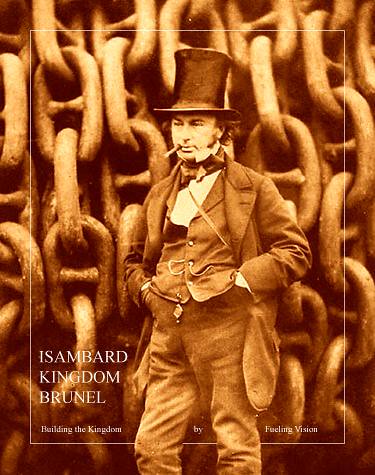
Isambard Kingdom Brunel
What a Nineteenth Century Innovator Can Teach Us Now
© 2013 The Kirchman Studio, All rights reserved.

They say that the condition for a miracle is difficulty, but the condition for a great miracle is impossibility” -- Angus Buchan, “G-d's Farmer”

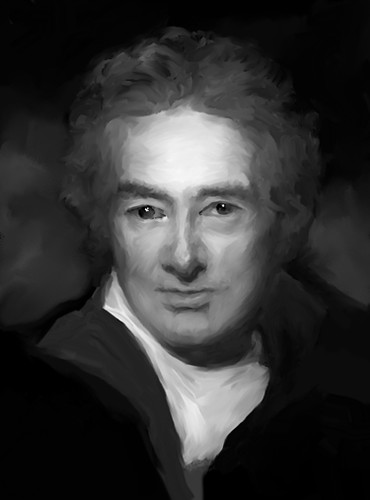
When William Wilberforce [1.] had ended the slave trade in the British Empire, he had thrown the city of Bristol, England into economic depression. The port there was heavily devoted to that wretched business and suffered heavily when it was brought to a sudden halt. The unintended consequence had been a rise in children condemned to a life of poverty. Ending the vile business of enslaving Africa's children had resulting in England's society spurning the needs of her own. Into this world came George Müller [2.], who, relying on faith in G-d alone, provided redemption for thousands of orphans. Many of these children were cast-offs of a society in economic despair.

George Müller [3.] had seen the wretched street urchins most people despised as jewels to be polished. Muller, relying solely on Divine provision, built five large houses for Orphans at Ashley Downs in Bristol, England. He trained the girls to be nurses, teachers, clerical workers and domestics. He apprenticed all the boys in various trades. He was excoriated for training these unwanted children "above their station." He ignored the critics.

Müller looked to G-d alone, but Bristol needed an outfowing of Divine provision to provide for her children. G-d's provision for Bristol was to come in the form of inspiration and innovation, embodied in the work of a young pioneer of civil engineering. He also ignored his critics.

suspension-bridge001
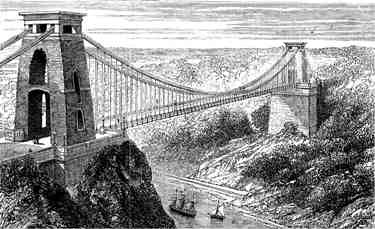
Brunel's Clifton Suspension Bridge became the symbol of the City of Bristol.

greatwesternrr001
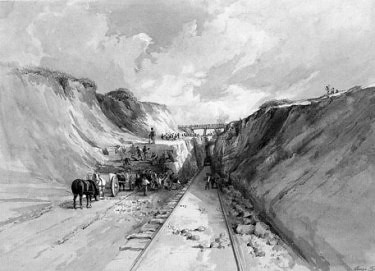
Building the Great Western Railway.

In 1831, 24 year old Isambard Kingdom Brunel [4.] was awarded a contract to bridge the Avon Gorge. It was the dream of a prosperous wine merchant who provided the initial funding. The completed bridge would become the symbol of the city, but lack of funding dogged the project. It took thirty years to complete it. For years only the towers stood completed. In 1833 Brunel began work on the Great Western Railway, which would become the instrument of Bristol's economic revitalization. The nicknames: "Great Way Round" and "G-d's Wonderful Railway" seem to describe well Brunel's great work.

Brunel was an innovator. He probably experienced as many failures as successes in his short lifetime. Born on April 9, 1806, the son of Sir Marc Brunel, he assisted his father in building a tunnel under the Thames. He would later become the resident engineer of that project. At twenty years of age, he designed a suspension bridge to cross the Avon river. A modified version of his plan was actually constructed.

At 26, Brunel was building the Great Western Railway, commissioned to maintain Bristol's importance as a port and position her for  trade with America. This wide-gauge railroad linked Bristol and Western regions of England to London. Bristol's prosperity as a port was assured and the work of Müller created solid citizens with strong spiritual foundations to benefit.

But Brunel was not content to simply build a better railway. He looked across the Atlantic, envisioning fleets of ocean greyhounds -- great steamships that would complete the linking of his Great Western Railway to America! The S. S. Great Britain was his creation. It was the first metal-hulled propeller-driven ocean ship and became the prototype for modern ocean liners.

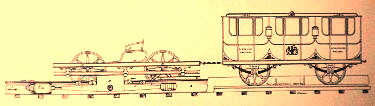
Building the South Devon Railway as a spur to the Great Western, Brunel experimented with an alternative to steam engines -- Vacuum tube powered trains. Stationary vacuum plants evacuated tubes laid along the center of the track that powered the movement of trains.

atmosenginesmall
Brunel's 'Atmospheric Railway.'

The technology required the use of leather flaps to seal the vacuum pipes. The natural oils were drawn out of the leather by the vacuum, making the leather vulnerable to water, rotting it and breaking the fibres when it froze. It had to be kept supple with tallow, which is attractive to rats. The flaps were eaten, and vacuum operation lasted less than a year, from 1847 (experimental service began in September; operations from February 1848) to 10 September 1848.[45] It has been suggested that the whole project was an expensive flop. In Brunel's favour, it has been noted that he had the courage to call a halt to the venture instead of struggling on with it at greater cost." -- Wikipedia

Like alternative transportation prototypes of our day, the vacuum tube system was more expensive. The accounts of the SDR for 1848 show that atmospheric traction cost 3s 1d (three shillings and one penny) per mile compared to 1s 4d/mile for conventional steam power.Though considered a failure at the time, vacuum powered trains may have been a distant precursor to Evacuated Tube Technology [5.] which is now being developed to move entire transport capsules through large tubes -- essentially powered in the same way as Brunel's South Devon train. Brunel was simply two Centuries before his time on this.

What can we learn from Brunel today? Plenty! Inspiration and innovation are needed now as they were needed then. Brunel teaches us valuable lessons about expanding vision with proven technologies and wisely exploring alternatives (and abandoning them when they do not work as planned).

Praying people see the diaconate role of economic development as an integral part of G-d's provision. In “Resources for Deacons, Love Expressed Through Mercy Ministries,” [6.] Tim Keller states his belief in three “levels” of mercy in diaconal ministry:

The first Level Is Simple Relief: That is taking care of the immediate need.

The Second Level Is Economic Development: That is teaching the poor how to get out of poverty by teaching them how to handle money, property, etc. and furnishing them with the means to do so. “Not handouts, but ownership is the way to break the cycle of poverty.”

The Third Level Is Social Reform: Christians should be involved in the culture in an effort to change the social structure.

We see it very localized in a place like Zambia, where people of faith instruct widows to become seamstresses (and people in America gift them with sewing machines). But, can we believe G-d for ever greater inspiration? What vision would G-d give us for our family, our company of employment, our city and county... and beyond? Müller said "the age of miracles is not past." Angus Buchan [7.], in the turmoil of Zambia and South Africa, looked to G-d for inspiration. G-d met him in a corn field where he learned the power of prayer!

Buchan had packed his family up during the unrest in Zambia in the late 'seventies and moved them to South Africa. A successful farmer in Zambia, he felt that he would be happy if he could acquire another farm in South Africa. It didn't. Experiencing deep depression, Buchan was angry and confused. Wandering into a lay-witness Sunday at the local Methodist Church, Angus heard builders, tradesmen and fellow farmers tell of what Jesus meant in their lives. For the first time he saw men crying, he wept unashamedly himself as he responded to an altar call. He took the Lord seriously about the changed life promise.

Buchan went back to his farm and learned to pray in his own corn field. Then he sought to minister to his Zulu workers. His farm manager, Simeon Bhengu, told him: "that's women's religion..." But G-d met Angus and spoke through his friendship with Simeon. Today the men are brothers in faith and brothers in every way. "My children are his and his are mine." Angus says of his Zulu brother. Angus expanded his farming operations and G-d's miraculous provision was seen at every turn. The movie "Faith like Potatoes" is the true story of Angus Buchan and it is quite inspiring! Buchan used machinery but avoided totally mechanizing the farm, looking to provide steady employment to his Zulu neighbors.

In the early 1980's Buchan became aware of a new tragic development. AIDS was ravaging families and creating untold numbers of orphans. Buchan reached out to these orphans but had no place to house them. A local school had temporary classrooms they were going to demolish and Angus received permission to take them apart and reassemble them at Shalom, which he had named his complex at the farm. At first the children lived in dormitories but gradually Angus was able to create "houses" where one "mother" cared for a smaller number.

South Africa in her recent history has experienced much uncertainty and Buchan's experience is instructive as we look to address the turmoil in our own country today. Isambard Kingdom Brunel should serve as an inspiration as well.

Let no man despise thy youth; but be thou an example of the believers, in word, in conversation, in charity, in spirit, in faith, in purity." -- 1 Timothy 4:12

Wilberforce_Web

Public Service as a Holy Calling
The Life of William Wilberforce

If we define patriotism as the dangerous and domineering tendency to promote not the nation’s well-being, but its glory at the cost of other nations, a tendency that leads to oppression and conquest, then we would have to say that Christianity is an enemy of patriotism. But if we understand patriotism to give us a love for our own land, a love that never confines our concern for humanity to our political boundaries, then Christianity gives us abundant encouragement to this brand of patriotic feeling.” – William Wilberforce

If we find that we are well-liked and popular, then we should think that we have got more than we bargained for – and then watch ourselves all the more carefully for fear we become too fond of something that we will soon be asked to give up. We need to consider often that worldly fame never lasts; we may all have to submit ourselves sooner or later to disgrace and criticism, so that we are not taken by surprise. We need to cultivate in our hearts the desire for “that honour which cometh from God,” for this is the most effective means of bringing our thoughts into perspective in regards to the love of human approval.” – William Wilberforce

In the Bible we learn the painful lesson of human degradation and unworthiness. We learn that humility and contrition are the emotions best suited to our fallen condition and most acceptable in the sight of our Creator. In addition, we learn that we should habitually cherish and cultivate these feelings, while we put off our arrogance and self-importance. We are to studiously maintain a continual sense that any natural advantages we may have over others means nothing in God’s eyes; instead, His love for us depends totally on His own unmerited mercy.” – William Wilberforce

Mortify the flesh, with its affections and lusts,” is the Christian rule, but most modern Christians practice a soft luxurious life of habitual indulgence. We seem to think that a healthy disciplined self-denial went out of style years ago along with the austerities once practiced in monasteries. Christianity calls us to a state of alert diligence and active service.” – William Wilberforce

It is amazing to ponder the fact that these thoughts were penned two Centuries ago, for they speak eloquently to the time we live in.
(to be continued)

The [Amazing] Grace Option
A Model for the Church Today
[click to read]

By Bob Kirchman

Rod Dreher, [1.] in a new book is promoting what he calls The Benedictine Option as the direction the church should take today. The Benedictines, followers of the man who would become St. Benedict sought as the Roman Empire declined “How to live life as a whole. Not a life of worldly success so much as one of human success.” But are we living in the last days of Rome? Certainly philosophers such as Alasdair MacIntyre [2.] can draw parallels, suggesting that the creation of smaller communities is essential for the preservation of the Faith. New Monasticism has been around for a while. Its desire is to preserve the vitality of true Christian Faith in a culture that is hostile to it and somehow be an influence to those outside its walls toward the light of the Divine.

William Wilberforce has been the subject of a series of essays I have recently written... mainly around his own quotes; and I suggest that his world was actually not at all different from the world we live in today. Britain had become the greatest empire in the world and as such was also sinking into softness and depravity, Wilberforce himself was the son of a prosperous merchant and had no need to worry about providing for himself. He partied his way through school and entered a career in politics. He cared nothing for righting any wrongs or performing any great works. But the young Member of Parliament went on to find Faith and the rest is history. (read more)

Passover
Dogwood Flower. Photo by Bob Kirchman

From the Earth to the Moon
By Jules Verne

CHAPTER X, ONE ENEMY v. 
TWENTY-FIVE MILLIONS OF FRIENDS

The American public took a lively interest in the smallest details of the enterprise of the Gun Club. It followed day by day the discussion of the committee. The most simple preparations for the great experiment, the questions of figures which it involved, the mechanical difficulties to be resolved-- in one word, the entire plan of work-- roused the popular excitement to the highest pitch.

The purely scientific attraction was suddenly intensified by the following incident:

We have seen what legions of admirers and friends Barbicane's project had rallied round its author. There was, however, one single individual alone in all the States of the Union who protested against the attempt of the Gun Club. He attacked it furiously on every opportunity, and human nature is such that Barbicane felt more keenly the opposition of that one man than he did the applause of all the others. He was well aware of the motive of this antipathy, the origin of this solitary enmity, the cause of its personality and old standing, and in what rivalry of self-love it had its rise.

This persevering enemy the president of the Gun Club had never seen. Fortunate that it was so, for a meeting between the two men would certainly have been attended with serious consequences. This rival was a man of science, like Barbicane himself, of a fiery, daring, and violent disposition; a pure Yankee. His name was Captain Nicholl; he lived at Philadelphia.

Most people are aware of the curious struggle which arose during the Federal war between the guns and armor of iron-plated ships. The result was the entire reconstruction of the navy of both the continents; as the one grew heavier, the other became thicker in proportion. The Merrimac, the Monitor, the Tennessee, the Weehawken discharged enormous projectiles themselves, after having been armor-clad against the projectiles of others.

In fact they did to others that which they would not they should do to them-- that grand principle of immortality upon which rests the whole art of war.

Now if Barbicane was a great founder of shot, Nicholl was a great forger of plates; the one cast night and day at Baltimore, the other forged day and night at Philadelphia. As soon as ever Barbicane invented a new shot, Nicholl invented a new plate; each followed a current of ideas essentially opposed to the other. Happily for these citizens, so useful to their country, a distance of from fifty to sixty miles separated them from one another, and they had never yet met. Which of these two inventors had the advantage over the other it was difficult to decide from the results obtained. By last accounts, however, it would seem that the armor-plate would in the end have to give way to the shot; nevertheless, there were competent judges who had their doubts on the point.

At the last experiment the cylindro-conical projectiles of Barbicane stuck like so many pins in the Nicholl plates. On that day the Philadelphia iron-forger then believed himself victorious, and could not evince contempt enough for his rival; but when the other afterward substituted for conical shot simple 600-pound shells, at very moderate velocity, the captain was obliged to give in. In fact, these projectiles knocked his best metal plate to shivers.

Matters were at this stage, and victory seemed to rest with the shot, when the war came to an end on the very day when Nicholl had completed a new armor-plate of wrought steel. It was a masterpiece of its kind, and bid defiance to all the projectiles of the world. The captain had it conveyed to the Polygon at Washington, challenging the president of the Gun Club to break it. Barbicane, peace having been declared, declined to try the experiment.

Nicholl, now furious, offered to expose his plate to the shock of any shot, solid, hollow, round, or conical. Refused by the president, who did not choose to compromise his last success.

Nicholl, disgusted by this obstinacy, tried to tempt Barbicane by offering him every chance. He proposed to fix the plate within two hundred yards of the gun. Barbicane still obstinate in refusal. A hundred yards? Not even seventy-five!

At fifty then!" roared the captain through the newspapers. "At twenty-five yards! and I'll stand behind!"

Barbicane returned for answer that, even if Captain Nicholl would be so good as to stand in front, he would not fire any more.

Nicholl could not contain himself at this reply; threw out hints of cowardice; that a man who refused to fire a cannon-shot was pretty near being afraid of it; that artillerists who fight at six miles distance are substituting mathematical formulae for individual courage.

To these insinuations Barbicane returned no answer; perhaps he never heard of them, so absorbed was he in the calculations for his great enterprise.

When his famous communication was made to the Gun Club, the captain's wrath passed all bounds; with his intense jealousy was mingled a feeling of absolute impotence. How was he to invent anything to beat this 900-feet Columbiad? What armor-plate could ever resist a projectile of 30,000 pounds weight? Overwhelmed at first under this violent shock, he by and by recovered himself, and resolved to crush the proposal by weight of his arguments.

He then violently attacked the labors of the Gun Club, published a number of letters in the newspapers, endeavored to prove Barbicane ignorant of the first principles of gunnery. He maintained that it was absolutely impossible to impress upon any body whatever a velocity of 12,000 yards per second; that even with such a velocity a projectile of such a weight could not transcend the limits of the earth's atmosphere. Further still, even regarding the velocity to be acquired, and granting it to be sufficient, the shell could not resist the pressure of the gas developed by the ignition of 1,600,000 pounds of powder; and supposing it to resist that pressure, it would be less able to support that temperature; it would melt on quitting the Columbiad, and fall back in a red-hot shower upon the heads of the imprudent spectators.

Barbicane continued his work without regarding these attacks.

Nicholl then took up the question in its other aspects. Without touching upon its uselessness in all points of view, he regarded the experiment as fraught with extreme danger, both to the citizens, who might sanction by their presence so reprehensible a spectacle, and also to the towns in the neighborhood of this deplorable cannon. He also observed that if the projectile did not succeed in reaching its destination (a result absolutely impossible), it must inevitably fall back upon the earth, and that the shock of such a mass, multiplied by the square of its velocity, would seriously endanger every point of the globe. Under the circumstances, therefore, and without interfering with the rights of free citizens, it was a case for the intervention of Government, which ought not to endanger the safety of all for the pleasure of one individual.

In spite of all his arguments, however, Captain Nicholl remained alone in his opinion. Nobody listened to him, and he did not succeed in alienating a single admirer from the president of the Gun Club. The latter did not even take the pains to refute the arguments of his rival.

Nicholl, driven into his last entrenchments, and not able to fight personally in the cause, resolved to fight with money. He published, therefore, in the Richmond Inquirer a series of wagers, conceived in these terms, and on an increasing scale:

No. 1 ($1,000).-- That the necessary funds for the experiment of the Gun Club will not be forthcoming.

No. 2 ($2,000).-- That the operation of casting a cannon of 900 feet is impracticable, and cannot possibly succeed.

No. 3 ($3,000).-- That is it impossible to load the Columbiad, and that the pyroxyle will take fire spontaneously under the pressure of the projectile.

No. 4 ($4,000).-- That the Columbiad will burst at the first fire.

No. 5 ($5,000).-- That the shot will not travel farther than six miles, and that it will fall back again a few seconds after its discharge.

It was an important sum, therefore, which the captain risked in his invincible obstinacy. He had no less than $15,000 at stake.

Notwithstanding the importance of the challenge, on the 19th of May he received a sealed packet containing the following superbly laconic reply: "BALTIMORE, October 19. "Done. "BARBICANE."

CHAPTER XI, FLORIDA AND TEXAS

One question remained yet to be decided; it was necessary to choose a favorable spot for the experiment. According to the advice of the Observatory of Cambridge, the gun must be fired perpendicularly to the plane of the horizon, that is to say, toward the zenith. Now the moon does not traverse the zenith, except in places situated between 0@ and 28@ of latitude. It became, then, necessary to determine exactly that spot on the globe where the immense Columbiad should be cast.

On the 20th of October, at a general meeting of the Gun Club, Barbicane produced a magnificent map of the United States. "Gentlemen," said he, in opening the discussion, "I presume that we are all agreed that this experiment cannot and ought not to be tried anywhere but within the limits of the soil of the Union. Now, by good fortune, certain frontiers of the United States extend downward as far as the 28th parallel of the north latitude. If you will cast your eye over this map, you will see that we have at our disposal the whole of the southern portion of Texas and Florida."

It was finally agreed, then, that the Columbiad must be cast on the soil of either Texas or Florida. The result, however, of this decision was to create a rivalry entirely without precedent between the different towns of these two States.

The 28th parallel, on reaching the American coast, traverses the peninsula of Florida, dividing it into two nearly equal portions. Then, plunging into the Gulf of Mexico, it subtends the arc formed by the coast of Alabama, Mississippi, and Louisiana; then skirting Texas, off which it cuts an angle, it continues its course over Mexico, crosses the Sonora, Old California, and loses itself in the Pacific Ocean.

It was, therefore, only those portions of Texas and Florida which were situated below this parallel which came within the prescribed conditions of latitude.

Florida, in its southern part, reckons no cities of importance; it is simply studded with forts raised against the roving Indians. One solitary town, Tampa Town, was able to put in a claim in favor of its situation.

In Texas, on the contrary, the towns are much more numerous and important. Corpus Christi, in the county of Nueces, and all the cities situated on the Rio Bravo, Laredo, Comalites, San Ignacio on the Web, Rio Grande City on the Starr, Edinburgh in the Hidalgo, Santa Rita, Elpanda, Brownsville in the Cameron, formed an imposing league against the pretensions of Florida. So, scarcely was the decision known, when the Texan and Floridan deputies arrived at Baltimore in an incredibly short space of time. From that very moment President Barbicane and the influential members of the Gun Club were besieged day and night by formidable claims. If seven cities of Greece contended for the honor of having given birth to a Homer, here were two entire States threatening to come to blows about the question of a cannon.

The rival parties promenaded the streets with arms in their hands; and at every occasion of their meeting a collision was to be apprehended which might have been attended with disastrous results. Happily the prudence and address of President Barbicane averted the danger. These personal demonstrations found a division in the newspapers of the different States. The New York Herald and the Tribune supported Texas, while the Times and the American Review espoused the cause of the Floridan deputies. The members of the Gun Club could not decide to which to give the preference.

Texas produced its array of twenty-six counties; Florida replied that twelve counties were better than twenty-six in a country only one-sixth part of the size.

Texas plumed itself upon its 330,000 natives; Florida, with a far smaller territory, boasted of being much more densely populated with 56,000.

The Texans, through the columns of the Herald claimed that some regard should be had to a State which grew the best cotton in all America, produced the best green oak for the service of the navy, and contained the finest oil, besides iron mines, in which the yield was fifty per cent. of pure metal.

To this the American Review replied that the soil of Florida, although not equally rich, afforded the best conditions for the moulding and casting of the Columbiad, consisting as it did of sand and argillaceous earth.

That may be all very well," replied the Texans; "but you must first get to this country. Now the communications with Florida are difficult, while the coast of Texas offers the bay of Galveston, which possesses a circumference of fourteen leagues, and is capable of containing the navies of the entire world!"

A pretty notion truly," replied the papers in the interest of Florida, "that of Galveston bay below the 29th parallel! Have we not got the bay of Espiritu Santo, opening precisely upon the 28th degree, and by which ships can reach Tampa Town by direct route?"

A fine bay; half choked with sand!"

Choked yourselves!" returned the others.

Thus the war went on for several days, when Florida endeavored to draw her adversary away on to fresh ground; and one morning the Times hinted that, the enterprise being essentially American, it ought not to be attempted upon other than purely American territory.

To these words Texas retorted, "American! are we not as much so as you? Were not Texas and Florida both incorporated into the Union in 1845?"

Undoubtedly," replied the Times; "but we have belonged to the Americans ever since 1820."

Yes!" returned the Tribune; "after having been Spaniards or English for two hundred years, you were sold to the United States for five million dollars!"

Well! and why need we blush for that? Was not Louisiana bought from Napoleon in 1803 at the price of sixteen million dollars?"

Scandalous!" roared the Texas deputies.

A wretched little strip of country like Florida to dare to compare itself to Texas, who, in place of selling herself, asserted her own independence, drove out the Mexicans in March 2, 1846, and declared herself a federal republic after the victory gained by Samuel Houston, on the banks of the San Jacinto, over the troops of Santa Anna!-- a country, in fine, which voluntarily annexed itself to the United States of America!"

Yes; because it was afraid of the Mexicans!" replied Florida.

Afraid!" From this moment the state of things became intolerable. A sanguinary encounter seemed daily imminent between the two parties in the streets of Baltimore. It became necessary to keep an eye upon the deputies.

President Barbicane knew not which way to look. Notes, documents, letters full of menaces showered down upon his house. Which side ought he to take? As regarded the appropriation of the soil, the facility of communication, the rapidity of transport, the claims of both States were evenly balanced. As for political prepossessions, they had nothing to do with the question.

This dead block had existed for some little time, when Barbicane resolved to get rid of it all at once. He called a meeting of his colleagues, and laid before them a proposition which, it will be seen, was profoundly sagacious.

On carefully considering," he said, "what is going on now between Florida and Texas, it is clear that the same difficulties will recur with all the towns of the favored State. The rivalry will descend from State to city, and so on downward. Now Texas possesses eleven towns within the prescribed conditions, which will further dispute the honor and create us new enemies, while Florida has only one. I go in, therefore, for Florida and Tampa Town."

This decision, on being made known, utterly crushed the Texan deputies. Seized with an indescribable fury, they addressed threatening letters to the different members of the Gun Club by name. The magistrates had but one course to take, and they took it. They chartered a special train, forced the Texans into it whether they would or no; and they quitted the city with a speed of thirty miles an hour.

Quickly, however, as they were despatched, they found time to hurl one last and bitter sarcasm at their adversaries.

Alluding to the extent of Florida, a mere peninsula confined between two seas, they pretended that it could never sustain the shock of the discharge, and that it would "bust up" at the very first shot.

Very well, let it bust up!" replied the Floridans, with a brevity of the days of ancient Sparta.
(to be continued)

Monuments to Washington
Paintings by Bob Kirchman

LAUS DEO

GW Bridge
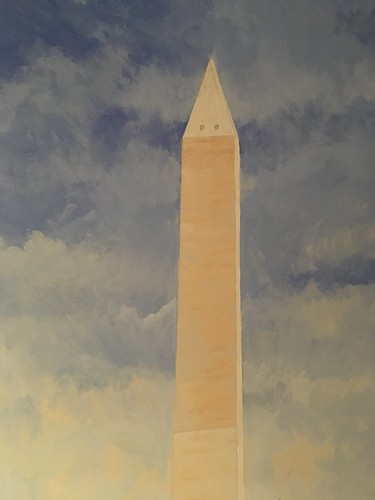
Top: Inscribed in the Capstone of the Washington Monument are the words: "LAUS DEO," meaning "Glory to G-d!" Above: The Roman Arched Towers of the George Washington Bridge were originally designed to be faced with granite. The bridge was built during the Great Depression and the granite was not installed as it was considered an unnecessary expense.

Isambard Kingdom Brunel


Faith and Beauty IV
Seeing the Divine in the Creation

Trees of the Field

For ye shall go out with joy, and be led forth with peace: the mountains and the hills shall break forth before you into singing, and all the trees of the field shall clap their hands.” – Isaiah 55:12

Trees of the Field

Trees of the Field

Trees of the Field

Trees of the Field

Trees of the Field

Trees of the Field
Photos by Bob Kirchman.

PontifusBANNER

Wednesday, May 2, 2018

Faith and Beauty, Vitus Bering's Voyages, Verne

VITUS
Volume XIV, Issue XVIII

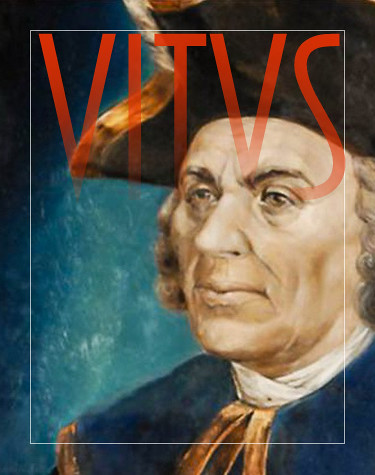
Vitus Bering's Voyages of Discovery

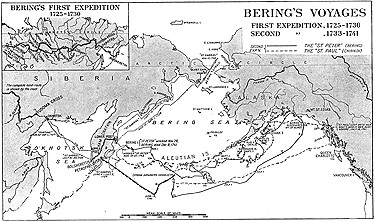
Vitus Jonassen Bering was born in Horsens, Denmark in 1681. He became a lieutenant in the Russian navy of Tsar Peter the Great in 1704. During the Great Northern War he served in both the Black and Baltic seas. In January 1725 Peter I asked Bering to lead an expedition to discover the extent of Siberia and establish a foothold in North America. He was also charged with the exploration of a possible Northeast Passage, which would allow one to sail around Siberia to China. This First Kamchatka Expedition began with a 6000 mile trek through the Siberian wilderness to Okhotsk. The party reached Okhotsk on September 30, 1726. They built the ship Gabriel there and set sail traveling Northward on July 14, 1728. He rounded the East Cape of Siberia on August 14 of that same Summer. The coast now had turned West and Bering had sighted no land beyond them to the East so he turned back at latitude 67° 18' to avoid being trapped by Winter weather. The expedition wintered at Kamchatka and Bering observed signs indication land to the East, but returned to St. Petersburg in March of 1730.

In 1733, in the wake of criticism that he had not explored Siberia beyond East Cape, Bering set out again on the Great Northern Expedition. Now charged with mapping the American Coast all the way to the first European settlement, the expedition also carried scientists and many workers who created quite a bit of discord. Arriving in Okhotsk, the party began preparations and they were ready to sail by 1740. Bering set sail for Kamchatka with two ships and wintered there. In June of 1741 he set sail again. He lost sight of the second ship, but continued North in the St. Peter, landing on present day Kayak Island. Exhausted, he turned back to Kamchatka.

Now began a rather erratic Southwesterly voyage where Bering charted landfalls on numerous islands. In August he was too sick to leave his cabin and many of the crew began to die. Arriving in the Komandorskie Islands on November 4th, Bering Decided to winter there. His ship was severely damaged and his men were sick. Bering himself died on December 8, 1741. Out of the 77 original crew, 45 would make it to safety in 1742. Among them was Georg Wilhelm Steller, the naturalist. Driven by an “insatiable desire to visit foreign lands and to investigate their conditions and curiosities,” Steller’s journals provided valuable new information on the region. This, in addition to the mapping done by Bering, provided a valuable guide to those who followed them.

Steller
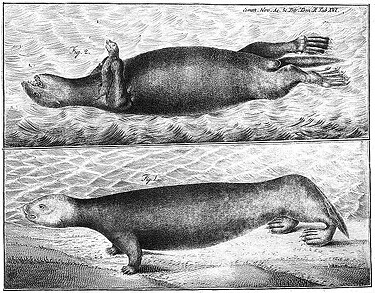
Georg Wilhelm Steller's Illustraton of a Sea Otter.

BeringVoyages
The Voyages of Vitus Bering.

The Ballad of Bering and His Friends
The Explorer of the Bering Strait


Before Captain Cook explored the Pacific, Vitus Bering made two voyages of discovery for Peter the Great. (Russian Film, No Subtitles).

Faith and Beauty III
Seeing the Divine in the Creation

Emerging Dogwood
Dogwood Blossom. Photo by Bob Kirchman.

The heavens declare the glory of God; and the firmament sheweth his handywork.

Day unto day uttereth speech, and night unto night sheweth knowledge.

There is no speech nor language, where their voice is not heard.

Their line is gone out through all the earth, and their words to the end of the world. In them hath he set a tabernacle for the sun,

Which is as a bridegroom coming out of his chamber, and rejoiceth as a strong man to run a race.

His going forth is from the end of the heaven, and his circuit unto the ends of it: and there is nothing hid from the heat thereof.

The law of the Lord is perfect, converting the soul: the testimony of the Lord is sure, making wise the simple.

The statutes of the Lord are right, rejoicing the heart: the commandment of the Lord is pure, enlightening the eyes.

The fear of the Lord is clean, enduring for ever: the judgments of the Lord are true and righteous altogether.

More to be desired are they than gold, yea, than much fine gold: sweeter also than honey and the honeycomb.

Moreover by them is thy servant warned: and in keeping of them there is great reward.

Who can understand his errors? cleanse thou me from secret faults.

Keep back thy servant also from presumptuous sins; let them not have dominion over me: then shall I be upright, and I shall be innocent from the great transgression.

Let the words of my mouth, and the meditation of my heart, be acceptable in thy sight, O Lord, my strength, and my redeemer.” – Psalm 19

Emerging Dogwood
Dogwood Blossom. Photo by Bob Kirchman.

The Reckless Engineer
Great Britain's Isambard Kingdom Brunel


The inspiration for my own 'Reckless Engineer' story.

Dogwood Blossoms
Photo by Bob Kirchman

Dogwoods

From the Earth to the Moon
By Jules Verne

CHAPTER VIII: HISTORY OF THE CANNON

The resolutions passed at the last meeting produced a great effect out of doors. Timid people took fright at the idea of a shot weighing 20,000 pounds being launched into space; they asked what cannon could ever transmit a sufficient velocity to such a mighty mass. The minutes of the second meeting were destined triumphantly to answer such questions. The following evening the discussion was renewed.

My dear colleagues," said Barbicane, without further preamble, "the subject now before us is the construction of the engine, its length, its composition, and its weight. It is probable that we shall end by giving it gigantic dimensions; but however great may be the difficulties in the way, our mechanical genius will readily surmount them. Be good enough, then, to give me your attention, and do not hesitate to make objections at the close. I have no fear of them. The problem before us is how to communicate an initial force of 12,000 yards per second to a shell of 108 inches in diameter, weighing 20,000 pounds. Now when a projectile is launched into space, what happens to it? It is acted upon by three independent forces: the resistance of the air, the attraction of the earth, and the force of impulsion with which it is endowed. Let us examine these three forces.

The resistance of the air is of little importance. The atmosphere of the earth does not exceed forty miles. Now, with the given rapidity, the projectile will have traversed this in five seconds, and the period is too brief for the resistance of the medium to be regarded otherwise than as insignificant. Proceding, then, to the attraction of the earth, that is, the weight of the shell, we know that this weight will diminish in the inverse ratio of the square of the distance. When a body left to itself falls to the surface of the earth, it falls five feet in the first second; and if the same body were removed 257,542 miles further off, in other words, to the distance of the moon, its fall would be reduced to about half a line in the first second. That is almost equivalent to a state of perfect rest. Our business, then, is to overcome progressively this action of gravitation. The mode of accomplishing that is by the force of impulsion."

There's the difficulty," broke in the major.

True," replied the president; "but we will overcome that, for the force of impulsion will depend on the length of the engine and the powder employed, the latter being limited only by the resisting power of the former. Our business, then, to-day is with the dimensions of the cannon."

Now, up to the present time," said Barbicane, "our longest guns have not exceeded twenty-five feet in length. We shall therefore astonish the world by the dimensions we shall be obliged to adopt. It must evidently be, then, a gun of great range, since the length of the piece will increase the detention of the gas accumulated behind the projectile; but there is no advantage in passing certain limits."

Quite so," said the major. "What is the rule in such a case?" "Ordinarily the length of a gun is twenty to twenty-five times the diameter of the shot, and its weight two hundred and thirty-five to two hundred and forty times that of the shot."

That is not enough," cried J. T. Maston impetuously.

I agree with you, my good friend; and, in fact, following this proportion for a projectile nine feet in diameter, weighing 30,000 pounds, the gun would only have a length of two hundred and twenty- five feet, and a weight of 7,200,000 pounds." "Ridiculous!" rejoined Maston. "As well take a pistol."

I think so too," replied Barbicane; "that is why I propose to quadruple that length, and to construct a gun of nine hundred feet."

The general and the major offered some objections; nevertheless, the proposition, actively supported by the secretary, was definitely adopted.

But," said Elphinstone, "what thickness must we give it?"

A thickness of six feet," replied Barbicane.

You surely don't think of mounting a mass like that upon a carriage?" asked the major.

It would be a superb idea, though," said Maston.

But impracticable," replied Barbicane. "No, I think of sinking this engine in the earth alone, binding it with hoops of wrought iron, and finally surrounding it with a thick mass of masonry of stone and cement. The piece once cast, it must be bored with great precision, so as to preclude any possible windage. So there will be no loss whatever of gas, and all the expansive force of the powder will be employed in the propulsion."

One simple question," said Elphinstone: "is our gun to be rifled?"

No, certainly not," replied Barbicane; "we require an enormous initial velocity; and you are well aware that a shot quits a rifled gun less rapidly than it does a smooth-bore."

True," rejoined the major.

The committee here adjourned for a few minutes to tea and sandwiches.

On the discussion being renewed, "Gentlemen," said Barbicane, "we must now take into consideration the metal to be employed. Our cannon must be possessed of great tenacity, great hardness, be infusible by heat, indissoluble, and inoxidable by the corrosive action of acids."

There is no doubt about that," replied the major; "and as we shall have to employ an immense quantity of metal, we shall not be at a loss for choice."

Well, then," said Morgan, "I propose the best alloy hitherto known, which consists of one hundred parts of copper, twelve of tin, and six of brass."

I admit," replied the president, "that this composition has yielded excellent results, but in the present case it would be too expensive, and very difficult to work.

I think, then, that we ought to adopt a material excellent in its way and of low price, such as cast iron. What is your advice, major?"

I quite agree with you," replied Elphinstone.

In fact," continued Barbicane, "cast iron costs ten times less than bronze; it is easy to cast, it runs readily from the moulds of sand, it is easy of manipulation, it is at once economical of money and of time. In addition, it is excellent as a material, and I well remember that during the war, at the siege of Atlanta, some iron guns fired one thousand rounds at intervals of twenty minutes without injury."

Cast iron is very brittle, though," replied Morgan.

Yes, but it possesses great resistance. I will now ask our worthy secretary to calculate the weight of a cast-iron gun with a bore of nine feet and a thickness of six feet of metal."

In a moment," replied Maston. Then, dashing off some algebraical formulae with marvelous facility, in a minute or two he declared the following result:

The cannon will weigh 68,040 tons. And, at two cents a pound, it will cost----"

Two million five hundred and ten thousand seven hundred and one dollars."

Maston, the major, and the general regarded Barbicane with uneasy looks.

Well, gentlemen," replied the president, "I repeat what I said yesterday. Make yourselves easy; the millions will not be wanting."

With this assurance of their president the committee separated, after having fixed their third meeting for the following evening.

CHAPTER IX: THE QUESTION OF THE POWDERS

There remained for consideration merely the question of powders. The public awaited with interest its final decision. The size of the projectile, the length of the cannon being settled, what would be the quantity of powder necessary to produce impulsion?

It is generally asserted that gunpowder was invented in the fourteenth century by the monk Schwartz, who paid for his grand discovery with his life. It is, however, pretty well proved that this story ought to be ranked among the legends of the middle ages. Gunpowder was not invented by any one; it was the lineal successor of the Greek fire, which, like itself, was composed of sulfur and saltpeter. Few persons are acquainted with the mechanical power of gunpowder. Now this is precisely what is necessary to be understood in order to comprehend the importance of the question submitted to the committee.

A litre of gunpowder weighs about two pounds; during combustion it produces 400 litres of gas. This gas, on being liberated and acted upon by temperature raised to 2,400 degrees, occupies a space of 4,000 litres: consequently the volume of powder is to the volume of gas produced by its combustion as 1 to 4,000. One may judge, therefore, of the tremendous pressure on this gas when compressed within a space 4,000 times too confined. All this was, of course, well known to the members of the committee when they met on the following evening.

The first speaker on this occasion was Major Elphinstone, who had been the director of the gunpowder factories during the war.

Gentlemen," said this distinguished chemist, "I begin with some figures which will serve as the basis of our calculation. The old 24-pounder shot required for its discharge sixteen pounds of powder."

You are certain of this amount?" broke in Barbicane.

Quite certain," replied the major. "The Armstrong cannon employs only seventy-five pounds of powder for a projectile of eight hundred pounds, and the Rodman Columbiad uses only one hundred and sixty pounds of powder to send its half ton shot a distance of six miles. These facts cannot be called in question, for I myself raised the point during the depositions taken before the committee of artillery."

Quite true," said the general.

Well," replied the major, "these figures go to prove that the quantity of powder is not increased with the weight of the shot; that is to say, if a 24-pounder shot requires sixteen pounds of powder;-- in other words, if in ordinary guns we employ a quantity of powder equal to two-thirds of the weight of the projectile, this proportion is not constant.

Calculate, and you will see that in place of three hundred and thirty-three pounds of powder, the quantity is reduced to no more than one hundred and sixty pounds."

What are you aiming at?" asked the president.

If you push your theory to extremes, my dear major," said J. T. Maston, "you will get to this, that as soon as your shot becomes sufficiently heavy you will not require any powder at all."

Our friend Maston is always at his jokes, even in serious matters," cried the major; "but let him make his mind easy, I am going presently to propose gunpowder enough to satisfy his artillerist's propensities. I only keep to statistical facts when I say that, during the war, and for the very largest guns, the weight of the powder was reduced, as the result of experience, to a tenth part of the weight of the shot."

Perfectly correct," said Morgan; "but before deciding the quantity of powder necessary to give the impulse, I think it would be as well----"

We shall have to employ a large-grained powder," continued the major; "its combustion is more rapid than that of the small."

No doubt about that," replied Morgan; "but it is very destructive, and ends by enlarging the bore of the pieces."

Granted; but that which is injurious to a gun destined to perform long service is not so to our Columbiad. We shall run no danger of an explosion; and it is necessary that our powder should take fire instantaneously in order that its mechanical effect may be complete."

We must have," said Maston, "several touch-holes, so as to fire it at different points at the same time."

Certainly," replied Elphinstone; "but that will render the working of the piece more difficult. I return then to my large-grained powder, which removes those difficulties. In his Columbiad charges Rodman employed a powder as large as chestnuts, made of willow charcoal, simply dried in cast- iron pans. This powder was hard and glittering, left no trace upon the hand, contained hydrogen and oxygen in large proportion, took fire instantaneously, and, though very destructive, did not sensibly injure the mouth-piece."

Up to this point Barbicane had kept aloof from the discussion; he left the others to speak while he himself listened; he had evidently got an idea. He now simply said, "Well, my friends, what quantity of powder do you propose?"

The three members looked at one another.

Two hundred thousand pounds." at last said Morgan.

Five hundred thousand," added the major.

Eight hundred thousand," screamed Maston.

A moment of silence followed this triple proposal; it was at last broken by the president.

Gentlemen," he quietly said, "I start from this principle, that the resistance of a gun, constructed under the given conditions, is unlimited. I shall surprise our friend Maston, then, by stigmatizing his calculations as timid; and I propose to double his 800,000 pounds of powder."

Sixteen hundred thousand pounds?" shouted Maston, leaping from his seat.

Just so."

We shall have to come then to my ideal of a cannon half a mile long; for you see 1,600,000 pounds will occupy a space of about 20,000 cubic feet; and since the contents of your cannon do not exceed 54,000 cubic feet, it would be half full; and the bore will not be more than long enough for the gas to communicate to the projectile sufficient impulse."

Nevertheless," said the president, "I hold to that quantity of powder. Now, 1,600,000 pounds of powder will create 6,000,000,000 litres of gas. Six thousand millions! You quite understand?"

What is to be done then?" said the general.

The thing is very simple; we must reduce this enormous quantity of powder, while preserving to it its mechanical power."

Good; but by what means?"

I am going to tell you," replied Barbicane quietly.

Nothing is more easy than to reduce this mass to one quarter of its bulk. You know that curious cellular matter which constitutes the elementary tissues of vegetable? This substance is found quite pure in many bodies, especially in cotton, which is nothing more than the down of the seeds of the cotton plant. Now cotton, combined with cold nitric acid, become transformed into a substance eminently insoluble, combustible, and explosive. It was first discovered in 1832, by Braconnot, a French chemist, who called it xyloidine.

In 1838 another Frenchman, Pelouze, investigated its different properties, and finally, in 1846, Schonbein, professor of chemistry at Bale, proposed its employment for purposes of war. This powder, now called pyroxyle, or fulminating cotton, is prepared with great facility by simply plunging cotton for fifteen minutes in nitric acid, then washing it in water, then drying it, and it is ready for use."

Nothing could be more simple," said Morgan.

Moreover, pyroxyle is unaltered by moisture-- a valuable property to us, inasmuch as it would take several days to charge the cannon. It ignites at 170 degrees in place of 240, and its combustion is so rapid that one may set light to it on the top of the ordinary powder, without the latter having time to ignite."

Perfect!" exclaimed the major.

Only it is more expensive."

What matter?" cried J. T. Maston.

Finally, it imparts to projectiles a velocity four times superior to that of gunpowder. I will even add, that if we mix it with one-eighth of its own weight of nitrate of potassium, its expansive force is again considerably augmented."

Will that be necessary?" asked the major.

I think not," replied Barbicane. "So, then, in place of 1,600,000 pounds of powder, we shall have but 400,000 pounds of fulminating cotton; and since we can, without danger, compress 500 pounds of cotton into twenty-seven cubic feet, the whole quantity will not occupy a height of more than 180 feet within the bore of the Columbiad. In this way the shot will have more than 700 feet of bore to traverse under a force of 6,000,000,000 litres of gas before taking its flight toward the moon."

At this juncture J. T. Maston could not repress his emotion; he flung himself into the arms of his friend with the violence of a projectile, and Barbicane would have been stove in if he had not been boom-proof.

This incident terminated the third meeting of the committee.

Barbicane and his bold colleagues, to whom nothing seemed impossible, had succeeding in solving the complex problems of projectile, cannon, and powder. Their plan was drawn up, and it only remained to put it into execution.

A mere matter of detail, a bagatelle," said J. T. Maston.
(to be continued)

Misty Skyline Drive
Skyline Drive in the Morning Mist. Photo by Bob Kirchman.

PontifusBANNER