Showing posts with label C.S. Lewis. Show all posts

Friday, October 2, 2020

The Redemption of Susan Pevensie in Narnia

Susan
Volume XIX, Issue VIIIb:

The Redemption of Susan Pevensie

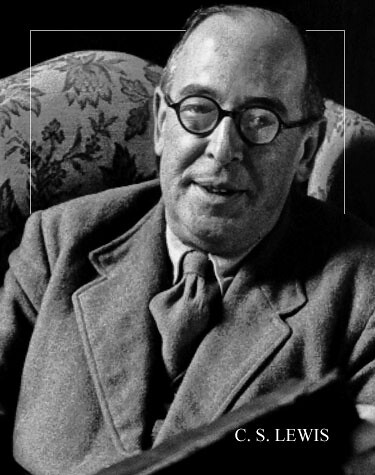
Pauline Bannister, a young fan of C. S. Lewis’s Chronicles of Narnia, wrote to the author with great concern. In the seventh book in the series, The Last Battle, it is revealed that “Susan is no longer a friend of Narnia.” Indeed this is a rather startling and distressing moment for those of us who have grown to love the Pevensies and comes about all too quickly and with way too little explanation. Peter says that she is “no longer a friend of Narnia”, and Jill Pole's adds: “she's interested in nothing now-a-days except nylons and lipstick and invitations.” Eustace Scrubb quotes her as saying, “What wonderful memories you have! Fancy you still thinking about all those funny games we used to play when we were children,” and Polly Plummer adds, “She wasted all her school time wanting to be the age she is now, and she'll waste all the rest of her life trying to stay that age. Her whole idea is to race on to the silliest time of one's life as quick as she can and then stop there as long as she can.” Susan does not come into the real Narnia with the others at the end of the series. It is left ambiguous whether Susan's absence is permanent, especially since Lewis stated elsewhere that: “The books don't tell us what happened to Susan. She is left alive in this world at the end, having by then turned into a rather silly, conceited young woman. But there's plenty of time for her to mend and perhaps she will get to Aslan's country in the end... in her own way.”

Susan is around twelve when she first steps into the wardrobe and a young woman in her twenties at the time of The Last Battle. Two modern authors who are greatly influenced by Lewis’s work offer the following commentary: “There comes a point where Susan, who was the older girl, is lost to Narnia because she becomes interested in lipstick. She's become irreligious basically because she found sex. I have a big problem with that.” — J. K. Rowling. “I just don’t like the conclusions Lewis comes to, after all that analysis, the way he shuts children out from heaven, or whatever it is, on the grounds that the one girl is interested in boys. She’s a teenager! Ah, it’s terrible: Sex — can’t have that.” — Philip Pullman. But I believe that over-analyzing the comments of Edmund and Polly we miss the point of something bigger that I believe C. S. Lewis is coming to. He is anticipating the plight of the ‘Nones’ – the young people of today who have walked away from Faith. He himself had discovered the world of ‘Nones’ when, after his mother’s death, he immersed himself in the logic of his mentor Kirkpatrick. He sought out the world of reason as he himself walked away from Faith. He had found belief in God ‘unreliable,’ and there was a world out there. 'Logic and Learning' would engage the young Lewis. ‘Lipstick and invitations’ are the symptoms, not the ailment. Susan, it would appear, finds herself at the same crossroads Lewis did.

In Surprised by Joy, Lewis details his falling away and his coming to the deeper faith of his adulthood. Could it be that he intended to write another novel illustrating this, much as the book That Hideous Strength illuminates The Abolition of Man? That is what I truly suspect. Susan’s quest will be the same as Lewis’s. We will discover that her friends were too concentrated on the outward manifestations of her innermost struggle. Isn’t that almost always true?

Lewis must have struggled with that story though. Each of us who has come to real mature Faith has one. It is unique to each saint and therefore hard to capture. In the end, he writes to Pauline and suggests that she write a bit of ‘fan fiction’ long before this is a thing! “Dear Pauline Bannister I could not write that story [about Susan’s future?] myself. Not that I have no hope of Susan’s ever getting to Aslan’s country, but because I have a feeling that the story of her journey would be longer and more like a grown-up novel than I wanted to write. But I may be mistaken. Why not try it yourself?”The Collected Letters of C. S. Lewis, Volume 3: Narnia, Cambridge, and Joy, pages 1,135–1,136. Lewis seems to truly believe that Susan will find Faith and return to Narnia, but he passes the torch in the telling of it.

Dyane Forde’s Lost Pen Magazine just published their ‘Repentance and Reconciliation’ issue. I submitted a piece of fiction for it that I very much believe to be the thing he wished Pauline Bannister to write. I do believe he wished her to explore his own journey in Surprised by Joy and find in it a roadmap for Susan. You can read my story: Further Up and Further In, in Issue Three of Lost Pen Magazine [click to read].


A Journey of “Moral Imagination”

IMG_2384

A counterfeit gospel, a false myth, created a cacophony of despair in the West. Yet two friends and authors refused to succumb to this storm of doubt and disillusionment. Fortified by their faith, they proclaimed for their generation – and ours – a True Myth about the dignity of human life and its relationship to God. Against all expectations, their writings would captivate and inspire countless readers from every culture and every part of the globe.

What explains their enduring influence? As mythmakers they create new worlds. They invent new languages. They transport us into realms of brooding darkness and unforgettable beauty. Yet their mythic imagination only partly accounts for their influence” – Joseph Loconte

J. R. R. Tolkien and C. S. Lewis both lived in a time when Western Civilization was tearing itself apart. Joseph Loconte, in his book: A Hobbit, A Wardrobe, And a Great War tells how these two men, who both experienced the horrors of trench warfare, found a Faith that would be so important in their time. Their rediscovery of Faith and True Heroism and the imaginative way they shared it with a wanting world are the very things we need in our present day!

A Bit of Narnian Architecture
Photos by Bob Kirchman

IMG_2364

IMG_2366 
Old Pump House, Oak Ridge Estate, Arrington, Virginia.

PontifusBANNER

Wednesday, December 20, 2017

Special Christmas Edition II, "Behold the Man,"

ChristmasII
Volume XIII, Issue XXIV

"Behold the Man!"

-- John 19:5b

Many years ago I celebrated Thanksgiving with our church family. There I met the first Nepali I have ever had the chance to speak with. His name was Prem Pradhan. This Gurkha warrior had served in Britain's Royal Air Force before returning to his native land. An accident had permanently injured him and he walked with a limp; but walk he did. In a land where foot travel is necessary to reach most of the villages, Prem walked. He had learned something amazing and he felt compelled to travel to the ends of this mountain kingdom to share it!

Walking all day to reach some remote village, Prem would seek out the men and elders of the place and say: "I have heard a NEW THING! I have heard about a man who died and came to life again!" Who would NOT be intrigued? Pradhan would go on to share his fresh vision of the risen Jesus... and many put their faith in Christ through the fresh telling of the old old story. Not everyone was thrilled to hear this 'Good News,' however. Prem had run afoul of the country's anti-conversion laws. He was put into prison, where he languished for seven years.

Nepali prisons are notorious. Prem's enemies sent him there knowing that it was a place to die. Like the amazing man Prem spoke of, he too was basically sentenced to death. But here he was, years later, telling me his story. He didn't die. While he was in prison he had a vision of the risen Lord, and was further strengthened in his resolve to tell the story of redemption. When he left prison he became involved in education and took in a lot of orphans. While proselytizers are discouraged in Nepal, educators are revered. Prem became a leader of his town and never stopped telling the amazing story.

The Babe of Bethlehem became a man. We have heard the Christmas story so many times that we fail to appreciate its audacity! Let us listen again to it with fresh hearing: "I have heard a NEW THING! I have heard about a man who died and came to life again!" Let us follow the grown Jesus to that time of his death. We first meet him on a hillside. An unlikely candidate for leader of a world religion, he attracts multitudes nonetheless. He teaches a simple message that "The Kingdom of G-d is at hand," and then withdraws to a lonely place with his disciples.

Children flock to Him. He is often surrounded by them and his disciples want to shoo them away. Jesus rebukes them. The Kingdom of G-d is meant for such as these. I met an Egyptian woman who had visions of this place. She says that in Heaven Jesus is SURROUNDED by children. This Jesus did not seek out the halls of power, but instead sought out the weak and simple people of this world. He was a carpenter. His disciples were fishermen, zealots and a tax collector. He spoke to women (most rabbis would not). He spoke "as one having authority." Indeed, one of the most amazing parts of the story is when Jesus stands before the Roman ruler Pilate, who's reaction to Jesus is worth noting.

The promises of Messiah were well known and many in Judea hoped for the coming of that leader who would free them from the oppression of Rome. There were many who claimed to be Messiah, looking to fire a zealot rebellion, and Rome was especially good at killing people. So when a maligned and fairly ordinary Galilean was brought before Pilate, why should he hesitate? There was the fact that he was not actually inciting any uprising... but something in Jesus caused this tough old Roman to pause. Pilate knew his job, but he also recognized authority and chain of command. This Galilean was not blustering about rebellion, in fact He was holding the details of His true mission close to His heart. Pilate saw more than met the eye about the man from Galilee. There is more searching than sneering in his question: "Are you a king?"

Pilate finds himself drawn into a higher sort of dialogue with this man... even asking Him: "What is Truth?" Already troubled by the man he sees, he is further troubled by his wife's dream of him. Indeed, he wants to "wash his hands" of this matter. The simple execution of a supposed rebel has become something far bigger. Pilate tries to release Jesus but is pressed to release Barrabas, a real insurrectionist, instead. The death and Resurrection of Jesus became the story that eventually captivated the Gurkha from Nepal.

The modern age brought about a dismissal of the unseen. Science and Naturalism pushed for concentration on what can be observed. The spiritual and invisible dimensions of life no longer dominated great thought... except to perhaps be broad brushed as simply unknowable. Had Pilate limited himself to that which was observable he would have quickly executed this ragged Galilean. There would be no need for angst, for though he SPOKE as one with authority, he had no physical evidence of that authority.

C.S. Lewis was a man of the modern age. He dismissed the faith as a young man, embracing the Naturalism of his day. As an enlightened Medieval scholar, he nonetheless dismissed the power of story to convey unseen truths. His friendship with men like J.R. R. Tolkien led him to become: "the most reluctant convert in all of England." Lewis, along with his friend Tolkien, discovered the power of the story to convey unseen truths. Imagination for them became the key to discover and share: "a NEW THING!"

"When the Pupil is Ready, The Master Will Appear"

CS Lewis-1
"Imagination is the organ of understanding." -- C. S. Lewis

If I find in myself desires which nothing in this world can satisfy, the only logical explanation is that I was made for another world.” -- C. S. Lewis

NewBanner

Wednesday, June 14, 2017

Phantasies, C. S. Lewis, George MacDonald

Citizen Journalism with a Better Flavor

Phantasies20
Volume XII, Issue XXVI

Phantasies
By George MacDonald, Chapter 20

Thou hadst no fame; that which thou didst like good
Was but thy appetite that swayed thy blood
For that time to the best; for as a blast
That through a house comes, usually doth cast
Things out of order, yet by chance may come
And blow some one thing to his proper room,
So did thy appetite, and not thy zeal,
Sway thee by chance to do some one thing well."
~ from John Fletcher's "Faithful Shepherdess".

The noble hart that harbours vertuous thought
And is with childe of glorious great intent,
Can never rest, until it forth have brought
Th' eternall brood of glorie excellent."
~ from Edmund Spenser's "The Faerie Queene".

I had not gone very far before I felt that the turf beneath my feet was soaked with the rising waters. But I reached the isthmus in safety. It was rocky, and so much higher than the level of the peninsula, that I had plenty of time to cross. I saw on each side of me the water rising rapidly, altogether without wind, or violent motion, or broken waves, but as if a slow strong fire were glowing beneath it. Ascending a steep acclivity, I found myself at last in an open, rocky country. After travelling for some hours, as nearly in a straight line as I could, I arrived at a lonely tower, built on the top of a little hill, which overlooked the whole neighbouring country. As I approached, I heard the clang of an anvil; and so rapid were the blows, that I despaired of making myself heard till a pause in the work should ensue. It was some minutes before a cessation took place; but when it did, I knocked loudly, and had not long to wait; for, a moment after, the door was partly opened by a noble-looking youth, half-undressed, glowing with heat, and begrimed with the blackness of the forge. In one hand he held a sword, so lately from the furnace that it yet shone with a dull fire. As soon as he saw me, he threw the door wide open, and standing aside, invited me very cordially to enter. I did so; when he shut and bolted the door most carefully, and then led the way inwards. He brought me into a rude hall, which seemed to occupy almost the whole of the ground floor of the little tower, and which I saw was now being used as a workshop. A huge fire roared on the hearth, beside which was an anvil. By the anvil stood, in similar undress, and in a waiting attitude, hammer in hand, a second youth, tall as the former, but far more slightly built. Reversing the usual course of perception in such meetings, I thought them, at first sight, very unlike; and at the second glance, knew that they were brothers. The former, and apparently the elder, was muscular and dark, with curling hair, and large hazel eyes, which sometimes grew wondrously soft. The second was slender and fair, yet with a countenance like an eagle, and an eye which, though pale blue, shone with an almost fierce expression. He stood erect, as if looking from a lofty mountain crag, over a vast plain outstretched below. As soon as we entered the hall, the elder turned to me, and I saw that a glow of satisfaction shone on both their faces. To my surprise and great pleasure, he addressed me thus:

Brother, will you sit by the fire and rest, till we finish this part of our work?"

I signified my assent; and, resolved to await any disclosure they might be inclined to make, seated myself in silence near the hearth.

The elder brother then laid the sword in the fire, covered it well over, and when it had attained a sufficient degree of heat, drew it out and laid it on the anvil, moving it carefully about, while the younger, with a succession of quick smart blows, appeared either to be welding it, or hammering one part of it to a consenting shape with the rest. Having finished, they laid it carefully in the fire; and, when it was very hot indeed, plunged it into a vessel full of some liquid, whence a blue flame sprang upwards, as the glowing steel entered.

There they left it; and drawing two stools to the fire, sat down, one on each side of me.

We are very glad to see you, brother. We have been expecting you for some days," said the dark-haired youth.

I am proud to be called your brother," I rejoined; "and you will not think I refuse the name, if I desire to know why you honour me with it?"

Ah! then he does not know about it," said the younger. "We thought you had known of the bond betwixt us, and the work we have to do together. You must tell him, brother, from the first."

So the elder began:

Our father is king of this country. Before we were born, three giant brothers had appeared in the land. No one knew exactly when, and no one had the least idea whence they came. They took possession of a ruined castle that had stood unchanged and unoccupied within the memory of any of the country people. The vaults of this castle had remained uninjured by time, and these, I presume, they made use of at first. They were rarely seen, and never offered the least injury to any one; so that they were regarded in the neighbourhood as at least perfectly harmless, if not rather benevolent beings. But it began to be observed, that the old castle had assumed somehow or other, no one knew when or how, a somewhat different look from what it used to have. Not only were several breaches in the lower part of the walls built up, but actually some of the battlements which yet stood, had been repaired, apparently to prevent them from falling into worse decay, while the more important parts were being restored. Of course, every one supposed the giants must have a hand in the work, but no one ever saw them engaged in it. The peasants became yet more uneasy, after one, who had concealed himself, and watched all night, in the neighbourhood of the castle, reported that he had seen, in full moonlight, the three huge giants working with might and main, all night long, restoring to their former position some massive stones, formerly steps of a grand turnpike stair, a great portion of which had long since fallen, along with part of the wall of the round tower in which it had been built. This wall they were completing, foot by foot, along with the stair. But the people said they had no just pretext for interfering: although the real reason for letting the giants alone was, that everybody was far too much afraid of them to interrupt them.

At length, with the help of a neighbouring quarry, the whole of the external wall of the castle was finished. And now the country folks were in greater fear than before. But for several years the giants remained very peaceful. The reason of this was afterwards supposed to be the fact, that they were distantly related to several good people in the country; for, as long as these lived, they remained quiet; but as soon as they were all dead the real nature of the giants broke out. Having completed the outside of their castle, they proceeded, by spoiling the country houses around them, to make a quiet luxurious provision for their comfort within. Affairs reached such a pass, that the news of their robberies came to my father's ears; but he, alas! was so crippled in his resources, by a war he was carrying on with a neighbouring prince, that he could only spare a very few men, to attempt the capture of their stronghold. Upon these the giants issued in the night, and slew every man of them. And now, grown bolder by success and impunity, they no longer confined their depredations to property, but began to seize the persons of their distinguished neighbours, knights and ladies, and hold them in durance, the misery of which was heightened by all manner of indignity, until they were redeemed by their friends, at an exorbitant ransom. Many knights have adventured their overthrow, but to their own instead; for they have all been slain, or captured, or forced to make a hasty retreat. To crown their enormities, if any man now attempts their destruction, they, immediately upon his defeat, put one or more of their captives to a shameful death, on a turret in sight of all passers-by; so that they have been much less molested of late; and we, although we have burned, for years, to attack these demons and destroy them, dared not, for the sake of their captives, risk the adventure, before we should have reached at least our earliest manhood. Now, however, we are preparing for the attempt; and the grounds of this preparation are these. Having only the resolution, and not the experience necessary for the undertaking, we went and consulted a lonely woman of wisdom, who lives not very far from here, in the direction of the quarter from which you have come. She received us most kindly, and gave us what seems to us the best of advice. She first inquired what experience we had had in arms. We told her we had been well exercised from our boyhood, and for some years had kept ourselves in constant practice, with a view to this necessity.

But you have not actually fought for life and death?' said she.

We were forced to confess we had not.

So much the better in some respects,' she replied. 'Now listen to me. Go first and work with an armourer, for as long time as you find needful to obtain a knowledge of his craft; which will not be long, seeing your hearts will be all in the work. Then go to some lonely tower, you two alone. Receive no visits from man or woman. There forge for yourselves every piece of armour that you wish to wear, or to use, in your coming encounter. And keep up your exercises.

As, however, two of you can be no match for the three giants, I will find you, if I can, a third brother, who will take on himself the third share of the fight, and the preparation. Indeed, I have already seen one who will, I think, be the very man for your fellowship, but it will be some time before he comes to me. He is wandering now without an aim. I will show him to you in a glass, and, when he comes, you will know him at once. If he will share your endeavours, you must teach him all you know, and he will repay you well, in present song, and in future deeds.'

She opened the door of a curious old cabinet that stood in the room. On the inside of this door was an oval convex mirror. Looking in it for some time, we at length saw reflected the place where we stood, and the old dame seated in her chair. Our forms were not reflected. But at the feet of the dame lay a young man, yourself, weeping.

Surely this youth will not serve our ends,' said I, 'for he weeps.'

The old woman smiled. 'Past tears are present strength,' said she.

Oh!' said my brother, 'I saw you weep once over an eagle you shot.'

That was because it was so like you, brother,' I replied; 'but indeed, this youth may have better cause for tears than that--I was wrong.'

Wait a while,' said the woman; 'if I mistake not, he will make you weep till your tears are dry for ever. Tears are the only cure for weeping. And you may have need of the cure, before you go forth to fight the giants. You must wait for him, in your tower, till he comes.' 

Now if you will join us, we will soon teach you to make your armour; and we will fight together, and work together, and love each other as never three loved before. And you will sing to us, will you not?"

That I will, when I can," I answered; "but it is only at times that the power of song comes upon me. For that I must wait; but I have a feeling that if I work well, song will not be far off to enliven the labour."

This was all the compact made: the brothers required nothing more, and I did not think of giving anything more. I rose, and threw off my upper garments.

I know the uses of the sword," I said. "I am ashamed of my white hands beside yours so nobly soiled and hard; but that shame will soon be wiped away."

No, no; we will not work to-day. Rest is as needful as toil. Bring the wine, brother; it is your turn to serve to-day."

The younger brother soon covered a table with rough viands, but good wine; and we ate and drank heartily, beside our work. Before the meal was over, I had learned all their story. Each had something in his heart which made the conviction, that he would victoriously perish in the coming conflict, a real sorrow to him. Otherwise they thought they would have lived enough. The causes of their trouble were respectively these:

While they wrought with an armourer, in a city famed for workmanship in steel and silver, the elder had fallen in love with a lady as far beneath him in real rank, as she was above the station he had as apprentice to an armourer. Nor did he seek to further his suit by discovering himself; but there was simply so much manhood about him, that no one ever thought of rank when in his company. This is what his brother said about it. The lady could not help loving him in return. He told her when he left her, that he had a perilous adventure before him, and that when it was achieved, she would either see him return to claim her, or hear that he had died with honour. The younger brother's grief arose from the fact, that, if they were both slain, his old father, the king, would be childless. His love for his father was so exceeding, that to one unable to sympathise with it, it would have appeared extravagant. Both loved him equally at heart; but the love of the younger had been more developed, because his thoughts and anxieties had not been otherwise occupied. When at home, he had been his constant companion; and, of late, had ministered to the infirmities of his growing age. The youth was never weary of listening to the tales of his sire's youthful adventures; and had not yet in the smallest degree lost the conviction, that his father was the greatest man in the world. The grandest triumph possible to his conception was, to return to his father, laden with the spoils of one of the hated giants. But they both were in some dread, lest the thought of the loneliness of these two might occur to them, in the moment when decision was most necessary, and disturb, in some degree, the self-possession requisite for the success of their attempt. For, as I have said, they were yet untried in actual conflict. "Now," thought I, "I see to what the powers of my gift must minister." For my own part, I did not dread death, for I had nothing to care to live for; but I dreaded the encounter because of the responsibility connected with it. I resolved however to work hard, and thus grow cool, and quick, and forceful.

The time passed away in work and song, in talk and ramble, in friendly fight and brotherly aid. I would not forge for myself armour of heavy mail like theirs, for I was not so powerful as they, and depended more for any success I might secure, upon nimbleness of motion, certainty of eye, and ready response of hand. Therefore I began to make for myself a shirt of steel plates and rings; which work, while more troublesome, was better suited to me than the heavier labour. Much assistance did the brothers give me, even after, by their instructions, I was able to make some progress alone. Their work was in a moment abandoned, to render any required aid to mine. As the old woman had promised, I tried to repay them with song; and many were the tears they both shed over my ballads and dirges. The songs they liked best to hear were two which I made for them. They were not half so good as many others I knew, especially some I had learned from the wise woman in the cottage; but what comes nearest to our needs we like the best.

I

The king sat on his throne
Glowing in gold and red;
The crown in his right hand shone,
And the gray hairs crowned his head.

His only son walks in,
And in walls of steel he stands:
Make me, O father, strong to win,
With the blessing of holy hands."

He knelt before his sire,
Who blessed him with feeble smile
His eyes shone out with a kingly fire,
But his old lips quivered the while.

Go to the fight, my son,
Bring back the giant's head; 
And the crown with which my brows have done,
Shall glitter on thine instead."

My father, I seek no crowns,
But unspoken praise from thee;
For thy people's good, and thy renown,
I will die to set them free."

The king sat down and waited there,
And rose not, night nor day;
Till a sound of shouting filled the air,
And cries of a sore dismay.

Then like a king he sat once more,
With the crown upon his head;
And up to the throne the people bore
A mighty giant dead.

And up to the throne the people bore
A pale and lifeless boy.
The king rose up like a prophet of yore,
In a lofty, deathlike joy.

He put the crown on the chilly brow:
"Thou should'st have reigned with me
But Death is the king of both, and now
I go to obey with thee.

Surely some good in me there lay,
To beget the noble one."
The old man smiled like a winter day,
And fell beside his son.

II

O lady, thy lover is dead," they cried;
"He is dead, but hath slain the foe;
He hath left his name to be magnified
In a song of wonder and woe."

Alas! I am well repaid," said she,
With a pain that stings like joy:
For I feared, from his tenderness to me,
That he was but a feeble boy.

Now I shall hold my head on high,
The queen among my kind;
If ye hear a sound, 'tis only a sigh
For a glory left behind."

The first three times I sang these songs they both wept passionately. But after the third time, they wept no more. Their eyes shone, and their faces grew pale, but they never wept at any of my songs again.
(to be continued)

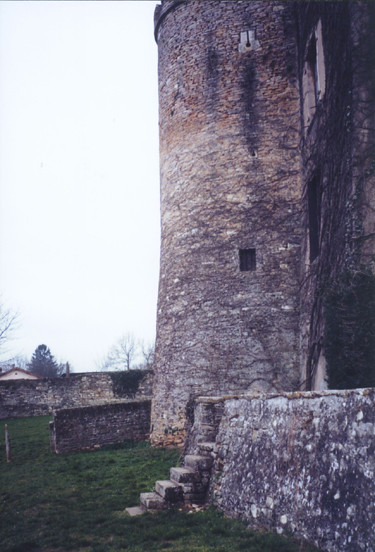
Le Château de St. Albain
Photos by Bob Kirchman

Chateau001
The Tower. Photo by Bob Kirchman.

Chateau002
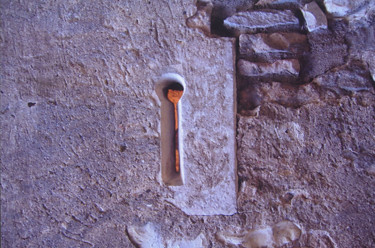
Archer Slit. Photo by Bob Kirchman.

Chateau003
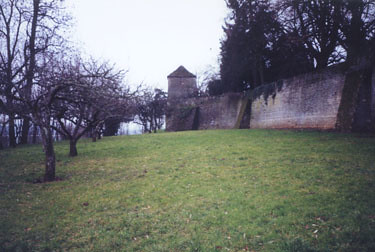
Outer Wall. Photo by Bob Kirchman.

The tower and some of the walls survived the French Revolution and the Schweitzer family once lived here, including the grandparents and the mother of French philosopher, playwright, novelist, political activist, biographer, and literary critic Jean Paul Sartre.

Himeji 姫路市
Photos by Bob Kirchman

Himeji002

Himeji001
Photos by Bob Kirchman.

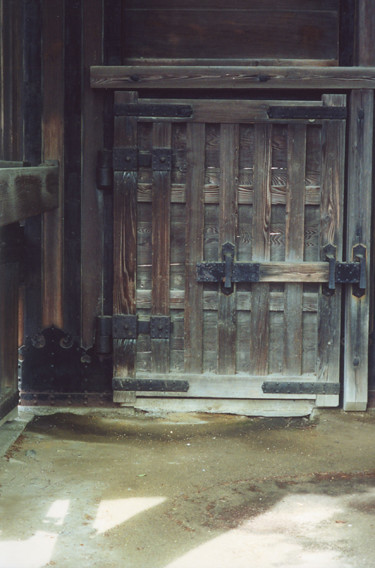
In 1333, Akamatsu Norimura first built a fort on top of Himeyama hill. The fort was dismantled and rebuilt as Himeyama Castle in 1346, and then remodeled into Himeji Castle two centuries later. Himeji Castle was then significantly remodeled in 1581 by Toyotomi Hideyoshi, who added a three-story castle keep. In 1600, Tokugawa Ieyasu awarded the castle to Ikeda Terumasa for his help in the Battle of Sekigahara, and Ikeda completely rebuilt the castle from 1601 to 1609, expanding it into a large castle complex. Several buildings were later added to the castle complex by Honda Tadamasa from 1617 to 1618. For over 400 years, Himeji Castle has remained intact, even throughout the extensive bombing of Himeji in World War II, and natural disasters such as the 1995 Great Hanshin earthquake.

C. S. Lewis's Timely Message

LEWIS
Lewis has a powerful message for our time.

Many of us are quite frustrated as we try to convey the notion that there are greater realities. There are those who stand in solidarity on this and there are those who pretty much see 'truth' as a matter of what they believe about something, saying: "That may be right for you, but what I believe is right for me." Absent from the discussion is the notion that a position might be guided by higher... even DIVINE principles. Might it surprise you that this assault on the notion of 'absolute truth' is not new? What if we find that it influenced the thinkers and textbook writers decades ago... even the work of journalists such as H. L. Mencken, who pretty much eviscerated the victory of William Jennings Bryan in the Scopes Trial.

Hillsdale College in Michigan presents a fascinating series of lectures on the work and vision of C. S. Lewis. All of us who wish to speak of deeper realities into our culture need to avail ourselves of this great resource!

CS_Lewis_Banner

Dr. Larry Arrn, President of Hillsdale College, begins the series with a talk on two of Lewis's works, The Abolition of Man and That Hideous Strength.

ABOLITION
THATHIDEOUSSTRNGTH

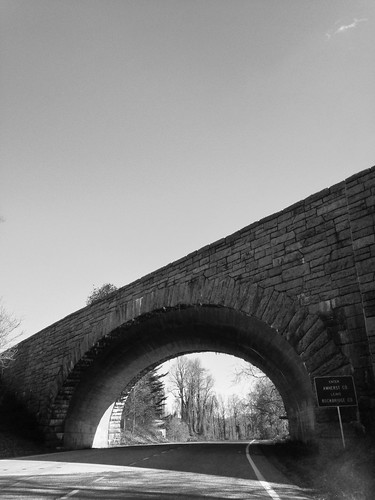
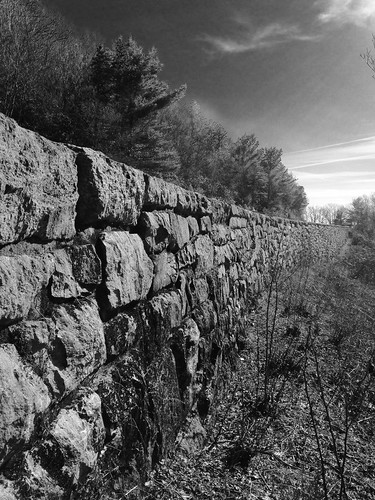
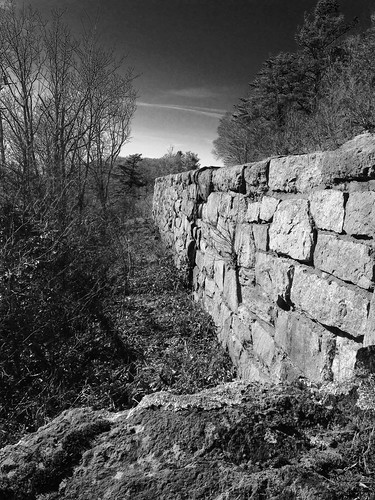
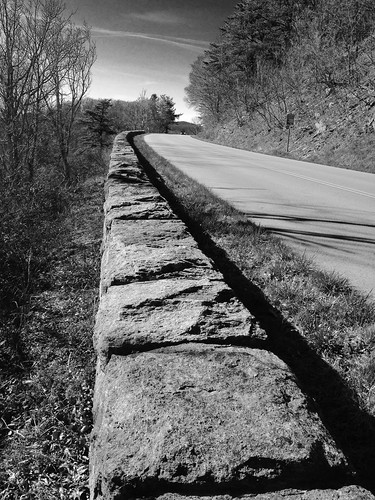
Blue Ridge Parkway Stonework
Photos by Bob Kirchman

Blue Ridge Parkway Bridge
The Bridge over Route 60.

Parkway Walls
Italian and Spanish stonemasons built these walls and bridges...

Parkway Walls
...which are often incorrectly attributed to CCC workers.

Parkway Walls
Photos by Bob Kirchman.

C. S. Lewis and MacDonald

I was brought back… (from atheism to Christianity) by the strong influence of two writers, the Presbyterian George MacDonald and the Roman Catholic G. K. Chesterton.” – C. S. Lewis

In his novel, The Great Divorce, C. S. Lewis describes an fictional trip to Heaven where George MacDonald serves as his guide: “I tried, trembling, to tell this man all that his writing had done for me. I tried to tell how a certain frosty afternoon at Leatherhead Station when I first bought a copy of Phantasies (being then about sixteen years old) had been to me what the first sight of Beatrice had been to Dante: Here begins the New Life. I tried to confess how long that life had delayed in the region of imagination merely: how slowly and reluctantly I had come to admit that his Christendom had more than an accidental connection with it, how hard I had tried not to see that the true name of this quality which first met me in his books is Holiness.”

This week’s excerpt from Phantasies and next week’s impress me most particularly as being the type of writing that must have stirred something in young Lewis that would not be satisfied until it found its completeness in the Gospel of Jesus Christ. That MacDonald could dig so deeply into essential humanness is worthy of reflection. That he stirred that awakening in a man who is arguably the Twentieth Century’s greatest apologist is worthy of serious study. Before Marianne Wright compiled her excellent collection of MacDonald excerpts, Lewis published a collection of MacDonald excerpts as well. In introduction Lewis wrote: “In making this collection I was discharging a debt of justice. I have never concealed the fact that I regarded him as my master; indeed I fancy I have never written a book in which I did not quote from him. But it has not seemed to me that those who have received my books kindly take even now sufficient notice of the affiliation. Honesty drives me to emphasize it.”

Vincent van Gogh
The Man You Don't Know

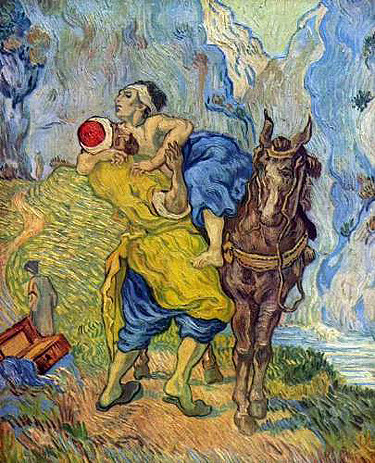
Van-Gogh-The-Good-Samaritan-1890
The Good Samaritan, Vincent van Gogh, 1890

Be clearly aware of the stars and infinity on high. Then life seems almost enchanted after all.”
― Vincent van Gogh

Most of us know something of the story of the great Post-impressionist. In the June 28 issue of THYME, we will explore his life and discover some surprising things about the man!

THYME0709
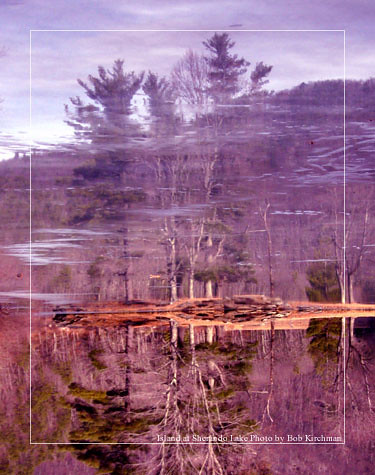
Sherando Lake. Photo by Bob Kirchman.

A Case for Vision VII
© 2017 The Kirchman Studio.

Our nation is in need of an I. K. Brunel's vision today.  Our situation is no less dire than that of Bristol in the Nineteenth Century and we need to find direction, both in spirit and economically, if we are to emerge successfully. [1.] Looking at what is happening in North Dakota it is imperative that we find similar opportunity for people in every state of the union. Where shall we look for a vision of the future? Certainly not to an administration that sees massive unemployment and underemployment as a good thing! Many of us have seen our hopes and dreams take a serious hit from the policies of this administration. The marketplace has less resources available to support the creative endeavors we are now supposedly 'free' to pursue. Just ask anyone actually selling fine art these days. People need to be making money in order to spend it! If you are looking to the National Endowment for the Arts to fund your work, guess what? Diminishing tax revenues means less money to fund 'public' art. In fact, the government will be hard pressed to meet obligations such as Social Security and Medicare.

The last administration had no intention of encouraging the true creative sector in this country. In fact, it has became quite clear that they WANTED us discouraged. Our discouragement was essential for them to implement their 'fundamental change' to the country we live in. That is why we must not succumb. I would like to, in the spirit of Theodor Herzl's Aultneuland, give you reason for hope and reason to stay in the fight as well! Herzl was a man with a vision. In Altneuland he was spot-on in describing the nation that was born, or reborn, if you will in the creation of modern day Israel. When Herzl wrote his novel the land was securely in the hands of the Ottoman Empire. In 1917 England's foreign secretary Arthur Balfour wrote a declaration stating that this land should indeed be given as a homeland to the people who had inhabited it since ancient times. World War I saw the end of the empire and British control. It wasn't until 1947 that Israel was truly 'reborn' in the wake of that terrible war.

So, it is essential for us in our time to keep the vision alive that created our own republic. We need to teach our young people, instructing them in the Faith and values that are the true foundation of America's remarkable story. Just like Bristol, England in the Nineteenth Century, we need to look beyond our immediate boundaries and see new possibilities. I believe that ultimately the unseen hand of creativity and human ingenuity can prevail. Will we live to see new wonders? I believe in G-d. I believe in inspiration, and I believe in Imago Dei... the knowledge that in creation G-d did indeed give mankind a small spark of His own creative energy. When Samuel Morse telegraphed: "What hath G-d wrought?" he was correct in his attribution even as he worked with his own hands to make the device. Now we need to be open to the same sort of inspiration. There are things we can make again (or for the first time)!

Consider the more recent story of R. G. LeTourneau, who's company had been awarded a contract to build a machine to lift airplanes by the government during the great war. No one had ever built such a machine before, and the engineers were stumped. Wednesday evening rolled around and LeTourneau announced to his stunned team that he was going to a prayer meeting. "But, sir,... We've got a deadline on this thing!" The great industrialist replied: "But I have a deadline with G-d." LeTourneau went to the prayer meeting. He sang praises and poured out his heart in earnest prayer. He said that walking back to his office from the prayer meeting, he 'saw' the design he was seeking for the machine clearly in his head! What if a modern-day Brunel were indeed to create new dorways for American commerce, as American ingenuity continues to finds new sources for energy to power that commerce. Just think, new geothermal resources powering new frontiers in American inventiveness.

I, for one, refuse to believe that the age of inspiration is past. I do believe that it is essential that we return to the roots of Faith and freedom that have given birth to the American experiment and sustained it. It is not enough to be brilliant in business if we squander the return it gives us in a false sense of entitlement: "For unto whomsoever much is given, of him shall be much required." -- Luke 12:8 So, come with me, in the spirit of Aultneuland, to an America not too far in the distant future. Let us visit a land where a greater vision prevails than simply profit or personal reward. In my youth we once rode the train into Philadelphia from Baltimore. At the time, when you entered into Pennsylvania from Delaware, you were greeted by a large sign that read: "What Chester Makes Makes Chester." The city of Chester was at the time a center of manufacturing and it indeed saw itself in terms of its contributions to the world.

Would that we would see ourselves as contributors to the world once more! If Herzl were to step into his beloved Zion today, he would be amazed to see the center of advanced technology she has become. He would wonder at technologies being developed there that might one day give sight to the blind! Though he forsaw them, the modern cities such as Tel Aviv would still astound him! He would see the amazing works of irrigation that have made Israel the garden state of the world. The flowers we had at our wedding in 1980 came in boxes that proudly proclaimed that they were grown in Israel. Abraham the Patriarch was given the promise in Genesis 22:18: "And in thy seed shall all the nations of the earth be blessed; because thou hast obeyed my voice." What wonderful contributions might we as a people make to the world if we will ourselves heed the voice of the One who created creativity itself?

chesterport2
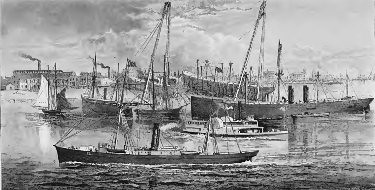
The waterfront of Chester, Pennsylvania in 1875.

CS_Lewis_Banner

Wednesday, February 22, 2017

Phantasies by George MacDonald

Citizen Journalism with a Better Flavor

MacTHYME_004
Volume XII, Issue IX

Phantasies
By George MacDonald, Chapter 4

When bale is att hyest, boote is nyest."
~ Ballad of Sir Aldingar.

By this time, my hostess was quite anxious that I should be gone. So, with warm thanks for their hospitality, I took my leave, and went my way through the little garden towards the forest. Some of the garden flowers had wandered into the wood, and were growing here and there along the path, but the trees soon became too thick and shadowy for them. I particularly noticed some tall lilies, which grew on both sides of the way, with large dazzlingly white flowers, set off by the universal green. It was now dark enough for me to see that every flower was shining with a light of its own. Indeed it was by this light that I saw them, an internal, peculiar light, proceeding from each, and not reflected from a common source of light as in the daytime. This light sufficed only for the plant itself, and was not strong enough to cast any but the faintest shadows around it, or to illuminate any of the neighbouring objects with other than the faintest tinge of its own individual hue. From the lilies above mentioned, from the campanulas, from the foxgloves, and every bell-shaped flower, curious little figures shot up their heads, peeped at me, and drew back. They seemed to inhabit them, as snails their shells but I was sure some of them were intruders, and belonged to the gnomes or goblin-fairies, who inhabit the ground and earthy creeping plants. From the cups of Arum lilies, creatures with great heads and grotesque faces shot up like Jack- in-the-box, and made grimaces at me; or rose slowly and slily over the edge of the cup, and spouted water at me, slipping suddenly back, like those little soldier-crabs that inhabit the shells of sea-snails. Passing a row of tall thistles, I saw them crowded with little faces, which peeped every one from behind its flower, and drew back as quickly; and I heard them saying to each other, evidently intending me to hear, but the speaker always hiding behind his tuft, when I looked in his direction, "Look at him! Look at him! He has begun a story without a beginning, and it will never have any end. He! he! he! Look at him!"

But as I went further into the wood, these sights and sounds became fewer, giving way to others of a different character. A little forest of wild hyacinths was alive with exquisite creatures, who stood nearly motionless, with drooping necks, holding each by the stem of her flower, and swaying gently with it, whenever a low breath of wind swung the crowded floral belfry. In like manner, though differing of course in form and meaning, stood a group of harebells, like little angels waiting, ready, till they were wanted to go on some yet unknown message. In darker nooks, by the mossy roots of the trees, or in little tufts of grass, each dwelling in a globe of its own green light, weaving a network of grass and its shadows, glowed the glowworms.

They were just like the glowworms of our own land, for they are fairies everywhere; worms in the day, and glowworms at night, when their own can appear, and they can be themselves to others as well as themselves. But they had their enemies here. For I saw great strong-armed beetles, hurrying about with most unwieldy haste, awkward as elephant-calves, looking apparently for glowworms; for the moment a beetle espied one, through what to it was a forest of grass, or an underwood of moss, it pounced upon it, and bore it away, in spite of its feeble resistance. Wondering what their object could be, I watched one of the beetles, and then I discovered a thing I could not account for. But it is no use trying to account for things in Fairy Land; and one who travels there soon learns to forget the very idea of doing so, and takes everything as it comes; like a child, who, being in a chronic condition of wonder, is surprised at nothing. What I saw was this. Everywhere, here and there over the ground, lay little, dark-looking lumps of something more like earth than anything else, and about the size of a chestnut. The beetles hunted in couples for these; and having found one, one of them stayed to watch it, while the other hurried to find a glowworm. By signals, I presume, between them, the latter soon found his companion again: they then took the glowworm and held its luminous tail to the dark earthly pellet; when lo, it shot up into the air like a sky-rocket, seldom, however, reaching the height of the highest tree. Just like a rocket too, it burst in the air, and fell in a shower of the most gorgeously coloured sparks of every variety of hue; golden and red, and purple and green, and blue and rosy fires crossed and inter-crossed each other, beneath the shadowy heads, and between the columnar stems of the forest trees. They never used the same glowworm twice, I observed; but let him go, apparently uninjured by the use they had made of him.

In other parts, the whole of the immediately surrounding foliage was illuminated by the interwoven dances in the air of splendidly coloured fire-flies, which sped hither and thither, turned, twisted, crossed, and recrossed, entwining every complexity of intervolved motion. Here and there, whole mighty trees glowed with an emitted phosphorescent light. You could trace the very course of the great roots in the earth by the faint light that came through; and every twig, and every vein on every leaf was a streak of pale fire.

All this time, as I went through the wood, I was haunted with the feeling that other shapes, more like my own size and mien, were moving about at a little distance on all sides of me. But as yet I could discern none of them, although the moon was high enough to send a great many of her rays down between the trees, and these rays were unusually bright, and sight-giving, notwithstanding she was only a half-moon. I constantly imagined, however, that forms were visible in all directions except that to which my gaze was turned; and that they only became invisible, or resolved themselves into other woodland shapes, the moment my looks were directed towards them. However this may have been, except for this feeling of presence, the woods seemed utterly bare of anything like human companionship, although my glance often fell on some object which I fancied to be a human form; for I soon found that I was quite deceived; as, the moment I fixed my regard on it, it showed plainly that it was a bush, or a tree, or a rock.

Soon a vague sense of discomfort possessed me. With variations of relief, this gradually increased; as if some evil thing were wandering about in my neighbourhood, sometimes nearer and sometimes further off, but still approaching. The feeling continued and deepened, until all my pleasure in the shows of various kinds that everywhere betokened the presence of the merry fairies vanished by degrees, and left me full of anxiety and fear, which I was unable to associate with any definite object whatever. At length the thought crossed my mind with horror: "Can it be possible that the Ash is looking for me? or that, in his nightly wanderings, his path is gradually verging towards mine?" I comforted myself, however, by remembering that he had started quite in another direction; one that would lead him, if he kept it, far apart from me; especially as, for the last two or three hours, I had been diligently journeying eastward. I kept on my way, therefore, striving by direct effort of the will against the encroaching fear; and to this end occupying my mind, as much as I could, with other thoughts. I was so far successful that, although I was conscious, if I yielded for a moment, I should be almost overwhelmed with horror, I was yet able to walk right on for an hour or more. What I feared I could not tell. Indeed, I was left in a state of the vaguest uncertainty as regarded the nature of my enemy, and knew not the mode or object of his attacks; for, somehow or other, none of my questions had succeeded in drawing a definite answer from the dame in the cottage. How then to defend myself I knew not; nor even by what sign I might with certainty recognise the presence of my foe; for as yet this vague though powerful fear was all the indication of danger I had. To add to my distress, the clouds in the west had risen nearly to the top of the skies, and they and the moon were travelling slowly towards each other. Indeed, some of their advanced guard had already met her, and she had begun to wade through a filmy vapour that gradually deepened.

At length she was for a moment almost entirely obscured. When she shone out again, with a brilliancy increased by the contrast, I saw plainly on the path before me--from around which at this spot the trees receded, leaving a small space of green sward--the shadow of a large hand, with knotty joints and protuberances here and there. Especially I remarked, even in the midst of my fear, the bulbous points of the fingers. I looked hurriedly all around, but could see nothing from which such a shadow should fall. Now, however, that I had a direction, however undetermined, in which to project my apprehension, the very sense of danger and need of action overcame that stifling which is the worst property of fear. I reflected in a moment, that if this were indeed a shadow, it was useless to look for the object that cast it in any other direction than between the shadow and the moon. I looked, and peered, and intensified my vision, all to no purpose. I could see nothing of that kind, not even an ash-tree in the neighbourhood. Still the shadow remained; not steady, but moving to and fro, and once I saw the fingers close, and grind themselves close, like the claws of a wild animal, as if in uncontrollable longing for some anticipated prey. There seemed but one mode left of discovering the substance of this shadow. I went forward boldly, though with an inward shudder which I would not heed, to the spot where the shadow lay, threw myself on the ground, laid my head within the form of the hand, and turned my eyes towards the moon Good heavens! what did I see? I wonder that ever I arose, and that the very shadow of the hand did not hold me where I lay until fear had frozen my brain. I saw the strangest figure; vague, shadowy, almost transparent, in the central parts, and gradually deepening in substance towards the outside, until it ended in extremities capable of casting such a shadow as fell from the hand, through the awful fingers of which I now saw the moon. The hand was uplifted in the attitude of a paw about to strike its prey. But the face, which throbbed with fluctuating and pulsatory visibility--not from changes in the light it reflected, but from changes in its own conditions of reflecting power, the alterations being from within, not from without--it was horrible. I do not know how to describe it. It caused a new sensation. Just as one cannot translate a horrible odour, or a ghastly pain, or a fearful sound, into words, so I cannot describe this new form of awful hideousness. I can only try to describe something that is not it, but seems somewhat parallel to it; or at least is suggested by it. It reminded me of what I had heard of vampires; for the face resembled that of a corpse more than anything else I can think of; especially when I can conceive such a face in motion, but not suggesting any life as the source of the motion. The features were rather handsome than otherwise, except the mouth, which had scarcely a curve in it. The lips were of equal thickness; but the thickness was not at all remarkable, even although they looked slightly swollen. They seemed fixedly open, but were not wide apart. Of course I did not REMARK these lineaments at the time: I was too horrified for that. I noted them afterwards, when the form returned on my inward sight with a vividness too intense to admit of my doubting the accuracy of the reflex. But the most awful of the features were the eyes. These were alive, yet not with life.

They seemed lighted up with an infinite greed. A gnawing voracity, which devoured the devourer, seemed to be the indwelling and propelling power of the whole ghostly apparition. I lay for a few moments simply imbruted with terror; when another cloud, obscuring the moon, delivered me from the immediately paralysing effects of the presence to the vision of the object of horror, while it added the force of imagination to the power of fear within me; inasmuch as, knowing far worse cause for apprehension than before, I remained equally ignorant from what I had to defend myself, or how to take any precautions: he might be upon me in the darkness any moment. I sprang to my feet, and sped I knew not whither, only away from the spectre. I thought no longer of the path, and often narrowly escaped dashing myself against a tree, in my headlong flight of fear.

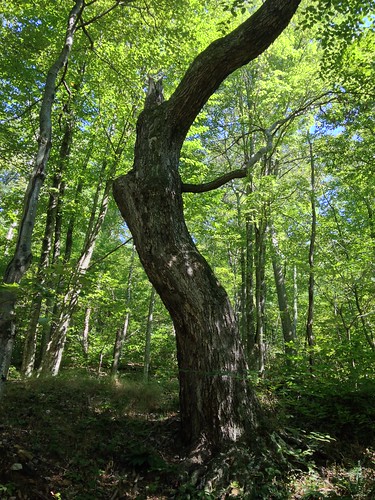
Great drops of rain began to patter on the leaves. Thunder began to mutter, then growl in the distance. I ran on. The rain fell heavier. At length the thick leaves could hold it up no longer; and, like a second firmament, they poured their torrents on the earth. I was soon drenched, but that was nothing. I came to a small swollen stream that rushed through the woods. I had a vague hope that if I crossed this stream, I should be in safety from my pursuer; but I soon found that my hope was as false as it was vague. I dashed across the stream, ascended a rising ground, and reached a more open space, where stood only great trees. Through them I directed my way, holding eastward as nearly as I could guess, but not at all certain that I was not moving in an opposite direction. My mind was just reviving a little from its extreme terror, when, suddenly, a flash of lightning, or rather a cataract of successive flashes, behind me, seemed to throw on the ground in front of me, but far more faintly than before, from the extent of the source of the light, the shadow of the same horrible hand. I sprang forward, stung to yet wilder speed; but had not run many steps before my foot slipped, and, vainly attempting to recover myself, I fell at the foot of one of the large trees. Half-stunned, I yet raised myself, and almost involuntarily looked back. All I saw was the hand within three feet of my face. But, at the same moment, I felt two large soft arms thrown round me from behind; and a voice like a woman's said: "Do not fear the goblin; he dares not hurt you now." With that, the hand was suddenly withdrawn as from a fire, and disappeared in the darkness and the rain. Overcome with the mingling of terror and joy, I lay for some time almost insensible. The first thing I remember is the sound of a voice above me, full and low, and strangely reminding me of the sound of a gentle wind amidst the leaves of a great tree. It murmured over and over again: "I may love him, I may love him; for he is a man, and I am only a beech-tree." I found I was seated on the ground, leaning against a human form, and supported still by the arms around me, which I knew to be those of a woman who must be rather above the human size, and largely proportioned. I turned my head, but without moving otherwise, for I feared lest the arms should untwine themselves; and clear, somewhat mournful eyes met mine. At least that is how they impressed me; but I could see very little of colour or outline as we sat in the dark and rainy shadow of the tree. The face seemed very lovely, and solemn from its stillness; with the aspect of one who is quite content, but waiting for something. I saw my conjecture from her arms was correct: she was above the human scale throughout, but not greatly.

Why do you call yourself a beech-tree?" I said.

Because I am one," she replied, in the same low, musical, murmuring voice.

You are a woman," I returned.

Do you think so? Am I very like a woman then?"

You are a very beautiful woman. Is it possible you should not know it?"

I am very glad you think so. I fancy I feel like a woman sometimes. I do so to-night--and always when the rain drips from my hair. For there is an old prophecy in our woods that one day we shall all be men and women like you. Do you know anything about it in your region? Shall I be very happy when I am a woman? I fear not, for it is always in nights like these that I feel like one. But I long to be a woman for all that."

I had let her talk on, for her voice was like a solution of all musical sounds. I now told her that I could hardly say whether women were happy or not. I knew one who had not been happy; and for my part, I had often longed for Fairy Land, as she now longed for the world of men. But then neither of us had lived long, and perhaps people grew happier as they grew older. Only I doubted it.

I could not help sighing. She felt the sigh, for her arms were still round me. She asked me how old I was.

Twenty-one," said I.

Why, you baby!" said she, and kissed me with the sweetest kiss of winds and odours. There was a cool faithfulness in the kiss that revived my heart wonderfully. I felt that I feared the dreadful Ash no more.

What did the horrible Ash want with me?" I said.

I am not quite sure, but I think he wants to bury you at the foot of his tree. But he shall not touch you, my child."

Are all the ash-trees as dreadful as he?"

Oh, no. They are all disagreeable selfish creatures--(what horrid men they will make, if it be true!)--but this one has a hole in his heart that nobody knows of but one or two; and he is always trying to fill it up, but he cannot. That must be what he wanted you for. I wonder if he will ever be a man. If he is, I hope they will kill him."

How kind of you to save me from him!"

I will take care that he shall not come near you again. But there are some in the wood more like me, from whom, alas! I cannot protect you. Only if you see any of them very beautiful, try to walk round them."

What then?"

I cannot tell you more. But now I must tie some of my hair about you, and then the Ash will not touch you. Here, cut some off. You men have strange cutting things about you."

She shook her long hair loose over me, never moving her arms.

I cannot cut your beautiful hair. It would be a shame."

Not cut my hair! It will have grown long enough before any is wanted again in this wild forest. Perhaps it may never be of any use again--not till I am a woman." And she sighed.

As gently as I could, I cut with a knife a long tress of flowing, dark hair, she hanging her beautiful head over me. When I had finished, she shuddered and breathed deep, as one does when an acute pain, steadfastly endured without sign of suffering, is at length relaxed. She then took the hair and tied it round me, singing a strange, sweet song, which I could not understand, but which left in me a feeling like this--

I saw thee ne'er before;
I see thee never more;
But love, and help, and pain, beautiful one,
Have made thee mine, till all my years are done."

I cannot put more of it into words. She closed her arms about me again, and went on singing. The rain in the leaves, and a light wind that had arisen, kept her song company. I was wrapt in a trance of still delight. It told me the secret of the woods, and the flowers, and the birds. At one time I felt as if I was wandering in childhood through sunny spring forests, over carpets of primroses, anemones, and little white starry things--I had almost said creatures, and finding new wonderful flowers at every turn. At another, I lay half dreaming in the hot summer noon, with a book of old tales beside me, beneath a great beech; or, in autumn, grew sad because I trod on the leaves that had sheltered me, and received their last blessing in the sweet odours of decay; or, in a winter evening, frozen still, looked up, as I went home to a warm fireside, through the netted boughs and twigs to the cold, snowy moon, with her opal zone around her. At last I had fallen asleep; for I know nothing more that passed till I found myself lying under a superb beech-tree, in the clear light of the morning, just before sunrise. Around me was a girdle of fresh beech-leaves. Alas! I brought nothing with me out of Fairy Land, but memories--memories. The great boughs of the beech hung drooping around me. At my head rose its smooth stem, with its great sweeps of curving surface that swelled like undeveloped limbs. The leaves and branches above kept on the song which had sung me asleep; only now, to my mind, it sounded like a farewell and a speedwell. I sat a long time, unwilling to go; but my unfinished story urged me on. I must act and wander. With the sun well risen, I rose, and put my arms as far as they would reach around the beech-tree, and kissed it, and said good- bye. A trembling went through the leaves; a few of the last drops of the night's rain fell from off them at my feet; and as I walked slowly away, I seemed to hear in a whisper once more the words: "I may love him, I may love him; for he is a man, and I am only a beech-tree."
(to be continued)
Blackrock Springs
Photo by Bob Kirchman.

Blackrock Springs
Photo by Bob Kirchman.

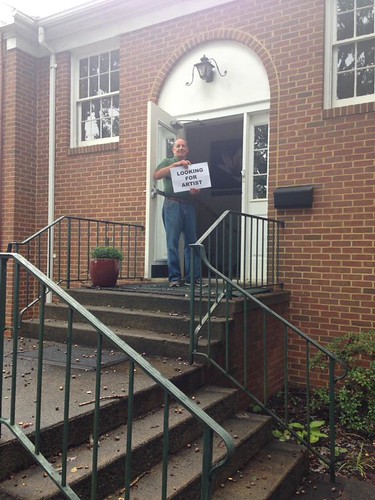
Looking for Artist
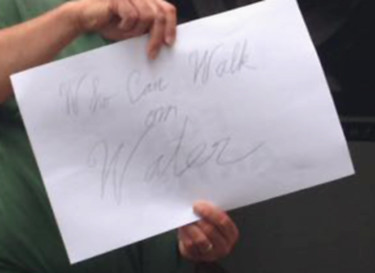
Who Can Walk on Water

The most creative job in the world involves fashion, decorating, recreation, education, transportation, psychology, romance, cuisine, literature, art, economics, government, pediatrics, geriatrics, entertainment, maintenance, purchasing, law, religion, energy and management. Anyone who can handle all of these has to be somebody special. She is. She’s a homemaker.” – Richard Kerr

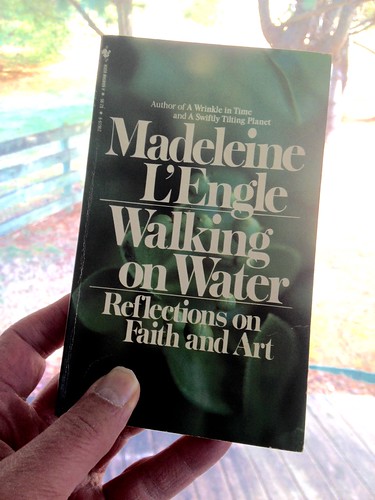
If the work comes to the artist and says, 'Here I am, serve me,' then the job of the artist, great or small, is to serve. The amount of the artist's talent is not what it is about. Jean Rhys said to an interviewer in the Paris Review, 'Listen to me. All of writing is a huge lake. There are great rivers that feed the lake, like Tolstoy and Dostoyevsky. And there are mere trickles, like Jean Rhys. All that matters is feeding the lake. I don't matter. The lake matters. You must keep feeding the lake'.” ― Madeleine L'Engle, Walking on Water: Reflections on Faith and Art

Somewhere in my past, I owned a book of Nineteenth Century industrial illustrations. They were beautiful. Of note were the obvious details of pure ornamentation that the designers sought to put into their work. There was a sense that there was wonder to be unfolded in the inventions so delineated. Design seems to have moved sharply away from the hand-rendered transcendence of that period to a more machine-based process. There is a beautiful quality to much of that as well, but there is less direct touch to paper and process. I miss that. Still, there is a place for Divine Design. Richard Kerr’s homemaker embodies the practice of creativity. Many building designers are quite adept at assembling elements and organizing spaces on their screens, but where once they would have had creative interaction with the renderer, the press of a few buttons and the arc of the mouse take them to the visualization of their work.

This week I started to re-read Madeline L’Engle’s Walking on Water: Reflections on Faith and Art. [1.] Not far into this fine little book one encounters the topic of obedience. L’engle puts it this way: A work of art, be it a painting, a book, or any other work, comes to the artist and says: “Here I am, Enflesh me. Give Birth to me.” The artist is faced with a choice. She may respond as Mary: “My soul doth magnify the Lord,” or she may refuse. The decision is not necessarily a conscious one. And so, as I continue to provide old-fashioned visualization for a few clients, I see the work there dwindling. Yet I am not yet ready to give up serving. There is still work to be done. For the past months, I have taught drawing and painting to a young high school student who is home schooled. There is Divine purpose there. Now the invitation has been extended to teach a unit in the home school coop. It seems the Divine mission is thus: to inspire a new generation to infuse their life in this world with the stuff that Kerr talks about. Divine mission, a Sacred trust, an invitation to join the Master in His finest work. I find myself enthused.

In a very real sense not one of us is qualified, but it seems that God continually chooses the most unqualified to do his work, to bear his glory. If we are qualified, we tend to think that we have done the job ourselves. If we are forced to accept our evident lack of qualification, then there's no danger that we will confuse God's work with our own, or God's glory with our own.” -- Madeleine L'Engle, Walking on Water: Reflections on Faith and Art
Wonder by LG
Looking for artist... Photo by Kristina Elaine Greer.
walkingonwater
...who can walk on water! Photo by Kristina Elaine Greer.
WOW

All children are artists, and it is an indictment of our culture that so many of them lose their creativity, their unfettered imaginations, as they grow older. But they start off without self-consciousness as they paint their purple flowers, their anatomically impossible people, their thunderous, sulphurous skies. They don’t worry that they may not be as good as Di Chirico or Bracque; they know intuitively that it is folly to make comparisons, and they go ahead and say what they want to say. What looks like a hat to a grownup may, to the child artist, be an elephant inside a boa constrictor.

So what happens? Why do we lose our wonderful, rackety creativity? What corrupts us?

Corrupt: another unpopular word; another important one. It’s importance first struck me when I was reading Thomas Traherne, one of my favorite seventeenth century poets and mystics. “Certainly Adam and Eve in Paradise had not more sweete and curious apprehensions of the world than when I was a child,” he wrote. Everything was new and delightful for him. The rosy glow of sunrise had in it the flaming glory of creation. The stars at night were a living, heavenly dance. He listened to the grass growing, smelled the west wind, tasted the rain, touched the grains of sand on the shore. All hi senses, his mind, his heart, were alive and in touch with being. “So that,” Trahane adds sadly, “without much ado I as corrupted, and made to learn the dirty devices of this world, which now I unlearn, and become as a little child again, that I may enter into the Kingdom of God.”

A lot of my adult life has been spent in trying to overcome this corruption, in unlearning the dirty devices of this world, which would dull our imaginations, cut away our creativity. So it is only with the conscious-unselfconsciousness of a child that I can think about theories of asthetics, of art, particularly as these touch upon my questions about life and love and God.” -- Madeleine L'Engle, Walking on Water: Reflections on Faith and Art

Il est très simple: on ne voit bien qu'avec le cœur. L'essentiel est invisible pour les yeux."
-- Antoin de St Exupery

Higher Calling
Thought from George MacDonald

IMG_3292
Pink Ladyslipper at White Rock Falls. Photo by Bob Kirchman

If, instead of a gem or even a flower, we could cast the gift of a lovely thought into the heart of a friend, that would be giving as the angels give."
- George Macdonald

A Gift of Beauty
Warnie's Box

WarniesBox

This absence of beauty, now that I come to think of it, is characteristic of our childhood. No picture on the walls of my father's house ever attracted — and indeed none deserved — our attention. We never saw a beautiful building nor imagined that a building could be beautiful. My earliest aesthetic experiences, if indeed they were aesthetic, were not of that kind; they were already incurably romantic, not formal. Once in those very early days my brother brought into the nursery the lid of a biscuit tin which he had covered with moss and garnished with twigs and flowers so as to make it a toy garden or a toy forest.

That was the first beauty I ever knew.

What the real garden had failed to do, the toy garden did. It made me aware of nature — not, indeed, as a storehouse of forms and colours but as something cool, dewy, fresh, exuberant. I do not think the impression was very important at the moment, but it soon became important in memory. As long as I live my imagination of Paradise will retain something of my brother's toy garden."
-- C. S. Lewis, Surprised by Joy [ 2.]

Fixing the Escalator
[click to read]

by Nicholas N. Eberstadt
escalator
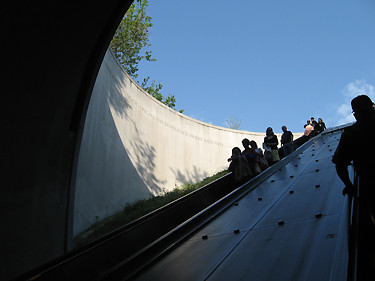
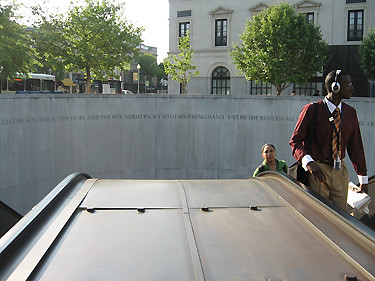
Metro Escalator, Washington, DC. Photo by Bob Kirchman

The abstraction of “inequality” doesn’t matter a lot to ordinary Americans. The reality of economic insecurity does. [3.] The Great American Escalator is broken—and it badly needs to be fixed. With the election of 2016, Americans within the bubble finally learned that the 21st century has gotten off to a very bad start in America. Welcome to the reality. We have a lot of work to do together to turn this around. (read more)

Looking for Creative Solutionists
By Bob Kirchman

Awareness of a problem is only the beginning. What if Divine Inspiration is available to lead us to new and innovative answers to human problems? It has happened in centuries past and I firmly believe it is within our grasp now.

Poll any group of young people today and you will find a degree of pessimism about the future. As the economy faltered, ‘experts’ essentially told them: “Welcome to the new normal.” But history tells us that economies are not a zero-sum game… one where someone must lose for another to win. New invention has lifted entire societies in the past and I believe it can do so again. Consider the case of Nineteenth Century England. We all know that William Wilberforce [4.] performed a great and noble work when he won the abolition of slavery, but did you know that that devastated the economy of Bristol, England’s chief slave port. Fortunes were lost. Men committed suicide. Children were cast out onto the street. Bristol’s children faced a dismal ‘new normal’ indeed.

But a young minister from Prussia came to Bristol as a missionary. George Müller [5.] saw Bristol’s street urchins as jewels to be polished. He built five large houses at Ashley Downs to care for orphans, trusting the Divine for provision. He cared for 10,024 orphan children in the course of his life, instructing the boys in trades and the ladies for work as teachers, nurses and housekeepers. He was excoriated by the ‘experts’ for training these young people ‘above their station.’ He ignored the experts. He established 117 schools which offered Christian education to over 120,000 children. But what future would there be for them?

Pastor Tim Keller calls economic development a Deaconate Ministry. To be sure the church does this work when it sends treadle sewing machines to Zambia, so that widowed ladies may become tailors. But it is also needed in the developed world. Sometimes the instrument of Divine blessing may not even know that they are. Consider the case of Isambard Kingdom Brunel, Britain’s Nineteenth Century Bridge Builder. [6.] He came to Bristol to build a suspension bridge and ended up building the Great Western Railroad, which revitalized Bristol’s economy! Brunel also designed great ships to connect Britain with the Americas, making cotton cheap and plentiful. The offshoot of this and modern textile manufacturing was that poor as well as rich could afford quality garments.

It was suggested in the Nineteenth Century that the United States Patent Office could be shut down because “everything that is going to be invented has already been invented!” Well, the truth was that much of the visionary technology depicted in Jules Verne’s Voyages Extraordinaire would not be perfected until the Twentieth Century. Only time will tell what wonders the Divine might inspire in the decades to come, but if history is any indicator, there is much to be hopeful for!
escalator2
Metro Escalator, Washington, DC. Photo by Bob Kirchman

CS_Lewis_Banner