The past fire-lit weeks in America’s cities have made clear that the protests, and the riots that attend them, have little to do with the condemnable alleged murder of George Floyd by police officers in Minneapolis.
Even in the non-violent demonstrations, protesters can be seen burning the American flag, an act that just 30 years ago engendered such outrage it spurred Congress to pass an unconstitutional law, but doesn’t even warrant coverage today. In broad daylight, protesters have defaced and toppled statues dedicated to any and all figures of America’s history.
Lest anyone think the mob’s Year Zero behavior stopped with the slaveholding Confederacy, in Boston a monument to the 54th Massachusetts, an all-black Union regiment during the Civil War, was among those vandalized. Matthias Baldwin, an early abolitionist, got the same treatment in Philadelphia, as did the lesser-known Rotary Club founder Paul Harris, whose plaque in Washington D.C. was marked simply with an ignorance-acknowledging “probably a racist.” The monument to the author of the Emancipation Proclamation on the National Mall was likely spared only because of the protection of the National Guard.
As John Daniel Davidson has noted, toppling statues is not a good sign for the future of the republic; it looks a lot less like a policy conversation about police reform than it does regime change and revolution. (read more)
American companies’ embrace of radical ideas appears both sudden and inexplicable. In internal trainings, companies from Disney to Lockheed-Martin ask their employees to “challenge colorblind ideologies” and “deconstruct their white male privilege.” Firms spend vast sums of money on such trainings, on diversity-related speakers, and on maintaining a progressive image. Employees find themselves wondering why their workplace has transformed into a progressive propaganda center.
Much has been made of the propagation of certain ideas—call them social-justice ideology, critical race theory, or wokeness—in American institutions. But surprisingly little attention has been paid to the question of why institutions “go woke.” Some address this question in philosophical or ideological terms, noting the continuity between these ideas and the work of certain twentieth-century intellectuals, from the Frankfurt School in the 1920s to the critical race theorists of the 1980s. But a historical and sociological analysis can help explain why institutions accepted these ideas as legitimate in the first place. (read more)
The America I Love, A Photo Journey
Photos byBob Kirchman
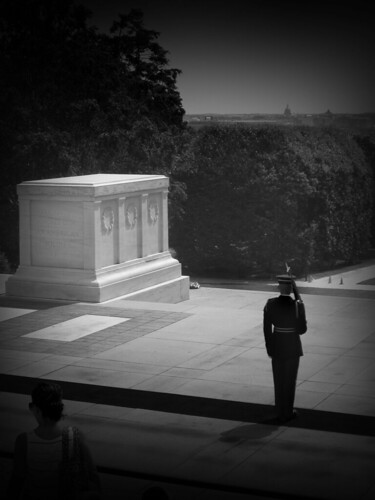
Tomb of the Unknown Soldier
Tomb of the Unknown Soldier, Arlington, Virginia.
Wright Brothers Memorial
Wright Brothers Memorial, Kitty Hawk, North Carolina.
America the Beautiful Words byKatharine Lee Bates, Melody bySamuel Ward
Obeautiful for spacious skies, For amber waves of grain, For purple mountain majesties Above the fruited plain! America! America! God shed his grace on thee And crown thy good with brotherhood From sea to shining sea!
Obeautiful for pilgrim feet Whose stern impassioned stress A thoroughfare of freedom beat Across the wilderness! America! America! God mend thine every flaw, Confirm thy soul in self-control, Thy liberty in law!
Obeautiful for heroes proved In liberating strife. Who more than self their country loved And mercy more than life! America! America! May God thy gold refine Till all success be nobleness And every gain divine!
Obeautiful for patriot dream That sees beyond the years Thine alabaster cities gleam Undimmed by human tears! America! America! God shed his grace on thee And crown thy good with brotherhood From sea to shining sea!
Obeautiful for halcyon skies, For amber waves of grain, For purple mountain majesties Above the enameled plain! America! America! God shed his grace on thee Till souls wax fair as earth and air And music-hearted sea!
O beautiful for pilgrims feet, Whose stem impassioned stress A thoroughfare for freedom beat Across the wilderness! America! America! God shed his grace on thee Till paths be wrought through wilds of thought By pilgrim foot and knee!
Obeautiful for glory-tale Of liberating strife When once and twice, for man's avail Men lavished precious life! America! America! God shed his grace on thee Till selfish gain no longer stain The banner of the free!
Obeautiful for patriot dream That sees beyond the years Thine alabaster cities gleam Undimmed by human tears! America! America! God shed his grace on thee Till nobler men keep once again Thy whiter jubilee!
The Cherokee Nation
New Echota, in present day Georgia, was the capital of the Cherokee Nation.
Mohomony, The Natural Bridge of Virginia
The Monacan People knew Virginia's Natural Bridge as Mohomony, the Bridge of God.
Sherando Lake, Jefferson National Forest
Ice covers Sherando Lake in Augusta County, Virginia.
America's Early Railroads
Baltimore and Ohio Railroad Bridge South of Staunton, Virginia.
Arches of the Baltimore and Ohio Railroad Bridge South of Staunton, Virginia.
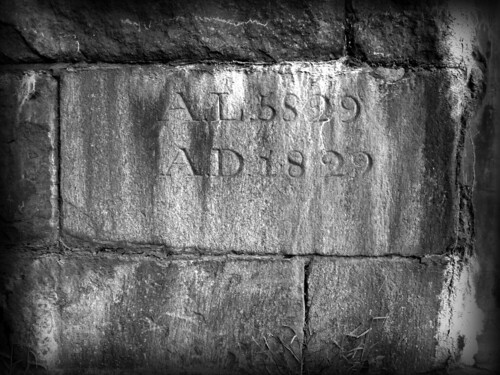
Cornerstone of Baltimore and Ohio Railroad Bridge, Ellicott City, Maryland.
Baltimore and Ohio Railroad Station, Ellicott City, Maryland. The station actually had an engine house behind the large door.
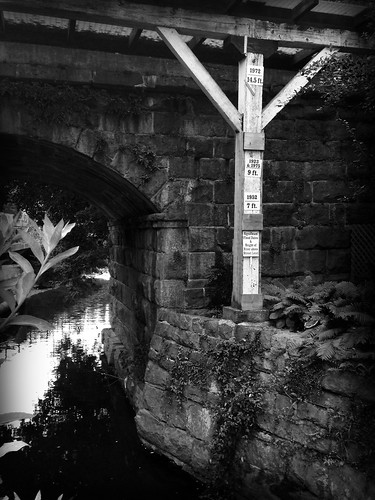
High Water Marks, Railroad Bridge in Ellicott City, Maryland.
The Patapsco Hotel, Ellicott City, Maryland. It is built of native granite.
Dolls in a Shop Window, Ellicott City, Maryland.
McCormick's Mill
It was here that Cyrus McCormick invented the reaper and revolutionized world agriculture. Steele's Tavern, Virginia.
Mount Airy Farm
Before she became famous as a folk painter, Grandma Moses lived at Mount Airy in Augusta County just North of Staunton, Virginia.
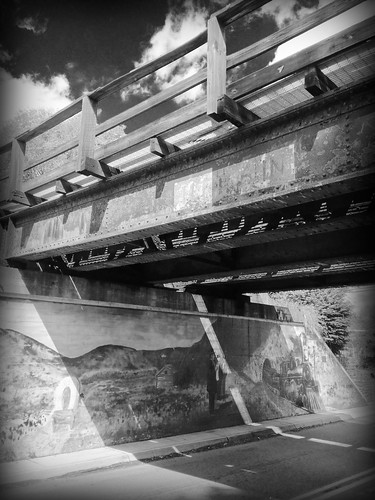
Historical Mural, Crozet, Virginia
This mural celebrating the history of the Crozet area was painted by John Pembroke, Bob Kirchmanand Western Albemarle High School Art Students. Restoration in 20112 was done by Kristina Elaine Greer, Meg Westand Western Albemarle High School Art Students. The mural highlights the Monacan settlement here, the Big Survey settlement and the coming of the railroad built by Claudius Crozet, for whom the town is named.
Virginia State Capital Building
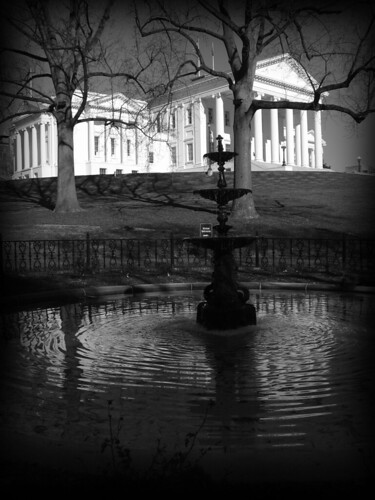
Thomas Jeffersondesigned the Virginia State Capital Building in Richmond, Virginia.
Poplar Forest
Thomas Jefferson's Octagonal House near Forest, Virginia.
University of Virginia
The Lawn, as designed byThomas Jefferson, originally opened out to the rolling hills of Albemarle County, Virginia. In this reconstruction by Bob Kirchman it is seen open once again.
Sitka, Alaska
The Russian Bishop's House in Sitka, Alaska.
Abandoned Cemetery, Sitka, Alaska.
Shenandoah National Park, Virginia
Mary's Rock Tunnel on Skyline Drive, Shenandoah National Park, Virginia.
White Rock Falls, Virginia
White Rock Falls is along the Blue Ridge Parkway in Virginia.
For decades, much of academia, the liberal activist class, and the public school system have operated on the premise that America is fundamentally racist. The latest manifestation of this outlook is the 1619 Project, rolled out last month by the New York Times. Claiming that “anti-black racism runs in the very DNA of this country,” it “aims to reframe the country’s history” by making 1619—the year slavery was first introduced by the British to Virginia—the year of “our true founding.” This narrative is akin to the Jacobins’ alteration of the calendar to make their revolution the decisive turning point in human history. Just as they would save France from the monarchy, so, too, will the Times save America from white supremacy. The Times encourages public schools to adopt an accompanying curriculum that spreads the 1619 Project’s message to young Americans. Its goal is to brand our founding documents—the Declaration of Independence and the Constitution—as immoral and thus unworthy of our allegiance. To make America’s Founding contemptible, one must hide, ignore, and distort the Founders’ writings and thoughts. Irresponsibly omitted from this narrative is the fact that not a single major Founder endorsed slavery. On the contrary, the Founders unambiguously saw slavery as evil. George Washington said, “there is not a man living who wishes more sincerely than I do, to see a plan adopted for the abolition of it,” and Thomas Jefferson’s original draft of the Declaration of Independence calls the slave trade an “execrable commerce” and an affront “against human nature itself.”Gouverneur Morris called slavery a “nefarious institution” and “the curse of heaven,” and John Jay said, “It is much to be wished that slavery may be abolished. . . . To contend for our own liberty, and to deny that blessing to others, involves an inconsistency not to be excused.”(read more)
The Man Who Moved a Mountain
Bob Childress, The Pastor Who Tamed Buffalo Mountain
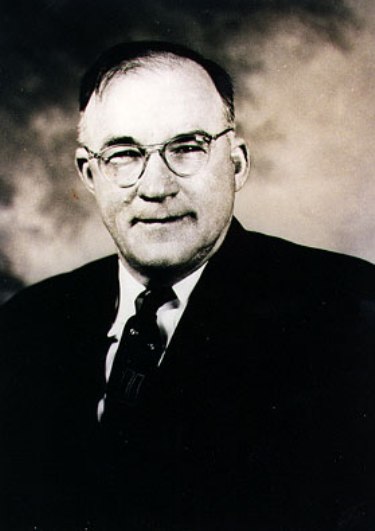
Pastor Bob Childress.
A Milestone Monday Feature
Today we think of gang violence downtown and forget that once there was gunfire in the small communities of Southwestern Virginia. Bob Childress was a hard-drinking, hard fighting resident of that region where the poverty of subsistence living was made more bearable, it was thought, by escaping to alcohol. Bob's parents drank heavily and fought constantly.
Following in his parent's footsteps, Childress missed a lot of school as a youth. One day he witnessed a massacre at the local courthouse and was moved to quit drinking and pursue a career in law enforcement. This was a noteworthy change in itself. Childress settled down, married and had four children; but G-d had plans for his life that would change the lives of people around him in a way he couldn't imagine.
Childress went to a revival meeting and found something more powerful than the spirits in a bottle. He found G-d and felt called to the ministry. At the age of thirty he returned to school, finishing high school in the same one-room schoolhouse attended by his six year old son.
He sought to bring the Spirit of the Lord to his hurting community. Though his education was pretty basic, he managed to go to Union Seminary in Richmond and struggled through. He became a much sought after speaker and was offered a very comfortable position with a large church... and he turned it down. Buffalo Mountain was his calling from G-d and he returned to his community and started a number of churches. His Sunday was a marathon as he made the journey to preach at each congregation.
Bob faced the daunting task of bringing the message of G-d's love to a community steeped in fatalistic despair. The churches he founded are testimony of what can be accomplished by a life lived for a greater purpose. Childress continued his ministry while caring for his daughter Hattie,
who was severely disabled. When Bob's wife died, he took on such tasks
as boiling the wash water for diapers. In the 1950's he was preaching in fourteen different churches every week. He died in 1956 at the age of 66.
Richard C. Davids tells his story in The Man Who Moved a Mountain[click to read], a stirring book. Lives like that of Bob Childress should challenge all of us. “Only eternity will tell the tremendous good accomplished in this unusual diocese.” -- The Synod of Virginia.
Remembering a Great Mentor
There was a Man who Convinced Me I Could Do This
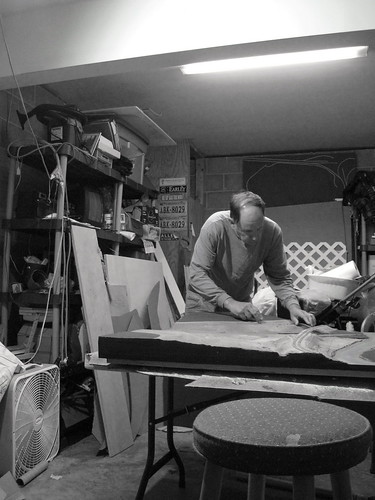
Reconstructing my model of Ellicot's Mills for the B and;O Railroad Museum.
A Milestone Monday Feature
In Chapter 14 of Chuck Balsamo's book Make Me a Legend Pastor Balsamo talks about the importance of finding a good mentor. He brought back some important memories as I recalled the influence of a man named Reggie. Reggie served in the Navy during World War II and achieved the rank of Aviation Machinist's Mate, Second Class. He was a first class mentor.
I met this amazing man because I went to school with his daughter. He was a Chevrolet mechanic and an avid outdoorsman. He introduced me to the wonders of Coastal New Jersey as I happily paddled for hours through marshes and creeks. At about 50 years old, Reggie became an instructor at the vocational technology school. There he discovered his true gifts and passions.
At an age where most men are thinking about taking it easy, Reggie enrolled in Rutgers University and pursued a degree in administration. Education and young people had become his true calling and he graduated from college the same time one of his daughters did.
Days at Reggies place where full ones. He lived in a little postwar bungalo and when his children and their assembled friends were descending on the place around ten in the evening, he'd put on a pot of coffee. It came as no surprise that Reggie enjoyed lively conversation and sometimes these talk sessions would end in the wee hours of the morning. Good coffee, however, always made up for sleep deprivation.
Reggie went on to become a high school principal, but I have to believe that the best classes he ever taught were at his own kitchen table. He noticed that I was a hands-on guy struggling with an academic world. He found information on architectural model making and shared it with me. "You'd be good at this, Bob." Years later I was literally living off of this compliment. My little studio built models for architects, including one famous one. I worked on several models for resort projects in Japan, though I'm not sure how a man who served in the Pacific Theater would feel about that.
No doubt, this man has influenced many young lives in a similar manor. I am priviledged to have known him.
Education's Misplaced Priorities
ByKasey Norton
FromWalking Redeemed [click to read]
Is it possible we’re educating our children right OUT of salvation?
It’s a scary and extremely counter-cultural thought but I believe there’s something to it. And if there’s any chance that even a grain of truth lies within that question, it’s something we’d better look at long and hard.
Because society over the past 200 years has evolved where we now worship at the altar of education. We serve the gods that feed us with information, curriculum, diplomas and degrees.
Which, in turn, causes us to remain bowed down before gods that feed us money.
More money.
All the money.
We stress education so much that our children grow up thinking it’s the link to true success. And that, my friends, is a lie that may just hinge them to a life of ruin.
Because success is NOT any worldly attainment. A man in a big house with a fancy car is NOT more successful than a man in a small house with a clunker. Not if the man in the small house knows and serves Jesus while the man in the big house doesn’t.
Society lies. Our culture lies. The devil lies. And we, innocently or not, perpetuate those lies.
If we push our children to read by 3, and speak multiple languages, and write poetry as poetically as Longfellow, but they don’t have the love of God that seeps into their being and transforms them from the inside out, they literally have nothing. Our work is in vain.
If we train them, through hours of repetition, to calculate with the speed and efficiency of a computer, or to solve complicated problems using high order algebraic function, but they don’t know the love of God that saves them from themselves, they have nothing to share with others. Their lives will be lived in vain.
If we spend hours and weeks and years filling the minds of our children with historical facts, and geographical landmarks, and the periodic table of elements, they’ll be very smart in many ways. If we serve them up a side of church and religion and we talk occasionally of faith and prayer, they’ll even have a bit of head knowledge about God. But if we haven’t CONNECTED them to God and shown them His character and taught them of His sacrifice and pointed them to His victory on OUR behalf, we’ve given them nothing.
We’ll have raised brilliant infidels who may even change the world ... they just won’t be changing it for Jesus.
Education isn’t what we’ve made it. Or more accurately, we’ve corrupted education until it’s been depleted of much of its value. Because we’re educating our children to assume their rightful place in a society of dream seekers and money makers.
But very few are educating these children to be God chasers.
I, myself, have done it wrong. I’ve not taken my lessons from the schools of the prophets and, as such, I’ve allowed the world to paint my view without even realizing it. And I see the world tugging HARD on the hearts of my young people.
And let me tell you, it’s very difficult to convince a person of something with your words when your actions have told them otherwise.
God is the author of redemption, however. He points out our mistakes so we can repent of them. He shows us a better way so we can tell others of it. And He promises to do all He can, within the parameters of the human will, to restore what the locusts have eaten.
If you’ve done it wrong and this culture has snagged your beloved children and is holding them within its grip, all is not lost. Repent of your wrong course and accept the forgiveness He offers. And then go out there and love them with all the love that God loves us with because it’s His love that wins us.
It’s not a setting aside of principle or a winking at sin or a compromise of conviction that wins our kids back. It’s the sweet love of Jesus filling us to overflowing that will ultimately infect them. He handles the details and He gives us the words and actions that will be most effective in reaching them.
And if your children are still young, choose the narrow way. Focus 99% of your time on showing them the face of Christ and 1% on facts that simply help them pass tests our societal rules demand. Because if they’re looking for evidences of God in nature, and storing up the treasure of Scripture in their memories, and studying the history of the great gospel commission and how it’s transformed hearts and saved lives, and learning how to spend the money they have to reach souls with the good news that so few truly grasp, you will be transferring the absolute and very best education possible to your precious children.
And God will add to them knowledge and understanding and wisdom according as they need it.
True education is miraculous and it’s also what’s going to set this world on fire when people grab ahold of it.
I’m picking up my torch, even if it’s not trendy. And I plan to get to work lighting theirs!
Just because everything in your life is running smoothly right now doesn’t mean that that’s going to last. (read more)
Proverbs 11:24-25
There is that scattereth, and yet increaseth; and there is that withholdeth more than is meet, but it tendeth to poverty. The liberal soul shall be made fat: and he that watereth shall be watered also himself.”
— Proverbs 11:24-25
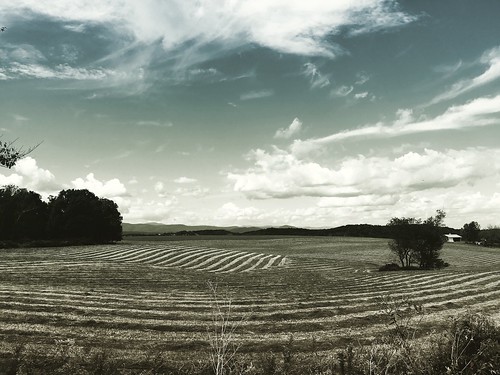
Fields near Swope, Virginia. Photo by Bob Kirchman.
Betsy Bell and Mary Gray Staunton's Twin Mountains Recall Two Young Ladies
Flowers and leaves on Betsy Bell Mountain.
Memorialized in a historic ballad, Betsy and Mary were daughters of two Perthshire gentlemen who went into isolation in the country to avoid a plague. The year was 1666 and a young man who was in love with both of them came to supply them regularly with food. The man eventually came down with the plague himself, passing it along to the two girls. The young man and both girls died of the plague.
The first settlers of the area named the mountains because they reminded them of two similarly named mountains in the old country. The City of Staunton's history records the following:
The original 50-acre park was donated to the City in 1941 by Charles Catlett, who specified that "The City of Staunton shall as far as is reasonably practicable and in its considered opinion advisable, and for the common benefit of its citizens and inhabitants, keep and maintain the crest of the mountain as a perpetual memorial..." of events in the past life of the community and in memory of its citizens who have given their lives in protecting the nation. Catlett further specified that the site be maintained in its natural state, that a "cross" cut out of the woods along the crest be maintained, and that City Council visit the crest of Betsy Bell once each Spring in remembrance of the gift. These requirements have been honored since the bequest. An additional 20 acres was acquired by the City through a donation from CSC Associates in 1995."
The two mountains are one of my favorite places to hike. They provide a wonderful bit of wilderness right in the city of Staunton.
You forget that you are in the city as you walk up Mary Gray Mountain.
The Cross cut out of the forest on Betsy Bell Mountain. It is there as a memorial to those who have given their lives in defense of this Nation.
Looking West from Bear Den Mountain, Mary Gray and Betsy Bell show you where Staunton is.
The trail up the mountain was alive with color when I visited it in Autumn.
The Place of Faith in Education
A Unique Perspective on the Issue from CIVITAS
Iris.
Education is only adequate and worthy when it is itself religious… There is no possibility of neutrality… To be neutral concerning G-d is the same thing as to ignore Him… If children are brought up to have an understanding of life in which, in fact, there is no reference to G-d, you cannot correct the effect of that by speaking about G-d for a certain period of the day. Therefore our ideal for the children of our country is the ideal for truly religious education." -- William Temple, Archbishop of Canterbury in 1942.
Here is a very interesting report from CIVITAS [1.], on The Place of Faith in Schools [click to read] byProfessor David Conway. It adds a new dimension to the debate now raging in America between those who would impose a strictly secular criteria and those who consider Faith an essential component of learning.
[A] nation which draws into itself continuously, and not merely in its first beginnings, the inspiration of a religious faith and a religious purpose will increase its own vitality… Our own nation… has been inspired by a not ignoble notion of national duty to aid the oppressed – the persecuted Vaudois, the suffering slave, the oppressed nationality – and it has been most... characteristically national when it has most felt such inspiration…
We offend against the essence of the [English] nation if we emphasise its secularity, or regard it as merely an earthly unit for earthly purposes. Its tradition began its life at the breast of Christianity; and its development in time, through the centuries… has not been utterly way from its nursing mother… [I]n England our national tradition has been opposed to the idea of a merely secular society for secular purposes standing over against a separate religious society for religious purposes. Our practice has been in the main that of the single society, which if national is also religious, making public profession of Christianity in its solemn acts, and recognising religious instruction as part of its scheme of education." -- Ernest Barker, Cambridge Philosopher
Professor Conway Concludes: "All would stand to benefit from such committed forms of religious education in the country’s state-funded schools, not simply because it would be likely to improve the educational performance, behaviour and well-being of the nation’s schoolchildren. They would also all benefit because, I believe, only by continuing to provide it can this country be assured of remaining the independent and united liberal polity that it has for so long been and from whose continuing to be such all its diverse inhabitants would derive benefit, even those who do not share that faith or any other."
In the end, the state of the Union comes down to the character of the people. I sought for the greatness and genius of America in her commodious harbors and her ample rivers, and it was not there. In the fertile fields and boundless prairies, and it was not there. In her rich mines and her vast world commerce, and it was not there. Not until I went into the churches of America and heard her pulpits, aflame with righteousness, did I understand the secret of her genius and power. America is great because she is good, and if America ever ceases to be good, America will cease to be great. -- Attributed to Alexis de Tocqueville, though it is not a direct quote from his work: Democracy in America. In the quest to restore and revitalize our great land, one often hears great solutions proposed but often very little in the way of addressing the real problem. We can create all the great economic models we want to, but if we allow greed and self-serving policies to prevail, we will see ever more of the type of destruction we saw in the mortgage crisis. If we attempt to spend our way out of our problems by creating more money, we will end up as a vassal to China. We need Revival! THYME has looked at the problem of Restoring the American Dream [click to read] before. Whether or not we can definitively find the quote in de Tocqueville's writings, the work of Alvin Schmidt[1.] and others documents well the evidence for Faith as a force in making better the human condition.
That is not to say that we don't need to seek and consider better ways to conduct our affairs. There is a practical side to problem solving that cannot be ignored. Consider how George Müller changed the lives of thousands of orphans in Bristol, England. First let us set the stage. The elimination of the slave trade by William Wilberforce in the Nineteenth Century destroyed not only a vile institution, but as an unintended consequence the city of Bristol, a major slave port, was thrown into decline. G-d had two chosen instruments to revitalize Bristol. There was Isambard Kingdom Brunel, [2.] who built bridges, railroads and great steamships to link Bristol to the world! But Bristol needed more than just economic development!
The city's decline had led to thousands of children either losing their parents or being put out on the streets by their desperate parents. George Müller was G-d's next instrument in the revitalization of Bristol. YoungMüller came to the city as a minister of the Gospel. As he sought to minister to the soul of a great city, the plight of her orphans tugged at his heart. He, depending on G-d alone, was able to provide five large houses for these unwanted children. He apprenticed all the boys in various trades but took great pains to educate the young women as office workers, nurses, teachers and housekeepers. They stayed at the homes until they were seventeen. This was a practical policy that kept them from being exploited by those engaged in viler trades.
Those who seek to revitalize our own nation would do well to do no less. We must first address the poverty of our national soul before we set into the very necessary business of restoring her fortunes!
A Case for Faith
On page 563 of his latest biography — John Quincy Adams: American Visionary — author Fred Kaplan (biographer of Abraham Lincoln, Charles Dickens, Mark Twain, and Gore Vidal among others) cites this insight of the sixth president:
Christianity had, all in all, he believed, been a civilizing force, “checking and controlling the anti-social passions of man.”
That insight is pretty much all an American needs to know in order to understand why the American Founders considered religion — specifically ethical monotheism rooted in the Hebrew Bible — indispensable to the American experiment; and why the America we have known since 1776 is in jeopardy." -- Dennis Prager.
It is easy to respect secular Americans who hold fast to the Constitution and to American values generally. And any one of us who believes in God can understand why some people, given all the unjust suffering in the world, just cannot believe that there is a Providential Being.
But one cannot respect the view that America can survive without the religious beliefs and values that shaped it. The argument that there are moral secularists and moral atheists is a non sequitur. Of course there are moral Americans devoid of religion. So what? There were moral people who believed in Jove. But an America governed by Roman religion would not be the America that has been the beacon of freedom and the greatest force for good in the world."
Here Dennis Prager is spot-on in his analysis of the nature of man. The academy may tell us that we can effectively control the passions that drive us, but history, honestly pursued, tells us otherwise. Prager points out that: "Our prisons are filled with people whose consciences are quite at peace with their criminal behavior. As for reason, they used it well — to figure out how to get away with everything from murder to white-collar crime.
But our prisons are not filled with religious Jewish and Christian murderers. On the contrary, if all Americans attended church weekly, we would need far fewer prisons; and the ones we needed would have very few murderers in them."
Prager goes on to describe the wreckage of the great socialist experiments of the Twentieth Century, and the wreckage of "anything goes" philosophies that encourage casual sex and tell us that fathers are "unnecessary!" Indeed, if the academy would produce more honest studies of the results of the philosopies they have espoused, they might recoil at the burden they have placed on society.
Prager concludes with this sobering thought: "For proof of the moral and intellectual consequences of the secularization of America, look at what has happened to the least religious institution in America, the university. Is that the future we want for the whole country?"
The film: 'Expelled' is a pretty powerful documentary. G-d is getting some pretty bad press these days from esteemed writers such as Richard Dawkins and Christopher Hitchens. The Intelligent Design movement, though it is not specifically theistic, is uniformly vilified in the academy. Why is an inquiry into the observable order of the universe so dangerous, especially when open inquiry is such a cherished part of scientific investigation? Perhaps such 'open inquiry' inevitably leads to the 'wrong' conclusions.
Theodore Dalrymple writes in City Journal: "What the New Atheists are Missing." Himself a non-believer, he points to a time when a teacher's hypocrasy led him to question. Dalrymple does not, however, reject the realm of faith as a force in creating and ordering societies. He see's naturalistic explainations and philosophies quite insufficient for dealing with all of human existence. Richard Dawkins' assertions that religious education is tantamount to child abuse, for example seem to Dalrymple no more than the rebellious ranting of a child who's just learned that his parents are not perfect. All of us have experienced some sort of disillusionment in our youth. I remember a time when a nun of the 'Sisters of Mercy' punished me for some infraction I had not [at least in my recollection] committed. I too questioned a lot of things. The Cuban missle crisis fueled more unanswered anxiety as I careened into adolescence.
But something happened in my teenaged years that is etched firmly in my memory. It was a dark and stressful winter day when I decided to walk in the woods near Triadelphia Reservoir. Something spoke to me that afternoon that was more eloquent than the ranting of hormones and the perceived unfairness of life. The buds of the trees were growing fat. here was the hope of spring and new life. Clearly spring would come. The buds gave evidence of an event hoped for. They were indeed the substance of something yet unseen!
For the invisible things of him from the creation of the world are clearly seen, being understood by the things that are made, even his eternal power and Godhead; so that they are without excuse:"-- Romans1:20 KJV
Holy writ makes the point that the order and beauty of the creation speaks eloquently of the creator. Thus Intelligent Design, though it merely points out the complex mechanisms of nature, leads one to seek the source of such wisdom. I look to that time in the trees as an affirmation of personal faith in a creator. Though at that point it was pretty detatched and intellectual at best.
"...for he that cometh to G-d must believe that he is, and that he is a rewarder of them that diligenly seek him." Hebrews 11:6b KJV
As a young adult I embraced faith in Christ as redeemer and rewarder. The journey of faith had begun with the fat buds years before though.Therefore I must conlude that those who consider the design of the universe dangerous information have good reason if they fear that others may follow the path I have walked. Dawkins would prefer me to credit space aliens with seeding life to this planet and thus push the hard questions of origin to another world.
Darwinism, in its purest form, rejects the idea that this world is some sort of intentional creation. Of course this leads to the rejection of theism and ultimately the rejection of certain absolutes. 'Expelled' takes a good look at 'eugenics' and how it is supported by a darwinian world view. In the first half of the Twentieth Century certain proponents of eugenics sought to speed evolution along by eliminating the reproduction of certain undesirable types of persons. The results were forced sterilization of the mentally ill and the holecaust. Contrast that movement with Dorethea Dix and others who, motivated by Christian faith, improved conditions for the mentally ill.
Alvin Schmidt makes a good case in his book 'Under the Influence' that faith is a builder of society rather than a force to destroy it. Dalrymple the non-believer would concur. Thus the danger of Intelligent Design leading to dangerous conclusions is much inflated. One might even conclude that the free discussion of order and design,wherever it is found, is wholesome. Certainly there is no basis for its exclusion from the academy.
The argument will no doubt be made: "what about the crusades, what about jihad, religion is dangerous?" Yes, it is certainly something that may be misused, but that must be countered with an honest look at how the so-called "good" science of evolution was the foundation of eugenics. Millions of people were killed in this misguided attempt to improve humanity. Ironically, such brilliant men as Albert Einstein met the criteria for elimination. We reduce the world to only naturalistic explainations at our own peril. The argument for open inquiry stands.
Autumn Leaves. Photo by Bob Kirchman
When through the woods,and forest glades I wander, and hear the birds sing sweetly in the trees; when I look down,from lofty mountain grandeur, and hear the brook and feel the gentle breeze"
-- "How Great Thou Art" Verse 2
A Case for Summer Vacation By Bob Kirchman
How does one nurture the creative genius of a Brunel, or the vision of a Wilberforce or a Müller? I would suggest that men and women of that ilk are often found walking on the "road less traveled!" Walking home alone from a prayer meeting along a quiet street, the great designer, R. G. LeTourneau says he was inspired with the design for a rather complex machine that had stymied his most brilliant designers for weeks. Could it be true that not only should we hold off on 'formal' education a bit, but we should make sure children are not scheduled to the point of losing free, creative time.
If indeed the creative muse shows up in the quiet times, if problems are indeed solved through the exploration of play, wouldn't it make sense for us to esteem these times in the sense their descriptive originally suggests: re-creation?! The 'other'Weekly News Magazine [click to read] once argued that Summer Vacation is over romanticized and merely stands in the way of the kids retaining all that book-learning they'll need so they can work for the Chinese some day. OK, I'll give you the point that a certain amount of knowledge is 'lost' as kids pursue other activities... but as one who's life and career was shaped by Summers of 'other activities' I'll raise a clear protest: "Not so fast!"
I spent my Summers drawing, building things, going to camp and playing for hours in the woods. I was Lewis and Clark when I set off to explore the woods surrounding Triadelphia Reservoir... with no Sacajawea to help with directions. Mom got a big bell to ring when it was time to come in for dinner. Sometimes I actually heard it. More often than not my appetite finally brought me back to a plate of cold food. Now I loved my groceries as much as any young boy, but didn't Simon Kenton eat cold biscuits while he was exporing the Ohio Valley?
When my younger siblings were old enough, Dad loaded us in Mom's VW Microbus [Mom was there first when it came to the minivan] and we took road trips. Man, I loved road trips. We'd go to places like Gettysburg and crawl into sniper's nests. We'd imagine what it must have been like rushing up the hill in Pickett's Charge. Then we'd go to Antietem and wonder some more. When I turned sixteen, Dad actually let me drive on the trips. Oh the white-knuckle thrill of the Capital Beltway! The endless perspective of NC Route 12 heading to Hatteras and the rollercoaster ride down US 29 to Grandma's. Life was good in the Summer. I hired myself out to the local farmers to bale hay and other jobs. Hot, nasty work is good for the teenaged soul.
One farmer had a wife who'd make us grape juice and lemonade. I've never found sweeter refreshment in all my life.
One Summer Dad decided I needed to build a greenhouse. He let me draw up the plans and he took them to the county... I was thirteen at the time. He gave me a budget and set me loose. I learned to lay block, build walls, buy old storm windows and pretty much whatever it took. The guys at Talbott's Lumber Yard in Ellicott City gave me lots of free advice. They pretty much convinced me I could do it. I wonder how much Dad was paying them?
I was not a licensed electrician... that presented a problem for hooking up the power. Dad said it wasn't a problem. He had a buddy who was licensed and came out and did the whole job in exchange for a bottle of Jack Daniels [Black Label] that Dad cheerfully 'donated' to the building fund. In addition to the electric heater, we got the brilliant idea that it would benefit the plants with both heat and moisture if we ran the dryer vent in there.
What to do about lint? Well, here's where it got really interesting. When we discovered that a discarded nylon stocking fit over the vent and caught the lint while allowing air to flow, we had our problem solved. Dad enjoyed the 'conversation piece' that resulted too.
The greenhouse, built of redwood, served our family for many years. Finally it succumbed to termites after I was gone and married. It's lessons are still with me today.
An op-ed in Sunday’s New York Times entitled “We Have Ruined Childhood” offers disheartening data about childhood depression and anxiety, closely linked to school attendance, as well as the disturbing trend away from childhood free play and toward increasing schooling, standardization, and control. “STEM, standardized testing and active-shooter drills have largely replaced recess, leisurely lunches, art and music,” says the writer Kim Brooks, who is the author of the book, Small Animals: Parenthood in the Age of Fear. (read more)
Many people associate stress with the struggles of adult life, but often forget that children also deal with stress. On this classic broadcast, Dr. Dobson talks about this subject with renowned author and psychologist, Dr. Arch Hart. They examine the pressure on our kids and identify the various physical, emotional, and mental indicators of anxiety. (read more)
In this fast-paced society, many children struggle to keep up and can develop severe anxiety problems. On this broadcast, Dr. Dobson continues to talk about our kids and stress with best-selling author and psychologist, Dr. Arch Hart. They discuss how trauma, hostility, overstimulation, and drastic change can intensify a child's stress level. (read more)
Reigniting the Dream
Lois M. Tupyi’s ‘Redemptive Compassion’
People who live in chronic need often lose their ability to hope, dream and make plans for their future.” – Lois M. Tupyi
Sometime around 1933 the United States government entered the business of meeting human needs. As the Great Depression drag on, Government found that it could indeed provide necessities and build houses. Eleanor Roosevelt’s planned community of Greenbelt, Maryland provided clean and new (albeit uniform) houses and apartments to replace the old ‘substandard’ housing of the previous century. In the surrounding fields of the Beltsville Agricultural Research Center, modern chemical dependent agriculture was being developed to assure we’d never have another ‘Dust Bowl.’ While the intent was indeed noble, the result was that people no longer depended on neighbors. Churches ceased to be the primary engine of compassionate care, called ministers being replaced by caseworkers. People became trapped in what would become known as generational poverty. Living from government check to government check, they lost the spark of IMAGO DEI – the ‘Image of God’ that really defines each one of us. Living in chronic need (or chronic dependency) can alter a person’s thinking. If we do not see the roots of it it may look like laziness or mental incapacity. People in the church who want to help become frustrated. Ministry is ineffective at best because there is no real connection between people.
Lois Tupyi is the Executive Director of Love in the Name of Christ, Treasure Valley, Idaho. She’s a Renaissance woman and the author of Selah: Pause and Consider, a devotional that goes beyond the short reading format to encompass Bible reading, praise music and beautiful photography. She’s all about restoring Christian ministry as the Defining Difference, bringing its impact to the local community. Seeing that the church often struggled with trying to provide relational ministry to people in need, Tupyi developed her Redemptive Compassion curriculum. So many of our commonly used methods seem so ineffective in reducing or alleviating ongoing need, and Redemptive Compassion addresses that deficiency by seeing the total person. Scripture shows us that humankind exists in body, soul and spirit. Love in the Name of Christ indeed begins by providing material help but begins immediately to bring disconnected individuals into relationship.
On Thursday evenings in Fishersville, Virginia, the Love Your Neighbor time begins. Church vans from area churches bring ‘Neighbors’ from Staunton, Waynesboro and Augusta County together for a meal and encouraging fellowship. If it looks a bit like the Biblical coming together for “Prayer, Teaching and Breaking of Bread,” that is by design. We begin arriving a few minutes before six and there is much lively conversation between Neighbors and ministry volunteers. Karen, our leader, calls us to prayer as her little daughter socializes with people in the room. A dinner is provided each week by a different local congregation. After dinner, Neighbors gather in small classes that teach Godly self image, basic finances and how to have a relationship with God. A whole group of local churches are involved in the ministry and the goal is to bring Neighbors into ongoing relationship, not only with God, but with His people.
When a Neighbor has completed all of the classes offered, and that may take a couple of years, they graduate from the program. They often offer stirring testimonies on the graduation night and by then have hopefully developed relationships in one of the local churches represented. Love in the Name of Christ is not a church, but it is an arm of THE Church to bring compassion and healing. Many former Neighbors do continue to volunteer in the program which has many opportunities. There is a warehouse for meeting physical needs, a thrift store and of course the Thursday night program. The real ministry is that a person moves from simply being a recipient of help to someone who dreams of making a difference in the world – a person fully alive!
Why Beauty Matters
Roger Scruton
Belmar, New Jersey Remembers
A sand sculpture on the beach in Belmar, New Jersey honors the memory of those who perished in the attacks of September 11, 2001.
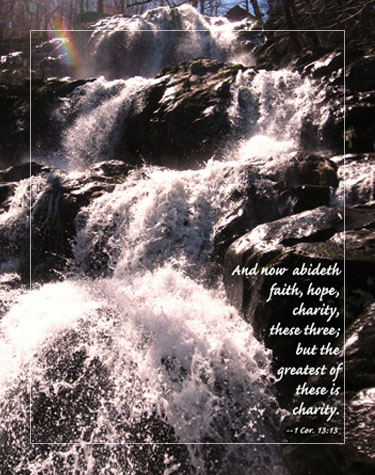
Cover Photo: Dark Hollow Falls Rainbow by Bob Kirchman.
Laney’s Palette Art Show
Saturday September 14th, 2019 in Crozet, VA
Works by Kristina Elaine Greer will be on display at the gallery space of Tabor Presbyterian Church, 5804 Tabor Street, Crozet, Virginia 22932. There will be an opening reception on Saturday, September 14th, 2019 from 1:00 to 4:00pm at the church. All are invited. The show will feature Laney’s Acrylic Paintings and Pencil Drawings from 2004 – 2019.
Finally, brethren, whatsoever things are true, whatsoever things are honest, whatsoever things are just, whatsoever things are pure, whatsoever things are lovely, whatsoever things are of good report; if there be any virtue, and if there be any praise, think on these things.”
— Philippians 4:8
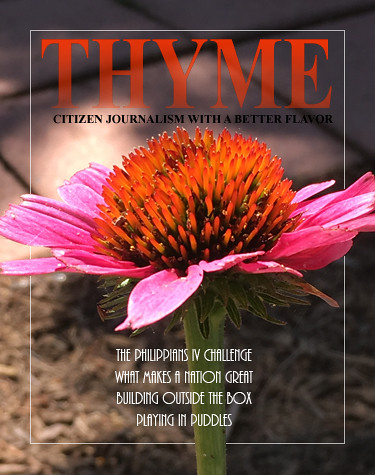
Volume XVII, Issue IXa
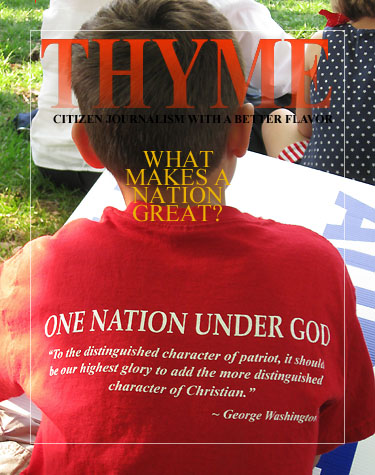
What Makes a Nation Great?
The 'other' Weekly News Magazine [click to read] once asked: "What makes a school great?"THYME asks: "Why stop there, what makes a NATION great?" As we seek to teach our children the foundations of our Nation, we can agree with the 'other' magazine that it takes great teachers.
No doubt, some will insist that it is a simple matter of perfecting institutions. Some will venture so far as to address the character of man himself, but it is quite evident that those who crafted the original documents our nation is founded on saw a need for a hand greater than their own to guide them. Their own writings give us a clear indication that they did, so here are some thoughts from our Founding Fathers:
John Adams and John Hancock: We Recognize No Sovereign but God, and no King but Jesus! [April 18, 1775] John Adams: “ The general principles upon which the Fathers achieved independence were the general principals of Christianity… I will avow that I believed and now believe that those general principles of Christianity are as eternal and immutable as the existence and attributes of G-d.” “[July 4th] ought to be commemorated as the day of deliverance by solemn acts of devotion to God Almighty.” –John Adams in a letter written to Abigail on the day the Declaration was approved by Congress
"We have no government armed with power capable of contending with human passions unbridled by morality and religion. Avarice, ambition, revenge, or gallantry, would break the strongest cords of our Constitution as a whale goes through a net. Our Constitution was made only for a moral and religious people. It is wholly inadequate to the government of any other." --October 11, 1798
"I have examined all religions, as well as my narrow sphere, my straightened means, and my busy life, would allow; and the result is that the Bible is the best Book in the world. It contains more philosophy than all the libraries I have seen." December 25, 1813 letter to Thomas Jefferson
"Without Religion this World would be Something not fit to be mentioned in polite Company, I mean Hell." [John Adams to Thomas Jefferson, April 19, 1817] Samuel Adams:
“He who made all men hath made the truths necessary to human happiness obvious to all… Our forefathers opened the Bible to all.” [ "American Independence," August 1, 1776. Speech delivered at the State House in Philadelphia]
“ Let divines and philosophers, statesmen and patriots, unite their endeavors to renovate the age by impressing the minds of men with the importance of educating their little boys and girls, inculcating in the minds of youth the fear and love of the Deity… and leading them in the study and practice of the exalted virtues of the Christian system.” [October 4, 1790] John Quincy Adams: “Why is it that, next to the birthday of the Savior of the world, your most joyous and most venerated festival returns on this day [the Fourth of July]?" “Is it not that, in the chain of human events, the birthday of the nation is indissolubly linked with the birthday of the Savior? That it forms a leading event in the progress of the Gospel dispensation? Is it not that the Declaration of Independence first organized the social compact on the foundation of the Redeemer's mission upon earth? That it laid the cornerstone of human government upon the first precepts of Christianity"? --1837, at the age of 69, when he delivered a Fourth of July speech at Newburyport, Massachusetts.
“The Law given from Sinai [The Ten Commandments] was a civil and municipal as well as a moral and religious code.” John Quincy Adams. Letters to his son. p. 61
Elias Boudinot: “Be religiously careful in our choice of all public officers . . . and judge of the tree by its fruits.”
Charles Carroll - signer of the Declaration of Independence " Without morals a republic cannot subsist any length of time; they therefore who are decrying the Christian religion, whose morality is so sublime and pure...are undermining the solid foundation of morals, the best security for the duration of free governments." [Source: To James McHenry on November 4, 1800.] Benjamin Franklin: “ G-d governs in the affairs of man. And if a sparrow cannot fall to the ground without his notice, is it probable that an empire can rise without His aid? We have been assured in the Sacred Writings that except the Lord build the house, they labor in vain that build it. I firmly believe this. I also believe that, without His concurring aid, we shall succeed in this political building no better than the builders of Babel” –Constitutional Convention of 1787 original manuscript of this speech
“In the beginning of the contest with Britain, when we were sensible of danger, we had daily prayers in this room for Divine protection. Our prayers, Sir, were heard, and they were graciously answered… do we imagine we no longer need His assistance?” [Constitutional Convention, Thursday June 28, 1787]
In Benjamin Franklin's 1749 plan of education for public schools in Pennsylvania, he insisted that schools teach "the excellency of the Christian religion above all others, ancient or modern."
In 1787 when Franklin helped found Benjamin Franklin University, it was dedicated as "a nursery of religion and learning, built on Christ, the Cornerstone." Alexander Hamilton: Hamilton began work with the Rev. James Bayard to form the Christian Constitutional Society to help spread over the world the two things which Hamilton said made America great: (1) Christianity (2) a Constitution formed under Christianity. “The Christian Constitutional Society, its object is first: The support of the Christian religion. Second: The support of the United States.”
On July 12, 1804 at his death, Hamilton said, “I have a tender reliance on the mercy of the Almighty, through the merits of the Lord Jesus Christ. I am a sinner. I look to Him for mercy; pray for me.”
"For my own part, I sincerely esteem it [the Constitution] a system which without the finger of G-d, never could have been suggested and agreed upon by such a diversity of interests." [1787 after the Constitutional Convention]
"I have carefully examined the evidences of the Christian religion, and if I was sitting as a juror upon its authenticity I would unhesitatingly give my verdict in its favor. I can prove its truth as clearly as any proposition ever submitted to the mind of man."
John Hancock: “In circumstances as dark as these, it becomes us, as Men and Christians, to reflect that whilst every prudent measure should be taken to ward off the impending judgments, …at the same time all confidence must be withheld from the means we use; and reposed only on that God rules in the armies of Heaven, and without His whole blessing, the best human counsels are but foolishness… Resolved; …Thursday the 11th of May…to humble themselves before God under the heavy judgments felt and feared, to confess the sins that have deserved them, to implore the Forgiveness of all our transgressions, and a spirit of repentance and reformation …and a Blessing on the … Union of the American Colonies in Defense of their Rights [for which hitherto we desire to thank Almighty God]…That the people of Great Britain and their rulers may have their eyes opened to discern the things that shall make for the peace of the nation…for the redress of America’s many grievances, the restoration of all her invaded liberties, and their security to the latest generations. "A Day of Fasting, Humiliation and Prayer, with a total abstinence from labor and recreation. Proclamation on April 15, 1775"
Patrick Henry: "Orator of the Revolution." This is all the inheritance I can give my dear family. The religion of Christ can give them one which will make them rich indeed.” —The Last Will and Testament of Patrick Henry
“It cannot be emphasized too clearly and too often that this nation was founded, not by religionists, but by Christians; not on religion, but on the gospel of Jesus Christ. For this very reason, peoples of other faiths have been afforded asylum, prosperity, and freedom of worship here.” [May 1765 Speech to the House of Burgesses]
“The Bible is worth all other books which have ever been printed.”
John Jay: “ Providence has given to our people the choice of their rulers, and it is the duty, as well as the privilege and interest of our Christian nation to select and prefer Christians for their rulers.” Source: October 12, 1816. The Correspondence and Public Papers of John Jay, Henry P. Johnston, ed., (New York: Burt Franklin, 1970), Vol. IV, p. 393.
“Whether our religion permits Christians to vote for infidel rulers is a question which merits more consideration than it seems yet to have generally received either from the clergy or the laity. It appears to me that what the prophet said to Jehoshaphat about his attachment to Ahab ["Shouldest thou help the ung-dly and love them that hate the Lord?" 2 Chronicles 19:2] affords a salutary lesson.” [The Correspondence and Public Papers of John Jay, 1794-1826, Henry P. Johnston, editor (New York: G.P. Putnam's Sons, 1893), Vol. IV, p.365] Thomas Jefferson: “ The doctrines of Jesus are simple, and tend to all the happiness of man.”
“Of all the systems of morality, ancient or modern which have come under my observation, none appears to me so pure as that of Jesus.”
"I am a real Christian, that is to say, a disciple of the doctrines of Jesus."
“God who gave us life gave us liberty. And can the liberties of a nation be thought secure when we have removed their only firm basis, a conviction in the minds of the people that these liberties are a gift from God? That they are not to be violated but with His wrath? Indeed I tremble for my country when I reflect that God is just, and that His justice cannot sleep forever.” (excerpts are inscribed on the walls of the Jefferson Memorial in the nations capital) [Source: Merrill . D. Peterson, ed., Jefferson Writings, (New York: Literary Classics of the United States, Inc., 1984), Vol. IV, p. 289. From Jefferson’s Notes on the State of Virginia, Query XVIII, 1781.] Samuel Johnston: “It is apprehended that... Mahometans (Muslims), pagans, etc., may be elected to high offices under the government of the United States. Those who are Mahometans, or any others who are not professors of the Christian religion, can never be elected to the office of President or other high office, [unless] first the people of America lay aside the Christian religion altogether, it may happen. Should this unfortunately take place, the people will choose such men as think as they do themselves. [Elliot’s Debates, Vol. IV, pp 198-199, Governor Samuel Johnston, July 30, 1788 at the North Carolina Ratifying Convention] James Madison: “ We’ve staked our future on our ability to follow the Ten Commandments with all of our heart.”
“We have staked the whole future of American civilization, not upon the power of government, far from it. We’ve staked the future of all our political institutions upon our capacity…to sustain ourselves according to the Ten Commandments of G-d.” [1778 to the General Assembly of the State of Virginia]
• I have sometimes thought there could not be a stronger testimony in favor of religion or against temporal enjoyments, even the most rational and manly, than for men who occupy the most honorable and gainful departments and [who] are rising in reputation and wealth, publicly to declare the unsatisfactoriness [of temportal enjoyments] by becoming fervent advocates in the cause of Christ; and I wish you may give in your evidence in this way. Letter by Madison to William Bradford (September 25, 1773) • In 1812, President Madison signed a federal bill which economically aided the Bible Society of Philadelphia in its goal of the mass distribution of the Bible . “ An Act for the relief of the Bible Society of Philadelphia” Approved February 2, 1813 by Congress
“It is the mutual duty of all to practice Christian forbearance, love, and charity toward each other.”
• A watchful eye must be kept on ourselves lest, while we are building ideal monuments of renown and bliss here, we neglect to have our names enrolled in the Annals of Heaven. [Letter by Madison to William Bradford [urging him to make sure of his own salvation] November 9, 1772]
At the Constitutional Convention of 1787, James Madison proposed the plan to divide the central government into three branches. He discovered this model of government from the Perfect Governor, as he read Isaiah 33:22; “For the LORD is our judge, the LORD is our lawgiver, the LORD is our king; He will save us.” [Baron Charles Montesquieu, wrote in 1748; “Nor is there liberty if the power of judging is not separated from legislative power and from executive power. If it [the power of judging] were joined to legislative power, the power over life and liberty of the citizens would be arbitrary, for the judge would be the legislature if it were joined to the executive power, the judge could have the force of an oppressor. All would be lost if the same … body of principal men … exercised these three powers." Madison claimed Isaiah 33:22 as the source of division of power in government See also: pp.241-242 in Teaching and Learning America’s Christian History: The Principle approach by Rosalie Slater]
James McHenry – Signer of the Constitution: Public utility pleads most forcibly for the general distribution of the Holy Scriptures. The doctrine they preach, the obligations they impose, the punishment they threaten, the rewards they promise, the stamp and image of divinity they bear, which produces a conviction of their truths, can alone secure to society, order and peace, and to our courts of justice and constitutions of government, purity, stability and usefulness. In vain, without the Bible, we increase penal laws and draw entrenchments around our institutions. Bibles are strong entrenchments. Where they abound, men cannot pursue wicked courses, and at the same time enjoy quiet conscience.
Jedediah Morse: "To the kindly influence of Christianity we owe that degree of civil freedom, and political and social happiness which mankind now enjoys. . . . Whenever the pillars of Christianity shall be overthrown, our present republican forms of government, and all blessings which flow from them, must fall with them." John Peter Gabriel Muhlenberg: In a sermon delivered to his Virginia congregation on Jan. 21, 1776, he preached from Ecclesiastes 3. Arriving at verse 8, which declares that there is a time of war and a time of peace, Muhlenberg noted that this surely was not the time of peace; this was the time of war. Concluding with a prayer, and while standing in full view of the congregation, he removed his clerical robes to reveal that beneath them he was wearing the uniform of an officer in the Continental army! He marched to the back of the church; ordered the drum to beat for recruits and over three hundred men joined him, becoming the Eighth Virginia Brigade. John Peter Muhlenberg finished the Revolution as a Major-General, having been at Valley Forge and having participated in the battles of Brandywine, Germantown, Monmouth, Stonypoint, and Yorktown.
Thomas Paine: “ It has been the error of the schools to teach astronomy, and all the other sciences, and subjects of natural philosophy, as accomplishments only; whereas they should be taught theologically, or with reference to the Being who is the author of them: for all the principles of science are of divine origin. Man cannot make, or invent, or contrive principles: he can only discover them; and he ought to look through the discovery to the Author.” “ The evil that has resulted from the error of the schools, in teaching natural philosophy as an accomplishment only, has been that of generating in the pupils a species of atheism. Instead of looking through the works of creation to the Creator himself, they stop short, and employ the knowledge they acquire to create doubts of his existence. They labour with studied ingenuity to ascribe every thing they behold to innate properties of matter, and jump over all the rest by saying, that matter is eternal.” “The Existence of God--1810” Benjamin Rush: • “I lament that we waste so much time and money in punishing crimes and take so little pains to prevent them…we neglect the only means of establishing and perpetuating our republican forms of government; that is, the universal education of our youth in the principles of Christianity by means of the Bible; for this Divine Book, above all others, constitutes the soul of republicanism.” “By withholding the knowledge of [the Scriptures] from children, we deprive ourselves of the best means of awakening moral sensibility in their minds.” [Letter written (1790’s) in Defense of the Bible in all schools in America] • “Christianity is the only true and perfect religion.” • “If moral precepts alone could have reformed mankind, the mission of the Son of God into our world would have been unnecessary.”
"Let the children who are sent to those schools be taught to read and write and above all, let both sexes be carefully instructed in the principles and obligations of the Christian religion. This is the most essential part of education” Letters of Benjamin Rush, "To the citizens of Philadelphia: A Plan for Free Schools", March 28, 1787 Justice Joseph Story: “ I verily believe Christianity necessary to the support of civil society. One of the beautiful boasts of our municipal jurisprudence is that Christianity is a part of the Common Law. . . There never has been a period in which the Common Law did not recognize Christianity as lying its foundations.” [Commentaries on the Constitution of the United States p. 593] “ Infidels and pagans were banished from the halls of justice as unworthy of credit.” [Life and letters of Joseph Story, Vol. II 1851, pp. 8-9.] “ At the time of the adoption of the constitution, and of the amendment to it, now under consideration [i.e., the First Amendment], the general, if not the universal sentiment in America was, that Christianity ought to receive encouragement from the state, so far as was not incompatible with the private rights of conscience, and the freedom of religious worship.” [Commentaries on the Constitution of the United States p. 593] Noah Webster: “ The duties of men are summarily comprised in the Ten Commandments, consisting of two tables; one comprehending the duties which we owe immediately to G-d-the other, the duties we owe to our fellow men.”
“In my view, the Christian religion is the most important and one of the first things in which all children, under a free government ought to be instructed...No truth is more evident to my mind than that the Christian religion must be the basis of any government intended to secure the rights and privileges of a free people.” [Source: 1828, in the preface to his American Dictionary of the English Language]
Let it be impressed on your mind that G-d commands you to choose for rulers just men who will rule in the fear of God [Exodus 18:21]. . . . If the citizens neglect their duty and place unprincipled men in office, the government will soon be corrupted . . . If our government fails to secure public prosperity and happiness, it must be because the citizens neglect the Divine commands, and elect bad men to make and administer the laws. [Noah Webster, The History of the United States (New Haven: Durrie and Peck, 1832), pp. 336-337, 49]
“All the miseries and evils which men suffer from vice, crime, ambition, injustice, oppression, slavery and war, proceed from their despising or neglecting the precepts contained in the Bible.” [Noah Webster. History. p. 339]
“The Bible was America’s basic textbook in all fields.” [Noah Webster. Our Christian Heritage p.5]
“Education is useless without the Bible” [Noah Webster. Our Christian Heritage p.5 ]
Statue of George Washington, National Cathedral. “I have tried to show not the soldier, not the President, but the man Washington, coming into Christ Church, Alexandria, pausing a moment before going down the aisle to his pew,” said sculptor Lee Lawrie (1877-1963).
George Washington:
Farewell Address: The name of American, which belongs to you, in your national capacity, must always exalt the just pride of Patriotism, more than any appellation derived from local discriminations. With slight shades of difference, you have the same religion" ...and later: "...reason and experience both forbid us to expect, that national morality can prevail in exclusion of religious principle..."
“ It is impossible to rightly govern the world without G-d and Bible.”
“What students would learn in American schools above all is the religion of Jesus Christ.” [speech to the Delaware Indian Chiefs May 12, 1779]
"To the distinguished character of patriot, it should be our highest glory to add the more distinguished character of Christian" [May 2, 1778, at Valley Forge]
During his inauguration, Washington took the oath as prescribed by the Constitution but added several religious components to that official ceremony. Before taking his oath of office, he summoned a Bible on which to take the oath, added the words “So help me G-d!” to the end of the oath, then leaned over and kissed the Bible.
Nelly Custis-Lewis (Washington’s adopted daughter): Is it necessary that any one should [ask], “Did General Washington avow himself to be a believer in Christianity?" As well may we question his patriotism, his heroic devotion to his country. His mottos were, "Deeds, not Words"; and, "For G-d and my Country."
“ O Most Glorious G-d, in Jesus Christ, my merciful and loving Father; I acknowledge and confess my guilt in the weak and imperfect performance of the duties of this day. I have called on Thee for pardon and forgiveness of my sins, but so coldly and carelessly that my prayers are become my sin, and they stand in need of pardon.” “ I have sinned against heaven and before Thee in thought, word, and deed. I have contemned Thy majesty and holy laws. I have likewise sinned by omitting what I ought to have done and committing what I ought not. I have rebelled against the light, despising Thy mercies and judgment, and broken my vows and promise. I have neglected the better things. My iniquities are multiplied and my sins are very great. I confess them, O Lord, with shame and sorrow, detestation and loathing and desire to be vile in my own eyes as I have rendered myself vile in Thine. I humbly beseech Thee to be merciful to me in the free pardon of my sins for the sake of Thy dear Son and only Savior Jesus Christ who came to call not the righteous, but sinners to repentance. Thou gavest Thy Son to die for me.” [George Washington; from a 24 page authentic handwritten manuscript book dated April 21-23, 1752 William J. Johnson George Washington, the Christian (New York: The Abingdon Press, New York & Cincinnati, 1919), pp. 24-35.]
"Although guided by our excellent Constitution in the discharge of official duties, and actuated, through the whole course of my public life, solely by a wish to promote the best interests of our country; yet, without the beneficial interposition of the Supreme Ruler of the Universe, we could not have reached the distinguished situation which we have attained with such unprecedented rapidity. To HIM, therefore, should we bow with gratitude and reverence, and endeavor to merit a continuance of HIS special favors". [1797 letter to John Adams] James Wilson:
Signer of the Declaration of Independence and the Constitution
Supreme Court Justice appointed by George Washington
Spoke 168 times during the Constitutional Convention
"Christianity is part of the common law" [Sources: James Wilson, Course of Lectures [vol 3, p.122]; and quoted in Updegraph v. The Commonwealth, 11 Serg, & R. 393, 403 (1824).]
Source: Quotes of the Founding Fathers.
The National Cathedral
“A Great Church for National Purposes”
View from the Bishop's Garden.
As Pierre L’Enfant was laying out the new capital city, George Washington and L’Enfant imagined “a great church for national purposes.” It was originally envisioned as being in the spot now occupied by the National Portrait Gallery, but when in 1893 Congress actually granted the charter for the cathedral, it would come to be located on the high ground it now occupies North of Glover Park and the Naval Observatory. Mount Saint Alban was the most commanding hill in the District of Columbia and the Right Reverend Henry Yates, Episcopal Bishop of Washington, selected it. In 1898 President William McKinley attended the dedication of the Peace Cross on the Cathedral Close marking the end of the Spanish-American War. Architects George Frederick Bodley and Henry Vaughn created the design – a Gothic Cathedral with flying buttresses!
The Foundation Stone was set in place on September 29, 1907. The Cathedral would be constructed entirely with donations. It was completed in 1990. The sculptures Ex Nihilo (out of nothing) over the entrance doors were carved by sculptor Frederick Hart over a ten year period in the mid 1970s. He entered a competition for the façade but his initial entry was rejected. Undeterred, he submitted a refined proposal and the rest is history.
Hart’s career path was anything but conventional. He dropped out of the Corcoran School. Took some art classes at American University and then took a job in the mail room of the National Cathedral for the specific purpose of pestering Roger Morigi. Morigi was the Cathedral’s master carver. He had carved the frieze for the United States Supreme Court Building. Hart wanted Morigi to take him on as an apprentice and eventually he did, becoming like a father figure to him.
Morigi was a temperamental perfectionist and a genius. He started Hart out carving details high up in the structure. As he became a master himself, he was allowed to work on the intricate details closer to the ground. When the great entry sculptures were needed, he was himself a master!
Flying Butresses.
The work: Ex Nihilo, completed in 1982, Hart’s depiction of the birth of mankind is considered one of the most important commissions of religious sculpture in the 20th century. The tympanum above the central door features half-formed figures of men and women emerging from the void. Beneath stands the figure of Adam, his eyes not yet open and his body not fully freed from the surrounding stone. The north tympanum depicts the Creation of Day, and the south tympanum depicts the Creation of Night.
Inside the Cathedral.
Inscription: This Cross is raised in the Historic Year A.D. 1898 to Mark the Founding of the Cathedral of St. Peter and St. Paul That it may please Thee To give to all Nations Unity Peace and Concord We beseech Thee to hear us Good Lord
JESUS CHRIST HIMSELF BEING THE CHIEF CORNER STONE
Photos by Bob Kirchman.
The twenty foot tall Peace Cross is a Celtic cross formed from two pieces of limestone. It was designed by the architect, Robert W. Gibson(who also designed National Cathedral School’s Hearst Hall), and donated by Cathedral Trustee Dr. William Cabell Rives. It bears on its front the litany for unity, peace, and concord.The Peace Cross was erected on October 23, 1898, at a memorial service at which President McKinley spoke, denoting that this land be set apart for sacred purposes. Mr. Nourse, senior warden at St. Alban’s church and a descendant of Joseph Nourse, the original owner of the land on Mount St. Alban, pulled the cord that held the flag enveloping the Peace Cross. “It was raised on Sunday, October 23, 1898, not only to mark the sign of the Cross, the site of the Cathedral of St. Peter and St. Paul, but also to commemorate the ending of the war between Spain and the United States and the first meeting of the General Convention in the Capitol. Here for three decades open air services of public worship have been held on Sabbath afternoons from May to September.” Cathedral Age, Michaelmas, 1928
The 'Space Window' was designed by St. Louis artist Rodney Winfield and fabricated under his supervision. It contains a moon rock. Whirling stars and orbiting planets are depicted in orange, red and white on a deep blue and green field.
Image Credit: NASA
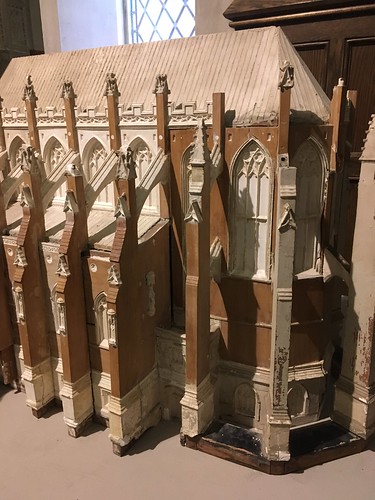
This architectural model was built in 1915 to represent the original plans for the Cathedral as designed by George Frederick Bodley and Henry Vaughn. It was used to show people all around the country the majestic cathedral they proposed.
When Thomas Jefferson originally moved into the South Pavilion of his Monticello estate in 1770, it was little more than an incomplete two-bedroom brick building and a cleared mountaintop. Over the course of the next 38 years, the author of the Declaration of Independence would personally design and oversee the construction of his “essay in architecture.” The main house at Monticello, as it stands today, is a piece of architectural wonder; its design embodies themes derived from both Classical and Palladian styles of work. While the Renaissance man himself was never formally trained as an architect, you can hardly tell, as his home consists of numerous unique features including a triangular pediment supported by Doric columns and his famous octagonal dome. Inside, the walls are covered with a variety of objects that highlight the former president’s interests and accomplishments. Even today, you can still find one of the last remaining original artifacts from the Lewis and Clark expedition—a pair of elk antlers—in the entrance hall. But just like the great Roman cities that heavily influenced the design of Jefferson’s home, Monticello wasn’t built in a day. Despite the fact that Jefferson amassed a great deal of debt by the time of his death, which can largely be attributed to debts he inherited from his father-in-law and his extensive list of hobbies, one can hardly argue that he failed to make sound economic choices with regard to his early years of homeownership. People do not start their adult lives the way early Jefferson did anymore. Today, most young individuals leave college and either become renters, pouring thousands of dollars a year into a property they will never own, or naively “take advantage” of artificially low interest rates and acquire a mortgage they can barely afford to pay off. There is an alternative path, however, and it is very much akin to the home-owning path Jefferson took at the end of the 18th century. (read more)
Photo by Nick Page.
School Starting Age: The Evidence
by David Whitebread
Earlier this month the "Too Much, Too Soon" campaign made headlines with a letter calling for a change to the start age for formal learning in schools. Here, one of the signatories, Cambridge researcher David Whitebread, from the Faculty of Education, explains why children may need more time to develop before their formal education begins in earnest.
"In the interests of children’s academic achievements and their emotional well-being, the UK government should take this evidence seriously" -- David Whitebread
In England children now start formal schooling, and the formal teaching of literacy and numeracy at the age of four. A recent letter signed by around 130 early childhood education experts, including myself, published in the Daily Telegraph (11 Sept 2013) advocated an extension of informal, play-based pre-school provision and a delay to the start of formal ‘schooling’ in England from the current effective start until the age of seven (in line with a number of other European countries who currently have higher levels of academic achievement and child well-being).
This is a brief review of the relevant research evidence [1.] which overwhelmingly supports a later start to formal education. This evidence relates to the contribution of playful experiences [2.] to children’s development as learners, and the consequences of starting formal learning at the age of four to five years of age
There are several strands of evidence which all point towards the importance of play in young children’s development, and the value of an extended period of playful learning before the start of formal schooling. These arise from anthropological, psychological, neuroscientific and educational studies. Anthropological studies of children’s play in extant hunter-gatherer societies, and evolutionary psychology studies of play in the young of other mammalian species, have identified play as an adaptation which evolved in early human social groups. It enabled humans to become powerful learners and problem-solvers. Neuroscientific studies have shown that playful activity leads to synaptic growth, particularly in the frontal cortex, the part of the brain responsible for all the uniquely human higher mental functions.
In my own area of experimental and developmental psychology, studies have also consistently demonstrated the superior learning and motivation arising from playful, as opposed to instructional, approaches to learning in children. Pretence play supports children’s early development of symbolic representational skills, including those of literacy, more powerfully than direct instruction. Physical, constructional and social play supports children in developing their skills of intellectual and emotional ‘self-regulation’, skills which have been shown to be crucial in early learning and development. Perhaps most worrying, a number of studies have documented the loss of play opportunities for children over the second half of the 20th century and demonstrated a clear link with increased indicators of stress and mental health problems.
Within educational research, a number of longitudinal studies have demonstrated superior academic, motivational and well-being outcomes for children who had attended child-initiated, play-based pre-school programmes. One particular study of 3,000 children across England, funded by the Department for Education themselves, showed that an extended period of high quality, play-based pre-school education was of particular advantage to children from disadvantaged households.
Studies have compared groups of children in New Zealand who started formal literacy lessons at ages 5 and 7. Their results show that the early introduction of formal learning approaches to literacy does not improve children’s reading development, and may be damaging. By the age of 11 there was no difference in reading ability level between the two groups, but the children who started at 5 developed less positive attitudes to reading, and showed poorer text comprehension than those children who had started later. In a separate study of reading achievement in 15 year olds across 55 countries, researchers showed that there was no significant association between reading achievement and school entry age.
This body of evidence raises important and serious questions concerning the direction of travel of early childhood education policy currently in England. In the interests of children’s academic achievements and their emotional well-being, the UK government should take this evidence seriously.
This work is licensed under a Creative Commons License. [1.] The original article appears Here [click to read].
The cat is slowly scratching its way out of the bag. Ever more people are becoming aware of the colossal waste of money, tragic waste of young people’s time, and cruel imposition of stress and anxiety produced by our coercive educational system. Children come into the world biologically designed to educate themselves. Their curiosity, playfulness, sociability, and willfulness were all shaped by natural selection to serve the function of education. So what do we do? At great expense (roughly $15,000 per child per year for public K-12), we send them to schools that deliberately shut off their educative instincts – that is, suppress their curiosity, playfulness, sociability, and willfulness – and then, at great expense and trouble, very inefficiently and ineffectively try to educate them through systems of reward and punishment that play on hubris, shame, and fear. For far less expense we can facilitate, rather than suppress, children’s natural ways of educating themselves. (read more)
Molly McElwee-Malloy uses her music degree every day in her work with health care professionals, advocacy groups and insurance companies to help people with diabetes. (read more)
Playing freely and having little adventures is part of childhood. So why do so many parents give me strange looks when my children roam and play?”
At a park near my house on a hot summer day, my five-year-old and two-year-old discover the water fountain. They make a game of splashing water out and stomping in the puddle with their bare feet. Other young children try to join in, but parent after parent says “no” and takes them away, sometimes in tears. These unhappy parents look offended as they search for the lazy mom who must not know her children are causing trouble. (read more)
DuPont Circle Fountain, Washington, DC. Photos by Bob Kirchman.
Laney’s Palette Art Show
Saturday September 14th, 2019 in Crozet, VA
Works by Kristina Elaine Greer will be on display at the gallery space of Tabor Presbyterian Church, 5804 Tabor Street, Crozet, Virginia 22932. There will be an opening reception on Saturday, September 14th, 2019 from 1:00 to 4:00pm at the church. All are invited. The show will feature Laney’s Acrylic Paintings and Pencil Drawings from 2004 – 2019.