Volume XVI, Issue VIII, Special Edition
Lillie’s Legacy
And Joshua set up twelve stones in the midst of Jordan, in the place where the feet of the priests which bare the ark of the covenant stood: and they are there unto this day.” – Joshua 4:1-9
This morning I was shoveling out after the (hopefully) last snow of the season when the propane man drove up to fill the tank. “You know there used to be a house down there – by those catalpa trees,” he said. “I grew up there.” “Did you have a basketball hoop on that closest catalpa?” I asked him. He wasn’t sure but said it was likely him or one of his siblings who put it up. He told us about his mother, Lillie Hogsett, “A real prayer warrior,” he said. “Family over that ridge would have someone sick, mom would gather us kids and walk across the ridge to the house and pray for them. She walked all over this land praying!” Here was a part of the history of ‘our’ place that I never knew and I was most grateful for the telling of it!
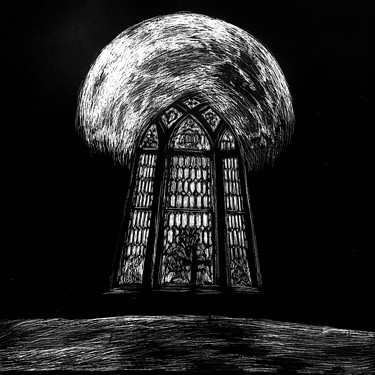
“Bringing the Beauty of Zion to the World”
— Scratchboard 12” x 12” by Bob Kirchman. A gift to Kristina and Jonathan Greer.
Walk about Zion, and go around her: tell the towers thereof. Mark ye well her bulwarks, consider her palaces; that ye May tell it to the generation following” — PSALM 48:12,13
“The Father of the Lunar Module”
Thomas Joseph Kelly
We all knew that we were part of a majestic endeavour, and that we were making history happen.” – Tom Kelly
When John F. Kennedy challenged America to reach for the moon, the technology to actually land there and return safely to earth was but a concept. There was no precedent anywhere for the spaceship that would have to be built. The spacecraft developed by Tom Kelly and his Lunar Lander Team at Grumman Aircraft was the first of its kind. The stakes were high too. The craft would have to separate from the Command Module in lunar orbit, fire its descent engine to slow the craft so it would descend to the moon and then slow the craft as the astronauts set it down on the lunar surface. Because the moon has no atmosphere the craft had to descend using the rocket engine to brake it. After touchdown the astronauts would use the Lunar Module as their base and their home while they explored the moon, then the descent stage would become the launch pad for the ascent stage as it took off to rejoin the command module in space. All of this required multiple firings of the essential rockets. Everything had to work perfectly in a time-critical sequence or the astronauts would be stranded. There was no way to ‘hold’ the countdown and fix something as had been often done prior to launches on earth.
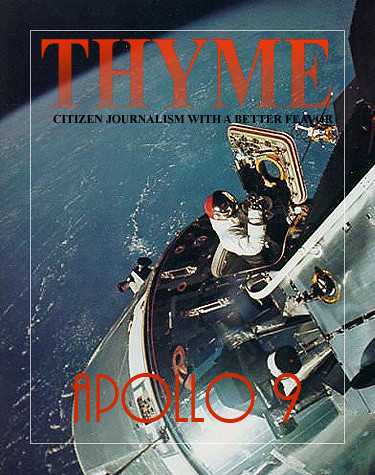
When Grumman won the contract, it was estimated that the spacecraft would cost $500 million to develop and produce, but as the seven years allotted for the project unfolded, the lunar lander proved to be much more of a challenge than anyone imagined. The first LEM was scheduled for a flight in the Fall of 1968 but as that deadline came and went engineers still worked to make the spacecraft ready. It was not until 1969 that the craft was actually flown for the first time by astronauts in earth orbit. Apollo 9 tested all of the functionality of the craft in earth orbit. Apollo 10 tested in lunar orbit but did not land on the moon. The Eagle, only the third lunar module to be flown, actually landed on the moon. The awkward little lunar lander, which had proved so difficult to develop for Kelly and his team, performed wonderfully. When Apollo 13 was crippled by an explosion in the service module, the LEM became the crew’s lifeboat. Without the critical systems of the lunar module the astronauts would have never made it home.
With NASA facing budget cuts and the American media yawning at America’s space aspirations, the agency opted for four more all-out Apollo missions with a much enhanced LEM that even included a lunar rover on the final missions. Then the Apollo Program was over. NASA refocused its resources on the Space Shuttle and the International Space Station – holding out the promise that these programs would lead to more deep space exploration in the future. The shuttle and the ISS proved to be very costly in their own right and maintaining those programs drained any resources that might have been used to take us back to the moon or on to Mars. Thus the lunar lander became a somewhat forgotten chapter in the history of space exploration. The fact remains that a group of dedicated men and women on Long Island devoted seven years of their life to developing a craft to land and function in deep space, landing on and returning from an airless world with 1/6 the earth’s gravity. They had to develop systems whose first trial would (and could only) be their actual use. This was perhaps the most ‘giant leap for mankind’ as far as spacecraft development. The machine they developed was so governed by weight requirements that it became a stripped-down spidery looking contraption unlike the streamlined Disney moon rocket of Tomorrowland. Tom Hanks, in the From the Earth to the Moon miniseries does well to compare building the LEM to Michelangelo painting the ceiling of the Sistine Chapel. I love the comparison. Tom Kelly, Lunar Module Designer, died in March of 2002. I like to think he would truly appreciate it as well.
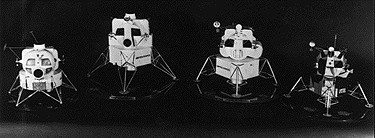
The development of the Lunar Module. NASA Photo.
The Amazing Lunar Module
Testing the Lunar Module
The First Manned Earth Orbit Test
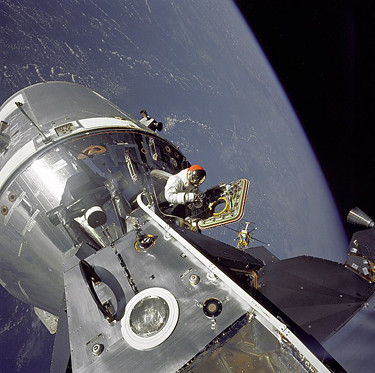
Before the LEM could undock, an EVA had to be performed to assure the astronauts could do an emergency transfer in the event that the spacecraft couldn't dock.
Photo by Russell L. Schweickart. NASA.

NASA Illustration S69-18547.

NASA Illustration S69-18547 (Detail).
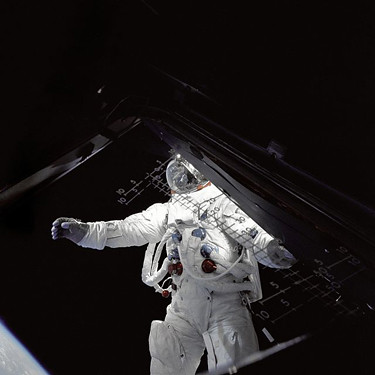
Jim McDivitt snapped this photo of Russell L. Schweickart testing the portable life support backpack used in the lunar missions.
NASA.
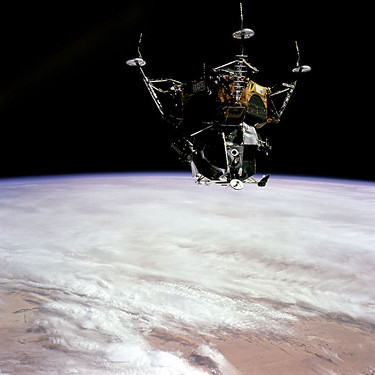
The Lunar Module 'Spider' undocked fron the Command module 'Gumdrop' to begin a test of undocking and rendezvous.
David Scott, NASA.
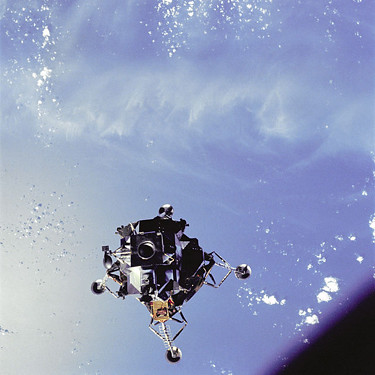
David Scott snapped this photo as the Lunar Module flew away from the Command Module.
NASA.
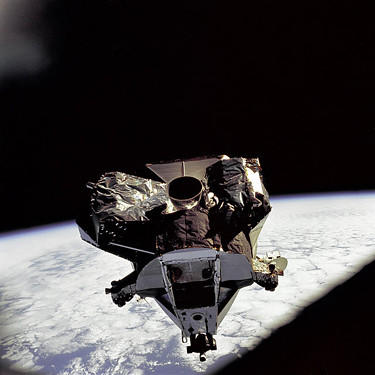
McDivvit and Schweickart return to the Command Module after firing the ascent engine.
NASA.
Public Schools Are A Lot Like Prison
[click to read]
By Lela Markham
Lela Markham is an Alaska novelist who told tales as soon as she could talk. She lives the adventure of a lifetime on the Last Frontier where the midnight sun encourages wandering the wilderness and the long winter nights favor reading, writing and staring at the northern lights. It's all about the aurora watching!
The other day, Kiernan and some friends of his were talking about being bullied in school. For Kiernan, this was a while ago. He made it stop by breaking the law. The kid was actually bullying Kiernan’s friend because he is an Eskimo. Kiernan and Tim walked off campus, let the bully follow them and then Kiernan socked the kid in the nose. He knew we’d have his back, union legal insurance all greased up, if necessary. The parents of the kid he socked didn’t call the cops, so I guess the kid learned his lesson … as did the bully I hit in the head with my metal lunchbox back in the third grade … only in that case the cop took one look at how little I was compared to how big the boy (who was picking on the littler kids I’d been asked to walk home) was and told Colin Cooper’s parents they needed to discipline their son or he’d do it for them. A different era when common sense was still common enough “not to be a unicorn.”
So while Kiernan and his friends were talking, our friend Lee remarked to Brad “Sounds like prison.” Lee would know. He spent four years in Alaska’s prison system 20-odd years ago. He’s willingly shared his stories with me and they’re becoming part of What If … Wasn’t, my literary fiction that still needs a lot of work. He and his wife home school their four children. Their son just won a full-ride academic scholarship to college having never attended public school, so this may have been the first time Lee became aware of school bullying. (read more)

Volume XVI, Issue VIIIa
Apollonius
By Bob Kirchman
Copyright © 2019, The Kirchman Studio, all rights reserved
Chapter 8: The False Messiah!
Dr. Kline would not oversee the care of the ship’s most prominent patient, George Apollonius, however. His personal physicians were accompanying the billionaire to the colony and would oversee the healthcare of the settlers. They were two young Russian women and had been caring for the man for some time. Kline wondered if this was a set-up for Apollonius to sire offspring on Mars, but his presumed age made the good doctor forget the thought. Surely Apollonius had wanted thousands of colonists in his original vision. That was simply unrealistic. Even adding fifty settlers a trip, that would take centuries if no ships were added to the fleet and the colonists did not rapidly produce lots of children.This wasn't like the wild places of Earth, where you simply built your dwelling and tried to farm. Survival required a fairly complex biosphere to maintain atmospheric pressure and breathable air. The settlement that would be built would be merely a prototype.
No one knew how old George Apollonius really was. There were rumors that he had been kept alive ‘past his time’ by drugs and secret technology. A photograph of World War II Nazi S. S. officer Oskar Groening once circulated, misidentified as George Apollonius. That had been pretty solidly debunked… Apollonius wasn’t even born then! He had, in fact, accompanied an uncle in his native country of Hungary as he confiscated private property from people considered ‘enemies of the state.’ He said of that time: “I could be on the other side or I could be the one from whom the thing is being taken away. But there was no sense that I shouldn’t be there, because … If I wasn’t doing it, somebody else would – would — would be taking it away anyhow. And it was the — whether I was there or not, I was only a spectator, the property was being taken away. So the — I had no role in taking away that property. So I had no sense of guilt.”
Apollonius had made the bulk of his fortune by manipulating currencies. During one Asian financial crisis, Malaysian Prime Minister Mahathir bin Mohamad accused him of bringing down the nation’s currency through his trading activities, and in Thailand he was called an “economic war criminal.” Known as “The Man who Broke the Bank of England,” Apollonius initiated a British financial crisis by dumping 10 billion sterling, forcing the devaluation of the currency and gaining a billion-dollar profit. These fortunes were used to turn the course of elections in the United States and elsewhere. Much of it was given to media organizations that perpetuated his ideas. He was a globalist and sought to diminish nations such as the United States and Britain through a variety of channels.
He once said: “I admit that I have always harbored an exaggerated view of my self-importance—to put it bluntly, I fancied myself as some kind of god... or I carried some rather potent messianic fantasies with me from childhood, which I felt I had to control, otherwise I might end up in the loony bin.” He was, to be sure a megalomaniac, and a very dangerous one! He insisted it was in everyone’s best interest for powers such as the United States to become subservient to international bodies. He sought more power for groups such as the World Bank and International Monetary Fund, even while saying the U.S. role in the IMF should be “downsized.” Of course, he would find an ever greater role for himself. In 1998, he wrote: “Insofar as there are collective interests that transcend state boundaries, the sovereignty of states must be subordinated to international law and international institutions.”
The establishment of the Alaska Republic accompanied by a renewed vitality of Russia put a wrinkle in his plans. Private property and individual initiative figured too heavily in the fabric of the new Alaska and the North. They, not the globalists, poised themselves as leaders in a new and wonderful economic revolution.
In the end, it was the cook/stewards who be in a position to learn the most about the reclusive billionaire as they were required to serve his meals in his quarters every day. Ben Gurion, Kline and the rest of the crew could only wonder.
(to be continued)
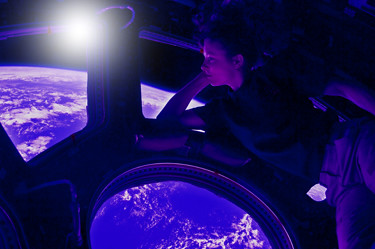
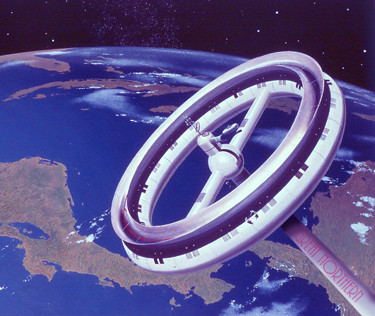
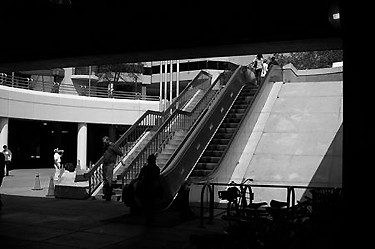
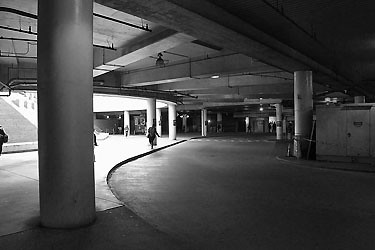
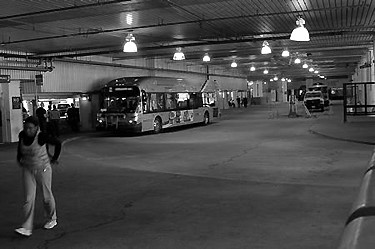
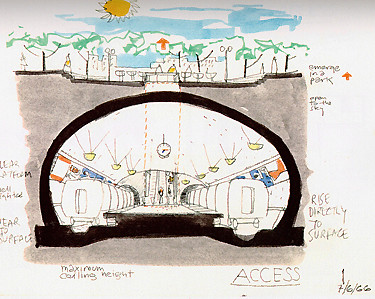
Elon Musk, Building and Boring
Imagining the future.
Thought for Our Times
Psalm 91:5-7
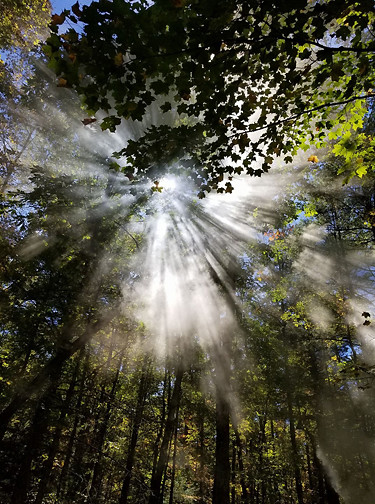
Photo by Jenna Von Moos, Used by Permission.
Thou shalt not be afraid for the terror by night; nor for the arrow that flieth by day; Nor for the pestilence that walketh in darkness; nor for the destruction that wasteth at noonday. A thousand shall fall at thy side, and ten thousand at thy right hand; but it shall not come nigh thee.”
The Monacans of Mohomony
Celebrating Heritage of Central Virginia's First People

A lady of Monacan ancestry presents the history of her people at Natural Bridge.

Monacan Lady (above) and warrier (below) as painted by Kristina Elaine Greer on the Crozet Trestle Mural.

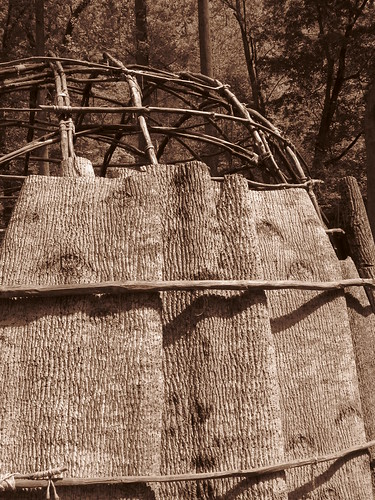
A Monacan ati, or house, covered with bark...
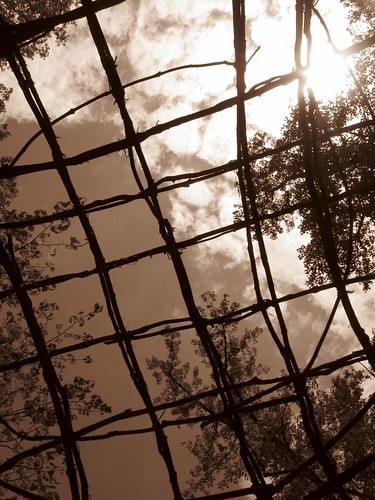
...on a framework of branches.
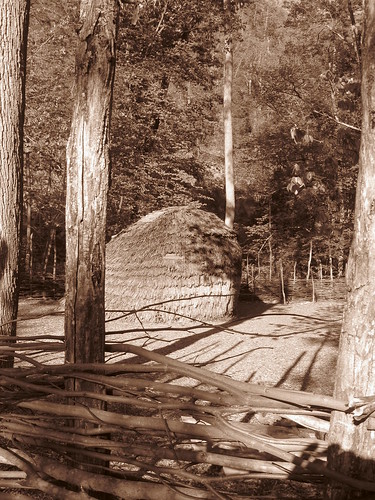
Here is an ati thatched with cattails. This variation would be used in lowland areas with plentiful water. Photos by Bob Kirchman.
Mohomony Poplar in the Sunlight
Large Tree Along Cedar Creek by Natural Bridge
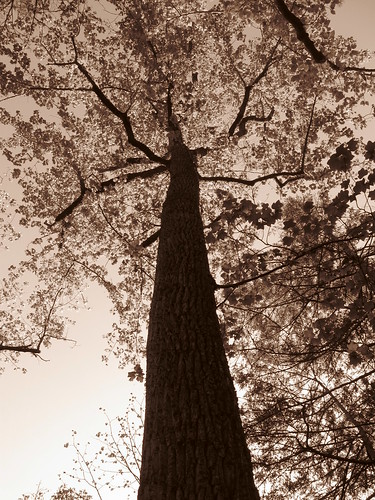
This poplar is along Cedar Creek near the reconstructed Monacan village. Photo by Bob Kirchman.

Dogwood by a Stream, Gypsy Hill Park, Staunton, Virginia.
Photo by Bob Kirchman.
Phantasies
By George Macdonald, Chapter 17
First, I thought, almost despairing,
This must crush my spirit now;
Yet I bore it, and am bearing--
Only do not ask me how."
~ Heinrich Heine.
When the daylight came, it brought the possibility of action, but with it little of consolation. With the first visible increase of light, I gazed into the chasm, but could not, for more than an hour, see sufficiently well to discover its nature. At last I saw it was almost a perpendicular opening, like a roughly excavated well, only very large. I could perceive no bottom; and it was not till the sun actually rose, that I discovered a sort of natural staircase, in many parts little more than suggested, which led round and round the gulf, descending spirally into its abyss. I saw at once that this was my path; and without a moment's hesitation, glad to quit the sunlight, which stared at me most heartlessly, I commenced my tortuous descent. It was very difficult. In some parts I had to cling to the rocks like a bat. In one place, I dropped from the track down upon the next returning spire of the stair; which being broad in this particular portion, and standing out from the wall at right angles, received me upon my feet safe, though somewhat stupefied by the shock. After descending a great way, I found the stair ended at a narrow opening which entered the rock horizontally. Into this I crept, and, having entered, had just room to turn round. I put my head out into the shaft by which I had come down, and surveyed the course of my descent. Looking up, I saw the stars; although the sun must by this time have been high in the heavens. Looking below, I saw that the sides of the shaft went sheer down, smooth as glass; and far beneath me, I saw the reflection of the same stars I had seen in the heavens when I looked up. I turned again, and crept inwards some distance, when the passage widened, and I was at length able to stand and walk upright. Wider and loftier grew the way; new paths branched off on every side; great open halls appeared; till at last I found myself wandering on through an underground country, in which the sky was of rock, and instead of trees and flowers, there were only fantastic rocks and stones. And ever as I went, darker grew my thoughts, till at last I had no hope whatever of finding the white lady: I no longer called her to myself my white lady. Whenever a choice was necessary, I always chose the path which seemed to lead downwards.
At length I began to find that these regions were inhabited. From behind a rock a peal of harsh grating laughter, full of evil humour, rang through my ears, and, looking round, I saw a queer, goblin creature, with a great head and ridiculous features, just such as those described, in German histories and travels, as Kobolds. "What do you want with me?" I said. He pointed at me with a long forefinger, very thick at the root, and sharpened to a point, and answered, "He! he! he! what do you want here?" Then, changing his tone, he continued, with mock humility--"Honoured sir, vouchsafe to withdraw from thy slaves the lustre of thy august presence, for thy slaves cannot support its brightness." A second appeared, and struck in: "You are so big, you keep the sun from us. We can't see for you, and we're so cold." Thereupon arose, on all sides, the most terrific uproar of laughter, from voices like those of children in volume, but scrannel and harsh as those of decrepit age, though, unfortunately, without its weakness. The whole pandemonium of fairy devils, of all varieties of fantastic ugliness, both in form and feature, and of all sizes from one to four feet, seemed to have suddenly assembled about me. At length, after a great babble of talk among themselves, in a language unknown to me, and after seemingly endless gesticulation, consultation, elbow-nudging, and unmitigated peals of laughter, they formed into a circle about one of their number, who scrambled upon a stone, and, much to my surprise, and somewhat to my dismay, began to sing, in a voice corresponding in its nature to his talking one, from beginning to end, the song with which I had brought the light into the eyes of the white lady. He sang the same air too; and, all the time, maintained a face of mock entreaty and worship; accompanying the song with the travestied gestures of one playing on the lute. The whole assembly kept silence, except at the close of every verse, when they roared, and danced, and shouted with laughter, and flung themselves on the ground, in real or pretended convulsions of delight. When he had finished, the singer threw himself from the top of the stone, turning heels over head several times in his descent; and when he did alight, it was on the top of his head, on which he hopped about, making the most grotesque gesticulations with his legs in the air. Inexpressible laughter followed, which broke up in a shower of tiny stones from innumerable hands. They could not materially injure me, although they cut me on the head and face. I attempted to run away, but they all rushed upon me, and, laying hold of every part that afforded a grasp, held me tight.
Crowding about me like bees, they shouted an insect-swarm of exasperating speeches up into my face, among which the most frequently recurring were--"You shan't have her; you shan't have her; he! he! he! She's for a better man; how he'll kiss her! how he'll kiss her!"
The galvanic torrent of this battery of malevolence stung to life within me a spark of nobleness, and I said aloud, "Well, if he is a better man, let him have her."
They instantly let go their hold of me, and fell back a step or two, with a whole broadside of grunts and humphs, as of unexpected and disappointed approbation. I made a step or two forward, and a lane was instantly opened for me through the midst of the grinning little antics, who bowed most politely to me on every side as I passed. After I had gone a few yards, I looked back, and saw them all standing quite still, looking after me, like a great school of boys; till suddenly one turned round, and with a loud whoop, rushed into the midst of the others. In an instant, the whole was one writhing and tumbling heap of contortion, reminding me of the live pyramids of intertwined snakes of which travellers make report. As soon as one was worked out of the mass, he bounded off a few paces, and then, with a somersault and a run, threw himself gyrating into the air, and descended with all his weight on the summit of the heaving and struggling chaos of fantastic figures. I left them still busy at this fierce and apparently aimless amusement. And as I went, I sang--
If a nobler waits for thee,
I will weep aside;
It is well that thou should'st be,
Of the nobler, bride.
For if love builds up the home,
Where the heart is free,
Homeless yet the heart must roam,
That has not found thee.
One must suffer: I, for her
Yield in her my part
Take her, thou art worthier--
Still I be still, my heart!
Gift ungotten! largess high
Of a frustrate will!
But to yield it lovingly
Is a something still.
Then a little song arose of itself in my soul; and I felt for the moment, while it sank sadly within me, as if I was once more walking up and down the white hall of Phantasy in the Fairy Palace. But this lasted no longer than the song; as will be seen.
Do not vex thy violet
Perfume to afford:
Else no odour thou wilt get
From its little hoard.
In thy lady's gracious eyes
Look not thou too long;
Else from them the glory flies,
And thou dost her wrong.
Come not thou too near the maid,
Clasp her not too wild;
Else the splendour is allayed,
And thy heart beguiled.
A crash of laughter, more discordant and deriding than any I had yet heard, invaded my ears. Looking on in the direction of the sound, I saw a little elderly woman, much taller, however, than the goblins I had just left, seated upon a stone by the side of the path. She rose, as I drew near, and came forward to meet me.
She was very plain and commonplace in appearance, without being hideously ugly. Looking up in my face with a stupid sneer, she said: "Isn't it a pity you haven't a pretty girl to walk all alone with you through this sweet country? How different everything would look? wouldn't it?
Strange that one can never have what one would like best! How the roses would bloom and all that, even in this infernal hole! wouldn't they, Anodos? Her eyes would light up the old cave, wouldn't they?"
That depends on who the pretty girl should be," replied I.
Not so very much matter that," she answered; "look here."
I had turned to go away as I gave my reply, but now I stopped and looked at her. As a rough unsightly bud might suddenly blossom into the most lovely flower; or rather, as a sunbeam bursts through a shapeless cloud, and transfigures the earth; so burst a face of resplendent beauty, as it were through the unsightly visage of the woman, destroying it with light as it dawned through it. A summer sky rose above me, gray with heat; across a shining slumberous landscape, looked from afar the peaks of snow-capped mountains; and down from a great rock beside me fell a sheet of water mad with its own delight.
Stay with me," she said, lifting up her exquisite face, and looking full in mine.
I drew back. Again the infernal laugh grated upon my ears; again the rocks closed in around me, and the ugly woman looked at me with wicked, mocking hazel eyes.
You shall have your reward," said she. "You shall see your white lady again."
That lies not with you," I replied, and turned and left her.
She followed me with shriek upon shriek of laughter, as I went on my way. I may mention here, that although there was always light enough to see my path and a few yards on every side of me, I never could find out the source of this sad sepulchral illumination.
(to be continued)
Mohomony
The Bridge of G-d
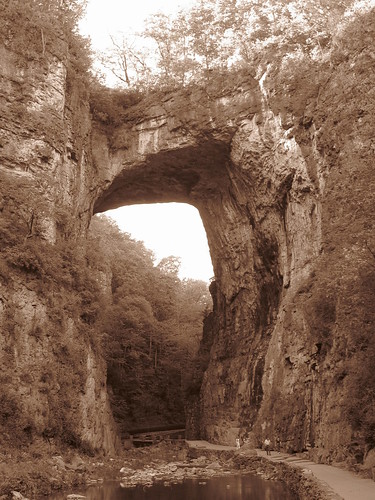
Unique Natural Formation Saved Early Monacans
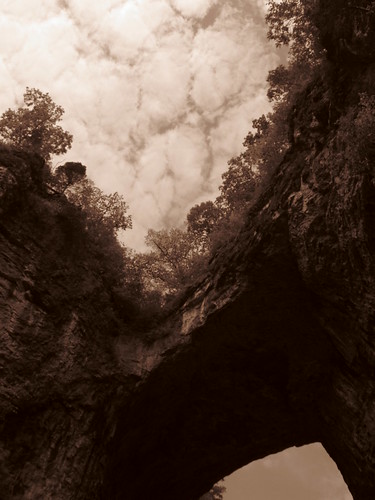
One can almost imagine the battle...
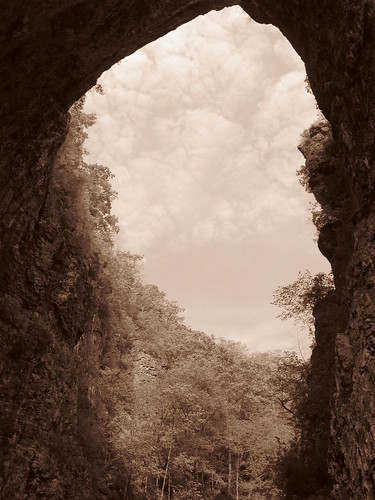
...raging above this deep chasm.
Amazing Story of Deliverance in Monacan Heritage
Running desperately through the forest, the small band of Monacan men, women and children were vastly outnumbered by their pursuers. Powhatan warriers were overtaking them. Suddenly they came to the edge of a vast chasm! They could see no way to cross it.
They closed their eyes and prayed. Then they looked up and saw the formation we know today as Natural Bridge, one of Virginia's most unique wonders, spanning the chasm. Hurrying their women and children across the stone span, they followed. Then they turned to make their stand. The much larger army was constricted by the narrow bridge and could only attack the Monacans in a much smaller number. The bridge became a great equalizer between the two forces and the Monacans were victorious that day.
Passed from generation to generation, the story of Monacan survival has made Natural Bridge a sacred place to the Monacans. They named it Mohomony, meaning 'Bridge of G-d."
Today a recreated Monacan village stands at the base of the bridge. Because the story predates written accounts, it is easy to dismiss it as legend, yet as we considered it my wife said: "I believe it recounts an actual event." The strategic element inherent in the story (the narrow bridge equalizing the battle) is too much like something another Rockbridge County resident, Thomas Jackson, would want to remember.
Like Homer's accounts of the Trojan War and the Odyssey home, some unknown Monacan warrier seems to have recounted this amazing story, remembering the time when geography aided them in battle. I walked across the bridge on route 11, imagining an epic battle like something out of Tolkien (like Gandalf facing the Balrog)! Young Monacans standing shoulder to shoulder to protect children and wives from an overwhelming enemy, who prevailed that day, passed the story to their children.
It just seemed to me like one of many grand moments in history where the unseen hand of G-d was seen as deliverer.
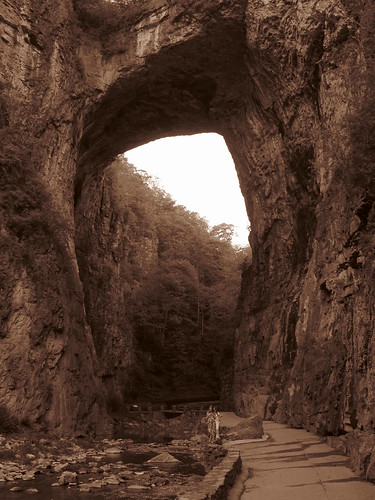
Today visitors walk beneath the bridge...
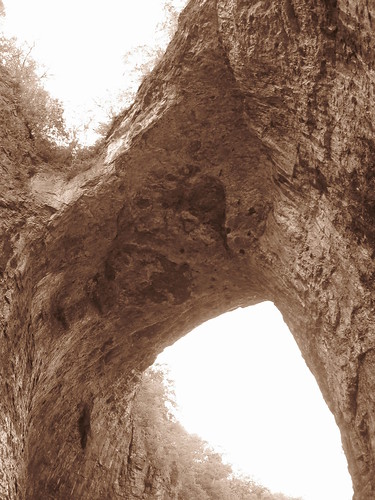
...but her greatest story may have played out above!
Meeting Merlin
A Visit to Enchanted Castle Studios
[click to read]
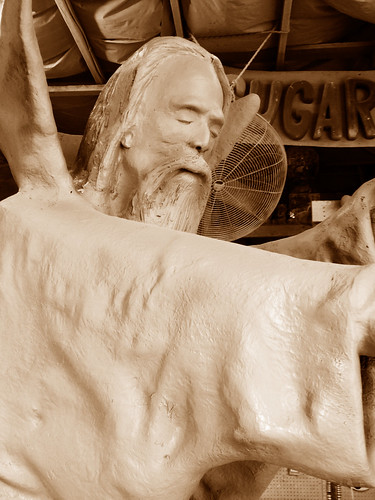
Sculptor Mark Cline of Natural Bridge had a great fan in his friend Jamie Jordan of Waynesboro. He had an unusual request for the sculptor. He knew he was dying and asked his friend to create a lasting impression of his face and to “use it appropriately.” When Mr. Jordan died just short of his sixtieth birthday, Cline made a casting of his friend’s face two days later at the funeral home and used it to create ‘Merlin.’(read more)
A Floral Legacy Continues
[click to read]

Everyone must leave something behind when he dies, my grandfather said. A child or a book or a painting or a house or a wall built or a pair of shoes made. Or a garden planted. Something your hand touched some way so your soul has somewhere to go when you die, and when people look at that tree or that flower you planted, you're there. It doesn't matter what you do, he said, so long as you change something from the way it was before you touched it into something that's like you after you take your hands away. The difference between the man who just cuts lawns and a real gardener is in the touching, he said. The lawn-cutter might just as well not have been there at all; the gardener will be there a lifetime." – Ray Bradbury, Fahrenheit 451 (read more)
University of Virginia Chapel
A Gothic Chapel amidst Jefferson's Classical Village
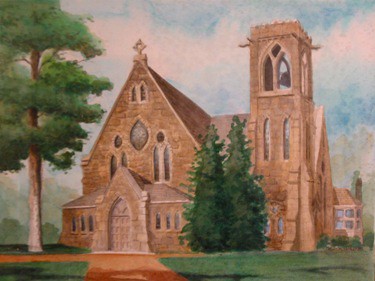
This is my painting of University Chapel. When Jefferson created his academic village it did not have a place of worship. In the late Nineteenth Century members of the Charlottesville community raised the money to build this gothic revival chapel designed by Charles Emmet Cassell of Baltimore. The cornerstone was set in 1885, and the completed chapel was dedicated in 1889. The chapel marks a sharp departure from Jefferson's classical forms.
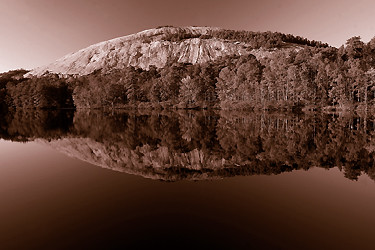
Thirty-eight years ago, I stood in this fine Gothic building as I married the love of my life. Thus this historic building is also a part of the story of our own family. It is a story that includes a hike in a rainstorm on Stone Mountain in Georgia and has continued for well over three decades!
One of the greatest challenges to our Faith is our forgetfulness. Scripture reminds us how the people were instructed to remember the great things G-d had done for them. G-d separated the Jordan, as He had the Red Sea, for the people to walk across and gave them the following command:
And it came to pass, when all the people were clean passed over Jordan, that the Lord spake unto Joshua, saying, Take you twelve men out of the people, out of every tribe a man, And command ye them, saying, Take you hence out of the midst of Jordan, out of the place where the priests' feet stood firm, twelve stones, and ye shall carry them over with you, and leave them in the lodging place, where ye shall lodge this night.
Then Joshua called the twelve men, whom he had prepared of the children of Israel, out of every tribe a man: And Joshua said unto them, Pass over before the ark of the Lord your G-d into the midst of Jordan, and take you up every man of you a stone upon his shoulder, according unto the number of the tribes of the children of Israel: That this may be a sign among you, that when your children ask their fathers in time to come, saying, What mean ye by these stones?
Then ye shall answer them, That the waters of Jordan were cut off before the ark of the covenant of the Lord; when it passed over Jordan, the waters of Jordan were cut off: and these stones shall be for a memorial unto the children of Israel for ever. And the children of Israel did so as Joshua commanded, and took up twelve stones out of the midst of Jordan, as the Lord spake unto Joshua, according to the number of the tribes of the children of Israel, and carried them over with them unto the place where they lodged, and laid them down there.
And Joshua set up twelve stones in the midst of Jordan, in the place where the feet of the priests which bare the ark of the covenant stood: and they are there unto this day." -- Joshua 4:1-9