Volume XVIII, Issue VI: Gleaning in Our Modern World
Gleaning: Biblical Wisdom for Today
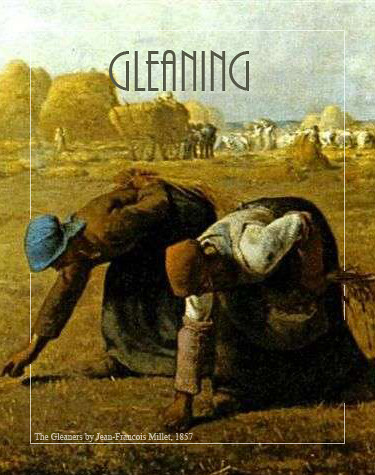
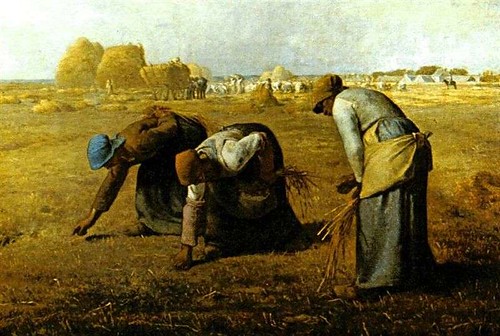
Now when you reap the harvest of your land, you shall not reap to the very corners of your field, nor shall you gather the gleanings of your harvest. 'Nor shall you glean your vineyard, nor shall you gather the fallen fruit of your vineyard; you shall leave them for the needy and for the stranger. I am the LORD your God.” – Leviticus 19:9-10
I love the Biblical account of Ruth and Boaz. If you are not familiar with it I urge you to read it. Many are touched by the love story therein but there is a deeper love story there that in a hasty reading we may indeed miss. Ruth is the daughter-in-law of Naomi, who though originally from Bethlehem, followed her husband and their two sons to Moab. The boys both married Moabite women. Naomi’s husband dies in Moab, as do both of her sons. She is left a widow and decides to return to her home country. She tells her two daughters-in-law to stay in Moab. It is at this point that Ruth makes an amazing declaration: “And Ruth said, Intreat me not to leave thee, or to return from following after thee: for whither thou goest, I will go; and where thou lodgest, I will lodge: thy people shall be my people, and thy God my God.” – Ruth 1:16
Upon returning home, Ruth goes out to glean in order to provide for herself and Naomi. In doing so she meets Boaz, the Kinsman-redeemer. This too is a Biblical concept, where no one was left behind because of a prescribed system of responsibility for family. Boaz owns the field where Ruth goes to glean. He arrives at the harvest site and greets his workers: “THE LORD BLESS YOU!” How many of you with employees would so greet YOUR workers? I daresay you might be sued for ‘Religious Harassment,’ but really, how many people would be blessed to know that sentiment from an employer? Really, I think we could stand a lot more of it. South Carolina Senator Tim Scott remembers his younger days, where his manager at Chick Fil A took him under his wing and helped him become confident through mentorship.
How many of you are investing in the lives of young people? We entrust the institution now with the job of preparing them for their futures, but now, with youths out of the institution, do you not see the great opportunity before us? Those of us with a heart for young people; Now is our time! I think of George Westinghouse, inventor of the railroad airbrake. Indeed we remember his contributions to transportation and electric power, but do we remember how the ‘Gentle Genius’ nurtured his colleagues? Westinghouse had been a foot soldier in the Civil War. He never forgot his simple roots and poured himself into the workers around him. The reason his inventiveness did not result in him having more patents than his rival Thomas Edison is simple. While Edison took all of his patents in his own name, Westinghouse was big on making sure his engineers were recognized by having their names on the things they created. Somehow that seems to me not all that different from leaving grain in the corners of your field.
And so we find Boaz leaving extra for Ruth to ‘find,’ even instructing his men to purposefully do so. Naomi notices this kindness. The story has a very happy and amazing ending as Ruth will become part of the family tree that will become the royal line of Israel!
The great stories are born in the worst times. Surely our day shall see such tales. We need to look beyond the present crisis to a time of promise fulfilled. Most importantly, stories like that of Ruth and Boaz give the God-fearer insight into the nature of the Divine. Truly He cares for His people. Let us extend that love to our fellows and see what He might do.
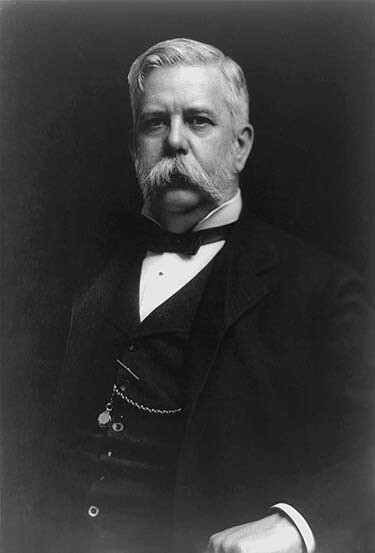
George Westinghouse American Innovator
George Westinghouse, American Innovator.
The qualities of George Westinghouse which, it seems to me, gave him the supreme quality of genius, were the qualities of imagination, faith, and courage. We know many men of great mental vigor; we know many men of strong character. Those qualities are, of course, the background of any successful career, but I am sure none of us has ever known a man who combined the qualities of faith, imagination, and courage as they were combined in George Westinghouse.” – Paul D. Cravath
We need more heroes like George Westinghouse. In our day the development of great works and human decency are often (mistakenly) considered mutually exclusive. Westinghouse was a brilliant man, an innovator, and a captain of industry. He was worth millions of dollars but never forgot his humble beginnings. Westinghouse as a youth was one you would have not thought likely to succeed. School bored him and he preferred working in his father’s shops where he eventually found himself working at a very young age. Most of us remember that he invented air brakes for trains, but few remember that when he built his great air brake factory outside of Pittsburgh, he built beautiful houses for his workers and set up a monthly payment plan so that they could buy them. He even insured the houses so that if a family were to lose their breadwinner, they would not lose their home.
While other inventors like Thomas Edison accumulated many patents based on the work of their employees, Westinghouse assembled around him the best and brightest he could find and insisted that they receive attribution for their own patents. It is said that he would have well over a thousand patents had he registered them in his own name. His brilliant engineers were not all men either. Because of his generous attribution policy we know that he had in his employ one Bertha Lamme, Nineteenth Century electrical engineer.
Westinghouse went on to develop Alternating Current electrical generation capability, demonstrating it at the 1893 Chicago World’s Fair. He continued to pioneer improvements in railway equipment including electric locomotives and sophisticated block control systems which enhanced railroad safety greatly. He was inspired by Nikola Tesla, the Serbian-American inventor, electrical engineer, mechanical engineer, physicist, and futurist who is best known for his contributions to the design of the modern alternating current electricity supply system. He looked to Tesla’s work as he sought to make Alternating Current practical for powering industry. In his lifetime Westinghouse created over forty different companies and made possible many of the appliances we take for granted in our homes today.
Westinghouse practiced Christian principles in his management style though he firmly believed in the freedom of his workers. He chose to live his beliefs in example rather than by preaching. He was a modest and temperate man, always devoted to his wife Marguerite Erskine Westinghouse. This quote says volumes about the man: “If someday they say of me that in my work I have contributed something to the welfare and happiness of my fellow man, I shall be satisfied.”
If my people, which are called by my name, shall humble themselves, and pray, and seek my face, and turn from their wicked ways; then will I hear from heaven, and will forgive their sin, and will heal their land.” – 2 Chronicles 7:14
Today we join with many churches praying for an end to the Corona Virus. We pray for reconciliation and healing for our land.
Hannah brought out the coffee for the young man who had just arrived at the Zimmerman Organization Headquarters in Wales. In true form to the local traditions, Josiah poured her a cup, then one for himself. It honored Zimmerman’s Mother who was an engineer in that formerly male dominated profession decades ago. Rupert Zimmerman had insisted the practice continue as a memorial to her. In fact, the culture of the bridge now contained many such nods to those who had paved the way. Josiah had laughed at them in his youth, but now he had come to learn that they were rooted most of all in a sense of reverence for the Divine, who made families and gave wisdom to be passed from generation to generation.
Soon they were joined by Alan West, Flight Director for Cape Lisbon, Rupert’s Granddaughter, Chief Engineer of the Zimmerman Organization, Elizabeth Zimmerman O’Malley, CEO, Abiyah Ben-Gurion and Jon Greene, Professors of the College on Big Diomede.
Mrs. O’Malley began, “My Father devoted his life to making a way for mankind to go where we’d never been before. He considered himself most blessed that he lived to see the things he did. But he always felt a responsibility to those he felt he’d recklessly lead there. It is in that spirit that I have called us together. That drive led us to go to another world and now there are people living there in some confusion. We do not want to send ‘Great Northern’ back there – we don’t even think it is wise, but we’d like to reach out to the colonists and try to help them.”
West offered, “We could continue to supply them remotely with unmanned landers. Eventually they’d have enough landers that some of them could return to Earth, if they so desired. But it is painfully obvious that they feel alienated from us – and our traditions. We feel a human touch would do much to ‘build a bridge,’ if you get my drift.”
Greene observed, “Ray Bradbury once wrote about a similar scenario. Earth is destroyed in a nuclear war but a family takes a rocket on a "fishing trip" to Mars and they escape destruction. They destroy all artifacts of their old ‘misguided’ life. Later, the father offers his sons a gift in the form of their new world. He introduces them to Martians—their own reflections in a canal. That is what we have here. You once said you wished for an unreached world to reach. May I introduce to you the Martians?”
West interjected “It would mean nine months in a fairly cramped environment. There is some risk in any spaceflight and we plan to send a crew of three. There would be no guarantee as to how the colonists would respond when you landed. It seems there are several factions and they disagree on things sharply.”
Josiah’s mind wandered to the story of Nathanael "Nate" Saint, who along with four other men, Jim Elliot, Ed McCully, Pete Fleming, and Roger Youderian, sought to establish communication with the warlike Huaorani of Ecuador. They set out in a little yellow Piper PA-14 and landed on a beach of the Curaray River. Though the Huaorani had enthusiastically received gifts lowered in a bucket from the plane earlier, they murdered the five men with spears on January 8, 1958.
Though the men were armed, they did not want to kill any Huaorani and they did not use their weapons. West said “I think it prudent to give you some means of protecting yourselves, but I cannot guarantee anyone’s safety at this point. We could continue to send supplies by unmanned craft, but I think they need to see us as more than that, if you know what I mean.” (to be continued)
George Westinghouse American Innovator
George Westinghouse, American Innovator.
The qualities of George Westinghouse which, it seems to me, gave him the supreme quality of genius, were the qualities of imagination, faith, and courage. We know many men of great mental vigor; we know many men of strong character. Those qualities are, of course, the background of any successful career, but I am sure none of us has ever known a man who combined the qualities of faith, imagination, and courage as they were combined in George Westinghouse.” – Paul D. Cravath
We need more heroes like George Westinghouse. In our day the development of great works and human decency are often (mistakenly) considered mutually exclusive. Westinghouse was a brilliant man, an innovator, and a captain of industry. He was worth millions of dollars but never forgot his humble beginnings. Westinghouse as a youth was one you would have not thought likely to succeed. School bored him and he preferred working in his father’s shops where he eventually found himself working at a very young age. Most of us remember that he invented air brakes for trains, but few remember that when he built his great air brake factory outside of Pittsburgh, he built beautiful houses for his workers and set up a monthly payment plan so that they could buy them. He even insured the houses so that if a family were to lose their breadwinner, they would not lose their home.
While other inventors like Thomas Edison accumulated many patents based on the work of their employees, Westinghouse assembled around him the best and brightest he could find and insisted that they receive attribution for their own patents. It is said that he would have well over a thousand patents had he registered them in his own name. His brilliant engineers were not all men either. Because of his generous attribution policy we know that he had in his employ one Bertha Lamme, Nineteenth Century electrical engineer.
Westinghouse went on to develop Alternating Current electrical generation capability, demonstrating it at the 1893 Chicago World’s Fair. He continued to pioneer improvements in railway equipment including electric locomotives and sophisticated block control systems which enhanced railroad safety greatly. He was inspired by Nikola Tesla, the Serbian-American inventor, electrical engineer, mechanical engineer, physicist, and futurist who is best known for his contributions to the design of the modern alternating current electricity supply system. He looked to Tesla’s work as he sought to make Alternating Current practical for powering industry. In his lifetime Westinghouse created over forty different companies and made possible many of the appliances we take for granted in our homes today.
Westinghouse practiced Christian principles in his management style though he firmly believed in the freedom of his workers. He chose to live his beliefs in example rather than by preaching. He was a modest and temperate man, always devoted to his wife Marguerite Erskine Westinghouse. This quote says volumes about the man: “If someday they say of me that in my work I have contributed something to the welfare and happiness of my fellow man, I shall be satisfied.”
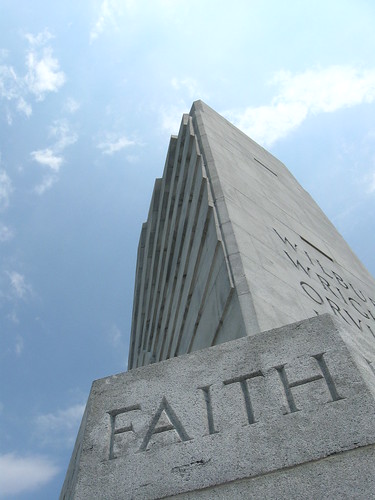
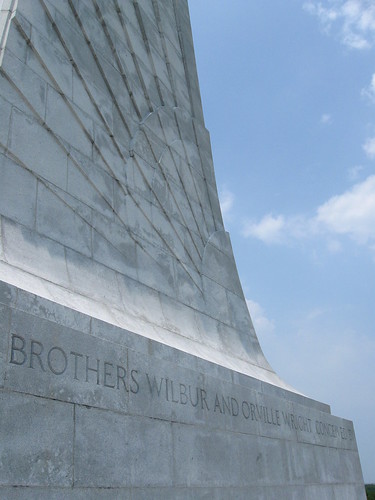
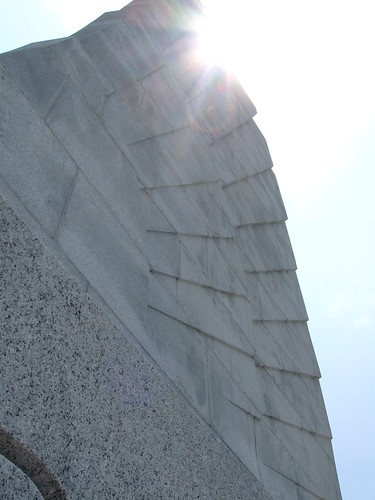
Wright Brothers Memorial, Kitty Hawk
Photos by Bob Kirchman
They Taught the World to Fly!
Wind, sand, and a dream of flight brought Wilbur and Orville Wright to Kitty Hawk, North Carolina where, after four years of scientific experimentation, they achieved the first successful airplane flights on December 17, 1903.
With courage and perseverance, these self-taught engineers relied on teamwork and application of the scientific process. What they achieved changed our world forever.
The tower was designed by Rodgers and Poor, a New York City architectural firm; the design was officially selected on February 14, 1930. Prior to the memorial's construction, the War Department selected Captain William H. Kindervater of the Quartermaster Corps to prepare the site for construction and to manage the area landscaping. To secure the sandy foundation, Captain Kindervater selected bermuda grass to be planted on Kill Devil Hill and the surrounding area. He also ordered a special fertilizer to be spread throughout the area to promote grass and shrubbery growth and decided to build a fence to prevent animal grazing. With a strong foundation in place, the Office of the Quartermaster selected Marine Captain John A. Gilman to preside over the construction project. Construction began in October 1931 and with a budget of $213,000, the memorial was completed in November 1932. In the end, 1,200 tons of granite, more than 2,000 tons of gravel, more than 800 tons of sand and almost 400 tons of cement were used to build the structure, along with numerous other materials. It is constructed of granite mined at the North Carolina Granite Corporation Quarry Complex. National Park service.
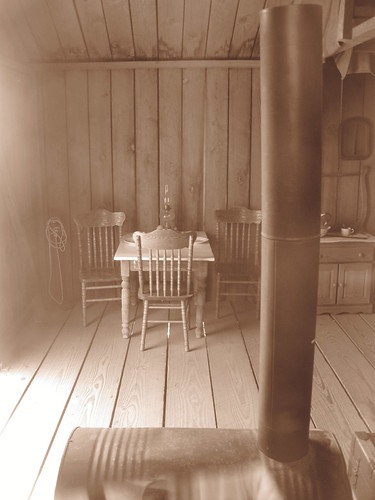
Wright Brothers' Kitty Hawk Camp
The Simple Quarters of the Pioneers of Flight
Photos byBob Kirchman
This is the reconstructed camp of the brothers as it might have looked in December of 1903.
Sunset Over the Sound, Duck, NC
Photo byKarley Spralin
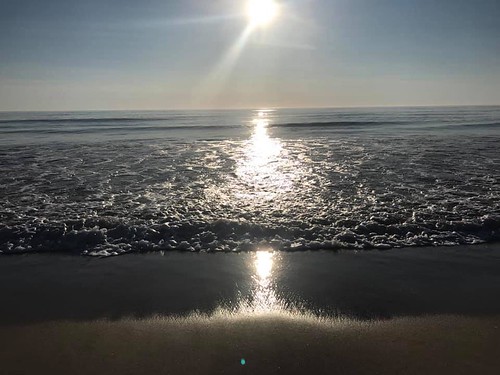
Sunrise Over the Atlantic Ocean
Photo byKarley Spralin
Ends of the Road
Eastern and Western Terminus of I 40
Photo by John Stradle.
When the Interstate Highway System was originally constructed, Interstate 40 was only planned to go from Barstow, California to Greensboro, North Carolina but in the late 1970s it was extended to Raleigh, the state capital. In the following years it would be extended to the port city of Wilmington, North Carolina. Interstate 40 is 2554 miles long between Barstow and Wilmington but the cities are only 2480 miles apart if you travel by US 74 to I 95 and I 20 to I40.
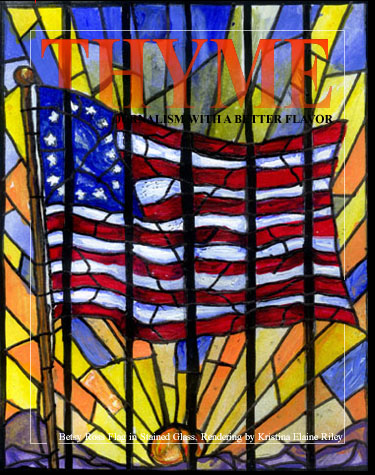
Betsy Ross Flag in Stained Glass. Rendering by Kristina Elaine Greer.
Reverend Richard's Prayer
From Homer Hickam's Book: 'Sky of Stone'
I was reading Homer Hickam's book: Sky of Stone when this passage riveted me with its profound wisdom, succinctly stated. Hickam describes a 4th of July celebration in Coalwood where the Reverend gave this invocation: [1.]
Dear Lord, we are gathered here to celebrate not just the independence of our great land, but also the document on which it stands. There is much to admire in that document but what we best remember is this: We hold these truths to be self-evident; that all men are created equal; that they are endowed by their Creator with certain inalienable rights; that among these are life, liberty, and the pursuit of happiness. To prepare for this invocation today, I have pondered long and hard these words. Most of you know that I rarely go anywhere without my Bible. It is an old Bible. It belonged to my grandfather. What you don't know is that inside this book, I have always kept a copy of the Declaration of Independence. It also belonged to my grandfather. He believed it to be as Holy as his Bible. When I was a boy, somebody once asked me if my grandfather had been a slave. I couldn't imagine that could be true so I went to him and asked him: Grandfather, were you a slave? He said, Child, a man called me that but I was never a slave and you know why? Because I could read. My mama, she taught me when that man wasn't looking, just as her mama taught her. When he became officially a free man, my grandfather purchased this Bible and a copy of the Declaration of Independence. He kept them both until the day he died. He left them to me. I have come to understand my grandfather was right. No man or woman can be a slave if they can read. Especially if they can read the Bible and the American Declaration of Independence. But that means there are still slaves in this land. There are slaves who do not know that they have inalienable rights given to them by God, and that they also have, by the grace of the Lord, life, liberty, and the right to pursue their happiness and the happiness of their families. They are slaves to their own ignorance. Ignorance is the ultimate slave owner. So on this 4th of July, I pray a special prayer.I pray for the day when the tyranny of ignorance will be banished all across this great land and every man, woman, and child can read and understand what they read. I pray for that day.I pray every day for that day."
The good Reverend had planted in me a renewed vision of the mission before us. That is the mission of educating ourselves and our children.
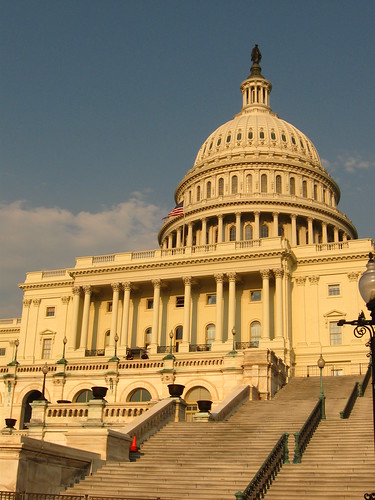
The U.S. Capitol.
“If Thine Enemy Hunger; Feed Him”
Here is sound advice for our time:
Let love be without dissimulation. Abhor that which is evil; cleave to that which is good. Be kindly affectioned one to another with brotherly love; in honour preferring one another; Not slothful in business; fervent in spirit; serving the Lord; Rejoicing in hope; patient in tribulation; continuing instant in prayer; Distributing to the necessity of saints; given to hospitality. Bless them which persecute you: bless, and curse not. Rejoice with them that do rejoice, and weep with them that weep. Be of the same mind one toward another. Mind not high things, but condescend to men of low estate. Be not wise in your own conceits.
Recompense to no man evil for evil. Provide things honest in the sight of all men. If it be possible, as much as lieth in you, live peaceably with all men. Dearly beloved, avenge not yourselves, but rather give place unto wrath: for it is written, Vengeance is mine; I will repay, saith the Lord. Therefore if thine enemy hunger, feed him; if he thirst, give him drink: for in so doing thou shalt heap coals of fire on his head. Be not overcome of evil, but overcome evil with good.” – ROMANS 12:9-21
Had the casting succeeded? They were reduced to mere conjecture. There was indeed every reason to expect success, since the mould has absorbed the entire mass of the molten metal; still some considerable time must elapse before they could arrive at any certainty upon the matter.
The patience of the members of the Gun Club was sorely tried during this period of time. But they could do nothing. J. T. Maston escaped roasting by a miracle. Fifteen days after the casting an immense column of smoke was still rising in the open sky and the ground burned the soles of the feet within a radius of two hundred feet round the summit of Stones Hill. It was impossible to approach nearer. All they could do was to wait with what patience they might.
Here we are at the 10th of August," exclaimed J. T. Maston one morning, "only four months to the 1st of December! We shall never be ready in time!" Barbicane said nothing, but his silence covered serious irritation.
However, daily observations revealed a certain change going on in the state of the ground. About the 15th of August the vapors ejected had sensibly diminished in intensity and thickness. Some days afterward the earth exhaled only a slight puff of smoke, the last breath of the monster enclosed within its circle of stone. Little by little the belt of heat contracted, until on the 22nd of August, Barbicane, his colleagues, and the engineer were enabled to set foot on the iron sheet which lay level upon the summit of Stones Hill.
"At last!" exclaimed the president of the Gun Club, with an immense sigh of relief.
The work was resumed the same day. They proceeded at once to extract the interior mould, for the purpose of clearing out the boring of the piece. Pickaxes and boring irons were set to work without intermission. The clayey and sandy soils had acquired extreme hardness under the action of the heat; but, by the aid of the machines, the rubbish on being dug out was rapidly carted away on railway wagons; and such was the ardor of the work, so persuasive the arguments of Barbicane's dollars, that by the 3rd of September all traces of the mould had entirely disappeared.
Immediately the operation of boring was commenced; and by the aid of powerful machines, a few weeks later, the inner surface of the immense tube had been rendered perfectly cylindrical, and the bore of the piece had acquired a thorough polish.
At length, on the 22d of September, less than a twelvemonth after Barbicane's original proposition, the enormous weapon, accurately bored, and exactly vertically pointed, was ready for work. There was only the moon now to wait for; and they were pretty sure that she would not fail in the rendezvous.
The ecstasy of J. T. Maston knew no bounds, and he narrowly escaped a frightful fall while staring down the tube. But for the strong hand of Colonel Blomsberry, the worthy secretary, like a modern Erostratus, would have found his death in the depths of the Columbiad.
The cannon was then finished; there was no possible doubt as to its perfect completion. So, on the 6th of October, Captain Nicholl opened an account between himself and President Barbicane, in which he debited himself to the latter in the sum of two thousand dollars.
One may believe that the captain's wrath was increased to its highest point, and must have made him seriously ill. However, he had still three bets of three, four, and five thousand dollars, respectively; and if he gained two out of these, his position would not be very bad. But the money question did not enter into his calculations; it was the success of his rival in casting a cannon against which iron plates sixty feet thick would have been ineffectual, that dealt him a terrible blow.
After the 23rd of September the enclosure of Stones hill was thrown open to the public; and it will be easily imagined what was the concourse of visitors to this spot! There was an incessant flow of people to and from Tampa Town and the place, which resembled a procession, or rather, in fact, a pilgrimage.
It was already clear to be seen that, on the day of the experiment itself, the aggregate of spectators would be counted by millions; for they were already arriving from all parts of the earth upon this narrow strip of promontory. Europe was emigrating to America.
Up to that time, however, it must be confessed, the curiosity of the numerous comers was but scantily gratified. Most had counted upon witnessing the spectacle of the casting, and they were treated to nothing but smoke. This was sorry food for hungry eyes; but Barbicane would admit no one to that operation. Then ensued grumbling, discontent, murmurs; they blamed the president, taxed him with dictatorial conduct. His proceedings were declared "un-American." There was very nearly a riot round Stones Hill; but Barbicane remained inflexible. When, however, the Columbiad was entirely finished, this state of closed doors could no longer be maintained; besides it would have been bad taste, and even imprudence, to affront the public feeling. Barbicane, therefore, opened the enclosure to all comers; but, true to his practical disposition, he determined to coin money out of the public curiosity.
It was something, indeed, to be enabled to contemplate this immense Columbiad; but to descend into its depths, this seemed to the Americans the ne plus ultra of earthly felicity. Consequently, there was not one curious spectator who was not willing to give himself the treat of visiting the interior of this great metallic abyss. Baskets suspended from steam-cranes permitted them to satisfy their curiosity. There was a perfect mania.
Women, children, old men, all made it a point of duty to penetrate the mysteries of the colossal gun. The fare for the descent was fixed at five dollars per head; and despite this high charge, during the two months which preceded the experiment, the influx of visitors enabled the Gun Club to pocket nearly five hundred thousand dollars!
It is needless to say that the first visitors of the Columbiad were the members of the Gun Club. This privilege was justly reserved for that illustrious body. The ceremony took place on the 25th of September. A basket of honor took down the president, J. T. Maston, Major Elphinstone, General Morgan, Colonel Blomsberry, and other members of the club, to the number of ten in all. How hot it was at the bottom of that long tube of metal! They were half suffocated. But what delight! What ecstasy! A table had been laid with six covers on the massive stone which formed the bottom of the Columbiad, and lighted by a jet of electric light resembling that of day itself. Numerous exquisite dishes, which seemed to descend from heaven, were placed successively before the guests, and the richest wines of France flowed in profusion during this splendid repast, served nine hundred feet beneath the surface of the earth!
The festival was animated, not to say somewhat noisy. Toasts flew backward and forward. They drank to the earth and to her satellite, to the Gun Club, the Union, the Moon, Diana, Phoebe, Selene, the "peaceful courier of the night!" All the hurrahs, carried upward upon the sonorous waves of the immense acoustic tube, arrived with the sound of thunder at its mouth; and the multitude ranged round Stones Hill heartily united their shouts with those of the ten revelers hidden from view at the bottom of the gigantic Columbiad.
J. T. Maston was no longer master of himself. Whether he shouted or gesticulated, ate or drank most, would be a difficult matter to determine. At all events, he would not have given his place up for an empire, "not even if the cannon-- loaded, primed, and fired at that very moment--were to blow him in pieces into the planetary world."
CHAPTER XVII, A TELEGRAPHIC DISPATCH
The great works undertaken by the Gun Club had now virtually come to an end; and two months still remained before the day for the discharge of the shot to the moon. To the general impatience these two months appeared as long as years! Hitherto the smallest details of the operation had been daily chronicled by the journals, which the public devoured with eager eyes.
Just at this moment a circumstance, the most unexpected, the most extraordinary and incredible, occurred to rouse afresh their panting spirits, and to throw every mind into a state of the most violent excitement.
One day, the 30th of September, at 3:47 P.M., a telegram, transmitted by cable from Valentia (Ireland) to Newfoundland and the American Mainland, arrived at the address of President Barbicane.
The president tore open the envelope, read the dispatch, and, despite his remarkable powers of self-control, his lips turned pale and his eyes grew dim, on reading the twenty words of this telegram.
Here is the text of the dispatch, which figures now in the archives of the Gun Club:
FRANCE, PARIS, 30 September, 4 A.M. Barbicane, Tampa Town, Florida, United States.
Substitute for your spherical shell a cylindro-conical projectile. I shall go inside. Shall arrive by steamer Atlanta. MICHEL ARDAN. (to be continued)
Isambard Kingdom Brunel
An Honest Look at the Life of a Great Man
Brunel's Great Ship
The Building of the Great Eastern
The 1893 Chicago World's Fair
Paintings of the Proposed Fair
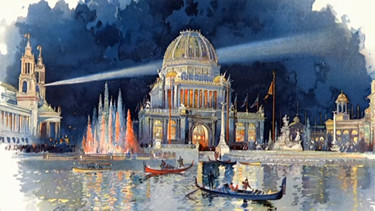
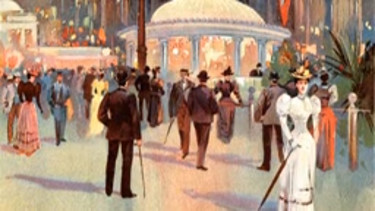
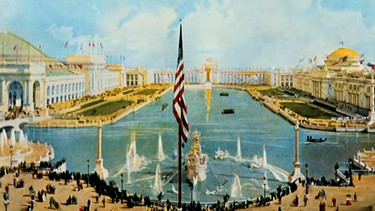
Designers envisioned a great classical city that would inspire American civic architecture for years to come. George Westinghouse provided the magic of electrical illumination. Walt Disney's father worked as a construction worker on the fair buildings.
Westinghouse Workers' Housing
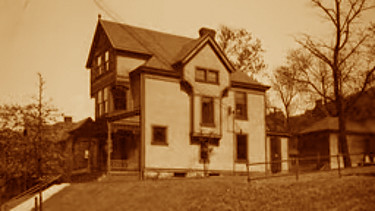
While many industrialists of the late Nineteenth Century gave little thought to the quality of workers' housing, George Westinghouse built houses like these that his workers could purchase for a small monthly installment. He even insured the houses so that if a family experienced the unfortunate loss of their breadwinner they would not lose their house.
In the Bible, many a man and a few women stumbled over idols in their pursuit to follow God and there were times in Israel’s history when God sent prophets to the nation to warn them to tear down the high places of Canaanite worship. I believe that these days the churches are faced with similar circumstances and that God can use Christian novelists as messengers to alert His Bride to the need to reform.
Art, though, is never the voice of a country; it is an even more precious thing, the voice of the individual, doing its best to speak, not comfort of any sort, but truth. And the art that speaks it most unmistakably, most directly, most variously, most fully, is fiction; in particular, the novel.” ~ Eudora Welty in On Writing. (read more)
A Lighthouse on a Mountain On Mount Greylock, a Monument Rises in the Mist
In the clouds hanging on Greylock, Massachusetts' highest mountain, stands a lighthouse...
"Thy word is a lamp unto my feet, and a light unto my path." -- Psalm 119:105
Walking up the trail to the top of Greylock in November of 2000, I stepped into a cloud. The top of the mountain, unseen, was covered with a frosting of heavy ice. Inching upward, I came to this monument at the summit. A war memorial, but also an allusion to local author Herman Melville, who wrote Moby Dick. When the monument was first lit you could see it for seventy miles on a clear night.
Sinai
After the miraculous deliverance from Egypt, the establishment of the Passover celebration and the inspiration of Bezaleel and Aholiab to build the Tabernacle, Moses went up into a cloud on Mount Sinai. There G-d gave the law that would be a light to thousands of generations to Moses, but the people couldn't see what was happening on the mountain. They Turned Away [click to read] and made themselves a god of metal. Unable to visualize what they didn't see, they subjected themselves to foolishness.
Golgotha
On a hill called Golgotha, the man who said: "I am the light of the world." -- John 9:5 slipped into death. And the people stood beholding."And the rulers also with them derided him, saying, He saved others; let him save himself." -- Luke 23:35 Surely they felt that this was not the Messiah they had hoped for. Dying between two criminals, His body placed in the dark tomb, He was gone from them. His followers hid themselves away, fearing they would be killed as well.
Zion
What happened on that mountain, though unseen, changed history. "Now faith is the substance of things hoped for, the evidence of things not seen." -- Hebrews 11:1. We now know the rest of the story, so it is easy to forget the need to retell the stories of promise. Revelation 21 [click to read] takes us to yet another mountaintop: "And he carried me away in the spirit to a great and high mountain, and shewed me that great city, the holy Jerusalem, descending out of heaven from G-d." -- Revelation 21:10 Itis this unseen hope that must sustain us in the world we live in today.
...a war memorial and an allusion to author Herman Melville.
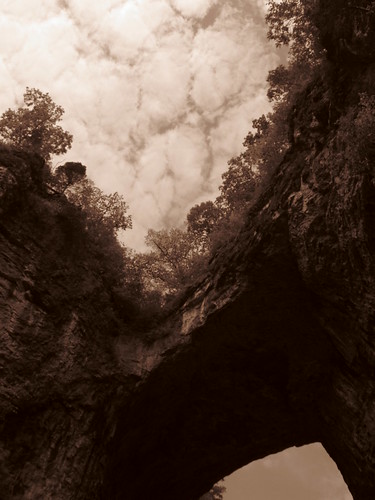
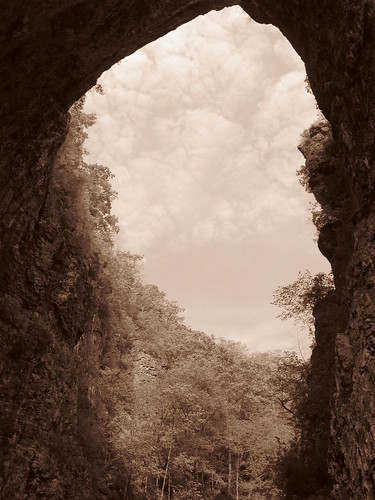
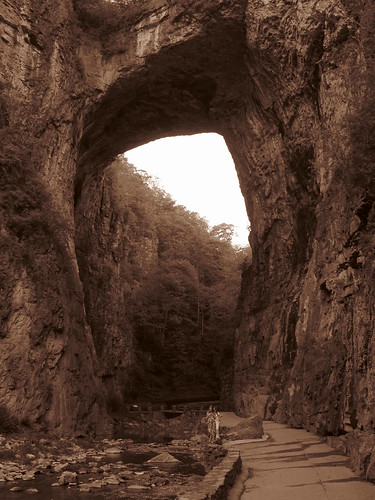
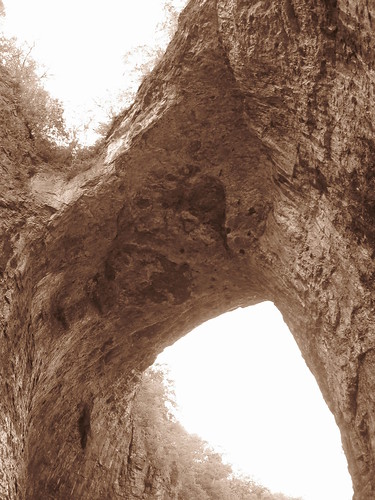
Mohomony The Bridge of G-d
Unique Natural Formation Saved Early Monacans
One can almost imagine the battle... ...raging above this deep chasm.
Amazing Story of Deliverance in Monacan Heritage
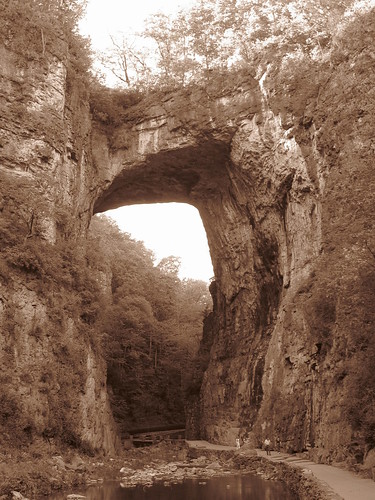
Running desperately through the forest, the small band of Monacan men, women and children were vastly outnumbered by their pursuers. Powhatan warriers were overtaking them. Suddenly they came to the edge of a vast chasm! They could see no way to cross it.
They closed their eyes and prayed. Then they looked up and saw the formation we know today as Natural Bridge, one of Virginia's most unique wonders, spanning the chasm. Hurrying their women and children across the stone span, they followed. Then they turned to make their stand. The much larger army was constricted by the narrow bridge and could only attack the Monacans in a much smaller number. The bridge became a great equalizer between the two forces and the Monacans were victorious that day.
Passed from generation to generation, the story of Monacan survival has made Natural Bridge a sacred place to the Monacans. They named it Mohomony, meaning 'Bridge of G-d."
Today a recreated Monacan village stands at the base of the bridge. Because the story predates written accounts, it is easy to dismiss it as legend, yet as we considered it my wife said: "I believe it recounts an actual event." The strategic element inherent in the story (the narrow bridge equalizing the battle) is too much like something another Rockbridge County resident, Thomas Jackson, would want to remember.
Like Homer's accounts of the Trojan War and the Odyssey home, some unknown Monacan warrier seems to have recounted this amazing story, remembering the time when geography aided them in battle. I walked across the bridge on route 11, imagining an epic battle like something out of Tolkien (like Gandalf facing the Balrog)! Young Monacans standing shoulder to shoulder to protect children and wives from an overwhelming enemy, who prevailed that day, passed the story to their children.
It just seemed to me like one of many grand moments in history where the unseen hand of G-d was seen as deliverer.
Today visitors walk beneath the bridge... ...but her greatest story may have played out above!
The Monacans of Mohomony
Celebrating Heritage of Central Virginia's First People
A lady of Monacan ancestry presents the history of her people at Natural Bridge.
Monacan Lady (above) and warrier (below) as painted by Kristina Elaine Greer on the Crozet Trestle Mural.
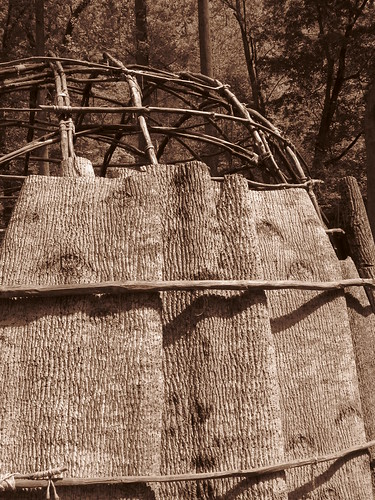
A Monacan ati, or house, covered with bark...
...on a framework of branches.
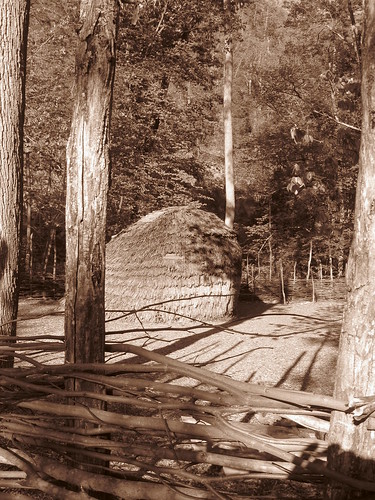
Here is an ati thatched with cattails. This variation would be used in lowland areas with plentiful water.
Meeting Merlin A Visit to Enchanted Castle Studios
[click to read]
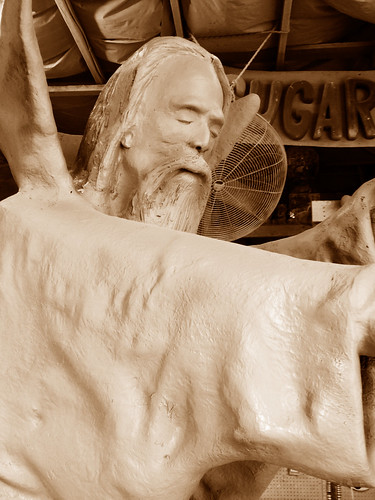
Sculptor Mark Cline of Natural Bridge had a great fan in his friend Jamie Jordan of Waynesboro. He had an unusual request for the sculptor. He knew he was dying and asked his friend to create a lasting impression of his face and to “use it appropriately.” When Mr. Jordan died just short of his sixtieth birthday, Cline made a casting of his friend’s face two days later at the funeral home and used it to create ‘Merlin.’(read more)
Everyone must leave something behind when he dies, my grandfather said. A child or a book or a painting or a house or a wall built or a pair of shoes made. Or a garden planted. Something your hand touched some way so your soul has somewhere to go when you die, and when people look at that tree or that flower you planted, you're there. It doesn't matter what you do, he said, so long as you change something from the way it was before you touched it into something that's like you after you take your hands away. The difference between the man who just cuts lawns and a real gardener is in the touching, he said. The lawn-cutter might just as well not have been there at all; the gardener will be there a lifetime." – Ray Bradbury, Fahrenheit 451 (read more)
University of Virginia Chapel A Gothic Chapel amidst Jefferson's Classical Village
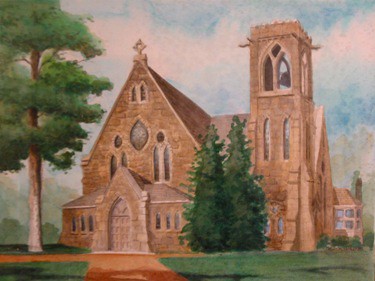
This is my painting of University Chapel. When Jefferson created his academic village it did not have a place of worship. In the late Nineteenth Century members of the Charlottesville community raised the money to build this gothic revival chapel designed by Charles Emmet Cassell of Baltimore. The cornerstone was set in 1885, and the completed chapel was dedicated in 1889. The chapel marks a sharp departure from Jefferson's classical forms.
Thirty-eight years ago this past thursday, I stood in this fine Gothic building as I married the love of my life. Thus this historic building is also a part of the story of our own family. It is a story that includes a hike in a rainstorm on Stone Mountain in Georgia and has continued for well over three decades!
One of the greatest challenges to our Faith is our forgetfulness. Scripture reminds us how the people were instructed to remember the great things G-d had done for them. G-d separated the Jordan, as He had the Red Sea, for the people to walk across and gave them the following command:
And it came to pass, when all the people were clean passed over Jordan, that the Lord spake unto Joshua, saying, Take you twelve men out of the people, out of every tribe a man, And command ye them, saying, Take you hence out of the midst of Jordan, out of the place where the priests' feet stood firm, twelve stones, and ye shall carry them over with you, and leave them in the lodging place, where ye shall lodge this night.
Then Joshua called the twelve men, whom he had prepared of the children of Israel, out of every tribe a man: And Joshua said unto them, Pass over before the ark of the Lord your G-d into the midst of Jordan, and take you up every man of you a stone upon his shoulder, according unto the number of the tribes of the children of Israel: That this may be a sign among you, that when your children ask their fathers in time to come, saying, What mean ye by these stones?
Then ye shall answer them, That the waters of Jordan were cut off before the ark of the covenant of the Lord; when it passed over Jordan, the waters of Jordan were cut off: and these stones shall be for a memorial unto the children of Israel for ever. And the children of Israel did so as Joshua commanded, and took up twelve stones out of the midst of Jordan, as the Lord spake unto Joshua, according to the number of the tribes of the children of Israel, and carried them over with them unto the place where they lodged, and laid them down there.
And Joshua set up twelve stones in the midst of Jordan, in the place where the feet of the priests which bare the ark of the covenant stood: and they are there unto this day." -- Joshua 4:1-9