Volume XV, Issue VIII
Even the smallest person can change the course of the future.”
– J. R. R. Tolkien
One Summer in my youth I worked as a janitor at NASA. It was an interesting job because we had to put on clean room suits and work in the actual clean rooms where spacecraft components were assembled and tested. We mopped floors, but we had to learn how to mop them so as to control the spread of dust. Grumman’s Orbiting Astronomical Observatory (a predecessor of the Hubble Space Telescope) was in our clean room and we were told over and over again that one speck of dust could cause this complex machine to fail in space. Thus the simple act of mopping a floor became mission critical! One day I was putting a bit of muscle into my mopping when a Grumman guy told me to back it down. “That’s a $10,000 mirror sitting there in its crate.” He told me. Lesson learned, it was the little actions by so many of us unknown people that had to be done right or the spacecraft wouldn’t fly.
“You Saved 1968”
The Legendary Telegram
The year 1968 was a difficult one. The war in Vietnam raged on. At home Dr. Martin Luther King’s assassination and that of Bobby Kennedy made for uncertain times. We forget sometimes that the 1960s were a time when our nation was divided in so many ways and the threat of Soviet military might loomed heavy over us. It was in that time that President John Kennedy artfully redirected our space program into a civilian program that would muster the best in us for a lofty endeavor. He challenged us to go to the moon.
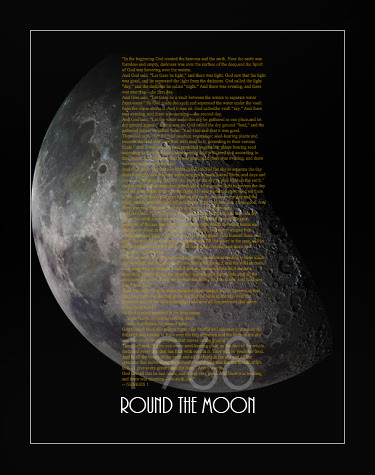
For years we played catch-up with the Russians, but on Christmas Eve, 1968, three American Astronauts read from Genesis as they orbited the moon. They were the first humans to fly into deep space and circumnavigate another world. Fifty years ago they charted a course to a place where man had never ventured before and for a brief moment they brought us all together. It is reported that they received an anonymous telegram summing up what their mission meant to a watching world. In an interview, the Astronauts put it in these words:
Lovell: I think that Bill got this telegram that said what, "You made 1968."
Borman: Saved.
Anders: Right.
Lovell: "You saved 1968."
The Doctor Behind Shepard's Apollo 14 Flight
[click to read]
Astronaut Alan Shepard, the first American in space and the first man to play golf on the moon, never forgot that Dr. William House of Newport Beach helped him get there. House performed delicate ear surgery on Shepard, allowing him to return to space in 1971. The famed astronaut's expression of thanks made House a historical footnote in the NASA space program. (read more)
From the Earth to the Moon
(to be continued)
“Narnia Beckons”
Photo by Bob Kirchman
Round the Moon
By Jules Verne
CHAPTER XIX, A STRUGGLE AGAINST THE IMPOSSIBLE
For a long time Barbicane and his companions looked silently and sadly upon that world which they had only seen from a distance, as Moses saw the land of Canaan, and which they were leaving without a possibility of ever returning to it. The projectile's position with regard to the moon had altered, and the base was now turned to the earth.
This change, which Barbicane verified, did not fail to surprise them. If the projectile was to gravitate round the satellite in an elliptical orbit, why was not its heaviest part turned toward it, as the moon turns hers to the earth? That was a difficult point. In watching the course of the projectile they could see that on leaving the moon it followed a course analogous to that traced in approaching her. It was describing a very long ellipse, which would most likely extend to the point of equal attraction, where the influences of the earth and its satellite are neutralized.
Such was the conclusion which Barbicane very justly drew from facts already observed, a conviction which his two friends shared with him.
And when arrived at this dead point, what will become of us?" asked Michel Ardan.
We don't know," replied Barbicane.
But one can draw some hypotheses, I suppose?"
Two," answered Barbicane; "either the projectile's speed will be insufficient, and it will remain forever immovable on this line of double attraction----"
I prefer the other hypothesis, whatever it may be," interrupted Michel.
Or," continued Barbicane, "its speed will be sufficient, and it will continue its elliptical course, to gravitate forever around the orb of night."
A revolution not at all consoling," said Michel, "to pass to the state of humble servants to a moon whom we are accustomed to look upon as our own handmaid. So that is the fate in store for us?"
Neither Barbicane nor Nicholl answered.
You do not answer," continued Michel impatiently.
There is nothing to answer," said Nicholl.
Is there nothing to try?"
No," answered Barbicane. "Do you pretend to fight against the impossible?"
Why not? Do one Frenchman and two Americans shrink from such a word?"
But what would you do?"
Subdue this motion which is bearing us away."
Subdue it?"
Yes," continued Michel, getting animated, "or else alter it, and employ it to the accomplishment of our own ends."
And how?"
That is your affair. If artillerymen are not masters of their projectile they are not artillerymen. If the projectile is to command the gunner, we had better ram the gunner into the gun. My faith! fine savants! who do not know what is to become of us after inducing me----"
Inducing you!" cried Barbicane and Nicholl. "Inducing you! What do you mean by that?"
No recrimination," said Michel. "I do not complain, the trip has pleased me, and the projectile agrees with me; but let us do all that is humanly possible to do the fall somewhere, even if only on the moon."
We ask no better, my worthy Michel," replied Barbicane, "but means fail us."
We cannot alter the motion of the projectile?"
No."
Nor diminish its speed?"
No."
Not even by lightening it, as they lighten an overloaded vessel?"
What would you throw out?" said Nicholl. "We have no ballast on board; and indeed it seems to me that if lightened it would go much quicker."
Slower."
Quicker." "Neither slower nor quicker," said Barbicane, wishing to make his two friends agree; "for we float is space, and must no longer consider specific weight."
Very well," cried Michel Ardan in a decided voice; "then their remains but one thing to do."
What is it?" asked Nicholl.
Breakfast," answered the cool, audacious Frenchman, who always brought up this solution at the most difficult juncture.
In any case, if this operation had no influence on the projectile's course, it could at least be tried without inconvenience, and even with success from a stomachic point of view.
Certainly Michel had none but good ideas. They breakfasted then at two in the morning; the hour mattered little. Michel served his usual repast, crowned by a glorious bottle drawn from his private cellar. If ideas did not crowd on their brains, we must despair of the Chambertin of 1853. The repast finished, observation began again. Around the projectile, at an invariable distance, were the objects which had been thrown out. Evidently, in its translatory motion round the moon, it had not passed through any atmosphere, for the specific weight of these different objects would have checked their relative speed.
On the side of the terrestrial sphere nothing was to be seen. The earth was but a day old, having been new the night before at twelve; and two days must elapse before its crescent, freed from the solar rays, would serve as a clock to the Selenites, as in its rotary movement each of its points after twenty-four hours repasses the same lunar meridian.
On the moon's side the sight was different; the orb shone in all her splendor amid innumerable constellations, whose purity could not be troubled by her rays. On the disc, the plains were already returning to the dark tint which is seen from the earth. The other part of the nimbus remained brilliant, and in the midst of this general brilliancy Tycho shone prominently like a sun.
Barbicane had no means of estimating the projectile's speed, but reasoning showed that it must uniformly decrease, according to the laws of mechanical reasoning. Having admitted that the projectile was describing an orbit around the moon, this orbit must necessarily be elliptical; science proves that it must be so. No motive body circulating round an attracting body fails in this law.
Every orbit described in space is elliptical. And why should the projectile of the Gun Club escape this natural arrangement? In elliptical orbits, the attracting body always occupies one of the foci; so that at one moment the satellite is nearer, and at another farther from the orb around which it gravitates. When the earth is nearest the sun she is in her perihelion; and in her aphelion at the farthest point. Speaking of the moon, she is nearest to the earth in her perigee, and farthest from it in her apogee. To use analogous expressions, with which the astronomers' language is enriched, if the projectile remains as a satellite of the moon, we must say that it is in its "aposelene" at its farthest point, and in its "periselene" at its nearest. In the latter case, the projectile would attain its maximum of speed; and in the former its minimum. It was evidently moving toward its aposelenitical point; and Barbicane had reason to think that its speed would decrease up to this point, and then increase by degrees as it neared the moon. This speed would even become nil, if this point joined that of equal attraction. Barbicane studied the consequences of these different situations, and thinking what inference he could draw from them, when he was roughly disturbed by a cry from Michel Ardan.
By Jove!" he exclaimed, "I must admit we are down-right simpletons!"
I do not say we are not," replied Barbicane; "but why?"
Because we have a very simple means of checking this speed which is bearing us from the moon, and we do not use it!"
And what is the means?"
To use the recoil contained in our rockets."
Done!" said Nicholl.
We have not used this force yet," said Barbicane, "it is true, but we will do so."
When?" asked Michel.
When the time comes. Observe, my friends, that in the position occupied by the projectile, an oblique position with regard to the lunar disc, our rockets, in slightly altering its direction, might turn it from the moon instead of drawing it nearer?"
Just so," replied Michel.
Let us wait, then. By some inexplicable influence, the projectile is turning its base toward the earth. It is probable that at the point of equal attraction, its conical cap will be directed rigidly toward the moon; at that moment we may hope that its speed will be nil; then will be the moment to act, and with the influence of our rockets we may perhaps provoke a fall directly on the surface of the lunar disc."
Bravo!" said Michel.
What we did not do, what we could not do on our first passage at the dead point, because the projectile was then endowed with too great a speed."
Very well reasoned," said Nicholl.
Let us wait patiently," continued Barbicane. "Putting every chance on our side, and after having so much despaired, I may say I think we shall gain our end."
This conclusion was a signal for Michel Ardan's hips and hurrahs. And none of the audacious boobies remembered the question that they themselves had solved in the negative. No! the moon is not inhabited; no! the moon is probably not habitable. And yet they were going to try everything to reach her.
One single question remained to be solved. At what precise moment the projectile would reach the point of equal attraction, on which the travelers must play their last card. In order to calculate this to within a few seconds, Barbicane had only to refer to his notes, and to reckon the different heights taken on the lunar parallels. Thus the time necessary to travel over the distance between the dead point and the south pole would be equal to the distance separating the north pole from the dead point. The hours representing the time traveled over were carefully noted, and the calculation was easy. Barbicane found that this point would be reached at one in the morning on the night of the 7th-8th of December. So that, if nothing interfered with its course, it would reach the given point in twenty-two hours.
The rockets had primarily been placed to check the fall of the projectile upon the moon, and now they were going to employ them for a directly contrary purpose. In any case they were ready, and they had only to wait for the moment to set fire to them. "Since there is nothing else to be done," said Nicholl, "I make a proposition."
What is it?" asked Barbicane.
I propose to go to sleep."
What a motion!" exclaimed Michel Ardan.
It is forty hours since we closed our eyes," said Nicholl. "Some hours of sleep will restore our strength."
Never," interrupted Michel.
Well," continued Nicholl, "every one to his taste; I shall go to sleep." And stretching himself on the divan, he soon snored like a forty-eight pounder.
That Nicholl has a good deal of sense," said Barbicane; "presently I shall follow his example." Some moments after his continued bass supported the captain's baritone.
Certainly," said Michel Ardan, finding himself alone, "these practical people have sometimes most opportune ideas."
And with his long legs stretched out, and his great arms folded under his head, Michel slept in his turn.
But this sleep could be neither peaceful nor lasting, the minds of these three men were too much occupied, and some hours after, about seven in the morning, all three were on foot at the same instant.
The projectile was still leaving the moon, and turning its conical part more and more toward her.
An explicable phenomenon, but one which happily served Barbicane's ends.
Seventeen hours more, and the moment for action would have arrived.
The day seemed long. However bold the travelers might be, they were greatly impressed by the approach of that moment which would decide all-- either precipitate their fall on to the moon, or forever chain them in an immutable orbit. They counted the hours as they passed too slow for their wish; Barbicane and Nicholl were obstinately plunged in their calculations, Michel going and coming between the narrow walls, and watching that impassive moon with a longing eye.
At times recollections of the earth crossed their minds. They saw once more their friends of the Gun Club, and the dearest of all, J. T. Maston. At that moment, the honorable secretary must be filling his post on the Rocky Mountains. If he could see the projectile through the glass of his gigantic telescope, what would he think? After seeing it disappear behind the moon's south pole, he would see them reappear by the north pole! They must therefore be a satellite of a satellite! Had J. T. Maston given this unexpected news to the world? Was this the denouement of this great enterprise?
But the day passed without incident. The terrestrial midnight arrived. The 8th of December was beginning. One hour more, and the point of equal attraction would be reached. What speed would then animate the projectile? They could not estimate it. But no error could vitiate Barbicane's calculations. At one in the morning this speed ought to be and would be nil.
Besides, another phenomenon would mark the projectile's stopping-point on the neutral line. At that spot the two attractions, lunar and terrestrial, would be annulled. Objects would "weigh" no more. This singular fact, which had surprised Barbicane and his companions so much in going, would be repeated on their return under the very same conditions. At this precise moment they must act. Already the projectile's conical top was sensibly turned toward the lunar disc, presented in such a way as to utilize the whole of the recoil produced by the pressure of the rocket apparatus. The chances were in favor of the travelers. If its speed was utterly annulled on this dead point, a decided movement toward the moon would suffice, however slight, to determine its fall.
Five minutes to one," said Nicholl.
All is ready," replied Michel Ardan, directing a lighted match to the flame of the gas.
Wait!" said Barbicane, holding his chronometer in his hand.
At that moment weight had no effect. The travelers felt in themselves the entire disappearance of it. They were very near the neutral point, if they did not touch it.
One o'clock," said Barbicane.
Michel Ardan applied the lighted match to a train in communication with the rockets. No detonation was heard in the inside, for there was no air. But, through the scuttles, Barbicane saw a prolonged smoke, the flames of which were immediately extinguished.
The projectile sustained a certain shock, which was sensibly felt in the interior.
The three friends looked and listened without speaking, and scarcely breathing. One might have heard the beating of their hearts amid this perfect silence.
Are we falling?" asked Michel Ardan, at length.
No," said Nicholl, "since the bottom of the projectile is not turning to the lunar disc!"
At this moment, Barbicane, quitting his scuttle, turned to his two companions. He was frightfully pale, his forehead wrinkled, and his lips contracted.
We are falling!" said he.
Ah!" cried Michel Ardan, "on to the moon?"
On to the earth!"
The devil!" exclaimed Michel Ardan, adding philosophically, "well, when we came into this projectile we were very doubtful as to the ease with which we should get out of it!"
And now this fearful fall had begun. The speed retained had borne the projectile beyond the dead point. The explosion of the rockets could not divert its course. This speed in going had carried it over the neutral line, and in returning had done the same thing. The laws of physics condemned it to pass through every point which it had already gone through. It was a terrible fall, from a height of 160,000 miles, and no springs to break it. According to the laws of gunnery, the projectile must strike the earth with a speed equal to that with which it left the mouth of the Columbiad, a speed of 16,000 yards in the last second.
But to give some figures of comparison, it has been reckoned that an object thrown from the top of the towers of Notre Dame, the height of which is only 200 feet, will arrive on the pavement at a speed of 240 miles per hour. Here the projectile must strike the earth with a speed of 115,200 miles per hour.
We are lost!" said Michel coolly.
Very well! if we die," answered Barbicane, with a sort of religious enthusiasm, "the results of our travels will be magnificently spread. It is His own secret that God will tell us! In the other life the soul will want to know nothing, either of machines or engines! It will be identified with eternal wisdom!"
In fact," interrupted Michel Ardan, "the whole of the other world may well console us for the loss of that inferior orb called the moon!"
Barbicane crossed his arms on his breast, with a motion of sublime resignation, saying at the same time: "The will of heaven be done!"
CHAPTER XX, THE SOUNDINGS OF THE SUSQUEHANNA
Well, lieutenant, and our soundings?"
I think, sir, that the operation is nearing its completion," replied Lieutenant Bronsfield.
But who would have thought of finding such a depth so near in shore, and only 200 miles from the American coast?"
Certainly, Bronsfield, there is a great depression," said Captain Blomsberry. "In this spot there is a submarine valley worn by Humboldt's current, which skirts the coast of America as far as the Straits of Magellan."
These great depths," continued the lieutenant, "are not favorable for laying telegraphic cables. A level bottom, like that supporting the American cable between Valentia and Newfoundland, is much better."
I agree with you, Bronsfield. With your permission, lieutenant, where are we now?"
Sir, at this moment we have 3,508 fathoms of line out, and the ball which draws the sounding lead has not yet touched the bottom; for if so, it would have come up of itself."
Brook's apparatus is very ingenious," said Captain Blomsberry; "it gives us very exact soundings."
Touch!" cried at this moment one of the men at the forewheel, who was superintending the operation.
The captain and the lieutenant mounted the quarterdeck.
What depth have we?" asked the captain.
Three thousand six hundred and twenty-seven fathoms," replied the lieutenant, entering it in his notebook.
Well, Bronsfield," said the captain, "I will take down the result. Now haul in the sounding line. It will be the work of some hours. In that time the engineer can light the furnaces, and we shall be ready to start as soon as you have finished. It is ten o'clock, and with your permission, lieutenant, I will turn in."
Do so, sir; do so!" replied the lieutenant obligingly.
The captain of the Susquehanna, as brave a man as need be, and the humble servant of his officers, returned to his cabin, took a brandy-grog, which earned for the steward no end of praise, and turned in, not without having complimented his servant upon his making beds, and slept a peaceful sleep.
It was then ten at night. The eleventh day of the month of December was drawing to a close in a magnificent night.
The Susquehanna, a corvette of 500 horse-power, of the United States navy, was occupied in taking soundings in the Pacific Ocean about 200 miles off the American coast, following that long peninsula which stretches down the coast of Mexico.
The wind had dropped by degrees. There was no disturbance in the air. The pennant hung motionless from the maintop-gallant- mast truck.
Captain Jonathan Blomsberry (cousin-german of Colonel Blomsberry, one of the most ardent supporters of the Gun Club, who had married an aunt of the captain and daughter of an honorable Kentucky merchant)-- Captain Blomsberry could not have wished for finer weather in which to bring to a close his delicate operations of sounding. His corvette had not even felt the great tempest, which by sweeping away the groups of clouds on the Rocky Mountains, had allowed them to observe the course of the famous projectile.
Everything went well, and with all the fervor of a Presbyterian, he did not forget to thank heaven for it. The series of soundings taken by the Susquehanna, had for its aim the finding of a favorable spot for the laying of a submarine cable to connect the Hawaiian Islands with the coast of America.
It was a great undertaking, due to the instigation of a powerful company. Its managing director, the intelligent Cyrus Field, purposed even covering all the islands of Oceanica with a vast electrical network, an immense enterprise, and one worthy of American genius.
To the corvette Susquehanna had been confided the first operations of sounding. It was on the night of the 11th-12th of December, she was in exactly 27@ 7' north latitude, and 41@ 37' west longitude, on the meridian of Washington.
The moon, then in her last quarter, was beginning to rise above the horizon.
After the departure of Captain Blomsberry, the lieutenant and some officers were standing together on the poop. On the appearance of the moon, their thoughts turned to that orb which the eyes of a whole hemisphere were contemplating.
The best naval glasses could not have discovered the projectile wandering around its hemisphere, and yet all were pointed toward that brilliant disc which millions of eyes were looking at at the same moment.
They have been gone ten days," said Lieutenant Bronsfield at last. "What has become of them?"
They have arrived, lieutenant," exclaimed a young midshipman, "and they are doing what all travelers do when they arrive in a new country, taking a walk!"
Oh! I am sure of that, if you tell me so, my young friend," said Lieutenant Bronsfield, smiling.
But," continued another officer, "their arrival cannot be doubted. The projectile was to reach the moon when full on the 5th at midnight. We are now at the 11th of December, which makes six days. And in six times twenty-four hours, without darkness, one would have time to settle comfortably. I fancy I see my brave countrymen encamped at the bottom of some valley, on the borders of a Selenite stream, near a projectile half-buried by its fall amid volcanic rubbish, Captain Nicholl beginning his leveling operations, President Barbicane writing out his notes, and Michel Ardan embalming the lunar solitudes with the perfume of his----"
Yes! it must be so, it is so!" exclaimed the young midshipman, worked up to a pitch of enthusiasm by this ideal description of his superior officer.
I should like to believe it," replied the lieutenant, who was quite unmoved. "Unfortunately direct news from the lunar world is still wanting."
Beg pardon, lieutenant," said the midshipman, "but cannot President Barbicane write?"
A burst of laughter greeted this answer.
No letters!" continued the young man quickly. "The postal administration has something to see to there."
Might it not be the telegraphic service that is at fault?" asked one of the officers ironically.
Not necessarily," replied the midshipman, not at all confused. "But it is very easy to set up a graphic communication with the earth."
And how?"
By means of the telescope at Long's Peak. You know it brings the moon to within four miles of the Rocky Mountains, and that it shows objects on its surface of only nine feet in diameter. Very well; let our industrious friends construct a giant alphabet; let them write words three fathoms long, and sentences three miles long, and then they can send us news of themselves."
The young midshipman, who had a certain amount of imagination, was loudly applauded; Lieutenant Bronsfield allowing that the idea was possible, but observing that if by these means they could receive news from the lunar world they could not send any from the terrestrial, unless the Selenites had instruments fit for taking distant observations at their disposal.
Evidently," said one of the officers; "but what has become of the travelers? what they have done, what they have seen, that above all must interest us. Besides, if the experiment has succeeded (which I do not doubt), they will try it again. The Columbiad is still sunk in the soil of Florida. It is now only a question of powder and shot; and every time the moon is at her zenith a cargo of visitors may be sent to her."
It is clear," replied Lieutenant Bronsfield, "that J. T. Maston will one day join his friends."
If he will have me," cried the midshipman, "I am ready!"
Oh! volunteers will not be wanting," answered Bronsfield; "and if it were allowed, half of the earth's inhabitants would emigrate to the moon!"
This conversation between the officers of the Susquehanna was kept up until nearly one in the morning. We cannot say what blundering systems were broached, what inconsistent theories advanced by these bold spirits. Since Barbicane's attempt, nothing seemed impossible to the Americans. They had already designed an expedition, not only of savants, but of a whole colony toward the Selenite borders, and a complete army, consisting of infantry, artillery, and cavalry, to conquer the lunar world.
At one in the morning, the hauling in of the sounding-line was not yet completed; 1,670 fathoms were still out, which would entail some hours' work.
According to the commander's orders, the fires had been lighted, and steam was being got up. The Susquehanna could have started that very instant.
At that moment (it was seventeen minutes past one in the morning) Lieutenant Bronsfield was preparing to leave the watch and return to his cabin, when his attention was attracted by a distant hissing noise. His comrades and himself first thought that this hissing was caused by the letting off of steam; but lifting their heads, they found that the noise was produced in the highest regions of the air. They had not time to question each other before the hissing became frightfully intense, and suddenly there appeared to their dazzled eyes an enormous meteor, ignited by the rapidity of its course and its friction through the atmospheric strata.
This fiery mass grew larger to their eyes, and fell, with the noise of thunder, upon the bowsprit, which it smashed close to the stem, and buried itself in the waves with a deafening roar!
A few feet nearer, and the Susquehanna would have foundered with all on board!
At this instant Captain Blomsberry appeared, half-dressed, and rushing on to the forecastle-deck, whither all the officers had hurried, exclaimed, "With your permission, gentlemen, what has happened?"
And the midshipman, making himself as it were the echo of the body, cried, "Commander, it is `they' come back again!"
CHAPTER XXI, J. T. MASTON RECALLED
It is `they' come back again!" the young midshipman had said, and every one had understood him. No one doubted but that the meteor was the projectile of the Gun Club. As to the travelers which it enclosed, opinions were divided regarding their fate.
They are dead!" said one.
They are alive!" said another; "the crater is deep, and the shock was deadened."
But they must have wanted air," continued a third speaker; "they must have died of suffocation."
Burned!" replied a fourth; "the projectile was nothing but an incandescent mass as it crossed the atmosphere."
What does it matter!" they exclaimed unanimously; "living or dead, we must pull them out!"
But Captain Blomsberry had assembled his officers, and "with their permission," was holding a council. They must decide upon something to be done immediately. The more hasty ones were for fishing up the projectile. A difficult operation, though not an impossible one. But the corvette had no proper machinery, which must be both fixed and powerful; so it was resolved that they should put in at the nearest port, and give information to the Gun Club of the projectile's fall.
This determination was unanimous. The choice of the port had to be discussed. The neighboring coast had no anchorage on 27@ latitude. Higher up, above the peninsula of Monterey, stands the important town from which it takes its name; but, seated on the borders of a perfect desert, it was not connected with the interior by a network of telegraphic wires, and electricity alone could spread these important news fast enough.
Some degrees above opened the bay of San Francisco. Through the capital of the gold country communication would be easy with the heart of the Union. And in less than two days the Susquehanna, by putting on high pressure, could arrive in that port. She must therefore start at once.
The fires were made up; they could set off immediately. Two thousand fathoms of line were still out, which Captain Blomsberry, not wishing to lose precious time in hauling in, resolved to cut.
We will fasten the end to a buoy," said he, "and that buoy will show us the exact spot where the projectile fell."
Besides," replied Lieutenant Bronsfield, "we have our situation exact-- 27@ 7' north latitude and 41@ 37' west longitude."
Well, Mr. Bronsfield," replied the captain, "now, with your permission, we will have the line cut."
A strong buoy, strengthened by a couple of spars, was thrown into the ocean. The end of the rope was carefully lashed to it; and, left solely to the rise and fall of the billows, the buoy would not sensibly deviate from the spot.
At this moment the engineer sent to inform the captain that steam was up and they could start, for which agreeable communication the captain thanked him. The course was then given north-northeast, and the corvette, wearing, steered at full steam direct for San Francisco. It was three in the morning.
Four hundred and fifty miles to cross; it was nothing for a good vessel like the Susquehanna. In thirty-six hours she had covered that distance; and on the 14th of December, at twenty-seven minutes past one at night, she entered the bay of San Francisco. At the sight of a ship of the national navy arriving at full speed, with her bowsprit broken, public curiosity was greatly roused. A dense crowd soon assembled on the quay, waiting for them to disembark.
After casting anchor, Captain Blomsberry and Lieutenant Bronsfield entered an eight-pared cutter, which soon brought them to land. They jumped on to the quay.
The telegraph?" they asked, without answering one of the thousand questions addressed to them.
The officer of the port conducted them to the telegraph office through a concourse of spectators. Blomsberry and Bronsfield entered, while the crowd crushed each other at the door.
Some minutes later a fourfold telegram was sent out--the first to the Naval Secretary at Washington; the second to the vice-president of the Gun Club, Baltimore; the third to the Hon. J. T. Maston, Long's Peak, Rocky Mountains; and the fourth to the sub-director of the Cambridge Observatory, Massachusetts.
It was worded as follows:
In 20@ 7' north latitude, and 41@ 37' west longitude, on the 12th of December, at seventeen minutes past one in the morning, the projectile of the Columbiad fell into the Pacific. Send instructions.-- BLOMSBERRY, Commander Susquehanna.
Five minutes afterward the whole town of San Francisco learned the news. Before six in the evening the different States of the Union had heard the great catastrophe; and after midnight, by the cable, the whole of Europe knew the result of the great American experiment. We will not attempt to picture the effect produced on the entire world by that unexpected denouement.
On receipt of the telegram the Naval Secretary telegraphed to the Susquehanna to wait in the bay of San Francisco without extinguishing her fires. Day and night she must be ready to put to sea.
The Cambridge observatory called a special meeting; and, with that composure which distinguishes learned bodies in general, peacefully discussed the scientific bearings of the question. At the Gun Club there was an explosion. All the gunners were assembled. Vice-President the Hon. Wilcome was in the act of reading the premature dispatch, in which J. T. Maston and Belfast announced that the projectile had just been seen in the gigantic reflector of Long's Peak, and also that it was held by lunar attraction, and was playing the part of under satellite to the lunar world.
We know the truth on that point.
But on the arrival of Blomsberry's dispatch, so decidely contradicting J. T. Maston's telegram, two parties were formed in the bosom of the Gun Club. On one side were those who admitted the fall of the projectile, and consequently the return of the travelers; on the other, those who believed in the observations of Long's Peak, concluded that the commander of the Susquehanna had made a mistake. To the latter the pretended projectile was nothing but a meteor! nothing but a meteor, a shooting globe, which in its fall had smashed the bows of the corvette. It was difficult to answer this argument, for the speed with which it was animated must have made observation very difficult. The commander of the Susquehanna and her officers might have made a mistake in all good faith; one argument however, was in their favor, namely, that if the projectile had fallen on the earth, its place of meeting with the terrestrial globe could only take place on this 27@ north latitude, and (taking into consideration the time that had elapsed, and the rotary motion of the earth) between the 41@ and the 42@ of west longitude.
In any case, it was decided in the Gun Club that Blomsberry brothers, Bilsby, and Major Elphinstone should go straight to San Francisco, and consult as to the means of raising the projectile from the depths of the ocean.
These devoted men set off at once; and the railroad, which will soon cross the whole of Central America, took them as far as St. Louis, where the swift mail-coaches awaited them. Almost at the same moment in which the Secretary of Marine, the vice-president of the Gun Club, and the sub-director of the Observatory received the dispatch from San Francisco, the Honorable J. T. Maston was undergoing the greatest excitement he had ever experienced in his life, an excitement which even the bursting of his pet gun, which had more than once nearly cost him his life, had not caused him. We may remember that the secretary of the Gun Club had started soon after the projectile (and almost as quickly) for the station on Long's Peak, in the Rocky Mountains, J. Belfast, director of the Cambridge Observatory, accompanying him. Arrived there, the two friends had installed themselves at once, never quitting the summit of their enormous telescope. We know that this gigantic instrument had been set up according to the reflecting system, called by the English "front view." This arrangement subjected all objects to but one reflection, making the view consequently much clearer; the result was that, when they were taking observation, J. T. Maston and Belfast were placed in the upper part of the instrument and not in the lower, which they reached by a circular staircase, a masterpiece of lightness, while below them opened a metal well terminated by the metallic mirror, which measured two hundred and eighty feet in depth.
It was on a narrow platform placed above the telescope that the two savants passed their existence, execrating the day which hid the moon from their eyes, and the clouds which obstinately veiled her during the night.
What, then, was their delight when, after some days of waiting, on the night of the 5th of December, they saw the vehicle which was bearing their friends into space! To this delight succeeded a great deception, when, trusting to a cursory observation, they launched their first telegram to the world, erroneously affirming that the projectile had become a satellite of the moon, gravitating in an immutable orbit.
From that moment it had never shown itself to their eyes-- a disappearance all the more easily explained, as it was then passing behind the moon's invisible disc; but when it was time for it to reappear on the visible disc, one may imagine the impatience of the fuming J. T. Maston and his not less impatient companion. Each minute of the night they thought they saw the projectile once more, and they did not see it. Hence constant discussions and violent disputes between them, Belfast affirming that the projectile could not be seen, J. T. Maston maintaining that "it had put his eyes out."
It is the projectile!" repeated J. T. Maston.
No," answered Belfast; "it is an avalanche detached from a lunar mountain."
Well, we shall see it to-morrow."
No, we shall not see it any more. It is carried into space."
Yes!"
No!"
And at these moments, when contradictions rained like hail, the well-known irritability of the secretary of the Gun Club constituted a permanent danger for the Honorable Belfast. The existence of these two together would soon have become impossible; but an unforseen event cut short their everlasting discussions.
During the night, from the 14th to the 15th of December, the two irreconcilable friends were busy observing the lunar disc, J. T. Maston abusing the learned Belfast as usual, who was by his side; the secretary of the Gun Club maintaining for the thousandth time that he had just seen the projectile, and adding that he could see Michel Ardan's face looking through one of the scuttles, at the same time enforcing his argument by a series of gestures which his formidable hook rendered very unpleasant.
At this moment Belfast's servant appeared on the platform (it was ten at night) and gave him a dispatch. It was the commander of the Susquehanna's telegram.
Belfast tore the envelope and read, and uttered a cry.
What!" said J. T. Maston.
The projectile!"
Well!"
Has fallen to the earth!"
Another cry, this time a perfect howl, answered him. He turned toward J. T. Maston. The unfortunate man, imprudently leaning over the metal tube, had disappeared in the immense telescope. A fall of two hundred and eighty feet! Belfast, dismayed, rushed to the orifice of the reflector.
He breathed. J. T. Maston, caught by his metal hook, was holding on by one of the rings which bound the telescope together, uttering fearful cries.
Belfast called. Help was brought, tackle was let down, and they hoisted up, not without some trouble, the imprudent secretary of the Gun Club.
He reappeared at the upper orifice without hurt.
Ah!" said he, "if I had broken the mirror?"
You would have paid for it," replied Belfast severely. "And that cursed projectile has fallen?" asked J. T. Maston.
Into the Pacific!"
Let us go!"
A quarter of an hour after the two savants were descending the declivity of the Rocky Mountains; and two days after, at the same time as their friends of the Gun Club, they arrived at San Francisco, having killed five horses on the road.
Elphinstone, the brothers Blomsberry, and Bilsby rushed toward them on their arrival.
What shall we do?" they exclaimed.
Fish up the projectile," replied J. T. Maston, "and the sooner the better."
(to be continued)
After the Rain
Photos by Bob Kirchman

Trail on Humpback Mountain.

Clouds in the Valley from Raven's Roost.
Mom and the Circus Acrobats
My mother was never one to miss using a teachable moment. One such moment came at a rather unusual place. The Clyde Beatty Cole Brothers Circus came to town one Summer and we all went. This was a real tent circus. We sat down close to the ring and I remember how massive an elephant really is when the elephants all step their front feet up on the back of the one in front of them. Well, if the elephants were impressive, our wiggly little selves became a bit less than respectful later on in the show. A troup of acrobats came on and made their moves look effortless. In fact, mom felt compelled to show us the true cost of their amazing performance.
The girls smiled as they went through their wonderful routine, but mom could see them just offstage from our vantage point and she said “look at the acrobats now.” You see, the once smiling girls now grimaced with pain as they picked cinders out of their hands. The sawdust in the ring had been lightly laid down over a parking area and the nasty cinders below it found their way into the girls’ palms. Probably it was only mom who noticed how heroic their performance really was.
That was how mom taught us to be more compassionate, not by a sermon so much as by always teaching us to be more observant. Many people around us are performing with a smile – but if we bother to watch them closely, we will notice that they too have cinders to pick.
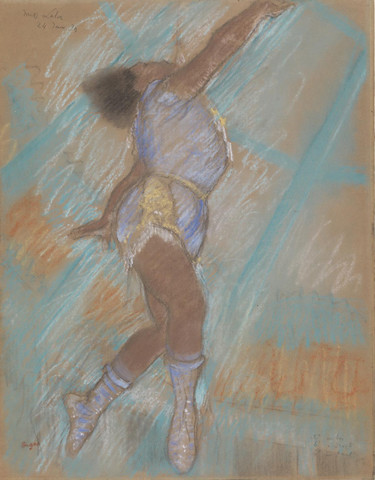
Miss Lala at the Cirque Fernando 1879 Edgar Degas.
This quest may be attempted by the weak with as much hope as the strong. Yet such is oft the course of deeds that move the wheels of the world: small hands do them because they must, while the eyes of the great are elsewhere.”
– J. R. R. Tolkien