Wednesday, June 6, 2018

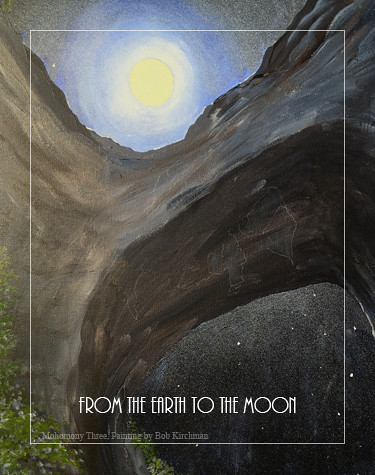
Mary Jackson, From the Earth to the Moon

0002Moon
Volume XIV, Issue XXII

Divine Design, Mary Jackson
How NASA Got its First Black Female Engineer

Watching the movie Hidden Figures, there was a place where I found myself clapping and crying, it is the scene where Paul, a colleague of Katherine Johnson, serves her coffee! If you have not seen the film yet, I recommend it highly. It follows the careers of three women in NASA's Langly Research Center's West Computing Division... a group of genius mathematicians who because of their skills found themselves in a highly important part of the space race with incredible responsibility.

That in itself would be a great and wonderful story but it gets even better. In the height of segregation in mid-Twentieth Century Virginia, in the 1950's, the brilliant minds of the West Computing Division were all women and they were African-American! Women were actually not strangers to engineering departments. My MOTHER had done similar work in aircraft design for the Martin Company in Baltimore. In fact, she is responsible for my FAVORITE part of the Kirchman Studio's Employee Handbook (if there is such a thing).

When Mom started at the Martin Company's Engineering Department, some old guy snarled: "Get me some coffee deary." Big mistake! Mom rose to her full almost five foot frame and snapped back: "I am here to do your calculations, and assist in design, but I will NOT fetch your coffee!" Dad, who worked in the same department, married her!

The Fay Kirchman Rule is how I honor her memory. Simply stated: "Female Colleagues are NOT required to make or fetch the coffee of their male counterparts, regardless of rank." My former assistant Kristina will attest to it. I always made the coffee and handed her a cup when she came in... and always fondly remembered Mom! The studio operated on Biblical Principle: HE-brews! So when Paul hands Katherine a cup of coffee, I remember Mom!

Mom had studied Mathematics and Physics before becoming a school teacher in Manassas, Virginia. Her career path was very similar to Mary Jackson's in that regard. Mom was doing graduate work at John's Hopkins when she was tapped to work for an engineering team at Martin. While she had to go against resistance to women in the sciences, she never had to contend with Jim Crow Laws. One of her Mentors in College was Dr. Robert Edward Loving, who taught Physics at Richmond College (before it and Westhampton were merged to become the University of Richmond). She would remember snippets of Dr. Loving's lectures in conversation with us children: "Can my little dog Garfield shake a bridge?" he would ask in a dialogue still strongly influenced by the black children who were his childhood playmates.

Mary Jackson graduated from Hampton Institute in 1942 with a dual degree in Math and Physical Sciences, and accepted a job as a math teacher at a black school in Calvert County, Maryland. Like Mom, the great war opened up the opportunity for her to go further. Langley was an important center for aeronautical research then, but it was not until 1951 that Mary joined the West Computing Division at Langley.

Margot Lee Shetterly writes: "After two years in the computing pool, Mary Jackson received an offer to work for engineer Kazimierz Czarnecki in the 4-foot by 4-foot Supersonic Pressure Tunnel, a 60,000 horsepower wind tunnel capable of blasting models with winds approaching twice the speed of sound. Czarnecki offered Mary hands-on experience conducting experiments in the facility, and eventually suggested that she enter a training program that would allow her to earn a promotion from mathematician to engineer. Trainees had to take graduate level math and physics in after-work courses managed by the University of Virginia. Because the classes were held at then-segregated Hampton High School, however, Mary needed special permission from the City of Hampton to join her white peers in the classroom. Never one to flinch in the face of a challenge, Mary completed the courses, earned the promotion, and in 1958 became NASA’s first black female engineer. That same year, she co-authored her first report, Effects of Nose Angle and Mach Number on Transition on Cones at Supersonic Speeds." [1.] Her journey to becoming an engineer is chronicled in Hidden Figures.

She worked for two decades as an engineer and authored over a dozen papers on air flow around aircraft. She became a mentor to young people, helping students build a wind tunnel at a Hampton Community Center. Thanks to the Movie Hidden Figures her story will inspire new generations of young scientists to do great things!
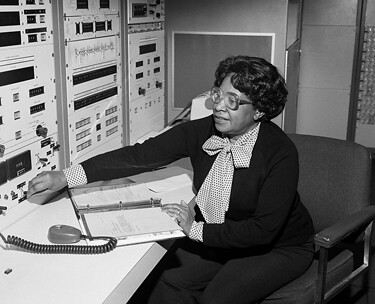
Mary_Jackson_working_2
Mary Jackson. NASA Langley Research Center Photo.

Seeing Things in 'Living Color'

In the Vietnam era, American prisoners confined in the infamous 'Hanoi Hilton' developed some unique strategies for keeping their sanity in an environment that was designed to break them. One man, a musician, carefully drew a keyboard on a piece of scrap wood. He hid it in his cell and although it was not capable of producing sound, the man would 'sit' at it and composed pieces of music which he later was able to play. Another prisoner was a golfer. Every day he would 'play' an imaginary round in his head. Upon his release and subsequent physical rehabilitation, he went out to the golf course. His initial score was pretty low considering the years he had spent unable to play.

In the 1960's, as man raced to the moon, engineers had to develop procedures that were up to the time unheard of. My Father was an aeronautical structural engineer and in his work he tackled the problem of getting sensitive instruments and equipment into space on top of a rapidly accelerating missile. In that day the success rate for launches was pretty abysmal, something like a 50% success rate, so Dad and his team went to work imagining the forces that would assault an ascending rocket.

They developed a machine they called the Launch Phase Simulator. It was an enormous centrifuge to simulate the increased g forces of launch. A vibrator simulated the shock and vibration a spacecraft was likely to experience as it went up. The subject was mounted in a vacuum chamber and the atmospheric pressure was decreased to simulate flying into space. Finally, a system of heating and cooling apparatus simultaneously baked and cooled respective sides of the subject craft.

By imagining and simulating the possible combinations of forces assaulting an ascending spacecraft, engineers were able to make remarkable improvements in the success rate of launches.
(to be continued)


From the Earth to the Moon
By Jules Verne

CHAPTER XVIII, THE PASSENGER OF THE ATLANTA

If this astounding news, instead of flying through the electric wires, had simply arrived by post in the ordinary sealed envelope, Barbicane would not have hesitated a moment. He would have held his tongue about it, both as a measure of prudence, and in order not to have to reconsider his plans. This telegram might be a cover for some jest, especially as it came from a Frenchman. What human being would ever have conceived the idea of such a journey? and, if such a person really existed, he must be an idiot, whom one would shut up in a lunatic ward, rather than within the walls of the projectile.

The contents of the dispatch, however, speedily became known; for the telegraphic officials possessed but little discretion, and Michel Ardan's proposition ran at once throughout the several States of the Union. Barbicane, had, therefore, no further motives for keeping silence. Consequently, he called together such of his colleagues as were at the moment in Tampa Town, and without any expression of his own opinions simply read to them the laconic text itself. It was received with every possible variety of expressions of doubt, incredulity, and derision from every one, with the exception of J. T. Maston, who exclaimed, "It is a grand idea, however!"

When Barbicane originally proposed to send a shot to the moon every one looked upon the enterprise as simple and practicable enough-- a mere question of gunnery; but when a person, professing to be a reasonable being, offered to take passage within the projectile, the whole thing became a farce, or, in plainer language a humbug.

One question, however, remained. Did such a being exist? This telegram flashed across the depths of the Atlantic, the designation of the vessel on board which he was to take his passage, the date assigned for his speedy arrival, all combined to impart a certain character of reality to the proposal. They must get some clearer notion of the matter. Scattered groups of inquirers at length condensed themselves into a compact crowd, which made straight for the residence of President Barbicane. That worthy individual was keeping quiet with the intention of watching events as they arose.

But he had forgotten to take into account the public impatience; and it was with no pleasant countenance that he watched the population of Tampa Town gathering under his windows. The murmurs and vociferations below presently obliged him to appear. He came forward, therefore, and on silence being procured, a citizen put point-blank to him the following question: "Is the person mentioned in the telegram, under the name of Michel Ardan, on his way here? Yes or no."

Gentlemen," replied Barbicane, "I know no more than you do."

We must know," roared the impatient voices.

Time will show," calmly replied the president.

Time has no business to keep a whole country in suspense," replied the orator. "Have you altered the plans of the projectile according to the request of the telegram?"

Not yet, gentlemen; but you are right! we must have better information to go by. The telegraph must complete its information."

To the telegraph!" roared the crowd.

Barbicane descended; and heading the immense assemblage, led the way to the telegraph office. A few minutes later a telegram was dispatched to the secretary of the underwriters at Liverpool, requesting answers to the following queries:

About the ship Atlanta-- when did she leave Europe? Had she on board a Frenchman named Michel Ardan?"

Two hours afterward Barbicane received information too exact to leave room for the smallest remaining doubt.

The steamer Atlanta from Liverpool put to sea on the 2nd of October, bound for Tampa Town, having on board a Frenchman borne on the list of passengers by the name of Michel Ardan."

That very evening he wrote to the house of Breadwill and Co., requesting them to suspend the casting of the projectile until the receipt of further orders. On the 10th of October, at nine A.M., the semaphores of the Bahama Canal signaled a thick smoke on the horizon. Two hours later a large steamer exchanged signals with them. the name of the Atlanta flew at once over Tampa Town. At four o'clock the English vessel entered the Bay of Espiritu Santo. At five it crossed the passage of Hillisborough Bay at full steam. At six she cast anchor at Port Tampa. The anchor had scarcely caught the sandy bottom when five hundred boats surrounded the Atlanta, and the steamer was taken by assault. Barbicane was the first to set foot on deck, and in a voice of which he vainly tried to conceal the emotion, called "Michel Ardan."

Here!" replied an individual perched on the poop.

Barbicane, with arms crossed, looked fixedly at the passenger of the Atlanta.

He was a man of about forty-two years of age, of large build, but slightly round-shouldered. His massive head momentarily shook a shock of reddish hair, which resembled a lion's mane. His face was short with a broad forehead, and furnished with a moustache as bristly as a cat's, and little patches of yellowish whiskers upon full cheeks. Round, wildish eyes, slightly near-sighted, completed a physiognomy essentially feline. His nose was firmly shaped, his mouth particularly sweet in expression, high forehead, intelligent and furrowed with wrinkles like a newly-plowed field. The body was powerfully developed and firmly fixed upon long legs. Muscular arms, and a general air of decision gave him the appearance of a hardy, jolly, companion. He was dressed in a suit of ample dimensions, loose neckerchief, open shirtcollar, disclosing a robust neck; his cuffs were invariably unbuttoned, through which appeared a pair of red hands.

On the bridge of the steamer, in the midst of the crowd, he bustled to and fro, never still for a moment, "dragging his anchors," as the sailors say, gesticulating, making free with everybody, biting his nails with nervous avidity. He was one of those originals which nature sometimes invents in the freak of a moment, and of which she then breaks the mould.

Among other peculiarities, this curiosity gave himself out for a sublime ignoramus, "like Shakespeare," and professed supreme contempt for all scientific men.

Those "fellows," as he called them, "are only fit to mark the points, while we play the game." He was, in fact, a thorough Bohemian, adventurous, but not an adventurer; a hare-brained fellow, a kind of Icarus, only possessing relays of wings. For the rest, he was ever in scrapes, ending invariably by falling on his feet, like those little figures which they sell for children's toys. In a few words, his motto was "I have my opinions," and the love of the impossible constituted his ruling passion.

Such was the passenger of the Atlanta, always excitable, as if boiling under the action of some internal fire by the character of his physical organization. If ever two individuals offered a striking contrast to each other, these were certainly Michel Ardan and the Yankee Barbicane; both, moreover, being equally enterprising and daring, each in his own way.

The scrutiny which the president of the Gun Club had instituted regarding this new rival was quickly interrupted by the shouts and hurrahs of the crowd. The cries became at last so uproarious, and the popular enthusiasm assumed so personal a form, that Michel Ardan, after having shaken hands some thousands of times, at the imminent risk of leaving his fingers behind him, was fain at last to make a bolt for his cabin.

Barbicane followed him without uttering a word.

You are Barbicane, I suppose?" said Michel Ardan, in a tone of voice in which he would have addressed a friend of twenty years' standing.

Yes," replied the president of the Gun Club.

All right! how d'ye do, Barbicane? how are you getting on-- pretty well? that's right."

So," said Barbicane without further preliminary, "you are quite determined to go."

Quite decided."

Nothing will stop you?"

Nothing. Have you modified your projectile according to my telegram?"

I waited for your arrival. But," asked Barbicane again, "have you carefully reflected?"

Reflected? have I any time to spare? I find an opportunity of making a tour in the moon, and I mean to profit by it. There is the whole gist of the matter."

Barbicane looked hard at this man who spoke so lightly of his project with such complete absence of anxiety. "But, at least," said he, "you have some plans, some means of carrying your project into execution?"

Excellent, my dear Barbicane; only permit me to offer one remark: My wish is to tell my story once for all, to everybody, and then have done with it; then there will be no need for recapitulation. So, if you have no objection, assemble your friends, colleagues, the whole town, all Florida, all America if you like, and to-morrow I shall be ready to explain my plans and answer any objections whatever that may be advanced. You may rest assured I shall wait without stirring. Will that suit you?" .

All right," replied Barbicane.

So saying, the president left the cabin and informed the crowd of the proposal of Michel Ardan. His words were received with clappings of hands and shouts of joy. They had removed all difficulties. To-morrow every one would contemplate at his ease this European hero. However, some of the spectators, more infatuated than the rest, would not leave the deck of the Atlanta. They passed the night on board. Among others J. T. Maston got his hook fixed in the combing of the poop, and it pretty nearly required the capstan to get it out again.

He is a hero! a hero!" he cried, a theme of which he was never tired of ringing the changes; "and we are only like weak, silly women, compared with this European!" 

As to the president, after having suggested to the visitors it was time to retire, he re-entered the passenger's cabin, and remained there till the bell of the steamer made it midnight.

But then the two rivals in popularity shook hands heartily and parted on terms of intimate friendship.

CHAPTER XIX, A MONSTER MEETING.

On the following day Barbicane, fearing that indiscreet questions might be put to Michel Ardan, was desirous of reducing the number of the audience to a few of the initiated, his own colleagues for instance. .

He might as well have tried to check the Falls of Niagara! he was compelled, therefore, to give up the idea, and let his new friend run the chances of a public conference. The place chosen for this monster meeting was a vast plain situated in the rear of the town. In a few hours, thanks to the help of the shipping in port, an immense roofing of canvas was stretched over the parched prairie, and protected it from the burning rays of the sun. There three hundred thousand people braved for many hours the stifling heat while awaiting the arrival of the Frenchman. Of this crowd of spectators a first set could both see and hear; a second set saw badly and heard nothing at all; and as for the third, it could neither see nor hear anything at all. At three o'clock Michel Ardan made his appearance, accompanied by the principal members of the Gun Club. He was supported on his right by President Barbicane, and on his left by J. T. Maston, more radiant than the midday sun, and nearly as ruddy. Ardan mounted a platform, from the top of which his view extended over a sea of black hats. .

He exhibited not the slightest embarrassment; he was just as gay, familiar, and pleasant as if he were at home. To the hurrahs which greeted him he replied by a graceful bow; then, waving his hands to request silence, he spoke in perfectly correct English as follows:

Gentlemen, despite the very hot weather I request your patience for a short time while I offer some explanations regarding the projects which seem to have so interested you. I am neither an orator nor a man of science, and I had no idea of addressing you in public; but my friend Barbicane has told me that you would like to hear me, and I am quite at your service. Listen to me, therefore, with your six hundred thousand ears, and please excuse the faults of the speaker. Now pray do not forget that you see before you a perfect ignoramus whose ignorance goes so far that he cannot even understand the difficulties! It seemed to him that it was a matter quite simple, natural, and easy to take one's place in a projectile and start for the moon! That journey must be undertaken sooner or later; and, as for the mode of locomotion adopted, it follows simply the law of progress. Man began by walking on all-fours; then, one fine day, on two feet; then in a carriage; then in a stage-coach; and lastly by railway. Well, the projectile is the vehicle of the future, and the planets themselves are nothing else! Now some of you, gentlemen, may imagine that the velocity we propose to impart to it is extravagant. It is nothing of the kind. All the stars exceed it in rapidity, and the earth herself is at this moment carrying us round the sun at three times as rapid a rate, and yet she is a mere lounger on the way compared with many others of the planets! And her velocity is constantly decreasing. Is it not evident, then, I ask you, that there will some day appear velocities far greater than these, of which light or electricity will probably be the mechanical agent?

Yes, gentlemen," continued the orator, "in spite of the opinions of certain narrow-minded people, who would shut up the human race upon this globe, as within some magic circle which it must never outstep, we shall one day travel to the moon, the planets, and the stars, with the same facility, rapidity, and certainty as we now make the voyage from Liverpool to New York! Distance is but a relative expression, and must end by being reduced to zero."

The assembly, strongly predisposed as they were in favor of the French hero, were slightly staggered at this bold theory. Michel Ardan perceived the fact.

Gentlemen," he continued with a pleasant smile, "you do not seem quite convinced. Very good! Let us reason the matter out. Do you know how long it would take for an express train to reach the moon? Three hundred days; no more! And what is that? The distance is no more than nine times the circumference of the earth; and there are no sailors or travelers, of even moderate activity, who have not made longer journeys than that in their lifetime. 

And now consider that I shall be only ninety- seven hours on my journey. Ah! I see you are reckoning that the moon is a long way off from the earth, and that one must think twice before making the experiment. What would you say, then, if we were talking of going to Neptune, which revolves at a distance of more than two thousand seven hundred and twenty millions of miles from the sun! And yet what is that compared with the distance of the fixed stars, some of which, such as Arcturus, are billions of miles distant from us? And then you talk of the distance which separates the planets from the sun! And there are people who affirm that such a thing as distance exists. Absurdity, folly, idiotic nonsense! Would you know what I think of our own solar universe? Shall I tell you my theory? It is very simple! In my opinion the solar system is a solid homogeneous body; the planets which compose it are in actual contact with each other; and whatever space exists between them is nothing more than the space which separates the molecules of the densest metal, such as silver, iron, or platinum! I have the right, therefore, to affirm, and I repeat, with the conviction which must penetrate all your minds, `Distance is but an empty name; distance does not really exist!'"

Hurrah!" cried one voice (need it be said it was that of J. T. Maston). "Distance does not exist!" And overcome by the energy of his movements, he nearly fell from the platform to the ground. He just escaped a severe fall, which would have proved to him that distance was by no means an empty name. "Gentlemen," resumed the orator, "I repeat that the distance between the earth and her satellite is a mere trifle, and undeserving of serious consideration. I am convinced that before twenty years are over one-half of our earth will have paid a visit to the moon. Now, my worthy friends, if you have any question to put to me, you will, I fear, sadly embarrass a poor man like myself; still I will do my best to answer you." Up to this point the president of the Gun Club had been satisfied with the turn which the discussion had assumed. It became now, however, desirable to divert Ardan from questions of a practical nature, with which he was doubtless far less conversant. Barbicane, therefore, hastened to get in a word, and began by asking his new friend whether he thought that the moon and the planets were inhabited. "You put before me a great problem, my worthy president," replied the orator, smiling. "Still, men of great intelligence, such as Plutarch, Swedenborg, Bernardin de St. Pierre, and others have, if I mistake not, pronounced in the affirmative. Looking at the question from the natural philosopher's point of view, I should say that nothing useless existed in the world; and, replying to your question by another, I should venture to assert, that if these worlds are habitable, they either are, have been, or will be inhabited."

No one could answer more logically or fairly," replied the president. "The question then reverts to this: Are these worlds habitable? For my own part I believe they are."

For myself, I feel certain of it," said Michel Ardan.

Nevertheless," retorted one of the audience, "there are many arguments against the habitability of the worlds. The conditions of life must evidently be greatly modified upon the majority of them. To mention only the planets, we should be either broiled alive in some, or frozen to death in others, according as they are more or less removed from the sun."

I regret," replied Michel Ardan, "that I have not the honor of personally knowing my contradictor, for I would have attempted to answer him. His objection has its merits, I admit; but I think we may successfully combat it, as well as all others which affect the habitability of other worlds. If I were a natural philosopher, I would tell him that if less of caloric were set in motion upon the planets which are nearest to the sun, and more, on the contrary, upon those which are farthest removed from it, this simple fact would alone suffice to equalize the heat, and to render the temperature of those worlds supportable by beings organized like ourselves.

If I were a naturalist, I would tell him that, according to some illustrious men of science, nature has furnished us with instances upon the earth of animals existing under very varying conditions of life; that fish respire in a medium fatal to other animals; that amphibious creatures possess a double existence very difficult of explanation; that certain denizens of the seas maintain life at enormous depths, and there support a pressure equal to that of fifty or sixty atmospheres without being crushed; that several aquatic insects, insensible to temperature, are met with equally among boiling springs and in the frozen plains of the Polar Sea; in fine, that we cannot help recognizing in nature a diversity of means of operation oftentimes incomprehensible, but not the less real. If I were a chemist, I would tell him that the aerolites, bodies evidently formed exteriorly of our terrestrial globe, have, upon analysis, revealed indisputable traces of carbon, a substance which owes its origin solely to organized beings, and which, according to the experiments of Reichenbach, must necessarily itself have been endued with animation. And lastly, were I a theologian, I would tell him that the scheme of the Divine Redemption, according to St. Paul, seems to be applicable, not merely to the earth, but to all the celestial worlds. But, unfortunately, I am neither theologian, nor chemist, nor naturalist, nor philosopher; therefore, in my absolute ignorance of the great laws which govern the universe, I confine myself to saying in reply, `I do not know whether the worlds are inhabited or not: and since I do not know, I am going to see!'"

Whether Michel Ardan's antagonist hazarded any further arguments or not it is impossible to say, for the uproarious shouts of the crowd would not allow any expression of opinion to gain a hearing. On silence being restored, the triumphant orator contented himself with adding the following remarks: .

Gentlemen, you will observe that I have but slightly touched upon this great question. There is another altogether different line of argument in favor of the habitability of the stars, which I omit for the present. I only desire to call attention to one point. To those who maintain that the planets are not inhabited one may reply: You might be perfectly in the right, if you could only show that the earth is the best possible world, in spite of what Voltaire has said. She has but one satellite, while Jupiter, Uranus, Saturn, Neptune have each several, an advantage by no means to be despised. But that which renders our own globe so uncomfortable is the inclination of its axis to the plane of its orbit. Hence the inequality of days and nights; hence the disagreeable diversity of the seasons. On the surface of our unhappy spheroid we are always either too hot or too cold; we are frozen in winter, broiled in summer; it is the planet of rheumatism, coughs, bronchitis; while on the surface of Jupiter, for example, where the axis is but slightly inclined, the inhabitants may enjoy uniform temperatures. It possesses zones of perpetual springs, summers, autumns, and winters; every Jovian may choose for himself what climate he likes, and there spend the whole of his life in security from all variations of temperature. You will, I am sure, readily admit this superiority of Jupiter over our own planet, to say nothing of his years, which each equal twelve of ours! Under such auspices and such marvelous conditions of existence, it appears to me that the inhabitants of so fortunate a world must be in every respect superior to ourselves. All we require, in order to attain such perfection, is the mere trifle of having an axis of rotation less inclined to the plane of its orbit!"

Hurrah!" roared an energetic voice, "let us unite our efforts, invent the necessary machines, and rectify the earth's axis!"

A thunder of applause followed this proposal, the author of which was, of course, no other than J. T. Maston. And, in all probability, if the truth must be told, if the Yankees could only have found a point of application for it, they would have constructed a lever capable of raising the earth and rectifying its axis. It was just this deficiency which baffled these daring mechanicians.
(to be continued)

The Brookwood Designs
The Kirchman Studio's Own Neighborhood

Brookwood
Double Rainbow over the studio window.

brookwood014

brookwood013

brookwood015

brookwood016
In the studio, Mr. Kirchman sought to create an environment that was conducive to inspiration.

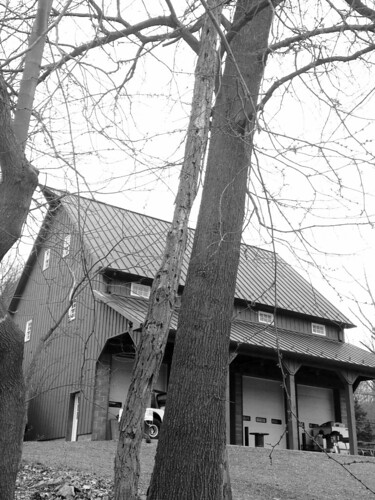
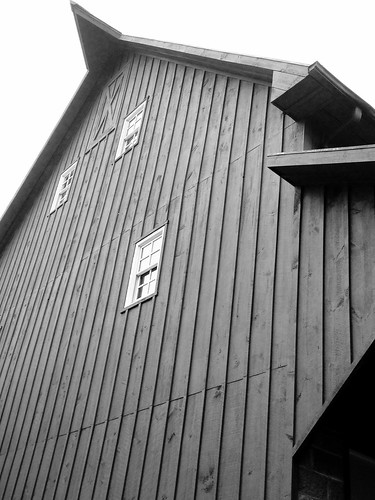
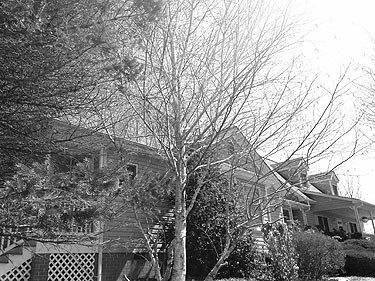
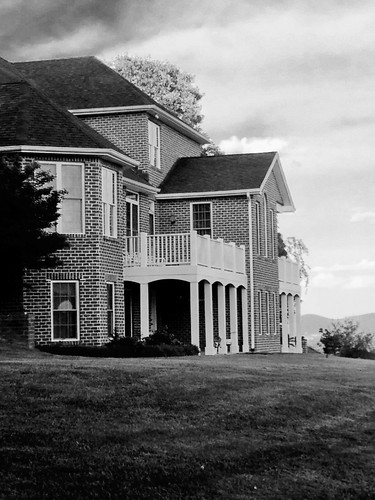
The Kirchman Studio Brookwood Designs are of note because they are projects in the vicinity of and including the studio space. In addition to renovations to the existing house for aging in place, Mr. Kirchman designed the studio, a residence next door and a shop/work-van garage in the form of a barn. The designs are of note because they attempt to honor the region's agricultural heritage and a very nice stone church by the firm of T. J. Collins, visible from the neighborhood. The residence draws from the simplicity of German stone architecture. The stonework itself is by mason: Lewis Wright.

The Patterson Residence

brookwood020

brookwood019

brookwood018

The Barn (Shop and Garage)

Brookwood001

brookwood002

brookwood003

The Studio

brookwood023

brookwood009

brookwood007

brookwood021

brookwood022

Garden002

Garden001

Garden003

brookwood008

House in a House

Brookwood022
Here the garage is converted into a small house within a house with its own discreet separate entrance. It also has its own kitchenette. The perfect solution for multi-generational living.

Barbour Colonnade

Barbour Portico

Barbour Portico

IMG_1025_web
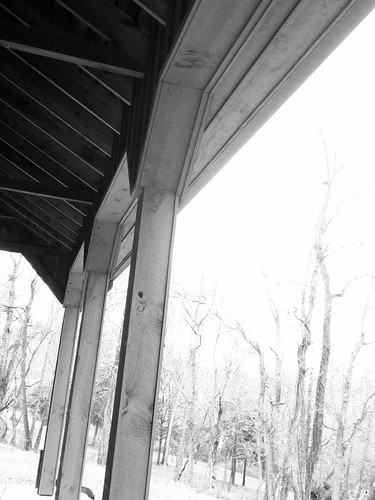
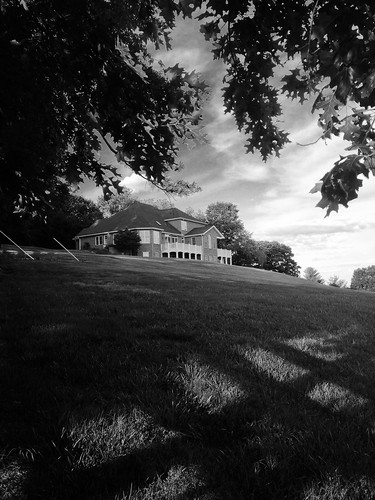
This was a planbook house built on the highest point in Brookwood. The builder turned the house so that the 'back' faced the road and the deck was sitting on skinny 4" x 4" posts. This is my design to add presence to the elevation facing the neighborhood.

________________________________________

Residences in Albemarle County
Greenwood Residence
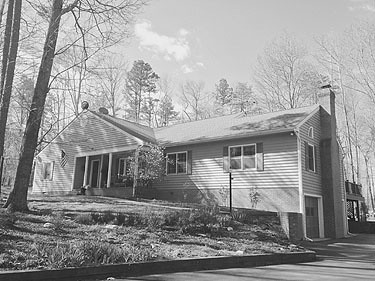
RileyHouse023
This was also developed as a house within a house concept to house the client's elderly mother.

Crozet Addition
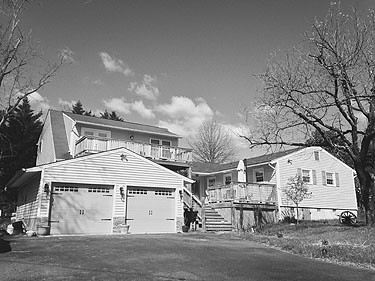
RossbergHouse023
Substantial space and a garage are added to a small house. The massing is hidden in the trees and invisible from the front of the original house.
________________________________________

Staunton, Virginia Commercial Work
Enterprise Centre

EnterpriseCentre001

EnterpriseCentre002
Here an old strip shopping center was given a new parapet and a new trussed roof. The original flat roof was not salvageable so it was trussed over.

Law Offices from Gas Station

LawFirm001
An old 'box' style gas station at the corner of Greenville Avenue and Richmond Road received a new facade and an office wing added to the rear.

________________________________________

Creating Connection with History
A Sense of Place

Brookwood024
Stonework on the facade creates a sense of connection...
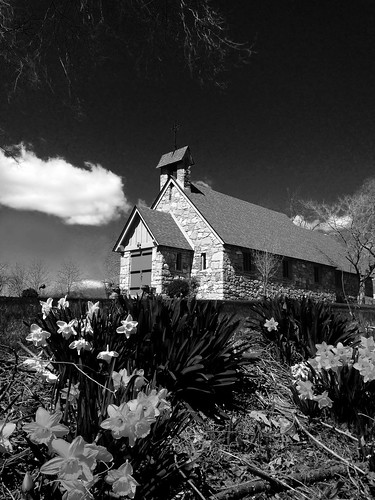
Spring
...with the historic architecture of Good Shepherd Episcopal Church by the firm of T. J. Collins.

Copyright © 2017, The Kirchman Studio, all rights reserved.

In Defense of Summer Vacation

The 'other' Weekly News Magazine [click to read] once argued that Summer Vacation is over romanticized and merely stands in the way of the kids retaining all that book-learning they'll need so they can work for the Chinese some day. OK, I'll give you the point that a certain amount of knowledge is 'lost' as kids pursue other activities... but as one who's life and career was shaped by Summers of 'other activities' I'll raise a clear protest: "Not so fast!"

I spent my Summers drawing, building things, going to camp and playing for hours in the woods. I was Lewis and Clark when I set off to explore the woods surrounding Triadelphia Reservoir... with no Sacajawea to help with directions. Mom got a big bell to ring when it was time to come in for dinner. Sometimes I actually heard it. More often than not my appetite finally brought me back to a plate of cold food. Now I loved my groceries as much as any young boy, but didn't Simon Kenton eat cold biscuits while he was exporing the Ohio Valley?

When my younger siblings were old enough, Dad loaded us in Mom's VW Microbus [Mom was there first when it came to the minivan] and we took road trips. Man, I loved road trips. We'd go to places like Gettysburg and crawl into sniper's nests. We'd imagine what it must have been like rushing up the hill in Pickett's Charge. Then we'd go to Antietem and wonder some more. When I turned sixteen, Dad actually let me drive on the trips. Oh the white-knuckle thrill of the Capital Beltway! The endless perspective of NC Route 12 heading to Hatteras and the rollercoaster ride down US 29 to Grandma's. Life was good in the Summer. I hired myself out to the local farmers to bale hay and other jobs. Hot, nasty work is good for the teenaged soul.

One farmer had a wife who'd make us grape juice and lemonade. I've never found sweeter refreshment in all my life.

One Summer Dad decided I needed to build a greenhouse. He let me draw up the plans and he took them to the county... I was thirteen at the time. He gave me a budget and set me loose. I learned to lay block, build walls, buy old storm windows and pretty much whatever it took. The guys at Talbott's Lumber Yard in Ellicott City gave me lots of free advice. They pretty much convinced me I could do it. I wonder how much Dad was paying them?

I was not a licensed electrician... that presented a problem for hooking up the power. Dad said it wasn't a problem. He had a buddy who was licensed and came out and did the whole job in exchange for a bottle of Jack Daniels [Black Label] that Dad cheerfully 'donated' to the building fund. In addition to the electric heater, we got the brilliant idea that it would benefit the plants with both heat and moisture if we ran the dryer vent in there.

What to do about lint? Well, here's where it got really interesting. When we discovered that a discarded nylon stocking fit over the vent and caught the lint while allowing air to flow, we had our problem solved. Dad enjoyed the 'conversation piece' that resulted too.

The greenhouse, built of redwood, served our family for many years. Finally it succombed to termites after I was gone and married. It's lessons are still with me today.

The Royal Wedding Preachers
Bishop Michael Curry and Archbishop Justin Welby


PontifusBANNER

Wednesday, May 30, 2018

Lighthouse on a Mountain, Earth to the Moon

0000000Moon
Volume XIV, Issue XXI

From the Earth to the Moon
By Jules Verne

CHAPTER XVI, THE COLUMBIAD

Had the casting succeeded? They were reduced to mere conjecture. There was indeed every reason to expect success, since the mould has absorbed the entire mass of the molten metal; still some considerable time must elapse before they could arrive at any certainty upon the matter.

The patience of the members of the Gun Club was sorely tried during this period of time. But they could do nothing. J. T. Maston escaped roasting by a miracle. Fifteen days after the casting an immense column of smoke was still rising in the open sky and the ground burned the soles of the feet within a radius of two hundred feet round the summit of Stones Hill. It was impossible to approach nearer. All they could do was to wait with what patience they might.
Here we are at the 10th of August," exclaimed J. T. Maston one morning, "only four months to the 1st of December! We shall never be ready in time!" Barbicane said nothing, but his silence covered serious irritation.

However, daily observations revealed a certain change going on in the state of the ground. About the 15th of August the vapors ejected had sensibly diminished in intensity and thickness. Some days afterward the earth exhaled only a slight puff of smoke, the last breath of the monster enclosed within its circle of stone. Little by little the belt of heat contracted, until on the 22nd of August, Barbicane, his colleagues, and the engineer were enabled to set foot on the iron sheet which lay level upon the summit of Stones Hill. "At last!" exclaimed the president of the Gun Club, with an immense sigh of relief.

The work was resumed the same day. They proceeded at once to extract the interior mould, for the purpose of clearing out the boring of the piece. Pickaxes and boring irons were set to work without intermission. The clayey and sandy soils had acquired extreme hardness under the action of the heat; but, by the aid of the machines, the rubbish on being dug out was rapidly carted away on railway wagons; and such was the ardor of the work, so persuasive the arguments of Barbicane's dollars, that by the 3rd of September all traces of the mould had entirely disappeared.

Immediately the operation of boring was commenced; and by the aid of powerful machines, a few weeks later, the inner surface of the immense tube had been rendered perfectly cylindrical, and the bore of the piece had acquired a thorough polish.

At length, on the 22d of September, less than a twelvemonth after Barbicane's original proposition, the enormous weapon, accurately bored, and exactly vertically pointed, was ready for work. There was only the moon now to wait for; and they were pretty sure that she would not fail in the rendezvous.

The ecstasy of J. T. Maston knew no bounds, and he narrowly escaped a frightful fall while staring down the tube. But for the strong hand of Colonel Blomsberry, the worthy secretary, like a modern Erostratus, would have found his death in the depths of the Columbiad.

The cannon was then finished; there was no possible doubt as to its perfect completion. So, on the 6th of October, Captain Nicholl opened an account between himself and President Barbicane, in which he debited himself to the latter in the sum of two thousand dollars.

One may believe that the captain's wrath was increased to its highest point, and must have made him seriously ill. However, he had still three bets of three, four, and five thousand dollars, respectively; and if he gained two out of these, his position would not be very bad. But the money question did not enter into his calculations; it was the success of his rival in casting a cannon against which iron plates sixty feet thick would have been ineffectual, that dealt him a terrible blow.

After the 23rd of September the enclosure of Stones hill was thrown open to the public; and it will be easily imagined what was the concourse of visitors to this spot! There was an incessant flow of people to and from Tampa Town and the place, which resembled a procession, or rather, in fact, a pilgrimage.

It was already clear to be seen that, on the day of the experiment itself, the aggregate of spectators would be counted by millions; for they were already arriving from all parts of the earth upon this narrow strip of promontory. Europe was emigrating to America.

Up to that time, however, it must be confessed, the curiosity of the numerous comers was but scantily gratified. Most had counted upon witnessing the spectacle of the casting, and they were treated to nothing but smoke. This was sorry food for hungry eyes; but Barbicane would admit no one to that operation. Then ensued grumbling, discontent, murmurs; they blamed the president, taxed him with dictatorial conduct. His proceedings were declared "un-American." There was very nearly a riot round Stones Hill; but Barbicane remained inflexible. When, however, the Columbiad was entirely finished, this state of closed doors could no longer be maintained; besides it would have been bad taste, and even imprudence, to affront the public feeling. Barbicane, therefore, opened the enclosure to all comers; but, true to his practical disposition, he determined to coin money out of the public curiosity.

It was something, indeed, to be enabled to contemplate this immense Columbiad; but to descend into its depths, this seemed to the Americans the ne plus ultra of earthly felicity. Consequently, there was not one curious spectator who was not willing to give himself the treat of visiting the interior of this great metallic abyss. Baskets suspended from steam-cranes permitted them to satisfy their curiosity. There was a perfect mania.

Women, children, old men, all made it a point of duty to penetrate the mysteries of the colossal gun. The fare for the descent was fixed at five dollars per head; and despite this high charge, during the two months which preceded the experiment, the influx of visitors enabled the Gun Club to pocket nearly five hundred thousand dollars!

It is needless to say that the first visitors of the Columbiad were the members of the Gun Club. This privilege was justly reserved for that illustrious body. The ceremony took place on the 25th of September. A basket of honor took down the president, J. T. Maston, Major Elphinstone, General Morgan, Colonel Blomsberry, and other members of the club, to the number of ten in all. How hot it was at the bottom of that long tube of metal! They were half suffocated. But what delight! What ecstasy! A table had been laid with six covers on the massive stone which formed the bottom of the Columbiad, and lighted by a jet of electric light resembling that of day itself. Numerous exquisite dishes, which seemed to descend from heaven, were placed successively before the guests, and the richest wines of France flowed in profusion during this splendid repast, served nine hundred feet beneath the surface of the earth!

The festival was animated, not to say somewhat noisy. Toasts flew backward and forward. They drank to the earth and to her satellite, to the Gun Club, the Union, the Moon, Diana, Phoebe, Selene, the "peaceful courier of the night!" All the hurrahs, carried upward upon the sonorous waves of the immense acoustic tube, arrived with the sound of thunder at its mouth; and the multitude ranged round Stones Hill heartily united their shouts with those of the ten revelers hidden from view at the bottom of the gigantic Columbiad.

J. T. Maston was no longer master of himself. Whether he shouted or gesticulated, ate or drank most, would be a difficult matter to determine. At all events, he would not have given his place up for an empire, "not even if the cannon-- loaded, primed, and fired at that very moment--were to blow him in pieces into the planetary world."

CHAPTER XVII, A TELEGRAPHIC DISPATCH

The great works undertaken by the Gun Club had now virtually come to an end; and two months still remained before the day for the discharge of the shot to the moon. To the general impatience these two months appeared as long as years! Hitherto the smallest details of the operation had been daily chronicled by the journals, which the public devoured with eager eyes.
Just at this moment a circumstance, the most unexpected, the most extraordinary and incredible, occurred to rouse afresh their panting spirits, and to throw every mind into a state of the most violent excitement.

One day, the 30th of September, at 3:47 P.M., a telegram, transmitted by cable from Valentia (Ireland) to Newfoundland and the American Mainland, arrived at the address of President Barbicane.

The president tore open the envelope, read the dispatch, and, despite his remarkable powers of self-control, his lips turned pale and his eyes grew dim, on reading the twenty words of this telegram.

Here is the text of the dispatch, which figures now in the archives of the Gun Club:

FRANCE, PARIS, 30 September, 4 A.M. Barbicane, Tampa Town, Florida, United States.

Substitute for your spherical shell a cylindro-conical projectile. I shall go inside. Shall arrive by steamer Atlanta. MICHEL ARDAN.
(to be continued)

Isambard Kingdom Brunel
An Honest Look at the Life of a Great Man


Brunel's Great Ship
The Building of the Great Eastern


The 1893 Chicago World's Fair
Paintings of the Proposed Fair

Chicago001a

Chicago003a

Chicago002a
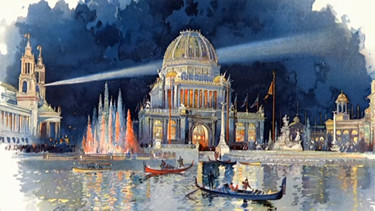
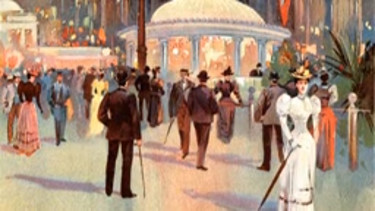
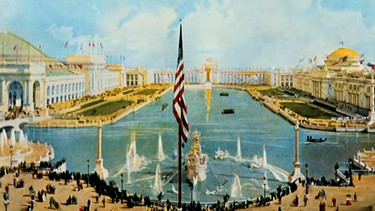
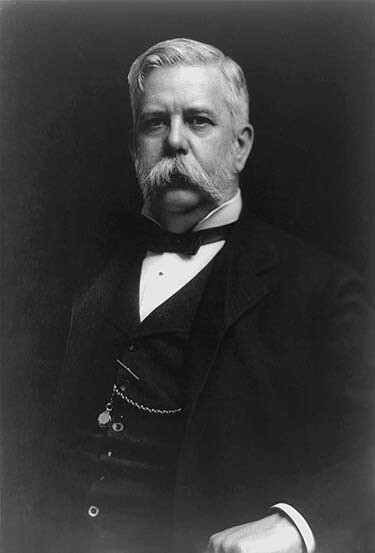
Designers envisioned a great classical city that would inspire American civic architecture for years to come. George Westinghouse provided the magic of electrical illumination. Walt Disney's father worked as a construction worker on the fair buildings.

Westinghouse Workers' Housing

WestinghouseWorkersWeb
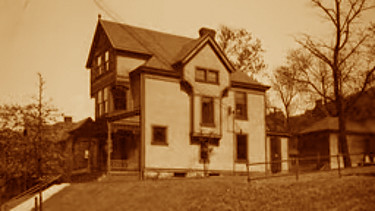
While many industrialists of the late Nineteenth Century gave little thought to the quality of workers' housing, George Westinghouse built houses like these that his workers could purchase for a small monthly installment. He even insured the houses so that if a family experienced the unfortunate loss of their breadwinner they would not lose their house.

Tearing Down High-Places
by Lela Markham

[click to read more]

In the Bible, many a man and a few women stumbled over idols in their pursuit to follow God and there were times in Israel’s history when God sent prophets to the nation to warn them to tear down the high places of Canaanite worship. I believe that these days the churches are faced with similar circumstances and that God can use Christian novelists as messengers to alert His Bride to the need to reform.

Art, though, is never the voice of a country; it is an even more precious thing, the voice of the individual, doing its best to speak, not comfort of any sort, but truth. And the art that speaks it most unmistakably, most directly, most variously, most fully, is fiction; in particular, the novel.” ~ Eudora Welty in On Writing. (read more)

A Lighthouse on a Mountain
On Mount Greylock, a Monument Rises in the Mist

melville2_web
In the clouds hanging on Greylock, Massachusetts' highest mountain, stands a lighthouse...

lanternwastes2_web

"Thy word is a lamp unto my feet, and a light unto my path." -- Psalm 119:105

Walking up the trail to the top of Greylock in November of 2000, I stepped into a cloud. The top of the mountain, unseen, was covered with a frosting of heavy ice. Inching upward, I came to this monument at the summit. A war memorial, but also an allusion to local author Herman Melville, who wrote Moby Dick. When the monument was first lit you could see it for seventy miles on a clear night.

Sinai 

After the miraculous deliverance from Egypt, the establishment of the Passover celebration and the inspiration of Bezaleel and Aholiab to build the Tabernacle, Moses went up into a cloud on Mount Sinai. There G-d gave the law that would be a light to thousands of generations to Moses, but the people couldn't see what was happening on the mountain. They Turned Away [click to read] and made themselves a god of metal. Unable to visualize what they didn't see, they subjected themselves to foolishness.

Golgotha

On a hill called Golgotha, the man who said: "I am the light of the world." -- John 9:5 slipped into death.  And the people stood beholding. "And the rulers also with them derided him, saying, He saved others; let him save himself." -- Luke 23:35 Surely they felt that this was not the Messiah they had hoped for. Dying between two criminals, His body placed in the dark tomb, He was gone from them. His followers hid themselves away, fearing they would be killed as well.

Zion

What happened on that mountain, though unseen, changed history. "Now faith is the substance of things hoped for, the evidence of things not seen." -- Hebrews 11:1. We now know the rest of the story, so it is easy to forget the need to retell the stories of promise. Revelation 21 [click to read] takes us to yet another mountaintop: "And he carried me away in the spirit to a great and high mountain, and shewed me that great city, the holy Jerusalem, descending out of heaven from G-d." -- Revelation 21:10 It is this unseen hope that must sustain us in the world we live in today.

frosty2_web
...a war memorial and an allusion to author Herman Melville.

PontifusBANNER

Mohomony
The Bridge of G-d

IMG_7545

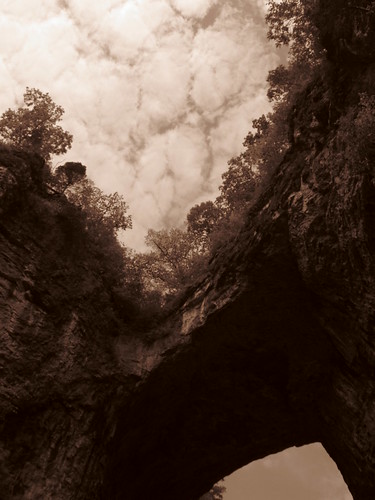
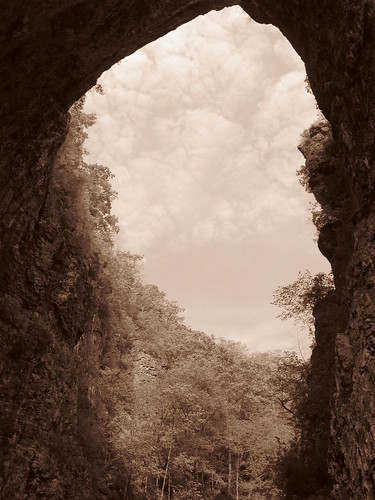
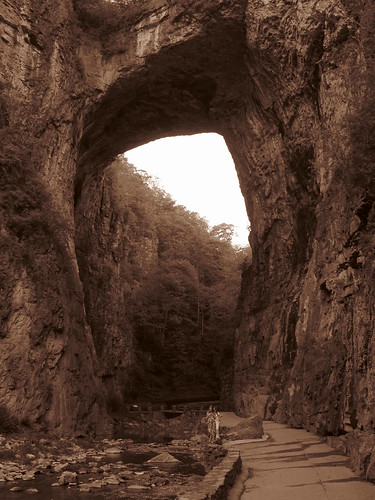
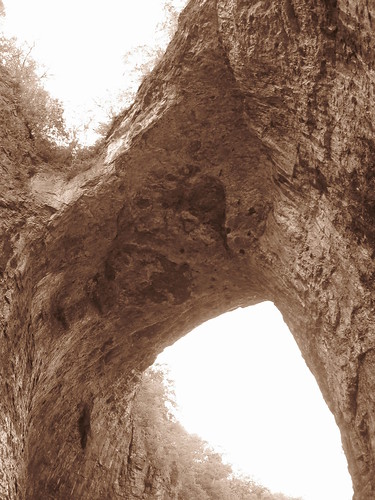
Unique Natural Formation Saved Early Monacans

IMG_7621
One can almost imagine the battle...

IMG_7623
...raging above this deep chasm.

Amazing Story of Deliverance in Monacan Heritage

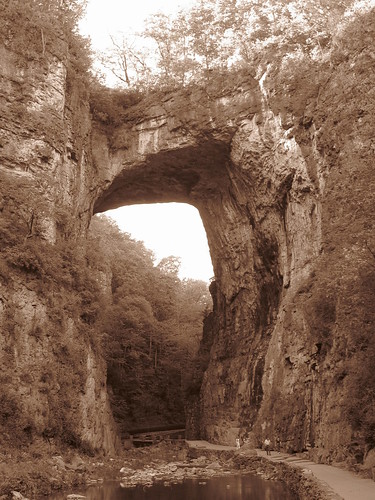
Running desperately through the forest, the small band of Monacan men, women and children were vastly outnumbered by their pursuers. Powhatan warriers were overtaking them. Suddenly they came to the edge of a vast chasm! They could see no way to cross it.

They closed their eyes and prayed. Then they looked up and saw the formation we know today as Natural Bridge, one of Virginia's most unique wonders, spanning the chasm. Hurrying their women and children across the stone span, they followed. Then they turned to make their stand. The much larger army was constricted by the narrow bridge and could only attack the Monacans in a much smaller number. The bridge became a great equalizer between the two forces and the Monacans were victorious that day.

Passed from generation to generation, the story of Monacan survival has made Natural Bridge a sacred place to the Monacans. They named it Mohomony, meaning 'Bridge of G-d."

Today a recreated Monacan village stands at the base of the bridge. Because the story predates written accounts, it is easy to dismiss it as legend, yet as we considered it my wife said: "I believe it recounts an actual event." The strategic element inherent in the story (the narrow bridge equalizing the battle) is too much like something another Rockbridge County resident, Thomas Jackson, would want to remember.

Like Homer's accounts of the Trojan War and the Odyssey home, some unknown Monacan warrier seems to have recounted this amazing story, remembering the time when geography aided them in battle. I walked across the bridge on route 11, imagining an epic battle like something out of Tolkien (like Gandalf facing the Balrog)! Young Monacans standing shoulder to shoulder to protect children and wives from an overwhelming enemy, who prevailed that day, passed the story to their children.

It just seemed to me like one of many grand moments in history where the unseen hand of G-d was seen as deliverer.

IMG_7546
Today visitors walk beneath the bridge...

IMG_7551
...but her greatest story may have played out above!

The Monacans of Mohomony
Celebrating Heritage of  Central Virginia's First People

IMG_7630
A lady of Monacan ancestry presents the history of her people at Natural Bridge.

IMG_7296
Monacan Lady (above) and warrier (below) as painted by Kristina Elaine Greer on the Crozet Trestle Mural.

IMG_7380

IMG_7647
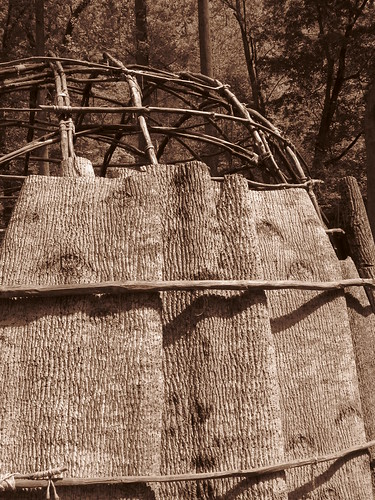
A Monacan ati, or house, covered with bark...

IMG_7649
...on a framework of branches.

IMG_7586
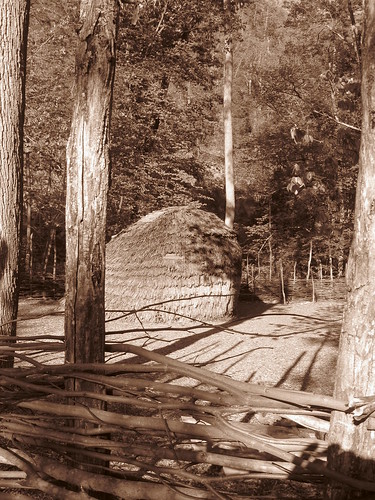
Here is an ati thatched with cattails. This variation would be used in lowland areas with plentiful water.

Meeting Merlin
A Visit to Enchanted Castle Studios
[click to read]

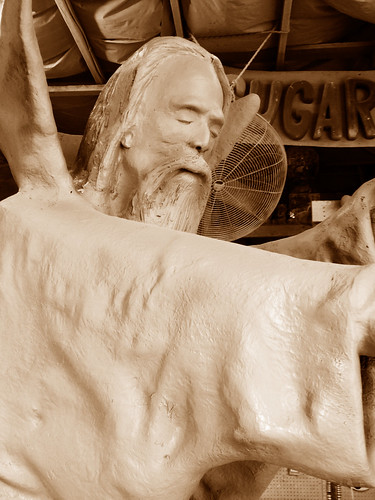
Merlin

Sculptor Mark Cline of Natural Bridge had a great fan in his friend Jamie Jordan of Waynesboro. He had an unusual request for the sculptor. He knew he was dying and asked his friend to create a lasting impression of his face and to “use it appropriately.” When Mr. Jordan died just short of his sixtieth birthday, Cline made a casting of his friend’s face two days later at the funeral home and used it to create ‘Merlin.’(read more)

A Floral Legacy Continues
[click to read]

springhill

Everyone must leave something behind when he dies, my grandfather said. A child or a book or a painting or a house or a wall built or a pair of shoes made. Or a garden planted. Something your hand touched some way so your soul has somewhere to go when you die, and when people look at that tree or that flower you planted, you're there. It doesn't matter what you do, he said, so long as you change something from the way it was before you touched it into something that's like you after you take your hands away. The difference between the man who just cuts lawns and a real gardener is in the touching, he said. The lawn-cutter might just as well not have been there at all; the gardener will be there a lifetime." – Ray Bradbury, Fahrenheit 451 (read more)

University of Virginia Chapel
A Gothic Chapel amidst Jefferson's Classical Village

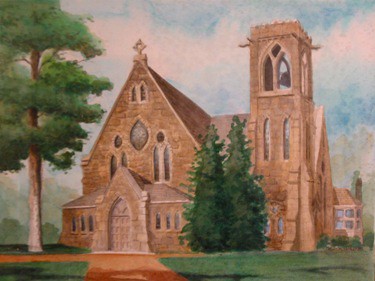
chapel
This is my painting of University Chapel. When Jefferson created his academic village it did not have a place of worship. In the late Nineteenth Century members of the Charlottesville community raised the money to build this gothic revival chapel designed by Charles Emmet Cassell of Baltimore. The cornerstone was set in 1885, and the completed chapel was dedicated in 1889. The chapel marks a sharp departure from Jefferson's classical forms.

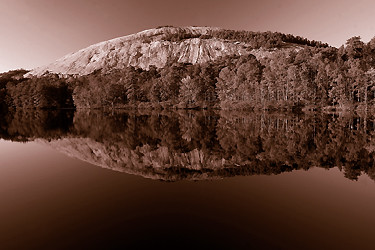
Thirty-eight years ago this past thursday, I stood in this fine Gothic building as I married the love of my life. Thus this historic building is also a part of the story of our own family. It is a story that includes a hike in a rainstorm on Stone Mountain in Georgia and has continued for well over three decades!

One of the greatest challenges to our Faith is our forgetfulness. Scripture reminds us how the people were instructed to remember the great things G-d had done for them. G-d separated the Jordan, as He had the Red Sea, for the people to walk across and gave them the following command:

And it came to pass, when all the people were clean passed over Jordan, that the Lord spake unto Joshua, saying, Take you twelve men out of the people, out of every tribe a man, And command ye them, saying, Take you hence out of the midst of Jordan, out of the place where the priests' feet stood firm, twelve stones, and ye shall carry them over with you, and leave them in the lodging place, where ye shall lodge this night.

Then Joshua called the twelve men, whom he had prepared of the children of Israel, out of every tribe a man: And Joshua said unto them, Pass over before the ark of the Lord your G-d into the midst of Jordan, and take you up every man of you a stone upon his shoulder, according unto the number of the tribes of the children of Israel: That this may be a sign among you, that when your children ask their fathers in time to come, saying, What mean ye by these stones?

Then ye shall answer them, That the waters of Jordan were cut off before the ark of the covenant of the Lord; when it passed over Jordan, the waters of Jordan were cut off: and these stones shall be for a memorial unto the children of Israel for ever. And the children of Israel did so as Joshua commanded, and took up twelve stones out of the midst of Jordan, as the Lord spake unto Joshua, according to the number of the tribes of the children of Israel, and carried them over with them unto the place where they lodged, and laid them down there.

And Joshua set up twelve stones in the midst of Jordan, in the place where the feet of the priests which bare the ark of the covenant stood: and they are there unto this day." -- Joshua 4:1-9

stonemountain_web

CS_Lewis_Banner

Monday, May 28, 2018

Arlington and Washington on Memorial Day

MONUMENT
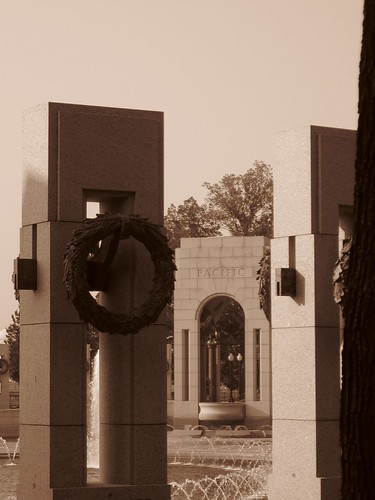
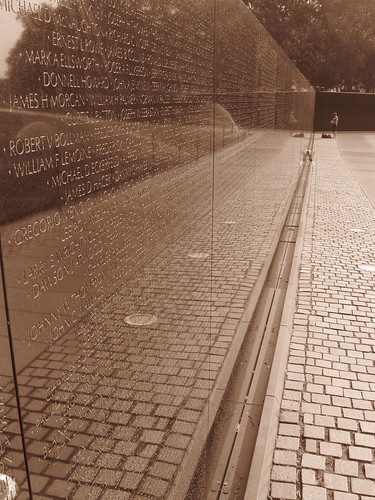
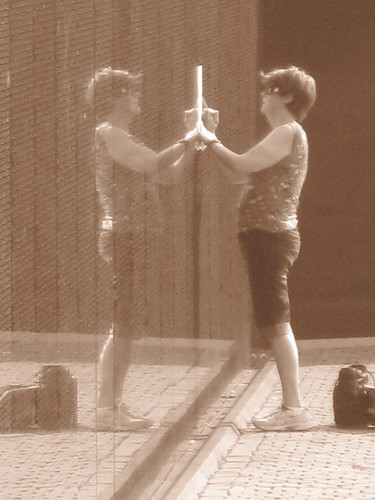
Remembering Those Who Died Defending Liberty

Pacific
The World War II Memorial.

Vietnam Memorial
Vietnam Memorial...

Vietnam Memorial
...and a hero remembered.

IMG_2858
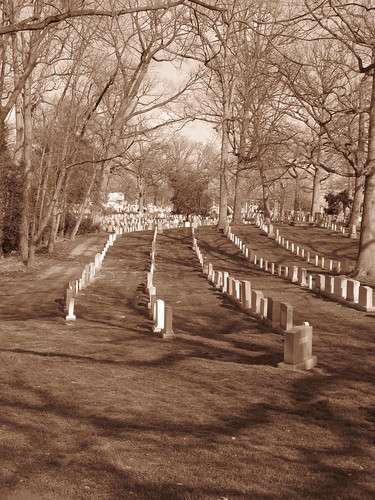
This is the view of Arlington Cemetery from the Old Post Chapel at Ft. Meyer.

IMG_2705
Spring buds in Arlington National Cemetery.

Wednesday, May 23, 2018

Faith and Bright Hope, George Westinghouse

THYME0912
Volume XIV, Issue XX

Jesus is Coming, Plant a Tree!

Therefore, my beloved brethren, be ye stedfast, unmoveable, always abounding in the work of the Lord, forasmuch as ye know that your labour is not in vain in the Lord."
   -- 1 Corinthians 15:58

In a wonderful article by N. T. Wright entitled Jesus is Coming, Plant a Tree [click to read], the author writes: "For the early Christians, the resurrection of Jesus launched God’s new creation upon the world, beginning to fulfill the prayer Jesus taught his followers, that God’s kingdom would come “on earth as in heaven” (Matt. 6:10), and anticipating the “new heavens and a new earth” (Isa. 65:17, 66:22; 2 Pet. 3:13; Rev. 21:1) promised by Isaiah and again in the New Testament. From this point of view, as I have often said (though the phrase is not original to me), Heaven is undoubtedly important, but it’s not the end of the world. The early Christians were not very interested, in the way our world has been interested, in what happens to people immediately after they die. They were extremely interested in a topic many Western Christians in the last few years have forgotten about altogether, namely the final new creation, new heavens and new earth joined together, and the resurrection of the body that will create new human beings to live in that new world."

I have friends who are very much into eschatology, wonderful people, but they are pretty much convinced that this world is pretty rotten and the sooner it passes away the better. I also have friends who are very much into fixing things in the here and now, not thinking about the hereafter at all. Wright makes the case that I very much agree with: Both are missing something! He also struck a chord with me, especially in light of this dedication in my yet to be published novel: "Pontifus, The Bridge Builder's Tale:"

This little book is dedicated to those brave young people, who though I shall not name them here, will likely recognize bits of themselves in the characters I portray. I apologize beforehand for this intrusion into your privacy but feel that the world so desperately needs your story. Your very real dedication and bravery inspired this book and it cannot be written without a foundation of such truth. Most of all it is dedicated to my beautiful wife, of whom the accolade: "Well done, good and faithful servant!" is most fitting. You have stood by me in good times and bad. We have shared in the raising of some incredible young people who inhabited our own home. You have poured your love and wonder into the lives of countless students. I love you with all my being!!!

It is because we both love young people so that I write this. It is but a poor attempt to offer hope and direction to a world so devoid of it. We err, perhaps, in pointing to the hope of the hereafter without providing adequate models and renderings of that Kingdom and those who have labored to bring it into the world we inhabit now. The water that will quench the soul's thirst is dismissed because those who profess to bear it often seem, (to the society around them,) preoccupied with apocalyptic visions and derision for the world as it is now. It is not wrong to love such things, but they are not easily shared with those for whom the flower of life is yet to come. No bride-to-be, having just unwrapped her wedding planner, wants to engage in a lengthy discourse on Eschatology!

Jeremiah of old told those in exile to "Build, Plant, Marry and Have Children, Prosper and Pray!" [1.] Jeremiah 29:4-7 -- and to be sure, there are many who do. They just don't make the headlines very often. The historical references in this work, and there are probably too many, are essential to understanding how men and women have navigated dangerous times before. They are most necessary to show how one can indeed have vision for one's own times and hope in a greater, unseen reality as well."
-- Excerpt from "Pontifus, The Bridge Builder's Tale"  ©Copyright, 2015, The Kirchman Studio

Referencing 1 Corinthians 15:58, Wright presents the important idea that our work here in this world is not wasted. It is incredibly important to the building of the Kingdom to come! Just as human marriage is a picture of Christ and his Church, there is much to do to point the way and give vision to the Unseen Kingdom. Wright continues: "I have no idea precisely what this means. I do not know how the painting an artist paints today in prayer and wisdom will find a place in G-d’s new world. I don’t know what musical instruments we will have to play Bach, though I’m sure Bach’s music will be there. 

I don’t know how my planting a tree today will relate to the wonderful trees that will be in G-d’s recreated world. I don’t know how my work for justice for the poor, for remission of global debts, will reappear in that new world. But I know that G-d’s new world of justice and joy, of hope for the whole earth, was launched when Jesus came out of the tomb on Easter morning: I know he calls me and you to live in him and by the power of his spirit, and so to be new-creation people here and now, giving birth to signs and symbols of the kingdom on earth as in heaven. 

The resurrection of Jesus and the gift of the Spirit mean that we are called to bring forth real and effective signs of G-d’s renewed creation even in the midst of the present age. Not to do so is at best to put ourselves in the position of those Second Temple Jews who believed they had to wait passively for G-d to act – when G-d has acted in Jesus to inaugurate his kingdom on earth as in heaven. At worst, not to bring forth works and signs of renewal in G-d’s creation is to collude, as gnosticism always does, with the forces of sin and death."

Revelation 19:6-9 speaks of the time when people of all nations are joined in communion with G-d:

And I heard as it were the voice of a great multitude, and as the voice of many waters, and as the voice of mighty thunderings, saying, Alleluia: for the Lord G-d omnipotent reigneth. Let us be glad and rejoice, and give honour to him: for the marriage of the Lamb is come, and his wife hath made herself ready. And to her was granted that she should be arrayed in fine linen, clean and white: for the fine linen is the righteousness of saints. And he saith unto me, Write, Blessed are they which are called unto the marriage supper of the Lamb. And he saith unto me, These are the true sayings of G-d."

In Isaiah 60 [4.] and in Revelation 21 Believers look to a New Heaven and a New Earth where a Heavenly Jerusalem descends to join the Earth. Here is a Kingdom that needs no temple, needs no sun to light it, for G-d Himself is the force that illuminates it! [5.]

And I saw a new Heaven and a new earth: for the first Heaven and the first earth were passed away; and there was no more sea. And I John saw the holy city, new Jerusalem, coming down from G-d out of heaven, prepared as a bride adorned for her husband. And I heard a great voice out of heaven saying, Behold, the tabernacle of G-d is with men, and he will dwell with them, and they shall be his people, and G-d himself shall be with them, and be their G-d." -- Revelation 21:1-3

West_web East_web
Journey to Jesus, a mural depicting the nations coming to Jesus in the New Heaven and New Earth described in Revelation 21. Mural by Kristina Elaine Greer and Bob Kirchman

Journey to Jesus [click to view larger images].

Our Christian hope is that we're going to live with Christ in a new Earth, where there is not only no more death, but where life is what it was always meant to be." -- Timothy Keller.

THYMELESS
The hope of Heaven and New Earth.

The Power of Love
By Bishop Michael Curry
(Delivered at the Royal Wedding)

And now in the name of our loving, liberating and life-giving God, Father, Son and Holy Spirit. Amen.

From the Song of Solomon in the Bible: Set me as a seal upon your heart, as a seal upon your arm; for love is strong as death, passion fierce as the grave. Its flashes are flashes of fire, a raging flame. Many waters cannot quench love, neither can floods drown it.

The late Dr Martin Luther King Jr once said, and I quote: "We must discover the power of love, the redemptive power of love. And when we do that, we will make of this old world a new world, for love is the only way."

There's power in love. Don't underestimate it. Don't even over-sentimentalize it. There's power, power in love.

If you don't believe me, think about a time when you first fell in love. The whole world seemed to center around you and your beloved.

Oh there's power, power in love. Not just in its romantic forms, but any form, any shape of love. There's a certain sense in which when you are loved, and you know it, when someone cares for you, and you know it, when you love and you show it - it actually feels right.

There is something right about it. And there's a reason for it. The reason has to do with the source. We were made by a power of love, and our lives were meant - and are meant - to be lived in that love. That's why we are here.

Ultimately, the source of love is God himself: the source of all of our lives. There's an old medieval poem that says: 'Where true love is found, God himself is there.

The New Testament says it this way: "Beloved, let us love one another, because love is of God, and those who love are born of God and know God. Those who do not love do not know God. Why? For God is love."

There's power in love. There's power in love to help and heal when nothing else can.

There's power in love to lift up and liberate when nothing else will.

There's power in love to show us the way to live.

Set me as a seal on your heart... a seal on your arm, for love is as strong as death.

But love is not only about a young couple. Now the power of love is demonstrated by the fact that we're all here. Two young people fell in love, and we all showed up.

But it's not just for and about a young couple, who we rejoice with. It's more than that. Jesus of Nazareth on one occasion was asked by a lawyer to sum up the essence of the teachings of Moses, and he went back and he reached back into the Hebrew scriptures, to Deuteronomy and Leviticus, and Jesus said: "You shall love the Lord your God with all your heart, all your soul, all your mind and all your strength. This is the first and great commandment. And the second is like it: Love your neighbor as yourself."

And then in Matthew's version, he added, he said: "On these two, love of God and love of neighbor, hang all the law, all the prophets, everything that Moses wrote, everything in the holy prophets, everything in the scriptures, everything that God has been trying to tell the world ... love God, love your neighbors, and while you're at it, love yourself."

Someone once said that Jesus began the most revolutionary movement in human history. A movement grounded in the unconditional love of God for the world - and a movement mandating people to live that love, and in so doing to change not only their lives but the very life of the world itself.

I'm talking about power. Real power. Power to change the world.

If you don't believe me, well, there were some old slaves in America's Antebellum South who explained the dynamic power of love and why it has the power to transform.

They explained it this way. They sang a spiritual, even in the midst of their captivity. It's one that says 'There is a balm in Gilead...' a healing balm, something that can make things right.

There is a balm in Gilead to make the wounded whole, there is a balm in Gilead to heal the sin-sick soul.'

And one of the stanzas actually explains why. They said: 'If you cannot preach like Peter, and you cannot pray like Paul, you just tell the love of Jesus, how he died to save us all."

Oh, that's the balm in Gilead! This way of love, it is the way of life. They got it. He died to save us all.

He didn't die for anything he could get out of it. Jesus did not get an honorary doctorate for dying. He didn't... he wasn't getting anything out of it. He gave up his life, he sacrificed his life, for the good of others, for the good of the other, for the wellbeing of the world... for us.

That's what love is. Love is not selfish and self-centered. Love can be sacrificial, and in so doing, becomes redemptive. And that way of unselfish, sacrificial, redemptive love changes lives, and it can change this world.

If you don't believe me, just stop and imagine. Think and imagine a world where love is the way."

Imagine our homes and families where love is the way. Imagine neighborhoods and communities where love is the way.

Imagine governments and nations where love is the way. Imagine business and commerce where this love is the way.

Imagine this tired old world where love is the way. When love is the way - unselfish, sacrificial, redemptive.

When love is the way, then no child will go to bed hungry in this world ever again.

When love is the way, we will let justice roll down like a mighty stream and righteousness like an ever-flowing brook.

When love is the way, poverty will become history. When love is the way, the earth will be a sanctuary.

When love is the way, we will lay down our swords and shields, down by the riverside, to study war no more.

When love is the way, there's plenty good room - plenty good room - for all of God's children.

Because when love is the way, we actually treat each other, well... like we are actually family.

When love is the way, we know that God is the source of us all, and we are brothers and sisters, children of God.

My brothers and sisters, that's a new Heaven, a new earth, a new world, a new human family.

And let me tell you something, old Solomon was right in the Old Testament: that's fire. Pierre Teilhard de Chardin - and with this I will sit down, we gotta get you all married - French Jesuit Pierre Teilhard de Chardin was arguably one of the great minds, great spirits of the 20th century.

Jesuit, Roman Catholic priest, scientist, a scholar, a mystic.

In some of his writings, he said, from his scientific background as well as his theological one, in some of his writings he said - as others have - that the discovery, or invention, or harnessing of fire was one of the great scientific and technological discoveries in all of human history.

Fire to a great extent made human civilization possible. Fire made it possible to cook food and to provide sanitary ways of eating which reduced the spread of disease in its time.

Fire made it possible to heat warm environments and thereby made human migration around the world a possibility, even into colder climates. Fire made it possible - there was no Bronze Age without fire, no Iron Age without fire, no Industrial Revolution without fire.

The advances of fire and technology are greatly dependent on the human ability and capacity to take fire and use it for human good.

Anybody get here in a car today? An automobile? Nod your heads if you did - I know there were some carriages. But those of us who came in cars, fire - the controlled, harnessed fire - made that possible.

I know that the Bible says, and I believe it, that Jesus walked on the water. But I have to tell you, I did not walk across the Atlantic Ocean to get here.

Controlled fire in that plane got me here. Fire makes it possible for us to text and tweet and email and Instagram and Facebook and socially be dysfunctional with each other. Fire makes all of that possible, and de Chardin said fire was one of the greatest discoveries in all of human history.

And he then went on to say that if humanity ever harnesses the energy of fire again, if humanity ever captures the energy of love - it will be the second time in history that we have discovered fire.

Dr King was right: we must discover love - the redemptive power of love. And when we do that, we will make of this old world, a new world.

My brother, my sister, God love you, God bless you, and may God hold us all in those almighty hands of love.

A Lesson from the Missionaries

Wes Stafford, founder of Compassion International, remembers with great joy the times he and his missionary father dug wells together. He happily recalls the tired, sweaty, muddy process of ensuring clean water for the villages in Africa that they served. Father and son came home tired and filthy and the people saw a beautiful illustration of the love of G-d! Clean wells, fenced off so that cattle could not foul them, meant healthy children instead of sickly ones. Lives were saved and the people, through that expression of love, were moved to trust in Christ!

The Staffords excitedly sent photographs of the whole operation, dirty faces and all. They surely would be an exciting part of the mission's newsletter. To their dismay, when the newsletter arrived, there were no pictures of the well digging. It wasn't about 'salvation' in the eyes of the mission board. Yet it had resulted in real salvation (earthly as well as Heavenly) to the villagers! Years later, as head of Compassion International, Wes Stafford still presides over the digging of a lot of wells!

Tragically, the board's earthward myopia extended to the boarding school for missionary kids that Wes and his sister attended. Those who washed out as missionaries were assigned to teach at the school. Not seeing the school as an important work of G-d, the children were poorly cared for, sometimes even abused, and the faith of many was destroyed. In his book: Too Small to Ignore, [2.] Stafford makes the case that the work of teaching and caring for children is paramount in the work of the Kingdom of G-d.

Passing the Torch

Perhaps the greatest lesson Stafford's father ever taught was in the digging of the wells. Wes grew up with practical experience in participating in the building of the Kingdom. That lesson would stick with him as he grew to head Compassion International. There is a poem by Gary Snyder: Axe Handles [click to read] which captures the Sacred process quite nicely:

I am an axe And my son a handle, soon
To be shaping again, model
And tool, craft of culture,
How we go on."

How are we doing as teachers. Not very well, I fear. As we are all too eager to see this world pass away, our young adults busy themselves with apocalyptic video games. The sad truth is that both generations have lost the mandate to build the Kingdom. A little child, it turns out, will teach me a "more excellent way." We are outside her house together... initially we set out to dig in the snow. Perhaps we'll build a snowman.

But we notice the chaos of snow and ice on the path to the trash cans. I chip, she digs. We create a beautiful clear walk for the neighbors. Then we clear off some sidewalk. The young child is clearly enjoying the whole process. But my adult mind soon grows restless that we have not built the snowman! Funny, how the adult mind can be distracted so easily!

It is only later that I realize that the child has been the teacher that day. We created a small patch of beauty (and safety) for her neighbors. She indeed saw that such labor was a good thing. No pontification, just a simple model, simply followed. We were making something together! Didn't Jesus say that: "the kingdom of God belongs to such as these!" -- Luke 18:16

The Fragrance of Eden
Wisdom from an Old Rebbe

AT on Hazeltop
In the Blue Ridge Mountains.

Here is a Beautiful Story [click to read] of an old Rebbe who's devotion to G-d's work of redemption shaped the way he lived his own life. The wise man was told one day that the Messiah had come and was in the steet outside. The man opened the window, sniffed the air outside and declared the so-called 'Messiah' a fraud. His instincts told him the coming Messiah would bring with him the sweet fragrance of Eden, the fragrance of the divine presence in the tabernacle and the temple, that was lost when the Glory departed.

Years later, the Rebbe's son wondered why his father had to go to the window to sniff the air. Surely the sweet smell of redemption would come into the house. His son then realized that the father had lived his life in devotion to torah study and the expectancy of Messiah's coming. His life, so lived, gave his own dwelling place the fragrance of what he hoped for. Thus it was necessary for him to smell the air outside his house to know if what he hoped for had truly appeared.

May our faith and devotion create such an aroma in our own dwelling places!

Spring Crocus
Spring Crocus

From the Earth to the Moon
By Jules Verne

CHAPTER XIV, PICKAXE AND TROWEL

The same evening Barbicane and his companions returned to Tampa Town; and Murchison, the engineer, re-embarked on board the Tampico for New Orleans. His object was to enlist an army of workmen, and to collect together the greater part of the materials. The members of the Gun Club remained at Tampa Town, for the purpose of setting on foot the preliminary works by the aid of the people of the country.

Eight days after its departure, the Tampico returned into the bay of Espiritu Santo, with a whole flotilla of steamboats. Murchison had succeeded in assembling together fifteen hundred artisans. Attracted by the high pay and considerable bounties offered by the Gun Club, he had enlisted a choice legion of stokers, iron-founders, lime-burners, miners, brickmakers, and artisans of every trade, without distinction of color. As many of these people brought their families with them, their departure resembled a perfect emigration.

On the 31st of October, at ten o'clock in the morning, the troop disembarked on the quays of Tampa Town; and one may imagine the activity which pervaded that little town, whose population was thus doubled in a single day.

During the first few days they were busy discharging the cargo brought by the flotilla, the machines, and the rations, as well as a large number of huts constructed of iron plates, separately pieced and numbered. At the same period Barbicane laid the first sleepers of a railway fifteen miles in length, intended to unite Stones Hill with Tampa Town. On the first of November Barbicane quitted Tampa Town with a detachment of workmen; and on the following day the whole town of huts was erected round Stones Hill. This they enclosed with palisades; and in respect of energy and activity, it might have been mistaken for one of the great cities of the Union. Everything was placed under a complete system of discipline, and the works were commenced in most perfect order.

The nature of the soil having been carefully examined, by means of repeated borings, the work of excavation was fixed for the 4th of November.

On that day Barbicane called together his foremen and addressed them as follows: "You are well aware, my friends, of the object with which I have assembled you together in this wild part of Florida. Our business is to construct a cannon measuring nine feet in its interior diameter, six feet thick, and with a stone revetment of nineteen and a half feet in thickness. We have, therefore, a well of sixty feet in diameter to dig down to a depth of nine hundred feet. This great work must be completed within eight months, so that you have 2,543,400 cubic feet of earth to excavate in 255 days; that is to say, in round numbers, 2,000 cubic feet per day. That which would present no difficulty to a thousand navvies working in open country will be of course more troublesome in a comparatively confined space. However, the thing must be done, and I reckon for its accomplishment upon your courage as much as upon your skill."

At eight o'clock the next morning the first stroke of the pickaxe was struck upon the soil of Florida; and from that moment that prince of tools was never inactive for one moment in the hands of the excavators. The gangs relieved each other every three hours.

On the 4th of November fifty workmen commenced digging, in the very center of the enclosed space on the summit of Stones Hill, a circular hole sixty feet in diameter. The pickaxe first struck upon a kind of black earth, six inches in thickness, which was speedily disposed of.

To this earth succeeded two feet of fine sand, which was carefully laid aside as being valuable for serving the casting of the inner mould. After the sand appeared some compact white clay, resembling the chalk of Great Britain, which extended down to a depth of four feet. Then the iron of the picks struck upon the hard bed of the soil; a kind of rock formed of petrified shells, very dry, very solid, and which the picks could with difficulty penetrate. At this point the excavation exhibited a depth of six and a half feet and the work of the masonry was begun.

At the bottom of the excavation they constructed a wheel of oak, a kind of circle strongly bolted together, and of immense strength. The center of this wooden disc was hollowed out to a diameter equal to the exterior diameter of the Columbiad. Upon this wheel rested the first layers of the masonry, the stones of which were bound together by hydraulic cement, with irresistible tenacity. The workmen, after laying the stones from the circumference to the center, were thus enclosed within a kind of well twenty-one feet in diameter. When this work was accomplished, the miners resumed their picks and cut away the rock from underneath the wheel itself, taking care to support it as they advanced upon blocks of great thickness. At every two feet which the hole gained in depth they successively withdrew the blocks. The wheel then sank little by little, and with it the massive ring of masonry, on the upper bed of which the masons labored incessantly, always reserving some vent holes to permit the escape of gas during the operation of the casting. This kind of work required on the part of the workmen extreme nicety and minute attention. More than one, in digging underneath the wheel, was dangerously injured by the splinters of stone. But their ardor never relaxed, night or day. By day they worked under the rays of the scorching sun; by night, under the gleam of the electric light. The sounds of the picks against the rock, the bursting of mines, the grinding of the machines, the wreaths of smoke scattered through the air, traced around Stones Hill a circle of terror which the herds of buffaloes and the war parties of the Seminoles never ventured to pass. Nevertheless, the works advanced regularly, as the steam-cranes actively removed the rubbish. Of unexpected obstacles there was little account; and with regard to foreseen difficulties, they were speedily disposed of.

At the expiration of the first month the well had attained the depth assigned for that lapse of time, namely, 112 feet. This depth was doubled in December, and trebled in January.

During the month of February the workmen had to contend with a sheet of water which made its way right across the outer soil. It became necessary to employ very powerful pumps and compressed-air engines to drain it off, so as to close up the orifice from whence it issued; just as one stops a leak on board ship. They at last succeeded in getting the upper hand of these untoward streams; only, in consequence of the loosening of the soil, the wheel partly gave way, and a slight partial settlement ensued. This accident cost the life of several workmen.

No fresh occurrence thenceforward arrested the progress of the operation; and on the tenth of June, twenty days before the expiration of the period fixed by Barbicane, the well, lined throughout with its facing of stone, had attained the depth of 900 feet. At the bottom the masonry rested upon a massive block measuring thirty feet in thickness, while on the upper portion it was level with the surrounding soil.

President Barbicane and the members of the Gun Club warmly congratulated their engineer Murchison; the cyclopean work had been accomplished with extraordinary rapidity. During these eight months Barbicane never quitted Stones Hill for a single instant. Keeping ever close by the work of excavation, he busied himself incessantly with the welfare and health of his workpeople, and was singularly fortunate in warding off the epidemics common to large communities of men, and so disastrous in those regions of the globe which are exposed to the influences of tropical climates.

Many workmen, it is true, paid with their lives for the rashness inherent in these dangerous labors; but these mishaps are impossible to be avoided, and they are classed among the details with which the Americans trouble themselves but little. They have in fact more regard for human nature in general than for the individual in particular.

Nevertheless, Barbicane professed opposite principles to these, and put them in force at every opportunity. So, thanks to his care, his intelligence, his useful intervention in all difficulties, his prodigious and humane sagacity, the average of accidents did not exceed that of transatlantic countries, noted for their excessive precautions-- France, for instance, among others, where they reckon about one accident for every two hundred thousand francs of work.

CHAPTER XV, THE FETE OF THE CASTING

During the eight months which were employed in the work of excavation the preparatory works of the casting had been carried on simultaneously with extreme rapidity. A stranger arriving at Stones Hill would have been surprised at the spectacle offered to his view.

At 600 yards from the well, and circularly arranged around it as a central point, rose 1,200 reverberating ovens, each six feet in diameter, and separated from each other by an interval of three feet. The circumference occupied by these 1,200 ovens presented a length of two miles. Being all constructed on the same plan, each with its high quadrangular chimney, they produced a most singular effect.

It will be remembered that on their third meeting the committee had decided to use cast iron for the Columbiad, and in particular the white description. This metal, in fact, is the most tenacious, the most ductile, and the most malleable, and consequently suitable for all moulding operations; and when smelted with pit coal, is of superior quality for all engineering works requiring great resisting power, such as cannon, steam boilers, hydraulic presses, and the like.

Cast iron, however, if subjected to only one single fusion, is rarely sufficiently homogeneous; and it requires a second fusion completely to refine it by dispossessing it of its last earthly deposits. So long before being forwarded to Tampa Town, the iron ore, molten in the great furnaces of Coldspring, and brought into contact with coal and silicium heated to a high temperature, was carburized and transformed into cast iron. After this first operation, the metal was sent on to Stones Hill. They had, however, to deal with 136,000,000 pounds of iron, a quantity far too costly to send by railway. The cost of transport would have been double that of material. It appeared preferable to freight vessels at New York, and to load them with the iron in bars. This, however, required not less than sixty- eight vessels of 1,000 tons, a veritable fleet, which, quitting New York on the 3rd of May, on the 10th of the same month ascended the Bay of Espiritu Santo, and discharged their cargoes, without dues, in the port at Tampa Town. Thence the iron was transported by rail to Stones Hill, and about the middle of January this enormous mass of metal was delivered at its destination.

It will easily be understood that 1,200 furnaces were not too many to melt simultaneously these 60,000 tons of iron. Each of these furnaces contained nearly 140,000 pounds weight of metal. They were all built after the model of those which served for the casting of the Rodman gun; they were trapezoidal in shape, with a high elliptical arch. These furnaces, constructed of fireproof brick, were especially adapted for burning pit coal, with a flat bottom upon which the iron bars were laid. This bottom, inclined at an angle of 25 degrees, allowed the metal to flow into the receiving troughs; and the 1,200 converging trenches carried the molten metal down to the central well.

The day following that on which the works of the masonry and boring had been completed, Barbicane set to work upon the central mould. His object now was to raise within the center of the well, and with a coincident axis, a cylinder 900 feet high, and nine feet in diameter, which should exactly fill up the space reserved for the bore of the Columbiad.

This cylinder was composed of a mixture of clay and sand, with the addition of a little hay and straw. The space left between the mould and the masonry was intended to be filled up by the molten metal, which would thus form the walls six feet in thickness. This cylinder, in order to maintain its equilibrium, had to be bound by iron bands, and firmly fixed at certain intervals by cross-clamps fastened into the stone lining; after the castings these would be buried in the block of metal, leaving no external projection.

This operation was completed on the 8th of July, and the run of the metal was fixed for the following day.

This fete of the casting will be a grand ceremony," said J. T. Maston to his friend Barbicane.

Undoubtedly," said Barbicane; "but it will not be a public fete"

What! will you not open the gates of the enclosure to all comers?"

I must be very careful, Maston. The casting of the Columbiad is an extremely delicate, not to say a dangerous operation, and I should prefer its being done privately. At the discharge of the projectile, a fete if you like-- till then, no!"

The president was right. The operation involved unforeseen dangers, which a great influx of spectators would have hindered him from averting. It was necessary to preserve complete freedom of movement. No one was admitted within the enclosure except a delegation of members of the Gun Club, who had made the voyage to Tampa Town. Among these was the brisk Bilsby, Tom Hunter, Colonel Blomsberry, Major Elphinstone, General Morgan, and the rest of the lot to whom the casting of the Columbiad was a matter of personal interest. J. T. Maston became their cicerone. He omitted no point of detail; he conducted them throughout the magazines, workshops, through the midst of the engines, and compelled them to visit the whole 1,200 furnaces one after the other. At the end of the twelve-hundredth visit they were pretty well knocked up.

The casting was to take place at twelve o'clock precisely. The previous evening each furnace had been charged with 114,000 pounds weight of metal in bars disposed cross-ways to each other, so as to allow the hot air to circulate freely between them. At daybreak the 1,200 chimneys vomited their torrents of flame into the air, and the ground was agitated with dull tremblings. As many pounds of metal as there were to cast, so many pounds of coal were there to burn. Thus there were 68,000 tons of coal which projected in the face of the sun a thick curtain of smoke. The heat soon became insupportable within the circle of furnaces, the rumbling of which resembled the rolling of thunder. The powerful ventilators added their continuous blasts and saturated with oxygen the glowing plates. The operation, to be successful, required to be conducted with great rapidity. On a signal given by a cannon-shot each furnace was to give vent to the molten iron and completely to empty itself. These arrangements made, foremen and workmen waited the preconcerted moment with an impatience mingled with a certain amount of emotion. Not a soul remained within the enclosure. Each superintendent took his post by the aperture of the run.

Barbicane and his colleagues, perched on a neighboring eminence, assisted at the operation. In front of them was a piece of artillery ready to give fire on the signal from the engineer. Some minutes before midday the first driblets of metal began to flow; the reservoirs filled little by little; and, by the time that the whole melting was completely accomplished, it was kept in abeyance for a few minutes in order to facilitate the separation of foreign substances.

Twelve o'clock struck! A gunshot suddenly pealed forth and shot its flame into the air. Twelve hundred melting-troughs were simultaneously opened and twelve hundred fiery serpents crept toward the central well, unrolling their incandescent curves. There, down they plunged with a terrific noise into a depth of 900 feet. It was an exciting and a magnificent spectacle. The ground trembled, while these molten waves, launching into the sky their wreaths of smoke, evaporated the moisture of the mould and hurled it upward through the vent-holes of the stone lining in the form of dense vapor-clouds.

These artificial clouds unrolled their thick spirals to a height of 1,000 yards into the air. A savage, wandering somewhere beyond the limits of the horizon, might have believed that some new crater was forming in the bosom of Florida, although there was neither any eruption, nor typhoon, nor storm, nor struggle of the elements, nor any of those terrible phenomena which nature is capable of producing. No, it was man alone who had produced these reddish vapors, these gigantic flames worthy of a volcano itself, these tremendous vibrations resembling the shock of an earthquake, these reverberations rivaling those of hurricanes and storms; and it was his hand which precipitated into an abyss, dug by himself, a whole Niagara of molten metal!
(to be continued)

George Westinghouse
American Innovator

George Westinghouse
George Westinghouse, American Innovator.

The qualities of George Westinghouse which, it seems to me, gave him the supreme quality of genius, were the qualities of imagination, faith, and courage. We know many men of great mental vigor; we know many men of strong character. Those qualities are, of course, the background of any successful career, but I am sure none of us has ever known a man who combined the qualities of faith, imagination, and courage as they were combined in George Westinghouse.” – Paul D. Cravath

We need more heroes like George Westinghouse. In our day the development of great works and human decency are often (mistakenly) considered mutually exclusive. Westinghouse was a brilliant man, an innovator, and a captain of industry. He was worth millions of dollars but never forgot his humble beginnings. Westinghouse as a youth was one you would have not thought likely to succeed. School bored him and he preferred working in his father’s shops where he eventually found himself working at a very young age. Most of us remember that he invented air brakes for trains, but few remember that when he built his great air brake factory outside of Pittsburgh, he built beautiful houses for his workers and set up a monthly payment plan so that they could buy them. He even insured the houses so that if a family were to lose their breadwinner, they would not lose their home.

While other inventors like Thomas Edison accumulated many patents based on the work of their employees, Westinghouse assembled around him the best and brightest he could find and insisted that they receive attribution for their own patents. It is said that he would have well over a thousand patents had he registered them in his own name. His brilliant engineers were not all men either. Because of his generous attribution policy we know that he had in his employ one Bertha Lamme, Nineteenth Century electrical engineer.

Westinghouse went on to develop Alternating Current electrical generation capability, demonstrating it at the 1893 Chicago World’s Fair. He continued to pioneer improvements in railway equipment including electric locomotives and sophisticated block control systems which enhanced railroad safety greatly. He was inspired by Nikola Tesla, the Serbian-American inventor, electrical engineer, mechanical engineer, physicist, and futurist who is best known for his contributions to the design of the modern alternating current electricity supply system. He looked to Tesla’s work as he sought to make Alternating Current practical for powering industry. In his lifetime Westinghouse created over forty different companies and made possible many of the appliances we take for granted in our homes today.

Westinghouse practiced Christian principles in his management style though he firmly believed in the freedom of his workers. He chose to live his beliefs in example rather than by preaching. He was a modest and temperate man, always devoted to his wife Marguerite Erskine Westinghouse. This quote says volumes about the man: “If someday they say of me that in my work I have contributed something to the welfare and happiness of my fellow man, I shall be satisfied.”


PontifusBANNER

Sunday, May 20, 2018

Shavuot/Pentecost, The Giving of Law and Grace

THYMEPENT
Volume XIV, Issue XIXa

The Giving of the Law and the Spirit

Seven weeks after Passover comes Shavuot. is directly linked to that of Passover. Shavuot commemorates the giving of the Torah, the Law, on Sinai. On Passover, the people of Israel were freed from Egyptian servitude; on Shavuot they were given the Torah and became a nation committed to serving G-d. Shavuot is one of the three 'pilgrimage feasts,' where the people were required to come to Jerusalem. The three feasts are: Pesach (Passover), Shavuot (Weeks), and Sukkot (Tents or Booths).

Shavuot also is a the first time for the giving of the Bikkurim, or first fruits. The first fruits of wheat, barley, grapes, figs, pomegranates, olives, and dates (Deut. 8:8) would be brought in a procession to the temple.

As thousands of pilgrims filled Jerusalem for this feast, after Jesus had risen from the dead and ascended into heaven, the second chapter of the Book of Acts records a unique event:

And when the day of Pentecost was fully come, they were all with one accord in one place. And suddenly there came a sound from heaven as of a rushing mighty wind, and it filled all the house where they were sitting. And there appeared unto them cloven tongues like as of fire, and it sat upon each of them. And they were all filled with the Holy Ghost, and began to speak with other tongues, as the Spirit gave them utterance. And there were dwelling at Jerusalem Jews, devout men, out of every nation under heaven. Now when this was noised abroad, the multitude came together, and were confounded, because that every man heard them speak in his own language. And they were all amazed and marvelled, saying one to another, Behold, are not all these which speak Galilaeans? And how hear we every man in our own tongue, wherein we were born? Parthians, and Medes, and Elamites, and the dwellers in Mesopotamia, and in Judaea, and Cappadocia, in Pontus, and Asia, Phrygia, and Pamphylia, in Egypt, and in the parts of Libya about Cyrene, and strangers of Rome, Jews and proselytes, Cretes and Arabians, we do hear them speak in our tongues the wonderful works of G-d. And they were all amazed, and were in doubt, saying one to another, What meaneth this?

Others mocking said, These men are full of new wine. But Peter, standing up with the eleven, lifted up his voice, and said unto them, Ye men of Judaea, and all ye that dwell at Jerusalem, be this known unto you, and hearken to my words: For these are not drunken, as ye suppose, seeing it is but the third hour of the day. But this is that which was spoken by the prophet Joel; And it shall come to pass in the last days, saith G-d, I will pour out of my Spirit upon all flesh: and your sons and your daughters shall prophesy, and your young men shall see visions, and your old men shall dream dreams: And on my servants and on my handmaidens I will pour out in those days of my Spirit; and they shall prophesy: And I will shew wonders in heaven above, and signs in the earth beneath; blood, and fire, and vapour of smoke: The sun shall be turned into darkness, and the moon into blood, before the great and notable day of the Lord come: And it shall come to pass, that whosoever shall call on the name of the Lord shall be saved. Ye men of Israel, hear these words; Jesus of Nazareth, a man approved of G-d among you by miracles and wonders and signs, which G-d did by him in the midst of you, as ye yourselves also know."

These were the firstfruits of the promise made to Abram in Genesis 22:18: "And in thy seed shall all the nations of the earth be blessed; because thou hast obeyed my voice."

Shavuot, or Pentecost, as it is called in Greek, first marked the giving of the Law. It was also the time for giving of the firstfruits of the Promised Land. Now the Spirit was given, empowering the Church to bring in human firstruits of the Promised Kingdom! The disciples, who had cowered in the upper room, now spoke boldly to men from other nations who had assembled in Jerusalem. The Church was now reaching out in Judea, Samaria and eventually to the very ends of the Earth. Isaiah 60 and Revelation 21 speak of the Nations coming to this Jerusalem and the restoration of fellowship between man and the Almighty!

In Isaiah 60 [4.] and in Revelation 21 Believers look to a New Heaven and a New Earth where a Heavenly Jerusalem descends to join the Earth. Here is a Kingdom that needs no temple, needs no sun to light it, for G-d Himself is the force that illuminates it! [5.]

And I saw a new Heaven and a new earth: for the first Heaven and the first earth were passed away; and there was no more sea. And I John saw the holy city, new Jerusalem, coming down from G-d out of heaven, prepared as a bride adorned for her husband. And I heard a great voice out of heaven saying, Behold, the tabernacle of G-d is with men, and he will dwell with them, and they shall be his people, and G-d himself shall be with them, and be their G-d." -- Revelation 21:1-3

West_web East_web
Journey to Jesus, a mural depicting the nations coming to Jesus in the New Heaven and New Earth described in Revelation 21. Mural by Kristina Elaine Greer and Bob Kirchman

Journey to Jesus [click to view larger images].

Our Christian hope is that we're going to live with Christ in a new Earth, where there is not only no more death, but where life is what it was always meant to be." -- Timothy Keller.

IMG_1796
The sun breaks through after a passing storm.

PontifusBANNER