Simply travelling around our city one sees fine buildings reflecting the Faith of those who built them. From Irish railroad workers to world leaders and educators, our community has nurtured Faith as an essential component of our culture. Here is an address by Justice Clarence Thomas at the dedication of Hillsdale College’s new chapel that underscores that very fact. (read more)
This TRIPLE ISSUE gives you several weeks’ reading as I step back from weekly publication to devote myself to several important projects. I hope you enjoy it.(read more)
As Josiah related it to West on Earth, it was not so clear how it started. He began with a bit of background, “You know, we now were ready to create a new evolution of human institutions so we intentionally cast off a lot of the ‘archaic’ rules of the past. Our society became a pragmatic one. We don’t force monogamy, for instance, insisting only that the society as a whole take responsibility for the needs of the children. Well, most of the settlers simply paired off like in the old days. They raised their own kids. They lived quiet lives. But there were some of the APOLLONIUS faction that were not content to stay within the lines. Human jealousy, I’m afraid, is still very real and when a man lies dead and another stands with a bloody stone in his hands asserting his boundaries, the institution’s response is not so clear anymore.”
What did you do next?” West asked.
Well, we don’t believe in capital punishment, so the question was how to deal with the crime. The killer was simply restricted to his portion of the greenhouse and was informed that if he ventured forth he would simply be forcibly returned. It was an answer, but it was not a good one. Over the years you can see the tension between his people and the people of the victim. Our society, I fear, is a very fearful and unsettled one at the moment. I’m beginning to wonder if we can actually achieve the vision APOLLONIUS left us with and I don’t say that lightly. Mr. West.”
So, should we begin to evacuate you? We can only move ten out in the transport that just landed, but we can send others. We can resupply the colony as we gradually get you home.”
But there are those who see this as home, and the life they’ve fled so wretched, that I believe they will not come.”
Think about it, Josiah, and we will formulate a plan for your evacuation and reassimilation.”
‘Peaceable Kingdom’
Deer and Dog Romp on the Front Lawn
Photo Credit: Paula Delaney
Sometimes the unexpected happens. The creatures remember a time before they were mortal enemies and play together – forgetting the antagonism between their respective species! It is almost like a Disney movie playing out on the front lawn but even more it is like those wonderful paintings of the ‘Peaceable Kingdom’ where the Lion lies down with the Lamb.
And there shall come forth a rod out of the stem of Jesse, and a Branch shall grow out of his roots: And the spirit of the Lord shall rest upon him, the spirit of wisdom and understanding, the spirit of counsel and might, the spirit of knowledge and of the fear of the Lord; And shall make him of quick understanding in the fear of the Lord: and he shall not judge after the sight of his eyes, neither reprove after the hearing of his ears: But with righteousness shall he judge the poor, and reprove with equity for the meek of the earth: and he shall smite the earth: with the rod of his mouth, and with the breath of his lips shall he slay the wicked. And righteousness shall be the girdle of his loins, and faithfulness the girdle of his reins. The wolf also shall dwell with the lamb, and the leopard shall lie down with the kid; and the calf and the young lion and the fatling together; and a little child shall lead them. And the cow and the bear shall feed; their young ones shall lie down together: and the lion shall eat straw like the ox. And the sucking child shall play on the hole of the asp, and the weaned child shall put his hand on the cockatrice' den. They shall not hurt nor destroy in all my holy mountain: for the earth shall be full of the knowledge of the Lord, as the waters cover the sea. And in that day there shall be a root of Jesse, which shall stand for an ensign of the people; to it shall the Gentiles seek: and his rest shall be glorious. And it shall come to pass in that day, that the Lord shall set his hand again the second time to recover the remnant of his people, which shall be left, from Assyria, and from Egypt, and from Pathros, and from Cush, and from Elam, and from Shinar, and from Hamath, and from the islands of the sea.And he shall set up an ensign for the nations, and shall assemble the outcasts of Israel, and gather together the dispersed of Judah from the four corners of the earth. The envy also of Ephraim shall depart, and the adversaries of Judah shall be cut off: Ephraim shall not envy Judah, and Judah shall not vex Ephraim. But they shall fly upon the shoulders of the Philistines toward the west; they shall spoil them of the east together: they shall lay their hand upon Edom and Moab; and the children of Ammon shall obey them. And the Lord shall utterly destroy the tongue of the Egyptian sea; and with his mighty wind shall he shake his hand over the river, and shall smite it in the seven streams, and make men go over dryshod. And there shall be an highway for the remnant of his people, which shall be left, from Assyria; like as it was to Israel in the day that he came up out of the land of Egypt.” – ISAIAH 11
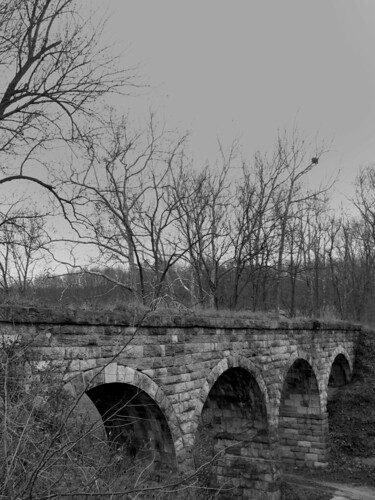
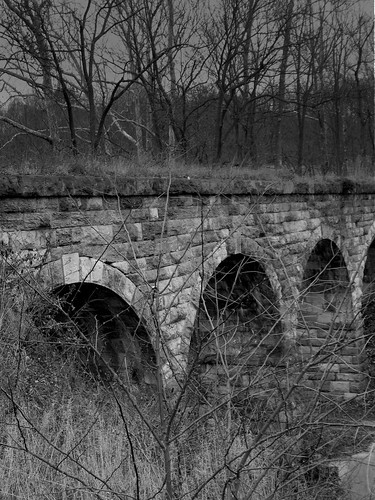
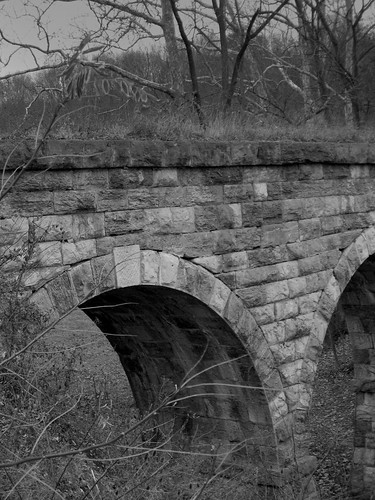
Baltimore and Ohio Railroad Stone Bridges Built to Endure
The Valley Railroad, a branch of the Baltimore and Ohio, once ran all the way to Lexington, Virginia crossing this fine stone bridge. Photos by Bob Kirchman.
Although American railroads became known for wooden trestles and iron bridges, it is worth noting that the engineers of the Baltimore and Ohio Railroad built fine stone bridges with smooth roman arches in the early days of the railroad. Two particularly fine examples are this bridge near Staunton, Virginia and the Thomas Viaduct on the road between Baltimore and Washington DC which still carries trains today.
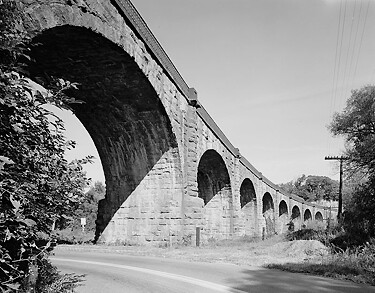
The Thomas Viaduct spans the Patapsco River and Patapsco Valley between Relay and Elkridge, Maryland, USA. It was commissioned by the Baltimore and Ohio Railroad; built between July 4, 1833, and July 4, 1835; and named forPhilip E. Thomas, the company's first president.
At its completion, the Thomas Viaduct was the largest bridge in the United States and the country's first multi-span masonry railroad bridge to be built on a curve. It remains the world's oldest multiple arched stone railroad bridge. In 1964, it was designated as a National Historic Landmark.
The viaduct is now owned and operated by CSX Transportation and still in use today, making it one of the oldest railroad bridges still in service.
This Roman-arch stone bridge is divided into eight spans. It was designed by Benjamin Henry Latrobe, II, then B and O's assistant engineer and later its chief engineer. The main design problem to overcome was that of constructing such a large bridge on a curve. The design called for several variations in span and pier widths between the opposite sides of the structure. This problem was solved by having the lateral pier faces laid out on radial lines, making the piers essentially wedge-shaped and fitted to the 4-degree curve.
The viaduct was built byJohn McCartneyof Ohio, who received the contract after completing the Patterson Viaduct. Caspar Wever, the railroad's chief of construction, supervised the work.
The span of the viaduct is 612 feet (187 m) long; the individual arches are roughly 58 feet (18 m) in span, with a height of 59 feet (18 m) from the water level to the base of the rail. The width at the top of the spandrel wall copings is 26 feet 4 inches (8 m). The bridge is constructed using a rough-dressed Maryland granite ashlar from Patapsco River quarries, known as Woodstock granite.[6] A wooden-floored walkway built for pedestrian and railway employee use is four feet wide and supported by cast iron brackets and edged with ornamental cast iron railings. The viaduct contains 24,476 cubic yards (18,713 m3) of masonry and cost $142,236.51, an estimated $2,769,917.36 in 2007 dollars. [Wikipedia]
The Thomas Viaduct across the Patapsco River. Library of Congress Photo. [1.]
Riding Railroading's Romantic Beginnings
Wind Power on the Baltimore and Ohio Railroad
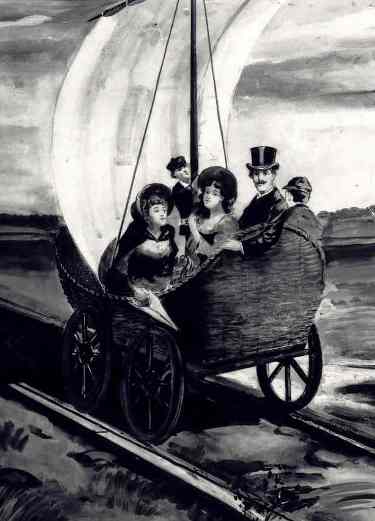
AEolus sails down the Baltimore and Ohio tracks.From the Collections of the B and O Railroad Museum, used with permission.
A recent CSX Transportation radio spot invites canines in cars to "ride the wind, doggies!" It is a reference to the open roads created by CSX trains taking freight off the highways and a doggie's desire to ride in a car with his head sticking out of the open window. Railroading's early days briefly offered another opportunity to "ride the wind" as a unique experiment in motive power took place on America's first operating rail line.
In the early days of the Baltimore and Ohio Railroad, the motive power was provided by horses. The carriages were pulled along the tracks by fine animals selected for this purpose. The building that housed stables and a blacksmith shop in Ellicott's Mills still stands. But horsepower would soon become a standard instead of a literal fact. Peter Cooper's small locomotive with its upright boiler would define the future of railroading. Still, there was a brief period in railroad history where passengers could literally ride the wind.
Evan Thomas of Baltimore constructed an experimental wicker car with a sail which he named the "AEolus." When there was enough wind blowing in direction to make it functional it was operated on the tracks between Baltimore and Ellicott's Mills.
The Russian Ambassador, Baron de Krudner came to observe the operationof the experimental car and actually handled the sail on the trip. He was presented by the President of the railroad with a model of the car. This led to an exchange of American engineers who helped construct Russia's rail system.
The demonstration of Cooper's steam locomotive set the direction for railroad operation. The Fourth Annual Report of the B and O Railroad in 1830 states:
Experience with regard to the celerity of the conveyance of passengers during the preceeding four months on the first 13 miles of the Baltimore and Ohio Railroad, is of the most cheerful and convincing character. The practicability of maintaining a speed of 10 miles per hour with horses has been exhibited. With proper relays,this rate of traveling may be continued through any length of railway, the ascent and descents of which shall not exceed about 30 feet per mile.
Within the last few months, the improvements to locomotive steam engines have been such as to insure their general use on all railways of suitable gradation, and where fuel is cheap."[2.]
Wood and coal would fuel the first boilers. Riding the train could be a dirty experience as smoke and cinders wreaked havoc on the wardrobes of female travelers. Clean coal was used and promoted by the New York Central in this little rhyme:
Says Phoebe Snow about to go upon a trip to Buffalo "My gown stays white from morn till night Upon the Road of Anthracite"
The modern railroad saw the use of diesel and electric power. Welded rails and modern track alignment would finally create the illusion of a smooth and effortless glide down the tracks.
21st Century railroads would like to harness the energy of wind farms to power their catenaries [the overhead wires providing power to locomotives], but even now, as during the Nineteenth Century, the winds remain as fickle as they are romantic.
2. The early motive power of the Baltimore and Ohio railroad By Joseph Snowden Bell, p. 5.
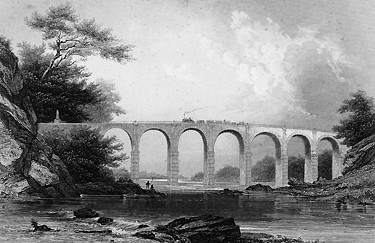
1858 Engraving of the Thomas Viaduct on the then Baltimore and Washington Railroad, a subsidiary of the Baltimore and Ohio. Engraving from The United States Illustrated, Charles A. Dana, Editor, c. 1858. Retrieved from Historic American Engineering Record; Library of Congress [3.]
Viaduct of the Baltimore and Washington Railroad from The United States Illustrated, Charles A. Dana, Editor, c. 1858
The traveler may well discern in the viaduct of a railroad, a monumental atonement on the part of surveyors and engineers for the injuries their labors elsewhere inflict upon the picturesque beauty of the landscape. Who has not hailed with delight, upon many a railway, the passage over some viaduct, and welcomed it amid the journey through dust and cinders, as the pilgrim over the African desert welcomes the oasis and its well of crystal water? Underneath, tons of smoothly hewn granite press deeply into the bed of the river, a whiff of whose cooling vapor, at least, comes into the passenger’s nostrils, as he dashes over a superstructure, the length of which would have been the admiration of the Romans, whose creek like Tiber might have provoked the sneer of a “go ahead” engineer.
The “Pons Narniensis,” whose framer was the imperial Augustus; the arches of Trajan over the Danube, and the bridge of Alcántara across the Spanish Tagus, have long been famous in ancient history, whilst America, for the accommodation of no imperial cortege, but of the masses of the people, has rivalled them all in her numerous railroad viaducts, and especially in the Starrucca Viaduct upon the Erie Railroad.
The one given in the engraving was of the first built in the country, although exceeded by the one above named in length, breadth, height, and the span of the arches, it is not surpassed for beauty of location and compactness of execution. But alas, by only one or two of the thousand passengers who rush along its surface, is this beauty and compactness noticed. Now and then a passenger drops off at the neighboring station, intent upon converting his walking staff into a fishing rod, beside the shadow of its arches, or about once in a twelvemonth a detention upon the neighboring “switch” allows the traveller a saunter by its railing, or a hurried clamber down the rocky ledge which confines the waters of the Patuxent (actually the Patapsco) River and in great part forms its bed.”[4.]
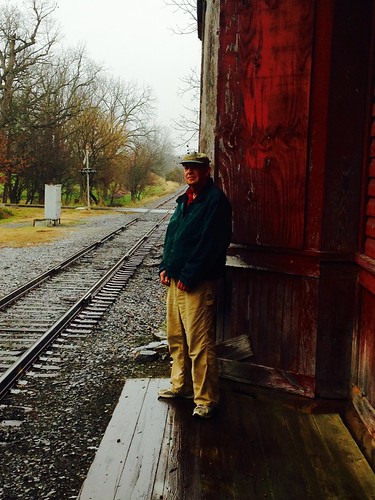
This station at Fort Defiance, Virginia once served the Baltimore and Ohio's Valley Railroad.
Bracket detail of Lexington, Virginia's Baltimore and Ohio Railroad Station, Built in 1883. Photo by Bob Kirchman.
Galaxies in Pansies Photographs byBob Kirchman
These close-up photographs capture the feeling of Hubble Telescope photographs from space. Photos by Bob Kirchman
The Holy Spirit Comes at Pentecost
Fresco of the pentecostal dove (representing Holy Spirit) at the Karlskirche in Vienna, Austria.
On the day Pentecost was being fulfilled, all the disciples were gathered in one place. Suddenly they heard the sound of a violent blast of wind rushing into the house from out of the heavenly realm. The roar of the wind was so overpowering it was all anyone could bear! Then all at once a pillar of fire appeared before their eyes. It separated into tongues of fire that engulfed each one of them. They were all filled and equipped with the Holy Spirit and were inspired to speak in tongues—empowered by the Spirit to speak in languages they had never learned! – Acts 2:1-4 The Passion Translation (TPT)
The Plane that Changed the World
Celebrating the DC-3
Dynamic Aviation in Bridgewater, Virginia owns this beautiful aircraft. Photo by Bob Kirchman.
Not surprisingly, the hand-picked crew was Israeli. The first mate was Major Sarah Cohen, who had been in service with Ben Gurion before. Ben Gurion made it clear that the Major was his first choice for the position and that without her selection, he was not interested in the command. In simulator flight practice you could see the crisp performance of the two veteran flyers as they worked together. In fact, no one would suspect the great secret they had in common… they were husband and wife! They had stood under a chuppah by the Sea of Galilee with a few friends who were sworn to secrecy. When Abiyah’s crew was finalized, you must know that the bulk of his crew were secret couples as well. Since the crew’s quarters were in a sealed off area near the lift to the bridge, this would not present a problem… unless Apollonius insisted on occupying the crew’s quarters as well. Fortunately he could not resist the offer of the more luxurious VIP quarters in another sector and so as far as he knew he simply had the best flying team in Israel handling his starship.
In fact, the crew were pretty much unopposed by any serious competition for their assignment. A few reckless adventurers and such vied for the positions but Ben Gurion’s little group outperformed them all. They occupied the Great Northern as simulated flight situations were run through her cockpit… practicing over and over for the journey to Mars. Most of them had enjoyed remarkable careers in the IAF and this two-year mission would be a wonderful transition into civilian retirement. Sarah Cohen was young and ambitious, but she wanted a legacy most of all. Retirement might be difficult for Abiyah, if not downright impossible, but they both dreamed of children. That would have to wait until they were safely back on Earth.
Apollonius makes me nervous.” Sarah confided to her husband. “He seems to have more than colonization on his mind. Trust me, I can sense it.”
We’ll have him on our backs for less than a year, then we’ll coast home. We’ve been in tighter places before. The Divine is our Hope and Protector.”
You read PSALMS a lot, husband. I am glad they give you hope and comfort, but this Apollonius… I think we all underestimate him, ESPECIALLY Rupert Zimmerman. That may just prove to be our undoing.”
In Wales, AK, at the headquarters of the Zimmerman organization, a similar conversation was ongoing between Elizabeth Zimmerman O’Malley and Rupert’s assistant Hannah.
The numbers all add up, Hannah, but I just don’t see something here and I can feel that I don’t see something!”
I know.” Hannah replied. “Its like Rupert forgets to ask the really tough questions. Usually he’s the one to ferret it out when there is something not quite right. But, as you say, the numbers make sense and the use of SS/AC006 virtually eliminates the unknowns as far as risk. So far as the mission itself, It’s textbook except that we weren’t going to do a MANNED mission and no one saw any benefit to colonization. We sell space on linear induction launches all the time. The people going out to the colony are volunteers and we’ve kept the process rigorous so they have plenty of time to rethink. The crew flying Great Northern is the best we have… and loyal to a fault. Apollonius himself, well, he’s one smooth operator and he seems to deftly answer any questions. But there its like he’s TOO scripted… TOO ready with the explanation. Do you know what I mean?”
I know. Really, it’s his connection to the One World Government Movement that troubles me the most. AAR and Israel will get the credit for the mission all right, but is he pushing something else that we can’t see here that will further his statist designs?”
He’s out of the picture until he returns for the launch.” said Elizabeth. “In the meantime, I will work with Mr. Zimmerman to assure we have the proper oversight in place for the mission.” (to be continued)
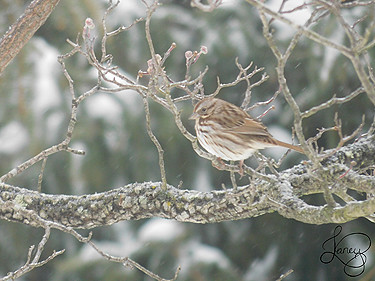
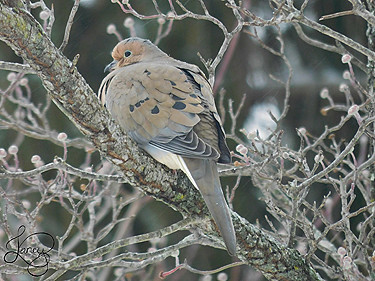
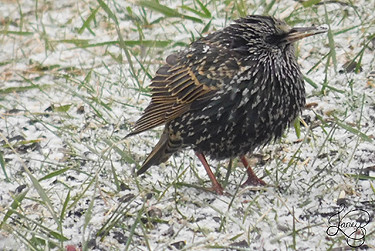
Birds in the Virginia Mountains
Photos byKristina Elaine Greer[1.]
Kristina Elaine (Laney) Greer is an artist in Selma, Virginia, up in the Alleghany Mountains. She was my studio assistant when she was in college and she now has her own studio; Laney’s Palette [click to visit]. In addition to creating her beautiful paintings and murals, Laney is also a photographer. These are some photos of the birds around her home which were a very lovely gift to us!
Female Northern Cardinal. Photo by Kristina Elaine Greer.
Red-Bellied Woodpecker. Photo by Kristina Elaine Greer.
House Sparrow. Photo by Kristina Elaine Greer.
Look at the birds of the air, that they do not sow, neither do they reap, nor gather into barns, and yet your heavenly Father feeds them. Are you not worth much more than they?” – Matthew 6:26
Northern Cardinal (Male). Photo by Kristina Elaine Greer.
Tufted Titmouse. Photo by Kristina Elaine Greer.
Mourning Dove. Photo by Kristina Elaine Greer.
European Starling (puffed in the cold). Photo by Kristina Elaine Greer.
A few months ago I revealed what I think is an exciting new find about the origins of J R R Tolkien’s Atlantis story, The Fall of Númenor, the ultimate predecessor of the accounts of Númenor given in The Lord of the Rings and The Silmarillion. I announced my discovery in an article for the Sunday Telegraph which also touched on the role played by Tolkien’s friend C S Lewis. The article can be read at the Telegraph website (sign-up is free for one ‘premium’ article per week), and I won’t now repeat everything it says. But I will recap here the main points I made there about when exactly the Númenor idea struck Tolkien. And I can add some refinements. (read more)
Nurture and Young Imagination
ByBob Kirchman
Imagine if schools actually helped kids identify their strengths by exploring their talents from a young age and growing their skills over the 12 years instead of letting them all follow the same routine like sheep and leaving them confused after graduation.” – Tallie Dar
I’m thinking about a wonderful illustration my supervisor at the homeschool coop, Amanda Riley gave to the students. She brought a box into the room and challenged all the students (about 17 individuals) to get into the box – all at once! The result was a bit of organized chaos that proved conclusively that all the students could NOT fit into the box! She then proceeded to underscore the uniqueness of each of our beautiful students. IMAGO DEI carries with it the same wonder that you find in a handmade piece of fine pottery. No two of them are EVER actually the same.
Yes, our job as educators is to provide a platform of basic grammar to facilitate our mutual growth and interaction, but I’m now convinced that we too often fail to observe – to see what our students are emerging to be as Divine works. I’m reading the Novel Mink River by Brian Doyle. Of particular interest to me is the sculptor Nora who takes a block of wood or stone and listens as she begins to chip away to see what it wants to be. So often we here the ‘malleable clay’ illustration applied to students and they are more like Nora’s wood or stone. We begin with the chisel and hammer, but even in the noise of chipping we must listen! My mother once took me to visit a friend of hers who was a sculptor. Somewhere in that conversation I think the old saw about “carving an elephant” came up in the conversation: “You cut away everything that doesn’t look like an elephant.” Actually that is not how great sculptors work, for they are looking for the elephant that is saying that it is in there!
My eyes scan our room full of unique works in progress. The future healers and builders and poets and prophets interact with the medium and hints emerge as to what the Divine is shaping there. They will go out from here and continue this process. Can what we do here serve to help them identify the grain and composition that they have been made with – and out of it shape a life pleasing to their maker?
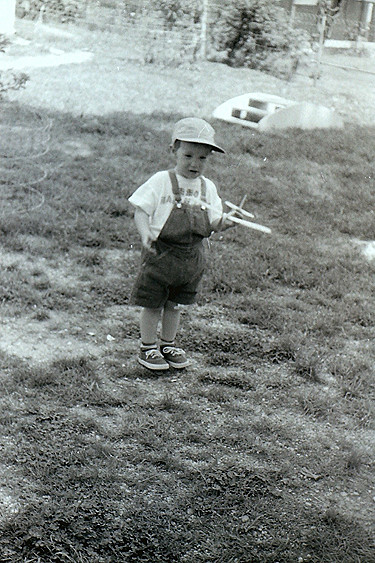
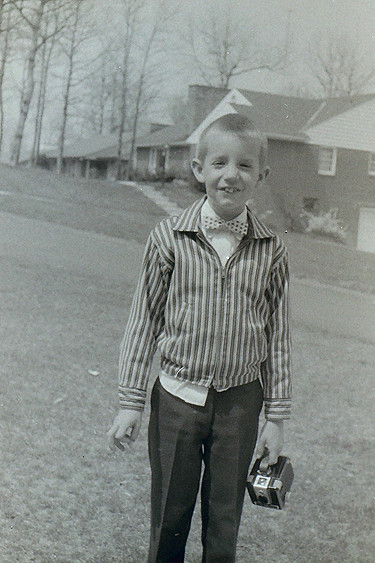
I think of my own childhood. At five, I think I remember mom put some construction paper, glue and scissors out on the picnic table behind our house on a glorious Spring day. My sisters and I proceeded to create a little village of paper houses! It was a day of glorious satisfaction as we placed them into natural settings. I was reminded of that beautiful day as I watched some kids at out last church picnic collect sticks and moss to create something similar. Dad gave me little model airplanes and my first camera, a Brownie Hawkeye. The wonderful thing about the Brownie was that it shot 21/4” film so although it was no Hasseblad, It’s plastic lens still rendered an incredibly crisp image. Since it only shot black and white, it came with a red filter so you could get pretty good clouds and sky! Dad shot his work with an Argus C3, which I eventually inherited. He took the photos that accompany this article. He was an engineer at NASA who wore a white shirt and a narrow tie. Behind his pocket protector their beat a wild heart!
Dad was trained in the day when engineers were not trained in the humanities and he developed his own love for fine literature and had an extensive library. He wrote papers on spacecraft structural dynamics and testing but at night he went home and read Shakespeare and Chaucer. Mom was a physicist and an engineer and she was even more of the Renaissance person. Such was the world of my preschool existence, but it was the 1950’s after all and the big modern school and the industrial model of education prevailed. At six I was packed off to a classroom with fifty students and entered the world of waxed hallways, antiseptic smelling restrooms and rote learning. By second grade I lamented that I had become a very ‘bad kid’ and was pretty much always in trouble for something. Sometime I understood the infraction, sometimes it was a mystery. I became a quiet rebel – I drew pictures and hid them under my bed. One of my teachers tore up a very nice drawing I had made of a T-rex. She told my dad I’d be lucky to be a truck driver. I continued to draw and hide the pictures under my bed. Somewhere along the way I discovered John Gnagy’s ‘Learn to Draw’ books. They taught me a lot of the basics. I found one of my Dad’s books on aircraft design. It was full of curves and calculus and wonderful elevations of airfoils. In the back there was a chapter on drawing perspective. The discovery of that chapter was an epiphany.
One day my dad noticed that I could draw a fairly decent perspective (and this was before any formal training), so he had me do a pencil drawing of a building he was proposing for his facility at NASA. I think he even paid me for it. I was twelve years old and that was my first architectural rendering.
But I think most of the adults in my greater sphere saw me as a daydreamer. Under my bed my pile of fantastic imaginings continued to grow – undersea worlds, cities on the moon, but on the outside I was resigned to the life the world poured me into. Driving a truck wouldn’t be all that bad. It was kind of like a monastic life on wheels and you got to see the country. Boy, when you’ve seen one interstate, you’ve seen them all. My buddy Chris actually did become a trucker but eventually he tried studying theology and lost his Faith. When I was older, I would learn of how Albert Einstein, the great theoretical physicist, had struggled in school. He, I would learn, was a daydreamer too. He barely passed school and then he couldn’t get a job in academia. That might have been why he found the path to brilliance. He took a job as a patent clerk in Berne, Switzerland. His job was to read the applications and recommend the good ones. Well, he became so proficient at analyzing the patent applications that he ended up with plenty of time to just stare out the window – and IMAGINE! “What would it be like to travel fater and faster away from the great clock tower in Berne. As you approached travelling at the speed of light the hand on the clock would appear to move ever slower. Then you reach the speed of light. The hand of the clock is now standing still. If you can travel faster, the hand of the clock is now moving backwards! From this little journey of imagination came new insight into the very nature of time, energy and matter! Brilliance nurtured by space to develop opened up the greatest mind in modern times.
But what if a discouraged Einstein had, as he once considered doing, gone on to sell insurance? He might have had a comfortable existence but his mind would have never taken that accelerated journey to brilliance. He would have been successful in the world’s eyes, but at what a loss! Another equally plausible scenario is that Einstein would have been admitted into academia in his younger days. He would have been consumed by the politics of the academy and writing papers of far less importance than his theories of gravity and general relativity. He would have lived his life as a successful but quirky professor without ever engaging in his great work. It was the wilderness years that played an important part in his development. There seems to be no course of study in academia to take you through the wilderness years. My early wilderness years saw me as a grill chef and a factory worker. But somehow I found myself in my mind travelling faster and faster to the other things I would later be able to do. If I could give one thing to a young person in the wilderness it would be a heightened sense of imagination. Imagination is not limited in speed to the currently available technology and it costs very little as well. A prince and a pauper can both access it and it may take either on a journey of great significance. Two bicycle mechanics can imagine flying machines. An air mail pilot can imagine flying the Atlantic. A German munitions designer can envision a trip to the moon! Imagine if schools…
Whatever you think of Elon Musk, whatever you think of the practicality of some of his ideas, it is well to consider that he represents but the latest expansion in humankind’s ability to imagine. Last year in our classes we had two sisters who collaborated to create a concept for an undersea resort – right down to such furnishings as a jellyfish lamp sconce for the hallways. Imagination! It is a gift possessed by the youth. What indeed should be our mission as educators when such illumination presents itself? Should not we ourselves find a passion to discover and nurture such wonder? And should not our nurture extend beyond the giving of tools and instruction to making sure the tool fits confidently into their young hands?
The author holds a balsa airplane. Photo by Ed Kirchman.
The author with his first camera, a Brownie Hawkeye. Photo by Ed Kirchman.
The author in front of a mural painted by our students. Photo by Madeline Maas.
How Does God Guide Us?
Volume XVI, Issue IIIa
Phantasies ByGeorge MacDonald, Chapter 12
Chained is the Spring. The night-wind bold Blows over the hard earth; Time is not more confused and cold, Nor keeps more wintry mirth.
Yet blow, and roll the world about; Blow, Time--blow, winter's Wind! Through chinks of Time, heaven peepeth out, And Spring the frost behind."
~ G. E. M.
They who believe in the influences of the stars over the fates of men, are, in feeling at least, nearer the truth than they who regard the heavenly bodies as related to them merely by a common obedience to an external law. All that man sees has to do with man. Worlds cannot be without an intermundane relationship. The community of the centre of all creation suggests an interradiating connection and dependence of the parts. Else a grander idea is conceivable than that which is already imbodied. The blank, which is only a forgotten life, lying behind the consciousness, and the misty splendour, which is an undeveloped life, lying before it, may be full of mysterious revelations of other connexions with the worlds around us, than those of science and poetry. No shining belt or gleaming moon, no red and green glory in a self-encircling twin-star, but has a relation with the hidden things of a man's soul, and, it may be, with the secret history of his body as well. They are portions of the living house wherein he abides.
Through the realms of the monarch Sun Creeps a world, whose course had begun, On a weary path with a weary pace, Before the Earth sprang forth on her race: But many a time the Earth had sped Around the path she still must tread, Ere the elder planet, on leaden wing, Once circled the court of the planet's king.
There, in that lonely and distant star, The seasons are not as our seasons are; But many a year hath Autumn to dress The trees in their matron loveliness; As long hath old Winter in triumph to go O'er beauties dead in his vaults below; And many a year the Spring doth wear Combing the icicles from her hair; And Summer, dear Summer, hath years of June, With large white clouds, and cool showers at noon: And a beauty that grows to a weight like grief, Till a burst of tears is the heart's relief.
Children, born when Winter is king, May never rejoice in the hoping Spring; Though their own heart-buds are bursting with joy, And the child hath grown to the girl or boy; But may die with cold and icy hours Watching them ever in place of flowers. And some who awake from their primal sleep, When the sighs of Summer through forests creep, Live, and love, and are loved again; Seek for pleasure, and find its pain; Sink to their last, their forsaken sleeping, With the same sweet odours around them creeping.
Now the children, there, are not born as the children are born in worlds nearer to the sun. For they arrive no one knows how. A maiden, walking alone, hears a cry: for even there a cry is the first utterance; and searching about, she findeth, under an overhanging rock, or within a clump of bushes, or, it may be, betwixt gray stones on the side of a hill, or in any other sheltered and unexpected spot, a little child. This she taketh tenderly, and beareth home with joy, calling out, "Mother, mother"--if so be that her mother lives--"I have got a baby--I have found a child!" All the household gathers round to see;--"Where is it? What is it like? Where did you find it?" and such-like questions, abounding. And thereupon she relates the whole story of the discovery; for by the circumstances, such as season of the year, time of the day, condition of the air, and such like, and, especially, the peculiar and never-repeated aspect of the heavens and earth at the time, and the nature of the place of shelter wherein it is found, is determined, or at least indicated, the nature of the child thus discovered. Therefore, at certain seasons, and in certain states of the weather, according, in part, to their own fancy, the young women go out to look for children. They generally avoid seeking them, though they cannot help sometimes finding them, in places and with circumstances uncongenial to their peculiar likings. But no sooner is a child found, than its claim for protection and nurture obliterates all feeling of choice in the matter. Chiefly, however, in the season of summer, which lasts so long, coming as it does after such long intervals; and mostly in the warm evenings, about the middle of twilight; and principally in the woods and along the river banks, do the maidens go looking for children just as children look for flowers. And ever as the child grows, yea, more and more as he advances in years, will his face indicate to those who understand the spirit of Nature, and her utterances in the face of the world, the nature of the place of his birth, and the other circumstances thereof; whether a clear morning sun guided his mother to the nook whence issued the boy's low cry; or at eve the lonely maiden (for the same woman never finds a second, at least while the first lives) discovers the girl by the glimmer of her white skin, lying in a nest like that of the lark, amid long encircling grasses, and the upward-gazing eyes of the lowly daisies; whether the storm bowed the forest trees around, or the still frost fixed in silence the else flowing and babbling stream.
After they grow up, the men and women are but little together. There is this peculiar difference between them, which likewise distinguishes the women from those of the earth. The men alone have arms; the women have only wings. Resplendent wings are they, wherein they can shroud themselves from head to foot in a panoply of glistering glory. By these wings alone, it may frequently be judged in what seasons, and under what aspects, they were born. From those that came in winter, go great white wings, white as snow; the edge of every feather shining like the sheen of silver, so that they flash and glitter like frost in the sun. But underneath, they are tinged with a faint pink or rose-colour. Those born in spring have wings of a brilliant green, green as grass; and towards the edges the feathers are enamelled like the surface of the grass-blades. These again are white within. Those that are born in summer have wings of a deep rose-colour, lined with pale gold. And those born in autumn have purple wings, with a rich brown on the inside. But these colours are modified and altered in all varieties, corresponding to the mood of the day and hour, as well as the season of the year; and sometimes I found the various colours so intermingled, that I could not determine even the season, though doubtless the hieroglyphic could be deciphered by more experienced eyes. One splendour, in particular, I remember--wings of deep carmine, with an inner down of warm gray, around a form of brilliant whiteness.
She had been found as the sun went down through a low sea-fog, casting crimson along a broad sea-path into a little cave on the shore, where a bathing maiden saw her lying.
But though I speak of sun and fog, and sea and shore, the world there is in some respects very different from the earth whereon men live. For instance, the waters reflect no forms. To the unaccustomed eye they appear, if undisturbed, like the surface of a dark metal, only that the latter would reflect indistinctly, whereas they reflect not at all, except light which falls immediately upon them. This has a great effect in causing the landscapes to differ from those on the earth. On the stillest evening, no tall ship on the sea sends a long wavering reflection almost to the feet of him on shore; the face of no maiden brightens at its own beauty in a still forest-well. The sun and moon alone make a glitter on the surface. The sea is like a sea of death, ready to ingulf and never to reveal: a visible shadow of oblivion. Yet the women sport in its waters like gorgeous sea-birds. The men more rarely enter them. But, on the contrary, the sky reflects everything beneath it, as if it were built of water like ours. Of course, from its concavity there is some distortion of the reflected objects; yet wondrous combinations of form are often to be seen in the overhanging depth. And then it is not shaped so much like a round dome as the sky of the earth, but, more of an egg-shape, rises to a great towering height in the middle, appearing far more lofty than the other. When the stars come out at night, it shows a mighty cupola, "fretted with golden fires," wherein there is room for all tempests to rush and rave.
One evening in early summer, I stood with a group of men and women on a steep rock that overhung the sea. They were all questioning me about my world and the ways thereof. In making reply to one of their questions, I was compelled to say that children are not born in the Earth as with them. Upon this I was assailed with a whole battery of inquiries, which at first I tried to avoid; but, at last, I was compelled, in the vaguest manner I could invent, to make some approach to the subject in question. Immediately a dim notion of what I meant, seemed to dawn in the minds of most of the women. Some of them folded their great wings all around them, as they generally do when in the least offended, and stood erect and motionless. One spread out her rosy pinions, and flashed from the promontory into the gulf at its foot. A great light shone in the eyes of one maiden, who turned and walked slowly away, with her purple and white wings half dispread behind her. She was found, the next morning, dead beneath a withered tree on a bare hill-side, some miles inland. They buried her where she lay, as is their custom; for, before they die, they instinctively search for a spot like the place of their birth, and having found one that satisfies them, they lie down, fold their wings around them, if they be women, or cross their arms over their breasts, if they are men, just as if they were going to sleep; and so sleep indeed. The sign or cause of coming death is an indescribable longing for something, they know not what, which seizes them, and drives them into solitude, consuming them within, till the body fails. When a youth and a maiden look too deep into each other's eyes, this longing seizes and possesses them; but instead of drawing nearer to each other, they wander away, each alone, into solitary places, and die of their desire. But it seems to me, that thereafter they are born babes upon our earth: where, if, when grown, they find each other, it goes well with them; if not, it will seem to go ill. But of this I know nothing. When I told them that the women on the Earth had not wings like them, but arms, they stared, and said how bold and masculine they must look; not knowing that their wings, glorious as they are, are but undeveloped arms.
But see the power of this book, that, while recounting what I can recall of its contents, I write as if myself had visited the far-off planet, learned its ways and appearances, and conversed with its men and women. And so, while writing, it seemed to me that I had.
The book goes on with the story of a maiden, who, born at the close of autumn, and living in a long, to her endless winter, set out at last to find the regions of spring; for, as in our earth, the seasons are divided over the globe. It begins something like this:
She watched them dying for many a day, Dropping from off the old trees away, One by one; or else in a shower Crowding over the withered flower For as if they had done some grievous wrong, The sun, that had nursed them and loved them so long, Grew weary of loving, and, turning back, Hastened away on his southern track; And helplessly hung each shrivelled leaf, Faded away with an idle grief. And the gusts of wind, sad Autumn's sighs, Mournfully swept through their families; Casting away with a helpless moan All that he yet might call his own, As the child, when his bird is gone for ever, Flingeth the cage on the wandering river. And the giant trees, as bare as Death, Slowly bowed to the great Wind's breath; And groaned with trying to keep from groaning Amidst the young trees bending and moaning. And the ancient planet's mighty sea Was heaving and falling most restlessly, And the tops of the waves were broken and white, Tossing about to ease their might; And the river was striving to reach the main, And the ripple was hurrying back again. Nature lived in sadness now; Sadness lived on the maiden's brow, As she watched, with a fixed, half-conscious eye, One lonely leaf that trembled on high, Till it dropped at last from the desolate bough-- Sorrow, oh, sorrow! 'tis winter now. And her tears gushed forth, though it was but a leaf, For little will loose the swollen fountain of grief: When up to the lip the water goes, It needs but a drop, and it overflows.
Oh! many and many a dreary year Must pass away ere the buds appear: Many a night of darksome sorrow Yield to the light of a joyless morrow, Ere birds again, on the clothed trees ,
Shall fill the branches with melodies. She will dream of meadows with wakeful streams; Of wavy grass in the sunny beams; Of hidden wells that soundless spring, Hoarding their joy as a holy thing; Of founts that tell it all day long To the listening woods, with exultant song; She will dream of evenings that die into nights, Where each sense is filled with its own delights, And the soul is still as the vaulted sky, Lulled with an inner harmony;
And the flowers give out to the dewy night, Changed into perfume, the gathered light; And the darkness sinks upon all their host, Till the sun sail up on the eastern coast-- She will wake and see the branches bare, Weaving a net in the frozen air.
The story goes on to tell how, at last, weary with wintriness, she travelled towards the southern regions of her globe, to meet the spring on its slow way northwards; and how, after many sad adventures, many disappointed hopes, and many tears, bitter and fruitless, she found at last, one stormy afternoon, in a leafless forest, a single snowdrop growing betwixt the borders of the winter and spring. She lay down beside it and died. I almost believe that a child, pale and peaceful as a snowdrop, was born in the Earth within a fixed season from that stormy afternoon.
(to be continued)
Serials have existed in fiction for a very long time. Books were expensive back in the 19th century, so they were printed in installments in order to keep the price low. Charles Dickens, often heralded as one of the greatest early self-publishers, was also one of the most successful writers of serialized fiction. Another big name, Alexandre Dumas, was a very prolific serial novelist, publishing both The Count of Monte Cristo and The Three Musketeers in serial format. In fact, serialization worked so well, it was considered the way to go by popular authors during the time." -- Samantha Warren
THYME Magazine presents, in serial form, the story of a man who challenged the proposition that something he wanted to achieve was "impossible." Based on history, depicted in the future, Pontifus is a tale of human triumph in the face of challenges such as face us today. (read more)
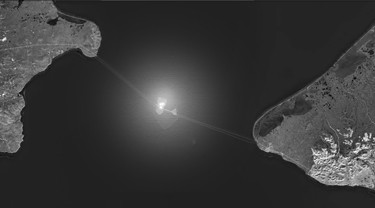
Sunlight reflects from the biosphere domes of Big Diomede in this photograph of the Bering Strait Bridge from space.
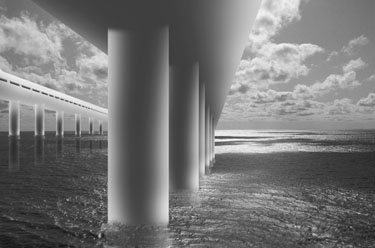
The twin spans of the Bering Strait Bridge. The original span (closest) is the Charles Alton Ellis Memorial Bridge. The second span is the Joseph Baermann Strauss Memorial Bridge.
Baltimore and Ohio Railroad Stone Bridges Built to Endure
The Valley Railroad, a branch of the Baltimore and Ohio, once ran all the way to Lexington, Virginia crossing this fine stone bridge. Photos by Bob Kirchman.
Although American railroads became known for wooden trestles and iron bridges, it is worth noting that the engineers of the Baltimore and Ohio Railroad built fine stone bridges with smooth roman arches in the early days of the railroad. Two particularly fine examples are this bridge near Staunton, Virginia and the Thomas Viaduct on the road between Baltimore and Washington DC which still carries trains today.
The Thomas Viaduct spans the Patapsco River and Patapsco Valley between Relay and Elkridge, Maryland, USA. It was commissioned by the Baltimore and Ohio Railroad; built between July 4, 1833, and July 4, 1835; and named forPhilip E. Thomas, the company's first president.
At its completion, the Thomas Viaduct was the largest bridge in the United States and the country's first multi-span masonry railroad bridge to be built on a curve. It remains the world's oldest multiple arched stone railroad bridge. In 1964, it was designated as a National Historic Landmark.
The viaduct is now owned and operated by CSX Transportation and still in use today, making it one of the oldest railroad bridges still in service.
This Roman-arch stone bridge is divided into eight spans. It was designed by Benjamin Henry Latrobe, II, then B and O's assistant engineer and later its chief engineer. The main design problem to overcome was that of constructing such a large bridge on a curve. The design called for several variations in span and pier widths between the opposite sides of the structure. This problem was solved by having the lateral pier faces laid out on radial lines, making the piers essentially wedge-shaped and fitted to the 4-degree curve.
The viaduct was built byJohn McCartneyof Ohio, who received the contract after completing the Patterson Viaduct. Caspar Wever, the railroad's chief of construction, supervised the work.
The span of the viaduct is 612 feet (187 m) long; the individual arches are roughly 58 feet (18 m) in span, with a height of 59 feet (18 m) from the water level to the base of the rail. The width at the top of the spandrel wall copings is 26 feet 4 inches (8 m). The bridge is constructed using a rough-dressed Maryland granite ashlar from Patapsco River quarries, known as Woodstock granite.[6] A wooden-floored walkway built for pedestrian and railway employee use is four feet wide and supported by cast iron brackets and edged with ornamental cast iron railings. The viaduct contains 24,476 cubic yards (18,713 m3) of masonry and cost $142,236.51, an estimated $2,769,917.36 in 2007 dollars. [Wikipedia]
The Thomas Viaduct across the Patapsco River. Library of Congress Photo. [1.]
Riding Railroading's Romantic Beginnings
Wind Power on the Baltimore and Ohio Railroad
AEolus sails down the Baltimore and Ohio tracks.From the Collections of the B and O Railroad Museum, used with permission.
A recent CSX Transportation radio spot invites canines in cars to "ride the wind, doggies!" It is a reference to the open roads created by CSX trains taking freight off the highways and a doggie's desire to ride in a car with his head sticking out of the open window. Railroading's early days briefly offered another opportunity to "ride the wind" as a unique experiment in motive power took place on America's first operating rail line.
In the early days of the Baltimore and Ohio Railroad, the motive power was provided by horses. The carriages were pulled along the tracks by fine animals selected for this purpose. The building that housed stables and a blacksmith shop in Ellicott's Mills still stands. But horsepower would soon become a standard instead of a literal fact. Peter Cooper's small locomotive with its upright boiler would define the future of railroading. Still, there was a brief period in railroad history where passengers could literally ride the wind.
Evan Thomas of Baltimore constructed an experimental wicker car with a sail which he named the "AEolus." When there was enough wind blowing in direction to make it functional it was operated on the tracks between Baltimore and Ellicott's Mills.
The Russian Ambassador, Baron de Krudner came to observe the operationof the experimental car and actually handled the sail on the trip. He was presented by the President of the railroad with a model of the car. This led to an exchange of American engineers who helped construct Russia's rail system.
The demonstration of Cooper's steam locomotive set the direction for railroad operation. The Fourth Annual Report of the B and O Railroad in 1830 states:
Experience with regard to the celerity of the conveyance of passengers during the preceeding four months on the first 13 miles of the Baltimore and Ohio Railroad, is of the most cheerful and convincing character. The practicability of maintaining a speed of 10 miles per hour with horses has been exhibited. With proper relays,this rate of traveling may be continued through any length of railway, the ascent and descents of which shall not exceed about 30 feet per mile.
Within the last few months, the improvements to locomotive steam engines have been such as to insure their general use on all railways of suitable gradation, and where fuel is cheap."[2.]
Wood and coal would fuel the first boilers. Riding the train could be a dirty experience as smoke and cinders wreaked havoc on the wardrobes of female travelers. Clean coal was used and promoted by the New York Central in this little rhyme:
Says Phoebe Snow about to go upon a trip to Buffalo "My gown stays white from morn till night Upon the Road of Anthracite"
The modern railroad saw the use of diesel and electric power. Welded rails and modern track alignment would finally create the illusion of a smooth and effortless glide down the tracks.
21st Century railroads would like to harness the energy of wind farms to power their catenaries [the overhead wires providing power to locomotives], but even now, as during the Nineteenth Century, the winds remain as fickle as they are romantic.
2. The early motive power of the Baltimore and Ohio railroad By Joseph Snowden Bell, p. 5.
1858 Engraving of the Thomas Viaduct on the then Baltimore and Washington Railroad, a subsidiary of the Baltimore and Ohio. Engraving from The United States Illustrated, Charles A. Dana, Editor, c. 1858. Retrieved from Historic American Engineering Record; Library of Congress [3.]
Viaduct of the Baltimore and Washington Railroad from The United States Illustrated, Charles A. Dana, Editor, c. 1858
The traveler may well discern in the viaduct of a railroad, a monumental atonement on the part of surveyors and engineers for the injuries their labors elsewhere inflict upon the picturesque beauty of the landscape. Who has not hailed with delight, upon many a railway, the passage over some viaduct, and welcomed it amid the journey through dust and cinders, as the pilgrim over the African desert welcomes the oasis and its well of crystal water? Underneath, tons of smoothly hewn granite press deeply into the bed of the river, a whiff of whose cooling vapor, at least, comes into the passenger’s nostrils, as he dashes over a superstructure, the length of which would have been the admiration of the Romans, whose creek like Tiber might have provoked the sneer of a “go ahead” engineer.
The “Pons Narniensis,” whose framer was the imperial Augustus; the arches of Trajan over the Danube, and the bridge of Alcántara across the Spanish Tagus, have long been famous in ancient history, whilst America, for the accommodation of no imperial cortege, but of the masses of the people, has rivalled them all in her numerous railroad viaducts, and especially in the Starrucca Viaduct upon the Erie Railroad.
The one given in the engraving was of the first built in the country, although exceeded by the one above named in length, breadth, height, and the span of the arches, it is not surpassed for beauty of location and compactness of execution. But alas, by only one or two of the thousand passengers who rush along its surface, is this beauty and compactness noticed. Now and then a passenger drops off at the neighboring station, intent upon converting his walking staff into a fishing rod, beside the shadow of its arches, or about once in a twelvemonth a detention upon the neighboring “switch” allows the traveller a saunter by its railing, or a hurried clamber down the rocky ledge which confines the waters of the Patuxent (actually the Patapsco) River and in great part forms its bed.”[4.]
This station at Fort Defiance, Virginia once served the Baltimore and Ohio's Valley Railroad.
Galaxies in Pansies Photographs byBob Kirchman
These close-up photographs capture the feeling of Hubble Telescope photographs from space. Photos by Bob Kirchman
High erected thought, seated in a heart of courtesy."
~ Sir Philip Sidney
A sweet attractive kinde of grace, A full assurance given by lookes, Continuall comfort in a face, The lineaments of Gospel bookes."
~ Matthew Roydon, on Sir Philip Sidney.
I had not gone far, for I had but just lost sight of the hated tower, when a voice of another sort, sounding near or far, as the trees permitted or intercepted its passage, reached me. It was a full, deep, manly voice, but withal clear and melodious. Now it burst on the ear with a sudden swell, and anon, dying away as suddenly, seemed to come to me across a great space. Nevertheless, it drew nearer; till, at last, I could distinguish the words of the song, and get transient glimpses of the singer, between the columns of the trees. He came nearer, dawning upon me like a growing thought. He was a knight, armed from head to heel, mounted upon a strange-looking beast, whose form I could not understand. The words which I heard him sing were like these:
Heart be stout, And eye be true; Good blade out! And ill shall rue.
Courage, horse! Thou lackst no skill; Well thy force Hath matched my will.
For the foe With fiery breath, At a blow, It still in death.
Gently, horse! Tread fearlessly; 'Tis his corse That burdens thee.
The sun's eye Is fierce at noon; Thou and I Will rest full soon.
And new strength New work will meet; Till, at length, Long rest is sweet.
And now horse and rider had arrived near enough for me to see, fastened by the long neck to the hinder part of the saddle, and trailing its hideous length on the ground behind, the body of a great dragon. It was no wonder that, with such a drag at his heels, the horse could make but slow progress, notwithstanding his evident dismay. The horrid, serpent-like head, with its black tongue, forked with red, hanging out of its jaws, dangled against the horse's side. Its neck was covered with long blue hair, its sides with scales of green and gold. Its back was of corrugated skin, of a purple hue. Its belly was similar in nature, but its colour was leaden, dashed with blotches of livid blue. Its skinny, bat-like wings and its tail were of a dull gray. It was strange to see how so many gorgeous colours, so many curving lines, and such beautiful things as wings and hair and scales, combined to form the horrible creature, intense in ugliness.
The knight was passing me with a salutation; but, as I walked towards him, he reined up, and I stood by his stirrup. When I came near him, I saw to my surprise and pleasure likewise, although a sudden pain, like a birth of fire, sprang up in my heart, that it was the knight of the soiled armour, whom I knew before, and whom I had seen in the vision, with the lady of the marble. But I could have thrown my arms around him, because she loved him. This discovery only strengthened the resolution I had formed, before I recognised him, of offering myself to the knight, to wait upon him as a squire, for he seemed to be unattended. I made my request in as few words as possible. He hesitated for a moment, and looked at me thoughtfully. I saw that he suspected who I was, but that he continued uncertain of his suspicion. No doubt he was soon convinced of its truth; but all the time I was with him, not a word crossed his lips with reference to what he evidently concluded I wished to leave unnoticed, if not to keep concealed.
Squire and knight should be friends," said he: "can you take me by the hand?" And he held out the great gauntleted right hand. I grasped it willingly and strongly. Not a word more was said. The knight gave the sign to his horse, which again began his slow march, and I walked beside and a little behind.
We had not gone very far before we arrived at a little cottage; from which, as we drew near, a woman rushed out with the cry:
My child! my child! have you found my child?"
Ihave found her," replied the knight, "but she is sorely hurt. I was forced to leave her with the hermit, as I returned. You will find her there, and I think she will get better. You see I have brought you a present. This wretch will not hurt you again." And he undid the creature's neck, and flung the frightful burden down by the cottage door.
The woman was now almost out of sight in the wood; but the husband stood at the door, with speechless thanks in his face.
You must bury the monster," said the knight. "If I had arrived a moment later, I should have been too late. But now you need not fear, for such a creature as this very rarely appears, in the same part, twice during a lifetime."
Will you not dismount and rest you, Sir Knight?" said the peasant, who had, by this time, recovered himself a little.
That I will, thankfully," said he; and, dismounting, he gave the reins to me, and told me to unbridle the horse, and lead him into the shade. "You need not tie him up," he added; "he will not run away."
When I returned, after obeying his orders, and entered the cottage, I saw the knight seated, without his helmet, and talking most familiarly with the simple host. I stood at the open door for a moment, and, gazing at him, inwardly justified the white lady in preferring him to me. A nobler countenance I never saw. Loving-kindness beamed from every line of his face. It seemed as if he would repay himself for the late arduous combat, by indulging in all the gentleness of a womanly heart. But when the talk ceased for a moment, he seemed to fall into a reverie. Then the exquisite curves of the upper lip vanished. The lip was lengthened and compressed at the same moment. You could have told that, within the lips, the teeth were firmly closed. The whole face grew stern and determined, all but fierce; only the eyes burned on like a holy sacrifice, uplift on a granite rock.
The woman entered, with her mangled child in her arms. She was pale as her little burden. She gazed, with a wild love and despairing tenderness, on the still, all but dead face, white and clear from loss of blood and terror.
The knight rose. The light that had been confined to his eyes, now shone from his whole countenance. He took the little thing in his arms, and, with the mother's help, undressed her, and looked to her wounds. The tears flowed down his face as he did so. With tender hands he bound them up, kissed the pale cheek, and gave her back to her mother. When he went home, all his tale would be of the grief and joy of the parents; while to me, who had looked on, the gracious countenance of the armed man, beaming from the panoply of steel, over the seemingly dead child, while the powerful hands turned it and shifted it, and bound it, if possible even more gently than the mother's, formed the centre of the story.
After we had partaken of the best they could give us, the knight took his leave, with a few parting instructions to the mother as to how she should treat the child.
I brought the knight his steed, held the stirrup while he mounted, and then followed him through the wood. The horse, delighted to be free of his hideous load, bounded beneath the weight of man and armour, and could hardly be restrained from galloping on. But the knight made him time his powers to mine, and so we went on for an hour or two. Then the knight dismounted, and compelled me to get into the saddle, saying: "Knight and squire must share the labour."
Holding by the stirrup, he walked along by my side, heavily clad as he was, with apparent ease. As we went, he led a conversation, in which I took what humble part my sense of my condition would permit me.
Somehow or other," said he, "notwithstanding the beauty of this country of Faerie, in which we are, there is much that is wrong in it. If there are great splendours, there are corresponding horrors; heights and depths; beautiful women and awful fiends; noble men and weaklings. All a man has to do, is to better what he can. And if he will settle it with himself, that even renown and success are in themselves of no great value, and be content to be defeated, if so be that the fault is not his; and so go to his work with a cool brain and a strong will, he will get it done; and fare none the worse in the end, that he was not burdened with provision and precaution."
But he will not always come off well," I ventured to say.
Perhaps not," rejoined the knight, "in the individual act; but the result of his lifetime will content him."
So it will fare with you, doubtless," thought I; "but for me---"
Venturing to resume the conversation after a pause, I said, hesitatingly:
May I ask for what the little beggar-girl wanted your aid, when she came to your castle to find you?"
He looked at me for a moment in silence, and then said--
I cannot help wondering how you know of that; but there is something about you quite strange enough to entitle you to the privilege of the country; namely, to go unquestioned. I, however, being only a man, such as you see me, am ready to tell you anything you like to ask me, as far as I can. The little beggar-girl came into the hall where I was sitting, and told me a very curious story, which I can only recollect very vaguely, it was so peculiar. What I can recall is, that she was sent to gather wings. As soon as she had gathered a pair of wings for herself, she was to fly away, she said, to the country she came from; but where that was, she could give no information.
She said she had to beg her wings from the butterflies and moths; and wherever she begged, no one refused her. But she needed a great many of the wings of butterflies and moths to make a pair for her; and so she had to wander about day after day, looking for butterflies, and night after night, looking for moths; and then she begged for their wings. But the day before, she had come into a part of the forest, she said, where there were multitudes of splendid butterflies flitting about, with wings which were just fit to make the eyes in the shoulders of hers; and she knew she could have as many of them as she liked for the asking; but as soon as she began to beg, there came a great creature right up to her, and threw her down, and walked over her. When she got up, she saw the wood was full of these beings stalking about, and seeming to have nothing to do with each other. As soon as ever she began to beg, one of them walked over her; till at last in dismay, and in growing horror of the senseless creatures, she had run away to look for somebody to help her. I asked her what they were like. She said, like great men, made of wood, without knee-or elbow-joints, and without any noses or mouths or eyes in their faces. I laughed at the little maiden, thinking she was making child's game of me; but, although she burst out laughing too, she persisted in asserting the truth of her story.
Only come, knight, come and see; I will lead you.'
So I armed myself, to be ready for anything that might happen, and followed the child; for, though I could make nothing of her story, I could see she was a little human being in need of some help or other. As she walked before me, I looked attentively at her. Whether or not it was from being so often knocked down and walked over, I could not tell, but her clothes were very much torn, and in several places her white skin was peeping through. I thought she was hump-backed; but on looking more closely, I saw, through the tatters of her frock--do not laugh at me--a bunch on each shoulder, of the most gorgeous colours. Looking yet more closely, I saw that they were of the shape of folded wings, and were made of all kinds of butterfly-wings and moth-wings, crowded together like the feathers on the individual butterfly pinion; but, like them, most beautifully arranged, and producing a perfect harmony of colour and shade. I could now more easily believe the rest of her story; especially as I saw, every now and then, a certain heaving motion in the wings, as if they longed to be uplifted and outspread. But beneath her scanty garments complete wings could not be concealed, and indeed, from her own story, they were yet unfinished.
After walking for two or three hours (how the little girl found her way, I could not imagine), we came to a part of the forest, the very air of which was quivering with the motions of multitudes of resplendent butterflies; as gorgeous in colour, as if the eyes of peacocks' feathers had taken to flight, but of infinite variety of hue and form, only that the appearance of some kind of eye on each wing predominated. 'There they are, there they are!' cried the child, in a tone of victory mingled with terror. Except for this tone, I should have thought she referred to the butterflies, for I could see nothing else. But at that moment an enormous butterfly, whose wings had great eyes of blue surrounded by confused cloudy heaps of more dingy colouring, just like a break in the clouds on a stormy day towards evening, settled near us. The child instantly began murmuring: 'Butterfly, butterfly, give me your wings'; when, the moment after, she fell to the ground, and began crying as if hurt. I drew my sword and heaved a great blow in the direction in which the child had fallen. It struck something, and instantly the most grotesque imitation of a man became visible. You see this Fairy Land is full of oddities and all sorts of incredibly ridiculous things, which a man is compelled to meet and treat as real existences, although all the time he feels foolish for doing so. This being, if being it could be called, was like a block of wood roughly hewn into the mere outlines of a man; and hardly so, for it had but head, body, legs, and arms--the head without a face, and the limbs utterly formless. I had hewn off one of its legs, but the two portions moved on as best they could, quite independent of each other; so that I had done no good. I ran after it, and clove it in twain from the head downwards; but it could not be convinced that its vocation was not to walk over people; for, as soon as the little girl began her begging again, all three parts came bustling up; and if I had not interposed my weight between her and them, she would have been trampled again under them. I saw that something else must be done. If the wood was full of the creatures, it would be an endless work to chop them so small that they could do no injury; and then, besides, the parts would be so numerous, that the butterflies would be in danger from the drift of flying chips. I served this one so, however; and then told the girl to beg again, and point out the direction in which one was coming. I was glad to find, however, that I could now see him myself, and wondered how they could have been invisible before. I would not allow him to walk over the child; but while I kept him off, and she began begging again, another appeared; and it was all I could do, from the weight of my armour, to protect her from the stupid, persevering efforts of the two. But suddenly the right plan occurred to me. I tripped one of them up, and, taking him by the legs, set him up on his head, with his heels against a tree. I was delighted to find he could not move.
Meantime the poor child was walked over by the other, but it was for the last time. Whenever one appeared, I followed the same plan--tripped him up and set him on his head; and so the little beggar was able to gather her wings without any trouble, which occupation she continued for several hours in my company."
What became of her?" I asked.
I took her home with me to my castle, and she told me all her story; but it seemed to me, all the time, as if I were hearing a child talk in its sleep. I could not arrange her story in my mind at all, although it seemed to leave hers in some certain order of its own. My wife---"
Here the knight checked himself, and said no more. Neither did I urge the conversation farther.
Thus we journeyed for several days, resting at night in such shelter as we could get; and when no better was to be had, lying in the forest under some tree, on a couch of old leaves.
I loved the knight more and more. I believe never squire served his master with more care and joyfulness than I. I tended his horse; I cleaned his armour; my skill in the craft enabled me to repair it when necessary; I watched his needs; and was well repaid for all by the love itself which I bore him.
This," I said to myself, "is a true man. I will serve him, and give him all worship, seeing in him the imbodiment of what I would fain become. If I cannot be noble myself, I will yet be servant to his nobleness." He, in return, soon showed me such signs of friendship and respect, as made my heart glad; and I felt that, after all, mine would be no lost life, if I might wait on him to the world's end, although no smile but his should greet me, and no one but him should say, "Well done! he was a good servant!" at last. But I burned to do something more for him than the ordinary routine of a squire's duty permitted.
One afternoon, we began to observe an appearance of roads in the wood. Branches had been cut down, and openings made, where footsteps had worn no path below. These indications increased as we passed on, till, at length, we came into a long, narrow avenue, formed by felling the trees in its line, as the remaining roots evidenced. At some little distance, on both hands, we observed signs of similar avenues, which appeared to converge with ours, towards one spot. Along these we indistinctly saw several forms moving, which seemed, with ourselves, to approach the common centre. Our path brought us, at last, up to a wall of yew-trees, growing close together, and intertwining their branches so, that nothing could be seen beyond it. An opening was cut in it like a door, and all the wall was trimmed smooth and perpendicular. The knight dismounted, and waited till I had provided for his horse's comfort; upon which we entered the place together.
It was a great space, bare of trees, and enclosed by four walls of yew, similar to that through which we had entered. These trees grew to a very great height, and did not divide from each other till close to the top, where their summits formed a row of conical battlements all around the walls. The space contained was a parallelogram of great length. Along each of the two longer sides of the interior, were ranged three ranks of men, in white robes, standing silent and solemn, each with a sword by his side, although the rest of his costume and bearing was more priestly than soldierly. For some distance inwards, the space between these opposite rows was filled with a company of men and women and children, in holiday attire. The looks of all were directed inwards, towards the further end. Far beyond the crowd, in a long avenue, seeming to narrow in the distance, went the long rows of the white-robed men. On what the attention of the multitude was fixed, we could not tell, for the sun had set before we arrived, and it was growing dark within. It grew darker and darker. The multitude waited in silence. The stars began to shine down into the enclosure, and they grew brighter and larger every moment. A wind arose, and swayed the pinnacles of the tree-tops; and made a strange sound, half like music, half like moaning, through the close branches and leaves of the tree-walls. A young girl who stood beside me, clothed in the same dress as the priests, bowed her head, and grew pale with awe.
The knight whispered to me, "How solemn it is! Surely they wait to hear the voice of a prophet. There is something good near!"
But I, though somewhat shaken by the feeling expressed by my master, yet had an unaccountable conviction that here was something bad. So I resolved to be keenly on the watch for what should follow.
Suddenly a great star, like a sun, appeared high in the air over the temple, illuminating it throughout; and a great song arose from the men in white, which went rolling round and round the building, now receding to the end, and now approaching, down the other side, the place where we stood. For some of the singers were regularly ceasing, and the next to them as regularly taking up the song, so that it crept onwards with gradations produced by changes which could not themselves be detected, for only a few of those who were singing ceased at the same moment. The song paused; and I saw a company of six of the white-robed men walk up the centre of the human avenue, surrounding a youth gorgeously attired beneath his robe of white, and wearing a chaplet of flowers on his head. I followed them closely, with my keenest observation; and, by accompanying their slow progress with my eyes, I was able to perceive more clearly what took place when they arrived at the other end. I knew that my sight was so much more keen than that of most people, that I had good reason to suppose I should see more than the rest could, at such a distance. At the farther end a throne stood upon a platform, high above the heads of the surrounding priests. To this platform I saw the company begin to ascend, apparently by an inclined plane or gentle slope. The throne itself was elevated again, on a kind of square pedestal, to the top of which led a flight of steps. On the throne sat a majestic-looking figure, whose posture seemed to indicate a mixture of pride and benignity, as he looked down on the multitude below. The company ascended to the foot of the throne, where they all kneeled for some minutes; then they rose and passed round to the side of the pedestal upon which the throne stood. Here they crowded close behind the youth, putting him in the foremost place, and one of them opened a door in the pedestal, for the youth to enter. I was sure I saw him shrink back, and those crowding behind pushed him in. Then, again, arose a burst of song from the multitude in white, which lasted some time. When it ceased, a new company of seven commenced its march up the centre. As they advanced, I looked up at my master: his noble countenance was full of reverence and awe. Incapable of evil himself, he could scarcely suspect it in another, much less in a multitude such as this, and surrounded with such appearances of solemnity. I was certain it was the really grand accompaniments that overcame him; that the stars overhead, the dark towering tops of the yew-trees, and the wind that, like an unseen spirit, sighed through their branches, bowed his spirit to the belief, that in all these ceremonies lay some great mystical meaning which, his humility told him, his ignorance prevented him from understanding.
More convinced than before, that there was evil here, I could not endure that my master should be deceived; that one like him, so pure and noble, should respect what, if my suspicions were true, was worse than the ordinary deceptions of priestcraft. I could not tell how far he might be led to countenance, and otherwise support their doings, before he should find cause to repent bitterly of his error. I watched the new procession yet more keenly, if possible, than the former. This time, the central figure was a girl; and, at the close, I observed, yet more indubitably, the shrinking back, and the crowding push. What happened to the victims, I never learned; but I had learned enough, and I could bear it no longer. I stooped, and whispered to the young girl who stood by me, to lend me her white garment. I wanted it, that I might not be entirely out of keeping with the solemnity, but might have at least this help to passing unquestioned. She looked up, half-amused and half-bewildered, as if doubting whether I was in earnest or not. But in her perplexity, she permitted me to unfasten it, and slip it down from her shoulders.
I easily got possession of it; and, sinking down on my knees in the crowd, I rose apparently in the habit of one of the worshippers.
Giving my battle-axe to the girl, to hold in pledge for the return of her stole, for I wished to test the matter unarmed, and, if it was a man that sat upon the throne, to attack him with hands bare, as I supposed his must be, I made my way through the crowd to the front, while the singing yet continued, desirous of reaching the platform while it was unoccupied by any of the priests. I was permitted to walk up the long avenue of white robes unmolested, though I saw questioning looks in many of the faces as I passed. I presume my coolness aided my passage; for I felt quite indifferent as to my own fate; not feeling, after the late events of my history, that I was at all worth taking care of; and enjoying, perhaps, something of an evil satisfaction, in the revenge I was thus taking upon the self which had fooled me so long. When I arrived on the platform, the song had just ceased, and I felt as if all were looking towards me. But instead of kneeling at its foot, I walked right up the stairs to the throne, laid hold of a great wooden image that seemed to sit upon it, and tried to hurl it from its seat. In this I failed at first, for I found it firmly fixed. But in dread lest, the first shock of amazement passing away, the guards would rush upon me before I had effected my purpose, I strained with all my might; and, with a noise as of the cracking, and breaking, and tearing of rotten wood, something gave way, and I hurled the image down the steps. Its displacement revealed a great hole in the throne, like the hollow of a decayed tree, going down apparently a great way. But I had no time to examine it, for, as I looked into it, up out of it rushed a great brute, like a wolf, but twice the size, and tumbled me headlong with itself, down the steps of the throne. As we fell, however, I caught it by the throat, and the moment we reached the platform, a struggle commenced, in which I soon got uppermost, with my hand upon its throat, and knee upon its heart. But now arose a wild cry of wrath and revenge and rescue. A universal hiss of steel, as every sword was swept from its scabbard, seemed to tear the very air in shreds. I heard the rush of hundreds towards the platform on which I knelt. I only tightened my grasp of the brute's throat. His eyes were already starting from his head, and his tongue was hanging out. My anxious hope was, that, even after they had killed me, they would be unable to undo my gripe of his throat, before the monster was past breathing. I therefore threw all my will, and force, and purpose, into the grasping hand. I remember no blow. A faintness came over me, and my consciousness departed. (to be continued)
Springhill Hollyhocks Photos byBob Kirchman
Every Summer they appear!, remnants of a garden planted long ago that continue to brighten the drive into Staunton along Churchville Avenue. What a great living legacy for a gardener!
Vincent, Don McClean
Staunton Mall Renaissance A New Vision for an Older Mall
Concept Development by Bob Kirchman
Strong anchor stores position the mall for future vitality...
...as the central mall becomes a place for concerts, tea dances...
...and a lively expression of Staunton's community life!
The large open spaces...
...now invite a variety of recreational options in all seasons.
Existing spaces can become more inviting...
...through invigorating design.
The attractiveness of the space is increased...
...by a phased opening out of the retail units to meet today's demands.
'A Case for Vision'
A Case for Vision X
Over the past nine weeks we have been exploring the case for vision. The original complete series, first published in 2014, may be seen here:
"We Can Build That" The past president’s statement five years ago that “You didn’t build that. Somebody else made that happen” is a very concise summary of the danger posed by modern progressive liberalism to the heart of the American idea and experience, as represented by its Constitution, founding principles, and the reasons for its modern success." -- C. Boyden Gray.
In an article entitled We Can Build That [click to read], in The American Conservative, Gray examines the often dismissed case for enlightened self interest and the Scottish Enlightenment's exploration of greed as a private vice, but a public benefit. He cites Bernard de Mandeville's The Fable of the Bees: or Private Vices,Public Benefits. Modern thought is quick to come down on "corporate greed," even as it promotes a hedonistic level of "self expression." Again, Gray's article shows that human nature is more like a spirited Arabian horse. The energy and spirit of the animal might well be gentled to some noble purpose. Indeed, Adam Smith asserts:
It is not from the benevolence of the butcher, the brewer, or the
baker that we expect our dinner, but from their regard to their own
interest.”
But, earlier in this series, A Case for Vision, it was rightly stated that markets will provide slavery and destructive things as well as food, clothing and shelter. Just as a bridle is necessary if one is to employ the energy of a fine horse, the Golden Rule and the Rule of Law are essential components of the process. Perhaps the biggest myopia in progressive thinking is the thought that private morality is somewhat irrelevant. Corporations are evil because they operate in the realm of self-interest, but government is somehow going to operate on a higher plane because there is no "profit motive."
Perhaps the best way to illustrate the fallacy of such thinking is with an historical example. In the days of William H. Howland [click to read] the city of Toronto moved from a lawless society to one influenced by the private morality of its great mayor:
Because of his great compassion for the poor, he was elected as Mayor of Toronto in 1885, with a strong mandate to clean up the city. Howland signaled his arrival in the mayor’s office by installing a twelve-foot banner on the wall, reading, "Except the Lord Build the City, the Watchman Wakes but in Vain". Despite fierce opposition, Howland was so successful, that Toronto became nicknamed "Toronto the Good". As champion of the poor, Howland and his Alliance friend, Rev. John Salmon, would tramp the lanes and alleys, feeding the poor, praying over the sick, and comforting the sad. With a population of just 104,000, Toronto had over 800 licensed and unlicensed saloons. Over half of all criminal offenses recorded in 1885 were related to drunkenness." -- Reverend Ed Hird
Reverend Hird goes on to document the work of Howland to enforce laws already on the books and improve sanitation services to the city. The work of Howland actually resulted in a decrease in saloon business. Now the interests of the people were redirected into the providing of nobler things. On the eve of his reelection, a group of saloon owners hired all the taxis in an effort to keep people from the polls. Women had recently been enfranchised, however, and great numbers of them trudged to the polls through the snow to give Howland a resounding victory.
The moral of the story is that Howland's private sense of morality led him to press against the corruption rampant in the city government. The revivals happening in the city enlightened the self-interests of citizens, who turned from drunkenness to the building up of community and home. It is a story that has often replayed itself in the affairs of humanity. It speaks of a balance we in our time might do well to regain. I recommend The Reverend Ed Hird's excellent article: William H. Howland [click to read] as an example we might emulate. Afterward he brought me again unto the door of the house; and, behold, waters issued out from under the threshold of the house eastward: for the forefront of the house stood toward the east, and the waters came down from under from the right side of the house, at the south side of the altar.
Then brought he me out of the way of the gate northward, and led me about the way without unto the utter gate by the way that looketh eastward; and, behold, there ran out waters on the right side.
And when the man that had the line in his hand went forth eastward, he measured a thousand cubits, and he brought me through the waters; the waters were to the ankles.
Again he measured a thousand, and brought me through the waters; the waters were to the knees. Again he measured a thousand, and brought me through; the waters were to the loins.
Afterward he measured a thousand; and it was a river that I could not pass over: for the waters were risen, waters to swim in, a river that could not be passed over.
And he said unto me, Son of man, hast thou seen this? Then he brought me, and caused me to return to the brink of the river.
Now when I had returned, behold, at the bank of the river were very many trees on the one side and on the other.
Then said he unto me, These waters issue out toward the east country, and go down into the desert, and go into the sea: which being brought forth into the sea, the waters shall be healed.
And it shall come to pass, that every thing that liveth, which moveth, whithersoever the rivers shall come, shall live: and there shall be a very great multitude of fish, because these waters shall come thither: for they shall be healed; and every thing shall live whither the river cometh.
And it shall come to pass, that the fishers shall stand upon it from Engedi even unto Eneglaim; they shall be a place to spread forth nets; their fish shall be according to their kinds, as the fish of the great sea, exceeding many.
But the miry places thereof and the marishes thereof shall not be healed; they shall be given to salt.
And by the river upon the bank thereof, on this side and on that side, shall grow all trees for meat, whose leaf shall not fade, neither shall the fruit thereof be consumed: it shall bring forth new fruit according to his months, because their waters they issued out of the sanctuary: and the fruit thereof shall be for meat, and the leaf thereof for medicine." -- Ezekiel 47:1-12
We are in need of a Great Miracle today. Other generations have faced times like this as well. In previous times of national peril, our LEADERS called for prayer. Today it is necessary for people of faith everywhere to pick up that fallen standard and lift it high. If we will prepare our own hearts, like soil for the planting, HE will plant the seed. If we will cultivate what G-d plants, nurturing it to maturity, HE will provide the bountiful harvest. If we will prepare the land, G-d promises to HEAL it. History (REAL history, that is) is filled with stories of just such promise being realized in the lives of ordinary men and women.
But to participate in promise requires a relationship. G-d is not some abstract concept, but rather He is the Author/Creator of the Universe. He has a NAME... a Name so Holy as not to be uttered lightly on Earth, but a Name, to be KNOWN by. And how shall I find this G-d? There are men and women in this world who converse with Him in prayer. It is through relationship with THEM that we may be introduced to the Magnificent One, the G-d of Redemption. I am at best a poor disciple of His, but I am His disciple. You should not be introduced to Him by some formula in the writings of man, but rather in the Inspired Words of His Own Testimony. That is why I, and many more of His disciples stand ready to open the Holy Scriptures WITH YOU. In them you will find the Life and Light I speak of. The Food Channel cannot actually nourish you. You must step into the room where the meals are served.
An Earthly author cannot see the 'Great Miracle' that you, the reader, desperately need. But we CAN go together to the Master, who indeed knows what will nourish each of us. It is highly likely that you know someone who knows the Master, who can take you to the place where He can meet you with healing and nourishment. As I write this I pray that that person might indeed come to mind. Before I came to faith I was keenly aware that there was a certain brightness and clarity about the lives of certain people I knew. Later I realized that some of them had indeed been praying for me. Yet, you might be reading this and G-d's Holy Spirit may be speaking to you and you are not sure who to go to. You may comment to this and it will not be published. I moderate all comments. Thus if you would like to know G-d as Reedemer, let me know in the comment block how to get in touch. It will not be made public. It is my desire that you be able to find the 'Living Water' that you so deeply desire.
The greatest miracle is not the parting of the sea or the feeding of thousands, it is the transformation of the human heart. That is the miracle that gives us access to G-d. It is in knowing G-d that we will find far more than we were looking for in the first place!
Vacation Bible School, Waynesboro, Virginia.
The Laying of the First Stone for the Railroad.
The Vision of Charles Carroll
July 4, 1828 the last surviving signer of the Declaration of Independence took part in an important ceremony as he turned the first spade of earth at the symbolic laying of the first stone of the Baltimore and Ohio Railroad. Fifty-two years after he put his name to the document that began our nation, Charles Carroll of Carrollton participated in an event that looked to her future. Indeed, inspired by the Ellicott Brothers [click to read], Carroll had already diversified agriculture on his large estate in Howard County, Maryland. He had helped build flour mills and limestone mills that in turn helped to create a more sustainable agriculture. The Quaker Ellicotts had migrated to this "picturesque wilderness" from Bucks County, Pennsylvania and partnered with Carroll, a Catholic, to move the region away from single crop plantations and enrich the soil with ground limestone, a practice that continues to this day. Now the ninety year old patriot was breaking ground for the prototype railroad. It was not exactly like the modern rails on cross ties we are familiar with, but rather iron straps laid on top of two continuous granite "curbs." The first motive power was horsepower. Horses actually pulled the carriages along the rails. A wind powered wicker car was even experimented with before the famous "Tom Thumb" steam engine gave challenge to a horse drawn train carriage in the now legendary race. [2.]
Iconsider this among the most important acts of my life, second only to my signing the Declaration of Independence, if even it be second to that.” Carroll said of the moment. The stone, laid in a field outside Baltimore, was also a time capsule, into which were placed a copy of the company's charter, newspapers of the day and a scroll bearing the words: "This Stone is deposited in commemoration of the commencement of the Baltimore and Ohio Railroad. A work of deep and vital interest to the American people. Its accomplishment will confer the most important benefits upon this nation, by facilitating its commerce, diffusing and extending its social intercourse, and perpetuating the happy Union of these, Confederated States. The first general meeting of the citizens of Baltimore to confer upon the adoption of proper measures for undertaking this magnificent work, was on the second day of' February 1827…”[1.]
The railroad would eventually do all of these things as a vast nation would be joined together by her steel rails. The Nineteenth Century would see her span from sea to sea to become a country her founders could scarcely have imagined!
Charles Carroll had been born in September 1737 in Annapolis. He attended Jesuit colleges in Maryland and France, before going on to study law in Paris and London. In 1765 he returned to Howard County and took charge of the Carroll family's vast estate there. Catholics in Maryland before independence were not allowed to participate in politics, practice law or vote, but Carroll became influential as a writer of tracts against taxation without representation under the pseudonym "First Citizen." In 1776 he was appointed to the Continental Congress. Although he was not present for the vote for independence, he was one of the first signers. He added the distinct identifier: "of Carrollton" to distinguish himself from a number of relatives having the same name. After independence was won, Carroll became a Maryland State Senator in 1777 and eventually became a United States Senator representing that state.
In 1800 he left political service and was instrumental in building canals and the establishment of the Baltimore and Ohio Railroad Company. His farm in Howard County became a model of improvements in agriculture. He died in Baltimore in 1835 at the age of 95.