Abiyah Ben Gurion seemed most at home in the cockpit of an F17, at least that is how it seemed to Sarah Cohen as she first tried to understand the man who commanded her squadron. He said little. He gave few clues. Most of the men and women in his command knew that he had studied engineering at MIT, but returned home to Israel determined to make as much difference as he could to his tiny country. As a boy, he’d had a fascination with flying and had his pilot’s license as a teenager. He must have had some wild adventures, but he never spoke of any. Outside of command, he rarely spoke unless spoken to. If you met him on the street, his short stature made you miss the fact that he was lean and muscular. He avoided showing that off too. Though there were rumors that he could drink bigger men under the table, he was only actually known to enjoy a polite drink at beer-call with his colleagues and go home early. Serving under him, as a strong pilot in her own right, Cohen began to see inside the man.
Once they were on leave in Jerusalem and as they walked in the old city, a suicide bomber/active shooter situation developed around them. After the initial blast, a sniper was attempting to inflict more casualties on the first-responders. There was a little Arab boy standing dazed in the street and before Sarah could articulate it in a sentence, Ben-Gurion had pushed her into a doorway, rushed out to grab the kid and ducking erratically, managed to return with the frightened child to the safety of the doorway. One of Ben-Gurion’s fellow flyers saw where the shooter was and ended the terror with a well-placed shot from her sidearm. Abiyah was concentrating on comforting the boy and it seemed like he was oblivious to the greater events playing out around him… until he congratulated his colleague: “Nice shot, Rachel.” “He must have some incredible peripheral vision!” Cohen thought to herself. The fact is they both scored exceptionally in that area at about the same level.
His only recreations seemed to be reading and nature photography. That was something he and Sarah shared. Gradually the two pilots found themselves sharing their hobby. Abiyah loved to photograph flowers and often visited the commercial nurseries where thousands grew. His stunning macros actually became quite sought after as he marketed them under a pseudonym. He had just recently become more serious in reading and studying Torah, his mind opened to the possibility of worlds unseen. Sarah was the product of a good Liberal home and initially listened politely as Abiyah shared his personal journey. The fact is the two were drawn to each other and it would be only a matter of time before Sarah thought feelings might be expressed. Abiyah seemed to have one great dream… he wanted to see the desert “blossom like a rose.” Then there came an unprecedented rain and the opportunity for leave. “Sarah,” he said, “I have wanted to see this. I’ve secured a pass for both of us. Would you come with me to see the blooms in the desert?”
Yes, Abiyah!” Sarah spoke before thinking.
They drove to a little hotel by the Sea of Galilee and checked in. From there it was a short drive to the desert where the recent rain had unleashed a vibrant display of wildflowers.
If the truth be known, the two had become quite good friends. They were probably already considered a ‘couple’ by their colleagues but the taciturn Abiyah seemed to take their friendship for granted. “Did he have family?” Sarah wondered. Sarah had learned, however, that there was substance behind the silence. She trusted that as she gave herself to him in her mind.
The two set into photographing desert flowers but Abiyah seemed to have something on his mind. Pilots learn to read cues from one another and Sarah said “Penny for your thoughts?” absently.
Oh, Sarah, I was just thinking…” an exceptionally vivid desert rose seemed to distract him for a moment, “…about you… and, er… us!”
Abiyah Ben-Gurion obviously was pretty lame when it came to pick-up lines. “What about us?” Sarah returned.
Idon’t want to live without you.” Abiyah blurted out. “I was just wondering how you felt about me?”
Well, most of our colleagues think we’re already pretty intimate.”
Do they?” Ben-Gurion asked, not so incredulously. “Is it that obvious in my eyes?”
Sarah said nothing.
Even though I am an uncommunicative old goat, you can still see the love that I have for you Sarah?”
Ican.”
“…and what do you think of that, dear Sarah? I see your affection for me, but is it love of the same fervor as mine for you?”
Ilove you, I love you, I love you; Abiyah Ben Gurion.” She replied through tears. “There, does three times make it clear?”
Quite!” he said, as they lost themselves in embrace.
Iwant you in the worst way,” Ben-Gurion continued after they had walked blissfully through the desert wonderland for some time.
Iam yours.” the woman responded, kissing him passionately. “Have me!”
I mean..” the man stammered, “I want you before God! Under a chupah! …and I do want you! Body, Soul and Spirit!" Sarah blushed. In the complex and convoluted world of modern ‘romance,’ such directness caught her off her guard, but in truth, she desired the same and nodded her approval.
The Chupah, and a few friends hastily gathered by the Sea of Galilee witnessed the marriage of Sarah and Abiyah. “We’ll make it public when we can,” Ben Gurion said, “But today we’ve made it forever.”
Someday I want to live in a place that’s called ’Shalom’ and make mad love to you until we fill our house with children.” Abiyah said as they slipped off to consummate their marriage.
Aliyah Ben Gurion would only lay claim to one virtue, that being gratitude. In the time that followed their whirlwind marriage, Sarah would learn that her husband began life as an orphan in London. His early years were wretched ones. His kind adoptive parents gave him a name that would command respect by its mere mention in their home country… and a name that carried with it a great hope and a future!
They indulged his passion for aviation, taught him Hebrew and encouraged his nobler dreams. The boy was filled with wonder at the new world that opened up to him when his parents immigrated to Israel and sent him to university in America. While many young people take their good fortune for granted and often treat their parents and home country with distain, Ben Gurion never got over the wonder.
He was a wild, tough youth of course. But he ultimately channeled that wildness to give something back to everyone who had blessed him… and that is what led him to love Torah. He read the history of his new adopted country. “Was this the work simply of a great people,” he wondered, “or is my land’s miraculous history truly from the hand of the Divine?”
His gratitude found a new focus as he read the Holy Texts. Like most young people he suffered through a series of awkward attempts at romance. When young and beautiful Sarah became part of his life, his gentleness toward her sprang from the most fervent gratitude to the Lord almighty!
(to be continued)
Jules Verne and Walt Disney
Journeys into the Imagination
Reportage sur l'importance de Jules Verne dans le monde créatif de Disney.
Voyage to the Moon
The news footage we watched as fifty years ago astronauts set out for the moon.
AstronautBuzz Aldrinat the State of the Union Address.
We're Going to Mars by 2024
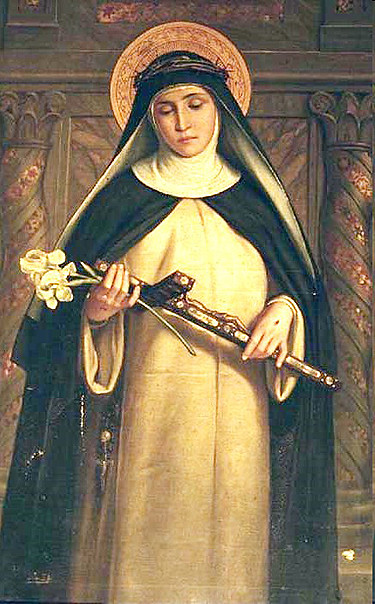
Saint Catherine of Siena
Icon of St. Catherine of Siena.
Be who you were created to be, and you will set the world on fire.”
― St. Catherine of Siena
Volume XVI, Issue VIa
Phantasies ByGeorge MacDonald, Chapter 15
Alexander: "When will you finish Campaspe?" Apelles: "Never finish: for always in absolute beauty there is somewhat above art." ~ from John Lyly's play, "Campaspe".
And now, what song should I sing to unveil my Isis, if indeed she was present unseen? I hurried away to the white hall of Phantasy, heedless of the innumerable forms of beauty that crowded my way: these might cross my eyes, but the unseen filled my brain. I wandered long, up and down the silent space: no songs came. My soul was not still enough for songs. Only in the silence and darkness of the soul's night, do those stars of the inward firmament sink to its lower surface from the singing realms beyond, and shine upon the conscious spirit. Here all effort was unavailing. If they came not, they could not be found.
Next night, it was just the same. I walked through the red glimmer of the silent hall; but lonely as there I walked, as lonely trod my soul up and down the halls of the brain. At last I entered one of the statue-halls. The dance had just commenced, and I was delighted to find that I was free of their assembly. I walked on till I came to the sacred corner. There I found the pedestal just as I had left it, with the faint glimmer as of white feet still resting on the dead black. As soon as I saw it, I seemed to feel a presence which longed to become visible; and, as it were, called to me to gift it with self-manifestation, that it might shine on me. The power of song came to me. But the moment my voice, though I sang low and soft, stirred the air of the hall, the dancers started; the quick interweaving crowd shook, lost its form, divided; each figure sprang to its pedestal, and stood, a self-evolving life no more, but a rigid, life-like, marble shape, with the whole form composed into the expression of a single state or act. Silence rolled like a spiritual thunder through the grand space. My song had ceased, scared at its own influences. But I saw in the hand of one of the statues close by me, a harp whose chords yet quivered. I remembered that as she bounded past me, her harp had brushed against my arm; so the spell of the marble had not infolded it. I sprang to her, and with a gesture of entreaty, laid my hand on the harp. The marble hand, probably from its contact with the uncharmed harp, had strength enough to relax its hold, and yield the harp to me. No other motion indicated life. Instinctively I struck the chords and sang. And not to break upon the record of my song, I mention here, that as I sang the first four lines, the loveliest feet became clear upon the black pedestal; and ever as I sang, it was as if a veil were being lifted up from before the form, but an invisible veil, so that the statue appeared to grow before me, not so much by evolution, as by infinitesimal degrees of added height. And, while I sang, I did not feel that I stood by a statue, as indeed it appeared to be, but that a real woman-soul was revealing itself by successive stages of imbodiment, and consequent manifestation and expression.
Feet of beauty, firmly planting Arches white on rosy heel! Whence the life-spring, throbbing, panting, Pulses upward to reveal! Fairest things know least despising; Foot and earth meet tenderly: 'Tis the woman, resting, rising Upward to sublimity, Rise the limbs, sedately sloping, Strong and gentle, full and free; Soft and slow, like certain hoping, Drawing nigh the broad firm knee. Up to speech! As up to roses Pants the life from leaf to flower, So each blending change discloses, Nearer still, expression's power.
Lo! fair sweeps, white surges, twining Up and outward fearlessly! Temple columns, close combining, Lift a holy mystery. Heart of mine! what strange surprises Mount aloft on such a stair! Some great vision upward rises, Curving, bending, floating fair.
Bands and sweeps, and hill and hollow Lead my fascinated eye; Some apocalypse will follow, Some new world of deity. Zoned unseen, and outward swelling, With new thoughts and wonders rife, Queenly majesty foretelling, See the expanding house of life!
Sudden heaving, unforbidden Sighs eternal, still the same-- Mounts of snow have summits hidden In the mists of uttered flame. But the spirit, dawning nearly Finds no speech for earnest pain; Finds a soundless sighing merely-- Builds its stairs, and mounts again.
Heart, the queen, with secret hoping, Sendeth out her waiting pair; Hands, blind hands, half blindly groping, Half inclasping visions rare; And the great arms, heartways bending; Might of Beauty, drawing home There returning, and re-blending, Where from roots of love they roam.
Build thy slopes of radiance beamy Spirit, fair with womanhood! Tower thy precipice, white-gleamy, Climb unto the hour of good. Dumb space will be rent asunder, Now the shining column stands Ready to be crowned with wonder By the builder's joyous hands.
All the lines abroad are spreading, Like a fountain's falling race. Lo, the chin, first feature, treading, Airy foot to rest the face! Speech is nigh; oh, see the blushing, Sweet approach of lip and breath! Round the mouth dim silence, hushing, Waits to die ecstatic death.
Span across in treble curving, Bow of promise, upper lip! Set them free, with gracious swerving; Let the wing-words float and dip. Dumb art Thou? O Love immortal, More than words thy speech must be; Childless yet the tender portal Of the home of melody.
Now the nostrils open fearless, Proud in calm unconsciousness, Sure it must be something peerless That the great Pan would express! Deepens, crowds some meaning tender, In the pure, dear lady-face. Lo, a blinding burst of splendour!-- 'Tis the free soul's issuing grace.
Two calm lakes of molten glory Circling round unfathomed deeps! Lightning-flashes, transitory, Cross the gulfs where darkness sleeps. This the gate, at last, of gladness, To the outward striving me: In a rain of light and sadness, Out its loves and longings flee!
With a presence I am smitten Dumb, with a foreknown surprise; Presence greater yet than written Even in the glorious eyes. Through the gulfs, with inward gazes, I may look till I am lost; Wandering deep in spirit-mazes, In a sea without a coast.
Windows open to the glorious! Time and space, oh, far beyond! Woman, ah! thou art victorious, And I perish, overfond. Springs aloft the yet Unspoken In the forehead's endless grace, Full of silences unbroken; Infinite, unfeatured face.
Domes above, the mount of wonder; Height and hollow wrapt in night; Hiding in its caverns under Woman-nations in their might. Passing forms, the highest Human Faints away to the Divine Features none, of man or woman, Can unveil the holiest shine.
Sideways, grooved porches only Visible to passing eye, Stand the silent, doorless, lonely Entrance-gates of melody. But all sounds fly in as boldly, Groan and song, and kiss and cry At their galleries, lifted coldly, Darkly, 'twixt the earth and sky.
Beauty, thou art spent, thou knowest So, in faint, half-glad despair, From the summit thou o'erflowest In a fall of torrent hair; Hiding what thou hast created In a half-transparent shroud: Thus, with glory soft-abated, Shines the moon through vapoury cloud. (to be continued)
Unipege. Photo by bob Kirchman
Eugenics Then and Now Northam/DeJarnett
Eugenics Then and Now
Once in the history of our Commonwealth our health system promoted a public policy that promised to deliver advancements in the betterment of the human race. In Staunton, Virginia it was promoted by the director of Western State Hospital, Joseph Spencer DeJarnette (September 29, 1866 – September 3, 1957). As the director of the mental hospital located in Staunton, Virginia from 1905 to November 15, 1943 he was a vocal proponent of racial segregation and eugenics, specifically, the compulsory sterilization of the mentally ill. He was considered a pillar of the community and Adolph Hitler (מַּח שְׁמוֹ) greatly admired his work. Today we shudder at the thought of the forced sterilizations that took place under Dr. DeJarnett’s directorship. The practice only ended in the 1970s.
Today that aspect of eugenics is unthinkable to us, but consider for a moment the recent push in the state legislature to remove restrictions on late-term abortions. Kathy Tran introduced a bill clearly allowing for abortion right up to the point the mother was dilating. The frightening aspect of this bill was that it appeared to push the decision point over the line – allowing for the ‘abortion’ of an already born child. Appearing on WTOP’s Ask The Governor, Virginia Governor Ralph Northam, a former pediatric neurologist, was asked whether he supported a Virginia legislator’s statement that Virginia Democrats’ proposed legislation would permit abortion for a woman in labor.
He stated: “This is why decisions such as this should be made by providers, physicians, and the mothers and fathers that are involved. When we talk about third-trimester abortions, these are done with the consent of the mother, with the consent of physicians, more than one physician by the way, and it’s done in cases where there may be severe deformities, there may be a fetus which is non-viable. So in this particular example, if the mother is in labor, I can tell you exactly what would happen, the infant would be delivered, the infant would be kept comfortable, the infant would be resuscitated if this is what the mother and the family desired, and then a discussion would ensue between the physician and the mother.”
Beyond the obvious possibility being allowed for infanticide is the argument for eugenic murder (see his comments about deformities). Ben Shapiro says: “Northam is specifically talking about delivering an infant alive and then asking the mother whether the infant should live or not. This is not an argument about the morning-after pill. It’s not an argument over whether a fetus feels pain. This is a statement that a fully-formed infant, born alive, ought to be murdered if the mother says the infant ought to be murdered.” A call to Northam’s office had a staffer saying that “The Governor is clearly not for infanticide,” and that “he is very protective of children, being a pediatrician.” Still, the news conference remarks do not rule out the possibility of eugenic killing – and eugenics was brought to us by Doctor DeJarnett not so long ago.
I call heaven and earth to record this day against you, [that] I have
set before you life and death, blessing and cursing: therefore choose
life, that both thou and thy seed may live:”
– Deuteronomy 30:19
Sunset seen from the ferry from Bali to Lombok Island. Photo by S. Kirchman.
The True Champions of Women's Rights
ByM. K. Hand
Today’s women's rights champions are too self-centered and busy appropriating titles they don’t understand to even realize that the real Suffragettes in white were pro-life.
The public statements of many early champions of women’s rights in the U.S. make clear their opposition to abortion. Elizabeth Cady Stanton referred to abortion as “infanticide” and wrote that “when we consider that women are treated as property, it is degrading to women that we should treat our children as property to be disposed of as we see fit.”Victoria Woodhull, the first female candidate for president, wrote: “Every woman knows that if she were free, she would never bear an unwished-for child, nor think of murdering one before its birth.” And Elizabeth Blackwell, the first woman to receive a medical degree in the U.S., wrote: “The gross perversion and destruction of motherhood by the abortionist filled me with indignation, and awakened active antagonism.”
Susan B. Anthony(the same woman on the American silver dollar) along with Cady Stanton, founded The Revolution newspaper, which served as a mouthpiece for the American women’s suffrage movement. Anthony funded the paper herself, refusing the capital that would have resulted from allowing advertisements for “restellism,” as abortion was then called. The Revolution published a piece, attributable to Anthony, that said abortion was a choice that would burden both a woman’s “conscience in life and soul in death” and also was ultimately an exploitation of women.
The first memorial to Anthony was established by African Americans. A stained-glass window was installed at the African Methodist Episcopal Zion church in Rochester that featured her portrait and the words "Failure is Impossible" (her mantra) on it. It was installed through the efforts of Hester C. Jeffrey, the president of the Susan B. Anthony Club, an organization of African American women in Rochester. Speaking at the window's dedication, Jeffrey said, "Miss Anthony had stood by the Negroes when it meant almost death to be a friend of the colored people.”
Yes, these modern women in white are so out of touch with their own American heritage that it would be laughable if it were not so evil. Eugenics and infanticide are their wicked games, and they do not deserve to even hint that they are, or ever could be, a Suffragette. Sources: Time Magazine and Wikipedia
If my people, which are called by my name, shall humble themselves, and pray, and seek my face, and turn from their wicked ways; then will I hear from heaven, and will forgive their sin, and will heal their land.”
– 2 Chronicles 7:14
Certain springs are tapped only when we are alone. The artist knows he must be alone to create; the writer, to work out his thoughts; the musician, to compose; the saint, to pray [and] women need solitude in order to find again the true essence of themselves.” -- Anne Morrow Lindbergh
In fact, Sarah Cohen was no stranger to the business of jumping into new worlds. As a girl she was always looking for new adventure. She crawled at six months and never stopped after that. She played for hours in the woods behind her house and most of her playmates were boys. Summertime allowed day-long adventures with them. At night, she was drawn to read Narnia, Tolkien and J. K. Rowling. She took up horseback riding and scared the wits out of her dear mother, it is said. For Sarah, the collaboration of man and beast opened up new worlds of speed and sensation. Once she’d learned to gallop a horse, she only stopped in kindness to the animal.
Her girlhood in suburban New Jersey probably wouldn’t count as being all that extraordinary. It was those quiet lazy afternoons in the Summer woods that fueled her imagination. Camping out in the Pine Barrens with her family and in the wild mountains of Western North Carolina, she was first drawn to the stars. One exceptionally clear night she lay in the open on a mountain roan as the rest of her family slept soundly and looked up at the Milky Way. “How many stars are out there?” She mused. “What wonders lie out there that I cannot see?”
Then came the day she announced to her surprised family that she was going to Israel. She was going to serve in the IDF! Well, somehow along the way she took a test for pilot skills, aced it, and the rest is history. No doubts her confidence as an aviator was first forged on the back of a strong horse! She flew F-17’s and that is how she came under the command of her husband when she joined his squadron.
The Alaska Space Program opened up the possibility of a childhood fantasy coming true for both her and her husband, as they both admired the American astronauts of the nineteen-sixties and the seventies who had taken man to the moon. Sarah also admired Anne Morrow Lindbergh, who, together with her husband, had pioneered the establishment of air service around the world. Anne and Charles had in fact flown together in a relationship very similar to hers and Abiyah’s. Anne married Charles in 1929 and got her glider pilot’s license a year later. She served as Lindbergh’s navigatior, radio operator and copilot as the famous aviator worked to lay out the routes for modern air travel. Their travels together took them to Europe, Asia and the Caribbean.
A true Renaissance person, Anne Lindbergh became a writer as well. Inspired by Anne's stories, Sarah kept a detailed diary of life aboard the Great Northern and in her spare moments took thousands of photographs as she planned to create a permanent record of their own historic adventure. She shuddered at the thought of the terrible kidnapping of Anne’s first child and wondered how she and Abiyah might drop out of the public eye and find some anonymity when they had their own children. Sarah Cohen was a dreamer, a visionary, and she was driven on in her present task by the knowledge that most of all one must give their children dreams and vision.
(to be continued)
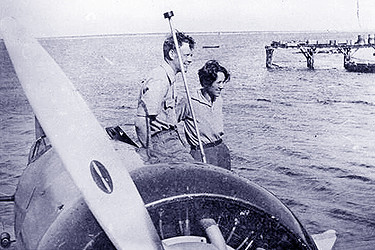
CharlesandAnne Morrow Lindbergh traveled the world in airplanes such as this as they charted the routes for intercontinental air service. She acted as his copilot, radio operator and navigator.
2001, a Space Odyssey
This film was made in the days before CGI, but it still defines the images of long-distance spaceflight.
Spiranthes
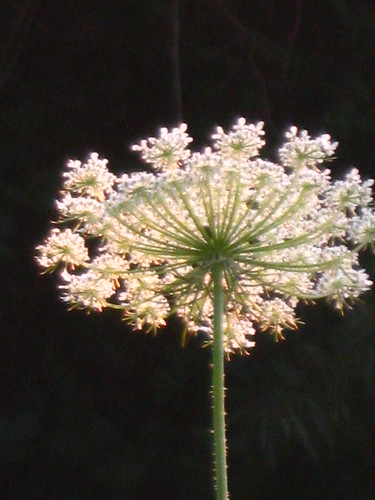
Photos byBob Kirchman
Spiranthes is a genus of orchids in the subfamily Orchidoideae. They are known commonly as ladies tresses, ladies'-tresses, or lady's tresses. The genus is distributed in the Americas, Eurasia, and Australia.
New Echota, Vann Tavern Photos by Bob Kirchman
Vann Tavern was built around 1805 by James Vann. He was a wealthy Cherokee plantation owner. The Nineteenth Century tavern served travelers as restaurant, store and inn. An outside stair led to guest quarters upstairs and the window on the porch served as a ‘takeout window’ for those the innkeeper would not allow inside. Although this particular building was moved to New Echota from Forsyth County, Georgia, it is representative of the tavern that would likely have stood here.
Interior of Vann Tavern.
Callanwolde The Candler Mansion in Atlanta
An intricate gable detail designed by Henry Hornbostel for Howard Candler, President of the Coca-Cola Company. Callanwolde was built in 1920. Photo by Bob Kirchman.
Callanwolde, the magnificent Tudor Revival style home of the Charles Howard Candler family, was completed in 1920. Howard Candler, the oldest son of Asa Griggs Candler(founder of The Coca-Cola Company), was the President of The Coca-Cola Company from 1916 to 1923. Today the home serves Atlanta as an arts center.
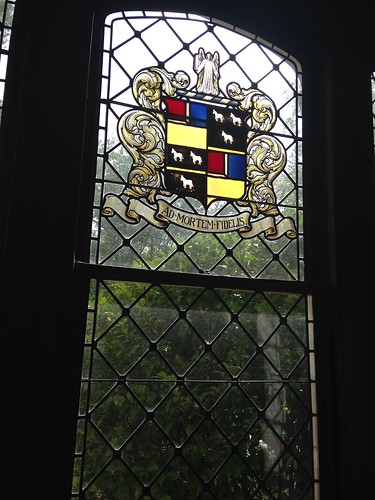
Family Crest in a window. Photo by Bob Kirchman.
Candler family lore holds that William Candlerof Newcastle-upon-Tyne served as an officer inCromwell’s Army during the Irish Rebellion of the mid-17th century. Candler served inSir Hardress Waller’s Regiment and after the end of the campaign was elevated to the rank of Lieutenant Colonel for “meritorious conduct in the field” by a grateful Cromwell and Parliament and granted lands in the Barony of Callan, County Kilkenny. He brought his wife,Anne Villiers, widow of Capt. John Villiers, and family over to Ireland and made their Irish home at Callan Castle. The name “Callanwolde” is based on this family connection to the Irish town of Callan and the Old English word for “woods” (“wolde”).” – History of Callanwolde
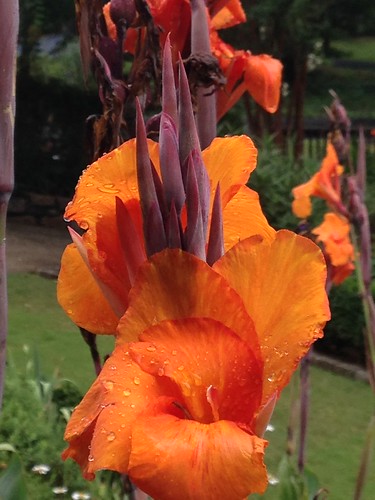
Canna Lilys in Callanwolde's formal gardens. Photos by Bob Kirchman.
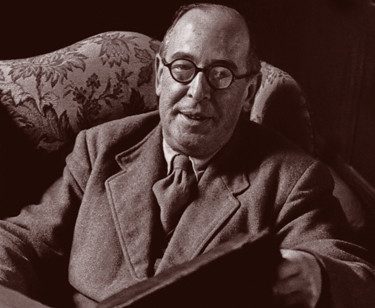
C. S. Lewis
C. S. Lewis.
For thus saith the high and lofty One that inhabiteth eternity, whose name is Holy; I dwell in the high and holy place, with him also that is of a contrite and humble spirit, to revive the spirit of the humble, and to revive the heart of the contrite ones.” – ISAIAH 57:15
Before Abraham was, I AM.” – John 8:58
C. S. Lewis was not a theologian by training. His specialty was actually literature. In his dialogues with J. R. R. Tolkien he came to the realization that all the great myths are a reflection of great Truth. This gave him deeper insight into the Great Story of God’s Redemption of man. Here we see that Lewis not only had a great grasp of the Divine Story, he had quite a bit of insight into the character of the Divine as well.
In his writings, Lewis was able to help his readers gain insight as well. Here we see some of what Peter Schackel describes in his book, Is Your Lord Large Enough, How C. S. Lewis Expands our View of God. If we try to write ‘hard data’ to describe God, we will undoubtedly fail. There simply aren’t enough ‘measurements’ available to us. Still, Lewis’s unique insight helps us to make some extrapolations from Scripture and our own imagination, guided by that Scripture. Schackle says: “We can know people only through mental images, is this more true about a God we haven’t seen than our neighbor who we see everyday?”
Since we have such a limited description of the Divine person in Scripture, Schackel continues: “this creates more space to imagine Him – to meditate on who He is and why He loves and what He does all day. How important it is, then, that we find guides to reflect aright on God and all His attributes – that provide a vision that expand’s God’s size in ways that keep hooks back in the few things we do know about God (including the Scripture)?” C. S. Lewis does this. “He takes what we know and builds on it. In the end, the landscape looks more vibrant and larger than our individualized, nationalized, materialized images of the Divine could ever be.”
God created things which had free will. That means creatures which can go wrong or right. Some people think they can imagine a creature which was free but had no possibility of going wrong, but I can't. If a thing is free to be good it's also free to be bad. And free will is what has made evil possible. Why, then, did God give them free will? Because free will, though it makes evil possible, is also the only thing that makes possible any love or goodness or joy worth having. A world of automata -of creatures that worked like machines- would hardly be worth creating. The happiness which God designs for His higher creatures is the happiness of being freely, voluntarily united to Him and to each other in an ecstasy of love and delight compared with which the most rapturous love between a man and a woman on this earth is mere milk and water. And for that they've got to be free.
Of course God knew what would happen if they used their freedom the wrong way: apparently, He thought it worth the risk. (...) If God thinks this state of war in the universe a price worth paying for free will -that is, for making a real world in which creatures can do real good or harm and something of real importance can happen, instead of a toy world which only moves when He pulls the strings- then we may take it it is worth paying.”– C.S. Lewis, The Case for Christianity
Everyone who believes in God at all believes that He knows what you and I are going to do tomorrow. But if He knows I am going to do so-and-so, how can I be free to do otherwise? Well, here once again, the difficulty comes from thinking that God is progressing along the Timeline like us: the only difference being that He can see ahead and we cannot. Well, if that were true, if God foresaw our acts, it would be very hard to understand how we could be free not to do them. But suppose God is outside and above the Time-line. In that case, what we call ‘tomorrow’ is visible to Him in just the same way as what we call ‘today’. All the days are ‘Now’ for Him. He does not remember you doing things yesterday; He simply sees you doing them, because, though you have lost yesterday, He has not. He does not ‘foresee’ you doing things tomorrow; He simply sees you doing them: because, though tomorrow is not yet there for you, it is for Him. You never supposed that your actions at this moment were any less free because God knows what you are doing. Well, He knows your tomorrow’s actions in just the same way—because He is already in tomorrow and can simply watch you. In a sense, He does not know your action till you have done it: but then the moment at which you have done it is already ‘Now’ for Him.”
– C.S. Lewis, Mere Christianity
The Nazis' extermination programme was carried out in the name of eugenics - but they were by no means the only advocates of racial purification. In this extract from his extraordinary new book,Edwin Blackdescribes how Adolf Hitler's (מַּח שְׁמוֹ) race hatred was underpinned by the work of American eugenicists
At 4am on November 12 1915, a woman named Anna Bollinger gave birth at the German-American Hospital in Chicago. The baby was somewhat deformed and suffered from extreme intestinal and rectal abnormalities, as well as other complications. The delivering physicians awakened Dr Harry Haiselden, the hospital's chief of staff. Haiselden came in at once. He consulted with colleagues. There was great disagreement over whether the child could be saved. But Haiselden decided the baby was too afflicted and fundamentally not worth saving. It would be killed. The method: denial of treatment.
Catherine Walsh, probably a friend of Bollinger's, heard the news and sped to the hospital to help. She found the baby, who had been named Allan, alone in a bare room. Walsh pleaded with Haiselden not to kill the baby by withholding treatment. "It was not a monster - that child," Walsh later told an inquest. "It was a beautiful baby. I saw no deformities." Walsh had patted the infant lightly. Allan's eyes were open, and he waved his tiny fists at her. Begging the doctor once more, Walsh tried an appeal to his humanity. "If the poor little darling has one chance in a thousand," she pleaded, "won't you operate to save it?"(read more)
Anne Morrow Lindbergh Trading Sky for Sea
ByHayley Morgan
Hayley is a mom of boys and a leader of women. She is the co-founder of The Influence Network and Wildly Co. She is the editor ofThe Tiny Twig [click to read]and her first book Wild and Free will be published by Zondervan in May 2016. The following is reposted with her permission:
Ink bottle, pen and notebook waited on the beach house desk, but for now Anne Morrow Lindbergh ambled along the Captiva shoreline looking for seashells to add to her collection. There, she spotted a little spiral shell. She rolled it in her hand and thought about the calm of this vacation by herself, the dizziness of her days back home, and what it would take “to remain whole in the midst of the distractions of life…to remain balanced, no matter what centrifugal forces tend to pull one off center.”
When she married world-famous aviator, Charles Lindbergh, she jumped right into his world, this tiny woman taking on big adventure as co-pilot, studying stars and logging flight plans. But she was more than propellers and airplane smoke. Even as she pursued her husband’s dreams, she brought her own creative passion along for the ride. She wrote award-winning novels based on their exploration over the world’s air routes and lent her writing skills to her husband’s autobiography “The Spirit of St. Louis.” He dedicated the book: “To A.M.L. who will never realize how much of this book she has written.”
But there was a new passion on the horizon, one that wouldn’t fit in the cockpit. On Mrs. Lindbergh’s 24th birthday, she delivered Baby Lindbergh. Flights went on and she felt the gravity of leaving her little one behind. Gradually, she gave up the turbulence of the skies to put her feet on the ground as a fully-present mom.
She would forever cherish the fleeting moments with her firstborn. Her dream turned nightmare in 1932 when kidnappers stole her son from his nursery and killed him in a ransom deal gone bad. She grieved as privately as possible in the midst of media frenzy, and used the pen to work out her sadness on the pages of her journal. Welcoming five more children after that tragic loss, she did her best to remain open to life no matter what it may bring.
Motherhood wasn’t easy. She’d be the first to say so: “Is this then what happens to a woman? She wants perpetually to spill herself away. All her instinct as a woman–the eternal nourisher of children, of men, of society–demands that she give. Her time, her energy, her creativeness drain out into these channels if there is any chance, any leak.”
All the stains to scrub, casseroles to cook, floors to sweep, baths to give, budgets to balance, appointments to make, parties to plan, messages to write– these leave us feeling drained, unless we are giving purposefully and being refilled.
Anne Morrow Lindbergh went to Captiva Island not for the adventure of travel, but to find quiet renewal at the water’s edge. In solitude she held out her cup to be filled to overflowing.
Certain springs are tapped only when we are alone,” she wrote, “The artist knows he must be alone to create; the writer, to work out his thoughts; the musician, to compose; the saint, to pray [and] women need solitude in order to find again the true essence of themselves.”
Mrs. Lindbergh went to the shore as a woman cluttered with life’s complications. She came home with a simple collection of shells and thoughtful words that became her famous memoir, Gift from the Sea. And so she took up a new passion, spurring women on to find creative pause, encouraging us to fill up so we can serve as we were “meant to in the eye of God.”
All quotes are from Gift from the Sea. For more on Anne Morrow Lindbergh, you’ll want to read:
Hour of Gold, Hour of Lead: Diaries and Letters of Anne Morrow Lindbergh, 1929-1932[1.]
Citizen Journalism with a Better Flavor
Volume XVI, Issue Va
Phantasies ByGeorge MacDonald, Chapter 14
Your gallery Ha we pass'd through, not without much content In many singularities; but we saw not That which my daughter came to look upon, The state of her mother."
~ from William Shakespeare's Winter's Tale.
It seemed to me strange, that all this time I had heard no music in the fairy palace. I was convinced there must be music in it, but that my sense was as yet too gross to receive the influence of those mysterious motions that beget sound. Sometimes I felt sure, from the way the few figures of which I got such transitory glimpses passed me, or glided into vacancy before me, that they were moving to the law of music; and, in fact, several times I fancied for a moment that I heard a few wondrous tones coming I knew not whence. But they did not last long enough to convince me that I had heard them with the bodily sense. Such as they were, however, they took strange liberties with me, causing me to burst suddenly into tears, of which there was no presence to make me ashamed, or casting me into a kind of trance of speechless delight, which, passing as suddenly, left me faint and longing for more.
Now, on an evening, before I had been a week in the palace, I was wandering through one lighted arcade and corridor after another. At length I arrived, through a door that closed behind me, in another vast hall of the palace. It was filled with a subdued crimson light; by which I saw that slender pillars of black, built close to walls of white marble, rose to a great height, and then, dividing into innumerable divergent arches, supported a roof, like the walls, of white marble, upon which the arches intersected intricately, forming a fretting of black upon the white, like the network of a skeleton-leaf. The floor was black.
Between several pairs of the pillars upon every side, the place of the wall behind was occupied by a crimson curtain of thick silk, hanging in heavy and rich folds. Behind each of these curtains burned a powerful light, and these were the sources of the glow that filled the hall. A peculiar delicious odour pervaded the place. As soon as I entered, the old inspiration seemed to return to me, for I felt a strong impulse to sing; or rather, it seemed as if some one else was singing a song in my soul, which wanted to come forth at my lips, imbodied in my breath. But I kept silence; and feeling somewhat overcome by the red light and the perfume, as well as by the emotion within me, and seeing at one end of the hall a great crimson chair, more like a throne than a chair, beside a table of white marble, I went to it, and, throwing myself in it, gave myself up to a succession of images of bewildering beauty, which passed before my inward eye, in a long and occasionally crowded train. Here I sat for hours, I suppose; till, returning somewhat to myself, I saw that the red light had paled away, and felt a cool gentle breath gliding over my forehead. I rose and left the hall with unsteady steps, finding my way with some difficulty to my own chamber, and faintly remembering, as I went, that only in the marble cave, before I found the sleeping statue, had I ever had a similar experience.
After this, I repaired every morning to the same hall; where I sometimes sat in the chair and dreamed deliciously, and sometimes walked up and down over the black floor. Sometimes I acted within myself a whole drama, during one of these perambulations; sometimes walked deliberately through the whole epic of a tale; sometimes ventured to sing a song, though with a shrinking fear of I knew not what. I was astonished at the beauty of my own voice as it rang through the place, or rather crept undulating, like a serpent of sound, along the walls and roof of this superb music-hall. Entrancing verses arose within me as of their own accord, chanting themselves to their own melodies, and requiring no addition of music to satisfy the inward sense. But, ever in the pauses of these, when the singing mood was upon me, I seemed to hear something like the distant sound of multitudes of dancers, and felt as if it was the unheard music, moving their rhythmic motion, that within me blossomed in verse and song. I felt, too, that could I but see the dance, I should, from the harmony of complicated movements, not of the dancers in relation to each other merely, but of each dancer individually in the manifested plastic power that moved the consenting harmonious form, understand the whole of the music on the billows of which they floated and swung.
At length, one night, suddenly, when this feeling of dancing came upon me, I bethought me of lifting one of the crimson curtains, and looking if, perchance, behind it there might not be hid some other mystery, which might at least remove a step further the bewilderment of the present one. Nor was I altogether disappointed. I walked to one of the magnificent draperies, lifted a corner, and peeped in. There, burned a great, crimson, globe-shaped light, high in the cubical centre of another hall, which might be larger or less than that in which I stood, for its dimensions were not easily perceived, seeing that floor and roof and walls were entirely of black marble.
The roof was supported by the same arrangement of pillars radiating in arches, as that of the first hall; only, here, the pillars and arches were of dark red. But what absorbed my delighted gaze, was an innumerable assembly of white marble statues, of every form, and in multitudinous posture, filling the hall throughout. These stood, in the ruddy glow of the great lamp, upon pedestals of jet black. Around the lamp shone in golden letters, plainly legible from where I stood, the two words--
TOUCH NOT!
There was in all this, however, no solution to the sound of dancing; and now I was aware that the influence on my mind had ceased. I did not go in that evening, for I was weary and faint, but I hoarded up the expectation of entering, as of a great coming joy.
Next night I walked, as on the preceding, through the hall. My mind was filled with pictures and songs, and therewith so much absorbed, that I did not for some time think of looking within the curtain I had last night lifted. When the thought of doing so occurred to me first, I happened to be within a few yards of it. I became conscious, at the same moment, that the sound of dancing had been for some time in my ears. I approached the curtain quickly, and, lifting it, entered the black hall. Everything was still as death. I should have concluded that the sound must have proceeded from some other more distant quarter, which conclusion its faintness would, in ordinary circumstances, have necessitated from the first; but there was a something about the statues that caused me still to remain in doubt. As I said, each stood perfectly still upon its black pedestal: but there was about every one a certain air, not of motion, but as if it had just ceased from movement; as if the rest were not altogether of the marbly stillness of thousands of years. It was as if the peculiar atmosphere of each had yet a kind of invisible tremulousness; as if its agitated wavelets had not yet subsided into a perfect calm. I had the suspicion that they had anticipated my appearance, and had sprung, each, from the living joy of the dance, to the death-silence and blackness of its isolated pedestal, just before I entered. I walked across the central hall to the curtain opposite the one I had lifted, and, entering there, found all the appearances similar; only that the statues were different, and differently grouped. Neither did they produce on my mind that impression--of motion just expired, which I had experienced from the others. I found that behind every one of the crimson curtains was a similar hall, similarly lighted, and similarly occupied.
The next night, I did not allow my thoughts to be absorbed as before with inward images, but crept stealthily along to the furthest curtain in the hall, from behind which, likewise, I had formerly seemed to hear the sound of dancing. I drew aside its edge as suddenly as I could, and, looking in, saw that the utmost stillness pervaded the vast place. I walked in, and passed through it to the other end.
There I found that it communicated with a circular corridor, divided from it only by two rows of red columns. This corridor, which was black, with red niches holding statues, ran entirely about the statue-halls, forming a communication between the further ends of them all; further, that is, as regards the central hall of white whence they all diverged like radii, finding their circumference in the corridor.
Round this corridor I now went, entering all the halls, of which there were twelve, and finding them all similarly constructed, but filled with quite various statues, of what seemed both ancient and modern sculpture. After I had simply walked through them, I found myself sufficiently tired to long for rest, and went to my own room.
In the night I dreamed that, walking close by one of the curtains, I was suddenly seized with the desire to enter, and darted in. This time I was too quick for them. All the statues were in motion, statues no longer, but men and women--all shapes of beauty that ever sprang from the brain of the sculptor, mingled in the convolutions of a complicated dance. Passing through them to the further end, I almost started from my sleep on beholding, not taking part in the dance with the others, nor seemingly endued with life like them, but standing in marble coldness and rigidity upon a black pedestal in the extreme left corner--my lady of the cave; the marble beauty who sprang from her tomb or her cradle at the call of my songs. While I gazed in speechless astonishment and admiration, a dark shadow, descending from above like the curtain of a stage, gradually hid her entirely from my view. I felt with a shudder that this shadow was perchance my missing demon, whom I had not seen for days. I awoke with a stifled cry.
Of course, the next evening I began my journey through the halls (for I knew not to which my dream had carried me), in the hope of proving the dream to be a true one, by discovering my marble beauty upon her black pedestal. At length, on reaching the tenth hall, I thought I recognised some of the forms I had seen dancing in my dream; and to my bewilderment, when I arrived at the extreme corner on the left, there stood, the only one I had yet seen, a vacant pedestal. It was exactly in the position occupied, in my dream, by the pedestal on which the white lady stood. Hope beat violently in my heart.
Now," said I to myself, "if yet another part of the dream would but come true, and I should succeed in surprising these forms in their nightly dance; it might be the rest would follow, and I should see on the pedestal my marble queen. Then surely if my songs sufficed to give her life before, when she lay in the bonds of alabaster, much more would they be sufficient then to give her volition and motion, when she alone of assembled crowds of marble forms, would be standing rigid and cold."
But the difficulty was, to surprise the dancers. I had found that a premeditated attempt at surprise, though executed with the utmost care and rapidity, was of no avail. And, in my dream, it was effected by a sudden thought suddenly executed. I saw, therefore, that there was no plan of operation offering any probability of success, but this: to allow my mind to be occupied with other thoughts, as I wandered around the great centre-hall; and so wait till the impulse to enter one of the others should happen to arise in me just at the moment when I was close to one of the crimson curtains. For I hoped that if I entered any one of the twelve halls at the right moment, that would as it were give me the right of entrance to all the others, seeing they all had communication behind. I would not diminish the hope of the right chance, by supposing it necessary that a desire to enter should awake within me, precisely when I was close to the curtains of the tenth hall.
At first the impulses to see recurred so continually, in spite of the crowded imagery that kept passing through my mind, that they formed too nearly a continuous chain, for the hope that any one of them would succeed as a surprise. But as I persisted in banishing them, they recurred less and less often; and after two or three, at considerable intervals, had come when the spot where I happened to be was unsuitable, the hope strengthened, that soon one might arise just at the right moment; namely, when, in walking round the hall, I should be close to one of the curtains.
At length the right moment and the impulse coincided. I darted into the ninth hall. It was full of the most exquisite moving forms. The whole space wavered and swam with the involutions of an intricate dance. It seemed to break suddenly as I entered, and all made one or two bounds towards their pedestals; but, apparently on finding that they were thoroughly overtaken, they returned to their employment (for it seemed with them earnest enough to be called such) without further heeding me. Somewhat impeded by the floating crowd, I made what haste I could towards the bottom of the hall; whence, entering the corridor, I turned towards the tenth. I soon arrived at the corner I wanted to reach, for the corridor was comparatively empty; but, although the dancers here, after a little confusion, altogether disregarded my presence, I was dismayed at beholding, even yet, a vacant pedestal. But I had a conviction that she was near me. And as I looked at the pedestal, I thought I saw upon it, vaguely revealed as if through overlapping folds of drapery, the indistinct outlines of white feet. Yet there was no sign of drapery or concealing shadow whatever. But I remembered the descending shadow in my dream. And I hoped still in the power of my songs; thinking that what could dispel alabaster, might likewise be capable of dispelling what concealed my beauty now, even if it were the demon whose darkness had overshadowed all my life. (to be continued)
A Case for Vision
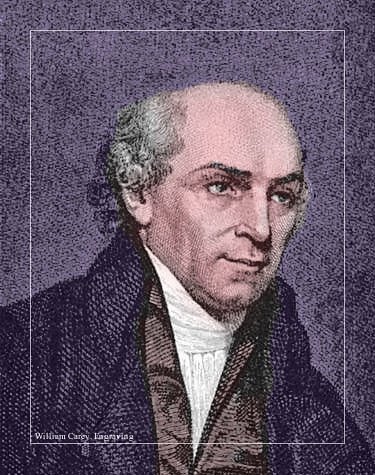
William Carey.
Sing, O barren, thou that didst not bear; break forth into singing, and cry aloud, thou that didst not travail with child: for more are the children of the desolate than the children of the married wife, saith the Lord.
Enlarge the place of thy tent, and let them stretch forth the curtains of thine habitations: spare not, lengthen thy cords, and strengthen thy stakes;
For thou shalt break forth on the right hand and on the left; and thy seed shall inherit the Gentiles, and make the desolate cities to be inhabited.
Fear not; for thou shalt not be ashamed: neither be thou confounded; for thou shalt not be put to shame: for thou shalt forget the shame of thy youth, and shalt not remember the reproach of thy widowhood any more.
For thy Maker is thine husband; the Lord of hosts is his name; and thy Redeemer the Holy One of Israel; The God of the whole earth shall he be called." -- Isaiah 54:1-5
William Carey
For three hundred years following the Reformation, many church leaders neglected the command of Christ to reach the nations. Towards the end of the Eighteenth Century, a newly ordained Baptist leader in England spoke to challenge this misapplication of the doctrine of election. "Young man, sit down! You are an enthusiast. When God pleases to convert the heathen, he'll do it without consulting you or me," said an older minister. The young man's name was William Carey. He was a cobbler by trade, but his calling would take him far beyond the walls of his little cobbler's shop. Carey's vision, you see, was as wide as the map of the world that he hung on his shop's wall. Gathering some like-minded friends, he began to pray for the fulfillment of his vision.
Carey admired the work of the Moravians [click to read], who at one point were one of the foremost sending congregations, planting churches around the world. They even founded churches among America's Cherokee Nation. Dismayed by his own denomination's lack of zeal for such work, he penned An Enquiry Into The Obligations Of Christians To Use Means For The Conversion Of The Heathens. Seeing the Great Commission as applying to the church of his day, he said: "Multitudes sit at ease and give themselves no concern about the far greater part of their fellow sinners, who to this day, are lost in ignorance and idolatry."
In 1792, Carey organized a missionary society and called for his fellow believers to: "Expect great things from God; attempt great things for God!" Few men today would have the patience and tenacity of Carey who said: "I can plod, I can persevere to any definite pursuit." Carey offered to become the first missionary of his society to the great subcontinent of India, offering to go if his friends back home would "hold the ropes." After a fourteen month journey and many personal tragedies, Carey labored on for seven years before he saw his first convert, Krishna Pal. Two months later he published his first Bengali New Testament. He and his colleagues would go on to publish translations of the entire Bible in Bengali, Oriya, Marathi, Hindi, Assamese, and Sanskrit, as well as hundreds of lesser used dialects.
Carey was instrumental in significant social reform in India. His work and advocacy resulted in the abolition of infanticide, widow burning (sati), and assisted suicide. Thus did a man's love for his Saviour result in the affirmation of Imago Dei in a whole new part of the world. When William Carey died, he had served the people of India for 41 years!
When Isaiah wrote the book that bears his name, Israel had forgotten the G-d given mission to be a light to the nations. Losing sight of this important purpose, the people sank into idolatry and pleasure-seeking. Every generation faces the very real danger of missing the great calling. Ours is no exception. Pastor Bruce Hankee related the story of Carey to his congregation, challenging us to program our lives for G-d's purpose through an understanding of Isaiah 54:1-5. He challenged us to enlarge our capacity for G-d's purpose, as Carey did. Ephesians 3:19 exhorts us: "And to know the love of Christ, which passeth knowledge, that ye might be filled with all the fulness of God." Indeed this is a great reason to expand our tent, that we might contain more of the love of G-d for our fellows! In lengthening our cords, we are expanding our influence. Just as a cobbler in the middle of England became a major pioneer in world missions, we too can have a greater influence if we will persevere in the pursuit of a great vision.
Counterpoint to Coruscant Two Arguments Set in Stone for a Low Profile Capital
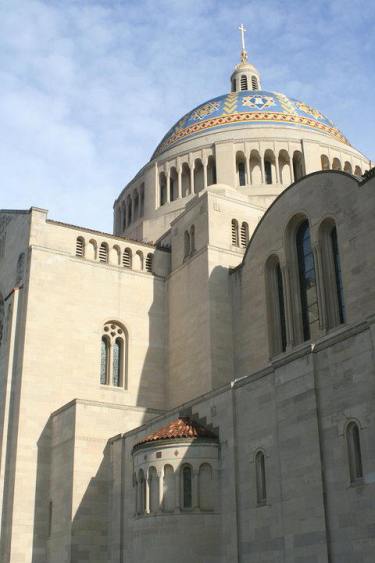
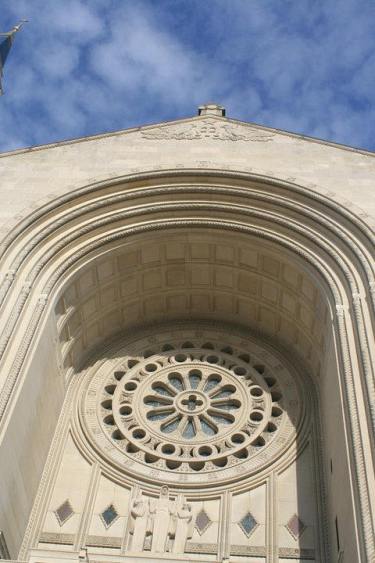
The Basilica of the National Shrine of the Immaculate Conception... Photo by Kristina Elaine Greer.
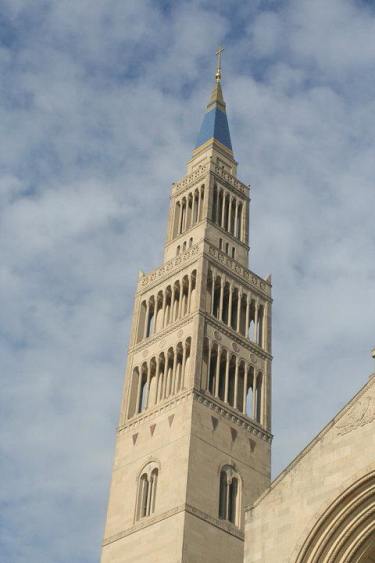
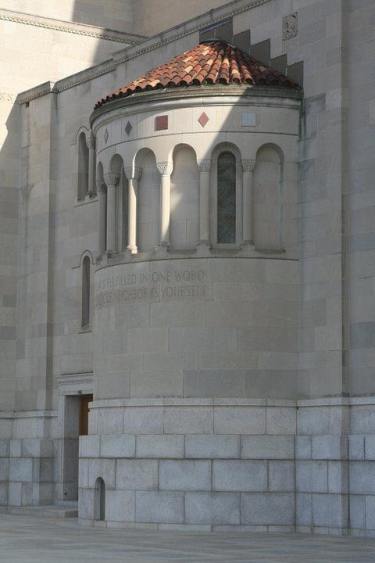
...is a fine example of Byzantine-Romanesque architecture. Photo by Kristina Elaine Greer.
The Shrine and the Cathedral
One unique distinctive of the city of Washington is its relatively low profile. The capital of the greatest nation on the face of the Earth is a city without skyscrapers. New York and Chicago, the great engines of finance and commerce, thrust their architectural presence into the sky while the nation's capital's relatively modest scale defers to iconic buildings that speak of the history and aspirations of her people.
It is widely believed that the legislation controlling building heights was put in place to make sure the Washington Monument would remain the tallest building in the city. The actual legislation has to do with the height of buildings in relation to the width of the streets they occupy.
The Height of Buildings Act of 1910 restricts all buildings in Washington D.C. to being no higher than the width of the adjacent street plus 20 feet. A building on a street that is 130 feet wide can only be 150 feet tall. To be taller than the 555 foot Washington Monument without violating this law, a building would need to be on a street that is over 535 feet wide.
The result is a city who's outlying neighborhoods open to vistas of splendid shrines and cathedrals. Her Northern neighborhoods are crowned by two architectural treasures: the National Cathedral and the the Basilica of the National Shrine of the Immaculate Conception.
Pierre Charles L'Enfant's original vision for the city, based on the palace and garden of Versailles, lends itself well to a garden city punctuated by such fine monuments. The gothic National cathedral brings to mind the great churches of Europe.
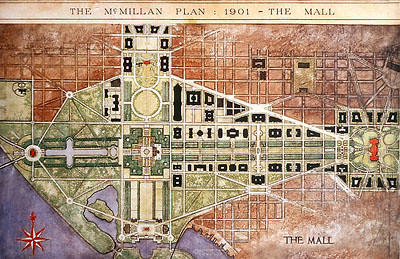
The McMillan Plan.
Pierre Charles L'Enfant's "Plan of the Federal City,” drawn in 1792,set aside a prominent site for a "great church for national purposes." Today the National Portrait Gallery stands in that place. It was not until 1891 that a meeting was held to renew plans for a National Cathedral. L’Enfant’s grand plan gave way to the Nineteenth Century growth of the city. Train tracks ran across what would become the National Mall.
At the beginning of the Twentieth Century, The United States Senate Park Commission was formed. Known as the McMillan Commission, it was named for its chairman, Senator James McMillan of Michigan. Some of the greatest American architects, landscape architects, and urban planners of the day served on the McMillan Commission, including Daniel Burnham, Frederick Law Olmsted, Jr., Charles F. McKim, and Augustus Saint-Gaudens. The Washington DC that we know today, with it’s inspiring vistas, cherry trees and reflecting pools is largely the product of this commission.
In 1902 the commission’s plan was published. Building on the work of L’Enfant, and inspired by the Cities Beautiful Movement, a grand but beautifully scaled Washington began to take shape. In her Northern reaches, plans for two beautiful houses of worship were also taking shape.
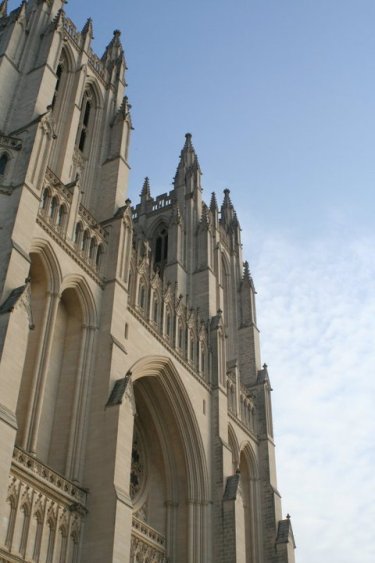
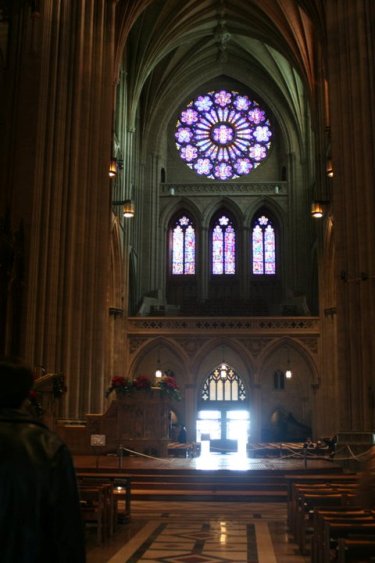
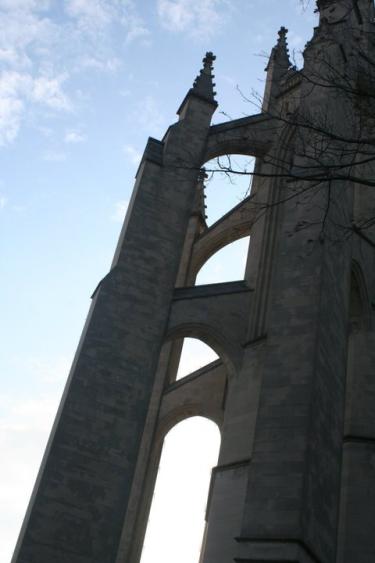
Frederick Bodley, known for his fine church designs in England, led the team designing the Cathedral Church of Saint Peter and Saint Paul for the Episcopal Diocese of Washington. [1.] Construction began in 1907. After World War I, Philip Hubert Frohman, an American architect, took over the supervision of the work. Construction of the National Cathedral went on for most of the Twentieth Century. As good stonemasons became harder to find, work was speeded up. Then a program to train stone masons was established on the Cathedral grounds. The Gothic cathedral features beautiful bas relief sculptures of the Creation and a gargoyle that resembles French President Charles DeGaulle! A statue of Darth Vader [2.] is up there as well, sculpted by Jay Hall Carpenter and Patrick J. Plunkett. The building was completed in 1990.
Today the cathedral is a prominent feature of the Northwest Quadrant of the city.
Bishop Thomas Joseph Shahan, the fourth rector of the Catholic University of America envisioned the construction of a national shrine to commemorate the Immaculate Conception in the country's capital. [3.] He took his appeal to Pope Pius X on August 15, 1913. The Pope was excited by Shahan’s vision and Catholic University donated land on its campus in the Northeast Quadrant of the city.
Architects Maginnis and Walsh of Boston first proposed a gothic building as well, but Bishop Shahan wanted the shrine to be bold, glorious and unique. A Byzantine-Romanesque design was chosen. The archbishop of Baltimore, Cardinal James Gibbons, blessed the foundation stone on September 23, 1920.
The Great Depression halted construction, as did the Second World War. In 1953 construction resumed and continued through the Twentieth Century. There are still mosaics remaining to be completed in the great dome, but the building is essentially complete. The Basilica of the National Shrine of the Immaculate Conception rises above the grey buildings of Catholic University as a prominent feature of the cityscape.
Thus two great architectural testimonies of faith hold their place in the profile of our nation’s capital. Neither is supported by federal monies but the presence of both stands as a reminder that: “Behold, the nations are as a drop of a bucket, and are counted as the small dust of the balance: behold, he taketh up the isles as a very little thing.” -- Isaiah 40:15
Tower... Photo by Kristina Elaine Greer.
...and tile of the National Shrine. Photo by Kristina Elaine Greer.
The National Cathedral. Photo by Kristina Elaine Greer.
Rose window in the cathedral. Photo by Kristina Elaine Greer. Flying buttresses of the cathedral. Photo by Kristina Elaine Greer.
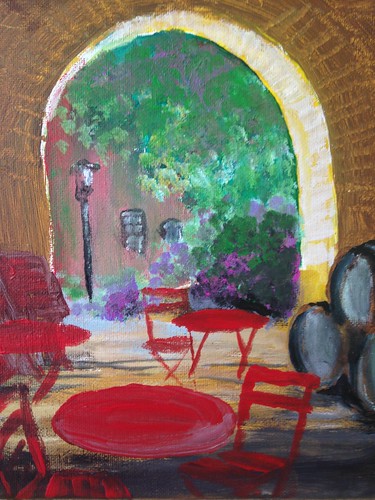
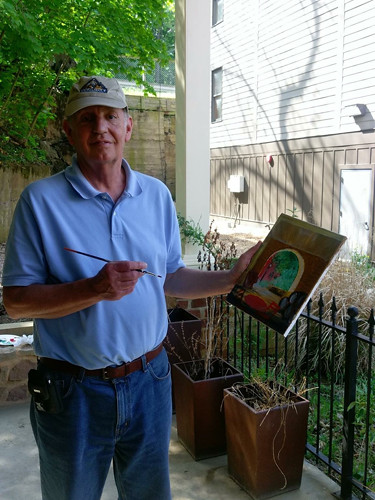
It was a day that dawned slightly overcast as I headed to town to 'stake out' our painting location. I knew it would be a hot one and I was going to be joined by my student, high school senior Savhanna Herndon and Lilly, a seven-year old who was one of Grace Christian School's best young artists. My concern was that the students have a great experience. The Ox Eye Vineyards tasting room seemed ideal, offering plenty of shade and interesting architecture. We set to work and shared color on our palates as we each tackled our respective painting. I must confess I dispensed with the easel and carried my canvass around as I interacted with the students. I painted what I would consider a good 'demonstration' canvas.
Savhanna chose a rich flower bed on the side of the Ox Eye building and she really started flowing with the project. She'd bought a bunch of new tubes of paint, heavy on what we call the 'Laney Colors,' so named for my last wonderful studio assistant who had pushed us 'brighter' in the renderings. (I was trained in a period which was far more muted and pastel). Savhanna was joying in the profusion of flowers that allowed her to play with happy color. We had arrived early in the morning so the archway area was open. I flitted between Lilly and Savhanna as I observed, and answered questions, but I kept at my own view so as to avoid 'hovering.' It was a good day.
Still, I felt like there wasn't much to my little painting until the staff of Ox Eye set out those wonderful little red tables and chairs! At that point I 'borrowed' some of Savhanna's bright colors and washed the atmospheric perspective. Getting better!, then I quickly rendered the tables and chairs with red, straight out of the tube from Savhanna's palate. Now I was getting somewhere! Suddenly focus and composition intersected in a joyous harmony. I was not expecting it! It was a beautiful day!
'Flowers at Ox Eye.' Painting by Savhanna Herndon.
Lilly's Painting of Sunspots across the street.
Savhanna Herndon, after a good morning's work!
Yes, I painted this standing up. Photo by Susan Kiers
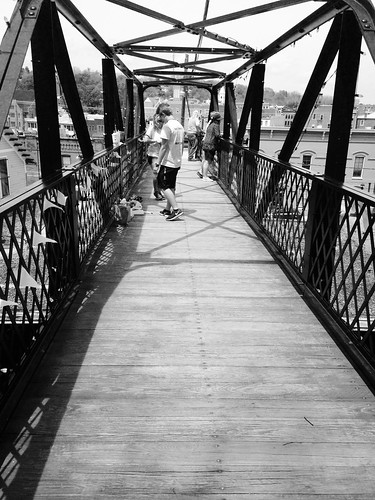
'Over the Bridge' 'Bridge Day' in Staunton, Virginia
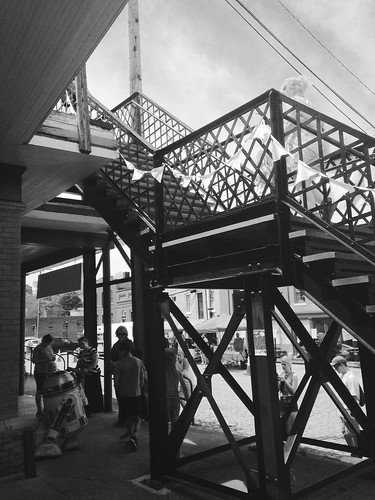
'Bridge Day' was happening as we painted, a celebration of the restoration of the Sears Hill Pedestrian Bridge across the Buckingham Branch Railroad in downtown Staunton. Photos by Bob Kirchman
Off to La La Land Musical with a Message for Our Time
DirectorDamien Chazelleunleashes an old-school, tour de force musical, proving that original, Oscar-worthy moviemaking—without R-rated gratuity—is actually still possible in Tinseltown." -- Plugged In
My lovely wife and I finished off the day watching the musical La La Land. It quickly ended up on our: "we need to own this DVD" list. Start with the fact that we both enjoy the old great musicals from Rodgers and Hammerstien and this modern day take off on that style is enjoyable in its own right. But where the old musicals often were fairly light on the story and heavy on the lavish numbers, La La Land had a great story to tell as well. The story is that of Sebastian (Ryan Gosling) and Mia (Emma Stone). He is a struggling keyboard artist and she is an aspiring actor. They meet in an awkward manner and their most decidedly unromantic beginnings are the beginnings of a sweet tale of love, creative aspiration, and collaboration.
It was fascinating to see how movie critics found things about the film to lambaste, such as Sebastian's love of traditional Jazz and his conflicts as he takes up playing in a Fusion band in order to move forward. While real music buffs might find it wanting in substance, the 'short explaination' offered by Sebastian is good enough for most of us. That and Mia's endless frustration in casting calls was actually quite a good build up to a tale about the tensions in a creative life. The fact is, for two creative people who've done Marriage Encounter, the film sparked some wonderful communication. I learned something.
We creatives often get so caught up in that which drives us that we become real jerks... especially with those we love the most. That is painful truth number one in this film as Sebastian, newly fired for not playing the required sets at his restaurant gig, leaves in a huff, smashing into Mia, who will eventually go on to become his greatest encourager. The themes of creative drive, love and encouragement, and sacrifice for another person make this a worthy movie indeed. Sebastian's narcissism created some good 'ouch' moments for me. Real sacrifice, it turns out, is not in the heroic selfless decision so much as in the daily 'dying to self' that makes life with another person rich. Indeed, there is a 'replay' moment near the end of the film that makes this clear.
Life itself is awkward. The film makes that clear, and I think anyone who's really loved and lived, and been the recipient of loving encouragement, will certainly find themselves in this story.
Neil Armstrong and Buzz Aldrin
The First Men on the Moon
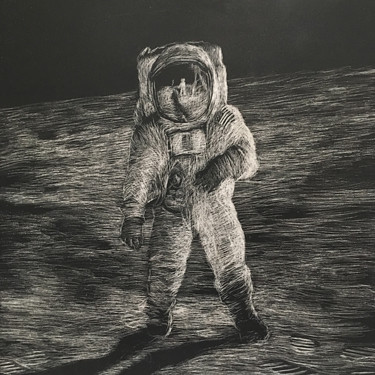
Neil Armstrongis reflected in the visor ofBuzz Aldrin, the first two humans to walk on the moon. Scratchboard, 12" x 12" by Bob Kirchman.