Volume XVII, Issue VIII
Lessons from the “World of Already”
By Bob Kirchman

The “World of Already.”
I was thirteen years old when the great New York World’s Fair took place. It was an event I looked forward to – the unveiling of new wonders of innovation and science, the amazing ‘Google’ architecture (the term having nothing to do with the search engine, but rather a ‘space aged’ futuristic style), and the wonderful sensory overload of a world on display! In my excitement I somehow missed the derisory piece TIME Magazine wrote, calling the fair “The World of Already.” TIME’s beef with the fair was that it was a hodgepodge of not so original things we could see springing up along the highway almost anywhere. In their intellectual disdain for public displays of this type, the writers of TIME missed something important. The ‘Future’ is a work in progress. The past and present have a lot to speak into it. Even if it is largely the present restyled, fairs have a lot to teach us.
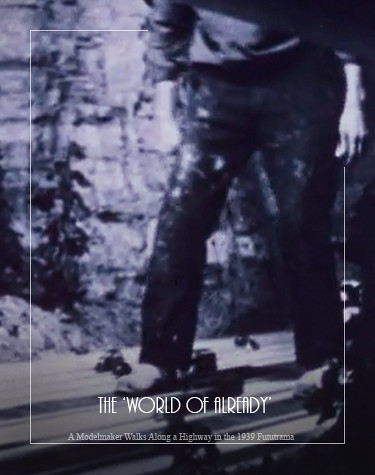
The argument that the world of the future presented by the fair is straight out of the 1950s cannot be denied, but human history is allowed to spill across decades. A lot of the world our parents built in the 1960s was indeed first sketched out in the preceding decade. Washington DC’s Dulles Airport designed by Eero Saarinen first appears as a “proposed Chantilly Airport” on a 1950s planning document along with alignments for outer belt highways that will eventually be the Fairfax County Parkway. In Queens, Robert Moses pushed the future along by building the Van Wyk Expressway as part of the fair project. Such infrastructure is first presented in the 1939 World’s Fair Futurama which predicts a superhighway system in 1960.
The 1964/65 World’s Fair had a Futurama too. It expanded on the first one and had underwater hotels and colonies on the moon. We’re still waiting for the colony on the moon. But here it must be said that the seeds of vision are often planted in the Crystal Palaces of these great international expositions. I came home from the fair and drew fantastic things of my own in the pile that I hid beneath my bed. The future was inspiring, even if it was mainly redressing things we already knew.
The great ‘White City’ of Chicago had inspired the creation of so many fine classical buildings in America’s growing towns and cities. It clearly looked to the past for inspiration. Isambard Kingdom Brunel borrowed heavily from Egyptian influences as he built bridges and tunnels for Britain’s modern infrastructure. The 1964/65 fair might at first seem to be lacking in lessons from the past, but the Vatican brought Michelangelo’s Pieta to the fair, placing it in futuristic pavilion that remotely evoked Bernini’s great colonnade. Here was marble come to life! Here was timeless beauty. It must be said that the Pieta brought the mystery and wonder of the Renaissance to Flushing Meadow Park. You viewed the sculpture on a series of moving sidewalks which created a sort of solemn procession. The background was blue, with a halo of stars suspended above. Here was a timeless thing that was objectively beautiful, positioned to inform humankind even as they set sail to explore the vastness of space. It was amazing!
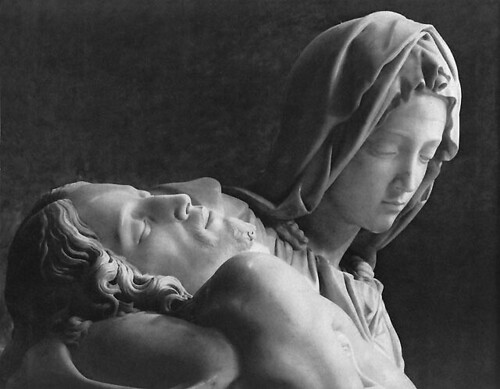
Michelangelo's Pieta, a lasting impression.
How the Waynesboro World’s
Fair Became Truly International
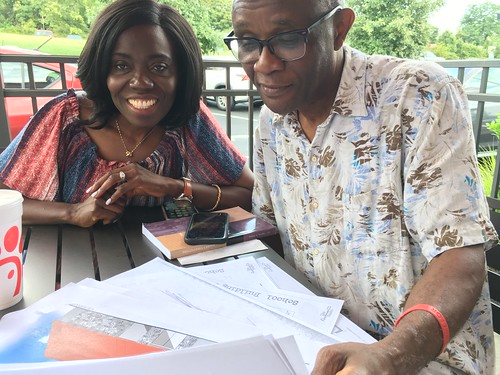
Tony and Beth Weeder.
It is probably one of my favorite project based activities, combining drawing and actual construction of three dimensional models, the ‘World’s Fair’ project. Here students study some architectural design and drawing and go on to create imaginative pavilions for an imaginary world’s fair. FunDoodle Art Camp created the 2019 Waynesboro World’s Fair and little did I know this would prove in some ways to be a truly international experience. Joining us for the camp was Ines Saiz Serna, visiting from Spain. She skillfully helped students assemble tetrahedrons and proved to be quite talented in a number of areas. The camp’s signature ‘Doodle’ sessions would prove inspirational as well. Hold this thought: I had remarked to myself that some of our doodle designs were quite like the design motifs found in African textiles and decorative arts.
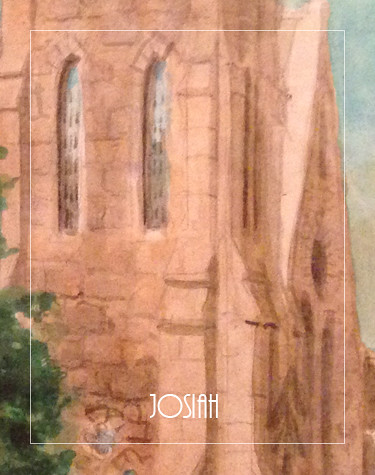
I had been given the task of creating a concept for a girls’ school in Monrovia, Liberia by Tony Weeder and his wife Beth. Education of girls is an important ministry as it gives them a safe and healthy path to a better future. Without education, their future can be pretty bleak. We created a school building and a chapel and I prepared some initial renderings. In a country with high unemployment, security bars are necessary on buildings such as our school and chapel, but they make it look like we’re in a prison too. Then it came together. Ines’s ‘doodles’ could provide a dignified alternative to the ugly bars. We could fabricate some of the lyrical doodles out of bar stock and do the same job in a way that gave dignity to the young women in our school. I hastily threw together the design and it was presented to the group building the project and was well received.
Such is the reason for ‘world’s fairs,’ real or imagined. They are a place where wonder and inspiration may happen. They inspire young people. They bring fresh ideas in a way that people can reach out and touch them. They add dimension and dialogue to the things we think we experience looking at our phones. They make a time of creative imagining fun! Looking forward, a young girl may look out of her school window one day, through Ms. Serna’s lyrical grille and envision a brighter future. Her education will provide an alternative to the bleak realities so many of her sisters face today. She’ll help remake her country and pass the baton of vision to her children! She’ll do so because of people of Faith like Tony and Beth Weeder, who see this outreach as an extension of the Love of Christ!

Design for a Chapel Building.
Many daughters have done virtuously, but thou excellest them all.” – Proverbs 31:29
A Capital Vision
Harry Weese's Metro Design
Harry Weese
Harry Weese
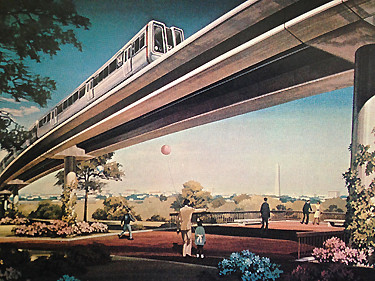
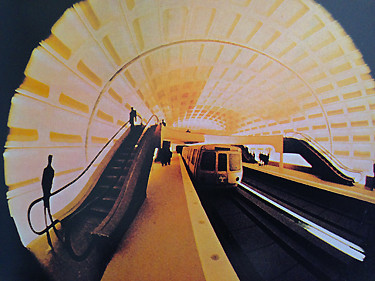
Harry Weese’s original design for Washington’s Metro system did indeed create a ‘crypt’ for the Federal City. It was meant to be somewhat devoid of ornamentation, depending on allusion to Classical vaults to tie it to the design of the city above. But there has always been some argument about the other spaces – the above-ground portions, for example. Did Weese intend them to be some stark brutalist viaduct? I found the above rendering by Weese’s office that shows a raised portion of the Metro at Reagan International Airport.
The Trains float on raised tracks supported by the ubiquitous round columns, but note that in the rendering the columns are integrated with the vegetation of the site – in this case the artist has placed them among the hydrangeas (going by scale and color), admitting that natural colors and forms of landscaping were to have softened the brutalism – especially in the vicinity of the airport and Arlington’s Cemetery.
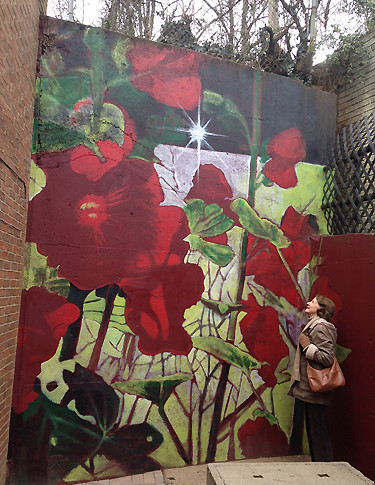
Below are my concepts for a mural that would have been painted in the bus bay of the Bethesda Metro Station. I like to think that Weese himself would be OK with the design.
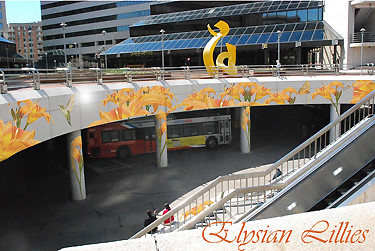
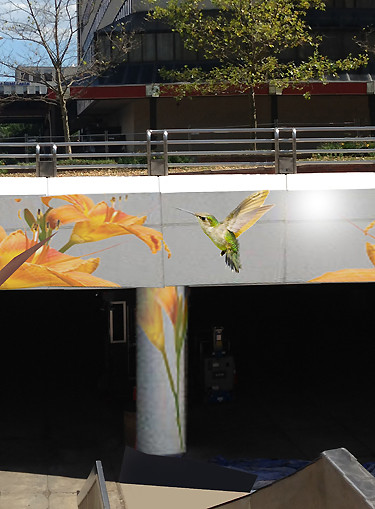
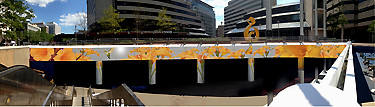
Concept by Bob Kirchman.
Elysian Lilies, it is a variation on the theme of Heaven’s Hollyhocks seen in last week’s issue. Passing through the asphalt and concrete bus bay descending to the Metro, the large lilies would have perhaps added a ‘touch of Heaven’ to Bethesda’s workaday world.
“Red Line” Bench Mural

The scope of work for the Bethesda Metro Station also included a bench in front of a fountain. My idea was a procession of red ants as this is a Red Line station.
"Religion and the Opening Up of the Mind"
By Bishop Robert Barron
Bishop Robert Barron speaks at Google Headquarters about religion and the opening up of the mind. Bishop Barron is the founder of Word on Fire Catholic Ministries and Auxiliary Bishop of the Archdiocese of Los Angeles. Bishop Barron is a #1 Amazon bestselling author and has published numerous books, essays, and articles on theology and the spiritual life, in addition to his regular YouTube videos (@wordonfirevideo).
Bishop Barron discusses how our minds restlessly seek, and how religion, at its best, never shuts down the mind, but opens it up. He explores the nature of "beatitudo", following the philosophy of Thomas Aquinas to conclude that wealth, power, pleasure, and honor will never satisfy, but only God can satisfy the infinite desires of our hearts.
Empowering Our Neighbors:
[click to read]
A Conversation with HUD Secretary Ben Carson
Jesus said, "whatever you do for the least of these, you do for Me." On this special edition, Dr. Tim Clinton sits down with Secretary of Housing and Urban Development, Dr. Ben Carson. They highlight HUD's many accomplishments, while Secretary Carson shares how churches are sacrificially serving and providing for their communities.(read more)
Ben Carson at Western Conservative Summit
[click to read]
On this broadcast, you will hear Dr. Ben Carson's speech from the 2019 Western Conservative Summit. He addresses his obligations as Secretary of Housing and Urban Development, and the optimism surrounding America's economy. Dr. Carson also explains the importance of a home as not only a physical structure, but an emotional and spiritual refuge for families. (read more)
‘New Left Urbanists’
[click to read]
The new left urbanists’ fatal mistake is to view cities as collections of buildings, roads, tunnels and bike lanes. Urbanists can demolish and rebuild physical environments, but they can’t pave over the people. Life in a metropolis is simply too complex, too variable and too ephemeral—it will evade even the most careful planning. Making cities better and more beautiful requires bringing neighbors, developers, employers and governments into the conversation. Thriving cities are built through cooperation, not compulsion.” (read more)
The Bishop's Garden, National Cathedral
Sharing a Magical Place in the Rain
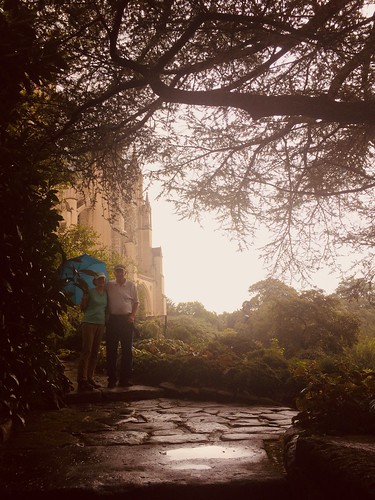
My bride and I share a magical moment in the Bishop's Garden of the National Cathedral in Washington, DC. Photo by S. Kirchman.
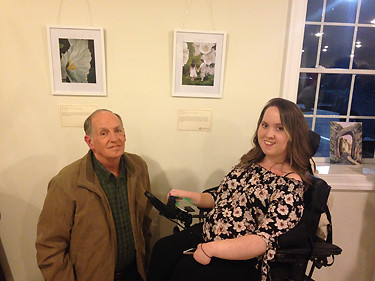
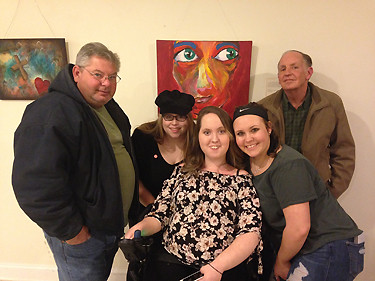
Laney’s Palette Art Show
Saturday September 14th, 2019 in Crozet, VA
Works by Kristina Elaine Greer will be on display at the gallery space of Tabor Presbyterian Church, 5804 Tabor Street, Crozet, Virginia 22932. There will be an opening reception on Saturday, September 14th, 2019 from 1:00 to 4:00pm at the church. All are invited. The show will feature Laney’s Acrylic Paintings and Pencil Drawings from 2004 – 2019.