Showing posts with label Metro. Show all posts

Sunday, August 25, 2019

Lessons from the “World of Already,” Ben Carson

Already
Volume XVII, Issue VIII

Lessons from the “World of Already”
By Bob Kirchman

IMG_1796
The “World of Already.”

I was thirteen years old when the great New York World’s Fair took place. It was an event I looked forward to – the unveiling of new wonders of innovation and science, the amazing ‘Google’ architecture (the term having nothing to do with the search engine, but rather a ‘space aged’ futuristic style), and the wonderful sensory overload of a world on display! In my excitement I somehow missed the derisory piece TIME Magazine wrote, calling the fair “The World of Already.” TIME’s beef with the fair was that it was a hodgepodge of not so original things we could see springing up along the highway almost anywhere. In their intellectual disdain for public displays of this type, the writers of TIME missed something important. The ‘Future’ is a work in progress. The past and present have a lot to speak into it. Even if it is largely the present restyled, fairs have a lot to teach us.

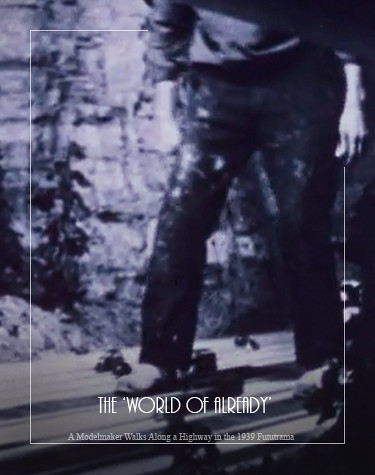
The argument that the world of the future presented by the fair is straight out of the 1950s cannot be denied, but human history is allowed to spill across decades. A lot of the world our parents built in the 1960s was indeed first sketched out in the preceding decade. Washington DC’s Dulles Airport designed by Eero Saarinen first appears as a “proposed Chantilly Airport” on a 1950s planning document along with alignments for outer belt highways that will eventually be the Fairfax County Parkway. In Queens, Robert Moses pushed the future along by building the Van Wyk Expressway as part of the fair project. Such infrastructure is first presented in the 1939 World’s Fair Futurama which predicts a superhighway system in 1960.

The 1964/65 World’s Fair had a Futurama too. It expanded on the first one and had underwater hotels and colonies on the moon. We’re still waiting for the colony on the moon. But here it must be said that the seeds of vision are often planted in the Crystal Palaces of these great international expositions. I came home from the fair and drew fantastic things of my own in the pile that I hid beneath my bed. The future was inspiring, even if it was mainly redressing things we already knew.

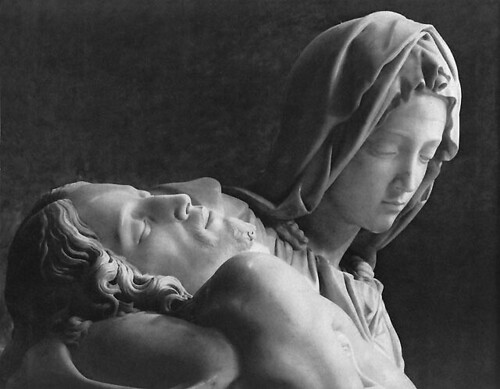
The great ‘White City’ of Chicago had inspired the creation of so many fine classical buildings in America’s growing towns and cities. It clearly looked to the past for inspiration. Isambard Kingdom Brunel borrowed heavily from Egyptian influences as he built bridges and tunnels for Britain’s modern infrastructure. The 1964/65 fair might at first seem to be lacking in lessons from the past, but the Vatican brought Michelangelo’s Pieta to the fair, placing it in futuristic pavilion that remotely evoked Bernini’s great colonnade. Here was marble come to life! Here was timeless beauty. It must be said that the Pieta brought the mystery and wonder of the Renaissance to Flushing Meadow Park. You viewed the sculpture on a series of moving sidewalks which created a sort of solemn procession. The background was blue, with a halo of stars suspended above. Here was a timeless thing that was objectively beautiful, positioned to inform humankind even as they set sail to explore the vastness of space. It was amazing!
michelangelo-71
Michelangelo's Pieta, a lasting impression.

How the Waynesboro World’s
Fair Became Truly International
IMG_1601
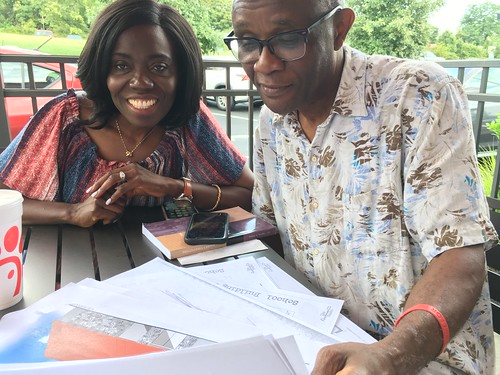
Tony and Beth Weeder.

It is probably one of my favorite project based activities, combining drawing and actual construction of three dimensional models, the ‘World’s Fair’ project. Here students study some architectural design and drawing and go on to create imaginative pavilions for an imaginary world’s fair. FunDoodle Art Camp created the 2019 Waynesboro World’s Fair and little did I know this would prove in some ways to be a truly international experience. Joining us for the camp was Ines Saiz Serna, visiting from Spain. She skillfully helped students assemble tetrahedrons and proved to be quite talented in a number of areas. The camp’s signature ‘Doodle’ sessions would prove inspirational as well. Hold this thought: I had remarked to myself that some of our doodle designs were quite like the design motifs found in African textiles and decorative arts.

I had been given the task of creating a concept for a girls’ school in Monrovia, Liberia by Tony Weeder and his wife Beth. Education of girls is an important ministry as it gives them a safe and healthy path to a better future. Without education, their future can be pretty bleak. We created a school building and a chapel and I prepared some initial renderings. In a country with high unemployment, security bars are necessary on buildings such as our school and chapel, but they make it look like we’re in a prison too. Then it came together. Ines’s ‘doodles’ could provide a dignified alternative to the ugly bars. We could fabricate some of the lyrical doodles out of bar stock and do the same job in a way that gave dignity to the young women in our school. I hastily threw together the design and it was presented to the group building the project and was well received.

Such is the reason for ‘world’s fairs,’ real or imagined. They are a place where wonder and inspiration may happen. They inspire young people. They bring fresh ideas in a way that people can reach out and touch them. They add dimension and dialogue to the things we think we experience looking at our phones. They make a time of creative imagining fun! Looking forward, a young girl may look out of her school window one day, through Ms. Serna’s lyrical grille and envision a brighter future. Her education will provide an alternative to the bleak realities so many of her sisters face today. She’ll help remake her country and pass the baton of vision to her children! She’ll do so because of people of Faith like Tony and Beth Weeder, who see this outreach as an extension of the Love of Christ!

IMG_1592
Design for a Chapel Building.

Many daughters have done virtuously, but thou excellest them all.” – Proverbs 31:29

A Capital Vision
Harry Weese's Metro Design
Weese001_web
Harry Weese

Weese002_web
Harry Weese

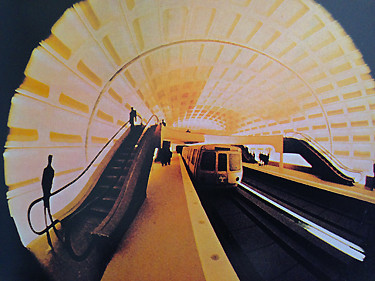
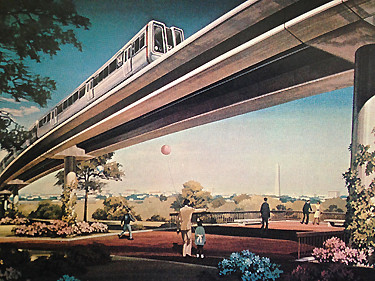
Harry Weese’s original design for Washington’s Metro system did indeed create a ‘crypt’ for the Federal City. It was meant to be somewhat devoid of ornamentation, depending on allusion to Classical vaults to tie it to the design of the city above. But there has always been some argument about the other spaces – the above-ground portions, for example. Did Weese intend them to be some stark brutalist viaduct? I found the above rendering by Weese’s office that shows a raised portion of the Metro at Reagan International Airport.

The Trains float on raised tracks supported by the ubiquitous round columns, but note that in the rendering the columns are integrated with the vegetation of the site – in this case the artist has placed them among the hydrangeas (going by scale and color), admitting that natural colors and forms of landscaping were to have softened the brutalism – especially in the vicinity of the airport and Arlington’s Cemetery.

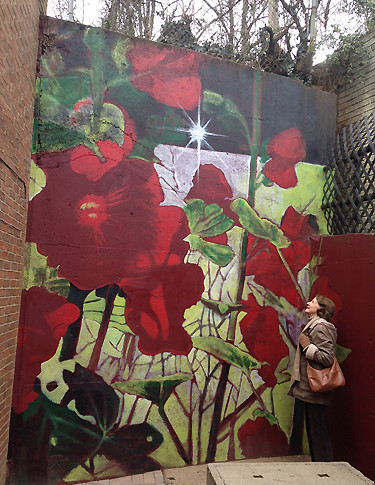
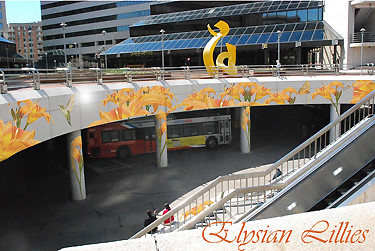
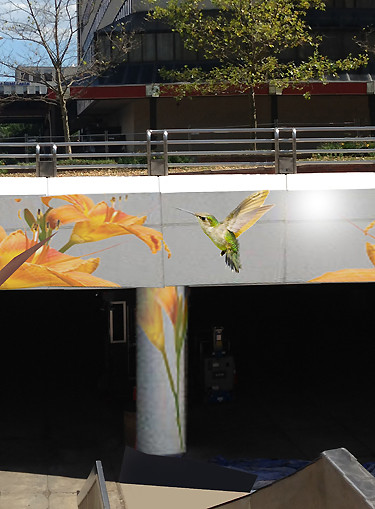
Below are my concepts for a mural that would have been painted in the bus bay of the Bethesda Metro Station. I like to think that Weese himself would be OK with the design.
Bethesda0002

Bethesda0003

Bethesda0001
Concept by Bob Kirchman.

Elysian Lilies, it is a variation on the theme of Heaven’s Hollyhocks seen in last week’s issue. Passing through the asphalt and concrete bus bay descending to the Metro, the large lilies would have perhaps added a ‘touch of Heaven’ to Bethesda’s workaday world.

“Red Line” Bench Mural

35
The scope of work for the Bethesda Metro Station also included a bench in front of a fountain. My idea was a procession of red ants as this is a Red Line station.

"Religion and the Opening Up of the Mind"
By Bishop Robert Barron


Bishop Robert Barron speaks at Google Headquarters about religion and the opening up of the mind. Bishop Barron is the founder of Word on Fire Catholic Ministries and Auxiliary Bishop of the Archdiocese of Los Angeles. Bishop Barron is a #1 Amazon bestselling author and has published numerous books, essays, and articles on theology and the spiritual life, in addition to his regular YouTube videos (@wordonfirevideo).

Bishop Barron discusses how our minds restlessly seek, and how religion, at its best, never shuts down the mind, but opens it up. He explores the nature of "beatitudo", following the philosophy of Thomas Aquinas to conclude that wealth, power, pleasure, and honor will never satisfy, but only God can satisfy the infinite desires of our hearts.

Empowering Our Neighbors:
[click to read]

A Conversation with HUD Secretary Ben Carson

Jesus said, "whatever you do for the least of these, you do for Me." On this special edition, Dr. Tim Clinton sits down with Secretary of Housing and Urban Development, Dr. Ben Carson. They highlight HUD's many accomplishments, while Secretary Carson shares how churches are sacrificially serving and providing for their communities.(read more)

Ben Carson at Western Conservative Summit
[click to read]

On this broadcast, you will hear Dr. Ben Carson's speech from the 2019 Western Conservative Summit. He addresses his obligations as Secretary of Housing and Urban Development, and the optimism surrounding America's economy. Dr. Carson also explains the importance of a home as not only a physical structure, but an emotional and spiritual refuge for families. (read more)

‘New Left Urbanists’
[click to read]

The new left urbanists’ fatal mistake is to view cities as collections of buildings, roads, tunnels and bike lanes. Urbanists can demolish and rebuild physical environments, but they can’t pave over the people. Life in a metropolis is simply too complex, too variable and too ephemeral—it will evade even the most careful planning. Making cities better and more beautiful requires bringing neighbors, developers, employers and governments into the conversation. Thriving cities are built through cooperation, not compulsion.” (read more)

The Bishop's Garden, National Cathedral
Sharing a Magical Place in the Rain

IMG_1933
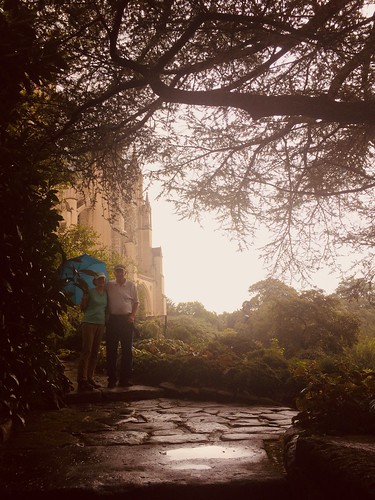
My bride and I share a magical moment in the Bishop's Garden of the National Cathedral in Washington, DC. Photo by S. Kirchman.

Laney’s Palette Art Show
Saturday September 14th, 2019 in Crozet, VA

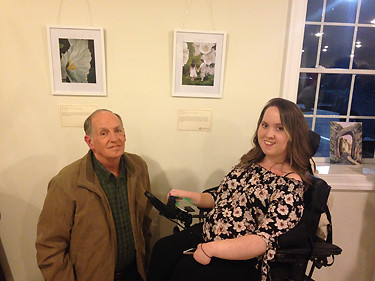
Works by Kristina Elaine Greer will be on display at the gallery space of Tabor Presbyterian Church, 5804 Tabor Street, Crozet, Virginia 22932. There will be an opening reception on Saturday, September 14th, 2019 from 1:00 to 4:00pm at the church. All are invited. The show will feature Laney’s Acrylic Paintings and Pencil Drawings from 2004 – 2019.

Banner

Wednesday, March 14, 2018

JOSIAH Chapter Eleven, The Art of Restoration

JOSIAH013
Volume XIV, Issue XI

Josiah
By Bob Kirchman
Copyright © 2018, The Kirchman Studio, all rights reserved

Chapter 11: Taking in Confidence

Ben-Gurion was wrestling. In the end he decided to take young Zimmerman into his confidence. Though the events on Mars were at the moment shrouded in secrecy, it would soon enough be time to let relatives of those who had survived know the fate of their loved ones.

He began, “Do you remember the Mars Mission before you were born? I was the pilot.”

Yes, a sad one, to be sure. No one survived on the planet’s surface. It must be painful for you to remember.”

Abiyah leaned closer, “We just sent an unmanned ship to the colony. There were survivors and we’ve been in conversation with them!”

The young man gasped.

Survivors – but HOW?!”

Ben-Gurion related the events that had transpired over the last year. He described the condition of the colony and the quandary it presented. “You see,” the professor concluded, “they see themselves, wretched as their lives are, as quite severed from Earth.”

So, am I to understand,” said Josiah, “that they have just enough technology to consider themselves self-sustaining, though they lack for so much we would consider basic essentials?”

Exactly, and MY quandary is what do we do next. They’re always on the verge of killing each other yet they fear us back on Earth more. APOLLONIUS taught them well, but he left out the most important lessons. They could stand to read Moses! Even though he killed the Egyptian, he thought better of it.”

Abiyah continued, “I am wrestling, my young friend – wrestling with making of you a most unusual request. Jon Greene and I are aware of your unique – gift, and your quandary as to how to use it. Obviously it would make more sense for ME to go to Mars, but I am a man of family. The other astronauts are largely technicians. They love their job. They man the defense platforms and in practice they get to blow stuff up, but they communicate in monotonous bursts. I am thinking we need someone gifted to ‘build the bridge,’ as it were.”

In Shalom, the Biosphere community on Big Diomede, as in the whole Zimmerman Organization, ‘Building the Bridge’ carried great meaning. It was a term not spoken lightly.
(to be continued)

The Art of Restoration
The Tabernacle Presbyterian Church Art Show

Tabernacle001
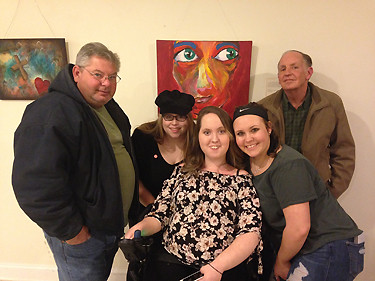
Bob Kirchman and Savhanna Herndon at the Second Annual Tabernacle Presbyterian Church Art Show. The theme was Restoration.

And the Lord spake unto Moses, saying, See, I have called by name Bezaleel the son of Uri, the son of Hur, of the tribe of Judah: And I have filled him with the spirit of God, in wisdom, and in understanding, and in knowledge, and in all manner of workmanship, To devise cunning works, to work in gold, and in silver, and in brass, And in cutting of stones, to set them, and in carving of timber, to work in all manner of workmanship. And I, behold, I have given with him Aholiab, the son of Ahisamach, of the tribe of Dan: and in the hearts of all that are wise hearted I have put wisdom, that they may make all that I have commanded thee;” – Exodus 31:1-6

Could there be anything to indicate more exquisitely God’s love of the beautiful than His instructions to crown the capitals of the temple pillars with “lily-work”? We can imagine Him adding in His directions, “Now David, don’t forget the lily-work decorations to be carved at the top of those pillars. And be sure to get them large enough to show up well.” Does it not suggest the artistic delight God must have experienced when with His own fingers he shaped man and woman into forms replete with comeliness?” – Clyde S. Kilby, The Arts and the Christian Imagination, p154.

In 2010, with the construction industry in the doldrums of recession, I teamed up with artist Kristina Elaine Greer to paint a mural of the New Heaven and the New Earth. The mural, titled ‘Journey to Jesus’ [1.] was indeed a statement of ultimate restoration. It referenced Isaiah 60, Revelation 21 and 22. Through this project I found a renewed joy in art as an expression of Divine purpose – especially in restoration. After we finished ‘Journey to Jesus’ I spoke with an Egyptian woman named Zipporah (same as Moses’s wife’s name) and she described Heaven in this way, “Jesus is in Heaven surrounded by children!” I was thrilled. We had just painted that. I begged her to tell me more: “The flowers there are ENORMOUS!” “Like sunflowers?” I asked – “No, more like TREES!”

That became the inspiration for the “Heaven’s Hollyhocks” paintings. Hollyhocks already represented a legacy in my way of thinking so now they became a Spiritual legacy. The Fifeville mural and a proposal for Bethesda’s Metro Station sprang from that vision. That vision is why participation in a show who’s theme was “The Restoration of All Things” meant so much to me. Hopefully that theme will find new and exciting expression in the future. Finding Redemption and Restoration in the midst of Recession is certainly a good thing!

Tabernacle002
Team Savhanna!

Hollyhocks
“Heaven’s Hollyhocks,” Painted by Bob Kirchman, inspired by the Springhill Hollyhocks planted by Kristina Elaine Greer’s Great-Great Grandmother, brightens an alleyway in front of a beauty shop in Charlottesville, Virginia’s Fifeville Community.

Restoration and Basketball
Tony Bennett’s Teaching Moment

The question seemed at first like one of those uncomfortable ones by a sports writer attempting to interject ‘greater significance’ into his reporting. “What does your victory mean to Charlottesville in light of all the recent news surrounding her?” UVA Coach Tony Bennett’s answer was a good one though. He said that the victory did indeed mean a lot to Charlottesville in that the team truly was a great example of “Unity in Diversity.” The team’s unselfish play and acknowledgement of the less-celebrated defense (controlling turnovers was key to their victory) made for a great lesson.

We still have our issues.” Bennett continued. But the example of these young men working it out and working together is indeed right up there with the message of “Remember the Titans.” If you remember, that story is about how the T. C. Williams football team brought a community together in the turbulent days of court-ordered integration. The Titans came together and showed their town just what they could accomplish by working together.

In the post-game interview you saw true humility and Bennett acknowledged his Faith. They took their teaching moment seriously. They played a beautiful unselfish game and showed us something we can carry into our own lives.

LateSnow
A March snow creates a Winter Wonderland. Photo by Bob Kirchman.

A Capital Vision
Harry Weese's Metro Design

Weese001_web
Harry Weese

Weese002_web
Harry Weese

Harry Weese’s original design for Washington’s Metro system did indeed create a ‘crypt’ for the Federal City. It was meant to be somewhat devoid of ornamentation, depending on allusion to Classical vaults to tie it to the design of the city above. But there has always been some argument about the other spaces – the above-ground portions, for example. Did Weese intend them to be some stark brutalist viaduct? I found the above rendering by Weese’s office that shows a raised portion of the Metro at Reagan International Airport.

The Trains float on raised tracks supported by the ubiquitous round columns, but note that in the rendering the columns are integrated with the vegetation of the site – in this case the artist has placed them among the hydrangeas (going by scale and color), admitting that natural colors and forms of landscaping were to have softened the brutalism – especially in the vicinity of the airport and Arlington’s Cemetery.

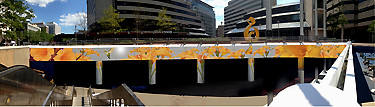
Below are my concepts for a mural that would have been painted in the bus bay of the Bethesda Metro Station. I like to think that Weese himself would be OK with the design.
Bethesda0002

Bethesda0003

Bethesda0001
Concept by Bob Kirchman.

Elysian Lilies, it is a variation on the theme of Heaven’s Hollyhocks seen in last week’s issue. Passing through the asphalt and concrete bus bay descending to the Metro, the large lilies would have perhaps added a ‘touch of Heaven’ to Bethesda’s workaday world.

Mountain Roads


Bejewelled Clover
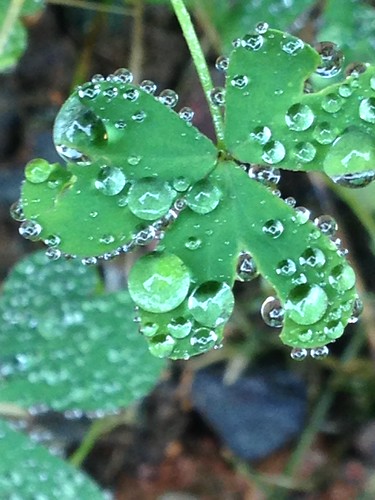
Bejeweled Clover. Photo by Bob Kirchman.

PontifusBANNER

Wednesday, July 12, 2017

Phantasies, Elysian Lilies, George Washington

Citizen Journalism with a Better Flavor

Phantasie24
Volume XIII, Issue II

Phantasies
By George Macdonald, Chapter 24

We are ne'er like angels till our passions die."
~ Thomas Dekker.

This wretched Inn, where we scarce stay to baite,
We call our dwelling-place:
We call one step a race:
But angels in their full enlightened state,
Angels, who live, and know what 'tis to be,
Who all the nonsense of our language see,
Who speak things, and our words, their ill-drawn
Pictures, scorn,
When we, by a foolish figure, say,
Behold an old man Dead! then they
Speak properly, and cry,
Behold a man-child born!"
~ Abraham Cowley

I was dead, and right content. I lay in my coffin, with my hands folded in peace. The knight, and the lady I loved, wept over me.

Her tears fell on my face.

Ah!" said the knight, "I rushed amongst them like a madman. I hewed them down like brushwood. Their swords battered on me like hail, but hurt me not. I cut a lane through to my friend. He was dead. But he had throttled the monster, and I had to cut the handful out of its throat, before I could disengage and carry off his body. They dared not molest me as I brought him back."

He has died well," said the lady.

My spirit rejoiced. They left me to my repose. I felt as if a cool hand had been laid upon my heart, and had stilled it. My soul was like a summer evening, after a heavy fall of rain, when the drops are yet glistening on the trees in the last rays of the down-going sun, and the wind of the twilight has begun to blow. The hot fever of life had gone by, and I breathed the clear mountain-air of the land of Death. I had never dreamed of such blessedness. It was not that I had in any way ceased to be what I had been. The very fact that anything can die, implies the existence of something that cannot die; which must either take to itself another form, as when the seed that is sown dies, and arises again; or, in conscious existence, may, perhaps, continue to lead a purely spiritual life. If my passions were dead, the souls of the passions, those essential mysteries of the spirit which had imbodied themselves in the passions, and had given to them all their glory and wonderment, yet lived, yet glowed, with a pure, undying fire. They rose above their vanishing earthly garments, and disclosed themselves angels of light. But oh, how beautiful beyond the old form! I lay thus for a time, and lived as it were an unradiating existence; my soul a motionless lake, that received all things and gave nothing back; satisfied in still contemplation, and spiritual consciousness.

Ere long, they bore me to my grave. Never tired child lay down in his white bed, and heard the sound of his playthings being laid aside for the night, with a more luxurious satisfaction of repose than I knew, when I felt the coffin settle on the firm earth, and heard the sound of the falling mould upon its lid. It has not the same hollow rattle within the coffin, that it sends up to the edge of the grave. They buried me in no graveyard. They loved me too much for that, I thank them; but they laid me in the grounds of their own castle, amid many trees; where, as it was spring-time, were growing primroses, and blue-bells, and all the families of the woods

Now that I lay in her bosom, the whole earth, and each of her many births, was as a body to me, at my will. I seemed to feel the great heart of the mother beating into mine, and feeding me with her own life, her own essential being and nature. I heard the footsteps of my friends above, and they sent a thrill through my heart. I knew that the helpers had gone, and that the knight and the lady remained, and spoke low, gentle, tearful words of him who lay beneath the yet wounded sod. I rose into a single large primrose that grew by the edge of the grave, and from the window of its humble, trusting face, looked full in the countenance of the lady. I felt that I could manifest myself in the primrose; that it said a part of what I wanted to say; just as in the old time, I had used to betake myself to a song for the same end. The flower caught her eye. She stooped and plucked it, saying, "Oh, you beautiful creature!" and, lightly kissing it, put it in her bosom. It was the first kiss she had ever given me. But the flower soon began to wither, and I forsook it.

It was evening. The sun was below the horizon; but his rosy beams yet illuminated a feathery cloud, that floated high above the world. I arose, I reached the cloud; and, throwing myself upon it, floated with it in sight of the sinking sun. He sank, and the cloud grew gray; but the grayness touched not my heart. It carried its rose-hue within; for now I could love without needing to be loved again. The moon came gliding up with all the past in her wan face. She changed my couch into a ghostly pallor, and threw all the earth below as to the bottom of a pale sea of dreams. But she could not make me sad. I knew now, that it is by loving, and not by being loved, that one can come nearest the soul of another; yea, that, where two love, it is the loving of each other, and not the being loved by each other, that originates and perfects and assures their blessedness. I knew that love gives to him that loveth, power over any soul beloved, even if that soul know him not, bringing him inwardly close to that spirit; a power that cannot be but for good; for in proportion as selfishness intrudes, the love ceases, and the power which springs therefrom dies. Yet all love will, one day, meet with its return. All true love will, one day, behold its own image in the eyes of the beloved, and be humbly glad. This is possible in the realms of lofty Death. "Ah! my friends," thought I, "how I will tend you, and wait upon you, and haunt you with my love."

My floating chariot bore me over a great city. Its faint dull sound steamed up into the air--a sound--how composed?" How many hopeless cries," thought I, "and how many mad shouts go to make up the tumult, here so faint where I float in eternal peace, knowing that they will one day be stilled in the surrounding calm, and that despair dies into infinite hope, and the seeming impossible there, is the law here!

But, O pale-faced women, and gloomy-browed men, and forgotten children, how I will wait on you, and minister to you, and, putting my arms about you in the dark, think hope into your hearts, when you fancy no one is near! Soon as my senses have all come back, and have grown accustomed to this new blessed life, I will be among you with the love that healeth."

With this, a pang and a terrible shudder went through me; a writhing as of death convulsed me; and I became once again conscious of a more limited, even a bodily and earthly life.
(to be continued)

WMTA
Elevator to Surface, Smithsonian Station in the Washington Metro.

Take Metro In a Wheelchair, Just Once
[click to read]

Do Metro executives know what the Metro is like for a person who uses a wheelchair? (read more)

A New Proposal for 'Elysian Lilies'
By Bob Kirchman

metro_web
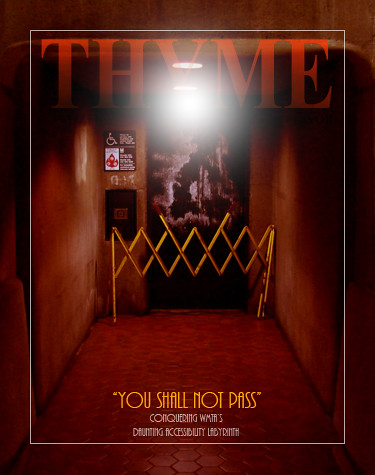
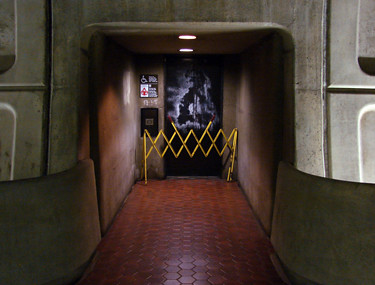
In Metro's Smithsonian Station, the Elevator is tucked into a dark alcove that is poorly marked. If you forget to check the status updates for elevators, you might encounter this scene... the elevator is out of service.

In the older Metro Stations in Washington D. C., the elevators might seem like an afterthought. In Smithsonian Station, the elevator sits in a dark alcove and is easily missed. Harry Weese designed the stations as a crypt, of sorts, to the Federal City. He wanted you to know you were underground.

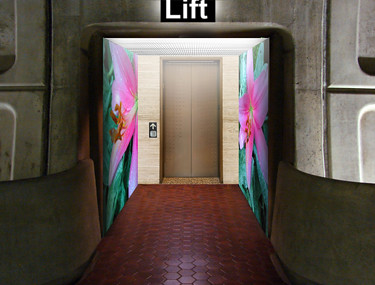
Newer Metro stations have two elevators side by side and they are large enough for two people in wheelchairs to ride together. Smithsonian Station's elevator is relatively small. Adding to the claustrophobia is the dark alcove. While the vaulted stations and open escalators are elegant in their muted illumination, a case might be made for the elevator alcove needing to visually signal connection to the world above.

To that end, a variation of the 'Elysian Lilies' mural is designed below, along with a brighter ceiling light and a brighter elevator door.

ElysianLily2_web
'Elysian Lilies' Mural Design for a Lift Alcove. Bob Kirchman

Panda Popularity Personified
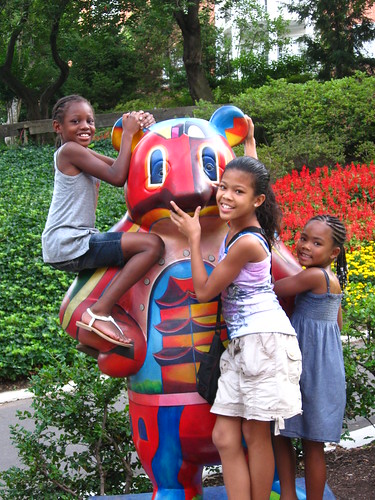
Kids and Pandas are Inseparable at DC Zoo

Panda at the Subway Entrance
A panda sculpture at the National Zoo Metro station attracts attention. Photo by Bob Kirchman 

The Challenge of Leadership

theprayer
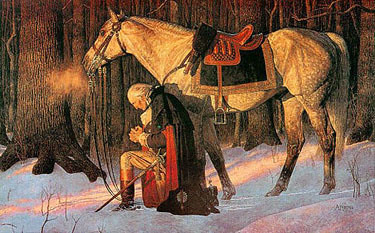
"The Prayer at Valley Forge" by Arnold Friberg is one of the best known paintings of the American Revolution. It depicts George Washington at Valley Forge.

No doubt, George Washington knew the challenge of leadership well. He began his career without a full college degree, but at the age of sixteen he obtained his surveyer's certificate from The College of William and Mary. At an age when most modern young men are playing video games, he was out discovering and marking an actual country! He did do something akin to the actions of modern young men when he discreetly carved his initials into Rock Bridge County's natural wonder, Natural Bridge!

Washington is noted for his military career, but historian James Hodges, Ph.D.gives us some unique insight into the man's character:

At the Battle of Brandywine in September 1777, a particularly brutal battle with much carnage on both sides, a fox terrier got lost between the lines. The little dog was captured by the Americans, who saw inscribed in his collar: “Property of General Howe.” Washington made sure the little dog was fed, cleaned and treated well. Under a flag of truce, Alexander Hamilton delivered the dog to General Howe, who had suffered great mental anguish thinking his little terrier had been lost to him forever.

Washington had been passionately fond of horses from early boyhood, and owned his first horse at 17. His mother, Mary Ball Washington, was a skilled horsewoman who taught young George how to train horses using only the gentlest of methods, and to never resort to any cruelty. Washington learned that harsh training methods were counter-productive, because horses treated with respect are eager to please their riders." [1.]

At the second battle of Trenton, on January 2, 1777, it was clearly evident that Washington's great charger Nelson returned the affection of his rider. Though cannon shells were bursting around them, man and horse stood firm. To those men Washington led into battle, they stood together as a symbol of strength. A soldier writes: “As I crossed the bridge crowded with fellow soldiers, I brushed up against the boot of the man and flank of the horse. Both seemed to exude courage.”

After the great war was over, Washington indeed became President of the nation he had helped to create. His leadership skills would be tested in the days of the Newburgh Conspiracy, where he would avert a military coup. The young nation's coffers were empty. The Continental Army had not been fully paid, and an uprising was brewing. There was talk of taking up arms against the Congress. Washington went to his officers and appealed to them in an emotional address on March 15, 1783.

Cool heads prevailed and Congress voted on a plan to pay the men. Interestingly, Washington distrusted the notion of political parties. He never aligned with one himself, though those around him were crafting the foundation for the two party system we have today. Perhaps the man's own sayings tell us volumes about his life and its motivations: [2.]

It is impossible to rightly govern the world without G-d and Bible."

The propitious smiles of Heaven can never be expected on a nation that disregards the eternal rules of order and right which Heaven itself has ordained”

Make sure you are doing what G-d wants you to do---then do it with all your strength."

What students would learn in American schools above all is the religion of Jesus Christ.” "It is the duty of all Nations to acknowledge the providence of Almighty G-d, to obey his will, to be grateful for his benefits, and humbly to implore his protection and favors."

My mother was the most beautiful woman I ever saw. All I am I owe to my mother. I attribute my success in life to the moral, intellectual and physical education I received from her."

The General hopes and trusts that every officer and man will endeavor to live and act as becomes a Christian soldier defending the dearest rights and liberties of his country."

If to please the people, we offer what we ourselves disapprove, how can we afterwards defend our work? Let us raise a standard to which the wise and honest can repair. The rest is in the hands of G-d."

No people can be bound to acknowledge the Invisible Hand which conducts the affairs of men more than the people of the United States. Every step by which they have advanced to the character of an independent nation seems to have been distinguished by some token of providential agency"

I am sure that never was a people, who had more reason to acknowledge a Divine interposition in their affairs, than those of the United States; and I should be pained to believe that they have forgotten that agency, which was so often manifested during our Revolution, or that they failed to consider the omnipotence of that G-d who is alone able to protect them.”

Happiness and moral duty are inseparably connected.”

I earnestly pray that the Omnipotent Being who has not deserted the cause of America in the hour of its extremist hazard, will never yield so fair a heritage of freedom a prey to "Anarchy" or "Despotism"."

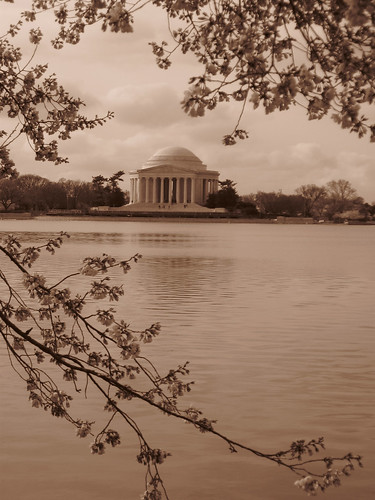
Blossoms
Cherry Blossoms frame the Jefferson Memorial on the Washington, D. C. Tidal Basin. Photo by Bob Kirchman

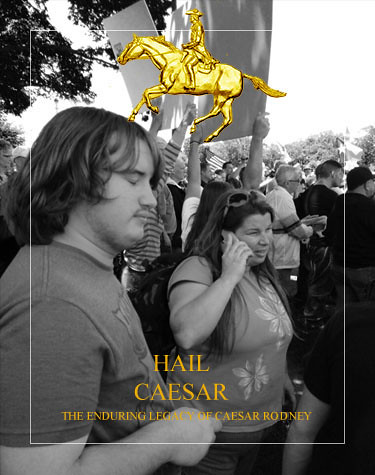
CAESAR
A Patriot's Legacy.

Caesar Rodney's Midnight Ride

Now one was neither Tory nor Whig; it was either dependence or independence.” Caesar Rodney, after Lexington and Concord.

We all know the famous story of Paul Revere's midnight ride. Virginians celebrate the memory of Jack Jouett, who rode to Monticello to warn Thomas Jefferson of approaching British troops.Jefferson and the Virginia Legislature were able to escape across the Blue Ridge Mountains to Staunton. Still, the most memorable midnight ride that saved the young republic has to be that of Caesar Rodney. Without Rodney's ride, there would not have been a republic at all.

Caesar Rodney was born in 1728 on his family's 800 acre farm, Byfield, on St. Jones Neck in East Dover Hundred, Kent County, Delaware. The family could trace its ancestry to the Adelmare family of Treviso, Italy. Caesar Rodney's farm was a large one, worked by slaves, and it provided wheat and barley to markets in Philadelphia. His brother Thomas described him as possessing a: "great fund of wit and humor of the pleasing kind, so that his conversation was always bright and strong and conducted by wisdom... He always lived a bachelor, was generally esteemed, and indeed very popular." Indeed, his talents found him taking his place in public service. He served as sheriff and in a number of other positions. He joined Thomas McKean as a delegate to the Stamp Act Congress in 1765 and was the Brigadier General of the Delaware Militia. He went on to serve in the Continental Congress.

Here is where he made his most courageous contribution to the cause of American independence. In 1776 the vote to adopt the Declaration saw the Delaware delegation deadlocked. This was a problem as the delegates to the convention had decided that an all or nothing approach was essential. Of Delaware's two present delegates Mckean favored independence. The other delegate, George Read, did not. Rodney, who was also qualified to vote, was at home performing his duties as General of the militia when the initial voting took place. Mckean had sent word to Rodney that his vote would be needed in Philadelphia... but the message never got to him. Rodney was a bachelor and his love interest at the time was being used by the Tories to divert his participation! She was intercepting the messages! By the time McKean's message finally got to Rodney, the first deadlocked vote had already taken place and it was well into the evening. Rodney mounted his horse and rode through a great thunderstorm along the muddy road to Philadelphia. Lightning illuminated the wet road as he sloshed along as rapidly as conditions would allow. For seventy miles he rode.

Rodney was not a well man. He suffered from a rare form of cancer that disfigured his face and sapped his strength. No doubt he knew the ride could kill him, but he pressed on. He was committed to an act of treason that might lead to his death if he did survive. But he pressed on through the darkness. He reached Philadelphia by mid-morning. Spattered with mud, he stepped into the chamber just in time to cast his historic vote. Now the votes by all colonies who actually voted was unanimous! The framers rightly considered this essential to the success of the Declaration. Without Caesar Rodney's heroic ride, there would have not been a July 4th for us to celebrate! Rodney served in the war effort, even fighting alongside George Washington, who said of him: “The readiness with which you took to the field at the period most critical to our affairs, the industry you used in bringing out the militia of the Delaware State and the alertness observed by you in forwarding on the troops from Trenton, reflect the highest honor on your character and place your attachment to the cause in a most distinguished point of view.” As a young republic took its place in the world, Rodney continued to serve but his health was now rapidly declining. He died in 1784. [2.]

His legacy lives on today though. My friend Brandy Leigh Messick and her four sons are proud descendents of this great patriot and continue his mission to promote the values of this great nation to this day! Special thanks to her for providing additional background for this article.

CS_Lewis_Banner