Showing posts with label Elysian Lilies. Show all posts

Sunday, August 18, 2019

Murals for Public Spaces, Legacies, Harry Weese

ElysianLilies002
Volume XVII, Issue VII

Murals for Public Spaces

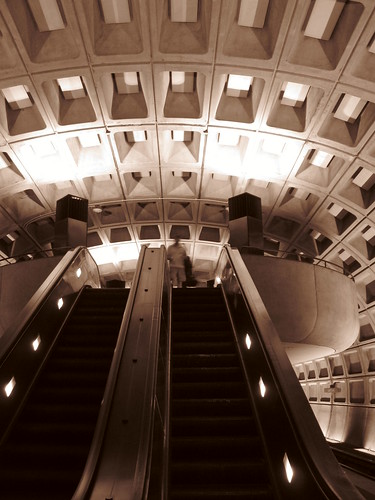
Harry Weese actually created the spaces of Washington’s Metro as a Brutalism/Minimalist statement. He specified that their be no murals, but four decades later the imposing fearsomeness of the spaces had the leadership of Bethesda, Maryland creating public art.

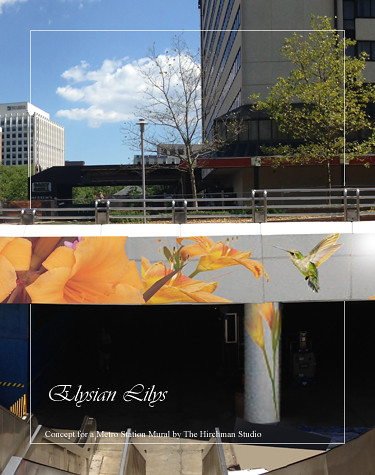
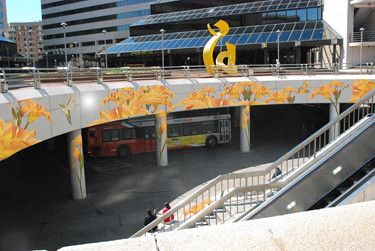
Was it successful? Our studio submitted a very natural floral mural... a continuation of the theme began in the Hollyhocks Mural in Charlottesville. Our goal was indeed to overlay the stark entrance/bus shed with a natural imagery to create an inviting space. I joked to my colleagues: “This won't win. Bethesda Arts likes stark geometrics.”

Sure enough, the winning design was stark and geometrical. Though it has vibrant colors and is a good mural, it's Mayan hyroglyphs read to some people more like a diagram of underground utility piping. Not exactly the way to make the space more inviting unless the artist is David McCauley. Here are some interesting comments from the article that follows:

Let’s Cover Blank Walls with Public Murals
By Dan Malouff
[click to read]

One of the most basic tenets of good urban design is that walkways should be lined with things to look at. Blank walls discourage walking because they make a walk seem boring and therefore longer, and because empty and lightly maintained spaces feel less safe. Detailed, colorful places are inherently more pedestrian friendly than dismal, blank spaces, and therefore urbanistically superior. So, given that, why do we accept so many blank spaces in our cities? (read more)

Scott on February 3, 2017 at 8:02pm

One man's art is often another man's grafitti. The original design for the Metro by Harry Weese specifically excluded art to avoid the discussion of what is appropriate and what is not. Have you all seen the awful mural that was added at the Bethesda Metro Station? I even like modern art, and this thing just looks bad, and is not good urban streetsscape design. Public art and heroic sculpture is a great idea if well done, but I have seen some very bad and tasteless artwork in public places.

Another topic is the fine line between thoughtfully commissioned murals and illegal vandalism. It really is difficult to enrich the public realm without offending at least some of the public. I vote for great lighting, interesting textures, useful way finding signage, even some bright colors but suggest that unless art is carefully curated, we should avoid filling our city with poorly conceived murals.”

John D on February 5, 2017 at 11:22am

I have to agree that the mural at the Bethesda Metro Station is spectaculary awful. it's easy to visualize alternatives for that space that would be simpler, more durable, and more complimentary to its environment. So if that's an example of what we might get, I'd have to vote for more advertising to fund the system, too. At least ads get vetted by someone's marketing department and has to meet a quality hurdle.”

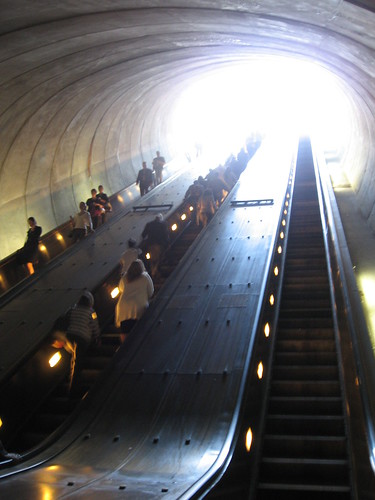
At this point, I want to emphasize that having designed a mural concept for the space, I can say flat-out that it is a difficult space. The bus shed is awkward in scale and the Metro escalator is long and scary. I noticed many able-bodied people opting for the elevator. I rode that escalator a number of times to get a sense of the sequence one went through going to Metro.

I rode down as a man and his girlfriend (or wife) descended in front of me. She was laden with packages and he, carrying nothing, followed her down. I slipped down the left side and placed myself in front of the woman, simply because Southern men are taught from childhood to place themselves between women and danger. I rode down the long escalator standing there. The old escalator gave a rather wobbly ride and I thought of how one of these Metro escalators had actually failed – freewheeling down during a day when hundreds of thousands visited Washington for a Pro-life Rally on the mall.

The media was often guilty of downplaying the numbers of Pro-life Rallys, so as the official ridership of the day became public record as part of the investigation, it was shown that there are a lot more people riding the Metro on a day when there’s a Pro-Life Rally than the media would like to admit. Thankfully there were only minor injuries and the most harrowing image of the day was that of crushed baby strollers. I would call it a miracle.

But back to the rude man and the laden lady -- That little moment convinced me that bringing beauty and nature into the space might be a very good thing. I wanted at that point so desperately to break the spell of that dirty brutalist space... but it was not to be. About forty of us were competing for the opportunity and the $30,000 muralist's fee. I was able to see some of the other entries. There were quite a few geometric designs (design to competition committee), and I liked many of them more than the winning design.

In the end I was satisfied that I had created a good solution and that on another day another committee might have wanted something ‘different.’ But this time the committee opted for what they had financed earlier in a retaining wall mural.

I called my concept Elyssian Lilys. It was a continuation of a theme that begins with my old assistant Kristina’s Great, Great Grandmother’s Hollyhocks, which return every year to bless the street where they were planted long ago even though the house is long gone. It is also a tribute to a friend’s daughter, Lily. I had done a smaller mural of Heavenly Hollyhocks in the Fifeville Neighborhood of Charlottesville, Virginia. It warmed what had been a rather stark entry to a beauty salon and that exercise proved to me and those acting as design critics: Kristina Elaine Greer and Lisa Johnson, that a large natural element might indeed create a welcoming environment overlayed on Weese’s Brutalism and was sufficient in contrast so as not to take much away from it.

I think it will find a good home in urban fabric someday.
ElysianLilies001

Elysianlilys003

A Floral Legacy

The Springhill Hollyhocks
Florals
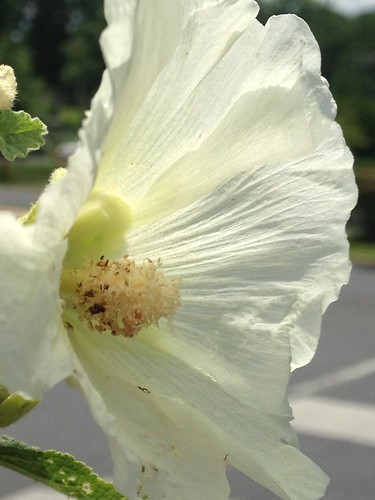
White Hollyhock, Springhill Road. Photo by Bob Kirchman

Everyone must leave something behind when he dies, my grandfather said. A child or a book or a painting or a house or a wall built or a pair of shoes made. Or a garden planted. Something your hand touched some way so your soul has somewhere to go when you die, and when people look at that tree or that flower you planted, you're there. It doesn't matter what you do, he said, so long as you change something from the way it was before you touched it into something that's like you after you take your hands away. The difference between the man who just cuts lawns and a real gardener is in the touching, he said. The lawn-cutter might just as well not have been there at all; the gardener will be there a lifetime." – Ray Bradbury, Fahrenheit 451

Passing something along to the generations to follow... a worthy ambition, indeed the great feast of Passover and the celebration of Purim involve the passing down of the great stories of Redemption! "And ye shall observe this thing for an ordinance to thee and to thy sons for ever. And it shall come to pass, when ye be come to the land which the Lord will give you, according as he hath promised, that ye shall keep this service. And it shall come to pass, when your children shall say unto you, What mean ye by this service? That ye shall say, It is the sacrifice of the Lord's passover, who passed over the houses of the children of Israel in Egypt, when he smote the Egyptians, and delivered our houses. And the people bowed the head and worshipped." -- Exodus 12:24-27

The just-celebrated Passover is a way of keeping the story alive. For generations this story told as a meal has given new generations the cherished history of their redemption. Indeed it should serve as a  model for us as we pass down a Legacy of faith to our children. Historically we have passed along so much more to our children as we would teach them how to work, how to build a life and so much more. Of late our society has built a reliance on 'experts' to prepare our young people for the future. While I would readily agree that a young person becoming a doctor needs to be trained by other doctors, there is much to be learned outside of the academy from the proceeding generations of one's own family. Most of our work ethic and our character is formed in the home. There is much wisdom of a deeper sort to be found there.

Indeed, modern generations seem to have diminished the importance of this tradition, as referenced here in some of my writing: "Haroset, bitter herbs and young lamb mingled together to add illustration to an old story. In ancient times a covenant was often made within the context of a meal. Rupert's own redemptive story was now unmistakably flavored by sweet tea and macaroni and cheese. In the 1950's the American company Swanson created an invention known as the "TV Dinner." Families no longer conversed around the table, often "watching the news" instead of passing truth from generation to generation. Food was placed into individual compartments in a small aluminum tray, individualized for each diner. There were no more passed dishes. The family ate in silence as the television did all the talking."[1.]

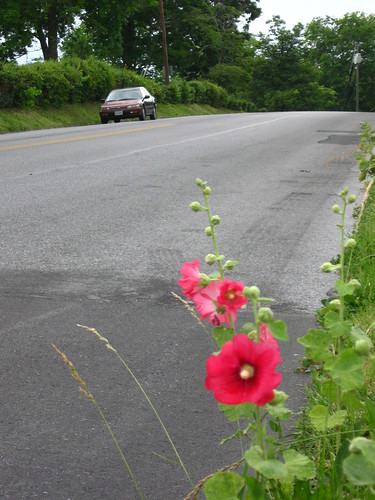
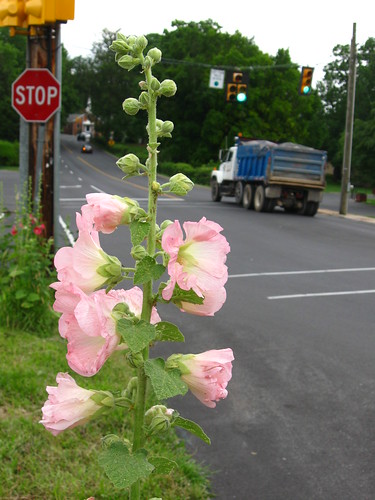
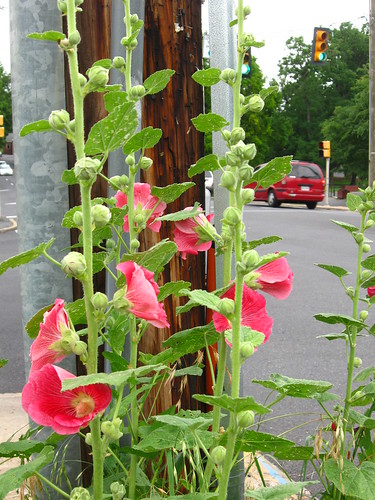
That is why I love Mrs. Landes' Hollyhocks. They represent the passing down of a gift to bless many generations to come. The house is gone now, replaced by a gas station, but the Great-great grandchildren of Mrs. Landes still enjoy the fact that they still bloom every year where her house once stood and that is a wonderful thing!

I first noticed the wonderful hollyhocks as I would drive over to my weekend job with organ builder Xaver Wilhelmy. There they were growing in the highway right of way. I started photographing them, marveling at their tenacity in growing where they did. One day I mentioned them to my assistant Kristina, who surprised me by telling me that her Great-great Grandmother had first planted them. They too would find their way into story: "The hollyhocks were in bloom now, and their offspring, lovingly sown from Kris' pods, blessed many a neighboring garden in the biosphere which protected the little town from the ravages of the severe climate. Today, the little gardens seemed especially alive as hummingbirds and butterflies seemed to abound. "Why does this day seem so different from any other?" mused Kris. Surely it had to be the special visit from Kate and Elizabeth. No, the light seemed more brilliant. The flowers seemed more defined. An artist noticed things like this, and each of these women was an artist in her own right." [2.]

The statement: "Why does this day seem so different from any other?" alludes to the Seder by design, referring to the child's question which prefaces the great retelling of the great story of redemption. Projecting the great story into the future is a direct reference to the hope we have in our own promised redemption! Indeed that hope is at the heart of the celebration of Redemption and resurrection!

Florals
White Hollyhock, Springhill Road. Photo by Bob Kirchman
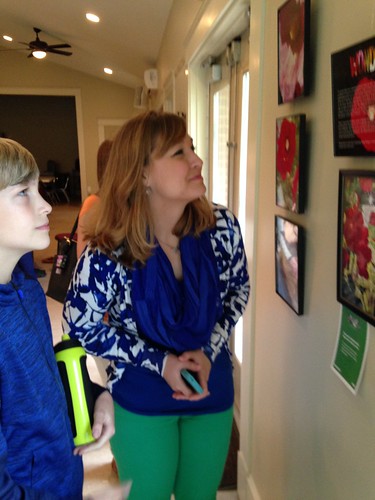
WONDER
The Great-great Grandchildren of Mrs. Landes and the story of her legacy of hollyhocks. Her hollyhocks still bloom every Summer on Springhill Road in Staunton, Virginia. Her house is long gone, replaced by a gas station but the flowers continue to bless those who pass that way. They were the inspiration for the mural: Heavenly Hollyhocks that Mr. Kirchman painted in Charlottesville, Virginia.


IMG_2499

IMG_8115

IMG_8116

IMG_8117

IMG_8119

IMG_8118

IMG_8120

Hollyhocks

Hollyhocks

Hollyhocks

Hollyhocks
Every Summer they appear!, remnants of a garden planted long ago that continue to brighten the drive into Staunton along Churchville Avenue. What a great living legacy for a gardener!Photos by Bob Kirchman
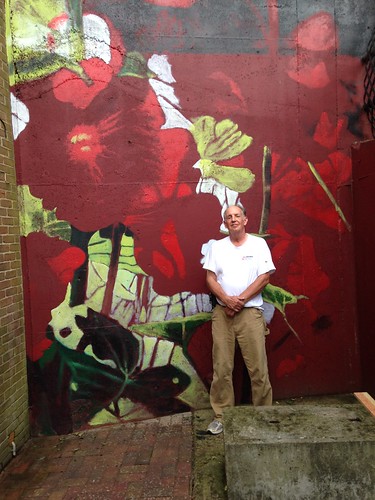
09/04/2015
Mural inspired by the Springhill Hollyhocks.

Zipporah’s Flowers

As we were finishing the Journey to Jesus Mural, an Egyptian woman visited our church. Her name was Zipporah (the same as Moses’ wife). She mentioned that she had had dreams or visions of Heaven. Naturally I was intrigued and when I met her in the foyer I asked her to describe what she had seen. “Jesus is in Heaven surrounded by Children,” she remarked. That was a “WOW” moment. The Journey to Jesus Mural depicts children of all nations coming to the throne of the Redeemer! Zipporah unknowingly was affirming the message of a two-year project that she had no prior knowledge of.

She continued: “The flowers there are ENORMOUS… more like TREES!” Zipporah had unwittingly planted the seeds for the concepts developed in Heaven’s Hollyhocks and Elysian Lilys. These visions had comforted a Christian lady living in the midst of persecution in her homeland and now they had a message of comfort for others as well. That prompted their introduction into stark urban environments.


West_web
East_web
Journey to Jesus, a mural depicting the nations coming to Jesus in the New Heaven and New Earth described in Revelation 21. Mural by Kristina Elaine Greer and Bob Kirchman

BSB Corporation Pavilion
Concept for a World's Fair Pavilion: Reproduction of Journey to Jesus.

Epic of Human Civilization

In 1932 the Trustees of Dartmouth College commissioned José Clemente Orozco,’s mural: The Epic of American Civilization, which depicts the history of the Americas. It is a great work of art but it presents a dark scenario ending with ‘gods of the modern world.’ It uplifts the great civilizations of the Maya and the Aztec but then delves into a rather dystopian depiction of modern times. Unseen is the fact that human civilization has never been without troubles and it is easy to see visions of the past as ‘pure’ forms because you are spared the sights and smells of everyday life there. Orozco’s mural was originally seen as controversial but as the academy aligned itself more and more with Anticolonialism and Socialism, the mural became more of a statement of where they were intellectually.

Dartmouth had originally been founded to evangelize the native peoples of America, but as the academy began to adopt the view that Western culture was ‘nothing special,’ Orozco became the Leonardo of this new faith. Selective history always sees the sins of those one disagrees with and overlooks a lot of those of one agrees with. Yes, the Conquistadors were terrible. Modern education is indeed soulless and seeks to indoctrinate, as Orozco intimates in his depiction of ‘gods of the modern world,’ but the academy, having espoused a more Marxist philosophy, continues to suppress other thoughts (especially Christian thoughts). Witness the recent speech by Noah Riner where the student body president talked of how finely educated Dartmouth graduates had not all been noble in their subsequent lives.

Noah Riner, 21 — homeschooled son of a Baptist preacher, and now student body president at Dartmouth College — sparked national controversy with his September 20th convocation speech to incoming freshmen. In what is traditionally an immemorable speech, Riner maintained that character, not just intelligence and talent, must be the goal for true education. Dartmouth, Riner told his peers, has turned out a lot of very talented, very intelligent individuals. “But if all we get from this place is knowledge, we’ve missed something,” he reasoned — citing examples, both historic and recent, of Dartmouth alums whose credentials were impeccable, but whose character was proven to be greatly corrupt. Turning to raise the issue of New Orleans — the looting, violence, and rape in the aftermath of Hurricane Katrina — Riner clarified, “My purpose… isn’t to condemn just [the citizens of New Orleans], rather it’s to condemn all of us.” “The real problem in this world,” Riner argued, “is not lack of education [but] lack of character.” “[C]haracter,” he held, “is what you do when no one is looking, but I’m afraid to say all the things I’ve done when no one was looking.” He challenged his fellow students to be honest with themselves and with one another. “We have the same flaws as the individuals who pillaged New Orleans,” he said, affirming the truth of the universal sin nature. “Ours haven’t been given such free range, but they exist and are part of us all the same.” [3.]

Here Riner offered the message of Christ… the original message of Dartmouth, to the protest of the modern institution that Dartmouth had become.

So Journey to Jesus is subtitled ‘The Epic of Human Civilization,’ a nod to Orazco’s work, but also a continuation of Riner’s assertion that if institutions have failed us we need something more than an institution to save us. It is in that spirit that we offer Christ and ‘visions of Heaven’ as an alternative.
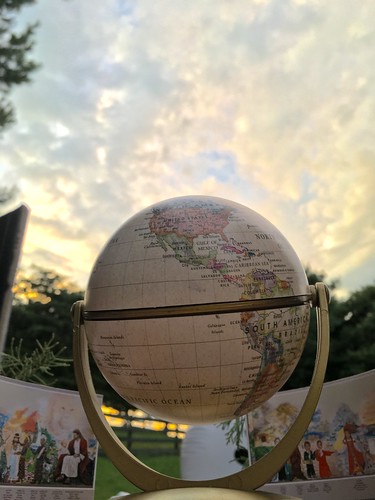
The BSB Pavilion
The BSB Corporation Pavilion at the 2019 Waynesboro World’s Fair. This was a FunDoodle Art Camp project where we built architectural models and photographed them against the sky to give them scale. The pavilion is a concept for an outdoor installation of the ‘Journey to Jesus ‘ Mural created by Kristina Elaine Greer and Bob Kirchman.

Harry Weese's Metro
Photos by Bob Kirchman
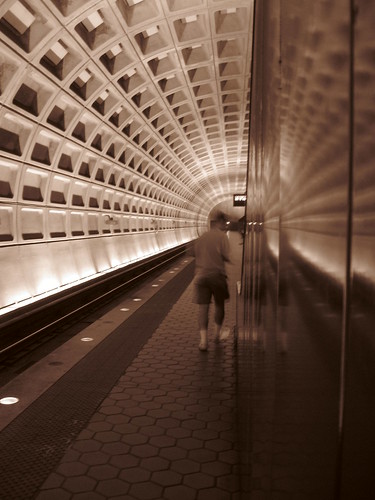
IMG_4236

IMG_4238

Metro 13

Metro 11

“No Safe Spaces II”
By Dennis Prager
[click to read]

Historically, colleges and universities were places dedicated to open dialogue and a free exchange of ideas. Sadly, intolerance and censorship toward conservatism is on the rise. On this special broadcast, Dr. Dobson talks with popular radio host Dennis Prager about his new documentary No Safe Spaces. Hear how free speech is under attack on campuses across the nation. (read more)

Dennis Prager is a nationally syndicated columnist, public speaker, and talk show host, broadcasting since 1982. He is the author of five books including Still the Best Hope, Why the Jews, and Happiness is a Serious Problem. He was a Fellow at Columbia University's School of International Affairs, where he did graduate work at the Middle East and Russian Institutes. He has taught Russian and Jewish history at Brooklyn College, and was appointed by President Ronald Reagan to the U.S. Delegation to the Vienna Review Conference on the Helsinki Accords. In 2011, Dennis co-founded Prager U, an institution of higher learning on the Internet.

In Search of the Perfect Burger
Sooner Barbeque in Stuarts Draft, Virginia

IMG_1291
Longhorn cattle in Stuarts Draft, Virginia.

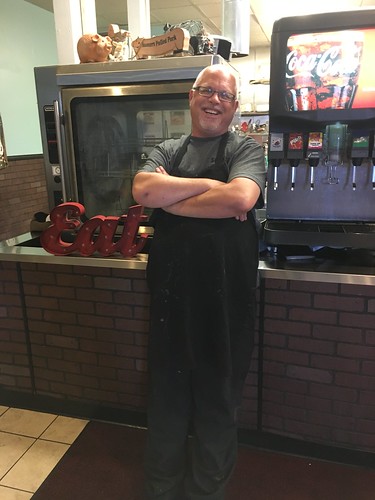
Number 17 was delicious. Brad Theodo, owner of Sooner Barbeque in Stuarts Draft, Virginia recently hosted a fundraiser for Risen Ridge Ministry, which offers horse related ministry to first responders (opening next year). Jen Beck, the visionary behind the ministry suggested I try the Draftburger. I was not disappointed! In fact, it was the kind of wonderful platter that food writers dream of! Grilled to perfection, and the beef is fresh!

How fresh? You ask. Well, the beef is local and Brad can even tell you the ‘name’ of your dinner. “Number 17” was indeed delicious – a longhorn from a farm right up the road. Of course the Barbeque is wonderful too. While I was sitting there, 40 pounds of pulled pork sailed out the door – headed for a catered event. Head down US 340 through Stuarts Draft and look for the cooker in front of the building. “You can’t miss it!”
IMG_1290
Brad Theodo.

Staunton's 'Unfinished' Mural
IMG_9169
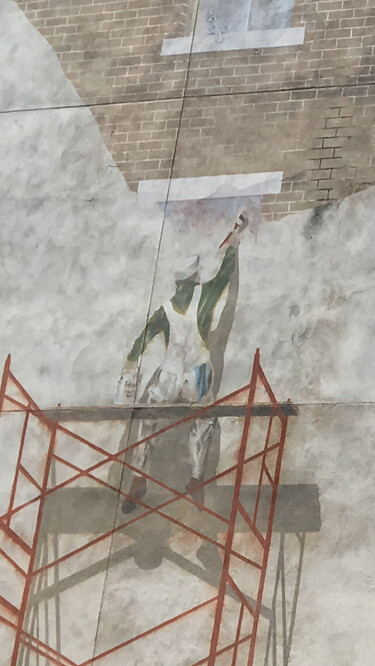
For 38 Years, the man on the scaffold has been painting the brick wall.

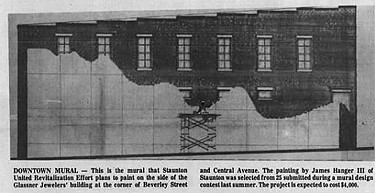
In the 1980s Staunton Revitalization Effort ran a competition to select a mural design for the wall of the Glassner Jeweler’s Building, which had been truncated to build access to the new parking garage. James Hanger III submitted the winning entry but the actual painting was done by Hugh Luck and Peter Freudenberg of Pine Street Studios. Here is where the story gets really interesting. Luck, at the time, worked for Peter Freudenberg. They later became business partners. In case you are unfamiliar with Freudenberg, he is the artist behind the ‘Peachoid’ in Gaffney, South Carolina. It is an enormous water tower that was created to look like a Brobdingnagian peach. Freudenberg carefully painted the water tower in realistic colors. Because of the unique cleft in the water tank, the sculpture sometimes receives a ‘bum rap,’ if you get my gist. Drivers on Interstate 85 enjoy it. Now you know that our city has a unique connection with it!
GlassnerMural
James Hanger III's original sketch for the mural. The budget for the project was estimated at $4000 ($11,644.63 in today's dollars)...

StauntonMural0001
...and here is the completed mural when it was new. 
Photo Courtesy of Hugh Luck.

Laney’s Palette Art Show
Saturday September 14th, 2019 in Crozet, VA

Works by Kristina Elaine Greer will be on display at the gallery space of Tabor Presbyterian Church, 5804 Tabor Street, Crozet, Virginia 22932. There will be an opening reception on Saturday, September 14th, 2019 from 1:00 to 4:00pm at the church. All are invited. The show will feature Laney’s Acrylic Paintings and Pencil Drawings from 2004 – 2019.


Banner

Monday, April 15, 2019

Notre Dame de Paris, A Mystery Appears, Easter

Easter
Volume XVI, Issue XV

Wishing You a Blessed Easter

IMG_8019
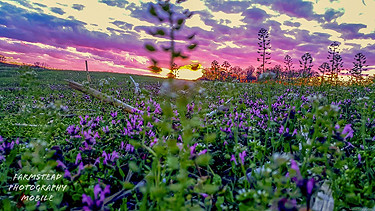
Photo by Stacey Phillips of Farmstead Photography. Used by permission.

Let the fields be jubilant, and everything in them; let all the trees of the forest sing for joy.” – Psalm 96:12

IMG_8004
Sunrise Through The Cherry Tree. Photo by Sandra Barlow Powell.

Palm Sunday, How to Cure Conflict
[click to read]

For unto us a child is born, unto us a son is given: and the government shall be upon his shoulder: and his name shall be called Wonderful, Counsellor, The mighty G-d, The everlasting Father, The Prince of Peace." -- Isaiah 9:6 (read more)

Restoration and Basketball
[click to read]

This was written after UVA's win at the time just after Charlottesville's difficult days when a young woman and a number of law enforcement officers were killed. Tony Bennett is deep, he is a true gentleman and he cares about the community he serves. (read more)

Notre Dame de Paris Rose Windows Safe!

IMG_8286

IMG_8285
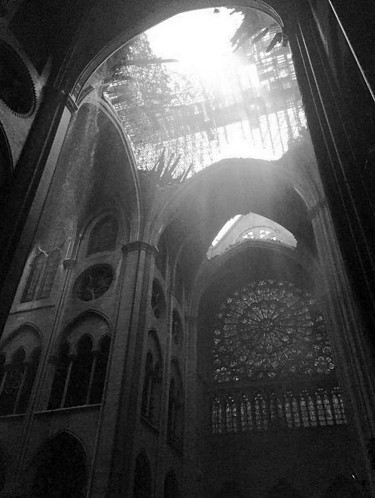
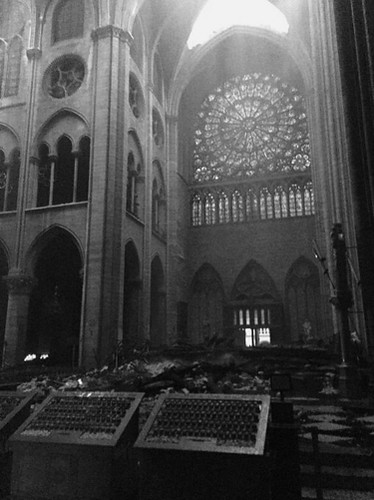
After the terrible fire that ripped through Notre Dame de Paris, today we learned that the priceless rose windows and the magnificent pipe organ have survived. These photos show the transept where the spire fell through the vault. There is much damage to repair as the roof was completely destroyed, but much remains. Photos by Christian Christensen

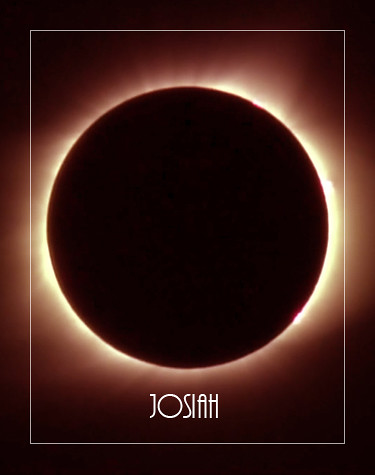
Josiah001

Josiah
By Bob Kirchman
Copyright © 2019, The Kirchman Studio, all rights reserved

Chapter 1: A Mystery Appears

You wanted to see me right away?” Abiyah Ben-Gurion said as he walked into the Zimmerman offices in Wales, Alaska. Elizabeth O’Malley’s assistant Hannah replied, “Yes, I did! I just received this communication from our office on Space Station/Assembly Center 005. It seems they’ve observed something you need to look at on Mars.”

She continued: “As you know, we’ve done periodic flyovers of the abandoned colony ruins… sort of a chance to observe decay in the Martian environment… and, Oh, I am so sorry. I recall how painful that was for you, but please indulge me. There is a mystery here we need you to weigh in on. Let me bring up the images.”

Hannah’s deskpad displayed two views of the colony ruins taken from orbit. The first was a photo Abiyah’s wife Sarah had taken several decades ago. The second was freshly processed from an unmanned probe that was orbiting Mars as they spoke.

See those surviving greenhouses in the shadow of that rock mass. That was all that remained of the APOLLONIUS Colony when you returned to Earth after it had been tragically destroyed by the missile. Look at the footprint carefully. Now look at the view from our probe as it flew over yesterday. See the difference?”

Abiyah’s keen eye caught it at once, “The footprint is different!” he exclaimed. “How can that be?”

We’re perplexed as well. It is BIGGER! We wondered if blast sand had covered some greenhouses and now has blown off, but Sarah’s images of the colony before destruction show no greenhouses there!”

Well, I’m stymied,” said Abiyah, “we scanned repeatedly for signs of life and you know how thorough Sarah is!”

The 3D printers we sent up then were pretty primitive by today’s standards. There was not the AI to self-duplicate anything. As I recall, the greenhouses involved a fair amount of human manipulation to construct. They could manufacture the struts and clear panels from local soils heated in the kiln, but that too required a lot of human oversight.”

So, obviously we have someone… or someTHING adding on to the remains of the colony!”

That’s it sir, we have a riddle on our hands.”

Well, Hannah, let’s use Occam's Razor to begin with. Someone has been adding greenhouses to our colony… or what’s left of it. Who would be the simplest to suspect. We have not tracked any ships from other nations going out to Mars. Space Aliens are always invoked in a case like this… but we’ve never actually seen one… EVER! I would have to say that someone survived the blast that destroyed the colony, incredible as that may sound. The reason we didn’t detect them was that they remained in an underground bunker… perhaps aware of the radiation danger outside. They had no communication ability as that was totally destroyed.”

He continued, “It would have had to have been one of the more technically inclined colonists, to be sure -- Someone who could keep the oxygenation going in the greenhouses and run the 3D printers. I daresay there is more than one survivor.”

So, what do we do next?” Hannah mused.

We need to make contact, if we can. Remember they launched the missile to destroy our ship in orbit. It fell back to Mars and exploded on the colony… we thought it exploded destroying everyone. We don’t know if they are so poisoned by the leadership of APOLLONIUS that they believe we are tainted and they are the enlightened ones.”

Hannah looked up at the painting of Rupert Zimmerman, the mind behind the enterprises that now required their oversight and wondered what Mr. Z would have said at this moment, but it had been some time since Rupert passed after taking pneumonia following the ceremonies to commence construction on the St. Lawrence Island Crossing. Rupert had always been somewhat of an enigma to those closest to him in life, and his painted eyes gazed down at Hannah giving nothing away.
(to be continued,)

Sherando Island
The Island in Sherando Lake. Photo by Bob kirchman.

Phantasie24
Volume XVI, Issue XVa

Phantasies
By George Macdonald, Chapter 24

We are ne'er like angels till our passions die."
~ Thomas Dekker.

This wretched Inn, where we scarce stay to baite,
We call our dwelling-place:
We call one step a race:
But angels in their full enlightened state,
Angels, who live, and know what 'tis to be,
Who all the nonsense of our language see,
Who speak things, and our words, their ill-drawn
Pictures, scorn,
When we, by a foolish figure, say,
Behold an old man Dead! then they
Speak properly, and cry,
Behold a man-child born!"
~ Abraham Cowley

I was dead, and right content. I lay in my coffin, with my hands folded in peace. The knight, and the lady I loved, wept over me.

Her tears fell on my face.

Ah!" said the knight, "I rushed amongst them like a madman. I hewed them down like brushwood. Their swords battered on me like hail, but hurt me not. I cut a lane through to my friend. He was dead. But he had throttled the monster, and I had to cut the handful out of its throat, before I could disengage and carry off his body. They dared not molest me as I brought him back."

He has died well," said the lady.

My spirit rejoiced. They left me to my repose. I felt as if a cool hand had been laid upon my heart, and had stilled it. My soul was like a summer evening, after a heavy fall of rain, when the drops are yet glistening on the trees in the last rays of the down-going sun, and the wind of the twilight has begun to blow. The hot fever of life had gone by, and I breathed the clear mountain-air of the land of Death. I had never dreamed of such blessedness. It was not that I had in any way ceased to be what I had been. The very fact that anything can die, implies the existence of something that cannot die; which must either take to itself another form, as when the seed that is sown dies, and arises again; or, in conscious existence, may, perhaps, continue to lead a purely spiritual life. If my passions were dead, the souls of the passions, those essential mysteries of the spirit which had imbodied themselves in the passions, and had given to them all their glory and wonderment, yet lived, yet glowed, with a pure, undying fire. They rose above their vanishing earthly garments, and disclosed themselves angels of light. But oh, how beautiful beyond the old form! I lay thus for a time, and lived as it were an unradiating existence; my soul a motionless lake, that received all things and gave nothing back; satisfied in still contemplation, and spiritual consciousness.

Ere long, they bore me to my grave. Never tired child lay down in his white bed, and heard the sound of his playthings being laid aside for the night, with a more luxurious satisfaction of repose than I knew, when I felt the coffin settle on the firm earth, and heard the sound of the falling mould upon its lid. It has not the same hollow rattle within the coffin, that it sends up to the edge of the grave. They buried me in no graveyard. They loved me too much for that, I thank them; but they laid me in the grounds of their own castle, amid many trees; where, as it was spring-time, were growing primroses, and blue-bells, and all the families of the woods

Now that I lay in her bosom, the whole earth, and each of her many births, was as a body to me, at my will. I seemed to feel the great heart of the mother beating into mine, and feeding me with her own life, her own essential being and nature. I heard the footsteps of my friends above, and they sent a thrill through my heart. I knew that the helpers had gone, and that the knight and the lady remained, and spoke low, gentle, tearful words of him who lay beneath the yet wounded sod. I rose into a single large primrose that grew by the edge of the grave, and from the window of its humble, trusting face, looked full in the countenance of the lady. I felt that I could manifest myself in the primrose; that it said a part of what I wanted to say; just as in the old time, I had used to betake myself to a song for the same end. The flower caught her eye. She stooped and plucked it, saying, "Oh, you beautiful creature!" and, lightly kissing it, put it in her bosom. It was the first kiss she had ever given me. But the flower soon began to wither, and I forsook it.

It was evening. The sun was below the horizon; but his rosy beams yet illuminated a feathery cloud, that floated high above the world. I arose, I reached the cloud; and, throwing myself upon it, floated with it in sight of the sinking sun. He sank, and the cloud grew gray; but the grayness touched not my heart. It carried its rose-hue within; for now I could love without needing to be loved again. The moon came gliding up with all the past in her wan face. She changed my couch into a ghostly pallor, and threw all the earth below as to the bottom of a pale sea of dreams. But she could not make me sad. I knew now, that it is by loving, and not by being loved, that one can come nearest the soul of another; yea, that, where two love, it is the loving of each other, and not the being loved by each other, that originates and perfects and assures their blessedness. I knew that love gives to him that loveth, power over any soul beloved, even if that soul know him not, bringing him inwardly close to that spirit; a power that cannot be but for good; for in proportion as selfishness intrudes, the love ceases, and the power which springs therefrom dies. Yet all love will, one day, meet with its return. All true love will, one day, behold its own image in the eyes of the beloved, and be humbly glad. This is possible in the realms of lofty Death. "Ah! my friends," thought I, "how I will tend you, and wait upon you, and haunt you with my love."

My floating chariot bore me over a great city. Its faint dull sound steamed up into the air--a sound--how composed?" How many hopeless cries," thought I, "and how many mad shouts go to make up the tumult, here so faint where I float in eternal peace, knowing that they will one day be stilled in the surrounding calm, and that despair dies into infinite hope, and the seeming impossible there, is the law here!

But, O pale-faced women, and gloomy-browed men, and forgotten children, how I will wait on you, and minister to you, and, putting my arms about you in the dark, think hope into your hearts, when you fancy no one is near! Soon as my senses have all come back, and have grown accustomed to this new blessed life, I will be among you with the love that healeth."

With this, a pang and a terrible shudder went through me; a writhing as of death convulsed me; and I became once again conscious of a more limited, even a bodily and earthly life.
(to be continued)

IMG_0119-EFFECTS
Tulip Symmetry. Photo by Bob Kirchman.

WMTA
Elevator to Surface, Smithsonian Station in the Washington Metro.

Take Metro In a Wheelchair, Just Once
[click to read]

Do Metro executives know what the Metro is like for a person who uses a wheelchair? (read more)

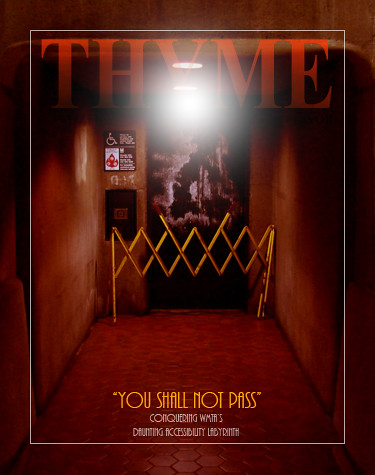
A New Proposal for 'Elysian Lilies'
By Bob Kirchman

metro_web
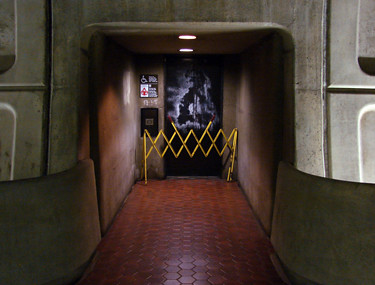
In Metro's Smithsonian Station, the Elevator is tucked into a dark alcove that is poorly marked. If you forget to check the status updates for elevators, you might encounter this scene... the elevator is out of service.

In the older Metro Stations in Washington D. C., the elevators might seem like an afterthought. In Smithsonian Station, the elevator sits in a dark alcove and is easily missed. Harry Weese designed the stations as a crypt, of sorts, to the Federal City. He wanted you to know you were underground.

Newer Metro stations have two elevators side by side and they are large enough for two people in wheelchairs to ride together. Smithsonian Station's elevator is relatively small. Adding to the claustrophobia is the dark alcove. While the vaulted stations and open escalators are elegant in their muted illumination, a case might be made for the elevator alcove needing to visually signal connection to the world above.

To that end, a variation of the 'Elysian Lilies' mural is designed below, along with a brighter ceiling light and a brighter elevator door.

ElysianLily2_web
'Elysian Lilies' Mural Design for a Lift Alcove. Bob Kirchman

Panda Popularity Personified
Kids and Pandas are Inseparable at DC Zoo

Panda at the Subway Entrance
A panda sculpture at the National Zoo Metro station attracts attention. Photo by Bob Kirchman 

The Challenge of Leadership

theprayer
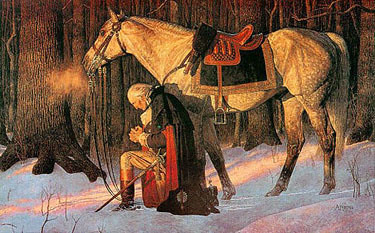
"The Prayer at Valley Forge" by Arnold Friberg is one of the best known paintings of the American Revolution. It depicts George Washington at Valley Forge.

No doubt, George Washington knew the challenge of leadership well. He began his career without a full college degree, but at the age of sixteen he obtained his surveyer's certificate from The College of William and Mary. At an age when most modern young men are playing video games, he was out discovering and marking an actual country! He did do something akin to the actions of modern young men when he discreetly carved his initials into Rock Bridge County's natural wonder, Natural Bridge!

Washington is noted for his military career, but historian James Hodges, Ph.D.gives us some unique insight into the man's character:

At the Battle of Brandywine in September 1777, a particularly brutal battle with much carnage on both sides, a fox terrier got lost between the lines. The little dog was captured by the Americans, who saw inscribed in his collar: “Property of General Howe.” Washington made sure the little dog was fed, cleaned and treated well. Under a flag of truce, Alexander Hamilton delivered the dog to General Howe, who had suffered great mental anguish thinking his little terrier had been lost to him forever.

Washington had been passionately fond of horses from early boyhood, and owned his first horse at 17. His mother, Mary Ball Washington, was a skilled horsewoman who taught young George how to train horses using only the gentlest of methods, and to never resort to any cruelty. Washington learned that harsh training methods were counter-productive, because horses treated with respect are eager to please their riders." [1.]

At the second battle of Trenton, on January 2, 1777, it was clearly evident that Washington's great charger Nelson returned the affection of his rider. Though cannon shells were bursting around them, man and horse stood firm. To those men Washington led into battle, they stood together as a symbol of strength. A soldier writes: “As I crossed the bridge crowded with fellow soldiers, I brushed up against the boot of the man and flank of the horse. Both seemed to exude courage.”

After the great war was over, Washington indeed became President of the nation he had helped to create. His leadership skills would be tested in the days of the Newburgh Conspiracy, where he would avert a military coup. The young nation's coffers were empty. The Continental Army had not been fully paid, and an uprising was brewing. There was talk of taking up arms against the Congress. Washington went to his officers and appealed to them in an emotional address on March 15, 1783.

Cool heads prevailed and Congress voted on a plan to pay the men. Interestingly, Washington distrusted the notion of political parties. He never aligned with one himself, though those around him were crafting the foundation for the two party system we have today. Perhaps the man's own sayings tell us volumes about his life and its motivations: [2.]

It is impossible to rightly govern the world without G-d and Bible."

The propitious smiles of Heaven can never be expected on a nation that disregards the eternal rules of order and right which Heaven itself has ordained”

Make sure you are doing what G-d wants you to do---then do it with all your strength."

What students would learn in American schools above all is the religion of Jesus Christ.” "It is the duty of all Nations to acknowledge the providence of Almighty G-d, to obey his will, to be grateful for his benefits, and humbly to implore his protection and favors."

My mother was the most beautiful woman I ever saw. All I am I owe to my mother. I attribute my success in life to the moral, intellectual and physical education I received from her."

The General hopes and trusts that every officer and man will endeavor to live and act as becomes a Christian soldier defending the dearest rights and liberties of his country."

If to please the people, we offer what we ourselves disapprove, how can we afterwards defend our work? Let us raise a standard to which the wise and honest can repair. The rest is in the hands of G-d."

No people can be bound to acknowledge the Invisible Hand which conducts the affairs of men more than the people of the United States. Every step by which they have advanced to the character of an independent nation seems to have been distinguished by some token of providential agency"

I am sure that never was a people, who had more reason to acknowledge a Divine interposition in their affairs, than those of the United States; and I should be pained to believe that they have forgotten that agency, which was so often manifested during our Revolution, or that they failed to consider the omnipotence of that G-d who is alone able to protect them.”

Happiness and moral duty are inseparably connected.”

I earnestly pray that the Omnipotent Being who has not deserted the cause of America in the hour of its extremist hazard, will never yield so fair a heritage of freedom a prey to "Anarchy" or "Despotism"."

Blossoms
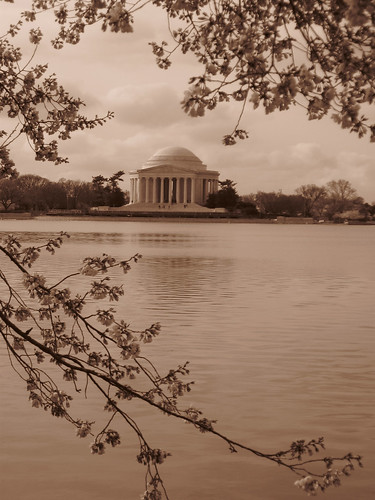
Cherry Blossoms frame the Jefferson Memorial on the Washington, D. C. Tidal Basin. Photo by Bob Kirchman

Caesar Rodney's Midnight Ride

Now one was neither Tory nor Whig; it was either dependence or independence.” Caesar Rodney, after Lexington and Concord.

We all know the famous story of Paul Revere's midnight ride. Virginians celebrate the memory of Jack Jouett, who rode to Monticello to warn Thomas Jefferson of approaching British troops.Jefferson and the Virginia Legislature were able to escape across the Blue Ridge Mountains to Staunton. Still, the most memorable midnight ride that saved the young republic has to be that of Caesar Rodney. Without Rodney's ride, there would not have been a republic at all.

Caesar Rodney was born in 1728 on his family's 800 acre farm, Byfield, on St. Jones Neck in East Dover Hundred, Kent County, Delaware. The family could trace its ancestry to the Adelmare family of Treviso, Italy. Caesar Rodney's farm was a large one, worked by slaves, and it provided wheat and barley to markets in Philadelphia. His brother Thomas described him as possessing a: "great fund of wit and humor of the pleasing kind, so that his conversation was always bright and strong and conducted by wisdom... He always lived a bachelor, was generally esteemed, and indeed very popular." Indeed, his talents found him taking his place in public service. He served as sheriff and in a number of other positions. He joined Thomas McKean as a delegate to the Stamp Act Congress in 1765 and was the Brigadier General of the Delaware Militia. He went on to serve in the Continental Congress.

Here is where he made his most courageous contribution to the cause of American independence. In 1776 the vote to adopt the Declaration saw the Delaware delegation deadlocked. This was a problem as the delegates to the convention had decided that an all or nothing approach was essential. Of Delaware's two present delegates Mckean favored independence. The other delegate, George Read, did not. Rodney, who was also qualified to vote, was at home performing his duties as General of the militia when the initial voting took place. Mckean had sent word to Rodney that his vote would be needed in Philadelphia... but the message never got to him. Rodney was a bachelor and his love interest at the time was being used by the Tories to divert his participation! She was intercepting the messages! By the time McKean's message finally got to Rodney, the first deadlocked vote had already taken place and it was well into the evening. Rodney mounted his horse and rode through a great thunderstorm along the muddy road to Philadelphia. Lightning illuminated the wet road as he sloshed along as rapidly as conditions would allow. For seventy miles he rode.

Rodney was not a well man. He suffered from a rare form of cancer that disfigured his face and sapped his strength. No doubt he knew the ride could kill him, but he pressed on. He was committed to an act of treason that might lead to his death if he did survive. But he pressed on through the darkness. He reached Philadelphia by mid-morning. Spattered with mud, he stepped into the chamber just in time to cast his historic vote. Now the votes by all colonies who actually voted was unanimous! The framers rightly considered this essential to the success of the Declaration. Without Caesar Rodney's heroic ride, there would have not been a July 4th for us to celebrate! Rodney served in the war effort, even fighting alongside George Washington, who said of him: “The readiness with which you took to the field at the period most critical to our affairs, the industry you used in bringing out the militia of the Delaware State and the alertness observed by you in forwarding on the troops from Trenton, reflect the highest honor on your character and place your attachment to the cause in a most distinguished point of view.” As a young republic took its place in the world, Rodney continued to serve but his health was now rapidly declining. He died in 1784. [2.]

His legacy lives on today though. My friend Brandy Leigh Messick and her four sons are proud descendents of this great patriot and continue his mission to promote the values of this great nation to this day! Special thanks to her for providing additional background for this article.

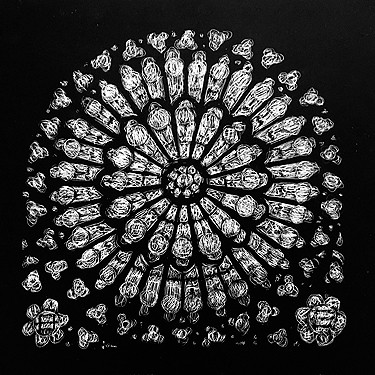
North Rose Window, Notre Dame de Paris
PSALM 48, Bringing the Beauty of Zion
to the World

NortRose
North Rose Window, Notre Dame de Paris. 
— Scratchboard, 12" x 12" by Bob Kirchman

ZION
“Bringing the Beauty of Zion to the World”
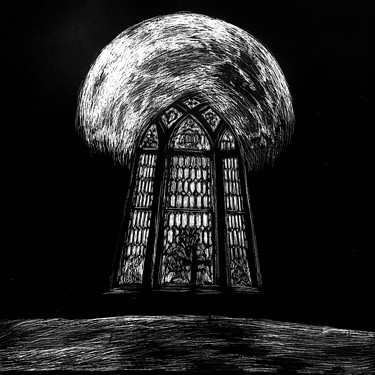
— Scratchboard 12” x 12” by Bob Kirchman. A gift to Kristina and Jonathan Greer.

Walk about Zion, and go around her: tell the towers thereof. Mark ye well her bulwarks, consider her palaces; that ye May tell it to the generation following” — PSALM 48:12,13

THYMEResurrectionIII
Volume XVI, Issue XVb

The Meaning of the Miraculous

For many Centuries man has acknowledged  the miraculous. In the weeks to come the Jewish community celebrates their deliverance from Egypt and the beginning of their journey to the Promised Land. [1.] A dialogue set in a meals has all generations together consider the preservation of their people that could only be seen as a work of G-d. Previous generations always saw G-d, or some miraculous force as Creator. The Patriarchs saw Him as Provider and Deliverer! The relatively recent concept of Evolution (Charles Darwin in the Nineteenth Century) has created a philosophy of Naturalism that either outright rejects or quietly diminishes the Theistic explanation.

I once attended an Easter service at a large church in Richmond. The minister asserted that the Resurrection was not important! I don't remember anything else he said. I was astonished because Christ's Resurrection would seem to be a cornerstone of Christianity. Many voices today denounce Faith. They may not directly denounce it, but in the academy it is the subject of "open discourse" such as that experienced by Ryan Rotella at FAU [click to read]. Rotella was asked to leave a class. His "offense" was refusing to participate in an excercise where students were required to "stamp on Jesus." Dennis Prager [click to read] has more details. Though the school ultimately apologized to Rotella, it justified its so-called "open discourse" in doing so.

Running from the Resurrection

In fact, among many in academia today you are likely to hear some variation of the following: "There are other reasons why I consider Christianity to be an ill-chosen creed, such as the morals actually taught in the Bible, many of which are abhorrent to a compassionate and just man, or other details of its theology which run counter to observable facts." writes atheist Richard Carrier in introduction to his argument against Jesus' resurrection from the dead.

Here in his introduction, Carrier gives what I believe is his real reason for being uncomfortable with a physical resurrection. A G-d who can so control the laws of nature can ask 'unreasonable' things of us as well. A 'Compassionate and Just Man,' in Carrier's world can support abortion on demand because it is not 'abhorrent' to his viewpoint that abortion is a kind response to the needs of women with unplanned pregnancies. The beating heart of the unborn child need not be seen here as an 'observable fact.' Likewise, the 'restrictive' definition of marriage as a relationship defined by Scripture in specific terms may be viewed as archaic and discriminatory.If G-d didn't design it, He cannot write the specifications.

The elimination of Christianity as an authoritative source allows us to personalize moral decisions. In a culture that elevates self-actualization, this is virtue. It spares us the heavy lifting required to weigh moral absolutes with human frailty.

Jesus, meeting a Samaritan woman at a well, is a prime example of what I mean by this heavy lifting. Balancing compassion for the woman with his observation that she has not been a faithful wife, Jesus creates a constructive dialogue. He does not condemn her, nor does He overlook the complexity she has created in her relationships. He speaks truth and ultimately the dialogue that results sets her free. Here Absolute Love and Absolute Truth are in no way mutually exclusive. In the end her search for 'Living Water' trumps her desire to live as she pleases. [2.]

A G-d who can part the Red Sea, Create worlds and has power over death is pretty much to be respected. A G-d who changes human lives in intimate communion with his Creation is amazing.

Before Jesus appeared, the concept of Resurrection is found in Scripture. Sometimes it is very clear and other times it is a logical assumption consistent with the text.

Resurrection Foretold

And he made his grave with the wicked, and with the rich in his death; because he had done no violence, neither was any deceit in his mouth. Yet it pleased the Lord to bruise him; he hath put him to grief: when thou shalt make his soul an offering for sin, he shall see his seed, he shall prolong his days, and the pleasure of the Lord shall prosper in his hand. He shall see of the travail of his soul, and shall be satisfied: by his knowledge shall my righteous servant justify many; for he shall bear their iniquities. Therefore will I divide him a portion with the great, and he shall divide the spoil with the strong; because he hath poured out his soul unto death: and he was numbered with the transgressors; and he bare the sin of many, and made intercession for the transgressors." -- Isaiah 53:9-12

The famous Messianic text above talks of triumph after death. Other texts that may be seen as prophetic of Resurrection are: Genesis 3:15, Psalm 2:7, Psalm 16:9-11, Psalm 22:14-25, Psalm 30:29, Psalm 40:13, Psalm 110:1, Psalm 118:21-24, Hosea 5:15-6:3, Zechariah 12:10.

Resurrection Documented and Verified

I know of no one fact in the history of mankind which is proved by better, fuller evidence of every sort, to the understanding of a fair inquirer, than the great sign which God hath given us that Christ died, and rose again from the dead." says Dr. Thomas Arnold, formerly Professor of History at Rugby and Oxford Universities. Simon Greenleaf, one of the most skilled legal minds ever produced in this nation, top authority on the question of what constitutes sound evidence, developer of the Harvard Law School, after a thorough evaluation of the four Gospel accounts from the point of view of their validity as objective testimonial evidence, concluded:

It was therefore impossible that they could have persisted in affirming the truths they had narrated, had not Jesus actually risen from the dead, and had they not known this fact as certainly as they knew any other fact." [3.] Dr. Henry M. Morris PhD writes more on The Importance of the Resurrection [click to read]. His point is that the foundational truth of the Christian faith has plenty of evidence to support it.

A G-d who can part the Red Sea, Create worlds and has power over death is pretty much to be respected. A G-d who changes human lives in intimate communion with his Creation is amazing.

Butterfly_icon
A Caterpillar becomes a butterfly. Nature itself suggests the possibility of miraculous transformation and new life! Rice Paper Butterfly, or Paper Kite Butterfly, Idea leuconoe.
Illustration © 2016, by Kristina Elaine Greer for HOPE Publications, Pvt. ltd.

PontifusBANNER