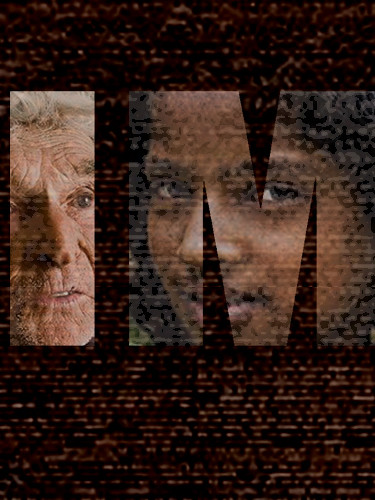
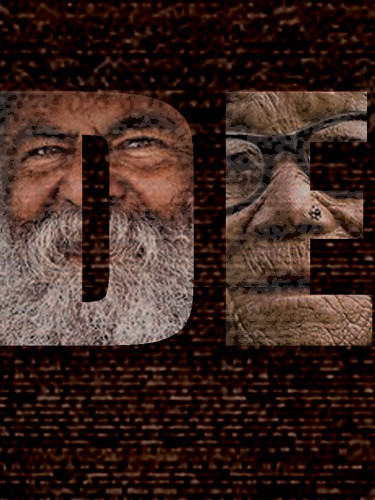
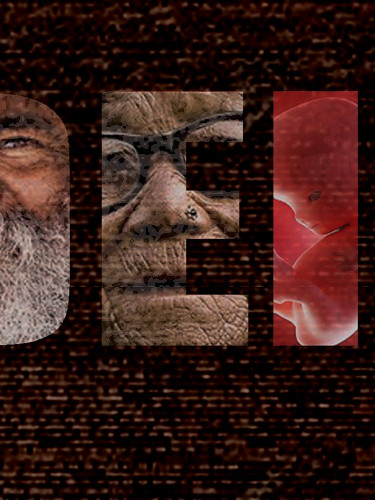
Understanding IMAGO DEI Change the conversation with #EachLifeMatters
I am a black man who is troubled by #BlackLivesMatter. A human being is a microcosm of humanity, yet as Father Zossima remarks in The Brothers Karamazov, “It is easy to love mankind, but much more difficult to love a single human being.” In the wake of the upsetting and seemingly racially-motivated string of incidents that has occurred across the United States, the widespread chant of #BlackLivesMatter has transformed into a movement. In contrast, the countercry of #AllLivesMatter has incurred the wrath of progressive voices for ostensibly invalidating the unique struggle of the contemporary African-American experience. While #AllLivesMatter insensitively suggests the colorblindness of such acts of violence clearly perpetrated against black bodies, #BlackLivesMatter co-opts such tragedies in order to renew the language of black victimization in America. What each side has lost is both a clear understanding of the nuance of contemporary racism in America, as well as any vision for the future.
Martin Luther King famously dreamt that his “four little children” would “one day live in a nation where they [would] not be judged by the color of their skin, but by the content of their character.” While we are indeed far from a post-racial society, its creation used to be an ideal rather than a taboo. Insisting that racism does not exist is flippant; however, the banner of black victimhood waved by more progressive voices does little more than perpetuate an anachronistic understanding of the contemporary American situation and delegitimize the laudable goal of a colorblind society of individuals. #BlackLivesMatter draws attention to a relevant problem, but it is offensive because it further divides without even seeking reunification. I offer the cry of “each life matters,” one that is both respectful of diversity and individuality while acknowledging our in-separateness from one another. The Buddha said, “In separateness lies the world’s great misery, in compassion lies the world’s true strength.” “Each life matters” is a compassionate call for justice that acknowledges we are not separate from one another, but we are indeed unique. Our political realities may temporarily be inequitable, but our existential reality is identical.
The Lord is not slack concerning his promise, as some men count slackness; but is longsuffering to us-ward, not willing that any should perish, but that all should come to repentance.” – 2 PETER 3:9
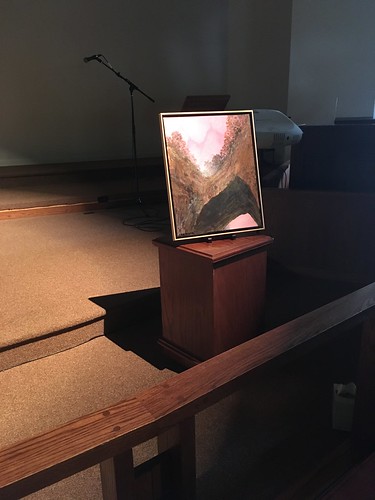
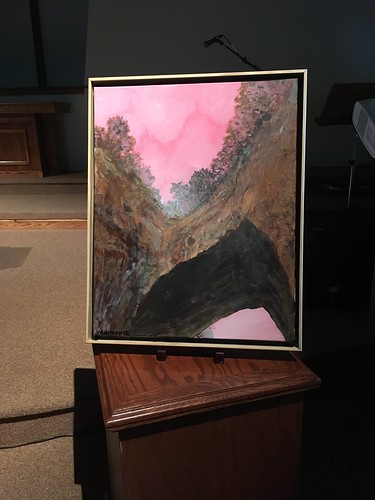
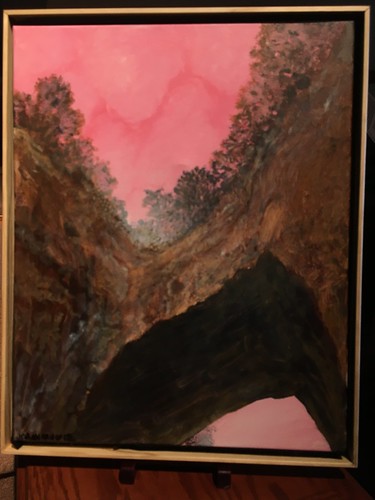
Details of the painting.
Artist’s Statement
I have attempted to create a work based on the thoughts of Andres Wilson that brings a Kingdom of God perspective to the current discussion. In Genesis 1:26-27 it is stated that we are each created in the image of our Creator, thus every single life is a reflection of the Divine Nature. Each life is precious.
For unto us a child is born, unto us a son is given: and the government shall be upon his shoulder: and his name shall be called Wonderful, Counsellor, The mighty G-d, The everlasting Father, The Prince of Peace." -- Isaiah 9:6 (read more)
This was written after UVA's win at the time just after Charlottesville's difficult days when a young woman and a number of law enforcement officers were killed. Tony Bennett is deep, he is a true gentleman and he cares about the community he serves. (read more)
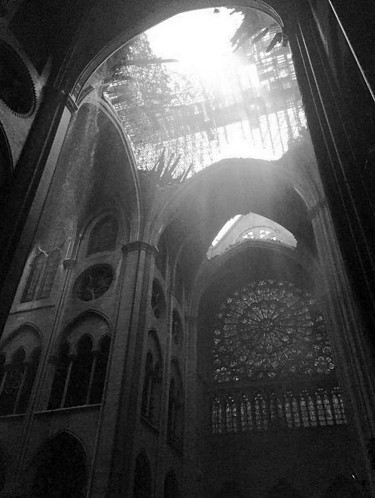
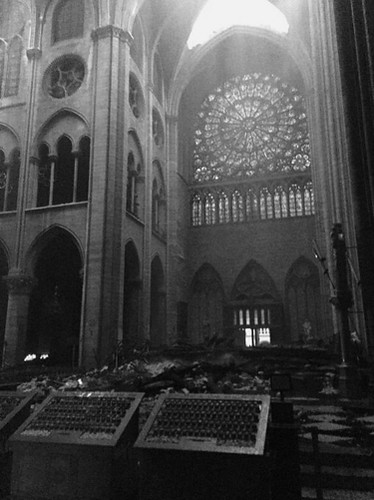
Notre Dame de Paris Rose Windows Safe!
After the terrible fire that ripped through Notre Dame de Paris, today we learned that the priceless rose windows and the magnificent pipe organ have survived. These photos show the transept where the spire fell through the vault. There is much damage to repair as the roof was completely destroyed, but much remains. Photos by Christian Christensen
You wanted to see me right away?” Abiyah Ben-Gurion said as he walked into the Zimmerman offices in Wales, Alaska. Elizabeth O’Malley’s assistant Hannah replied, “Yes, I did! I just received this communication from our office on Space Station/Assembly Center 005. It seems they’ve observed something you need to look at on Mars.”
She continued: “As you know, we’ve done periodic flyovers of the abandoned colony ruins… sort of a chance to observe decay in the Martian environment… and, Oh, I am so sorry. I recall how painful that was for you, but please indulge me. There is a mystery here we need you to weigh in on. Let me bring up the images.”
Hannah’s deskpad displayed two views of the colony ruins taken from orbit. The first was a photo Abiyah’s wife Sarah had taken several decades ago. The second was freshly processed from an unmanned probe that was orbiting Mars as they spoke.
See those surviving greenhouses in the shadow of that rock mass. That was all that remained of the APOLLONIUS Colony when you returned to Earth after it had been tragically destroyed by the missile. Look at the footprint carefully. Now look at the view from our probe as it flew over yesterday. See the difference?”
Abiyah’s keen eye caught it at once, “The footprint is different!” he exclaimed. “How can that be?”
We’re perplexed as well. It is BIGGER! We wondered if blast sand had covered some greenhouses and now has blown off, but Sarah’s images of the colony before destruction show no greenhouses there!”
Well, I’m stymied,” said Abiyah, “we scanned repeatedly for signs of life and you know how thorough Sarah is!”
The 3D printers we sent up then were pretty primitive by today’s standards. There was not the AI to self-duplicate anything. As I recall, the greenhouses involved a fair amount of human manipulation to construct. They could manufacture the struts and clear panels from local soils heated in the kiln, but that too required a lot of human oversight.”
So, obviously we have someone… or someTHING adding on to the remains of the colony!”
That’s it sir, we have a riddle on our hands.”
Well, Hannah, let’s use Occam's Razor to begin with. Someone has been adding greenhouses to our colony… or what’s left of it. Who would be the simplest to suspect. We have not tracked any ships from other nations going out to Mars. Space Aliens are always invoked in a case like this… but we’ve never actually seen one… EVER! I would have to say that someone survived the blast that destroyed the colony, incredible as that may sound. The reason we didn’t detect them was that they remained in an underground bunker… perhaps aware of the radiation danger outside. They had no communication ability as that was totally destroyed.”
He continued, “It would have had to have been one of the more technically inclined colonists, to be sure -- Someone who could keep the oxygenation going in the greenhouses and run the 3D printers. I daresay there is more than one survivor.”
So, what do we do next?” Hannah mused.
We need to make contact, if we can. Remember they launched the missile to destroy our ship in orbit. It fell back to Mars and exploded on the colony… we thought it exploded destroying everyone. We don’t know if they are so poisoned by the leadership of APOLLONIUS that they believe we are tainted and they are the enlightened ones.”
Hannah looked up at the painting of Rupert Zimmerman, the mind behind the enterprises that now required their oversight and wondered what Mr. Z would have said at this moment, but it had been some time since Rupert passed after taking pneumonia following the ceremonies to commence construction on the St. Lawrence Island Crossing. Rupert had always been somewhat of an enigma to those closest to him in life, and his painted eyes gazed down at Hannah giving nothing away. (to be continued,)
The Island in Sherando Lake. Photo by Bob kirchman.
Volume XVI, Issue XVa
Phantasies ByGeorge Macdonald, Chapter 24
We are ne'er like angels till our passions die."
~ Thomas Dekker.
This wretched Inn, where we scarce stay to baite, We call our dwelling-place: We call one step a race: But angels in their full enlightened state, Angels, who live, and know what 'tis to be, Who all the nonsense of our language see, Who speak things, and our words, their ill-drawn Pictures, scorn, When we, by a foolish figure, say, Behold an old man Dead! then they Speak properly, and cry, Behold a man-child born!"
~ Abraham Cowley
I was dead, and right content. I lay in my coffin, with my hands folded in peace. The knight, and the lady I loved, wept over me.
Her tears fell on my face.
Ah!" said the knight, "I rushed amongst them like a madman. I hewed them down like brushwood. Their swords battered on me like hail, but hurt me not. I cut a lane through to my friend. He was dead. But he had throttled the monster, and I had to cut the handful out of its throat, before I could disengage and carry off his body. They dared not molest me as I brought him back."
He has died well," said the lady.
My spirit rejoiced. They left me to my repose. I felt as if a cool hand had been laid upon my heart, and had stilled it. My soul was like a summer evening, after a heavy fall of rain, when the drops are yet glistening on the trees in the last rays of the down-going sun, and the wind of the twilight has begun to blow. The hot fever of life had gone by, and I breathed the clear mountain-air of the land of Death. I had never dreamed of such blessedness. It was not that I had in any way ceased to be what I had been. The very fact that anything can die, implies the existence of something that cannot die; which must either take to itself another form, as when the seed that is sown dies, and arises again; or, in conscious existence, may, perhaps, continue to lead a purely spiritual life. If my passions were dead, the souls of the passions, those essential mysteries of the spirit which had imbodied themselves in the passions, and had given to them all their glory and wonderment, yet lived, yet glowed, with a pure, undying fire. They rose above their vanishing earthly garments, and disclosed themselves angels of light. But oh, how beautiful beyond the old form! I lay thus for a time, and lived as it were an unradiating existence; my soul a motionless lake, that received all things and gave nothing back; satisfied in still contemplation, and spiritual consciousness.
Ere long, they bore me to my grave. Never tired child lay down in his white bed, and heard the sound of his playthings being laid aside for the night, with a more luxurious satisfaction of repose than I knew, when I felt the coffin settle on the firm earth, and heard the sound of the falling mould upon its lid. It has not the same hollow rattle within the coffin, that it sends up to the edge of the grave. They buried me in no graveyard. They loved me too much for that, I thank them; but they laid me in the grounds of their own castle, amid many trees; where, as it was spring-time, were growing primroses, and blue-bells, and all the families of the woods
Now that I lay in her bosom, the whole earth, and each of her many births, was as a body to me, at my will. I seemed to feel the great heart of the mother beating into mine, and feeding me with her own life, her own essential being and nature. I heard the footsteps of my friends above, and they sent a thrill through my heart. I knew that the helpers had gone, and that the knight and the lady remained, and spoke low, gentle, tearful words of him who lay beneath the yet wounded sod. I rose into a single large primrose that grew by the edge of the grave, and from the window of its humble, trusting face, looked full in the countenance of the lady. I felt that I could manifest myself in the primrose; that it said a part of what I wanted to say; just as in the old time, I had used to betake myself to a song for the same end. The flower caught her eye. She stooped and plucked it, saying, "Oh, you beautiful creature!" and, lightly kissing it, put it in her bosom. It was the first kiss she had ever given me. But the flower soon began to wither, and I forsook it.
It was evening. The sun was below the horizon; but his rosy beams yet illuminated a feathery cloud, that floated high above the world. I arose, I reached the cloud; and, throwing myself upon it, floated with it in sight of the sinking sun. He sank, and the cloud grew gray; but the grayness touched not my heart. It carried its rose-hue within; for now I could love without needing to be loved again. The moon came gliding up with all the past in her wan face. She changed my couch into a ghostly pallor, and threw all the earth below as to the bottom of a pale sea of dreams. But she could not make me sad. I knew now, that it is by loving, and not by being loved, that one can come nearest the soul of another; yea, that, where two love, it is the loving of each other, and not the being loved by each other, that originates and perfects and assures their blessedness. I knew that love gives to him that loveth, power over any soul beloved, even if that soul know him not, bringing him inwardly close to that spirit; a power that cannot be but for good; for in proportion as selfishness intrudes, the love ceases, and the power which springs therefrom dies. Yet all love will, one day, meet with its return. All true love will, one day, behold its own image in the eyes of the beloved, and be humbly glad. This is possible in the realms of lofty Death. "Ah! my friends," thought I, "how I will tend you, and wait upon you, and haunt you with my love."
My floating chariot bore me over a great city. Its faint dull sound steamed up into the air--a sound--how composed?" How many hopeless cries," thought I, "and how many mad shouts go to make up the tumult, here so faint where I float in eternal peace, knowing that they will one day be stilled in the surrounding calm, and that despair dies into infinite hope, and the seeming impossible there, is the law here!
But, O pale-faced women, and gloomy-browed men, and forgotten children, how I will wait on you, and minister to you, and, putting my arms about you in the dark, think hope into your hearts, when you fancy no one is near! Soon as my senses have all come back, and have grown accustomed to this new blessed life, I will be among you with the love that healeth."
With this, a pang and a terrible shudder went through me; a writhing as of death convulsed me; and I became once again conscious of a more limited, even a bodily and earthly life. (to be continued)
Tulip Symmetry. Photo by Bob Kirchman.
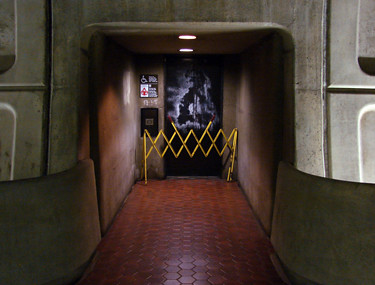
Elevator to Surface, Smithsonian Station in the Washington Metro.
Do Metro executives know what the Metro is like for a person who uses a wheelchair? (read more)
A New Proposal for 'Elysian Lilies' ByBob Kirchman
In Metro's Smithsonian Station, the Elevator is tucked into a dark alcove that is poorly marked. If you forget to check the status updates for elevators, you might encounter this scene... the elevator is out of service.
In the older Metro Stations in Washington D. C., the elevators might seem like an afterthought. In Smithsonian Station, the elevator sits in a dark alcove and is easily missed. Harry Weese designed the stations as a crypt, of sorts, to the Federal City. He wanted you to know you were underground.
Newer Metro stations have two elevators side by side and they are large enough for two people in wheelchairs to ride together. Smithsonian Station's elevator is relatively small. Adding to the claustrophobia is the dark alcove. While the vaulted stations and open escalators are elegant in their muted illumination, a case might be made for the elevator alcove needing to visually signal connection to the world above.
To that end, a variation of the 'Elysian Lilies' mural is designed below, along with a brighter ceiling light and a brighter elevator door.
'Elysian Lilies' Mural Design for a Lift Alcove. Bob Kirchman
Panda Popularity Personified
Kids and Pandas are Inseparable at DC Zoo
A panda sculpture at the National Zoo Metro station attracts attention. Photo by Bob Kirchman
The Challenge of Leadership
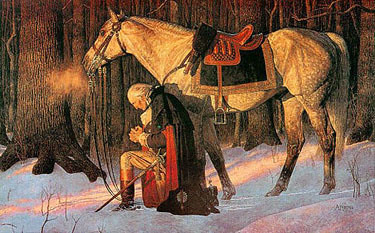
"The Prayer at Valley Forge" byArnold Fribergis one of the best known paintings of the American Revolution. It depicts George Washington at Valley Forge.
No doubt, George Washington knew the challenge of leadership well. He began his career without a full college degree, but at the age of sixteen he obtained his surveyer's certificate from The College of William and Mary. At an age when most modern young men are playing video games, he was out discovering and marking an actual country! He did do something akin to the actions of modern young men when he discreetly carved his initials into Rock Bridge County's natural wonder, Natural Bridge!
Washington is noted for his military career, but historian James Hodges, Ph.D.gives us some unique insight into the man's character:
At the Battle of Brandywine in September 1777, a particularly brutal battle with much carnage on both sides, a fox terrier got lost between the lines. The little dog was captured by the Americans, who saw inscribed in his collar: “Property of General Howe.” Washington made sure the little dog was fed, cleaned and treated well. Under a flag of truce, Alexander Hamilton delivered the dog to General Howe, who had suffered great mental anguish thinking his little terrier had been lost to him forever.
Washington had been passionately fond of horses from early boyhood, and owned his first horse at 17. His mother, Mary Ball Washington, was a skilled horsewoman who taught young George how to train horses using only the gentlest of methods, and to never resort to any cruelty. Washington learned that harsh training methods were counter-productive, because horses treated with respect are eager to please their riders." [1.]
At the second battle of Trenton, on January 2, 1777, it was clearly evident that Washington's great charger Nelson returned the affection of his rider. Though cannon shells were bursting around them, man and horse stood firm. To those men Washington led into battle, they stood together as a symbol of strength. A soldier writes: “As I crossed the bridge crowded with fellow soldiers, I brushed up against the boot of the man and flank of the horse. Both seemed to exude courage.”
After the great war was over, Washington indeed became President of the nation he had helped to create. His leadership skills would be tested in the days of the Newburgh Conspiracy, where he would avert a military coup. The young nation's coffers were empty. The Continental Army had not been fully paid, and an uprising was brewing. There was talk of taking up arms against the Congress. Washington went to his officers and appealed to them in an emotional address on March 15, 1783.
Cool heads prevailed and Congress voted on a plan to pay the men. Interestingly, Washington distrusted the notion of political parties. He never aligned with one himself, though those around him were crafting the foundation for the two party system we have today. Perhaps the man's own sayings tell us volumes about his life and its motivations: [2.]
It is impossible to rightly govern the world without G-d and Bible."
The propitious smiles of Heaven can never be expected on a nation that disregards the eternal rules of order and right which Heaven itself has ordained”
Make sure you are doing what G-d wants you to do---then do it with all your strength."
What students would learn in American schools above all is the religion of Jesus Christ.” "It is the duty of all Nations to acknowledge the providence of Almighty G-d, to obey his will, to be grateful for his benefits, and humbly to implore his protection and favors."
My mother was the most beautiful woman I ever saw. All I am I owe to my mother. I attribute my success in life to the moral, intellectual and physical education I received from her."
The General hopes and trusts that every officer and man will endeavor to live and act as becomes a Christian soldier defending the dearest rights and liberties of his country."
If to please the people, we offer what we ourselves disapprove, how can we afterwards defend our work? Let us raise a standard to which the wise and honest can repair. The rest is in the hands of G-d."
No people can be bound to acknowledge the Invisible Hand which conducts the affairs of men more than the people of the United States. Every step by which they have advanced to the character of an independent nation seems to have been distinguished by some token of providential agency"
Iam sure that never was a people, who had more reason to acknowledge a Divine interposition in their affairs, than those of the United States; and I should be pained to believe that they have forgotten that agency, which was so often manifested during our Revolution, or that they failed to consider the omnipotence of that G-d who is alone able to protect them.”
Happiness and moral duty are inseparably connected.”
Iearnestly pray that the Omnipotent Being who has not deserted the cause of America in the hour of its extremist hazard, will never yield so fair a heritage of freedom a prey to "Anarchy" or "Despotism"."
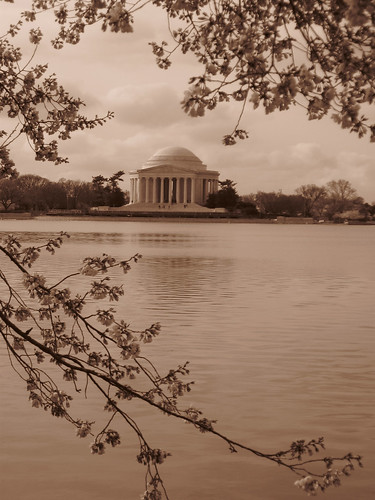
Cherry Blossoms frame the Jefferson Memorial on the Washington, D. C. Tidal Basin. Photo by Bob Kirchman
Caesar Rodney's Midnight Ride
Now one was neither Tory nor Whig; it was either dependence or independence.” Caesar Rodney, after Lexington and Concord.
We all know the famous story of Paul Revere's midnight ride. Virginians celebrate the memory of Jack Jouett, who rode to Monticello to warn Thomas Jefferson of approaching British troops.Jefferson and the Virginia Legislature were able to escape across the Blue Ridge Mountains to Staunton. Still, the most memorable midnight ride that saved the young republic has to be that of Caesar Rodney. Without Rodney's ride, there would not have been a republic at all.
Caesar Rodney was born in 1728 on his family's 800 acre farm, Byfield, on St. Jones Neck in East Dover Hundred, Kent County, Delaware. The family could trace its ancestry to the Adelmare family of Treviso, Italy. Caesar Rodney's farm was a large one, worked by slaves, and it provided wheat and barley to markets in Philadelphia. His brother Thomas described him as possessing a: "great fund of wit and humor of the pleasing kind, so that his conversation was always bright and strong and conducted by wisdom... He always lived a bachelor, was generally esteemed, and indeed very popular." Indeed, his talents found him taking his place in public service. He served as sheriff and in a number of other positions. He joined Thomas McKean as a delegate to the Stamp Act Congress in 1765 and was the Brigadier General of the Delaware Militia. He went on to serve in the Continental Congress.
Here is where he made his most courageous contribution to the cause of American independence. In 1776 the vote to adopt the Declaration saw the Delaware delegation deadlocked. This was a problem as the delegates to the convention had decided that an all or nothing approach was essential. Of Delaware's two present delegates Mckean favored independence. The other delegate, George Read, did not. Rodney, who was also qualified to vote, was at home performing his duties as General of the militia when the initial voting took place. Mckean had sent word to Rodney that his vote would be needed in Philadelphia... but the message never got to him. Rodney was a bachelor and his love interest at the time was being used by the Tories to divert his participation! She was intercepting the messages! By the time McKean's message finally got to Rodney, the first deadlocked vote had already taken place and it was well into the evening. Rodney mounted his horse and rode through a great thunderstorm along the muddy road to Philadelphia. Lightning illuminated the wet road as he sloshed along as rapidly as conditions would allow. For seventy miles he rode.
Rodney was not a well man. He suffered from a rare form of cancer that disfigured his face and sapped his strength. No doubt he knew the ride could kill him, but he pressed on. He was committed to an act of treason that might lead to his death if he did survive. But he pressed on through the darkness. He reached Philadelphia by mid-morning. Spattered with mud, he stepped into the chamber just in time to cast his historic vote. Now the votes by all colonies who actually voted was unanimous! The framers rightly considered this essential to the success of the Declaration. Without Caesar Rodney's heroic ride, there would have not been a July 4th for us to celebrate! Rodney served in the war effort, even fighting alongside George Washington, who said of him: “The readiness with which you took to the field at the period most critical to our affairs, the industry you used in bringing out the militia of the Delaware State and the alertness observed by you in forwarding on the troops from Trenton, reflect the highest honor on your character and place your attachment to the cause in a most distinguished point of view.” As a young republic took its place in the world, Rodney continued to serve but his health was now rapidly declining. He died in 1784. [2.]
His legacy lives on today though. My friend Brandy Leigh Messick and her four sons are proud descendents of this great patriot and continue his mission to promote the values of this great nation to this day! Special thanks to her for providing additional background for this article.
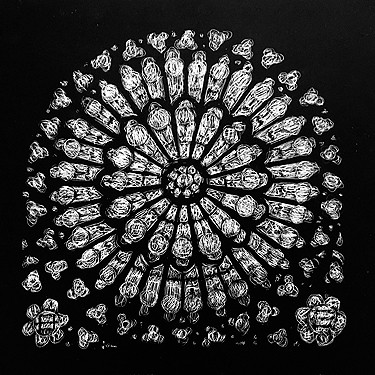
North Rose Window, Notre Dame de Paris PSALM 48, Bringing the Beauty of Zion to the World
North Rose Window, Notre Dame de Paris. — Scratchboard, 12" x 12" by Bob Kirchman
“Bringing the Beauty of Zion to the World” — Scratchboard 12” x 12” by Bob Kirchman. A gift to Kristina and Jonathan Greer.
Walk about Zion, and go around her: tell the towers thereof. Mark ye well her bulwarks, consider her palaces; that ye May tell it to the generation following” — PSALM 48:12,13
Volume XVI, Issue XVb
The Meaning of the Miraculous For many Centuries man has acknowledged the miraculous. In the weeks to come the Jewish community celebrates their deliverance from Egypt and the beginning of their journey to the Promised Land. [1.] A dialogue set in a meals has all generations together consider the preservation of their people that could only be seen as a work of G-d. Previous generations always saw G-d, or some miraculous force as Creator. The Patriarchs saw Him as Provider and Deliverer! The relatively recent concept of Evolution (Charles Darwin in the Nineteenth Century) has created a philosophy of Naturalism that either outright rejects or quietly diminishes the Theistic explanation.
I once attended an Easter service at a large church in Richmond. The minister asserted that the Resurrection was not important! I don't remember anything else he said. I was astonished because Christ's Resurrection would seem to be a cornerstone of Christianity. Many voices today denounce Faith. They may not directly denounce it, but in the academy it is the subject of "open discourse" such as that experienced by Ryan Rotella at FAU [click to read]. Rotella was asked to leave a class. His "offense" was refusing to participate in an excercise where students were required to "stamp on Jesus."Dennis Prager [click to read] has more details. Though the school ultimately apologized to Rotella, it justified its so-called "open discourse" in doing so.
Running from the Resurrection
In fact, among many in academia today you are likely to hear some variation of the following: "There are other reasons why I consider Christianity to be an
ill-chosen creed, such as the morals actually taught in the Bible,
many of which are abhorrent to a compassionate and just man, or other
details of its theology which run counter to observable facts." writes atheist
Richard Carrier in introduction to his argument against Jesus' resurrection from the dead.
Here in his introduction, Carrier gives what I believe is his real reason for being
uncomfortable with a physical resurrection. A G-d who can so control
the laws of nature can ask 'unreasonable' things of us as well. A
'Compassionate and Just Man,' in Carrier's world can support abortion
on demand because it is not 'abhorrent' to his viewpoint that abortion
is a kind response to the needs of women with unplanned pregnancies. The beating heart of the unborn child need not be seen here as an 'observable fact.'
Likewise, the 'restrictive' definition of marriage as a relationship
defined by Scripture in specific terms may be viewed as archaic and
discriminatory.If G-d didn't design it, He cannot write the specifications.
The elimination of Christianity as an authoritative source allows us
to personalize moral decisions. In a culture that elevates
self-actualization, this is virtue. It spares us the heavy lifting
required to weigh moral absolutes with human frailty.
Jesus, meeting a Samaritan woman at a well, is a prime example of what
I mean by this heavy lifting. Balancing compassion for the woman with his observation that
she has not been a faithful wife, Jesus creates a constructive
dialogue. He does not condemn her, nor does He overlook the complexity
she has created in her relationships. He speaks truth and ultimately
the dialogue that results sets her free. Here Absolute Love and Absolute Truth are in no way mutually exclusive. In the end her search for 'Living Water' trumps her desire to live as she pleases. [2.]
A G-d who can part the Red Sea, Create worlds and has power over death is pretty much to be respected. A G-d who changes human lives in intimate communion with his Creation is amazing.
Before Jesus appeared, the concept of Resurrection is found in Scripture. Sometimes it is very clear and other times it is a logical assumption consistent with the text.
Resurrection Foretold
And he made his grave
with the wicked, and with the rich in his death; because he had done no
violence, neither was any deceit in his mouth. Yet it pleased the Lord
to bruise him; he hath put him to grief: when thou shalt make his soul
an offering for sin, he shall see his seed, he shall prolong his days,
and the pleasure of the Lord shall prosper in his hand. He
shall see of the travail of his soul, and shall be satisfied: by his
knowledge shall my righteous servant justify many; for he shall bear
their iniquities. Therefore
will I divide him a portion with the great, and he shall divide the
spoil with the strong; because he hath poured out his soul unto death:
and he was numbered with the transgressors; and he bare the sin of many,
and made intercession for the transgressors." -- Isaiah 53:9-12 The famous Messianic text above talks of triumph after death. Other texts that may be seen as prophetic of Resurrection are: Genesis 3:15, Psalm 2:7, Psalm 16:9-11, Psalm 22:14-25, Psalm 30:29, Psalm 40:13, Psalm 110:1, Psalm 118:21-24, Hosea 5:15-6:3, Zechariah 12:10.
Resurrection Documented and Verified
I know of no one fact in the history of mankind which is proved by
better, fuller evidence of every sort, to the understanding of a fair
inquirer, than the great sign which God hath given us that Christ died,
and rose again from the dead." says Dr. Thomas Arnold, formerly Professor of History at Rugby and Oxford Universities. Simon Greenleaf, one of the most skilled legal minds ever produced in this nation, top
authority on the question of what constitutes sound evidence, developer
of the Harvard Law School, after a thorough evaluation of the four
Gospel accounts from the point of view of their validity as objective
testimonial evidence, concluded:
It was therefore impossible that they could have persisted in affirming
the truths they had narrated, had not Jesus actually risen from the
dead, and had they not known this fact as certainly as they knew any
other fact." [3.]Dr. Henry M. Morris PhD writes more onThe Importance of the Resurrection [click to read]. His point is that the foundational truth of the Christian faith has plenty of evidence to support it.
A G-d who can part the Red Sea, Create worlds and has power over death
is pretty much to be respected. A G-d who changes human lives in
intimate communion with his Creation is amazing.
Going into my bank, I had a pleasant surprise. The teller had noticed the mural being painted by our students and said that she had at first wondered if it had always been there. So many people had stopped by while it was being painted and were enthusiastic in their praise. Tim, at the drive in added that he had been walking by and had spoken with Madeline Mass as she painted that day. Amanda Riley’s vision to create a gift to the city of Staunton has come to amazing fruition and many a person’s daily commute has been brightened by the new mural. What started as an opportunity to give our students some large-scale experience has become a very large and very visible part of the fabric of our community!
Not only has this Summer involved muraling, but it has been my great joy to partner with Savhanna Herndon in offering programs for young artists! We are soon to put on a show of their work at Savhanna’s church. We have some amazing young people in the program and it will be so much fun to showcase their work!
The Augusta Christian Educators (ACE) Co-Op of Augusta County, Virginia chose Madeline Maas's design for a mural to be painted in downtown Staunton. She completed it this Summer with help from her fellow studio art students. Photo by Bob Kirchman
One of the greatest joys of this Summer was the art program for young people that Savhanna Herndon and I taught. We explored composition and color, made a lot of messes and found time to visit Natural Bridge with our students. We even found time to pose in front of the Staunton Sunflowers! Savhanna will be offering classes for students this Fall!
Natural Bridge
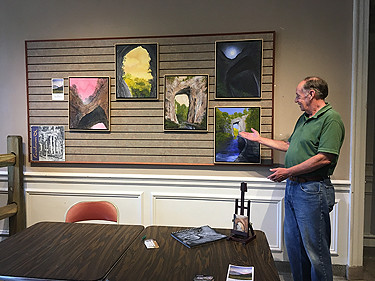
Once this Summer I was called upon to give the youth talk and I based it on this painting of Natural Bridge, or Mohomony, as the Monacans called it. To the Monacans it represents a great story of Divine deliverance as the bridge allowed them to defeat a much larger band of Powhatans. My message that evening was simply about remembering what God has done in your life. It is a simple truth, but it is a profound one.
Photos by Bob Kirchman.
Capturing Light My Talk at Natural Bridge
Walk about Zion, and go round about her: tell the towers thereof. Mark ye well her bulwarks, consider her palaces; that ye may tell it to the generation following. For this God is our God for ever and ever: he will be our guide even unto death.” – PSALM 48:12-14
I never tire of telling the story of Mohomony. That is what the Monacans called Virginia’s Natural Bridge. In their legend they faced a much larger force of Powhatans and prevailed because the bridge narrowed the attacking forces. The Monacans, fighting for wives and children behind them, overcame a much more powerful attacking force because they met them atop the bridge where an equal number of warriors faced them at any given time; constrained by the width of the bridge.
No doubt, the Monacans who fought in that battle would show young people the Natural Bridge and recount the wonder of Mohomony for them. This would be to them a story of Divine Deliverance just as the youth of Jerusalem would be encouraged to take note of their own history of Divine Deliverance. PSALM 48 ends with just such a charge!
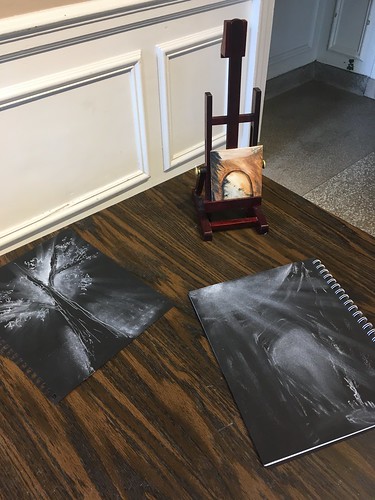
I am giving a talk on the inspiration for my paintings at Natural Bridge. Part of it is a workshop for children where I give them black paper and white charcoal. I encourage them to look up at the bridge and remember the story. Then I guide them in drawing the light. It is fun to watch them draw light instead of just dark lines on white paper.
One little girl from South Carolina was particularly inspired by the project. She was seven years old and her mother proudly showed me some phone pictures of her work. She wanted to give me her capture of the bridge but I insisted that she give it to her mom and I would take a picture of it for myself! There are a few souls who’s IMAGO DEI extends to very early expression in art. I told her mom that she had a great treasure. Cherish her well!
Here are my examples of 'Capturing Light' along with a painting by Savhanna Herndon for inspiration.
Demonstration of 'Capturing Light.' Photos by Bob Kirchman.
Mohomony
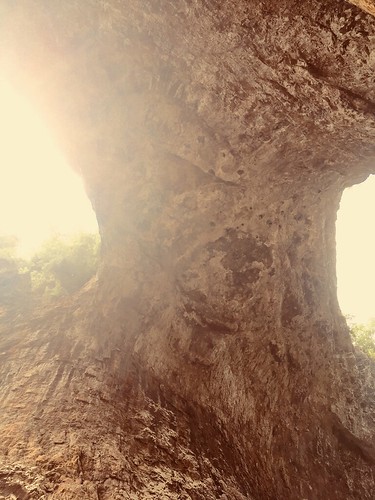
Natural Bridge as Seen from Below
Looking straight up at Mohomony from Cedar Creek. Photo by Bob Kirchman
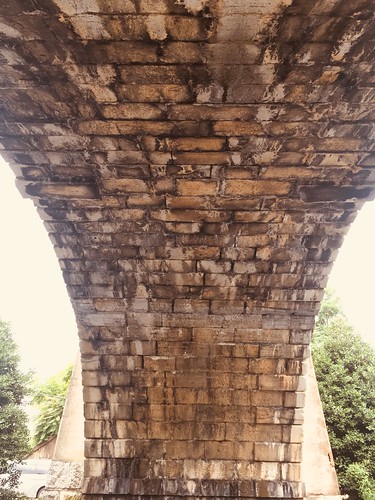
Chesapeake and Ohio Bridge
Photo byBob Kirchman
This arched stone bridge still carries rail traffic over Greenville Avenue. Photo by Bob Kirchman.
The Art of Design Communication Design Seminar byBob Kirchmanin Charlotte, NC, Sept. 13
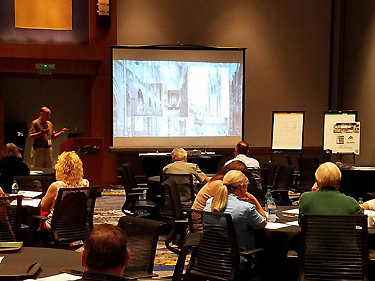
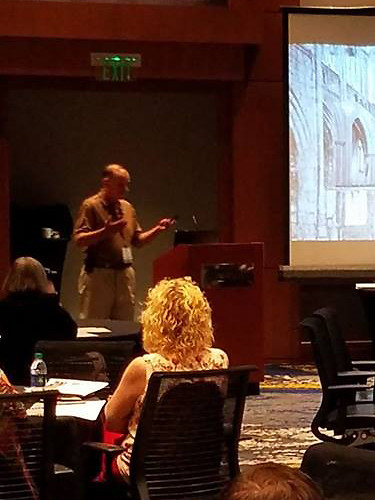
Here I am presenting 'The Art of Design Communication' at the American Institute of Building Design Summer Conference in Atlanta, Georgia last Summer. At this moment we are examining the beautiful rendering style of Architect Julian Abele. AIBD Photo.
In the Nineteenth Century, the German poet Heinrich Heine studied the Gothic Cathedrals of France, England and Germany. A friend asked him, “Why can we no longer build such majestic structures?” Heine answered, “In those days, men had convictions, whereas we moderns only have opinions, and something more is needed than an opinion to build a Gothic cathedral.” In our workshop we studied the drawings of Julian Abele, [1.] who did create such majestic structures in the Twentieth Century.
I will be presenting 'The Art of Design Communication' at the North Carolina Association of Homebuilders's Convention on September 13th 2018.
Note from Atlanta Workshop
We received this note from a participant in the AIBD Conference:
Thank you so much, Bob! Your work is amazing and the workshop gave me much
better confidence in my ability to sketch my ideas for a client. I've been
doing this a long time so you wouldn't think there would be a lack of
confidence, but.... so it goes.” – JH
AIBD Photo.
Workshop Materials. Photo by Bob Kirchman.
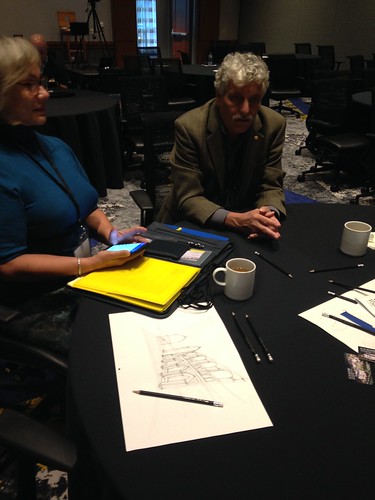
Participants in the workshop I presented at the American Institute of Building Design Summer Convention in Atlanta Georgia. Robert Browne of Cadworks Consulting, originally from Johannesburg, South Africa, especially enjoyed the drawing exercise in 'traditional media.'
New Echota, Cherokee Nation Capital Photos byBob Kirchman
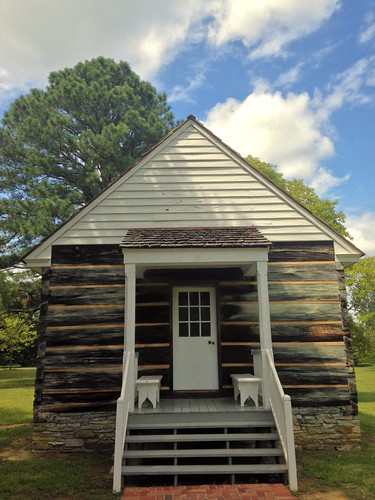
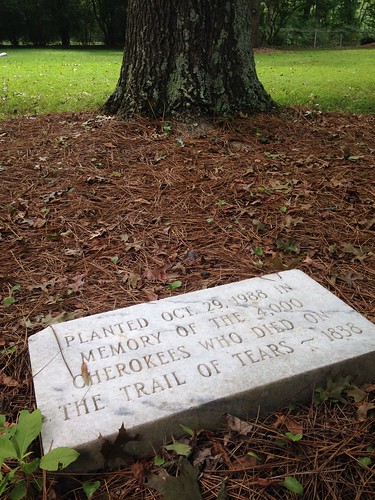
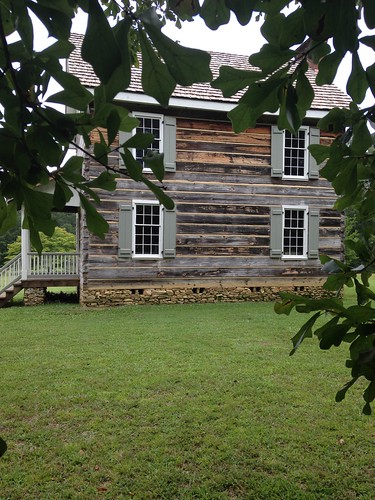
Many Cherokee farmers and their families were forced from small farms like this into stockades and eventually removed to Oklahoma in the 'Trail of Tears.'
Last Summer I traveled to Atlanta to present The Art of Design Communication and I took the opportunity to visit the capital of a great nation. Although this is last Summer’s trip, the memory is still fresh.
It is a warm August day as I travel to Atlanta Georgia through what was once the home of a great nation. Pulling off of Interstate 75, it is a short drive to the reconstructed capital of the Cherokee, New Echota. It was never a large city but it would swell to an encampment of hundreds of people when the council was in session.
The offices of the Cherokee Nation's Phoenix, a newspaper published in both English and Cherokee.
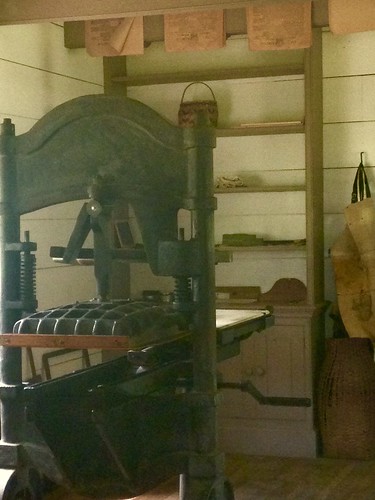
The Phoenix printing press.
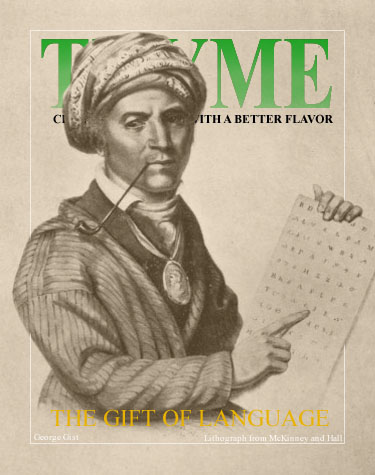
Sequoyah's 'Talking Leaves.'
The Gift of Language How Sequoyah Gave His People Written Words
Perhaps the most remarkable man who has ever lived on Georgia soil was neither a politician, nor a soldier, nor an ecclesiastic, nor a scholar, but merely a Cherokee Indian of mixed blood. And strange to say, this Indian acquired permanent fame, neither expecting or seeking it." -- H. A. Scomp, Emory College
He was hardly someone you would predict would create such a significant contribution to his nation. George Gist was born to a Cherokee mother, Wu-teh, a member of the Paint Clan, and Nathanial Gist, an English fur trader near the village of Tushkeegee on the Tennessee River. The year was around 1760 but no one knows for sure. Learning the ways of the Cherokee, young George became a trapper and a fur trader himself. He would probably have lived out his days as a man of the forest, but he suffered a hunting accident (or possibly succumbed to a crippling disease, depending on which version of his story you read), but the young man was permanently disabled, unable to earn his living by the skills he had been taught in childhood.
George Gist developed a talent for metal working. He learned to be a blacksmith and silversmith. His disability became both a source of ridicule (Sequoyah means "pig's foot" in Cherokee) and a spur to greater things. The man was a good learner and became a competent craftsman. A man who purchased one of his pieces suggested that he sign his work, but he was unable to. He could not write! And here as well his story might have ended, but events in the greater world were to spur him to his greatest work. Sequoyah married a Cherokee woman and raised a family. They moved to Cherokee County in Georgia where George learned how to write his name from a local farmer. Later he joined other Cherokees who fought under Andrew Jackson against England in the War of 1812. Though he never learned to read or write English, Sequoyah was fascinated by the white man's ability to create "talking leaves" by making marks on paper.
As early as 1809, Sequoyah was exploring the creation of a Cherokee alphabet. Though scholars believe there may have once been a written Cherokee language that was later forgotten, there was no written Cherokee language when Sequoyah was a youth. People suspected that the white man's words "moved around on the paper," and the time was right for Cherokee to be able to read things for themselves. Cherokee soldiers could not write letters home, read military orders for themselves, or record events they wished to remember. When he returned home from the war, he worked in earnest on a phonetic alphabet of 86 letters to write the Cherokee Language. Sequoyah became something of a recluse. His friends and family ridiculed him. Some said he was insane or practicing witchcraft. Moving West to Arkansas, he continued his great work.
He found that his young daughter Ayoka could easily learn to use the syllabary and demonstrated this to his cousin, George Lowrey, who encouraged him to demonstrate the use of the syllabary to the public. In a Cherokee court case in Chattooga, he read an argument about a boundary line from a piece of paper. In 1821 the Cherokee Nation officially adopted Sequoya's alphabet and within a matter of months thousands of Cherokee learned to read and write! In 1824 the Cherokee National Council at New Echota, Georgia presented him with a silver medal. Sequoyah proudly wore it for the rest of his life. He was given a $300 annuity and his widow continued to receive it after he died.
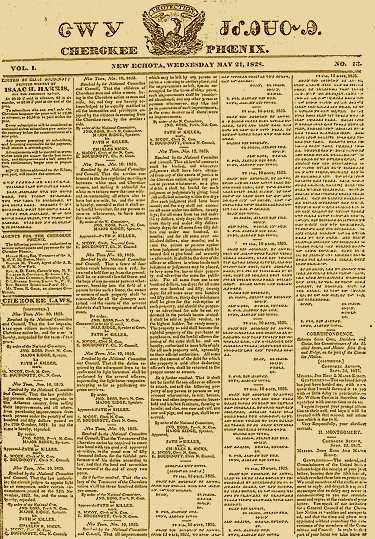
By 1825 the Cherokee had the Bible in their own language along with hymnals and all sorts of educational materials. There was even a large group of Moravian Cherokee. Legal documents and books of every kind were available, all translated into the Cherokee Language. In 1827 The Cherokee National Council funded the printing of Tsa la gi Tsu lehesanunhi," the Cherokee Phoenix. It was the first Native American newspaper printed in the United States. It was produced in the Cherokee Capital, New Echota on a press shipped there from Boston. The paper had parallel columns in Cherokee and English, printed side by side.
Sadly, the discovery of gold in North Georgia, unscrupulous men and treachery in treaty would lead to the removal of most of the Eastern nation. Sequoyah moved to Oklahoma were he served as an envoy to Washington D.C. to assist the displaced Eastern Cherokees. He continued to serve his people as a diplomat and a statesman. Well into his eighties, he traveled West again, looking for a band of Cherokees who were said to have moved to Mexico. He took ill and died in 1843 and the location of his grave remains unknown to this day. Two species of giant redwood trees have been named in his honor, as has Sequoia National Park in California. He gave his people the gift of literacy. His contribution is unique, as he, an uneducated, seemingly undistinguished individual, created a totally new system of writing for his beloved nation.
Remembering History
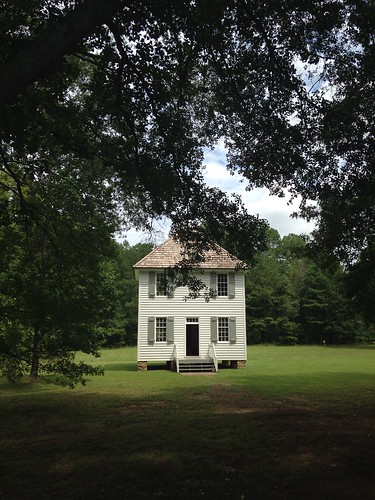
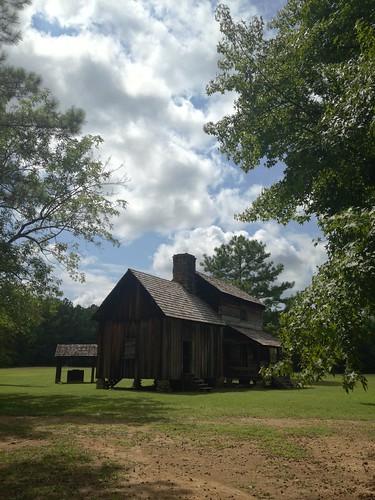
After the residents of New Echota were taken away in the ‘Trail of Tears,’ the town itself disappeared. The state of Georgia had held a lottery to redistribute the land and it became farmland. The houses were taken down, save for that of Samuel Worcester, missionary to the Cherokee and Postmaster. It survived in other hands. The trees that shaded the streets were cut down. The town itself was but a memory.
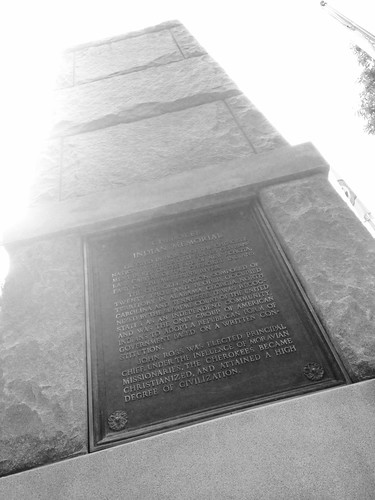
In the 1960’s a group of people came together who thought it important to remember the great nation that had once occupied North Georgia. They persuaded the state of Georgia to create the present park at New Echota. The principle buildings have been reconstructed and stand in silent monument to those who were ripped from their land a century before.
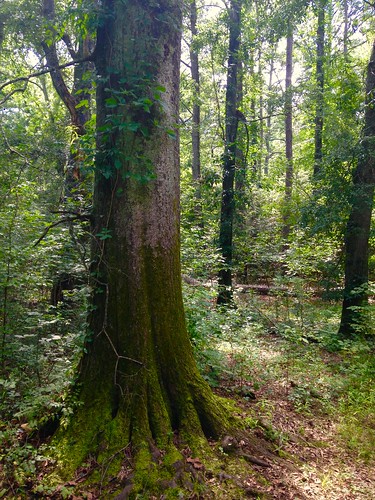
Forest, New Echota
Although the area surrounding New Echota, the Cherokee Capital, was cleared for farmland after the Cherokee Removal, the forest has returned. Photo by Bob Kirchman.
New Echota Houses of Government
Reconstructed Supreme Courthouse. Photo by Bob Kirchman.
In 1825 New Echota was officially designated as the Cherokee Capital. The Council had been meeting in New Town (as New Echota was originally known), on the headwaters of the Oostanaula River, since 1819 and the Council house was built in 1822. Beginning in 1823, the Cherokee Supreme Court met annually to hear cases appealed from lower district courts. The Supreme Courthouse was constructed in 1829.
The government was set up similar to that of the United States, with a Legislative, Judicial and Executive Branch. The Council chose the Executive Branch officers, the Principle Chief, the Vice-Principal chief and the Treasurer.
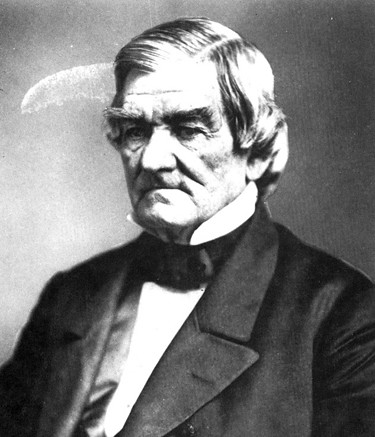
Principal Chief John Ross, who's Cherokee name was Tsan-Usdi, and is also known as Koo-wi-s-gu-wi, the name of a mythological, or rare migratory bird; served in that capacity from 1828 to 1866. He led his people through the times of the Cherokee Removal and the Civil War. Although he was only 1/8 Cherokee, the son of a Scotch Father and a Cherokee mother, he was raised traditionally. The full-blooded Cherokee recognized his skills in dealing with the United States government and the settlers around them who wanted their land. He was a tireless advocate for his people, resisting the removal. His wife Quatie, mother of their five children, died on the ‘Trail of Tears.’
Council House. Photo by Bob Kirchman.
Principal Chief John Ross. Archives of the State of Georgia
Cherokee Portal Painting byBob Kirchman
Cherokee Portal. Bob Kirchman 1998.
I painted this little watercolor nineteen years ago when I went to another conference in Georgia. On that trip I was able to go off in the mountains and had time to paint. It was a rainy day and I felt in the soft subdued light and mist like I had been transported to another time.
Stone Mountain, near present day Atlanta, was sacred to the Cherokees and the Creeks and the two nations used it as a meeting place.
New Echota, Cherokee Phoenix
1828 Edition of the Cherokee Phoenix.
Sometime around 1809 a mixed-blood Cherokee known as Sequoyah began developing a written Cherokee language. In 1821 his work was complete. The language had 86 characters and was adopted by the Cherokee Council in 1826. In 1827 Rev. Samuel Worcester helped to establish the Phoenix Printing Office. Using specially forged type, the newspaper had side by side columns of English and Cherokee. It was distributed throughout the Cherokee Nation, the United States and even parts of Europe. In addition to the newspaper, the press also produced a Cherokee Bible, a hymnal and even a novel.
This simple printing office managed an international distribution of the Phoenix. Photo by Bob Kirchman.
New Echota, Vann Tavern Photos by Bob Kirchman
Vann Tavern was built around 1805 by James Vann. He was a wealthy Cherokee plantation owner. The Nineteenth Century tavern served travelers as restaurant, store and inn. An outside stair led to guest quarters upstairs and the window on the porch served as a ‘takeout window’ for those the innkeeper would not allow inside. Although this particular building was moved to New Echota from Forsyth County, Georgia, it is representative of the tavern that would likely have stood here.
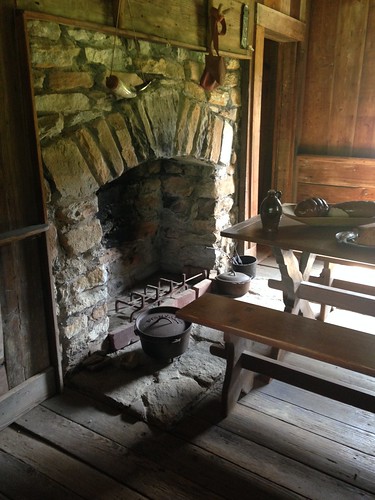
Interior of Vann Tavern.
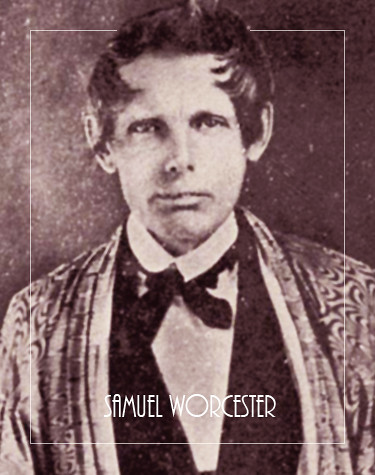
Samuel Worcester. Archives of the State of Georgia.
Samuel Worcester A Life of Service and Sacrifice
In 1828 the Reverend Samuel A. Worcester built his home among the Cherokee at New Echota. Working with Elias Boudinot, Worcester translated parts of the Bible and many hymns into Cherokee. The press at New Echota which also produced the Phoenix printed many of these works. Worcester planted a church at New Echota and also started a school. He served as the town’s postmaster.
As the state of Georgia passed laws that were oppressive to the Cherokee Nation, Worcester refused to obtain the permit the state required for a white person to live in the Cherokee lands. In 1831 he was arrested and sent to prison by Georgia officials.
His case was appealed to the United States Supreme Court. In Worcester v. Georgia, Worcester and the Cherokees won. The state of Georgia, however, continued to annex Cherokee land. In 1832 Worcester and his family were forced from the house when a white Georgian obtained title to it in the 1832 land lottery conducted by the state.
Samuel Worcester moved to Oklahoma where he continued to serve and advocate for the Cherokee Nation. As the town of New Echota disappeared and became farmland, his house continued in use by different families until 1958 when it was restored as a historic home.
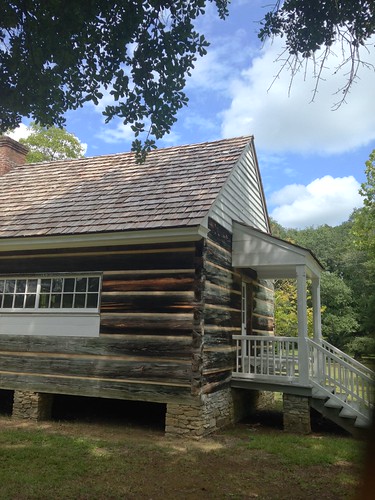
The restored home ofSamuel Worcesterin New Echota. Photo by Bob Kirchman.
Bears in Shenandoah Park
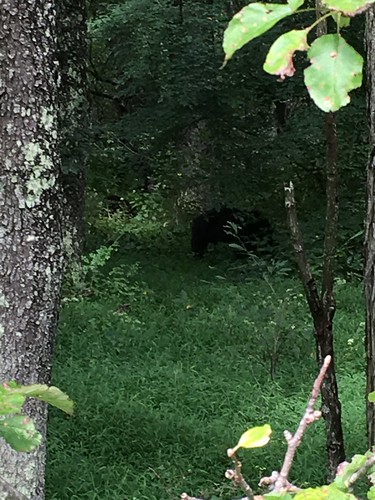
Ursus Americanus, Virginia's Largest Mammal
To celebrate NASA’s 60th anniversary this year, the agency partnered with the National Symphony Orchestra to present a concert in Washington entitled “NSO Pops: Space, the Next Frontier.” NASA mission images complemented performances of space-inspired music in the Kennedy Center’s concert hall, including Claude Debussy’s “Clair de Lune” (“Moonlight”), with a video of the Moon created by NASA science visualizer Ernie Wright.
At NASA’s Goddard Space Flight Center in Greenbelt, Maryland, Wright works in the Scientific Visualization Studio, using NASA data to create accurate visuals of celestial bodies. Wright made the lunar imagery accompanying “Clair de Lune” with data from the Lunar Reconnaissance Orbiter (LRO). (read more)
LRO Photo of Earthrise over the moon. NASA Photo.
Faith and Bright Hope
A Vision for Tomorrow
A vision for the future. Jesus is Coming, Plant a Tree!
Therefore, my beloved brethren, be ye stedfast, unmoveable, always abounding in the work of the Lord, forasmuch as ye know that your labour is not in vain in the Lord."
-- 1 Corinthians 15:58
In a wonderful article by N. T. Wright entitled Jesus is Coming, Plant a Tree [click to read], the author writes: "For the early Christians, the resurrection of Jesus launched God’s new creation upon the world, beginning to fulfill the prayer Jesus taught his followers, that God’s kingdom would come “on earth as in heaven” (Matt. 6:10), and anticipating the “new heavens and a new earth” (Isa. 65:17, 66:22; 2 Pet. 3:13; Rev. 21:1) promised by Isaiah and again in the New Testament. From this point of view, as I have often said (though the phrase is not original to me), Heaven is undoubtedly important, but it’s not the end of the world. The early Christians were not very interested, in the way our world has been interested, in what happens to people immediately after they die. They were extremely interested in a topic many Western Christians in the last few years have forgotten about altogether, namely the final new creation, new heavens and new earth joined together, and the resurrection of the body that will create new human beings to live in that new world."
I have friends who are very much into eschatology, wonderful people, but they are pretty much convinced that this world is pretty rotten and the sooner it passes away the better. I also have friends who are very much into fixing things in the here and now, not thinking about the hereafter at all. Wright makes the case that I very much agree with: Both are missing something! He also struck a chord with me, especially in light of this dedication in my yet to be published novel: "Pontifus, The Bridge Builder's Tale:"
This little book is dedicated to those brave young people, who though I shall not name them here, will likely recognize bits of themselves in the characters I portray. I apologize beforehand for this intrusion into your privacy but feel that the world so desperately needs your story. Your very real dedication and bravery inspired this book and it cannot be written without a foundation of such truth. Most of all it is dedicated to my beautiful wife, of whom the accolade: "Well done, good and faithful servant!" is most fitting. You have stood by me in good times and bad. We have shared in the raising of some incredible young people who inhabited our own home. You have poured your love and wonder into the lives of countless students. I love you with all my being!!!
It is because we both love young people so that I write this. It is but a poor attempt to offer hope and direction to a world so devoid of it. We err, perhaps, in pointing to the hope of the hereafter without providing adequate models and renderings of that Kingdom and those who have labored to bring it into the world we inhabit now. The water that will quench the soul's thirst is dismissed because those who profess to bear it often seem, (to the society around them,) preoccupied with apocalyptic visions and derision for the world as it is now. It is not wrong to love such things, but they are not easily shared with those for whom the flower of life is yet to come. No bride-to-be, having just unwrapped her wedding planner, wants to engage in a lengthy discourse on Eschatology!
Idon’t know how my planting a tree today will relate to the wonderful trees that will be in G-d’s recreated world. I don’t know how my work for justice for the poor, for remission of global debts, will reappear in that new world. But I know that G-d’s new world of justice and joy, of hope for the whole earth, was launched when Jesus came out of the tomb on Easter morning: I know he calls me and you to live in him and by the power of his spirit, and so to be new-creation people here and now, giving birth to signs and symbols of the kingdom on earth as in heaven.
The resurrection of Jesus and the gift of the Spirit mean that we are called to bring forth real and effective signs of G-d’s renewed creation even in the midst of the present age. Not to do so is at best to put ourselves in the position of those Second Temple Jews who believed they had to wait passively for G-d to act – when G-d has acted in Jesus to inaugurate his kingdom on earth as in heaven. At worst, not to bring forth works and signs of renewal in G-d’s creation is to collude, as gnosticism always does, with the forces of sin and death."
Revelation 19:6-9 speaks of the time when people of all nations are joined in communion with G-d:
And I heard as it were the voice of a great multitude, and as the voice of many waters, and as the voice of mighty thunderings, saying, Alleluia: for the Lord G-d omnipotent reigneth. Let us be glad and rejoice, and give honour to him: for the marriage of the Lamb is come, and his wife hath made herself ready. And to her was granted that she should be arrayed in fine linen, clean and white: for the fine linen is the righteousness of saints. And he saith unto me, Write, Blessed are they which are called unto the marriage supper of the Lamb. And he saith unto me, These are the true sayings of G-d."
In Isaiah 60 [4.] and in Revelation 21 Believers look to a New Heaven and a New Earth where a Heavenly Jerusalem descends to join the Earth. Here is a Kingdom that needs no temple, needs no sun to light it, for G-d Himself is the force that illuminates it! [5.] And I saw a new Heaven and a new earth: for the first Heaven and the first earth were passed away; and there was no more sea. And I John saw the holy city, new Jerusalem, coming down from G-d out of heaven, prepared as a bride adorned for her husband. And I heard a great voice out of heaven saying, Behold, the tabernacle of G-d is with men, and he will dwell with them, and they shall be his people, and G-d himself shall be with them, and be their G-d." -- Revelation 21:1-3
Journey to Jesus, a mural depicting the nations coming to Jesus in the New Heaven and New Earth described in Revelation 21. Mural by Kristina Elaine Greer and Bob Kirchman
Our Christian hope is that we're going to live with Christ in a new Earth, where there is not only no more death, but where life is what it was always meant to be." -- Timothy Keller.
The hope of Heaven and New Earth.
A Lesson from the Missionaries
Wes Stafford, founder of Compassion International, remembers with great joy the times he and his missionary father dug wells together. He happily recalls the tired, sweaty, muddy process of ensuring clean water for the villages in Africa that they served. Father and son came home tired and filthy and the people saw a beautiful illustration of the love of G-d! Clean wells, fenced off so that cattle could not foul them, meant healthy children instead of sickly ones. Lives were saved and the people, through that expression of love, were moved to trust in Christ!
The Staffords excitedly sent photographs of the whole operation, dirty faces and all. They surely would be an exciting part of the mission's newsletter. To their dismay, when the newsletter arrived, there were no pictures of the well digging. It wasn't about 'salvation' in the eyes of the mission board. Yet it had resulted in real salvation (earthly as well as Heavenly) to the villagers! Years later, as head of Compassion International, Wes Stafford still presides over the digging of a lot of wells!
Tragically, the board's earthward myopia extended to the boarding school for missionary kids that Wes and his sister attended. Those who washed out as missionaries were assigned to teach at the school. Not seeing the school as an important work of G-d, the children were poorly cared for, sometimes even abused, and the faith of many was destroyed. In his book: Too Small to Ignore, [2.] Stafford makes the case that the work of teaching and caring for children is paramount in the work of the Kingdom of G-d.
Passing the Torch
Perhaps the greatest lesson Stafford's father ever taught was in the digging of the wells. Wes grew up with practical experience in participating in the building of the Kingdom. That lesson would stick with him as he grew to head Compassion International. There is a poem by Gary Snyder: Axe Handles [click to read] which captures the Sacred process quite nicely:
Iam an axe
And my son a handle, soon To be shaping again, model And tool, craft of culture, How we go on."
How are we doing as teachers. Not very well, I fear. As we are all too eager to see this world pass away, our young adults busy themselves with apocalyptic video games. The sad truth is that both generations have lost the mandate to build the Kingdom. A little child, it turns out, will teach me a "more excellent way." We are outside her house together... initially we set out to dig in the snow. Perhaps we'll build a snowman.
But we notice the chaos of snow and ice on the path to the trash cans. I chip, she digs. We create a beautiful clear walk for the neighbors. Then we clear off some sidewalk. The young child is clearly enjoying the whole process. But my adult mind soon grows restless that we have not built the snowman! Funny, how the adult mind can be distracted so easily!
It is only later that I realize that the child has been the teacher that day. We created a small patch of beauty (and safety) for her neighbors. She indeed saw that such labor was a good thing. No pontification, just a simple model, simply followed. We were making something together! Didn't Jesus say that: "the kingdom of God belongs to such as these!" -- Luke 18:16
The Fragrance of Eden Wisdom from an Old Rebbe
In the Blue Ridge Mountains.
Here is a Beautiful Story[click to read] of an old Rebbe who's devotion to G-d's work of redemption shaped the way he lived his own life. The wise man was told one day that the Messiah had come and was in the steet outside. The man opened the window, sniffed the air outside and declared the so-called 'Messiah' a fraud. His instincts told him the coming Messiah would bring with him the sweet fragrance of Eden, the fragrance of the divine presence in the tabernacle and the temple, that was lost when the Glory departed.
Years later, the Rebbe's son wondered why his father had to go to the window to sniff the air. Surely the sweet smell of redemption would come into the house. His son then realized that the father had lived his life in devotion to torah study and the expectancy of Messiah's coming. His life, so lived, gave his own dwelling place the fragrance of what he hoped for. Thus it was necessary for him to smell the air outside his house to know if what he hoped for had truly appeared.
May our faith and devotion create such an aroma in our own dwelling places!