Showing posts with label Neil Armstrong. Show all posts

Sunday, July 14, 2019

Man on the Moon, Apollo 11, Fifty Years Ago!

apollo11
Volume XVII, Issue II

The First Humans on Another World
118692-050-194A0468
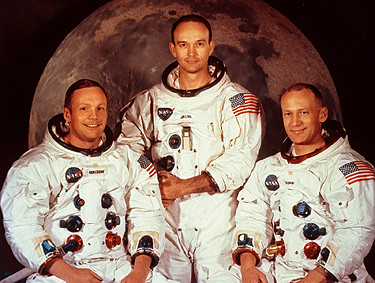
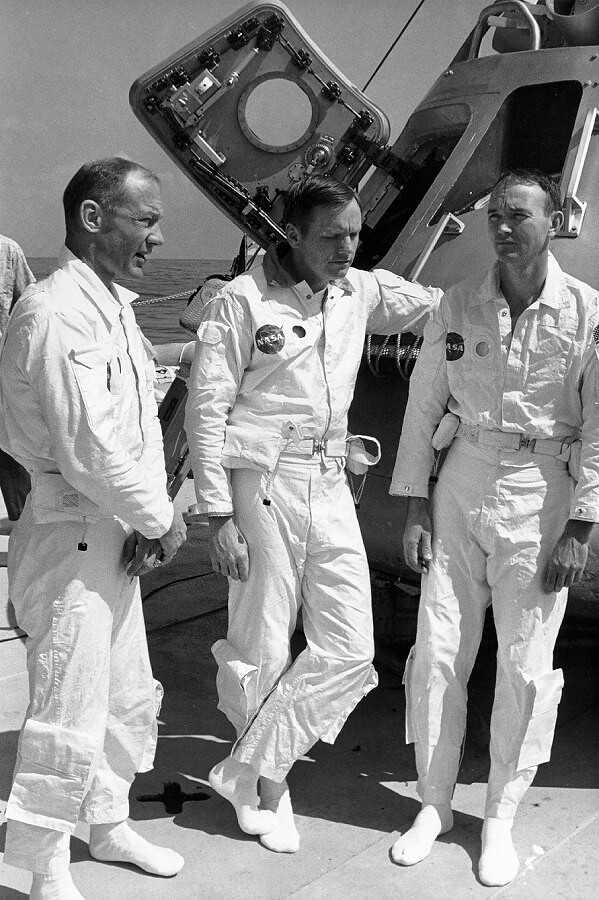
The crew of Apollo 11 (from left to right): Neil Armstrong, Michael Collins, and Edwin (“Buzz”) Aldrin. NASA Photo.

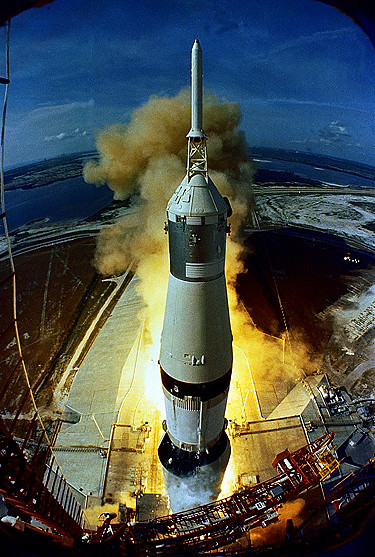
Fifty years ago on July 16th, the mighty Saturn V rocket carrying Apollo 11 lifted off from Cape Kennedy. Astronauts Neil Armstrong, Michael Collins and Edwin Aldrin flew with the first Lunar Module capable of actually landing. Though the astronauts had practiced this over and over in simulators, there was no way of knowing what their chances would be of actually landing. Armstrong even admits that he considered this to be merely the first attempt.
launch_apollo_11
Apollo 11 liftoff. NASA Photo.

Armstrong and Aldrin would proceed to fly the Lunar Module toward the lunar surface. Their descent would not be an easy one. Their computer overloaded, almost prompting an abort. Then the computer guided them to a landing area strewn with boulders. Armstrong took manual control of the spacecraft and skimmed along until he saw a better landing sight. Running critically low on descent stage fuel, Armstrong pushed on and brought the Eagle down. With five percent fuel remaining he gently eased the lander down onto the moon. “The Eagle has Landed!”
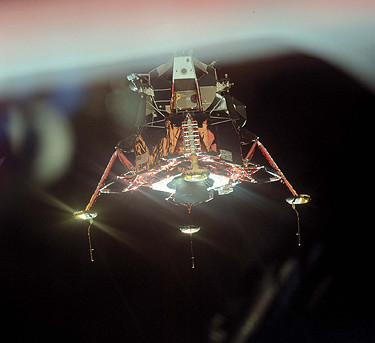
418-050-613974C9
The Lunar Lander, Eagle. NASA Photo.

John F. Kennedy
Address at Rice University on the Space Effort

September 12, 1962

Speech Transcript

President Pitzer, Mr. Vice President, Governor, Congressman Thomas, Senator Wiley, and Congressman Miller, Mr. Webb. Mr. Bell, scientists, distinguished guests, and ladies and gentlemen:

I appreciate your president having made me an honorary visiting professor, and I will assure you that my first lecture will be very brief. I am delighted to be here and I'm particularly delighted to be here on this occasion.

We meet at a college noted for knowledge, in a city noted for progress, in a State noted for strength, and we stand in need of all three, for we meet in an hour of change and challenge, in a decade of hope and fear, in an age of both knowledge and ignorance. The greater our knowledge increases, the greater our ignorance unfolds.

Despite the striking fact that most of the scientists that the world has ever known are alive and working today, despite the fact that this Nation's own scientific manpower is doubling every 12 years in a rate of growth more than three times that of our population as a whole, despite that, the vast stretches of the unknown and the unanswered and the unfinished still far out-strip our collective comprehension.

No man can fully grasp how far and how fast we have come, but condense, if you will, the 50,000 years of man's recorded history in a time span of but a half century. Stated in these terms, we know very little about the first 40 years, except at the end of them advanced man had learned to use the skins of animals to cover them. Then about 10 years ago, under this standard, man emerged from his caves to construct other kinds of shelter.

Only 5 years ago man learned to write and use a cart with wheels. Christianity began less than 2 years ago. The printing press came this year, and then less than 2 months ago, during this whole 50-year span of human history, the steam engine provided a new source of power.

Newton explored the meaning of gravity. Last month electric lights and telephones and automobiles and airplanes became available. Only last week did we develop penicillin and television and nuclear power, and now if America's new spacecraft succeeds in reaching Venus, we will have literally reached the stars before midnight tonight. This is a breathtaking pace, and such a pace cannot help but create new ills as it dispels old, new ignorance, new problems, new dangers. Surely the opening vistas of space promise high costs and hardships, as well as high reward.

So it is not surprising that some would have us stay where we are a little longer to rest, to wait. But this city of Houston, this State of Texas, this country of the United States was not built by those who waited and rested and wished to look behind them. This country was conquered by those who moved forward-and so will space.

William Bradford, speaking in 1630 of the founding of the Plymouth Bay Colony, said that all great and honorable actions are accompanied with great difficulties, and both must be enterprised and overcome with answerable courage.

If this capsule history of our progress teaches us anything, it is that man, in his quest for knowledge and progress, is determined and cannot be deterred. The exploration of space will go ahead, whether we join in it or not, and it is one of the great adventures of all time, and no nation which expects to be the leader of other nations can expect to stay behind in this race for space.

Those who came before us made certain that this country rode the first waves of the industrial revolutions, the first waves of modern invention, and the first wave of nuclear power, and this generation does not intend to founder in the backwash of the coming age of space. We mean to be a part of it - we mean to lead it. For the eyes of the world now look into space, to the moon and to the planets beyond, and we have vowed that we shall not see it governed by a hostile flag of conquest, but by a banner of freedom and peace. We have vowed that we shall not see space filled with weapons of mass destruction, but with instruments of knowledge and understanding.

Yet the vows of this Nation can only be fulfilled if we in this Nation are first, and, therefore, we intend to be first. In short, our leadership in science and in industry, our hopes for peace and security, our obligations to ourselves as well as others, all require us to make this effort, to solve these mysteries, to solve them for the good of all men, and to become the world's leading space-faring nation.

We set sail on this new sea because there is new knowledge to be gained, and new rights to be won, and they must be won and used for the progress of all people. For space science, like nuclear science and all technology, has no conscience of its own. Whether it will become a force for good or ill depends on man, and only if the United States occupies a position of pre-eminence can we help decide whether this new ocean will be a sea of peace or a new terrifying theater of war. I do not say that we should or will go unprotected against the hostile misuse of space any more than we go unprotected against the hostile use of land or sea, but I do say that space can be explored and mastered without feeding the fires of war, without repeating the mistakes that man has made in extending his writ around this globe of ours.

There is no strife, no prejudice, no national conflict in outer space as yet. Its hazards are hostile to us all. Its conquest deserves the best of all mankind, and its opportunity for peaceful cooperation may never come again. But why, some say, the moon? Why choose this as our goal? And they may well ask why climb the highest mountain. Why, 35 years ago, fly the Atlantic? Why does Rice play Texas?

We choose to go to the moon. We choose to go to the moon in this decade and do the other things, not because they are easy, but because they are hard, because that goal will serve to organize and measure the best of our energies and skills, because that challenge is one that we are willing to accept, one we are unwilling to postpone, and one which we intend to win, and the others, too.

It is for these reasons that I regard the decision last year to shift our efforts in space from low to high gear as among the most important decisions that will be made during my incumbency in the Office of the Presidency.

In the last 24 hours we have seen facilities now being created for the greatest and most complex exploration in man's history. We have felt the ground shake and the air shattered by the testing of a Saturn C-1 booster rocket, many times as powerful as the Atlas which launched John Glenn, generating power equivalent to 10,000 automobiles with their accelerators on the floor. We have seen the site where five F-1 rocket engines, each one as powerful as all eight engines of the Saturn combined, will be clustered together to make the advanced Saturn missile, assembled in a new building to be built at Cape Canaveral as tall as a 48-story structure, as wide as a city block, and as long as two lengths of this field.

Within these last 19 months at least 45 satellites have circled the earth. Some 40 of them were "made in the United States of America" and they were far more sophisticated and supplied far more knowledge to the people of the world than those of the Soviet Union. The Mariner spacecraft now on its way to Venus is the most intricate instrument in the history of space science. The accuracy of that shot is comparable to firing a missile from Cape Canaveral and dropping it in this stadium between the 40-yard lines. Transit satellites are helping our ships at sea to steer a safer course. Tiros satellites have given us unprecedented warnings of hurricanes and storms, and will do the same for forest fires and icebergs.

We have had our failures, but so have others, even if they do not admit them. And they may be less public.

To be sure, we are behind, and will be behind for some time in manned flight. But we do not intend to stay behind, and in this decade we shall make up and move ahead. The growth of our science and education will be enriched by new knowledge of our universe and environment, by new techniques of learning and mapping and observation, by new tools and computers for industry, medicine, the home as well as the school. Technical institutions, such as Rice, will reap the harvest of these gains.

And finally, the space effort itself, while still in its infancy, has already created a great number of new companies, and tens of thousands of new jobs. Space and related industries are generating new demands in investment and skilled personnel, and this city and this State, and this region, will share greatly in this growth. What was once the furthest outpost on the old frontier of the West will be the furthest outpost on the new frontier of science and space. Houston, your City of Houston, with its Manned Spacecraft Center, will become the heart of a large scientific and engineering community.

During the next 5 years the National Aeronautics and Space Administration expects to double the number of scientists and engineers in this area, to increase its outlays for salaries and expenses to $60 million a year; to invest some $200 million in plant and laboratory facilities; and to direct or contract for new space efforts over $1 billion from this Center in this City.

To be sure, all this costs us all a good deal of money. This year's space budget is three times what it was in January 1961, and it is greater than the space budget of the previous 8 years combined. That budget now stands at $5,400 million a year-a staggering sum, though somewhat less than we pay for cigarettes and cigars every year. Space expenditures will soon rise some more from 40 cents per person per week to more than 50 cents a week for every man, woman, and child in the United States, for we have given this program a high national priority even though I realize that this is in some measure an act of faith and vision, for we do not now know what benefits await us. But if I were to say, my fellow citizens, that we shall send to the moon, 240,000 miles away from the control station in Houston, a giant rocket more than 300 feet tall, the length of this football field, made of new metal alloys, some of which have not yet been invented, capable of standing heat and stresses several times more than have ever been experienced, fitted together with a precision better than the finest watch, carrying all the equipment needed for propulsion, guidance, control, communications, food and survival, on an untried mission, to an unknown celestial body, and then return it safely to earth, reentering the atmosphere at speeds of over 25,000 miles per hour, causing heat about half that of the temperature of the sun - almost as hot as it is here today - and do all this, and do it right, and do it first before this decade is out, then we must be bold. I'm the one who is doing all the work, so we just want you to stay cool for a minute.

[Laughter]

However, I think we're going to do it, and I think that we must pay what needs to be paid. I don't think we ought to waste any money, but I think we ought to do the job. And this will be done in the decade of the sixties. It may be done while some of you are still here at school at this college and university. It will be done during the terms of office of some of the people who sit here on this platform. But it will be done. And it will be done before the end of this decade.

I am delighted that this university is playing a part in putting a man on the moon as part of a great national effort of the United States of America.

Many years ago the great British explorer George Mallory, who was to die on Mount Everest, was asked why did he want to climb it. He said, "Because it is there."

Well, space is there, and we're going to climb it, and the moon and the planets are there, and new hopes for knowledge and peace are there. And, therefore, as we set sail we ask God's blessing on the most hazardous and dangerous and greatest adventure on which man has ever embarked.

Thank you.

NOTE: The President spoke in the Rice University Stadium at 10 a.m. In his opening words he referred to Dr. K. S. Pitzer, President of the University, Vice President Lyndon B. Johnson, Governor Price Daniel of Texas, Representative Albert Thomas of Texas, Senator Alexander Wiley of Wisconsin, Representative George P. Miller of California, James E. Webb, Administrator, National Aeronautics and Space Administration., David E. Bell, Director of the Bureau of the Budget.

Source: Public Papers of the Presidents of the United States, v. 1, 1962, pp. 669-670.

Apollo 11, The Moon Mission
[click to read]
34882
The crew of Apollo 11 relaxes during a training exercise. NASA Photo.

(see more photos)

On Board Apollo Moonships
[click to read]

By Carlos Clarivan

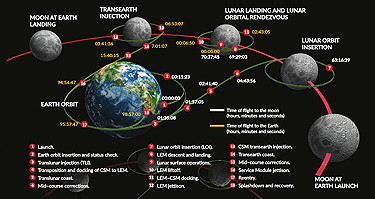
On Board Apollo Moonships contains 100 pages and more than 200 3D-illustrations and images that show in detail the spacecrafts that allowed to travel to the Moon and explore it in the late 1960s and early 70s: from the mighty Saturn V rocket and the Apollo mothership up to the the Lunar Module and the revolutionary Moon Rover. (read more)
TLI
From the Earth to the Moon. Illustration by Carlos Clarivan.

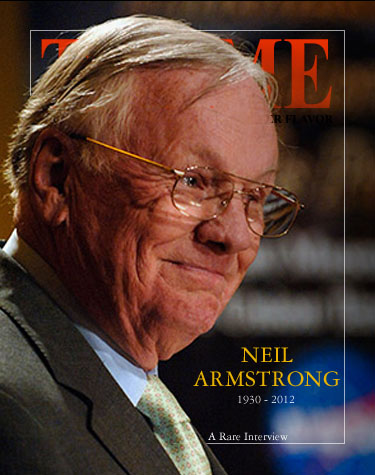
Interview with Neil Armstrong!


The first man to set foot on the moon!

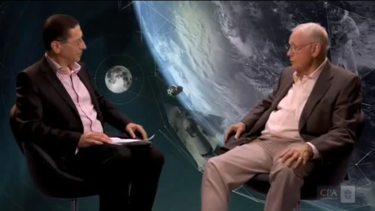
In this rare series of interviews, Neil Armstrong, the first man to set foot on the moon, tells the story of the historic mission from his own perspective. [1.] Alex Malley of Australia's EvoTV's The Bottom Line looks at the life and leadership of the lunar mission's commander. Fascinated by aircraft, even at a very early age, Armstrong obtained his pilot's license at the age of fifteen!

He went on to fly combat missions during the Korean War and later became a test pilot. He then became an astronaut as NASA geared up to meet President John F. Kennedy's challenge to put a man on the moon in the decade and return him safely to earth.

The Russians had already orbited the first satellite, Sputnik, on October 4, 1957 and subsequently orbited cosmonaut Yuri Gagarin as the Americans struggled to develop a dependable booster. After Alan Shepard's short suborbital flight in 1961, President Kennedy challenged the fledgeling space agency to go to the moon.

Armstrong is refreshingly honest in his discussion with Malley. The interview is presented in four parts and is worth watching to the very end. Neil Armstrong expresses very real concern that the space agency lacks the vision and sense of purpose it had in those early years. He ends with a challenge that we as a people would do well to heed and pursue in our own time!

The Full Interview may be found Here [click to listen].


Forty-seven years ago two human beings changed history by walking on the surface of the moon. But what happened before Buzz Aldrin and Neil Armstrong exited the Lunar Module is perhaps even more amazing, if only because so few people know about it.

The First Humans on the Moon
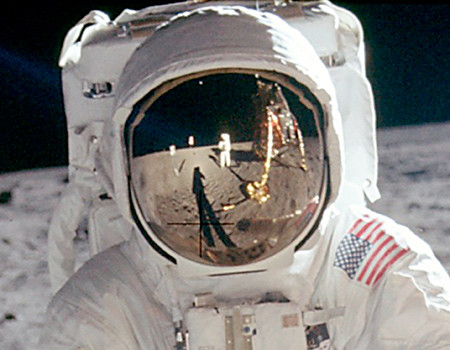
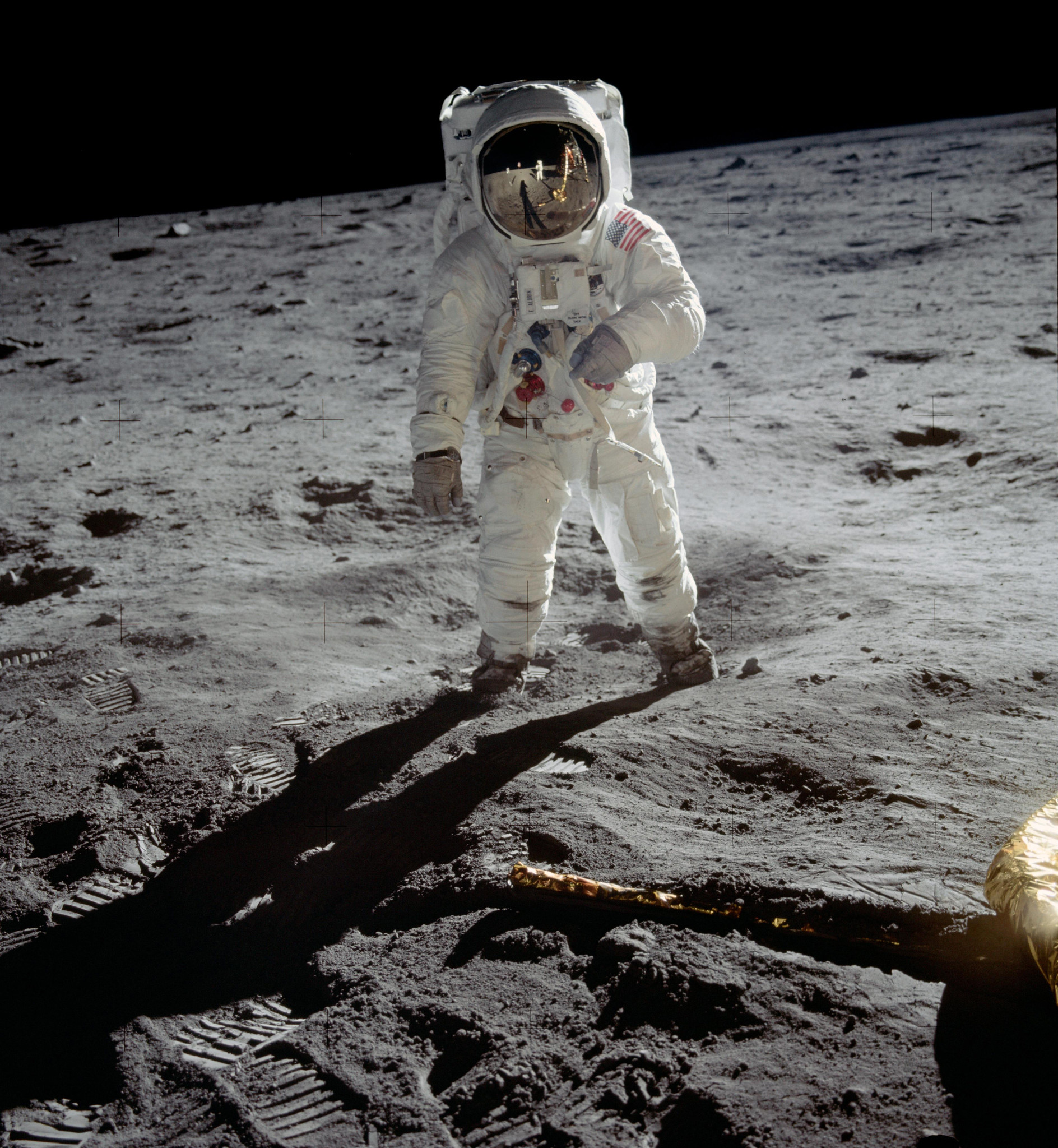
Neil Armstrong Reflected in Buzz Aldrin's Visor
Buzz

Apollo11_PhotoManOnMoon
NASA Photos

Neil Armstrong and Buzz Aldrin
The First Humans on the Moon
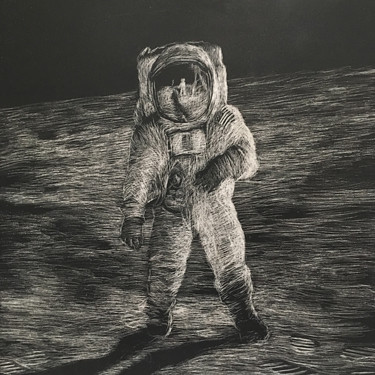
IMG_6623
Neil Armstrong is reflected in the visor of Buzz Aldrin, the first two humans to walk on the moon. Scratchboard, 12" x 12" by Bob Kirchman.

60 Years of NASA
[click to read]

Celebrating Where Art and Science Meet


To celebrate NASA’s 60th anniversary this year, the agency partnered with the National Symphony Orchestra to present a concert in Washington entitled “NSO Pops: Space, the Next Frontier.” NASA mission images complemented performances of space-inspired music in the Kennedy Center’s concert hall, including Claude Debussy’s “Clair de Lune” (“Moonlight”), with a video of the Moon created by NASA science visualizer Ernie Wright.

At NASA’s Goddard Space Flight Center in Greenbelt, Maryland, Wright works in the Scientific Visualization Studio, using NASA data to create accurate visuals of celestial bodies. Wright made the lunar imagery accompanying “Clair de Lune” with data from the Lunar Reconnaissance Orbiter (LRO). (read more)
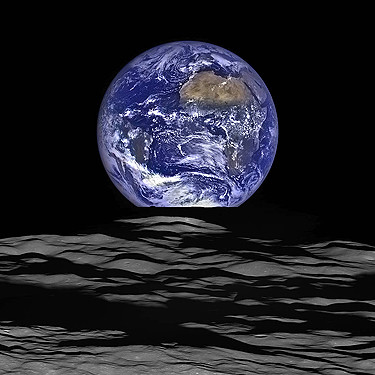
MoonEarthrise
LRO Photo of Earthrise over the moon. NASA Photo.

The World of Tomorrow
Eighty Years Ago the World Came to the NY Fair
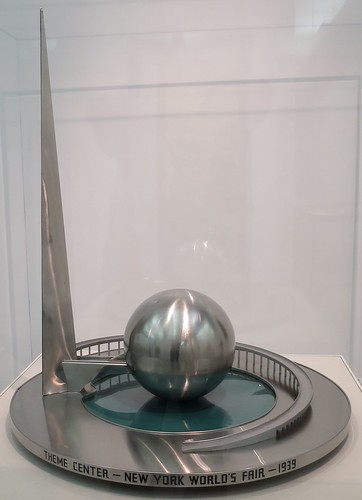
Model,_Theme_Center_-_New_York_World's_Fare_-_1939,_c._1938,_Harrison_&_Fouilhoux
Model of the Trylon and Perisphere, symbols of the fair.

When Frank Baum wrote the Wizard of Oz he based the Emerald City on the 1893 Chicago Columbian Exposition – the Chicago World’s Fair. The fair’s colossal white classical buildings and those of many fairs to follow, would inspire the civic architecture of a young nation coming of age. Baum’s Emerald City was white – until you put on the green glasses! The 1939 World’s Fair, forged in the middle of the Great Depression, sought to bring a new vision for American life as well. It brought more central planning and a stark modernism in its architecture – adding a bit of Art Deco for good measure. The Emerald City of the movie version, made in 1939, looked to the New York fair for its inspiration. That fair was ‘a horse of a different color.’ The Trylon and Perisphere were white, but the buildings were many different colors as they were arranged around the central iconic building. The ‘World of Tomorrow’ is seen from the eyes of a ten year old boy who visited with his family in the Summer of 1939.


This week I will be working with students of Fundoodle Art Camp as they construct a miniature World’s Fair. Here is an introductory video I prepared for them.

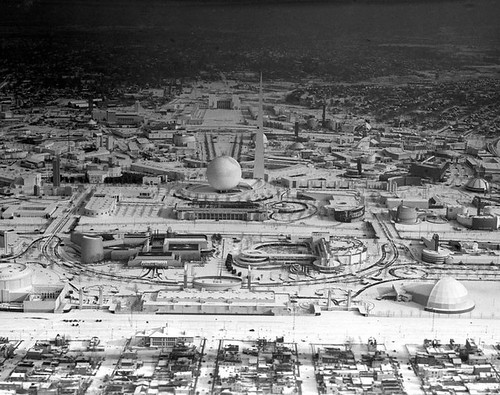

IMG_0428

IMG_0429

The 1964 World's Fair
55 Years Ago, The World Came to New York Again!


Lift your vision high,
   we're in a way we've never been before.
Lift your vision higher,
   and you will see the glory of the Lord.

For without a progressive vision
   we dwell carelessly.
Without a progressive vision
   we dwell carelessly.
So lift your vision higher
   and you will see the glory of the Lord.”
– Unknown
IMG_0431
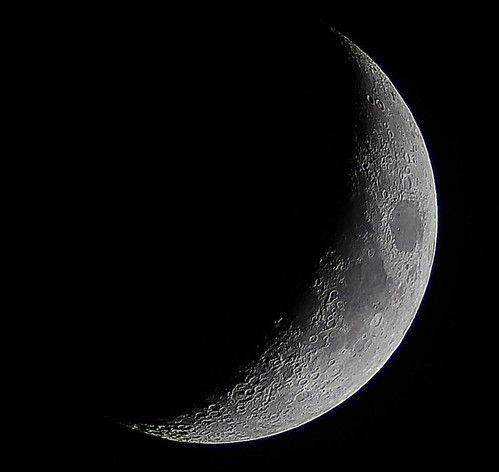
On Saturday, July 6, 2019 the moon was roughly the same waxing phase as it was on July 20, 1969. In honor of the 50th anniversary of Apollo 11, Michal Warzecha took 50 shots with his Canon T3i and 80mm Orion refractor and stacked the images with Autostakker. 
Photo by Michal Warzecha.

Banner

Tuesday, November 13, 2018

Phantasies by George MacDonald, Beethoven

PhantasiesSEVEN
Volume XV, Issue XX

Phantasies
By George MacDonald, Chapter 7

Fight on, my men, Sir Andrew sayes,
A little Ime hurt, but yett not slaine;
He but lye downe and bleede awhile,
And then Ile rise and fight againe."
~ from the "Ballad of Sir Andrew Barton".

But I could not remain where I was any longer, though the daylight was hateful to me, and the thought of the great, innocent, bold sunrise unendurable. Here there was no well to cool my face, smarting with the bitterness of my own tears. Nor would I have washed in the well of that grotto, had it flowed clear as the rivers of Paradise. I rose, and feebly left the sepulchral cave. I took my way I knew not whither, but still towards the sunrise. The birds were singing; but not for me. All the creatures spoke a language of their own, with which I had nothing to do, and to which I cared not to find the key any more.

I walked listlessly along. What distressed me most--more even than my own folly--was the perplexing question, How can beauty and ugliness dwell so near? Even with her altered complexion and her face of dislike; disenchanted of the belief that clung around her; known for a living, walking sepulchre, faithless, deluding, traitorous; I felt notwithstanding all this, that she was beautiful. Upon this I pondered with undiminished perplexity, though not without some gain. Then I began to make surmises as to the mode of my deliverance; and concluded that some hero, wandering in search of adventure, had heard how the forest was infested; and, knowing it was useless to attack the evil thing in person, had assailed with his battle-axe the body in which he dwelt, and on which he was dependent for his power of mischief in the wood. "Very likely," I thought, "the repentant-knight, who warned me of the evil which has befallen me, was busy retrieving his lost honour, while I was sinking into the same sorrow with himself; and, hearing of the dangerous and mysterious being, arrived at his tree in time to save me from being dragged to its roots, and buried like carrion, to nourish him for yet deeper insatiableness." I found afterwards that my conjecture was correct. I wondered how he had fared when his blows recalled the Ash himself, and that too I learned afterwards.

I walked on the whole day, with intervals of rest, but without food; for I could not have eaten, had any been offered me; till, in the afternoon, I seemed to approach the outskirts of the forest, and at length arrived at a farm-house. An unspeakable joy arose in my heart at beholding an abode of human beings once more, and I hastened up to the door, and knocked. A kind-looking, matronly woman, still handsome, made her appearance; who, as soon as she saw me, said kindly, "Ah, my poor boy, you have come from the wood! Were you in it last night?"

I should have ill endured, the day before, to be called boy; but now the motherly kindness of the word went to my heart; and, like a boy indeed, I burst into tears. She soothed me right gently; and, leading me into a room, made me lie down on a settle, while she went to find me some refreshment. She soon returned with food, but I could not eat. She almost compelled me to swallow some wine, when I revived sufficiently to be able to answer some of her questions. I told her the whole story.

It is just as I feared," she said; "but you are now for the night beyond the reach of any of these dreadful creatures. It is no wonder they could delude a child like you. But I must beg you, when my husband comes in, not to say a word about these things; for he thinks me even half crazy for believing anything of the sort. But I must believe my senses, as he cannot believe beyond his, which give him no intimations of this kind. I think he could spend the whole of Midsummer-eve in the wood and come back with the report that he saw nothing worse than himself. Indeed, good man, he would hardly find anything better than himself, if he had seven more senses given him."

But tell me how it is that she could be so beautiful without any heart at all--without any place even for a heart to live in."

I cannot quite tell," she said; "but I am sure she would not look so beautiful if she did not take means to make herself look more beautiful than she is. And then, you know, you began by being in love with her before you saw her beauty, mistaking her for the lady of the marble--another kind altogether, I should think. But the chief thing that makes her beautiful is this: that, although she loves no man, she loves the love of any man; and when she finds one in her power, her desire to bewitch him and gain his love (not for the sake of his love either, but that she may be conscious anew of her own beauty, through the admiration he manifests), makes her very lovely--with a self- destructive beauty, though; for it is that which is constantly wearing her away within, till, at last, the decay will reach her face, and her whole front, when all the lovely mask of nothing will fall to pieces, and she be vanished for ever. So a wise man, whom she met in the wood some years ago, and who, I think, for all his wisdom, fared no better than you, told me, when, like you, he spent the next night here, and recounted to me his adventures."

I thanked her very warmly for her solution, though it was but partial; wondering much that in her, as in woman I met on my first entering the forest, there should be such superiority to her apparent condition. Here she left me to take some rest; though, indeed, I was too much agitated to rest in any other way than by simply ceasing to move.

In half an hour, I heard a heavy step approach and enter the house. A jolly voice, whose slight huskiness appeared to proceed from overmuch laughter, called out "Betsy, the pigs' trough is quite empty, and that is a pity. Let them swill, lass! They're of no use but to get fat. Ha! ha! ha! Gluttony is not forbidden in their commandments. Ha! ha! ha!" The very voice, kind and jovial, seemed to disrobe the room of the strange look which all new places wear--to disenchant it out of the realm of the ideal into that of the actual. It began to look as if I had known every corner of it for twenty years; and when, soon after, the dame came and fetched me to partake of their early supper, the grasp of his great hand, and the harvest-moon of his benevolent face, which was needed to light up the rotundity of the globe beneath it, produced such a reaction in me, that, for a moment, I could hardly believe that there was a Fairy Land; and that all I had passed through since I left home, had not been the wandering dream of a diseased imagination, operating on a too mobile frame, not merely causing me indeed to travel, but peopling for me with vague phantoms the regions through which my actual steps had led me. But the next moment my eye fell upon a little girl who was sitting in the chimney-corner, with a little book open on her knee, from which she had apparently just looked up to fix great inquiring eyes upon me. I believed in Fairy Land again. She went on with her reading, as soon as she saw that I observed her looking at me. I went near, and peeping over her shoulder, saw that she was reading The History of Graciosa and Percinet."

Very improving book, sir," remarked the old farmer, with a good- humoured laugh. "We are in the very hottest corner of Fairy Land here. Ha! ha! Stormy night, last night, sir."

Was it, indeed?" I rejoined. "It was not so with me. A lovelier night I never saw." "Indeed! Where were you last night?"

I spent it in the forest. I had lost my way."

Ah! then, perhaps, you will be able to convince my good woman, that there is nothing very remarkable about the forest; for, to tell the truth, it bears but a bad name in these parts. I dare say you saw nothing worse than yourself there?"

I hope I did," was my inward reply; but, for an audible one, I contented myself with saying, "Why, I certainly did see some appearances I could hardly account for; but that is nothing to be wondered at in an unknown wild forest, and with the uncertain light of the moon alone to go by."

Very true! you speak like a sensible man, sir. We have but few sensible folks round about us. Now, you would hardly credit it, but my wife believes every fairy-tale that ever was written. I cannot account for it. She is a most sensible woman in everything else."

But should not that make you treat her belief with something of respect, though you cannot share in it yourself?"

Yes, that is all very well in theory; but when you come to live every day in the midst of absurdity, it is far less easy to behave respectfully to it. Why, my wife actually believes the story of the 'White Cat.' You know it, I dare say."

I read all these tales when a child, and know that one especially well."

But, father," interposed the little girl in the chimney-corner, "you know quite well that mother is descended from that very princess who was changed by the wicked fairy into a white cat. Mother has told me so a many times, and you ought to believe everything she says."

I can easily believe that," rejoined the farmer, with another fit of laughter; "for, the other night, a mouse came gnawing and scratching beneath the floor, and would not let us go to sleep. Your mother sprang out of bed, and going as near it as she could, mewed so infernally like a great cat, that the noise ceased instantly. I believe the poor mouse died of the fright, for we have never heard it again. Ha! ha! ha!"

The son, an ill-looking youth, who had entered during the conversation, joined in his father's laugh; but his laugh was very different from the old man's: it was polluted with a sneer. I watched him, and saw that, as soon as it was over, he looked scared, as if he dreaded some evil consequences to follow his presumption. The woman stood near, waiting till we should seat ourselves at the table, and listening to it all with an amused air, which had something in it of the look with which one listens to the sententious remarks of a pompous child. We sat down to supper, and I ate heartily. My bygone distresses began already to look far off.

In what direction are you going?" asked the old man.

Eastward," I replied; nor could I have given a more definite answer. "Does the forest extend much further in that direction?" "Oh! for miles and miles; I do not know how far. For although I have lived on the borders of it all my life, I have been too busy to make journeys of discovery into it. Nor do I see what I could discover. It is only trees and trees, till one is sick of them. By the way, if you follow the eastward track from here, you will pass close to what the children say is the very house of the ogre that Hop-o'-my-Thumb visited, and ate his little daughters with the crowns of gold." "Oh, father! ate his little daughters! No; he only changed their gold crowns for nightcaps; and the great long-toothed ogre killed them in mistake; but I do not think even he ate them, for you know they were his own little ogresses." "Well, well, child; you know all about it a great deal better than I do. However, the house has, of course, in such a foolish neighbourhood as this, a bad enough name; and I must confess there is a woman living in it, with teeth long enough, and white enough too, for the lineal descendant of the greatest ogre that ever was made. I think you had better not go near her." In such talk as this the night wore on. When supper was finished, which lasted some time, my hostess conducted me to my chamber. "If you had not had enough of it already," she said, "I would have put you in another room, which looks towards the forest; and where you would most likely have seen something more of its inhabitants. For they frequently pass the window, and even enter the room sometimes. Strange creatures spend whole nights in it, at certain seasons of the year. I am used to it, and do not mind it. No more does my little girl, who sleeps in it always. But this room looks southward towards the open country, and they never show themselves here; at least I never saw any." I was somewhat sorry not to gather any experience that I might have, of the inhabitants of Fairy Land; but the effect of the farmer's company, and of my own later adventures, was such, that I chose rather an undisturbed night in my more human quarters; which, with their clean white curtains and white linen, were very inviting to my weariness. In the morning I awoke refreshed, after a profound and dreamless sleep. The sun was high, when I looked out of the window, shining over a wide, undulating, cultivated country. Various garden-vegetables were growing beneath my window. Everything was radiant with clear sunlight. The dew-drops were sparkling their busiest; the cows in a near-by field were eating as if they had not been at it all day yesterday; the maids were singing at their work as they passed to and fro between the out-houses: I did not believe in Fairy Land. I went down, and found the family already at breakfast. But before I entered the room where they sat, the little girl came to me, and looked up in my face, as though she wanted to say something to me. I stooped towards her; she put her arms round my neck, and her mouth to my ear, and whispered--

A white lady has been flitting about the house all night."

No whispering behind doors!" cried the farmer; and we entered together. "Well, how have you slept? No bogies, eh?"

Not one, thank you; I slept uncommonly well."

I am glad to hear it. Come and breakfast."

After breakfast, the farmer and his son went out; and I was left alone with the mother and daughter.

When I looked out of the window this morning," I said, "I felt almost certain that Fairy Land was all a delusion of my brain; but whenever I come near you or your little daughter, I feel differently. Yet I could persuade myself, after my last adventures, to go back, and have nothing more to do with such strange beings."

How will you go back?" said the woman.

Nay, that I do not know."

Because I have heard, that, for those who enter Fairy Land, there is no way of going back. They must go on, and go through it. How, I do not in the least know."

That is quite the impression on my own mind. Something compels me to go on, as if my only path was onward, but I feel less inclined this morning to continue my adventures."

Will you come and see my little child's room? She sleeps in the one I told you of, looking towards the forest."

Willingly," I said.

So we went together, the little girl running before to open the door for us. It was a large room, full of old-fashioned furniture, that seemed to have once belonged to some great house.

The window was built with a low arch, and filled with lozenge-shaped panes. The wall was very thick, and built of solid stone. I could see that part of the house had been erected against the remains of some old castle or abbey, or other great building; the fallen stones of which had probably served to complete it. But as soon as I looked out of the window, a gush of wonderment and longing flowed over my soul like the tide of a great sea. Fairy Land lay before me, and drew me towards it with an irresistible attraction. The trees bathed their great heads in the waves of the morning, while their roots were planted deep in gloom; save where on the borders the sunshine broke against their stems, or swept in long streams through their avenues, washing with brighter hue all the leaves over which it flowed; revealing the rich brown of the decayed leaves and fallen pine-cones, and the delicate greens of the long grasses and tiny forests of moss that covered the channel over which it passed in motionless rivers of light. I turned hurriedly to bid my hostess farewell without further delay. She smiled at my haste, but with an anxious look.

You had better not go near the house of the ogre, I think. My son will show you into another path, which will join the first beyond it."

Not wishing to be headstrong or too confident any more, I agreed; and having taken leave of my kind entertainers, went into the wood, accompanied by the youth. He scarcely spoke as we went along; but he led me through the trees till we struck upon a path. He told me to follow it, and, with a muttered "good morning" left me.
(to be continued in two weeks)

WildWoods
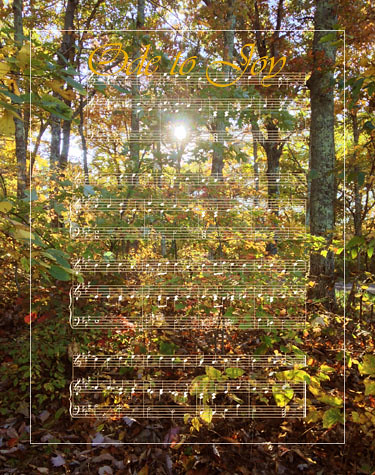
Photo by Bob Kirchman.

The First Man on the Moon
Actual Interviews with His Family and Friends


Karen’s Bracelet

In the movie First Man Neil Armstrong is shown walking over to the edge of Little West Crater and tossing a bracelet with his daughter’s name on it into the crater. Karen Armstrong died of a brain tumor at age two before Neil Armstrong became an astronaut in the Gemini Program. From all accounts he loved her deeply and after Karen’s death, Armstrong immersed himself in his work. Though the movie takes quite a bit of liberty in depicting the events of Armstrong’s life, the bracelet scene has its roots in some pretty sound speculation. Though the two hours and 31 minutes of EVA time on the lunar surface were packed with mission objectives, Armstrong did wander over to Little West Crater at one point and that was off script. Jim Hansen wrote the official biography of Armstrong and after extensive interviews with the family, he began to believe that Neil left something on the moon – something of Karen’s.

Other astronauts had left mementos as well. Gene Cernan had promised to bring his daughter back a moonbeam and he wrote her initials in the lunar dust. Charlie Duke left a picture of his family. Buzz Aldrin left personal effects of the Apollo One astronauts Grissom, White and Chaffee who had perished in the launch pad fire. Hansen put the question to June Hoffman, Neil’s sister, as to whether her brother had left something for Karen on the moon, She responded “Oh, I dearly hope so.”

Perhaps the answer to the mystery lies in the manifest for Neil Armstrong’s Personal Property Kit, which is sealed until 2020 in his archives at Perdue University. Buzz Aldrin’s manifest contains the communion set given to him by his pastor – which he used to Celebrate the Lord’s Supper as his first act on the moon. My own feeling is that it is highly likely. In the days when architectural rendering involved hours of drawing detail by hand, I often hid the names of my children in that detail. Celebrating our loved ones, particularly those who have passed, is a tradition that has lived for many generations.

IMG_4619
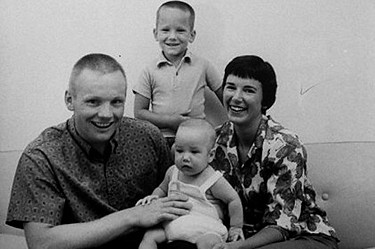
The Armstrongs.

Learning from L'Engle
[click to read]

by Blake Atwood

Obedience is an unpopular word nowadays, but the artist must be obedient to the work, whether it be a symphony, a painting, or a story for a small child. I believe that each work of art, whether it is a work of great genius or something very small, comes to the artist and says ‘Here I am. Enflesh me. Give birth to me.’ And the artist either says ‘My soul doth magnify the Lord’ and willingly becomes the bearer of the work, or refuses; but the obedient response is not necessarily a conscious one, and not everyone has the humble, courageous obedience of Mary [the mother of Jesus].” -- Madeline L'Engle

Walking on Water is as old as I am, and I’m saddened to know that I could have read this book years ago, possibly even adding it to the currently empty list of Books I Have to Read Every Year. I may be reading the wrong books, but few have ever arrested me as quickly or as deeply as this work has. Maybe it’s more about fortuitous timing, where her words hesitantly written decades ago ring true to where I now find myself. Regardless, it’s a stunning work that I highly recommend for any Christian endeavoring to use their creative gifts for the greater good … and I’ve only read two chapters. (read more)

Mission Control
The Unsung Heroes of Apollo


2 Chronicles 7:14

If my people, which are called by my name, shall humble themselves, and pray, and seek my face, and turn from their wicked ways; then will I hear from heaven, and will forgive their sin, and will heal their land.” – 2 Chronicles 7:14

Once again we have lived through a contentious election. This is not the first, nor will it likely be the last. Still, it is a good time to remember that it is the Soul of a nation, not its laws and rulers, that make it what it is.

Alexis de Tocqueville
[click to read]

July 29 marks the birth of Alexis de Tocqueville. Motivated by his “love of liberty and human dignity,” his Democracy in America has been called “one of the wisest works of modern thought,” that for understanding and preserving liberty, “the intelligent American reader can find no better guide.”

Despite democracy’s prominence in his title, de Tocqueville’s focus was liberty, because “the only passions I have are love of liberty and human dignity.” Revisiting him is particularly important now, when the need for a political majority has become virtually the only limit on government, because he saw how democracy can subvert liberty. (read more)

CarsonGifted
The final movement of Beethoven's 9th

The Final Movement

Discordant notes... 
...ruin the symphony.

Unless...

What if you embrace the discordant note?

And use it to start a new melody..."

A powerful short film by Jason Jones and  Eduardo Verástegui.


snowtrees003
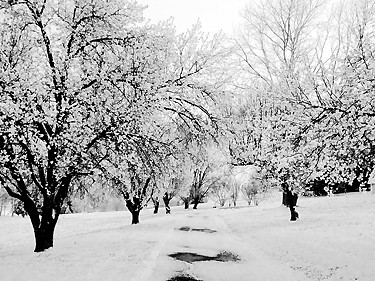
Bradford pear blossoms in snow. Photo by Bob Kirchman.

Art and the Gospel
Using Your Compass
[click to read]

To the real Christian, the Gospel’s unique truths are the center to which she gravitates – the very sun of her solar system, the soul of the world. They are the origin of all that is excellent and lovely, the source of light and life, motion and warmth. From them comes all creative energy. Our intellects would be cold and comfortless without their light and guidance.” – William Wilberforce

Not long ago The DaVinci Code came upon the literary scene and this work of fiction, based on Gnostic writings, became the center of much discussion about Faith in our day. One of the elders of our church conducted a very thorough study in which he pointed out what was based on Holy Writ, and what was based on these non-canonical sources. It was a very profitable investigation into what we believe and why. Naturally there are those who are unfamiliar with the Gospel who will read such a work at face value, not digging deeper to find that it has been sourced from works that are of varied integrity. Yes, this is dangerous, but perhaps there is also a benefit to be had by opening a discussion. (read more)

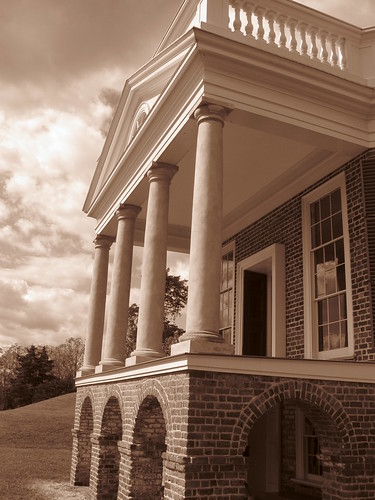
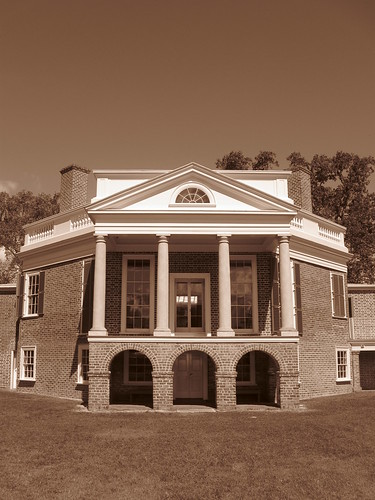
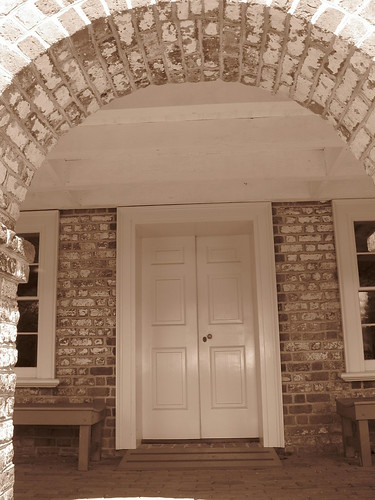
Thomas Jefferson's Poplar Forest
His Lesser Known Home Near Lynchburg
Photos by Bob Kirchman

IMG_3634
Photos by Bob Kirchman.

Legend has it that Thomas Jefferson, fleeing the British troops in June of 1781, retreated to a piece of property he had acquired through marrying Martha Wayles Skelton in 1773. Taking up residence with his family in the only small dwelling on the property -- a caretaker's house, he spent his time in the cramped quarters calculating how long it would take to repay the national debt!

Then, as now, the pressures of public life made a retreat desirable and Jefferson would return to the property and build 'Poplar Forest' over a period of almost two decades. Inspired by the villas of Renaissance architect, Andrea Palladio, he created the Neoclassical Octagon House. Construction began in 1806 and continued until 1823!

IMG_3615

IMG_3618

CS_Lewis_Banner

Wednesday, November 30, 2016

Interview with Neil Armstrong

Citizen Journalism with a Better Flavor

THYME0814a
Volume XII, Issue XIII

A Repeat of One of Our Favorite Issues

Interview with Neil Armstrong!


The first man to set foot on the moon!

In this rare series of interviews, Neil Armstrong, the first man to set foot on the moon, tells the story of the historic mission from his own perspective. [1.] Alex Malley of Australia's EvoTV's The Bottom Line looks at the life and leadership of the lunar mission's commander. Fascinated by aircraft, even at a very early age, Armstrong obtained his pilot's license at the age of fifteen!

He went on to fly combat missions during the Korean War and later became a test pilot. He then became an astronaut as NASA geared up to meet President John F. Kennedy's challenge to put a man on the moon in the decade and return him safely to earth.

The Russians had already orbited the first satellite, Sputnik, on October 4, 1957 and subsequently orbited cosmonaut Yuri Gagarin as the Americans struggled to develop a dependable booster. After Alan Shepard's short suborbital flight in 1961, President Kennedy challenged the fledgeling space agency to go to the moon.

Armstrong is refreshingly honest in his discussion with Malley. The interview is presented in four parts and is worth watching to the very end. Neil Armstrong expresses very real concern that the space agency lacks the vision and sense of purpose it had in those early years. He ends with a challenge that we as a people would do well to heed and pursue in our own time!


Forty-seven years ago two human beings changed history by walking on the surface of the moon. But what happened before Buzz Aldrin and Neil Armstrong exited the Lunar Module is perhaps even more amazing, if only because so few people know about it.

Solving an Age Old Problem


At Amsterdam's Schiphol Airport, items left on a plane are returned quickly as Sherlock sniffs out their owners!

Banner

Wednesday, August 3, 2016

Neil Armstrong Interview II

Citizen Journalism with a Better Flavor

THYME0815
Volume XII, Issue II

"We Choose to Go to the Moon..."

Last week we presented a rare Interview with Neil Armstrong [click to view]. If you have not had a chance to watch it in its entirety, please do so. It is a refreshing look at the fulfillment of great human aspiration from the perspective of the very humble man who did it! Alex Malley is refreshing in his open style of interview and he allows Neil Armstrong to be seen as the man he is. There is no drive to sensationalize or twist the story, rather one sees how Armstrong rose from a little boy who was uneasy with the concept of death to a man capable of taking great risks in a well reasoned manner. That was a quality he would need in his journey to the moon.

Armstrong!
Alex Malley converses with Commander Neil Armstrong.

Indeed, his story is one to remember, but he is not the first brave man who did not appear so in our first glimpse of him. The morning of my birthday I found myself reading from the Book of Judges in my daily reading. The story was that of Gideon. When we first meet him in Judges chapter 6 he is threshing grain while hiding in a winepress. Normally grain was threshed on a hill in the open so the chaff will blow away, but Gideon fears the Midionites, who raid the land and steal the grain. Hence, he is hiding in the winepress.

An angel of the Lord appears to him saying: "The LORD is with thee, thou mighty man of valour."

Gideon's answer is anything but valorous, he replies: "Oh my Lord, if the LORD be with us, why then is all this befallen us? and where be all his miracles which our fathers told us of, saying, Did not the LORD bring us up from Egypt? but now the LORD hath forsaken us, and delivered us into the hands of the Midianites."

And the LORD looked upon him, and said, Go in this thy might, and thou shalt save Israel from the hand of the Midianites: have not I sent thee?

And he said unto him, Oh my Lord, wherewith shall I save Israel? behold, my family is poor in Manasseh, and I am the least in my father's house.

And the LORD said unto him, Surely I will be with thee, and thou shalt smite the Midianites as one man.

And he said unto him, If now I have found grace in thy sight, then shew me a sign that thou talkest with me.

Gideon might have been the 'least in his father's house.' He indeed asked for a lot of confirmation but then he boldly stepped out and trusted G-d, who did mighty things through him. He went on to win a decisive victory over the Midianites with just 300 men! The time Gideon lived in was one of great despair for the people, as the Midianites had robbed and disheartened them. At times like that (and times like our own),we often find ourselves crying out for extraordinary leaders.We forget that extraordinary things are often done by very ordinary men and women in the face of extraordinary challenges.

Listening to Armstrong, one is struck by his humility and matter-of-fact description of the incredible events he participated in. He does not like to talk about himself and though he is a man of high accomplishment, he is reluctant to take any more of his share of the credit for it. I am incredibly blessed to know young men and women cast in the same mold who live in our times. What will the Divine accomplish through their lives, I ask? I think of President John F. Kennedy's setting the bar: "We choose to go to the moon. We choose to go to the moon in this decade and do the other things, not because they are easy, but because they are hard, because that goal will serve to organize and measure the best of our energies and skills, because that challenge is one that we are willing to accept, one we are unwilling to postpone, and one which we intend to win, and the others, too." [1.] The challenge before us in our times is great indeed!

I step out of the tent and gaze up at the stars. In my lifetime I saw mankind reach for them. My father was an engineer with NASA in its golden age and he developed a device known as the Launch Phase Simulator. [2.] Framed in the trees in the night sky I see the constellation Orion. That was one of the first ones my father taught me to recognize... the mighty hunter with his dagger and his distinctive belt! Generations must have been inspired by the sight before me this night! I think of the young people I have been priviledged to work with. I have seen them grow into people capable of being used to change the world (for the better), and I am humbled to think that I might have somehow been used to influence their lives. And so I plead; we NEED to leave them a country that challenges them as those before us were challenged... to dare and do great things!

Man's First Act on the Moon:

Buzz Aldrin describes, in his own words, the first act of men visiting another world, to honor G-d: “In the radio blackout, I opened the little plastic packages which contained the bread and the wine. I poured the wine into the chalice our church had given me. In the one-sixth gravity of the moon, the wine slowly curled and gracefully came up the side of the cup. Then I read the Scripture, ‘I am the vine, you are the branches. Whosoever abides in me will bring forth much fruit. Apart from me you can do nothing.’ I had intended to read my communion passage back to earth, but at the last minute [they] had requested that I not do this. NASA was already embroiled in a legal battle with Madelyn Murray O’Hare, the celebrated opponent of religion, over the Apollo 8 crew reading from Genesis while orbiting the moon at Christmas. I agreed reluctantly. …I ate the tiny Host and swallowed the wine. I gave thanks for the intelligence and spirit that had brought two young pilots to the Sea of Tranquility. It was interesting for me to think: the very first liquid ever poured on the moon, and the very first food eaten there, were the communion elements.”

Eric Metaxas writes: "And of course, it’s interesting to think that some of the first words spoken on the moon were the words of Jesus Christ, who made the Earth and the moon — and Who, in the immortal words of Dante, is Himself the “Love that moves the Sun and other stars.” [3.]

The America I Love
Photos by Bob Kirchman

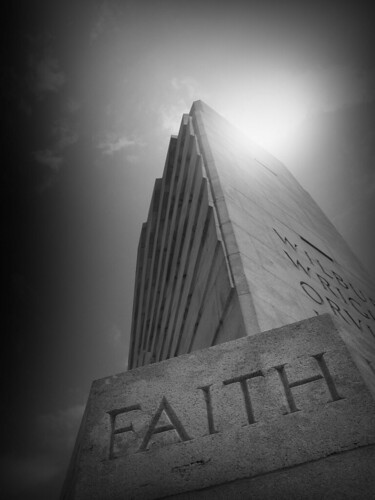
Wright Brothers' Memorial
The Wright Brothers' Memorial, Kitty Hawk, North Carolina.

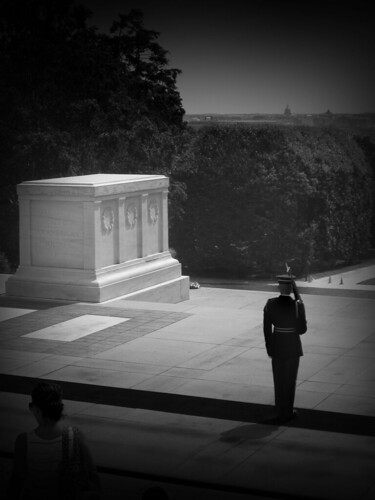
Tomb of the Unknown Soldier
Tomb of the Unknown Soldier, Arlington, Virginia.

Grier
William Moffatt Grier: Citizen, Soldier, Educator, Servant of Christ. Born Feb. 11 1843; Died Sept. 3, 1899. President of Erskine College from 1871 to 1899. His service is measured not by years but by results. He still lives in hundreds of useful lives to which he gave inspiration and guidance - "life's work well done, life's race well run, life's crown well won, now comes rest."

Grier lost a leg in the Civil War Battle of Williamsburg and later became an educator and president of a seminary.

Next Week in THYME:
A Story in a Painting

Meet Belle, her real life story is the story behind an intriguing Eighteenth Century Painting. It has recently been made into a fascinating movie and tells the story of how her family's love for her compelled them to stand against the beast within; the human depravity that would enslave and destroy her people!

Wednesday, July 27, 2016

Interview with Neill Armstrong

Citizen Journalism with a Better Flavor

THYME0814a
Volume XII, Issue I

Interview with Neil Armstrong!


The first man to set foot on the moon!

In this rare series of interviews, Neil Armstrong, the first man to set foot on the moon, tells the story of the historic mission from his own perspective. Alex Malley of Australia's EvoTV's The Bottom Line looks at the life and leadership of the lunar mission's commander. Fascinated by aircraft, even at a very early age, Armstrong obtained his pilot's license at the age of fifteen!

He went on to fly combat missions during the Korean War and later became a test pilot. He then became an astronaut as NASA geared up to meet President John F. Kennedy's challenge to put a man on the moon in the decade and return him safely to earth.

The Russians had already orbited the first satellite, Sputnik, on October 4, 1957 and subsequently orbited cosmonaut Yuri Gagarin as the Americans struggled to develop a dependable booster. After Alan Shepard's short suborbital flight in 1961, President Kennedy challenged the fledgeling space agency to go to the moon.

Armstrong is refreshingly honest in his discussion with Malley. The interview is presented in four parts and is worth watching to the very end. Neil Armstrong expresses very real concern that the space agency lacks the vision and sense of purpose it had in those early years. He ends with a challenge that we as a people would do well to heed and pursue in our own time!


Forty-seven years ago two human beings changed history by walking on the surface of the moon. But what happened before Buzz Aldrin and Neil Armstrong exited the Lunar Module is perhaps even more amazing, if only because so few people know about it.

Time to Awaken a Sleeping Giant

In 2004, Christian voter turnout increased by 93 percent over the 2002 turnout, and 42 percent of voters identified abortion as an important issue. As a result:

• 63 percent of the freshman U.S. congressmen elected were pro-life.
• 77 percent of the freshman U.S. senators were pro-life.

By increasing pro-life representation in Congress in the 2002 and 2004 elections, America witnessed the first four major abortion-restricting bills enacted since Roe v. Wade:

• Infants Born Alive Protection Act
• Unborn Victims of Violence Act
• Partial-Birth Abortion Ban
• Fetal Farming Ban

In addition, those senators helped confirm strict constructionists John Roberts and Samuel Alito to the U.S. Supreme Court. By 2006, Christian voter turnout decreased by 30 percent from the 2004 numbers, and only 30 percent of voters said that abortion was an important issue. As a result:

• Only 31 percent of the freshman U.S. congressmen elected were pro-life.
• Only 10 percent of the freshman U.S. senators elected were pro-life.
• The Baltimore Sun labeled the 2007 Congress as “the most pro-choice Congress in the history of the Republic.”

Your vote does matter, and you have the opportunity to protect life, marriage and family. Will you commit to cast your vote in support of the family this November?

Virginia Voter Information:

State General Election: November 8, 2016
Virginia polling times: 6:00am to 7:00pm
Registration deadline November 2, 2016
Register Online [click to register].

A Call to Action!

Right around you, in your church or place of business, are the discouraged people who likely share your values but won't bother to vote! Elections have consequences and we are losing religious freedom and basic protections found in the Bill of Rights by our apathy. There are Excellent Resources [click to read] to help you get your friends and neighbors registered. There are voter guides to help them make informed decisions.

"And let us not be weary in well doing: for in due season we shall reap, if we faint not." -- Galatians 6:9

Solving an Age Old Problem


At Amsterdam's Schiphol Airport, items left on a plane are returned quickly as Sherlock sniffs out their owners!

Friday, July 31, 2015

THYME Magazine: Interview with Neil Armstrong

Citizen Journalism with a Better Flavor

THYME0814a
Volume X, Issue III

Interview with Neil Armstrong!


The first man to set foot on the moon!

In this rare series of interviews, Neil Armstrong, the first man to set foot on the moon, tells the story of the historic mission from his own perspective. Alex Malley of Australia's EvoTV's The Bottom Line looks at the life and leadership of the lunar mission's commander. Fascinated by aircraft, even at a very early age, Armstrong obtained his pilot's license at the age of fifteen!

He went on to fly combat missions during the Korean War and later became a test pilot. He then became an astronaut as NASA geared up to meet President John F. Kennedy's challenge to put a man on the moon in the decade and return him safely to earth.

The Russians had already orbited the first satellite, Sputnik, on October 4, 1957 and subsequently orbited cosmonaut Yuri Gagarin as the Americans struggled to develop a dependable booster. After Alan Shepard's short suborbital flight in 1961, President Kennedy challenged the fledgeling space agency to go to the moon.

Armstrong is refreshingly honest in his discussion with Malley. The interview is presented in four parts and is worth watching to the very end. Neil Armstrong expresses very real concern that the space agency lacks the vision and sense of purpose it had in those early years. He ends with a challenge that we as a people would do well to heed and pursue in our own time!


Forty-five years ago two human beings changed history by walking on the surface of the moon. But what happened before Buzz Aldrin and Neil Armstrong exited the Lunar Module is perhaps even more amazing, if only because so few people know about it.

Man's First Act on the Moon:

Buzz Aldrin describes, in his own words, the first act of men visiting another world, to honor G-d: “In the radio blackout, I opened the little plastic packages which contained the bread and the wine. I poured the wine into the chalice our church had given me. In the one-sixth gravity of the moon, the wine slowly curled and gracefully came up the side of the cup. Then I read the Scripture, ‘I am the vine, you are the branches. Whosoever abides in me will bring forth much fruit. Apart from me you can do nothing.’ I had intended to read my communion passage back to earth, but at the last minute [they] had requested that I not do this. NASA was already embroiled in a legal battle with Madelyn Murray O’Hare, the celebrated opponent of religion, over the Apollo 8 crew reading from Genesis while orbiting the moon at Christmas. I agreed reluctantly. …I ate the tiny Host and swallowed the wine. I gave thanks for the intelligence and spirit that had brought two young pilots to the Sea of Tranquility. It was interesting for me to think: the very first liquid ever poured on the moon, and the very first food eaten there, were the communion elements.”

Eric Metaxas writes: "And of course, it’s interesting to think that some of the first words spoken on the moon were the words of Jesus Christ, who made the Earth and the moon — and Who, in the immortal words of Dante, is Himself the “Love that moves the Sun and other stars.” [3.]

Solving an Age Old Problem


At Amsterdam's Schiphol Airport, items left on a plane are returned quickly as Sherlock sniffs out their owners!

BannerforDinner

Special Book Section

Several weeks ago we began the serial presentation of "Pontifus, The Bridge Builder's Tale in Three Parts." [1.] This week we present the second chapter of the second book: "Zimmerman's Folly" Here [click to read]. This special book section will continue through the Summer. The full publication of THYME will resume in the Fall. Look for a new installment each Wednesday morning.