Wednesday, July 27, 2016

Interview with Neill Armstrong

Citizen Journalism with a Better Flavor
THYME0814a
Volume XII, Issue I

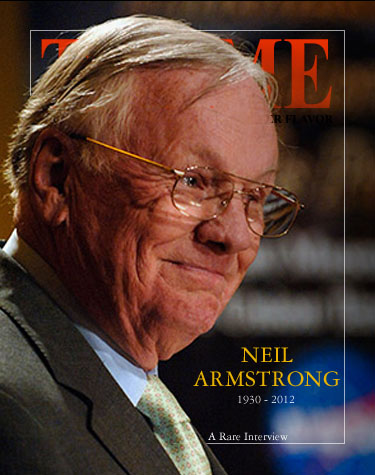
Interview with Neil Armstrong!


The first man to set foot on the moon!

In this rare series of interviews, Neil Armstrong, the first man to set foot on the moon, tells the story of the historic mission from his own perspective. Alex Malley of Australia's EvoTV's The Bottom Line looks at the life and leadership of the lunar mission's commander. Fascinated by aircraft, even at a very early age, Armstrong obtained his pilot's license at the age of fifteen!

He went on to fly combat missions during the Korean War and later became a test pilot. He then became an astronaut as NASA geared up to meet President John F. Kennedy's challenge to put a man on the moon in the decade and return him safely to earth.

The Russians had already orbited the first satellite, Sputnik, on October 4, 1957 and subsequently orbited cosmonaut Yuri Gagarin as the Americans struggled to develop a dependable booster. After Alan Shepard's short suborbital flight in 1961, President Kennedy challenged the fledgeling space agency to go to the moon.

Armstrong is refreshingly honest in his discussion with Malley. The interview is presented in four parts and is worth watching to the very end. Neil Armstrong expresses very real concern that the space agency lacks the vision and sense of purpose it had in those early years. He ends with a challenge that we as a people would do well to heed and pursue in our own time!


Forty-seven years ago two human beings changed history by walking on the surface of the moon. But what happened before Buzz Aldrin and Neil Armstrong exited the Lunar Module is perhaps even more amazing, if only because so few people know about it.

Time to Awaken a Sleeping Giant

In 2004, Christian voter turnout increased by 93 percent over the 2002 turnout, and 42 percent of voters identified abortion as an important issue. As a result:

• 63 percent of the freshman U.S. congressmen elected were pro-life.
• 77 percent of the freshman U.S. senators were pro-life.

By increasing pro-life representation in Congress in the 2002 and 2004 elections, America witnessed the first four major abortion-restricting bills enacted since Roe v. Wade:

• Infants Born Alive Protection Act
• Unborn Victims of Violence Act
• Partial-Birth Abortion Ban
• Fetal Farming Ban

In addition, those senators helped confirm strict constructionists John Roberts and Samuel Alito to the U.S. Supreme Court. By 2006, Christian voter turnout decreased by 30 percent from the 2004 numbers, and only 30 percent of voters said that abortion was an important issue. As a result:

• Only 31 percent of the freshman U.S. congressmen elected were pro-life.
• Only 10 percent of the freshman U.S. senators elected were pro-life.
• The Baltimore Sun labeled the 2007 Congress as “the most pro-choice Congress in the history of the Republic.”

Your vote does matter, and you have the opportunity to protect life, marriage and family. Will you commit to cast your vote in support of the family this November?

Virginia Voter Information:

State General Election: November 8, 2016
Virginia polling times: 6:00am to 7:00pm
Registration deadline November 2, 2016
Register Online [click to register].

A Call to Action!

Right around you, in your church or place of business, are the discouraged people who likely share your values but won't bother to vote! Elections have consequences and we are losing religious freedom and basic protections found in the Bill of Rights by our apathy. There are Excellent Resources [click to read] to help you get your friends and neighbors registered. There are voter guides to help them make informed decisions.

"And let us not be weary in well doing: for in due season we shall reap, if we faint not." -- Galatians 6:9

Solving an Age Old Problem


At Amsterdam's Schiphol Airport, items left on a plane are returned quickly as Sherlock sniffs out their owners!

Friday, July 15, 2016

THYME MAGAZINE: The Gift Horse

Citizen Journalism with a Better Flavor

GiftHorse
Volume XI, Issue XXVII

If there was anything that bothered Rupert Zimmerman it was 'impossibility' created solely by bureaucratic convolutions. When the family packed in the car during his youth to visit the extended family in Michigan, they were inevitably faced with the Breezewood Interchange on Interstate Seventy. On Summer road trips the mighty highway's brief diversion to the old Lincoln highway resulted in gargantuan traffic jams, boiling radiators and often as many boiling tempers. Zimmerman's father REFUSED to stop at the roadside businesses who's continual lobbying fended off many a reasonable attempt to build the connection.

The lack of a connection was originally a byproduct of the funding legislation that allowed the Interstate highways to be built. Highways without tolls received the 90% Federal funding and tolls were permitted in special circumstances if they were needed to retire the bonds the state issued to build the road, but the Pennsylvania Turnpike had been built depending on the toll revenue and the Turnpike Authority was going to use ongoing tolls to support operations and maintenance of the facility. Interstate Seventy from Maryland to the Turnpike had been built by using the standard funding formula but Federal funds for the connection to the turnpike would only be given if the Turnpike became a freeway atfer the bonds were retired.

Penndot would not commit the entire amount of funding to complete the interchange, so it languished as a grade intersection onto US Thirty for decades. Service businesses rose and fell, but all considered the 'permenant' detour of Interstate Seventy crucial to their continued viability. The Turnpike Authority relocated the road around the Sideling Hill Tunnel, which they abandoned. This created a rather awkward interchange where you crossed the road you WANTED to be on by an overpass on your way to US 30 where you would double back to take the road further.

The whole scenario seemed to be taken from the age of competing railroads in the Nineteenth Century where rival roads spurned each other at what engineers would consider logical connecting points. As Rupert Zimmerman connected continents in the later part of the Twenty-first Century, the roads in Breezewood remained separated. Indeed, one would have laughed at the notion that they EVER would be connected.

But now the continents were connected. Indeed it had taken some hard negotiations and the infusion of Zimmerman money to connect Hokkaido, Japan's Northernmost Island, to the Asian mainland. The Completion of the Pan-American Highway through guerilla infested Central America was a similar challenge. Elizabeth Zimmerman O'Malley became known for her skills as a negotiator as the world was brought together. As the Zimmerman clan cut the ribbon for the new Americas Connector and rode through the tunnel under the now somewhat antiquated Panama Canal, it seemed that there was no obstacle too great, no river too wide, no mountain to high... but then there was Breezewood!

Indeed, the task of joining continents and its successful completion left Rupert Zimmerman with time on his hands. In his complex at Wales, scores of young apprentices peered into computer screens seeking to smooth the world's traffic flow. Zimmerman silently chuckled at the thought, passed along to him that you were really old when your colleagues were young enough to be your children. "Hah!," the old man thought as he walked past the office of his granddaughter, who was running the great bridge's operation now. Rupert's mind wandered to the time when his little daughter Elizabeth sat at a little table beside his drawing ponies and princesses.

Working with young people kept you young. That was what Zimmerman's experience told him anyway. For centuries father and mother had taught the skills of life to their children, who in turn taught their children. In relatively modern times the task had been relegated to 'experts' residing in the great universities. Sadly, much of the world's distress could be traced to ideas such as Marxism that flourished in the halls of academia long after they had failed as actual methods of governance. Zimmerman's young friends, the Greenes were pioneering a new interaction of academy connected to the world; one that did not isolate itself in ivory towers.

But as Zimmerman walked through the 'Labyrinth of Exile,' as he called his complex at Wales, the thought washed over him that he really was unnecessary now. He walked to the stairs and proceeded to the roof of the complex's tallest tower. He thought of the Patriarch David, Israel's great warrior-king. His undoing had begun on a rooftop. Rupert needed to stay out of his daughter's way... and now he needed to stay out of the way of his granddaughter, but firmly convinced that: "The devil find's work for idle hands," that thought propelled his hasty retreat from the rooftop. He stopped at the office of a young engineer and asked him to pull up some map images. He was not at all surprised by the top entry that came up in unfinished highway connections. It had remained so for decades. Rupert Zimmerman set is mind on Breezewood!

*******
His reception in Panama had been far warmer, Zimmerman thought, than the one he received in Harrisburg, Pennsylvania. After several days of being pushed around through various offices of Penndot, Zimmerman had an audience with the Governor. Presenting her with a complete proposal of what Zimmerman Bridge and Highway would reconstruct the interchange for, he then handed her a cheque for the entire amount plus twenty per-cent for the inevitable overruns. The funds were clearly designated and the contract printed on the back of the cheque made it impossible for the funds to be diverted without a substantial penalty.

For years, a cartel of Breezewood businesses had successfully thwarted any effort to close the gap. Now they created a charge that Zimmerman was redistributing his own funds to line his own pockets! Even as the old man set up a trust to pay for 'substantial decreases in hospitality revenue,' Breezewood's lawyers lined their own pockets creating even more trumped-up charges to stall the project. Zimmerman rented a suite in one of Breezewood's hotels and made a show of having his breakfast at Perkin's or any number of Breezewood establishments. Though the old man graciously lobbied for his proposal, the local anger only intensified. There was an assassination attempt. After a bullet lodged in the wall of the pancake house behind the great builder, Pat and Elizabeth begged him to come home.

Panama and Nicaragua had been a breeze, compared to Breezewood," the old man thought. But after the assassination attempt, Penndot quickly and quietly awarded the contract for the Beezewood Connection to J. D. Eckman in Atglen, Pennsylvania. Slowly, the planning and construction began. Zimmerman admired the work of Eckman bescause they had pioneered some bridge jacking techniques. In decades past, the bridge carrying interstate 295 across the Christina River in Wilmington, Delaware had sunk on its pilings because of improperly stored sand piles at its pilings. Eckman brought in an innovative jacking system allowing the compromised pilings to be rebuilt. The bridge remained open even as its supporting structure was completely replaced.

Now the firm installed a prefabricated flyover to connect the interchange on the old section of turnpike to Interstate Seventy. Prefabrication was necessary because the 'cartel' had lobbied into place a set of 'environmental' regulations that made on-site construction impossible. Six months after permits were finally pulled, drivers sped from the interstate onto the turnpike. In the months that followed, Zimmerman's accountants held their breath, expecting a slew of lost revenue claims on the trust fund. As it turned out, Breezewood revenues actually increased. The few attempts to 'prove' otherwise and tap the fund were pretty quickly found out and prosecuted.

Zimmerman himself did not attend the opening ceremonies. He was to those outside of his circle of family and friends, seen as quite a recluse now, though his children and grandchildren would beg to differ. He DID drive through the connector, months later, in a Toyota. Three generations of Zimmerman family rode with him in the car as they drove from Virginia to Michigan.

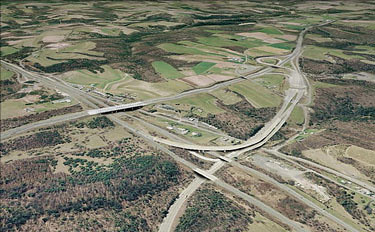
Breezewood_web
The rebuilt Breezewood Interchange.

Copyright © 2016, The Kirchman Studio, all rights reserved

PONTIFUS_Banner

The Men Who Made America Great Again

Citizen Journalism with a Better Flavor

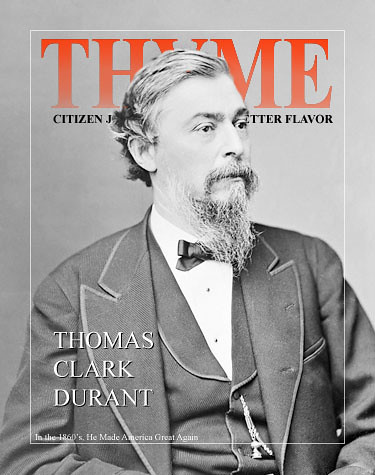
DURANT
Volume XI, Issue XXVII

In the early 1860’s there were two Americas. There were the Eastern states who would all too soon divide into Union and Confederacy, but then there was California. Although America stretched from “sea to shining sea,” California was isolated from the East by what many considered miles of uninhabitable desert. To get to California, one often took passage on a ship to Panama, made a short trip overland and then boarded another ship for San Francisco. California, in time, could have easily become another country.

Then there was the great settlement of the Latter Day Saints at Salt Lake. There could have been another nation created by their isolation on both sides. Railroads were already well established in the East, but there was none crossing the great desert. Hearty pioneers walked beside their ox-drawn wagons on trails to California and Oregon, but they likely saw this as a one-time migration, never looking back. Commerce was not possible on any scale without improved transportation.

As the Nation advanced toward her terrible Civil War, President Abraham Lincoln signed The Pacific Railroad Act of 1862 that made construction of the transcontinental railroad possible. It assigned the job to two companies: the Central Pacific Railroad of California was to build eastward from Sacramento, and a new company called the Union Pacific was to build westward up the Platte River Valley from Omaha, Nebraska. It was called a “work of giants” by some, but if they were giants, there were some of them who were not unlike the ruthless Philistine: Goliath.

The greatest ‘Goliath’ of all, in the building of the Union Pacific road would have to be Dr. Thomas Clark Durant. Trained in medicine, he kept the title as he pursued schemes for making money. He founded a railroad company, the Missouri and Mississippi Railroad, in 1854. Though he built very little of it, he poised himself to take advantage of a future Pacific railroad project, should it come to be. During the Civil War, he and his associate Grenville Dodge smuggled contraband cotton out of the South. With the money he made from smuggling, he invested in a fairly devious subscription scheme that left him in control of the Union Pacific Railroad Company.

Now the good doctor made himself Vice President and named a figurehead President for the company. Dodge would become his chief engineer. As the road was built, the scheming Durant would come into conflict with Dodge, as the engineer fought to direct resources to building track and Durant tried to divert them.

Prior to the Civil War the building of the road had been stalled by a dispute over whether a Northern or Southern route should be chosen. Secession allowed for the decisive selection of the Northern route from Omaha. The Pacific Railroad Act of 1862 had set aside a land grant to finance construction, but in the Civil War era it was not enough. The Pacific Railroad Act of 1864 increased the incentives.

Oakes and Oliver Ames had made a lot of money making shovels during the gold rush. They graduated to providing cannon during the war. The brothers put up a million dollars of their own money and pledged their credit to get the road built. By the end of 1965, however, Thomas Durant had spent half a million dollars and had laid only 40 miles of track across Nebraska. Grenville Dodge had a reputation, gained during the war, for building (and rebuilding) railroads with great speed. Durant appointed him chief engineer of the project. The conflict between Dodge and Durant as the road progressed would become legend, but Dodge was the man to get the job done. In a letter to his brother, Dodge speculated that he would likely have trouble with Durant. The two had worked together before and Dodge’s fears were well founded.

By 1866 things had changed. A newspaper man wrote: "The track laying on the Union Pacific was a science. We, pundits of the far East, stood upon that embankment, only about a thousand miles this side of sunset, and backed westward before that hurrying corps of sturdy operators with a mingled feeling of amusement, curiosity and profound respect. On they came. A light car, drawn by a single horse, gallops up to the front with its load of rails. Two men seize the end of a rail and start forward, the rest of the gang taking hold by twos, until it is clear of the car. They come forward at a run. At the word of command the rail is dropped in its place, right side up with care, while the same process goes on at the other side of the car.

Less than thirty seconds to a rail, and so four rails go down to the minute. The moment the car is empty it is tipped over on the side of the track to let the next loaded car pass it, and then it is tipped back again, and it is a sight to see it go flying back for another load, propelled by a horse at full gallop at the end of sixty or eighty feet of rope. Close behind the first gang come the gaugers, spikers and bolters, and a lively time they make of it. It is a grand 'Anvil Chorus' that those sturdy sledges are playing across the plains. It is in triple time, three strokes to the spike. . .ten spikes to a rail, four hundred rails to a mile, eighteen hundred miles to San Francisco. Twenty-one million times are those sledges to be swung ... before the great work of modern America is complete."

In Salt Lake City, which had been established two decades before the railroad came, Brigham Young was not happy. The shortest route for the new railroad had been laid across the Northern shore of the Great Salt Lake. Salt Lake City was on the Southern end of the lake. The rails would meet on the deserted Northern side of the lake at Promontory in 1969, but a spur would need to be built to serve Salt Lake City. Though he was not pleased with this arrangement, the Mormon leader still took a grading contract for the Union Pacific and one of his bishops took one with the Central Pacific.

Then there was no harmony at Promontory as the two lines built past each other, grading out parallel roadbeds. Grading crews would set off charges without warning to harass the men working on the grade beside them. It literally took an act of Congress to settle the joining point would be at Promontory. Durant, for his part, had not been paying his men. The men revolted, kidnapping Durant and chaining his private car to the tracks. Durant wired to his board of directors for $500,000 to pay the men and arrived late for the ceremony at Promontory.

Grenville Dodge and Durant’s relationship was frayed beyond repair. After the lines joined at Promontory, Oliver and Oakes Ames made plans to oust the scheming Durant, but he resigned before they could fire him.

David McCulloch adds this, perhaps greater perspective: "In the same year the road was completed, 1869, another monumental epic engineering feat was completed; the Suez Canal. Suddenly the world was getting smaller, an idea that inspired Jules Verne to write 'Around the World in Eighty Days.'" The great work of Nineteenth Century America had been built by men who were less than giants, men with feet of clay, but build it they did.

In the wake of America’s horrible Civil War, revival had begun. Ferenc Morton Szasz writes:

Though such signs of spiritual life appeared all over the Western landscape, they are completely absent from most people's visions of the nineteenth-century American frontier. Names like Buffalo Bill, Sitting Bull, Annie Oakley, Calamity Jane, Billy the Kid, and Wyatt Earp are almost synonymous with the West, while names like William D. Bloys, Daniel S. Tuttle, Charles Sheldon, Sheldon Jackson, and Brother Van Orsdel ring few bells. Yet if one looks at actual accomplishments, the situation might well be reversed. Most Western communities owe far more to these unheralded clerics than they do to the high-profile outlaws or icons.

From about 1840 to the end of the century, these largely anonymous ministers shaped the contours of Western life in three major ways. They formed the first churches and Sunday schools, which promoted social stability while reining in local violence; they developed a distinctly Western style of Christianity that emphasized a non-denominational message of salvation and personal ethics; and they helped lay the institutional foundations - orphanages, hospitals, and schools - for scores of Western communities.”

Though the railroads had been built by speculators and schemers, it was the great message of the Gospel that laid the foundations for the society of America’s vast interior.

The Gospel that Built Frontier America [click to read].

banneradvert

Is America a Christian nation?
Martin Mawyer Writes:

The question itself is ambiguous. Are we talking about the founding of America? The people of America? The government of America? The morality of America? We're weighing in on this important debate by reprinting The United States: A Christian Nation, written by Supreme Court Justice David Brewer and published in 1905. This pocket-sized, clearly written and inspiring book also includes a modern-day foreword and afterword by CAN founder Martin Mawyer.

So are we a Christian nation?

President Barack Obama narrowed it down to “the people of America” when he said on June 28, 2006:

Whatever we once were, we are no longer just a Christian nation; we are also a Jewish nation, a Muslim nation, a Buddhist nation, a Hindu nation, and a nation of nonbelievers.”

Under Obama’s logic, America is no longer a Christian nation because other faiths, beliefs and non-beliefs are represented in the land.

Carrying the Obama logic further, it can then be said that we are also a Satanic nation, witchcraft nation, voodoo nation and a nation of Nuwaubians (those who believe that white people were created to serve blacks). These too live in America and practice their religions freely.

Obama is not alone in his simplistic logic. Secularists, humanists and atheists also point to the diversity of religious belief in America to support the notion that the country is no longer a Christian nation, “whatever it once was.”

This argument is irrational and farcical. There are child molesters in America, and we have rapists, thieves and murderers among us, but does that mean we are no longer a law-abiding nation? Should we concede that we’re no longer a nation of laws?

The answer, obviously, is “No.” We were founded in law. Law shapes all of our lives. The vast majority of Americans respect and obey the law. Never could it be said that, because some choose to follow another course, we are no longer a law-abiding nation.

Did the Obama administration suddenly become “no longer a Democratic administration” simply because Ray LaHood (a former Republican congressman from Illinois) was appointed as Secretary of Transportation in 2009? Hardly.

Is the New York Times “no longer a liberal newspaper” just because George Will’s column appears in it? Of course not.

The mere presence of a person, or a group of people, does not change the history and distinctive nature of an entity. FOX News certainly isn’t considered a left-wing news organization just because Juan Williams, Geraldo Rivera and Alan Colmes appear on camera.

According to a 2015 Pew Research Center survey, the Muslim population in America is 1 percent. The Hindu: .07 percent. Jews were only slightly ahead of both minorities at a meager 1.8 percent. Buddhists weren’t even numerous enough for the Pew Research Center to sample.

Christians, however, represent 75 percent of Americans. And of those Americans who claim any sort of religious belief, a commanding 94 percent identify themselves as Christian.

I understand why Jesus-haters cannot stomach these numbers, but for the vast majority of Americans, the national figures answer the burning question:

Is America a Christian nation?

Of course it is.

The Pew Research Center is unabashed in saying, “American remains a predominantly Christian nation.”

Predominant means to be “present as the strongest element, exertion or power.” So the strongest element in America, according to the Pew Research Center, is Christians.

More Americans read the Bible than any other book ever published.

Even the liberal Huffington Post has admitted, “The Bible is the biggest bestseller in history.”

No other book resides in more American homes than the Bible, with 88 percent of households owning at least one. Most Americans own multiple copies, on average 4.4.

Bolstering the reality that the United States is a Christian nation are two U.S. Supreme Court rulings:

In 1892, Justice David Brewer wrote a majority opinion that asserted, “This is a Christian nation.” (Holy Trinity Church v. United States)

Again in 1931, the Supreme Court said, “We are a Christian people.” (U.S. v. Macintosh)

Neither of these rulings has been challenged or overturned.

Some will argue that referring to ourselves as a Christian nation is living in the past, and that it’s a notion too archaic and old-fashioned for modern civilization.

Tell that to the prime minister of England, who this past Christmas Eve referred to Britain as “a Christian country.”

As a Christian country,” Prime Minister David Cameron said in his national address, “we must remember what His birth represents: peace, mercy, goodwill and, above all, hope.”

This coming July 25, Poland will hold a public celebration in the western city of PoznaƄ marking its 1,050th anniversary of becoming a Christian nation.

These nations can look at themselves and see their true identity: Christian.

Meanwhile, in America these days, some look at a boy and call him a girl, look at a baby and call it a tissue mass, look at creation and call it random chance, look at Islam and call it a religion of peace ...

… Or look at a Christian nation and call it secular.

Not me. Americans should never forget or be ashamed of our historic relationship with Christ and what His message has done for all Americans, as expressed so wonderfully in the words of The Battle Hymn of the Republic.

In the beauty of the lilies Christ was born across the sea, With a glory in His bosom that transfigures you and me. As He died to make men holy, let us die to make men free While God is marching on.

What has Christianity done for America?

It has stood for liberty and the rights of man,” Justice Brewer wrote in his 1905 book The United States: A Christian Nation.

And the more thoroughly this republic is filled with the spirit of the gospel, the more universal the rule of Christianity in the hearts of our people, the more certainly will she ever be the welcome leader in movements for peace among the nations.”

Christianity has always represented the best things in the world: Justice, truth, free will and equality, to name a few. Whenever these great social gifts were torn apart, Christianity put them back together, sometimes through great sacrifice of human lives.

If anyone is turning the clock back, it’s the secularists and humanists who would throw us into the Age of Babylonianism – in which babies can be sold as spare body parts.

PONTIFUS_Banner


Irish Lives Matter

In the mid-Seventies, one of my friends embarked on a rather ambitious overseas study project. He set out for Northern Ireland in order to study the age-old conflict there, its roots and possible ways to overcome it. His presentation when he returned was much anticipated. He did not let us down. His photographs captured a car bomb exploding on a Belfast street. He scored an interview with Bernadette Devlin, the controversial Irish Republic activist and the youngest woman ever elected to the British Parliament.

My friend said that essentially the situation was similar to that in America where African Americans felt disenfranchised and were feeling that they had to resort to violence. The difference is that these people in Northern Ireland were divided by denomination. The Orange (Protestant) faction held power while the Green (Catholic) faction was often oppressed. He met with people from both sides who essentially pointed to a long-standing animosity rooted in historical events.

The irony, it seemed, was that here you could see very little, if any difference in the outward appearance of the people in each group. Indeed, the identification with Orange or Green was the great divide that could not be bridged. Sadly, my friend began to document his report on a struggle that in all likelihood had no solution.

But then he met a third group of people and they identified not so much as Catholic or Protestant, but as Christian. They included in their fellowship those of the creed they were not. They saw themselves as redeemed children of the Master and as neighbors! No longer Green, no longer Orange, they saw themselves as fellow partakers in the Kingdom of Heaven. Identification with the larger community, not a retreat to tribalism resulted in true healing. In concluding his presentation, my friend pointed to this new sense of community and laid out the great hope... that reconciliation is truly possible!

waroncops

Voting, a Sacred Obligation
[click to read]

Thoughts from Charles Colson (2008)

I have been surprised by the number of Christians who have given up on politics this year. "I don't like either candidate, so I'm staying home," some say.

How do we go about choosing the best candidates? Not by pulling a partisan lever—that's knee-jerk ideology. Christians live instead by revealed truth, never captive to any party. Thus, the best place to go for wisdom is not the candidates' websites, but the Bible.

I get fed up with the vain posturing and empty promises, too. But not voting is not an option—it's both our civic and sacred duty. Voting is required of us as good citizens and as God's agents for appointing leaders. (Read More)

So What's at Stake: Our Future

In the last election, a large number of people stayed home. The current administration gained another four years. We cannot afford to stay home again! What's at stake? First of all, with the passing of Justice Antonin Scalia, the Supreme Court's direction will be shaped for decades to come by who is elected this Fall. Here the choice is clear. If you stay home, vote third party or even vote directly for the party that holds the Executive Branch now, we can be assured that the most radical activist justices will be appointed. At stake are cases determining the security of Religious Liberty, Parent's Rights, and Sanctity of Human Life to name a few. On the other hand, Donald Trump has surrounded himself with people who will work to secure those values in the courts as well as in the legislative process. We cannot sit this one out!

Secondly, the current administration's all-out assault on the closely held values of God-fearing America will continue from the Executive Branch as well if their chosen candidate is elected. In the selection of Mike Pence as the Vice-Presidential candidate, we have an assurance that we indeed have a place at the table. [Updated Information]: The clear promise to: "work to repeal the Johnson Amendment" is reason enough for all people of Faith to vote for Donald Trump. In 1954, then Senator Lyndon Johnson was instrumental in passing legislation which restricted the free speech rights of Pastors from their pulpits. The IRS website states:

Under the Internal Revenue Code, all section 501(c)(3) organizations are absolutely prohibited from directly or indirectly participating in, or intervening in, any political campaign on behalf of (or in opposition to) any candidate for elective public office. Contributions to political campaign funds or public statements of position (verbal or written) made on behalf of the organization in favor of or in opposition to any candidate for public office clearly violate the prohibition against political campaign activity. Violating this prohibition may result in denial or revocation of tax-exempt status and the imposition of certain excise taxes.

Certain activities or expenditures may not be prohibited depending on the facts and circumstances. For example, certain voter education activities (including presenting public forums and publishing voter education guides) conducted in a non-partisan manner do not constitute prohibited political campaign activity. In addition, other activities intended to encourage people to participate in the electoral process, such as voter registration and get-out-the-vote drives, would not be prohibited political campaign activity if conducted in a non-partisan manner.

On the other hand, voter education or registration activities with evidence of bias that (a) would favor one candidate over another; (b) oppose a candidate in some manner; or (c) have the effect of favoring a candidate or group of candidates, will constitute prohibited participation or intervention.

The Internal Revenue Service provides resources to exempt organizations and the public to help them understand the prohibition. As part of its examination program, the IRS also monitors whether organizations are complying with the prohibition." Traditionally, this oversight has been heavily applied to Conservative and Pro-Life speech, while more Liberal positions being shared are largely ignored. The promise to work for the elimination of this provision is another clear statement that people of Faith indeed do have a place at the table.

Third, we have an opportunity to re-secure our borders, protect American productivity and reestablish our position as a mighty nation that creates opportunity while it protects basic freedoms and does indeed uphold the rights of those who's voice is not as loud or strong. Newt Gingrich summed it up in his speech to the Republican Convention, outlining the challenges before us. It is time to come together and reclaim America.

BannerAdvert

Monday, May 30, 2016

Thoughts for Memorial Day, 2016

Remembering Those Who Gave All for Freedom...

BRFlag000
Stained glass design of the Betsy Ross Flag in the sunrise by Xaver Wilhelmy. Rendering by Kristina Elaine Greer.

Sunday, March 27, 2016

"He is Risen!"

Citizen Journalism with a Better Flavor

THYMEResurrectionIII
Volume IX, Issue XIVaa

The Meaning of the Miraculous

For many Centuries man has acknowledged  the miraculous. In the weeks to come the Jewish community celebrates their deliverance from Egypt and the beginning of their journey to the Promised Land. [1.] A dialogue set in a meals has all generations together consider the preservation of their people that could only be seen as a work of G-d. Previous generations always saw G-d, or some miraculous force as Creator. The Patriarchs saw Him as Provider and Deliverer! The relatively recent concept of Evolution (Charles Darwin in the Nineteenth Century) has created a philosophy of Naturalism that either outright rejects or quietly diminishes the Theistic explanation.

I once attended an Easter service at a large church in Richmond. The minister asserted that the Resurrection was not important! I don't remember anything else he said. I was astonished because Christ's Resurrection would seem to be a cornerstone of Christianity. Many voices today denounce Faith. They may not directly denounce it, but in the academy it is the subject of "open discourse" such as that experienced by Ryan Rotella at FAU [click to read]. Rotella was asked to leave a class. His "offense" was refusing to participate in an excercise where students were required to "stamp on Jesus." Dennis Prager [click to read] has more details. Though the school ultimately apologized to Rotella, it justified its so-called "open discourse" in doing so.

Running from the Resurrection

In fact, among many in academia today you are likely to hear some variation of the following: "There are other reasons why I consider Christianity to be an ill-chosen creed, such as the morals actually taught in the Bible, many of which are abhorrent to a compassionate and just man, or other details of its theology which run counter to observable facts." writes atheist Richard Carrier in introduction to his argument against Jesus' resurrection from the dead.

Here in his introduction, Carrier gives what I believe is his real reason for being uncomfortable with a physical resurrection. A G-d who can so control the laws of nature can ask 'unreasonable' things of us as well. A 'Compassionate and Just Man,' in Carrier's world can support abortion on demand because it is not 'abhorrent' to his viewpoint that abortion is a kind response to the needs of women with unplanned pregnancies. The beating heart of the unborn child need not be seen here as an 'observable fact.' Likewise, the 'restrictive' definition of marriage as a relationship defined by Scripture in specific terms may be viewed as archaic and discriminatory.If G-d didn't design it, He cannot write the specifications.

The elimination of Christianity as an authoritative source allows us to personalize moral decisions. In a culture that elevates self-actualization, this is virtue. It spares us the heavy lifting required to weigh moral absolutes with human frailty.

Jesus, meeting a Samaritan woman at a well, is a prime example of what I mean by this heavy lifting. Balancing compassion for the woman with his observation that she has not been a faithful wife, Jesus creates a constructive dialogue. He does not condemn her, nor does He overlook the complexity she has created in her relationships. He speaks truth and ultimately the dialogue that results sets her free. Here Absolute Love and Absolute Truth are in no way mutually exclusive. In the end her search for 'Living Water' trumps her desire to live as she pleases. [2.]

A G-d who can part the Red Sea, Create worlds and has power over death is pretty much to be respected. A G-d who changes human lives in intimate communion with his Creation is amazing.

Before Jesus appeared, the concept of Resurrection is found in Scripture. Sometimes it is very clear and other times it is a logical assumption consistent with the text.

Resurrection Foretold

And he made his grave with the wicked, and with the rich in his death; because he had done no violence, neither was any deceit in his mouth. Yet it pleased the Lord to bruise him; he hath put him to grief: when thou shalt make his soul an offering for sin, he shall see his seed, he shall prolong his days, and the pleasure of the Lord shall prosper in his hand. He shall see of the travail of his soul, and shall be satisfied: by his knowledge shall my righteous servant justify many; for he shall bear their iniquities. Therefore will I divide him a portion with the great, and he shall divide the spoil with the strong; because he hath poured out his soul unto death: and he was numbered with the transgressors; and he bare the sin of many, and made intercession for the transgressors." -- Isaiah 53:9-12

The famous Messianic text above talks of triumph after death. Other texts that may be seen as prophetic of Resurrection are: Genesis 3:15, Psalm 2:7, Psalm 16:9-11, Psalm 22:14-25, Psalm 30:29, Psalm 40:13, Psalm 110:1, Psalm 118:21-24, Hosea 5:15-6:3, Zechariah 12:10.

Resurrection Documented and Verified

I know of no one fact in the history of mankind which is proved by better, fuller evidence of every sort, to the understanding of a fair inquirer, than the great sign which God hath given us that Christ died, and rose again from the dead." says Dr. Thomas Arnold, formerly Professor of History at Rugby and Oxford Universities. Simon Greenleaf, one of the most skilled legal minds ever produced in this nation, top authority on the question of what constitutes sound evidence, developer of the Harvard Law School, after a thorough evaluation of the four Gospel accounts from the point of view of their validity as objective testimonial evidence, concluded:

It was therefore impossible that they could have persisted in affirming the truths they had narrated, had not Jesus actually risen from the dead, and had they not known this fact as certainly as they knew any other fact." [3.] Dr. Henry M. Morris PhD writes more on The Importance of the Resurrection [click to read]. His point is that the foundational truth of the Christian faith has plenty of evidence to support it.

A G-d who can part the Red Sea, Create worlds and has power over death is pretty much to be respected. A G-d who changes human lives in intimate communion with his Creation is amazing.

Butterfly_icon
A Caterpillar becomes a butterfly. Nature itself suggests the possibility of miraculous transformation and new life! Rice Paper Butterfly, or Paper Kite Butterfly, Idea leuconoe.
Illustration © 2016, by Kristina Elaine Greer for HOPE Publications, Pvt. ltd.

Jesus

Friday, March 25, 2016

Faith and Bright Hope

Citizen Journalism with a Better Flavor

THYME0912
Volume XI, Issue XIIIa

Jesus is Coming, Plant a Tree!

Therefore, my beloved brethren, be ye stedfast, unmoveable, always abounding in the work of the Lord, forasmuch as ye know that your labour is not in vain in the Lord."
   -- 1 Corinthians 15:58

In a wonderful article by N. T. Wright entitled Jesus is Coming, Plant a Tree [click to read], the author writes: "For the early Christians, the resurrection of Jesus launched God’s new creation upon the world, beginning to fulfill the prayer Jesus taught his followers, that God’s kingdom would come “on earth as in heaven” (Matt. 6:10), and anticipating the “new heavens and a new earth” (Isa. 65:17, 66:22; 2 Pet. 3:13; Rev. 21:1) promised by Isaiah and again in the New Testament. From this point of view, as I have often said (though the phrase is not original to me), Heaven is undoubtedly important, but it’s not the end of the world. The early Christians were not very interested, in the way our world has been interested, in what happens to people immediately after they die. They were extremely interested in a topic many Western Christians in the last few years have forgotten about altogether, namely the final new creation, new heavens and new earth joined together, and the resurrection of the body that will create new human beings to live in that new world."

I have friends who are very much into eschatology, wonderful people, but they are pretty much convinced that this world is pretty rotten and the sooner it passes away the better. I also have friends who are very much into fixing things in the here and now, not thinking about the hereafter at all. Wright makes the case that I very much agree with: Both are missing something! He also struck a chord with me, especially in light of this dedication in my yet to be published novel: "Pontifus, The Bridge Builder's Tale:"

This little book is dedicated to those brave young people, who though I shall not name them here, will likely recognize bits of themselves in the characters I portray. I apologize beforehand for this intrusion into your privacy but feel that the world so desperately needs your story. Your very real dedication and bravery inspired this book and it cannot be written without a foundation of such truth. Most of all it is dedicated to my beautiful wife, of whom the accolade: "Well done, good and faithful servant!" is most fitting. You have stood by me in good times and bad. We have shared in the raising of some incredible young people who inhabited our own home. You have poured your love and wonder into the lives of countless students. I love you with all my being!!!

It is because we both love young people so that I write this. It is but a poor attempt to offer hope and direction to a world so devoid of it. We err, perhaps, in pointing to the hope of the hereafter without providing adequate models and renderings of that Kingdom and those who have labored to bring it into the world we inhabit now. The water that will quench the soul's thirst is dismissed because those who profess to bear it often seem, (to the society around them,) preoccupied with apocalyptic visions and derision for the world as it is now. It is not wrong to love such things, but they are not easily shared with those for whom the flower of life is yet to come. No bride-to-be, having just unwrapped her wedding planner, wants to engage in a lengthy discourse on Eschatology!

Jeremiah of old told those in exile to "Build, Plant, Marry and Have Children, Prosper and Pray!" [1.] Jeremiah 29:4-7 -- and to be sure, there are many who do. They just don't make the headlines very often. The historical references in this work, and there are probably too many, are essential to understanding how men and women have navigated dangerous times before. They are most necessary to show how one can indeed have vision for one's own times and hope in a greater, unseen reality as well."
-- Excerpt from "Pontifus, The Bridge Builder's Tale"  ©Copyright, 2015, The Kirchman Studio

Referencing 1 Corinthians 15:58, Wright presents the important idea that our work here in this world is not wasted. It is incredibly important to the building of the Kingdom to come! Just as human marriage is a picture of Christ and his Church, there is much to do to point the way and give vision to the Unseen Kingdom. Wright continues: "I have no idea precisely what this means. I do not know how the painting an artist paints today in prayer and wisdom will find a place in G-d’s new world. I don’t know what musical instruments we will have to play Bach, though I’m sure Bach’s music will be there. 

I don’t know how my planting a tree today will relate to the wonderful trees that will be in G-d’s recreated world. I don’t know how my work for justice for the poor, for remission of global debts, will reappear in that new world. But I know that G-d’s new world of justice and joy, of hope for the whole earth, was launched when Jesus came out of the tomb on Easter morning: I know he calls me and you to live in him and by the power of his spirit, and so to be new-creation people here and now, giving birth to signs and symbols of the kingdom on earth as in heaven. 

The resurrection of Jesus and the gift of the Spirit mean that we are called to bring forth real and effective signs of G-d’s renewed creation even in the midst of the present age. Not to do so is at best to put ourselves in the position of those Second Temple Jews who believed they had to wait passively for G-d to act – when G-d has acted in Jesus to inaugurate his kingdom on earth as in heaven. At worst, not to bring forth works and signs of renewal in G-d’s creation is to collude, as gnosticism always does, with the forces of sin and death."

Revelation 19:6-9 speaks of the time when people of all nations are joined in communion with G-d:

And I heard as it were the voice of a great multitude, and as the voice of many waters, and as the voice of mighty thunderings, saying, Alleluia: for the Lord G-d omnipotent reigneth. Let us be glad and rejoice, and give honour to him: for the marriage of the Lamb is come, and his wife hath made herself ready. And to her was granted that she should be arrayed in fine linen, clean and white: for the fine linen is the righteousness of saints. And he saith unto me, Write, Blessed are they which are called unto the marriage supper of the Lamb. And he saith unto me, These are the true sayings of G-d."

In Isaiah 60 [4.] and in Revelation 21 Believers look to a New Heaven and a New Earth where a Heavenly Jerusalem descends to join the Earth. Here is a Kingdom that needs no temple, needs no sun to light it, for G-d Himself is the force that illuminates it! [5.]

And I saw a new Heaven and a new earth: for the first Heaven and the first earth were passed away; and there was no more sea. And I John saw the holy city, new Jerusalem, coming down from G-d out of heaven, prepared as a bride adorned for her husband. And I heard a great voice out of heaven saying, Behold, the tabernacle of G-d is with men, and he will dwell with them, and they shall be his people, and G-d himself shall be with them, and be their G-d." -- Revelation 21:1-3

West_web East_web
Journey to Jesus, a mural depicting the nations coming to Jesus in the New Heaven and New Earth described in Revelation 21. Mural by Kristina Elaine Greer and Bob Kirchman

Journey to Jesus [click to view larger images].

Our Christian hope is that we're going to live with Christ in a new Earth, where there is not only no more death, but where life is what it was always meant to be." -- Timothy Keller.

THYMELESS
The hope of Heaven and New Earth.

A Lesson from the Missionaries

Wes Stafford, founder of Compassion International, remembers with great joy the times he and his missionary father dug wells together. He happily recalls the tired, sweaty, muddy process of ensuring clean water for the villages in Africa that they served. Father and son came home tired and filthy and the people saw a beautiful illustration of the love of G-d! Clean wells, fenced off so that cattle could not foul them, meant healthy children instead of sickly ones. Lives were saved and the people, through that expression of love, were moved to trust in Christ!

The Staffords excitedly sent photographs of the whole operation, dirty faces and all. They surely would be an exciting part of the mission's newsletter. To their dismay, when the newsletter arrived, there were no pictures of the well digging. It wasn't about 'salvation' in the eyes of the mission board. Yet it had resulted in real salvation (earthly as well as Heavenly) to the villagers! Years later, as head of Compassion International, Wes Stafford still presides over the digging of a lot of wells!

Tragically, the board's earthward myopia extended to the boarding school for missionary kids that Wes and his sister attended. Those who washed out as missionaries were assigned to teach at the school. Not seeing the school as an important work of G-d, the children were poorly cared for, sometimes even abused, and the faith of many was destroyed. In his book: Too Small to Ignore, [2.] Stafford makes the case that the work of teaching and caring for children is paramount in the work of the Kingdom of G-d.

Passing the Torch

Perhaps the greatest lesson Stafford's father ever taught was in the digging of the wells. Wes grew up with practical experience in participating in the building of the Kingdom. That lesson would stick with him as he grew to head Compassion International. There is a poem by Gary Snyder: Axe Handles [click to read] which captures the Sacred process quite nicely:

I am an axe And my son a handle, soon
To be shaping again, model
And tool, craft of culture,
How we go on."

How are we doing as teachers. Not very well, I fear. As we are all too eager to see this world pass away, our young adults busy themselves with apocalyptic video games. The sad truth is that both generations have lost the mandate to build the Kingdom. A little child, it turns out, will teach me a "more excellent way." We are outside her house together... initially we set out to dig in the snow. Perhaps we'll build a snowman.

But we notice the chaos of snow and ice on the path to the trash cans. I chip, she digs. We create a beautiful clear walk for the neighbors. Then we clear off some sidewalk. The young child is clearly enjoying the whole process. But my adult mind soon grows restless that we have not built the snowman! Funny, how the adult mind can be distracted so easily!

It is only later that I realize that the child has been the teacher that day. We created a small patch of beauty (and safety) for her neighbors. She indeed saw that such labor was a good thing. No pontification, just a simple model, simply followed. We were making something together! Didn't Jesus say that: "the kingdom of God belongs to such as these!" -- Luke 18:16

The Fragrance of Eden
Wisdom from an Old Rebbe

AT on Hazeltop
In the Blue Ridge Mountains.

Here is a Beautiful Story [click to read] of an old Rebbe who's devotion to G-d's work of redemption shaped the way he lived his own life. The wise man was told one day that the Messiah had come and was in the steet outside. The man opened the window, sniffed the air outside and declared the so-called 'Messiah' a fraud. His instincts told him the coming Messiah would bring with him the sweet fragrance of Eden, the fragrance of the divine presence in the tabernacle and the temple, that was lost when the Glory departed.

Years later, the Rebbe's son wondered why his father had to go to the window to sniff the air. Surely the sweet smell of redemption would come into the house. His son then realized that the father had lived his life in devotion to torah study and the expectancy of Messiah's coming. His life, so lived, gave his own dwelling place the fragrance of what he hoped for. Thus it was necessary for him to smell the air outside his house to know if what he hoped for had truly appeared.

May our faith and devotion create such an aroma in our own dwelling places!

Spring Crocus
Spring Crocus

Saturday, March 19, 2016

How to Cure Conflict

Citizen Journalism with a Better Flavor

THYME0515
Volume XI, Issue XIIa

How to Cure Conflict

For unto us a child is born, unto us a son is given: and the government shall be upon his shoulder: and his name shall be called Wonderful, Counsellor, The mighty G-d, The everlasting Father, The Prince of Peace." -- Isaiah 9:6

The world is a dangerous place today. As an American President faces a resolute Vladimir Putin, who is intent on reinvigorating the Soviet Empire, and Israel's Binyamin Netanyahu deals with hostilities on multiple borders, the problem of human conflict is on our minds. Indeed it seems like peace is beyond our grasp. Thousands of years of human history are filled with wars and strife.

This coming Sunday Christians remember the time when the Prince of Peace [1.] (Isaiah 9:6) rode into Jerusalem on a donkey! The people lined the way spreading their cloaks and palm branches, expecting the return of the King in an earthly manifestation of the Heavenly Kingdom. [2.] Jesus, however, had greater plans in mind.

Jesus rode into town as the lambs were being brought into the homes in preparation for Passover, the remembrance of G-d's deliverance from Pharaoh centuries before. [3.] Instead of establishing an earthly kingdom, He would be tried by both religious and civil authorities. Although there was no crime committed on His part, He would be sentenced to die a most horrible death by crucifixion.

He ate the Passover meal with His disciples, one of whom betrayed Him. The Roman ruler Pilate could find no fault in Him, yet the religious leaders stirred up a mob to demand His death. He died on a cross on a hill called Golgotha, flanked by two thieves. Hardly the way to begin a movement to transform the world, but that is what history tells us.

His death conquered sin and death. [4.] "The day Jesus was crucified was the day of the Passover celebration and the day that the Passover lamb was to be sacrificed. For the previous 1,200 years, the priest would blow the shophar (ram's horn) at 3:00 p.m. - the moment the lamb was sacrificed, and all the people would pause to contemplate the sacrifice for sins on behalf of the people of Israel. At 3:00, when Jesus was being crucified, He said, "It is finished" - at the moment that the Passover lamb was sacrificed and the shophar was blown from the Temple. The sacrifice of the lamb of God was fulfilled at the hour that the symbolic animal sacrifice usually took place. At the same time, the veil of the Temple (a three-inch thick, several story high cloth that demarked the Holy of Holies) tore from top to bottom - representing a removal of the separation between G-d and man. Fifty days later, on the anniversary of the giving of the law (Pentecost), G-d left the earthly temple to inhabit those who call on the name of Jesus through His Holy Spirit." -- How the Passover Reveals Jesus Christ by Rich Deem [click to read].

But the story does not end there. In Revelation 21 Christians look to a New Heaven and a New Earth where a Heavenly Jerusalem descends to join the Earth. Here is a Kingdom that needs no temple, needs no sun to light it, for G-d Himself is the force that illuminates it! [5.]

And I saw a new Heaven and a new earth: for the first Heaven and the first earth were passed away; and there was no more sea. And I John saw the holy city, new Jerusalem, coming down from G-d out of heaven, prepared as a bride adorned for her husband. And I heard a great voice out of heaven saying, Behold, the tabernacle of G-d is with men, and he will dwell with them, and they shall be his people, and God himself shall be with them, and be their G-d." -- Revelation 21:1-3

West_web East_web
Journey to Jesus, a mural depicting the nations coming to Jesus in the New Heaven and New Earth described in Revelation 21. Mural by Kristina Elaine Greer and Bob Kirchman

Journey to Jesus [click to view larger images].

IMG_3253
The Journey is complete when you reach the kind face of Jesus!
"I judge all things only by the price they shall gain in eternity." —John Wesley

Miracles from Heaven Movie

This film is based on the true story of the Beam family. In these days the 'Supernatural' is often dismissed, even as there continue to be events that cannot be fully explained in the 'Natural.' This film recounts one such event. In the classic Miracles, [6.] C.S. Lewis, the most important Christian writer of the 20th century, argues that a Christian must not only accept but rejoice in miracles as a testimony of the unique personal involvement of G-d in his creation.


advert