Showing posts with label Alan Bean. Show all posts

Friday, November 8, 2019

Apollo 12 Fifty Years Ago, Artist Alan Bean, Horses

apollo12
Volume XVII, Issue XVII, XVIII: Special Edition

Today’s DOUBLE ISSUE gives you two weeks’ reading as I step back from weekly publication to devote myself to several important projects. I hope you enjoy it.

The Journeys of Apollo


The heavens declare the glory of God; and the firmament sheweth his handywork. Day unto day uttereth speech, and night unto night sheweth knowledge. There is no speech nor language, where their voice is not heard.” – PSALM 19:1-3

First Paintings of Another World
By an Artist Who was Actually There, Alan Bean

[click to read]

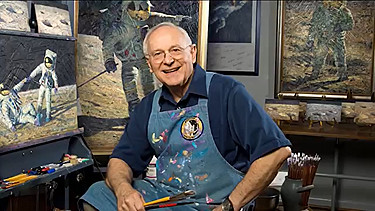
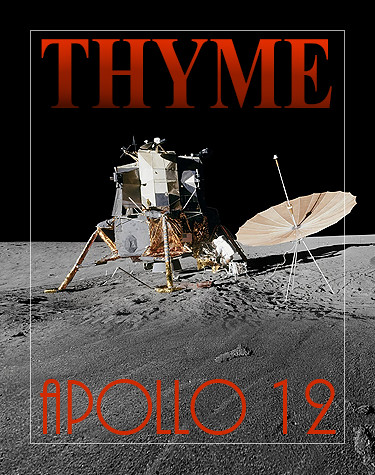
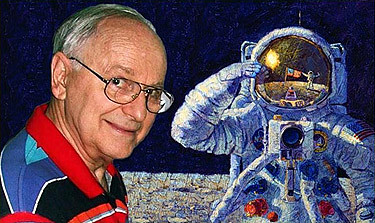
I was the Lunar Module Pilot of Apollo 12 and the fourth man to set foot on the moon. I explored the beautifully desolate landscape of the Ocean of Storms and later, as commander of Skylab 3 (Skylab Mission II), I spent 59 days in orbit around our fragile, blue-and-white Earth.

I had been painting earthbound subjects for many years by the time I returned from Apollo 12 and Skylab 3 missions, but my fellow astronauts convinced me to paint my experiences on the moon.

You can create the very first paintings in all of history of a place other than our own planet,” they said. “Your paintings will forever be the first paintings of the many other worlds humans will visit as the centuries unfold.”

Because of this unprecedented opportunity and challenge, I resigned from NASA in 1981 to devote all of my time and energy to painting, celebrating the great exploration that was Apollo.

Over the years, my art has evolved into a mixture of painting and sculpture, textured with my lunar tools, sprinkled with bits of our Apollo 12 spacecraft and a touch of moondust from the Ocean of Storms. You can see many of my paintings on this site and read more about the space-age techniques and materials I use in my work. (read more)
essay1
The Alan Bean Gallery.

IMG_1199
In the video: Astronaut Alan Bean, Moonwalker, Skylab Commander, Artist at the bottom of today's THYME, we learn how an astronaut's incredible observations led to a wonderful exploration in art!

Incredible Journey of Apollo 12


Seeing Things in 'Living Color'

I need a mathematician that can look beyond the numbers, a math that doesn't yet exist..."
-- Al Harrison in Hidden Figures

My colleague and I just were part of a very interesting discussion of 'lucid dreaming.' It seems there was a study some years ago where participants 'taught' themselves to dream lucidly using sound waves called binural beats. Supposedly the medical students who were the subjects of this study achieved higher grades because they were 'practicing surgeries/outcomes in their sleep.' While this would be hard to substantiate, it does open the fascinating discussion on the place of the human imagination in achieving outcomes.

In my youth, there was an idea floating around that 'sleep learning' would be the wave of the future as lessons would be fed to students as they slumbered. Nothing much ever came out of this.

But the training and use of vivid imagination, however, may indeed be the 'wave of the future.' To find it, however, may require a journey to the past. I recently watched the movie: Hidden Figures, and was fascinated as mathematician Katherine Johnson and her colleagues at NASA are stymied by the problem of calculating a transition from elliptical orbit to a parabolic descent. No modern mathematics would adequately calculate it. Katherine was a mathematical savant however and she dug deep into some antiquated equations to find the answer. She was a mathematician with imagination!

Industrialist R. G. LeTourneau once hit a roadblock, along with his team of engineers as they tried to design a machine to lift airplanes. He left the workgroup one Wednesday evening to go to a prayer meeting. His colleagues protested, reminding him that they had a deadline to meet. Walking home from the prayer meeting, LeTourneau says that he 'saw' the needed design in his mind!

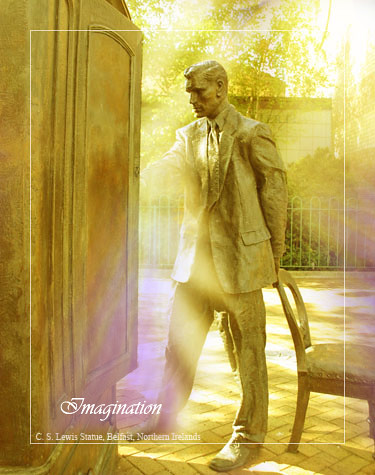
And so we arrive at the wonderful consideration of the place of vivid imagination as an instructor. C. S. Lewis found inspiration in the world of wonder opened to him by a rather lucid observation of nature and the works of Scottish fantasy writer: George MacDonald. Although MacDonald has fallen from favor with some scholars, there is renewed interest in his work, much of which is now in the public domain and so can be here presented. (h/t Kristina Elaine Greer)
(to be continued)

IMG_6163
Photo by Bob Kirchman

THYMEImagined
C. S. Lewis was influenced by the work of George MacDonald.

The Fantastic Imagination
Excerpt from A Dish of Orts (scraps)
By George MacDonald

That we have in English no word corresponding to the German Mährchen, drives us to use the word Fairytale, regardless of the fact that the tale may have nothing to do with any sort of fairy. The old use of the word Fairy, by Spenser at least, might, however, well be adduced, were justification or excuse necessary where need must.

Were I asked, what is a fairytale? I should reply, Read Undine: that is a fairytale; then read this and that as well, and you will see what is a fairytale. Were I further begged to describe the fairytale, or define what it is, I would make answer, that I should as soon think of describing the abstract human face, or stating what must go to constitute a human being. A fairytale is just a fairytale, as a face is just a face; and of all fairytales I know, I think Undine the most beautiful.

Many a man, however, who would not attempt to define a man, might venture to say something as to what a man ought to be: even so much I will not in this place venture with regard to the fairytale, for my long past work in that kind might but poorly instance or illustrate my now more matured judgment. I will but say some things helpful to the reading, in right-minded fashion, of such fairytales as I would wish to write, or care to read.

Some thinkers would feel sorely hampered if at liberty to use no forms but such as existed in nature, or to invent nothing save in accordance with the laws of the world of the senses; but it must not therefore be imagined that they desire escape from the region of law. Nothing lawless can show the least reason why it should exist, or could at best have more than an appearance of life.

The natural world has its laws, and no man must interfere with them in the way of presentment any more than in the way of use; but they themselves may suggest laws of other kinds, and man may, if he pleases, invent a little world of his own, with its own laws; for there is that in him which delights in calling up new forms--which is the nearest, perhaps, he can come to creation. When such forms are new embodiments of old truths, we call them products of the Imagination; when they are mere inventions, however lovely, I should call them the work of the Fancy: in either case, Law has been diligently at work.

His world once invented, the highest law that comes next into play is, that there shall be harmony between the laws by which the new world has begun to exist; and in the process of his creation, the inventor must hold by those laws. The moment he forgets one of them, he makes the story, by its own postulates, incredible. To be able to live a moment in an imagined world, we must see the laws of its existence obeyed. Those broken, we fall out of it. The imagination in us, whose exercise is essential to the most temporary submission to the imagination of another, immediately, with the disappearance, of Law, ceases to act. Suppose the gracious creatures of some childlike region of Fairyland talking either cockney or Gascon! Would not the tale, however lovelily begun, sink at once to the level of the Burlesque--of all forms of literature the least worthy? A man's inventions may be stupid or clever, but if he do not hold by the laws of them, or if he make one law jar with another, he contradicts himself as an inventor, he is no artist. He does not rightly consort his instruments, or he tunes them in different keys. The mind of man is the product of live Law; it thinks by law, it dwells in the midst of law, it gathers from law its growth; with law, therefore, can it alone work to any result. Inharmonious, unconsorting ideas will come to a man, but if he try to use one of such, his work will grow dull, and he will drop it from mere lack of interest. Law is the soil in which alone beauty will grow; beauty is the only stuff in which Truth can be clothed; and you may, if you will, call Imagination the tailor that cuts her garments to fit her, and Fancy his journeyman that puts the pieces of them together, or perhaps at most embroiders their button-holes. Obeying law, the maker works like his creator; not obeying law, he is such a fool as heaps a pile of stones and calls it a church.

In the moral world it is different: there a man may clothe in new forms, and for this employ his imagination freely, but he must invent nothing. He may not, for any purpose, turn its laws upside down. He must not meddle with the relations of live souls. The laws of the spirit of man must hold, alike in this world and in any world he may invent. It were no offence to suppose a world in which everything repelled instead of attracted the things around it; it would be wicked to write a tale representing a man it called good as always doing bad things, or a man it called bad as always doing good things: the notion itself is absolutely lawless. In physical things a man may invent; in moral things he must obey--and take their laws with him into his invented world as well.

You write as if a fairytale were a thing of importance: must it have a meaning?"

It cannot help having some meaning; if it have proportion and harmony it has vitality, and vitality is truth. The beauty may be plainer in it than the truth, but without the truth the beauty could not be, and the fairytale would give no delight. Everyone, however, who feels the story, will read its meaning after his own nature and development: one man will read one meaning in it, another will read another.

If so, how am I to assure myself that I am not reading my own meaning into it, but yours out of it?"

Why should you be so assured? It may be better that you should read your meaning into it. That may be a higher operation of your intellect than the mere reading of mine out of it: your meaning may be superior to mine.

Suppose my child ask me what the fairytale means, what am I to say?"
A Horse Web
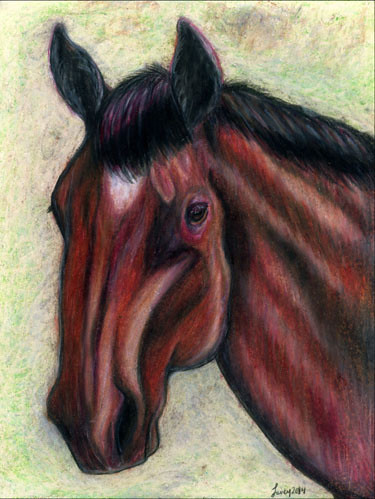
Illustration by Kristina Elaine Greer.

If you do not know what it means, what is easier than to say so? If you do see a meaning in it, there it is for you to give him. A genuine work of art must mean many things; the truer its art, the more things it will mean. If my drawing, on the other hand, is so far from being a work of art that it needs THIS IS A HORSE written under it, what can it matter that neither you nor your child should know what it means? It is there not so much to convey a meaning as to wake a meaning. If it do not even wake an interest, throw it aside. A meaning may be there, but it is not for you. If, again, you do not know a horse when you see it, the name written under it will not serve you much. At all events, the business of the painter is not to teach zoology.

But indeed your children are not likely to trouble you about the meaning. They find what they are capable of finding, and more would be too much. For my part, I do not write for children, but for the childlike, whether of five, or fifty, or seventy-five.

A fairytale is not an allegory. There may be allegory in it, but it is not an allegory. He must be an artist indeed who can, in any mode, produce a strict allegory that is not a weariness to the spirit. An allegory must be Mastery or Moorditch.

A fairytale, like a butterfly or a bee, helps itself on all sides, sips at every wholesome flower, and spoils not one. The true fairytale is, to my mind, very like the sonata. We all know that a sonata means something; and where there is the faculty of talking with suitable vagueness, and choosing metaphor sufficiently loose, mind may approach mind, in the interpretation of a sonata, with the result of a more or less contenting consciousness of sympathy. But if two or three men sat down to write each what the sonata meant to him, what approximation to definite idea would be the result? Little enough--and that little more than needful. We should find it had roused related, if not identical, feelings, but probably not one common thought. Has the sonata therefore failed? Had it undertaken to convey, or ought it to be expected to impart anything defined, anything notionally recognizable?

But words are not music; words at least are meant and fitted to carry a precise meaning!"

It is very seldom indeed that they carry the exact meaning of any user of them! And if they can be so used as to convey definite meaning, it does not follow that they ought never to carry anything else. Words are live things that may be variously employed to various ends. They can convey a scientific fact, or throw a shadow of her child's dream on the heart of a mother. They are things to put together like the pieces of a dissected map, or to arrange like the notes on a stave. Is the music in them to go for nothing? It can hardly help the definiteness of a meaning: is it therefore to be disregarded? They have length, and breadth, and outline: have they nothing to do with depth? Have they only to describe, never to impress? Has nothing any claim to their use but the definite? The cause of a child's tears may be altogether undefinable: has the mother therefore no antidote for his vague misery? That may be strong in colour which has no evident outline. A fairytale, a sonata, a gathering storm, a limitless night, seizes you and sweeps you away: do you begin at once to wrestle with it and ask whence its power over you, whither it is carrying you? The law of each is in the mind of its composer; that law makes one man feel this way, another man feel that way. To one the sonata is a world of odour and beauty, to another of soothing only and sweetness. To one, the cloudy rendezvous is a wild dance, with a terror at its heart; to another, a majestic march of heavenly hosts, with Truth in their centre pointing their course, but as yet restraining her voice. The greatest forces lie in the region of the uncomprehended.

I will go farther.--The best thing you can do for your fellow, next to rousing his conscience, is--not to give him things to think about, but to wake things up that are in him; or say, to make him think things for himself. The best Nature does for us is to work in us such moods in which thoughts of high import arise. Does any aspect of Nature wake but one thought? Does she ever suggest only one definite thing? Does she make any two men in the same place at the same moment think the same thing? Is she therefore a failure, because she is not definite? Is it nothing that she rouses the something deeper than the understanding--the power that underlies thoughts? Does she not set feeling, and so thinking at work? Would it be better that she did this after one fashion and not after many fashions? Nature is mood-engendering, thought-provoking: such ought the sonata, such ought the fairytale to be.

But a man may then imagine in your work what he pleases, what you never meant!"

Not what he pleases, but what he can. If he be not a true man, he will draw evil out of the best; we need not mind how he treats any work of art! If he be a true man, he will imagine true things; what matter whether I meant them or not? They are there none the less that I cannot claim putting them there! One difference between God's work and man's is, that, while God's work cannot mean more than he meant, man's must mean more than he meant. For in everything that God has made, there is layer upon layer of ascending significance; also he expresses the same thought in higher and higher kinds of that thought: it is God's things, his embodied thoughts, which alone a man has to use, modified and adapted to his own purposes, for the expression of his thoughts; therefore he cannot help his words and figures falling into such combinations in the mind of another as he had himself not foreseen, so many are the thoughts allied to every other thought, so many are the relations involved in every figure, so many the facts hinted in every symbol. A man may well himself discover truth in what he wrote; for he was dealing all the time with things that came from thoughts beyond his own.

But surely you would explain your idea to one who asked you?"

I say again, if I cannot draw a horse, I will not write THIS IS A HORSE under what I foolishly meant for one. Any key to a work of imagination would be nearly, if not quite, as absurd. The tale is there, not to hide, but to show: if it show nothing at your window, do not open your door to it; leave it out in the cold. To ask me to explain, is to say, "Roses! Boil them, or we won't have them!" My tales may not be roses, but I will not boil them.

So long as I think my dog can bark, I will not sit up to bark for him.

If a writer's aim be logical conviction, he must spare no logical pains, not merely to be understood, but to escape being misunderstood; where his object is to move by suggestion, to cause to imagine, then let him assail the soul of his reader as the wind assails an aeolian harp. If there be music in my reader, I would gladly wake it. Let fairytale of mine go for a firefly that now flashes, now is dark, but may flash again. Caught in a hand which does not love its kind, it will turn to an insignificant, ugly thing, that can neither flash nor fly.

The best way with music, I imagine, is not to bring the forces of our intellect to bear upon it, but to be still and let it work on that part of us for whose sake it exists. We spoil countless precious things by intellectual greed. He who will be a man, and will not be a child, must--he cannot help himself--become a little man, that is, a dwarf. He will, however, need no consolation, for he is sure to think himself a very large creature indeed.

If any strain of my "broken music" make a child's eyes flash, or his mother's grow for a moment dim, my labour will not have been in vain.

The paper on The Fantastic Imagination had its origin in the repeated request of readers for an explanation of things in certain shorter stories I had written. It forms the preface to an American edition of my so-called Fairy Tales. -- George MacDonald

Rainy Mountain Hike at Blackrock
'Wood Between the Worlds.' Photo by Bob Kirchman.

The Joy of Sauntering

262FA351-C2DC-4612-A662-4818FC73BCB5
John Muir. Public Domain.

Hiking - "I don't like either the word or the thing. People ought to saunter in the mountains - not hike! Do you know the origin of that word 'saunter?' It's a beautiful word. Away back in the Middle Ages people used to go on pilgrimages to the Holy Land, and when people in the villages through which they passed asked where they were going, they would reply, 'A la sainte terre,' 'To the Holy Land.' And so they became known as sainte-terre-ers or saunterers. Now these mountains are our Holy Land, and we ought to saunter through them reverently, not 'hike' through them."
- John Muir

The Smartest Horse that Ever Lived
A True Story


More than simply the biography of an unusual sideshow act, Beautiful Jim Key by Mim Eichler Rivas takes a thorough look at American history from before the Civil War to the mid-20th century, examining race relations, World’s Fair and exposition history, and the development of the humane movement. The story centers around the “Arabian-Hambletonian educated horse” Beautiful Jim Key, his breeder William Key, who was a business-savvy former slave, and their promoter, Albert Rogers, a privileged young New Yorker who aspired to being a philanthropist. (read more)

Jesus, Horses, Healing
Risen Ridge Ministry

IMG_20191104_1044391
Dezi, Socks and Maple graze at Risen Ridge Ministry. This Spring they will begin providing ministry sessions. Photo by Jen Beck.

Horses have an amazing way of communicating. They are honest, gentle, and encouraging. In a horse ministry, people who are seeking healing through the love of Jesus will come and find it through a relationship with a horse and a facilitator. They will learn what it is like to care for another's well being, and what it feels like to have an honest relationship based on love. Horses don't care about your past or what you look like. Over and over, the horse will see you for who you really are, whom God created you to be. The experiences will demonstrate that God's love never fails, can bring restoration, and how we all have value. (read more)

I will restore you to health and heal your wounds, declares the Lord.” - Jeremiah 30:17

Astronaut Alan Bean
Moonwalker, Skylab Commander, Artist


Apollo 12, Pinpoint for Science


Tolkien And The Eucharist In “Lord of the Rings”
[click to read]

This lecture was given by Prof. Peter Kreeft (Boston College) at Rutgers University on 8 October 2019. Dr. Peter Kreeft is a professor of philosophy at Boston College and teaches philosophy courses at King’s College. Kreeft is a popular writer of Christian philosophy, theology and apologetics and the author of dozens of books, two of which include The Philosophy of Tolkien: The Worldview Behind the Lord of the Rings and Symbol or Substance: A Dialogue on the Eucharist with C. S. Lewis, Billy Graham and J. R. R. Tolkien. (read more)

My Cathedral in Autumn
Photos by Bob Kirchman

My Cathedral, Autumn

My Cathedral, Autumn

My Cathedral, Autumn

Honoring Our Veterans

IMG_4361
Students at United Christian Academy in Stanardsville, Virginia created this display of flags to honor our veterans. Photo by Walter R. Key.

PontifusBANNER

Wednesday, June 20, 2018

Journeys of Apollo, From the Earth to the Moon

0007Moon
Volume XIV, Issue XXIV

The Journeys of Apollo


The heavens declare the glory of God; and the firmament sheweth his handywork. Day unto day uttereth speech, and night unto night sheweth knowledge. There is no speech nor language, where their voice is not heard.” – PSALM 19:1-3

First Paintings of Another World
By an Artist Who was Actually There, Alan Bean

[click to read]

I was the Lunar Module Pilot of Apollo 12 and the fourth man to set foot on the moon. I explored the beautifully desolate landscape of the Ocean of Storms and later, as commander of Skylab 3 (Skylab Mission II), I spent 59 days in orbit around our fragile, blue-and-white Earth.

I had been painting earthbound subjects for many years by the time I returned from Apollo 12 and Skylab 3 missions, but my fellow astronauts convinced me to paint my experiences on the moon.

You can create the very first paintings in all of history of a place other than our own planet,” they said. “Your paintings will forever be the first paintings of the many other worlds humans will visit as the centuries unfold.”

Because of this unprecedented opportunity and challenge, I resigned from NASA in 1981 to devote all of my time and energy to painting, celebrating the great exploration that was Apollo.

Over the years, my art has evolved into a mixture of painting and sculpture, textured with my lunar tools, sprinkled with bits of our Apollo 12 spacecraft and a touch of moondust from the Ocean of Storms. You can see many of my paintings on this site and read more about the space-age techniques and materials I use in my work. (read more)

essay1
The Alan Bean Gallery.

From the Earth to the Moon
By Jules Verne

CHAPTER XXII, THE NEW CITIZEN OF THE UNITED STATES

That same day all America heard of the affair of Captain Nicholl and President Barbicane, as well as its singular denouement. From that day forth, Michel Ardan had not one moment's rest. Deputations from all corners of the Union harassed him without cessation or intermission. He was compelled to receive them all, whether he would or no. How many hands he shook, how many people he was "hail-fellow-well-met" with, it is impossible to guess! Such a triumphal result would have intoxicated any other man; but he managed to keep himself in a state of delightful semi-tipsiness.

Among the deputations of all kinds which assailed him, that of "The Lunatics" were careful not to forget what they owed to the future conqueror of the moon. One day, certain of these poor people, so numerous in America, came to call upon him, and requested permission to return with him to their native country.

Singular hallucination!" said he to Barbicane, after having dismissed the deputation with promises to convey numbers of messages to friends in the moon. "Do you believe in the influence of the moon upon distempers?"

Scarcely!"

No more do I, despite some remarkable recorded facts of history. For instance, during an epidemic in 1693, a large number of persons died at the very moment of an eclipse. The celebrated Bacon always fainted during an eclipse. Charles VI relapsed six times into madness during the year 1399, sometimes during the new, sometimes during the full moon. Gall observed that insane persons underwent an accession of their disorder twice in every month, at the epochs of new and full moon. In fact, numerous observations made upon fevers, somnambulisms, and other human maladies, seem to prove that the moon does exercise some mysterious influence upon man."

But the how and the wherefore?" asked Barbicane.

Well, I can only give you the answer which Arago borrowed from Plutarch, which is nineteen centuries old. `Perhaps the stories are not true!'"

In the height of his triumph, Michel Ardan had to encounter all the annoyances incidental to a man of celebrity. Managers of entertainments wanted to exhibit him. Barnum offered him a million dollars to make a tour of the United States in his show. As for his photographs, they were sold of all size, and his portrait taken in every imaginable posture. More than half a million copies were disposed of in an incredibly short space of time.

But it was not only the men who paid him homage, but the women as well. He might have married well a hundred times over, if he had been willing to settle in life. The old maids, in particular, of forty years and upward, and dry in proportion, devoured his photographs day and night. They would have married him by hundreds, even if he had imposed upon them the condition of accompanying him into space. He had, however, no intention of transplanting a race of Franco-Americans upon the surface of the moon.

He therefore declined all offers.

As soon as he could withdraw from these somewhat embarrassing demonstrations, he went, accompanied by his friends, to pay a visit to the Columbiad. He was highly gratified by his inspection, and made the descent to the bottom of the tube of this gigantic machine which was presently to launch him to the regions of the moon. It is necessary here to mention a proposal of J. T. Maston's. When the secretary of the Gun Club found that Barbicane and Nicholl accepted the proposal of Michel Ardan, he determined to join them, and make one of a smug party of four. So one day he determined to be admitted as one of the travelers. Barbicane, pained at having to refuse him, gave him clearly to understand that the projectile could not possibly contain so many passengers. Maston, in despair, went in search of Michel Ardan, who counseled him to resign himself to the situation, adding one or two arguments ad hominem.

You see, old fellow," he said, "you must not take what I say in bad part; but really, between ourselves, you are in too incomplete a condition to appear in the moon!"

Incomplete?" shrieked the valiant invalid.

Yes, my dear fellow! imagine our meeting some of the inhabitants up there! Would you like to give them such a melancholy notion of what goes on down here? to teach them what war is, to inform them that we employ our time chiefly in devouring each other, in smashing arms and legs, and that too on a globe which is capable of supporting a hundred billions of inhabitants, and which actually does contain nearly two hundred millions? Why, my worthy friend, we should have to turn you out of doors!"

But still, if you arrive there in pieces, you will be as incomplete as I am."

Unquestionably," replied Michel Ardan; "but we shall not."

In fact, a preparatory experiment, tried on the 18th of October, had yielded the best results and caused the most well-grounded hopes of success. Barbicane, desirous of obtaining some notion of the effect of the shock at the moment of the projectile's departure, had procured a 38-inch mortar from the arsenal of Pensacola. He had this placed on the bank of Hillisborough Roads, in order that the shell might fall back into the sea, and the shock be thereby destroyed. His object was to ascertain the extent of the shock of departure, and not that of the return.

A hollow projectile had been prepared for this curious experiment. A thick padding fastened upon a kind of elastic network, made of the best steel, lined the inside of the walls. It was a veritable nest most carefully wadded.

What a pity I can't find room in there," said J. T. Maston, regretting that his height did not allow of his trying the adventure.

Within this shell were shut up a large cat, and a squirrel belonging to J. T. Maston, and of which he was particularly fond. They were desirous, however, of ascertaining how this little animal, least of all others subject to giddiness, would endure this experimental voyage.

The mortar was charged with 160 pounds of powder, and the shell placed in the chamber. On being fired, the projectile rose with great velocity, described a majestic parabola, attained a height of about a thousand feet, and with a graceful curve descended in the midst of the vessels that lay there at anchor.

Without a moment's loss of time a small boat put off in the direction of its fall; some divers plunged into the water and attached ropes to the handles of the shell, which was quickly dragged on board. Five minutes did not elapse between the moment of enclosing the animals and that of unscrewing the coverlid of their prison.

Ardan, Barbicane, Maston, and Nicholl were present on board the boat, and assisted at the operation with an interest which may readily be comprehended. Hardly had the shell been opened when the cat leaped out, slightly bruised, but full of life, and exhibiting no signs whatever of having made an aerial expedition. No trace, however, of the squirrel could be discovered. The truth at last became apparent-- the cat had eaten its fellow-traveler!

J. T. Maston grieved much for the loss of his poor squirrel, and proposed to add its case to that of other martyrs to science.

After this experiment all hesitation, all fear disappeared. Besides, Barbicane's plans would ensure greater perfection for his projectile, and go far to annihilate altogether the effects of the shock. Nothing now remained but to go!

Two days later Michel Ardan received a message from the President of the United States, an honor of which he showed himself especially sensible.

After the example of his illustrious fellow-countryman, the Marquis de la Fayette, the government had decreed to him the title of "Citizen of the United States of America."

CHAPTER XXIII, THE PROJECTILE-VEHICLE

On the completion of the Columbiad the public interest centered in the projectile itself, the vehicle which was destined to carry the three hardy adventurers into space.

The new plans had been sent to Breadwill and Co., of Albany, with the request for their speedy execution. The projectile was consequently cast on the 2nd of November, and immediately forwarded by the Eastern Railway to Stones Hill, which it reached without accident on the 10th of that month, where Michel Ardan, Barbicane, and Nicholl were waiting impatiently for it.

The projectile had now to be filled to the depth of three feet with a bed of water, intended to support a water-tight wooden disc, which worked easily within the walls of the projectile. It was upon this kind of raft that the travelers were to take their place. This body of water was divided by horizontal partitions, which the shock of the departure would have to break in succession. Then each sheet of the water, from the lowest to the highest, running off into escape tubes toward the top of the projectile, constituted a kind of spring; and the wooden disc, supplied with extremely powerful plugs, could not strike the lowest plate except after breaking successively the different partitions. Undoubtedly the travelers would still have to encounter a violent recoil after the complete escapement of the water; but the first shock would be almost entirely destroyed by this powerful spring. The upper parts of the walls were lined with a thick padding of leather, fastened upon springs of the best steel, behind which the escape tubes were completely concealed; thus all imaginable precautions had been taken for averting the first shock; and if they did get crushed, they must, as Michel Ardan said, be made of very bad materials.

The entrance into this metallic tower was by a narrow aperture contrived in the wall of the cone. This was hermetically closed by a plate of aluminum, fastened internally by powerful screw-pressure. The travelers could therefore quit their prison at pleasure, as soon as they should reach the moon.

Light and view were given by means of four thick lenticular glass scuttles, two pierced in the circular wall itself, the third in the bottom, the fourth in the top. These scuttles then were protected against the shock of departure by plates let into solid grooves, which could easily be opened outward by unscrewing them from the inside. Reservoirs firmly fixed contained water and the necessary provisions; and fire and light were procurable by means of gas, contained in a special reservoir under a pressure of several atmospheres. They had only to turn a tap, and for six hours the gas would light and warm this comfortable vehicle.

There now remained only the question of air; for allowing for the consumption of air by Barbicane, his two companions, and two dogs which he proposed taking with him, it was necessary to renew the air of the projectile. Now air consists principally of twenty-one parts of oxygen and seventy-nine of nitrogen. The lungs absorb the oxygen, which is indispensable for the support of life, and reject the nitrogen. The air expired loses nearly five per cent. of the former and contains nearly an equal volume of carbonic acid, produced by the combustion of the elements of the blood. In an air-tight enclosure, then, after a certain time, all the oxygen of the air will be replaced by the carbonic acid-- a gas fatal to life. There were two things to be done then-- first, to replace the absorbed oxygen; secondly, to destroy the expired carbonic acid; both easy enough to do, by means of chlorate of potassium and caustic potash. The former is a salt which appears under the form of white crystals; when raised to a temperature of 400 degrees it is transformed into chlorure of potassium, and the oxygen which it contains is entirely liberated. Now twenty-eight pounds of chlorate of potassium produces seven pounds of oxygen, or 2,400 litres-- the quantity necessary for the travelers during twenty-four hours.

Caustic potash has a great affinity for carbonic acid; and it is sufficient to shake it in order for it to seize upon the acid and form bicarbonate of potassium. By these two means they would be enabled to restore to the vitiated air its life- supporting properties.

It is necessary, however, to add that the experiments had hitherto been made in anima vili. Whatever its scientific accuracy was, they were at present ignorant how it would answer with human beings. The honor of putting it to the proof was energetically claimed by J. T. Maston.

Since I am not to go," said the brave artillerist, "I may at least live for a week in the projectile."

It would have been hard to refuse him; so they consented to his wish. A sufficient quantity of chlorate of potassium and of caustic potash was placed at his disposal, together with provisions for eight days. And having shaken hands with his friends, on the 12th of November, at six o'clock A.M., after strictly informing them not to open his prison before the 20th, at six o'clock P.M., he slid down the projectile, the plate of which was at once hermetically sealed. What did he do with himself during that week? They could get no information. The thickness of the walls of the projectile prevented any sound reaching from the inside to the outside. On the 20th of November, at six P.M. exactly, the plate was opened. The friends of J. T. Maston had been all along in a state of much anxiety; but they were promptly reassured on hearing a jolly voice shouting a boisterous hurrah.

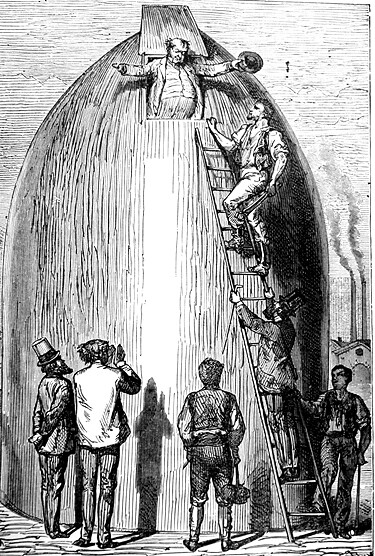
Presently afterward the secretary of the Gun Club appeared at the top of the cone in a triumphant attitude. He had grown fat!

j_t_maston_had_grown_fat

CHAPTER XXIV, THE TELESCOPE OF THE ROCKY MOUNTAINS

On the 20th of October in the preceding year, after the close of the subscription, the president of the Gun Club had credited the Observatory of Cambridge with the necessary sums for the construction of a gigantic optical instrument. This instrument was designed for the purpose of rendering visible on the surface of the moon any object exceeding nine feet in diameter.

At the period when the Gun Club essayed their great experiment, such instruments had reached a high degree of perfection, and produced some magnificent results. Two telescopes in particular, at this time, were possessed of remarkable power and of gigantic dimensions. The first, constructed by Herschel, was thirty-six feet in length, and had an object-glass of four feet six inches; it possessed a magnifying power of 6,000. The second was raised in Ireland, in Parsonstown Park, and belongs to Lord Rosse. The length of this tube is forty-eight feet, and the diameter of its object-glass six feet; it magnifies 6,400 times, and required an immense erection of brick work and masonry for the purpose of working it, its weight being twelve and a half tons.

Still, despite these colossal dimensions, the actual enlargements scarcely exceeded 6,000 times in round numbers; consequently, the moon was brought within no nearer an apparent distance than thirty-nine miles; and objects of less than sixty feet in diameter, unless they were of very considerable length, were still imperceptible.

In the present case, dealing with a projectile nine feet in diameter and fifteen feet long, it became necessary to bring the moon within an apparent distance of five miles at most; and for that purpose to establish a magnifying power of 48,000 times.

Such was the question proposed to the Observatory of Cambridge, There was no lack of funds; the difficulty was purely one of construction.

After considerable discussion as to the best form and principle of the proposed instrument the work was finally commenced. According to the calculations of the Observatory of Cambridge, the tube of the new reflector would require to be 280 feet in length, and the object-glass sixteen feet in diameter. Colossal as these dimensions may appear, they were diminutive in comparison with the 10,000 foot telescope proposed by the astronomer Hooke only a few years ago!

Regarding the choice of locality, that matter was promptly determined. The object was to select some lofty mountain, and there are not many of these in the United States. In fact there are but two chains of moderate elevation, between which runs the magnificent Mississippi, the "king of rivers" as these Republican Yankees delight to call it.

Eastwards rise the Appalachians, the very highest point of which, in New Hampshire, does not exceed the very moderate altitude of 5,600 feet.

On the west, however, rise the Rocky Mountains, that immense range which, commencing at the Straights of Magellan, follows the western coast of Southern America under the name of the Andes or the Cordilleras, until it crosses the Isthmus of Panama, and runs up the whole of North America to the very borders of the Polar Sea.

The highest elevation of this range still does not exceed 10,700 feet. With this elevation, nevertheless, the Gun Club were compelled to be content, inasmuch as they had determined that both telescope and Columbiad should be erected within the limits of the Union. All the necessary apparatus was consequently sent on to the summit of Long's Peak, in the territory of Missouri.

Neither pen nor language can describe the difficulties of all kinds which the American engineers had to surmount, of the prodigies of daring and skill which they accomplished. They had to raise enormous stones, massive pieces of wrought iron, heavy corner-clamps and huge portions of cylinder, with an object-glass weighing nearly 30,000 pounds, above the line of perpetual snow for more than 10,000 feet in height, after crossing desert prairies, impenetrable forests, fearful rapids, far from all centers of population, and in the midst of savage regions, in which every detail of life becomes an almost insoluble problem. And yet, notwithstanding these innumerable obstacles, American genius triumphed. In less than a year after the commencement of the works, toward the close of September, the gigantic reflector rose into the air to a height of 280 feet. It was raised by means of an enormous iron crane; an ingenious mechanism allowed it to be easily worked toward all the points of the heavens, and to follow the stars from the one horizon to the other during their journey through the heavens.

It had cost $400,000. The first time it was directed toward the moon the observers evinced both curiosity and anxiety. What were they about to discover in the field of this telescope which magnified objects 48,000 times? Would they perceive peoples, herds of lunar animals, towns, lakes, seas? No! there was nothing which science had not already discovered! and on all the points of its disc the volcanic nature of the moon became determinable with the utmost precision.

But the telescope of the Rocky Mountains, before doing its duty to the Gun Club, rendered immense services to astronomy. Thanks to its penetrative power, the depths of the heavens were sounded to the utmost extent; the apparent diameter of a great number of stars was accurately measured; and Mr. Clark, of the Cambridge staff, resolved the Crab nebula in Taurus, which the reflector of Lord Rosse had never been able to decompose.

CHAPTER XXV, FINAL DETAILS 
It was the 22nd of November; the departure was to take place in ten days. One operation alone remained to be accomplished to bring all to a happy termination; an operation delicate and perilous, requiring infinite precautions, and against the success of which Captain Nicholl had laid his third bet. It was, in fact, nothing less than the loading of the Columbiad, and the introduction into it of 400,000 pounds of gun-cotton. Nicholl had thought, not perhaps without reason, that the handling of such formidable quantities of pyroxyle would, in all probability, involve a grave catastrophe; and at any rate, that this immense mass of eminently inflammable matter would inevitably ignite when submitted to the pressure of the projectile.

There were indeed dangers accruing as before from the carelessness of the Americans, but Barbicane had set his heart on success, and took all possible precautions. In the first place, he was very careful as to the transportation of the gun-cotton to Stones Hill. He had it conveyed in small quantities, carefully packed in sealed cases. These were brought by rail from Tampa Town to the camp, and from thence were taken to the Columbiad by barefooted workmen, who deposited them in their places by means of cranes placed at the orifice of the cannon. No steam-engine was permitted to work, and every fire was extinguished within two miles of the works.

Even in November they feared to work by day, lest the sun's rays acting on the gun-cotton might lead to unhappy results. This led to their working at night, by light produced in a vacuum by means of Ruhmkorff's apparatus, which threw an artificial brightness into the depths of the Columbiad.

There the cartridges were arranged with the utmost regularity, connected by a metallic thread, destined to communicate to them all simultaneously the electric spark, by which means this mass of gun-cotton was eventually to be ignited.

By the 28th of November eight hundred cartridges had been placed in the bottom of the Columbiad. So far the operation had been successful! But what confusion, what anxieties, what struggles were undergone by President Barbicane! In vain had he refused admission to Stones Hill; every day the inquisitive neighbors scaled the palisades, some even carrying their imprudence to the point of smoking while surrounded by bales of gun-cotton. Barbicane was in a perpetual state of alarm. J. T. Maston seconded him to the best of his ability, by giving vigorous chase to the intruders, and carefully picking up the still lighted cigar ends which the Yankees threw about. A somewhat difficult task! seeing that more than 300,000 persons were gathered round the enclosure. Michel Ardan had volunteered to superintend the transport of the cartridges to the mouth of the Columbiad; but the president, having surprised him with an enormous cigar in his mouth, while he was hunting out the rash spectators to whom he himself offered so dangerous an example, saw that he could not trust this fearless smoker, and was therefore obliged to mount a special guard over him.

At last, Providence being propitious, this wonderful loading came to a happy termination, Captain Nicholl's third bet being thus lost. It remained now to introduce the projectile into the Columbiad, and to place it on its soft bed of gun-cotton.

But before doing this, all those things necessary for the journey had to be carefully arranged in the projectile vehicle. These necessaries were numerous; and had Ardan been allowed to follow his own wishes, there would have been no space remaining for the travelers. It is impossible to conceive of half the things this charming Frenchman wished to convey to the moon. A veritable stock of useless trifles! But Barbicane interfered and refused admission to anything not absolutely needed. Several thermometers, barometers, and telescopes were packed in the instrument case.

The travelers being desirous of examing the moon carefully during their voyage, in order to facilitate their studies, they took with them Boeer and Moeller's excellent Mappa Selenographica, a masterpiece of patience and observation, which they hoped would enable them to identify those physical features in the moon, with which they were acquainted. This map reproduced with scrupulous fidelity the smallest details of the lunar surface which faces the earth; the mountains, valleys, craters, peaks, and ridges were all represented, with their exact dimensions, relative positions, and names; from the mountains Doerfel and Leibnitz on the eastern side of the disc, to the Mare frigoris of the North Pole.

They took also three rifles and three fowling-pieces, and a large quantity of balls, shot, and powder.

We cannot tell whom we shall have to deal with," said Michel Ardan. "Men or beasts may possibly object to our visit. It is only wise to take all precautions."

These defensive weapons were accompanied by pickaxes, crowbars, saws, and other useful implements, not to mention clothing adapted to every temperature, from that of polar regions to that of the torrid zone.

Ardan wished to convey a number of animals of different sorts, not indeed a pair of every known species, as he could not see the necessity of acclimatizing serpents, tigers, alligators, or any other noxious beasts in the moon. "Nevertheless," he said to Barbicane, "some valuable and useful beasts, bullocks, cows, horses, and donkeys, would bear the journey very well, and would also be very useful to us."

I dare say, my dear Ardan," replied the president, "but our projectile-vehicle is no Noah's ark, from which it differs both in dimensions and object. Let us confine ourselves to possibilities."

After a prolonged discussion, it was agreed that the travelers should restrict themselves to a sporting-dog belonging to Nicholl, and to a large Newfoundland.

Several packets of seeds were also included among the necessaries. Michel Ardan, indeed, was anxious to add some sacks full of earth to sow them in; as it was, he took a dozen shrubs carefully wrapped up in straw to plant in the moon.

The important question of provisions still remained; it being necessary to provide against the possibility of their finding the moon absolutely barren. Barbicane managed so successfully, that he supplied them with sufficient rations for a year. These consisted of preserved meats and vegetables, reduced by strong hydraulic pressure to the smallest possible dimensions. They were also supplied with brandy, and took water enough for two months, being confident, from astronomical observations, that there was no lack of water on the moon's surface. As to provisions, doubtless the inhabitants of the earth would find nourishment somewhere in the moon. Ardan never questioned this; indeed, had he done so, he would never have undertaken the journey.

Besides," he said one day to his friends, "we shall not be completely abandoned by our terrestrial friends; they will take care not to forget us."

No, indeed!" replied J. T. Maston.

Nothing would be simpler," replied Ardan; "the Columbiad will be always there. Well! whenever the moon is in a favorable condition as to the zenith, if not to the perigee, that is to say about once a year, could you not send us a shell packed with provisions, which we might expect on some appointed day?"

Hurrah! hurrah!" cried J. T. Matson; "what an ingenious fellow! what a splendid idea! Indeed, my good friends, we shall not forget you!"

I shall reckon upon you! Then, you see, we shall receive news regularly from the earth, and we shall indeed be stupid if we hit upon no plan for communicating with our good friends here!"

These words inspired such confidence, that Michel Ardan carried all the Gun Club with him in his enthusiasm. What he said seemed so simple and so easy, so sure of success, that none could be so sordidly attached to this earth as to hesitate to follow the three travelers on their lunar expedition.

All being ready at last, it remained to place the projectile in the Columbiad, an operation abundantly accompanied by dangers and difficulties.

The enormous shell was conveyed to the summit of Stones Hill. There, powerful cranes raised it, and held it suspended over the mouth of the cylinder.

It was a fearful moment! What if the chains should break under its enormous weight? The sudden fall of such a body would inevitably cause the gun-cotton to explode!

Fortunately this did not happen; and some hours later the projectile-vehicle descended gently into the heart of the cannon and rested on its couch of pyroxyle, a veritable bed of explosive eider-down. Its pressure had no result, other than the more effectual ramming down of the charge in the Columbiad.

I have lost," said the captain, who forthwith paid President Barbicane the sum of three thousand dollars.

Barbicane did not wish to accept the money from one of his fellow-travelers, but gave way at last before the determination of Nicholl, who wished before leaving the earth to fulfill all his engagements.

Now," said Michel Ardan, "I have only one thing more to wish for you, my brave captain."

What is that?" asked Nicholl.

It is that you may lose your two other bets! Then we shall be sure not to be stopped on our journey!"
(to be continued)

IMG_3290
Pink Ladyslipper, White Rock Falls Trail on the Blue Ridge Parkway in Virginia. Photo by Bob Kirchman.

Seeing Things in 'Living Color'

Friedrich spoke thickly. "Don't you think, Mr. Kingscourt, that people would be much better if they were better off?"

No! If I believed that, I should not be going off to my lonely island; I should have stayed in the midst of humanity. I should have told them how to better themselves. They needn't wait to begin. Not a thousand years, not a hundred, not even fifty. Today! With the ideas, knowledge, and facilities that humanity possesses on this 31st day of December, 1902, it could save itself. No philosopher's stone, no dirigible airship is needed. Everything needful for the making of a better world exists already. And do you know, man, who could show the way? You! You Jews! Just because you're so badly off. You've nothing to lose. You could make the experimental land for humanity. Over yonder, where we were, you could create a new commonwealth. On that ancient soil, Old-New-Land!"

Friedrich heard Kingscourt's words only in a dream. He had fallen asleep. And, dreaming, he sailed through the Red Sea to meet the future."
-- Theodor Herzl, Altneuland  [1.]

In the Nineteenth Century, Theodor Herzl penned his futurist novel, Altneuland. In it, he envisions a renewed Zion, a land of rich agriculture and an industrious people. If Herzl were to step into modern-day Israel, he would probably feel very much at home. It probably would not surprise you that Theodor Herzl devoted most of his life to the creation of a Jewish homeland. The journey of Kingscourt and Friedrich that unfolds in this work of fiction is instructive because it puts form and color to the work Herzl sought to achieve. Likewise, Jules Verne in his Voyages Extraordinaires creates vivid pictures of journeys to the moon and fantastic invention that would actually occur in the century to follow!

Art often seems to come in advance of innovation. To lay forth a vision is an act of hope. In my own work PONTIFUS, [2.] which presents a vision for the future yet to come. It was written because I saw a dearth of encouraging vision being given to the generations to follow. In the post-Sputnik world of my youth we had Tom Swift as well as Jules Verne. American President, John F. Kennedy just said one day that we needed to put a man on the moon. Did we know how to even do it? I seriously doubt it, but the picture had already been painted. Brilliant men and women would fill in the details as the work progressed toward that day in July 1969 when Neil Armstrong and Buzz Aldrin walked on the moon..

Some of my fellow believers will, no doubt, say that my assertion is arrogant. They will invoke a reading of Scripture that they feel commands a more passive response to the world. I do not fault them for wanting to 'wait on the Lord,' but as I read stories like that of Nehemiah who prayed and worked ardently to rebuild the walls of Jerusalem, I see in them the most vivid portrayal of IMAGO DEI, the Scriptural truth that man is made in the Divine image.

Surprised by Joy
[click to read]

By C. S. Lewis

This book is written partly in answer to requests that I would tell how I passed from Atheism to Christianity and partly to correct one or two false notions that seem to have got about. How far the story matters to anyone but myself depends on the degree to which others have experienced what I call "joy". If it is at all common, a more detailed treatment of it than has (I believe) been attempted before may be of some use. I have been emboldened to write of it because I notice that a man seldom mentions what he had supposed to be his most idiosyncratic sensations without receiving from at least one (often more) of those present the reply, "What! Have you felt that too? I always thought I was the only one." (read more)

LEWIS_Banner

Journey from Atheism to Theism
C. S. Lewis Documentary


A Challenge, a Pis Aller!

What drove me to write was the extreme manual clumsiness from which I have always suffered. I attribute it to a physical defect which my brother and I both inherit from our father; we have only one joint in the thumb. The upper joint (that furthest from the nail) is visible, but it is a mere sham; we cannot bend it. But whatever the cause, nature laid on me from birth an utter incapacity to make anything.

With pencil and pen I was handy enough, and I can still tie as good a bow as ever lay on a man's collar; but with a tool or a bat or a gun, a sleeve-link or a corkscrew, I have always been unteachable. It was this that forced me to write. I longed to make things, ships, houses, engines. Many sheets of cardboard and pairs of scissors I spoiled, only to turn from my hopeless failures in tears. As a last resource, as a pis aller, I was driven to write stories instead; little dreaming to what a world of happiness I was being admitted. You can do more with a castle in a story than with the best cardboard castle that ever stood on a nursery table." -- C. S. Lewis, Surprised by Joy

Mountain Laurel in the Rain
Photos by Bob Kirchman

Mountain Laurel in the Rain

Mountain Laurel in the Rain

Mountain Laurel in the Rain

PontifusBANNER