Showing posts with label Dish of Orts. Show all posts

Wednesday, December 2, 2020

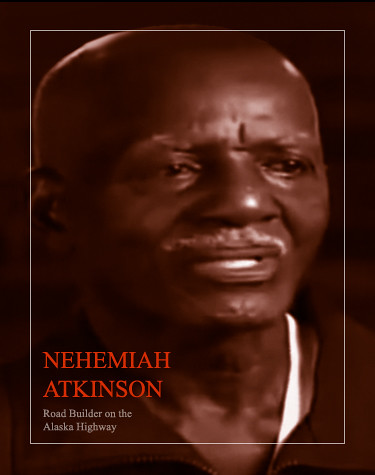
True Christian Service; Nehemiah Atkinson

THYME1204
Volume XIX, Issue IVIIIa

The Unsung Road Builders

Then I told them of the hand of my G-d which was good upon me; as also the king's words that he had spoken unto me. And they said, Let us rise up and build. So they strengthened their hands for this good work."
-- Nehemiah 2:18

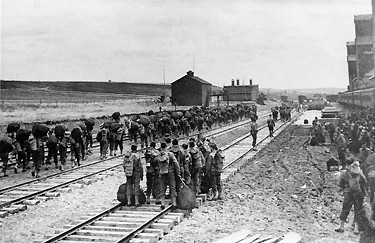
Nehemiah in Bible times returned from exile in Persia to rebuild the defenses of Jerusalem. In 1942 another Nehemiah would find himself building the defenses of North America. Nehemiah Atkinson was a young man in the Army's 97th Engineering Battalion who found himself traveling by train with his unit to an unknown destination. Little did he know he and his colleagues would be building a road to Alaska!

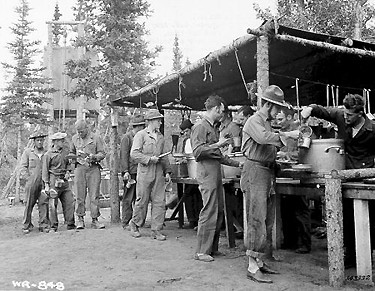
With manpower stretched thin, military leaders decided to send black troops, many from the deep South, North to Dawson Creek and the beginnings of the proposed Alcan Highway. In that era of segregation and Jim Crow laws, many doubted that these men could perform in the hostile climate of Northwestern Canada, but perform they did! Their clothing was only designed for temperatures around forty degrees ABOVE zero. They managed to improvise. Many of the men could not read, they organized themselves so that the literate men would write letters home for their colleagues. They taught their colleagues to read.

They worked twelve to fourteen hours a day. Diversions were few and the black troops were isolated far in the wilderness. Some of the men managed to 'tame' some of the local wildlife... including black bears who would wander into camp attracted by the smell of food. The animals here had no experience with humans in some cases so they had no fear.

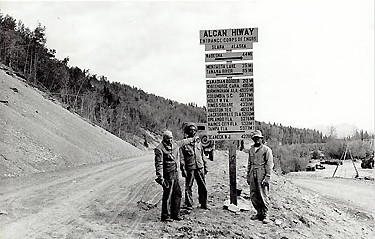
The black battalions were the last to get the best equipment, often laboring with hand tools even as the first D8 Caterpillar bulldozers came on the scene. Sometimes the guys from the 97th would perform a 'midnight requisition,' 'borrowing' a bulldozer from a better supplied unit. They would then proceed to build an impressive stretch of the highway on their own and post a sign to that effect.

Because the road was built under conditions of secrecy and the men of the 97th were so isolated, history largely forgot them. Still, their legacy is a mighty one. The Army was desegregated in 1948 and the 4000 black troops who had worked to build the Alcan had proved themselves ready for any task! Today their accomplishments are the subject of the book: The Black Soldiers who Built the Alaska Highway by John Virtue. They are also featured in the Megastructures presentation: Building the Alaskan Highway.

As America enters into a new era where she remembers how to build great works, the men of the 97th offer our generation an amazing example and inspiration!
Alaska001
Men arrive by train to build the highway.
Alaska002
Mess call for highway workers.

alaska003
Signposts provided an outlet for creative expression.

Redefining Boundaries

Nehemiah Atkinson was born in Biloxi, Mississippi, on September 8, 1918, the son of C.C. and Josephine Atkinson. His family moved to New Orleans in his youth when his father was appointed as Bishop of the diocese of the Holiness Church. He attended Thomy Lafon and J. W. Hoffman schools in New Orleans, and at the Louisiana Industrial Training School in Farmerville before beginning his military career. As a youth he had became fascinated by the game of tennis, hitting his first ball at age nine.

At that time, in the Great Depression, tennis was considered a pastime for the elite.White kids from places like Dartmouth were far more likely to play tennis than African-American kids in the Deep South. Still, Atkinson was undeterred in his pursuit of the game.

Atkinson loved the game and became quite good at it. When he came home from the war he had a passion to teach the game to young people of all backgrounds. He learned offset printing, worked as a night supervisor in a Coca-Cola plant and taught private tennis lessons by day to kids from well-to-do white families. He served as a tennis instructor for the New Orleans Recreation Department for 23 years before retiring in 1995. His legacy is an impressive number of young players who have attended college because of his mentoring!

New Orleans Tennis Professional Lloyd Dillon remembers Mr. Atkinson: “I can remember when Mr. Atkinson visited my high school in 1954. He played a classmate of mine who was also a good tennis player. Mr. Atkinson impressed me by the way he moved around on the basketball blacktop court converted into a tennis court for that event. He looked like he was gliding on air.”

Mr. A. ran tennis programs and used old wood racquets for kids each summer. He taught the basic tennis strokes, forehand, backhand, and serve; as well as the rules of the game. He had a way that made you love the game, even if you didn’t have any experience with the game.”

There were not tennis courts available for Blacks at that time in our neighborhood. Mr. A would use volleyball nets in parking lots or any place with space close by.”

He told me he was not going to retire unless he was certain that I got his job. Well, I did, but I knew it was going to be a tall order to do half of what he did with tennis and his life. Sometimes when I would get upset, he would always tell me to read Psalms 37:2,3:

 Trust in the LORD and do good; so shalt thou dwell in the land, and verily thou shalt be fed.”[1.]

Highway in the Wilderness
Building the Alcan Highway


The amazing story of an amazing road.

Alaskas

True Christian Service
Excerpt from A Dish of Orts (scraps)
By George MacDonald

But Jesus called them unto him and said, Ye know that the princes of the Gentiles exercise dominion over them, and they that are great exercise authority upon them. But it should not be so among you: but whosoever will be great among you, let him be your minister; and whosoever will be chief among you, let him be your servant: even as the Son of Man came not to be ministered unto, but to minister, and to give his life a ransom for many."
-- Matthew 20:25-28
archerslit
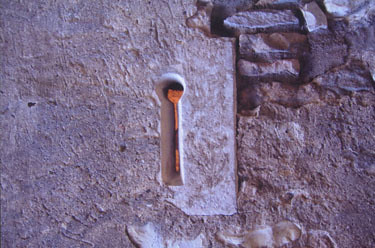
Archer slit, Chateau de Saint-Albain. Photo by Bob Kirchman.

Every spring-fountain of gladness about us is his making and his delight. He tends us and cares for us; he is close to us, breathing into our nostrils the breath of life, and breathing into our spirit this thought and that thought to make us look up and recognize the love and the care around us. What a poor thing for the little baby would it be if it were to be constantly tended thus tenderly and preciously by its mother, but if it were never to open its eyes to look up and see her mother's face bending over it. A poor thing all its tending would be without that. It is for that that the other exists; it is by that that the other comes. To recognize and know this loving-kindness, and to stand up in it strong and glad; this is the ministration of God unto us. Do you ever think "I could worship God if he was so-and-so?" Do you imagine that God is not as good, as perfect, as absolutely all-in-all as your thoughts can imagine? Aye, you cannot come up to it; do what you will you never will come up to it. Use all the symbols that we have in nature, in human relations, in the family--all our symbols of grace and tenderness, and loving-kindness between man and man, and between man and woman, and between woman and woman, but you can never come up to the thought of what God's ministration is. When our Lord came he just let us see how his Father was doing this always, he "came to give his life a ransom for many." It was in giving his life a ransom for us that he died; that was the consummation and crown of it all, but it was his life that he gave for us--his whole being, his whole strength, his whole energy--not alone his days of trouble and of toil, but deeper than that, he gave his whole being for us; yea, he even went down to death for us.

But how are we to learn this ministration? I will tell you where it begins. The most of us are forced to work; if you do not see that the commonest things in life belong to the Christian scheme, the plan of God, you have got to learn it. I say this is at the beginning. Most of us have to work, and infinitely better is that for us than if we were not forced to work, but not a very fine thing unless it goes to something farther. We are forced to work; and what is our work? It is doing something for other people always. It is doing; it is ministration in some shape or other. All kind of work is a serving, but it may not be always Christian service. No. Some of us only work for our wages; we must have them. We starve, and deserve to starve, if we do not work to get them. But we must go a little beyond that; yes, a very great way beyond that. There is no honest work that one man does for another which he may not do as unto the Lord and not unto men; in which he cannot do right as he ought to do right. Thus, I say that the man who sees the commonest thing in the world, recognizing it as part of the divine order of things, the law by which the world goes, being the intention of God that one man should be serviceable and useful to another--the man, I say, who does a thing well because of this, and who tries to do it better, is doing God service.

We talk of "divine service." It is a miserable name for a great thing. It is not service, properly speaking, at all. When a boy comes to his father and says, "May I do so and so for you?" or, rather, comes and breaks out in some way, showing his love to his father--says, "May I come and sit beside you? May I have some of your books? May I come and be quiet a little in your room?" what would you think of that boy if he went and said, "I have been doing my father a service." So with praying to and thanking God, do you call that serving God? If it is not serving yourselves it is worth nothing; if it is not the best condition you can find yourselves in, you have to learn what it is yet. Not so; the work you have to do to-morrow in the counting-house, in the shop, or wherever you may be, is that by which you are to serve God. Do it with a high regard, and then there is nothing mean in it; but there is everything mean in it if you are pretending to please people when you only look for your wages. It is mean then; but if you have regard to doing a thing nobly, greatly, and truly, because it is the work that God has given you to do, then you are doing the divine service.

Of course, this goes a great deal farther. We have endless opportunities of showing ourselves neighbours to the man who comes near us. That is the divine service; that is the reality of serving God. The others ought to be your reward, if "reward" is a word that can be used in such a relation at all. Go home and speak to God; nay, hold your tongue, and quietly go to him in the secret recesses of your own heart, and know that God is there. Say, "God has given me this work to do, and I am doing it;" and that is your joy, that is your refuge, that is your going to heaven. It is not service. The words "divine service," as they are used, always move me to something of indignation. It is perfect paganism; it is looking to please God by gathering together your services,--something that is supposed to be service to him. He is serving us for ever, and our Lord says, "If I have washed your feet, so you ought to wash one another's feet." This will be the way in which to minister for some.

But still, when we are beginning to learn this, some of us are looking about us in a blind kind of way, thinking, "I wish I could serve God; I do not know what to do! How is it to be begun? What is it at the root of it? What shall I find out to do? Where is there something to do?"

Now, first of all, service is obedience, or it is nothing. This is what I would gladly impress upon you; upon every young man who has come to the point to be able to receive it. There is a tendency in us to think that there is something degrading in obedience, something degrading in service. According to the social judgment there is; according to the judgment of the earth there is. Not so according to the judgment of heaven, for God would only have us do the very thing he is doing himself. You may see the tendency of this nowadays. There is scarcely a young man who will speak of his "master." He feels as if there is something that hurts his dignity in doing so. He does just what so many theologians have done about God, who, instead of taking what our Lord has given us, talk about God as "the Governor of the Universe." So a young man talks about his master as "the governor;" nay, he even talks of his own father in that way, and then you come in another region altogether, and a worse one. I take these things as symptoms, mind. I know habits may be picked up, when they get common, without any great corresponding feeling; but a wrong habit tends always to a wrong feeling, and if a man cannot learn to honour his father, so as to be able to call him "father," I think one or the other of them is greatly to blame, whether the father or the son I cannot say. I know there are such parents that to tell their children that God is their "Father" is no help to them, but the contrary. I heard of a lady just the other day to whom, in trying to comfort her, some one said, "Remember God is your Father." "Do not mention the name 'father' to me," she said. Ah! that kind of fault does not lie in God, but in those who, not being like him, cannot use the names aright which belong to him.

But now, as to this service, this obedience. Our Lord came to give his life a ransom for the many, and to minister unto all in obedience to his Father's will. We call him equal with God--at least, most of us here, I suppose, do; of course we do not pretend to explain; we know that God is greater than he, because he said so; but somehow, we can worship him with our God, and we need not try to distinguish more than is necessary about it. But do you think that he was less divine than the Father when he was obedient? Observe his obedience to the will of his Father. He was not the ruler there. He did not give the commands; he obeyed them. And yet we say He is God! Ah, that is no difficulty to me. Obedience is as divine in its essence as command; nay, it may be more divine in the human being far; it cannot be more divine in God, but obedience is far more divine in its essence with regard to humanity than command is. It is not the ruling being who is most like God; it is the man who ministers to his fellow, who is like God; and the man who will just sternly and rigidly do what his master tells him--be that master what he may--who is likest Christ in that one particular matter. Obedience is the grandest thing in the world to begin with. Yes, and we shall end with it too. I do not think the time will ever come when we shall not have something to do, because we are told to do it without knowing why. Those parents act most foolishly who wish to explain everything to their children--most foolishly. No; teach your child to obey, and you give him the most precious lesson that can be given to a child. Let him come to that before you have had him long, to do what he is told, and you have given him the plainest, first, and best lesson that you can give him. If he never goes to school at all he had better have that lesson than all the schooling in the world. Hence, when some people are accustomed to glorify this age of ours as being so much better in everything than those which went before, I look back to the times of chivalry, which we regard now, almost, as a thing to laugh at, or a merry thing to make jokes about; but I find that the one essential of chivalry was obedience. It is recognized in our army still, but in those times it was carried much farther. When a boy was seven years old he was sent into another family, and put with another boy there to do what? To wait with him upon the master and the mistress of the house, and to be taught, as well, what few things they knew in those times in the way of intellectual cultivation. But he also learned stern, strict obedience, such as it was impossible for him to forget. Then, when he had been there seven years, hard at work, standing behind the chair, and ministering, he was advanced a step; and what was that step? He was made an esquire. He had his armour given him; he had to watch his armour in the chapel all night, laying it on the altar in silent devotion to God. I do not say that all these things were carried out afterwards, but this was the idea of them. He was an esquire, and what was the duty of an esquire? More service; more important service. He still had to attend to his master, the knight. He had to watch him; he had to groom his horse for him; he had to see that his horse was sound; he had to clean his armour for him; to see that every bolt, every rivet, every strap, every buckle was sound, for the life of his master was in his hands. The master, having to fight, must not be troubled with these things, and therefore the squire had to attend to them. Then seven years after that a more solemn ceremony is gone through, and the squire is made a knight; but is he free of service then? No; he makes a solemn oath to help everybody who needs help, especially women and children, and so he rides out into the world to do the work of a true man. There was a grand and essential idea of Christianity in that--no doubt wonderfully broken and shattered, but not more so than the Christian church has been; wonderfully broken and shattered, but still the essence of obedience; and I say it is recognized in our army still, and in every army; and where it is lost it is a terrible loss, and an army is worth nothing without it. You remember that terrible story from the East, that fearful death-charge, one of the grandest things in our history, although one of the most blundering:--

Theirs not to make reply,
Theirs not to reason why,
Theirs but to do and die;
Into the valley of death
Rode the Six Hundred."

So with the Christian man; whatever meets him, obedience is the thing. If he is told by his conscience, which is the candle of God within him, that he must do a thing, why he must do it. He may tremble from head to foot at having to do it, but he will tremble more if he turns his back. You recollect how our old poet Spenser shows us the Knight of the Red Cross, who is the knight of holiness, ill in body, diseased in mind, without any of his armour on, attacked by a fearful giant. What does he do? Run away? No, he has but time to catch up his sword, and, trembling in every limb, he goes on to meet the giant; and that is the thing that every Christian man must do. I cannot put it too strongly; it is impossible. There is no escape from it. If death itself lies before us, and we know it, there is nothing to be said; it is all to be done, and then there is no loss; everything else is all lost unto God. Look at our Lord. He gave his life to do the will of his Father, and on he went and did it. Do you think it was easy for him--easier for him than it would have been for us? Ah! the greater the man the more delicate and tender his nature, and the more he shrinks from the opposition even of his fellowmen, because he loves them. It was a terrible thing for Christ. Even now and then, even in the little touches that come to us in the scanty story (though enough) this breaks out. "We are told by John that at the Last Supper He was troubled in spirit, and testified." And then how he tries to comfort himself as soon as Judas has gone out to do the thing which was to finish his great work: "Now is the Son of Man glorified, and God is glorified in him. If God be glorified in him, God shall also glorify him in himself." Then he adds,--just gathering up his strength,--"I shall straightway glorify him." This was said to his disciples, but I seem to see in it that some of it was said for himself. This is the grand obedience! Oh, friends, this is a hard lesson to learn. We find every day that it is a hard thing to teach. We are continually grumbling because we cannot get the people about us, our servants, our tradespeople, or whoever they may be, to do just what we tell them. It makes half the misery in the world because they will have something of their own in it against what they are told. But are we not always doing the same thing? and ought we not to learn something of forgiveness for them, and very much from the fact that we are just in the same position? We only recognize in part that we are put here in this world precisely to learn to be obedient. He who is our Lord and our God went on being obedient all the time, and was obedient always; and I say it is as divine for us to obey as it is for God to rule. As I have said already, God is ministering the whole time. Now, do you want to know how to minister? Begin by obeying. Obey every one who has a right to command you; but above all, look to what our Lord has said, and find out what he wants you to do out of what he left behind, and try whether obedience to that will not give a consciousness of use, of ministering, of being a part of the grand scheme and way of God in this world. In fact, take your place in it as a vital portion of the divine kingdom, or--to use a better figure than that--a vital portion of the Godhead. Try it, and see whether obedience is not salvation; whether service is not dignity; whether you will not feel in yourselves that you have begun to be cleansed from your plague when you begin to say, "I will seek no more to be above my fellows, but I will seek to minister to them, doing my work in God's name for them."[2.]

rcherslit003
Chateau de Saint-Albain. Photo by Bob Kirchman.

archerslit001
Chateau de Saint-Albain. Photo by Bob Kirchman.

Five Timeless Inauguration Prayers
[click to read]

From Billy Graham and Franklin Graham

Throughout the years, Billy Graham and Franklin Graham have prayed for incoming presidents, offering petitions for the head of state and our nation that still ring true today. Billy Graham, considered pastor to the presidents, continually pointed America back to G-d through his inaugural prayers. Here are five excerpts from previous prayers you can use while lifting up the outgoing and incoming presidents. (read more)

PontifusBANNER

Wednesday, February 1, 2017

The Fantastic Imagination

Citizen Journalism with a Better Flavor

THYMEImagined
Volume XII, Issue VI

The Fantastic Imagination
Excerpt from A Dish of Orts (scraps)
By George MacDonald

That we have in English no word corresponding to the German Mährchen, drives us to use the word Fairytale, regardless of the fact that the tale may have nothing to do with any sort of fairy. The old use of the word Fairy, by Spenser at least, might, however, well be adduced, were justification or excuse necessary where need must.

Were I asked, what is a fairytale? I should reply, Read Undine: that is a fairytale; then read this and that as well, and you will see what is a fairytale. Were I further begged to describe the fairytale, or define what it is, I would make answer, that I should as soon think of describing the abstract human face, or stating what must go to constitute a human being. A fairytale is just a fairytale, as a face is just a face; and of all fairytales I know, I think Undine the most beautiful.

Many a man, however, who would not attempt to define a man, might venture to say something as to what a man ought to be: even so much I will not in this place venture with regard to the fairytale, for my long past work in that kind might but poorly instance or illustrate my now more matured judgment. I will but say some things helpful to the reading, in right-minded fashion, of such fairytales as I would wish to write, or care to read.

Some thinkers would feel sorely hampered if at liberty to use no forms but such as existed in nature, or to invent nothing save in accordance with the laws of the world of the senses; but it must not therefore be imagined that they desire escape from the region of law. Nothing lawless can show the least reason why it should exist, or could at best have more than an appearance of life.

The natural world has its laws, and no man must interfere with them in the way of presentment any more than in the way of use; but they themselves may suggest laws of other kinds, and man may, if he pleases, invent a little world of his own, with its own laws; for there is that in him which delights in calling up new forms--which is the nearest, perhaps, he can come to creation. When such forms are new embodiments of old truths, we call them products of the Imagination; when they are mere inventions, however lovely, I should call them the work of the Fancy: in either case, Law has been diligently at work.

His world once invented, the highest law that comes next into play is, that there shall be harmony between the laws by which the new world has begun to exist; and in the process of his creation, the inventor must hold by those laws. The moment he forgets one of them, he makes the story, by its own postulates, incredible. To be able to live a moment in an imagined world, we must see the laws of its existence obeyed. Those broken, we fall out of it. The imagination in us, whose exercise is essential to the most temporary submission to the imagination of another, immediately, with the disappearance, of Law, ceases to act. Suppose the gracious creatures of some childlike region of Fairyland talking either cockney or Gascon! Would not the tale, however lovelily begun, sink at once to the level of the Burlesque--of all forms of literature the least worthy? A man's inventions may be stupid or clever, but if he do not hold by the laws of them, or if he make one law jar with another, he contradicts himself as an inventor, he is no artist. He does not rightly consort his instruments, or he tunes them in different keys. The mind of man is the product of live Law; it thinks by law, it dwells in the midst of law, it gathers from law its growth; with law, therefore, can it alone work to any result. Inharmonious, unconsorting ideas will come to a man, but if he try to use one of such, his work will grow dull, and he will drop it from mere lack of interest. Law is the soil in which alone beauty will grow; beauty is the only stuff in which Truth can be clothed; and you may, if you will, call Imagination the tailor that cuts her garments to fit her, and Fancy his journeyman that puts the pieces of them together, or perhaps at most embroiders their button-holes. Obeying law, the maker works like his creator; not obeying law, he is such a fool as heaps a pile of stones and calls it a church.

In the moral world it is different: there a man may clothe in new forms, and for this employ his imagination freely, but he must invent nothing. He may not, for any purpose, turn its laws upside down. He must not meddle with the relations of live souls. The laws of the spirit of man must hold, alike in this world and in any world he may invent. It were no offence to suppose a world in which everything repelled instead of attracted the things around it; it would be wicked to write a tale representing a man it called good as always doing bad things, or a man it called bad as always doing good things: the notion itself is absolutely lawless. In physical things a man may invent; in moral things he must obey--and take their laws with him into his invented world as well.

You write as if a fairytale were a thing of importance: must it have a meaning?"

It cannot help having some meaning; if it have proportion and harmony it has vitality, and vitality is truth. The beauty may be plainer in it than the truth, but without the truth the beauty could not be, and the fairytale would give no delight. Everyone, however, who feels the story, will read its meaning after his own nature and development: one man will read one meaning in it, another will read another.

If so, how am I to assure myself that I am not reading my own meaning into it, but yours out of it?"

Why should you be so assured? It may be better that you should read your meaning into it. That may be a higher operation of your intellect than the mere reading of mine out of it: your meaning may be superior to mine.

Suppose my child ask me what the fairytale means, what am I to say?"

A Horse Web
Illustration by Kristina Elaine Greer.

If you do not know what it means, what is easier than to say so? If you do see a meaning in it, there it is for you to give him. A genuine work of art must mean many things; the truer its art, the more things it will mean. If my drawing, on the other hand, is so far from being a work of art that it needs THIS IS A HORSE written under it, what can it matter that neither you nor your child should know what it means? It is there not so much to convey a meaning as to wake a meaning. If it do not even wake an interest, throw it aside. A meaning may be there, but it is not for you. If, again, you do not know a horse when you see it, the name written under it will not serve you much. At all events, the business of the painter is not to teach zoology.

But indeed your children are not likely to trouble you about the meaning. They find what they are capable of finding, and more would be too much. For my part, I do not write for children, but for the childlike, whether of five, or fifty, or seventy-five.

A fairytale is not an allegory. There may be allegory in it, but it is not an allegory. He must be an artist indeed who can, in any mode, produce a strict allegory that is not a weariness to the spirit. An allegory must be Mastery or Moorditch.

A fairytale, like a butterfly or a bee, helps itself on all sides, sips at every wholesome flower, and spoils not one. The true fairytale is, to my mind, very like the sonata. We all know that a sonata means something; and where there is the faculty of talking with suitable vagueness, and choosing metaphor sufficiently loose, mind may approach mind, in the interpretation of a sonata, with the result of a more or less contenting consciousness of sympathy. But if two or three men sat down to write each what the sonata meant to him, what approximation to definite idea would be the result? Little enough--and that little more than needful. We should find it had roused related, if not identical, feelings, but probably not one common thought. Has the sonata therefore failed? Had it undertaken to convey, or ought it to be expected to impart anything defined, anything notionally recognizable?

But words are not music; words at least are meant and fitted to carry a precise meaning!"

It is very seldom indeed that they carry the exact meaning of any user of them! And if they can be so used as to convey definite meaning, it does not follow that they ought never to carry anything else. Words are live things that may be variously employed to various ends. They can convey a scientific fact, or throw a shadow of her child's dream on the heart of a mother. They are things to put together like the pieces of a dissected map, or to arrange like the notes on a stave. Is the music in them to go for nothing? It can hardly help the definiteness of a meaning: is it therefore to be disregarded? They have length, and breadth, and outline: have they nothing to do with depth? Have they only to describe, never to impress? Has nothing any claim to their use but the definite? The cause of a child's tears may be altogether undefinable: has the mother therefore no antidote for his vague misery? That may be strong in colour which has no evident outline. A fairytale, a sonata, a gathering storm, a limitless night, seizes you and sweeps you away: do you begin at once to wrestle with it and ask whence its power over you, whither it is carrying you? The law of each is in the mind of its composer; that law makes one man feel this way, another man feel that way. To one the sonata is a world of odour and beauty, to another of soothing only and sweetness. To one, the cloudy rendezvous is a wild dance, with a terror at its heart; to another, a majestic march of heavenly hosts, with Truth in their centre pointing their course, but as yet restraining her voice. The greatest forces lie in the region of the uncomprehended.

I will go farther.--The best thing you can do for your fellow, next to rousing his conscience, is--not to give him things to think about, but to wake things up that are in him; or say, to make him think things for himself. The best Nature does for us is to work in us such moods in which thoughts of high import arise. Does any aspect of Nature wake but one thought? Does she ever suggest only one definite thing? Does she make any two men in the same place at the same moment think the same thing? Is she therefore a failure, because she is not definite? Is it nothing that she rouses the something deeper than the understanding--the power that underlies thoughts? Does she not set feeling, and so thinking at work? Would it be better that she did this after one fashion and not after many fashions? Nature is mood-engendering, thought-provoking: such ought the sonata, such ought the fairytale to be.

But a man may then imagine in your work what he pleases, what you never meant!"

Not what he pleases, but what he can. If he be not a true man, he will draw evil out of the best; we need not mind how he treats any work of art! If he be a true man, he will imagine true things; what matter whether I meant them or not? They are there none the less that I cannot claim putting them there! One difference between God's work and man's is, that, while God's work cannot mean more than he meant, man's must mean more than he meant. For in everything that God has made, there is layer upon layer of ascending significance; also he expresses the same thought in higher and higher kinds of that thought: it is God's things, his embodied thoughts, which alone a man has to use, modified and adapted to his own purposes, for the expression of his thoughts; therefore he cannot help his words and figures falling into such combinations in the mind of another as he had himself not foreseen, so many are the thoughts allied to every other thought, so many are the relations involved in every figure, so many the facts hinted in every symbol. A man may well himself discover truth in what he wrote; for he was dealing all the time with things that came from thoughts beyond his own.

But surely you would explain your idea to one who asked you?"

I say again, if I cannot draw a horse, I will not write THIS IS A HORSE under what I foolishly meant for one. Any key to a work of imagination would be nearly, if not quite, as absurd. The tale is there, not to hide, but to show: if it show nothing at your window, do not open your door to it; leave it out in the cold. To ask me to explain, is to say, "Roses! Boil them, or we won't have them!" My tales may not be roses, but I will not boil them.

So long as I think my dog can bark, I will not sit up to bark for him.

If a writer's aim be logical conviction, he must spare no logical pains, not merely to be understood, but to escape being misunderstood; where his object is to move by suggestion, to cause to imagine, then let him assail the soul of his reader as the wind assails an aeolian harp. If there be music in my reader, I would gladly wake it. Let fairytale of mine go for a firefly that now flashes, now is dark, but may flash again. Caught in a hand which does not love its kind, it will turn to an insignificant, ugly thing, that can neither flash nor fly.

The best way with music, I imagine, is not to bring the forces of our intellect to bear upon it, but to be still and let it work on that part of us for whose sake it exists. We spoil countless precious things by intellectual greed. He who will be a man, and will not be a child, must--he cannot help himself--become a little man, that is, a dwarf. He will, however, need no consolation, for he is sure to think himself a very large creature indeed.

If any strain of my "broken music" make a child's eyes flash, or his mother's grow for a moment dim, my labour will not have been in vain.

The paper on The Fantastic Imagination had its origin in the repeated request of readers for an explanation of things in certain shorter stories I had written. It forms the preface to an American edition of my so-called Fairy Tales. -- George MacDonald

C. S. Lewis's Timely Message

LEWIS
C. S. Lewis, writer and thinker.

Many of us are quite frustrated as we try to convey the notion that there are greater realities. There are those who stand in solidarity on this and there are those who pretty much see 'truth' as a matter of what they believe about something, saying: "That may be right for you, but what I believe is right for me." Absent from the discussion is the notion that a position might be guided by higher... even DIVINE principles. Might it surprise you that this assault on the notion of 'absolute truth' is not new? What if we find that it influenced the thinkers and textbook writers decades ago... even the work of journalists such as H. L. Mencken, who pretty much eviscerated the victory of William Jennings Bryan in the Scopes Trial.

Hillsdale College in Michigan presents a fascinating series of lectures on the work and vision of C. S. Lewis. All of us who wish to speak of deeper realities into our culture need to avail ourselves of this great resource!

CS_Lewis_Banner

Dr. Larry Arrn, President of Hillsdale College, begins the series with a talk on two of Lewis's works, The Abolition of Man and That Hideous Strength.

ABOLITION
THATHIDEOUSSTRNGTH

Seeing Things in 'Living Color'

I need a mathematician that can look beyond the numbers, a math that doesn't yet exist..."
-- Al Harrison in Hidden Figures

My colleague and I just were part of a very interesting discussion of 'lucid dreaming.' It seems there was a study some years ago where participants 'taught' themselves to dream lucidly using sound waves called binural beats. Supposedly the medical students who were the subjects of this study achieved higher grades because they were 'practicing surgeries/outcomes in their sleep.' While this would be hard to substantiate, it does open the fascinating discussion on the place of the human imagination in achieving outcomes.

In my youth, there was an idea floating around that 'sleep learning' would be the wave of the future as lessons would be fed to students as they slumbered. Nothing much ever came out of this.

But the training and use of vivid imagination, however, may indeed be the 'wave of the future.' To find it, however, may require a journey to the past. I recently watched the movie: Hidden Figures, and was fascinated as mathematician Katherine Johnson and her colleagues at NASA are stymied by the problem of calculating a transition from elliptical orbit to a parabolic descent. No modern mathematics would adequately calculate it. Katherine was a mathematical savant however and she dug deep into some antiquated equations to find the answer. She was a mathematician with imagination!

Industrialist R. G. LeTourneau once hit a roadblock, along with his team of engineers as they tried to design a machine to lift airplanes. He left the workgroup one Wednesday evening to go to a prayer meeting. His colleagues protested, reminding him that they had a deadline to meet. Walking home from the prayer meeting, LeTourneau says that he 'saw' the needed design in his mind!

And so we arrive at the wonderful consideration of the place of vivid imagination as an instructor. C. S. Lewis found inspiration in the world of wonder opened to him by a rather lucid observation of nature and the works of Scottish fantasy writer: George MacDonald. Although MacDonald has fallen from favor with some scholars, there is renewed interest in his work, much of which is now in the public domain and so can be here presented. (h/t Kristina Elaine Greer)
(to be continued)

IMG_6163
Photo by Bob Kirchman

Phantasies
By George MacDonald, Chapter 1

A spirit

The undulating and silent well,
And rippling rivulet, and evening gloom,
Now deepening the dark shades, for speech assuming,
Held commune with him; as if he and it
Were all that was."

~Shelley.

I awoke one morning with the usual perplexity of mind which accompanies the return of consciousness. As I lay and looked through the eastern window of my room, a faint streak of peach-colour, dividing a cloud that just rose above the low swell of the horizon, announced the approach of the sun. As my thoughts, which a deep and apparently dreamless sleep had dissolved, began again to assume crystalline forms, the strange events of the foregoing night presented themselves anew to my wondering consciousness. The day before had been my one-and-twentieth birthday. Among other ceremonies investing me with my legal rights, the keys of an old secretary, in which my father had kept his private papers, had been delivered up to me. As soon as I was left alone, I ordered lights in the chamber where the secretary stood, the first lights that had been there for many a year; for, since my father's death, the room had been left undisturbed. But, as if the darkness had been too long an inmate to be easily expelled, and had dyed with blackness the walls to which, bat-like, it had clung, these tapers served but ill to light up the gloomy hangings, and seemed to throw yet darker shadows into the hollows of the deep-wrought cornice. All the further portions of the room lay shrouded in a mystery whose deepest folds were gathered around the dark oak cabinet which I now approached with a strange mingling of reverence and curiosity. Perhaps, like a geologist, I was about to turn up to the light some of the buried strata of the human world, with its fossil remains charred by passion and petrified by tears. Perhaps I was to learn how my father, whose personal history was unknown to me, had woven his web of story; how he had found the world, and how the world had left him. Perhaps I was to find only the records of lands and moneys, how gotten and how secured; coming down from strange men, and through troublous times, to me, who knew little or nothing of them all. To solve my speculations, and to dispel the awe which was fast gathering around me as if the dead were drawing near, I approached the secretary; and having found the key that fitted the upper portion, I opened it with some difficulty, drew near it a heavy high-backed chair, and sat down before a multitude of little drawers and slides and pigeon-holes. But the door of a little cupboard in the centre especially attracted my interest, as if there lay the secret of this long-hidden world. Its key I found.

One of the rusty hinges cracked and broke as I opened the door: it revealed a number of small pigeon-holes. These, however, being but shallow compared with the depth of those around the little cupboard, the outer ones reaching to the back of the desk, I concluded that there must be some accessible space behind; and found, indeed, that they were formed in a separate framework, which admitted of the whole being pulled out in one piece. Behind, I found a sort of flexible portcullis of small bars of wood laid close together horizontally. After long search, and trying many ways to move it, I discovered at last a scarcely projecting point of steel on one side. I pressed this repeatedly and hard with the point of an old tool that was lying near, till at length it yielded inwards; and the little slide, flying up suddenly, disclosed a chamber--empty, except that in one corner lay a little heap of withered rose-leaves, whose long-lived scent had long since departed; and, in another, a small packet of papers, tied with a bit of ribbon, whose colour had gone with the rose-scent. Almost fearing to touch them, they witnessed so mutely to the law of oblivion, I leaned back in my chair, and regarded them for a moment; when suddenly there stood on the threshold of the little chamber, as though she had just emerged from its depth, a tiny woman-form, as perfect in shape as if she had been a small Greek statuette roused to life and motion. Her dress was of a kind that could never grow old-fashioned, because it was simply natural: a robe plaited in a band around the neck, and confined by a belt about the waist, descended to her feet. It was only afterwards, however, that I took notice of her dress, although my surprise was by no means of so overpowering a degree as such an apparition might naturally be expected to excite. Seeing, however, as I suppose, some astonishment in my countenance, she came forward within a yard of me, and said, in a voice that strangely recalled a sensation of twilight, and reedy river banks, and a low wind, even in this deathly room:--

Anodos, you never saw such a little creature before, did you?"

No," said I; "and indeed I hardly believe I do now."

Ah! that is always the way with you men; you believe nothing the first time; and it is foolish enough to let mere repetition convince you of what you consider in itself unbelievable. I am not going to argue with you, however, but to grant you a wish."

Here I could not help interrupting her with the foolish speech, of which, however, I had no cause to repent--

How can such a very little creature as you grant or refuse anything?"

Is that all the philosophy you have gained in one-and-twenty years?" said she. "Form is much, but size is nothing. It is a mere matter of relation. I suppose your six-foot lordship does not feel altogether insignificant, though to others you do look small beside your old Uncle Ralph, who rises above you a great half-foot at least. But size is of so little consequence with old me, that I may as well accommodate myself to your foolish prejudices." So saying, she leapt from the desk upon the floor, where she stood a tall, gracious lady, with pale face and large blue eyes. Her dark hair flowed behind, wavy but uncurled, down to her waist, and against it her form stood clear in its robe of white.

Now," said she, "you will believe me."

Overcome with the presence of a beauty which I could now perceive, and drawn towards her by an attraction irresistible as incomprehensible, I suppose I stretched out my arms towards her, for she drew back a step or two, and said--

Foolish boy, if you could touch me, I should hurt you. Besides, I was two hundred and thirty-seven years old, last Midsummer eve; and a man must not fall in love with his grandmother, you know."

But you are not my grandmother," said I.

How do you know that?" she retorted. "I dare say you know something of your great-grandfathers a good deal further back than that; but you know very little about your great-grandmothers on either side. Now, to the point. Your little sister was reading a fairy-tale to you last night."

She was."

When she had finished, she said, as she closed the book, 'Is there a fairy-country, brother?' You replied with a sigh, 'I suppose there is, if one could find the way into it.'"

I did; but I meant something quite different from what you seem to think."

Never mind what I seem to think. You shall find the way into Fairy Land to-morrow. Now look in my eyes."

Eagerly I did so. They filled me with an unknown longing. I remembered somehow that my mother died when I was a baby. I looked deeper and deeper, till they spread around me like seas, and I sank in their waters. I forgot all the rest, till I found myself at the window, whose gloomy curtains were withdrawn, and where I stood gazing on a whole heaven of stars, small and sparkling in the moonlight. Below lay a sea, still as death and hoary in the moon, sweeping into bays and around capes and islands, away, away, I knew not whither. Alas! it was no sea, but a low bog burnished by the moon. "Surely there is such a sea somewhere!" said I to myself. A low sweet voice beside me replied--

In Fairy Land, Anodos."

I turned, but saw no one. I closed the secretary, and went to my own room, and to bed.

All this I recalled as I lay with half-closed eyes. I was soon to find the truth of the lady's promise, that this day I should discover the road into Fairy Land.
(to be continued)

CS_Lewis_Banner

Wednesday, January 18, 2017

True Christian Service; Nehemiah Atkinson

Citizen Journalism with a Better Flavor

THYME1204
Volume XII, Issue IV

The Unsung Road Builders

Then I told them of the hand of my G-d which was good upon me; as also the king's words that he had spoken unto me. And they said, Let us rise up and build. So they strengthened their hands for this good work."
-- Nehemiah 2:18

Nehemiah in Bible times returned from exile in Persia to rebuild the defenses of Jerusalem. In 1942 another Nehemiah would find himself building the defenses of North America. Nehemiah Atkinson was a young man in the Army's 97th Engineering Battalion who found himself traveling by train with his unit to an unknown destination. Little did he know he and his colleagues would be building a road to Alaska!

With manpower stretched thin, military leaders decided to send black troops, many from the deep South, North to Dawson Creek and the beginnings of the proposed Alcan Highway. In that era of segregation and Jim Crow laws, many doubted that these men could perform in the hostile climate of Northwestern Canada, but perform they did! Their clothing was only designed for temperatures around forty degrees ABOVE zero. They managed to improvise. Many of the men could not read, they organized themselves so that the literate men would write letters home for their colleagues. They taught their colleagues to read.

They worked twelve to fourteen hours a day. Diversions were few and the black troops were isolated far in the wilderness. Some of the men managed to 'tame' some of the local wildlife... including black bears who would wander into camp attracted by the smell of food. The animals here had no experience with humans in some cases so they had no fear.

The black battalions were the last to get the best equipment, often laboring with hand tools even as the first D8 Caterpillar bulldozers came on the scene. Sometimes the guys from the 97th would perform a 'midnight requisition,' 'borrowing' a bulldozer from a better supplied unit. They would then proceed to build an impressive stretch of the highway on their own and post a sign to that effect.

Because the road was built under conditions of secrecy and the men of the 97th were so isolated, history largely forgot them. Still, their legacy is a mighty one. The Army was desegregated in 1948 and the 4000 black troops who had worked to build the Alcan had proved themselves ready for any task! Today their accomplishments are the subject of the book: The Black Soldiers who Built the Alaska Highway by John Virtue. They are also featured in the Megastructures presentation: Building the Alaskan Highway.

As America enters into a new era where she remembers how to build great works, the men of the 97th offer our generation an amazing example and inspiration!

Alaska001
Men arrive by train to build the highway.

Alaska002
Mess call for highway workers.

alaska003
Signposts provided an outlet for creative expression.

Redefining Boundaries

Nehemiah Atkinson was born in Biloxi, Mississippi, on September 8, 1918, the son of C.C. and Josephine Atkinson. His family moved to New Orleans in his youth when his father was appointed as Bishop of the diocese of the Holiness Church. He attended Thomy Lafon and J. W. Hoffman schools in New Orleans, and at the Louisiana Industrial Training School in Farmerville before beginning his military career. As a youth he had became fascinated by the game of tennis, hitting his first ball at age nine.

At that time, in the Great Depression, tennis was considered a pastime for the elite.White kids from places like Dartmouth were far more likely to play tennis than African-American kids in the Deep South. Still, Atkinson was undeterred in his pursuit of the game.

Atkinson loved the game and became quite good at it. When he came home from the war he had a passion to teach the game to young people of all backgrounds. He learned offset printing, worked as a night supervisor in a Coca-Cola plant and taught private tennis lessons by day to kids from well-to-do white families. He served as a tennis instructor for the New Orleans Recreation Department for 23 years before retiring in 1995. His legacy is an impressive number of young players who have attended college because of his mentoring!

New Orleans Tennis Professional Lloyd Dillon remembers Mr. Atkinson: “I can remember when Mr. Atkinson visited my high school in 1954. He played a classmate of mine who was also a good tennis player. Mr. Atkinson impressed me by the way he moved around on the basketball blacktop court converted into a tennis court for that event. He looked like he was gliding on air.”

Mr. A. ran tennis programs and used old wood racquets for kids each summer. He taught the basic tennis strokes, forehand, backhand, and serve; as well as the rules of the game. He had a way that made you love the game, even if you didn’t have any experience with the game.”

There were not tennis courts available for Blacks at that time in our neighborhood. Mr. A would use volleyball nets in parking lots or any place with space close by.”

He told me he was not going to retire unless he was certain that I got his job. Well, I did, but I knew it was going to be a tall order to do half of what he did with tennis and his life. Sometimes when I would get upset, he would always tell me to read Psalms 37:2,3:

 Trust in the LORD and do good; so shalt thou dwell in the land, and verily thou shalt be fed.”[1.]

Highway in the Wilderness
Building the Alcan Highway


The amazing story of an amazing road.

Alaskas

True Christian Service
Excerpt from A Dish of Orts (scraps)
By George MacDonald

But Jesus called them unto him and said, Ye know that the princes of the Gentiles exercise dominion over them, and they that are great exercise authority upon them. But it should not be so among you: but whosoever will be great among you, let him be your minister; and whosoever will be chief among you, let him be your servant: even as the Son of Man came not to be ministered unto, but to minister, and to give his life a ransom for many."
-- Matthew 20:25-28

archerslit
Archer slit, Chateau de Saint-Albain. Photo by Bob Kirchman.

Every spring-fountain of gladness about us is his making and his delight. He tends us and cares for us; he is close to us, breathing into our nostrils the breath of life, and breathing into our spirit this thought and that thought to make us look up and recognize the love and the care around us. What a poor thing for the little baby would it be if it were to be constantly tended thus tenderly and preciously by its mother, but if it were never to open its eyes to look up and see her mother's face bending over it. A poor thing all its tending would be without that. It is for that that the other exists; it is by that that the other comes. To recognize and know this loving-kindness, and to stand up in it strong and glad; this is the ministration of God unto us. Do you ever think "I could worship God if he was so-and-so?" Do you imagine that God is not as good, as perfect, as absolutely all-in-all as your thoughts can imagine? Aye, you cannot come up to it; do what you will you never will come up to it. Use all the symbols that we have in nature, in human relations, in the family--all our symbols of grace and tenderness, and loving-kindness between man and man, and between man and woman, and between woman and woman, but you can never come up to the thought of what God's ministration is. When our Lord came he just let us see how his Father was doing this always, he "came to give his life a ransom for many." It was in giving his life a ransom for us that he died; that was the consummation and crown of it all, but it was his life that he gave for us--his whole being, his whole strength, his whole energy--not alone his days of trouble and of toil, but deeper than that, he gave his whole being for us; yea, he even went down to death for us.

But how are we to learn this ministration? I will tell you where it begins. The most of us are forced to work; if you do not see that the commonest things in life belong to the Christian scheme, the plan of God, you have got to learn it. I say this is at the beginning. Most of us have to work, and infinitely better is that for us than if we were not forced to work, but not a very fine thing unless it goes to something farther. We are forced to work; and what is our work? It is doing something for other people always. It is doing; it is ministration in some shape or other. All kind of work is a serving, but it may not be always Christian service. No. Some of us only work for our wages; we must have them. We starve, and deserve to starve, if we do not work to get them. But we must go a little beyond that; yes, a very great way beyond that. There is no honest work that one man does for another which he may not do as unto the Lord and not unto men; in which he cannot do right as he ought to do right. Thus, I say that the man who sees the commonest thing in the world, recognizing it as part of the divine order of things, the law by which the world goes, being the intention of God that one man should be serviceable and useful to another--the man, I say, who does a thing well because of this, and who tries to do it better, is doing God service.

We talk of "divine service." It is a miserable name for a great thing. It is not service, properly speaking, at all. When a boy comes to his father and says, "May I do so and so for you?" or, rather, comes and breaks out in some way, showing his love to his father--says, "May I come and sit beside you? May I have some of your books? May I come and be quiet a little in your room?" what would you think of that boy if he went and said, "I have been doing my father a service." So with praying to and thanking God, do you call that serving God? If it is not serving yourselves it is worth nothing; if it is not the best condition you can find yourselves in, you have to learn what it is yet. Not so; the work you have to do to-morrow in the counting-house, in the shop, or wherever you may be, is that by which you are to serve God. Do it with a high regard, and then there is nothing mean in it; but there is everything mean in it if you are pretending to please people when you only look for your wages. It is mean then; but if you have regard to doing a thing nobly, greatly, and truly, because it is the work that God has given you to do, then you are doing the divine service.

Of course, this goes a great deal farther. We have endless opportunities of showing ourselves neighbours to the man who comes near us. That is the divine service; that is the reality of serving God. The others ought to be your reward, if "reward" is a word that can be used in such a relation at all. Go home and speak to God; nay, hold your tongue, and quietly go to him in the secret recesses of your own heart, and know that God is there. Say, "God has given me this work to do, and I am doing it;" and that is your joy, that is your refuge, that is your going to heaven. It is not service. The words "divine service," as they are used, always move me to something of indignation. It is perfect paganism; it is looking to please God by gathering together your services,--something that is supposed to be service to him. He is serving us for ever, and our Lord says, "If I have washed your feet, so you ought to wash one another's feet." This will be the way in which to minister for some.

But still, when we are beginning to learn this, some of us are looking about us in a blind kind of way, thinking, "I wish I could serve God; I do not know what to do! How is it to be begun? What is it at the root of it? What shall I find out to do? Where is there something to do?"

Now, first of all, service is obedience, or it is nothing. This is what I would gladly impress upon you; upon every young man who has come to the point to be able to receive it. There is a tendency in us to think that there is something degrading in obedience, something degrading in service. According to the social judgment there is; according to the judgment of the earth there is. Not so according to the judgment of heaven, for God would only have us do the very thing he is doing himself. You may see the tendency of this nowadays. There is scarcely a young man who will speak of his "master." He feels as if there is something that hurts his dignity in doing so. He does just what so many theologians have done about God, who, instead of taking what our Lord has given us, talk about God as "the Governor of the Universe." So a young man talks about his master as "the governor;" nay, he even talks of his own father in that way, and then you come in another region altogether, and a worse one. I take these things as symptoms, mind. I know habits may be picked up, when they get common, without any great corresponding feeling; but a wrong habit tends always to a wrong feeling, and if a man cannot learn to honour his father, so as to be able to call him "father," I think one or the other of them is greatly to blame, whether the father or the son I cannot say. I know there are such parents that to tell their children that God is their "Father" is no help to them, but the contrary. I heard of a lady just the other day to whom, in trying to comfort her, some one said, "Remember God is your Father." "Do not mention the name 'father' to me," she said. Ah! that kind of fault does not lie in God, but in those who, not being like him, cannot use the names aright which belong to him.

But now, as to this service, this obedience. Our Lord came to give his life a ransom for the many, and to minister unto all in obedience to his Father's will. We call him equal with God--at least, most of us here, I suppose, do; of course we do not pretend to explain; we know that God is greater than he, because he said so; but somehow, we can worship him with our God, and we need not try to distinguish more than is necessary about it. But do you think that he was less divine than the Father when he was obedient? Observe his obedience to the will of his Father. He was not the ruler there. He did not give the commands; he obeyed them. And yet we say He is God! Ah, that is no difficulty to me. Obedience is as divine in its essence as command; nay, it may be more divine in the human being far; it cannot be more divine in God, but obedience is far more divine in its essence with regard to humanity than command is. It is not the ruling being who is most like God; it is the man who ministers to his fellow, who is like God; and the man who will just sternly and rigidly do what his master tells him--be that master what he may--who is likest Christ in that one particular matter. Obedience is the grandest thing in the world to begin with. Yes, and we shall end with it too. I do not think the time will ever come when we shall not have something to do, because we are told to do it without knowing why. Those parents act most foolishly who wish to explain everything to their children--most foolishly. No; teach your child to obey, and you give him the most precious lesson that can be given to a child. Let him come to that before you have had him long, to do what he is told, and you have given him the plainest, first, and best lesson that you can give him. If he never goes to school at all he had better have that lesson than all the schooling in the world. Hence, when some people are accustomed to glorify this age of ours as being so much better in everything than those which went before, I look back to the times of chivalry, which we regard now, almost, as a thing to laugh at, or a merry thing to make jokes about; but I find that the one essential of chivalry was obedience. It is recognized in our army still, but in those times it was carried much farther. When a boy was seven years old he was sent into another family, and put with another boy there to do what? To wait with him upon the master and the mistress of the house, and to be taught, as well, what few things they knew in those times in the way of intellectual cultivation. But he also learned stern, strict obedience, such as it was impossible for him to forget. Then, when he had been there seven years, hard at work, standing behind the chair, and ministering, he was advanced a step; and what was that step? He was made an esquire. He had his armour given him; he had to watch his armour in the chapel all night, laying it on the altar in silent devotion to God. I do not say that all these things were carried out afterwards, but this was the idea of them. He was an esquire, and what was the duty of an esquire? More service; more important service. He still had to attend to his master, the knight. He had to watch him; he had to groom his horse for him; he had to see that his horse was sound; he had to clean his armour for him; to see that every bolt, every rivet, every strap, every buckle was sound, for the life of his master was in his hands. The master, having to fight, must not be troubled with these things, and therefore the squire had to attend to them. Then seven years after that a more solemn ceremony is gone through, and the squire is made a knight; but is he free of service then? No; he makes a solemn oath to help everybody who needs help, especially women and children, and so he rides out into the world to do the work of a true man. There was a grand and essential idea of Christianity in that--no doubt wonderfully broken and shattered, but not more so than the Christian church has been; wonderfully broken and shattered, but still the essence of obedience; and I say it is recognized in our army still, and in every army; and where it is lost it is a terrible loss, and an army is worth nothing without it. You remember that terrible story from the East, that fearful death-charge, one of the grandest things in our history, although one of the most blundering:--

Theirs not to make reply,
Theirs not to reason why,
Theirs but to do and die;
Into the valley of death
Rode the Six Hundred."

So with the Christian man; whatever meets him, obedience is the thing. If he is told by his conscience, which is the candle of God within him, that he must do a thing, why he must do it. He may tremble from head to foot at having to do it, but he will tremble more if he turns his back. You recollect how our old poet Spenser shows us the Knight of the Red Cross, who is the knight of holiness, ill in body, diseased in mind, without any of his armour on, attacked by a fearful giant. What does he do? Run away? No, he has but time to catch up his sword, and, trembling in every limb, he goes on to meet the giant; and that is the thing that every Christian man must do. I cannot put it too strongly; it is impossible. There is no escape from it. If death itself lies before us, and we know it, there is nothing to be said; it is all to be done, and then there is no loss; everything else is all lost unto God. Look at our Lord. He gave his life to do the will of his Father, and on he went and did it. Do you think it was easy for him--easier for him than it would have been for us? Ah! the greater the man the more delicate and tender his nature, and the more he shrinks from the opposition even of his fellowmen, because he loves them. It was a terrible thing for Christ. Even now and then, even in the little touches that come to us in the scanty story (though enough) this breaks out. "We are told by John that at the Last Supper He was troubled in spirit, and testified." And then how he tries to comfort himself as soon as Judas has gone out to do the thing which was to finish his great work: "Now is the Son of Man glorified, and God is glorified in him. If God be glorified in him, God shall also glorify him in himself." Then he adds,--just gathering up his strength,--"I shall straightway glorify him." This was said to his disciples, but I seem to see in it that some of it was said for himself. This is the grand obedience! Oh, friends, this is a hard lesson to learn. We find every day that it is a hard thing to teach. We are continually grumbling because we cannot get the people about us, our servants, our tradespeople, or whoever they may be, to do just what we tell them. It makes half the misery in the world because they will have something of their own in it against what they are told. But are we not always doing the same thing? and ought we not to learn something of forgiveness for them, and very much from the fact that we are just in the same position? We only recognize in part that we are put here in this world precisely to learn to be obedient. He who is our Lord and our God went on being obedient all the time, and was obedient always; and I say it is as divine for us to obey as it is for God to rule. As I have said already, God is ministering the whole time. Now, do you want to know how to minister? Begin by obeying. Obey every one who has a right to command you; but above all, look to what our Lord has said, and find out what he wants you to do out of what he left behind, and try whether obedience to that will not give a consciousness of use, of ministering, of being a part of the grand scheme and way of God in this world. In fact, take your place in it as a vital portion of the divine kingdom, or--to use a better figure than that--a vital portion of the Godhead. Try it, and see whether obedience is not salvation; whether service is not dignity; whether you will not feel in yourselves that you have begun to be cleansed from your plague when you begin to say, "I will seek no more to be above my fellows, but I will seek to minister to them, doing my work in God's name for them."[2.]

rcherslit003
Chateau de Saint-Albain. Photo by Bob Kirchman.

archerslit001
Chateau de Saint-Albain. Photo by Bob Kirchman.

Five Timeless Inauguration Prayers
[click to read]

From Billy Graham and Franklin Graham

Throughout the years, Billy Graham and Franklin Graham have prayed for incoming presidents, offering petitions for the head of state and our nation that still ring true today. Billy Graham, considered pastor to the presidents, continually pointed America back to G-d through his inaugural prayers. Here are five excerpts from previous prayers you can use while lifting up the outgoing and incoming presidents. (read more)

HiddenFigures