Citizen Journalism with a Better Flavor
 Volume XII, Issue V
The Imagination
Its Functions and its Culture
Excerpt from A Dish of Orts (scraps)
By George MacDonald
For me, reason is the natural organ of truth; but imagination is the organ of meaning. Imagination, producing new metaphors or revivifying old, is not the cause of truth, but its condition.”
-- C. S. Lewis
T
Volume XII, Issue V
The Imagination
Its Functions and its Culture
Excerpt from A Dish of Orts (scraps)
By George MacDonald
For me, reason is the natural organ of truth; but imagination is the organ of meaning. Imagination, producing new metaphors or revivifying old, is not the cause of truth, but its condition.”
-- C. S. Lewis
There are in whose notion education would seem to consist in the production of a certain repose through the development of this and that faculty, and the depression, if not eradication, of this and that other faculty. But if mere repose were the end in view, an unsparing depression of all the faculties would be the surest means of approaching it, provided always the animal instincts could be depressed likewise, or, better still, kept in a state of constant repletion. Happily, however, for the human race, it possesses in the passion of hunger even, a more immediate saviour than in the wisest selection and treatment of its faculties. For repose is not the end of education; its end is a noble unrest, an ever renewed awaking from the dead, a ceaseless questioning of the past for the interpretation of the future, an urging on of the motions of life, which had better far be accelerated into fever, than retarded into lethargy.
By those who consider a balanced repose the end of culture, the imagination must necessarily be regarded as the one faculty before all others to be suppressed. "Are there not facts?" say they. "Why forsake them for fancies? Is there not that which, may be known? Why forsake it for inventions? What God hath made, into that let man inquire."
We answer: To inquire into what God has made is the main function of the imagination. It is aroused by facts, is nourished by facts; seeks for higher and yet higher laws in those facts; but refuses to regard science as the sole interpreter of nature, or the laws of science as the only region of discovery.
We must begin with a definition of the word imagination, or rather some description of the faculty to which we give the name.
 'Heaven's Hollyhocks.' Photo by Bob Kirchman.
T
'Heaven's Hollyhocks.' Photo by Bob Kirchman.
The word itself means an imaging or a making of likenesses. The imagination is that faculty which gives form to thought--not necessarily uttered form, but form capable of being uttered in shape or in sound, or in any mode upon which the senses can lay hold. It is, therefore, that faculty in man which is likest to the prime operation of the power of God, and has, therefore, been called the creative faculty, and its exercise creation. Poet means maker. We must not forget, however, that between creator and poet lies the one unpassable gulf which distinguishes--far be it from us to say divides--all that is God's from all that is man's; a gulf teeming with infinite revelations, but a gulf over which no man can pass to find out God, although God needs not to pass over it to find man; the gulf between that which calls, and that which is thus called into being; between that which makes in its own image and that which is made in that image. It is better to keep the word creation for that calling out of nothing which is the imagination of God; except it be as an occasional symbolic expression, whose daring is fully recognized, of the likeness of man's work to the work of his maker. The necessary unlikeness between the creator and the created holds within it the equally necessary likeness of the thing made to him who makes it, and so of the work of the made to the work of the maker. When therefore, refusing to employ the word creation of the work of man, we yet use the word imagination of the work of God, we cannot be said to dare at all. It is only to give the name of man's faculty to that power after which and by which it was fashioned. The imagination of man is made in the image of the imagination of God. Everything of man must have been of God first; and it will help much towards our understanding of the imagination and its functions in man if we first succeed in regarding aright the imagination of God, in which the imagination of man lives and moves and has its being.
As to what thought is in the mind of God ere it takes form, or what the form is to him ere he utters it; in a word, what the consciousness of God is in either case, all we can say is, that our consciousness in the resembling conditions must, afar off, resemble his. But when we come to consider the acts embodying the Divine thought (if indeed thought and act be not with him one and the same), then we enter a region of large difference. We discover at once, for instance, that where a man would make a machine, or a picture, or a book, God makes the man that makes the book, or the picture, or the machine. Would God give us a drama? He makes a Shakespere. Or would he construct a drama more immediately his own? He begins with the building of the stage itself, and that stage is a world--a universe of worlds. He makes the actors, and they do not act,--they are their part. He utters them into the visible to work out their life--his drama. When he would have an epic, he sends a thinking hero into his drama, and the epic is the soliloquy of his Hamlet. Instead of writing his lyrics, he sets his birds and his maidens a-singing. All the processes of the ages are God's science; all the flow of history is his poetry. His sculpture is not in marble, but in living and speech-giving forms, which pass away, not to yield place to those that come after, but to be perfected in a nobler studio. What he has done remains, although it vanishes; and he never either forgets what he has once done, or does it even once again. As the thoughts move in the mind of a man, so move the worlds of men and women in the mind of God, and make no confusion there, for there they had their birth, the offspring of his imagination. Man is but a thought of God.
If we now consider the so-called creative faculty in man, we shall find that in no primary sense is this faculty creative. Indeed, a man is rather being thought than thinking, when a new thought arises in his mind. He knew it not till he found it there, therefore he could not even have sent for it. He did not create it, else how could it be the surprise that it was when it arose? He may, indeed, in rare instances foresee that something is coming, and make ready the place for its birth; but that is the utmost relation of consciousness and will he can bear to the dawning idea. Leaving this aside, however, and turning to the embodiment or revelation of thought, we shall find that a man no more creates the forms by which he would reveal his thoughts, than he creates those thoughts themselves.
For what are the forms by means of which a man may reveal his thoughts? Are they not those of nature? But although he is created in the closest sympathy with these forms, yet even these forms are not born in his mind. What springs there is the perception that this or that form is already an expression of this or that phase of thought or of feeling. For the world around him is an outward figuration of the condition of his mind; an inexhaustible storehouse of forms whence he may choose exponents--the crystal pitchers that shall protect his thought and not need to be broken that the light may break forth. The meanings are in those forms already, else they could be no garment of unveiling. God has made the world that it should thus serve his creature, developing in the service that imagination whose necessity it meets. The man has but to light the lamp within the form: his imagination is the light, it is not the form. Straightway the shining thought makes the form visible, and becomes itself visible through the form.
[Footnote: We would not be understood to say that the man works consciously even in this. Oftentimes, if not always, the vision arises in the mind, thought and form together.]
In illustration of what we mean, take a passage from the poet Shelley.
In his poem Adonais, written upon the death of Keats, representing death as the revealer of secrets, he says:--
The one remains; the many change and pass;
Heaven's light for ever shines; earth's shadows fly;
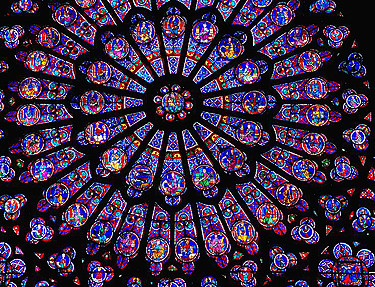
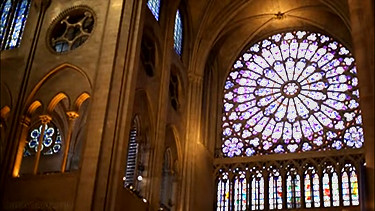
Life, like a dome of many coloured glass,
Stains the white radiance of eternity,
Until death tramples it to fragments."
This is a new embodiment, certainly, whence he who gains not, for the moment at least, a loftier feeling of death, must be dull either of heart or of understanding. But has Shelley created this figure, or only put together its parts according to the harmony of truths already embodied in each of the parts? For first he takes the inventions of his fellow-men, in glass, in colour, in dome: with these he represents life as finite though elevated, and as an analysis although a lovely one. Next he presents eternity as the dome of the sky above this dome of coloured glass--the sky having ever been regarded as the true symbol of eternity. This portion of the figure he enriches by the attribution of whiteness, or unity and radiance. And last, he shows us Death as the destroying revealer, walking aloft through, the upper region, treading out this life-bubble of colours, that the man may look beyond it and behold the true, the uncoloured, the all-coloured.
 Rainbow over the Magic Garden. Photo by Bob Kirchman.
B
Rainbow over the Magic Garden. Photo by Bob Kirchman.
But although the human imagination has no choice but to make use of the forms already prepared for it, its operation is the same as that of the divine inasmuch as it does put thought into form. And if it be to man what creation is to God, we must expect to find it operative in every sphere of human activity. Such is, indeed, the fact, and that to a far greater extent than is commonly supposed.
The sovereignty of the imagination, for instance, over the region of poetry will hardly, in the present day at least, be questioned; but not every one is prepared to be told that the imagination has had nearly as much to do with the making of our language as with
"Macbeth" or the
"Paradise Lost." The half of our language is the work of the imagination.
For how shall two agree together what name they shall give to a thought or a feeling. How shall the one show the other that which is invisible? True, he can unveil the mind's construction in the face--that living eternally changeful symbol which God has hung in front of the unseen spirit--but that without words reaches only to the expression of present feeling. To attempt to employ it alone for the conveyance of the intellectual or the historical would constantly mislead; while the expression of feeling itself would be misinterpreted, especially with regard to cause and object: the dumb show would be worse than dumb.
But let a man become aware of some new movement within him. Loneliness comes with it, for he would share his mind with his friend, and he cannot; he is shut up in speechlessness. Thus
He may live a man forbid
Weary seven nights nine times nine,
or the first moment of his perplexity may be that of his release. Gazing about him in pain, he suddenly beholds the material form of his immaterial condition. There stands his thought! God thought it before him, and put its picture there ready for him when he wanted it. Or, to express the thing more prosaically, the man cannot look around him long without perceiving some form, aspect, or movement of nature, some relation between its forms, or between such and himself which resembles the state or motion within him. This he seizes as the symbol, as the garment or body of his invisible thought, presents it to his friend, and his friend understands him. Every word so employed with a new meaning is henceforth, in its new character, born of the spirit and not of the flesh, born of the imagination and not of the understanding, and is henceforth submitted to new laws of growth and modification.
Thinkest thou," says Carlyle in
"Past and Present," "there were no poets till Dan Chaucer? No heart burning with a thought which it could not hold, and had no word for; and needed to shape and coin a word for--what thou callest a metaphor, trope, or the like? For every word we have there was such a man and poet. The coldest word was once a glowing new metaphor and bold questionable originality. Thy very ATTENTION, does it not mean an attentio, a STRETCHING-TO? Fancy that act of the mind, which all were conscious of, which none had yet named,--when this new poet first felt bound and driven to name it. His questionable originality and new glowing metaphor was found adoptable, intelligible, and remains our name for it to this day."
All words, then, belonging to the inner world of the mind, are of the imagination, are originally poetic words. The better, however, any such word is fitted for the needs of humanity, the sooner it loses its poetic aspect by commonness of use. It ceases to be heard as a symbol, and appears only as a sign. Thus thousands of words which were originally poetic words owing their existence to the imagination, lose their vitality, and harden into mummies of prose. Not merely in literature does poetry come first, and prose afterwards, but poetry is the source of all the language that belongs to the inner world, whether it be of passion or of metaphysics, of psychology or of aspiration. No poetry comes by the elevation of prose; but the half of prose comes by the
"massing into the common clay" of thousands of winged words, whence, like the lovely shells of by-gone ages, one is occasionally disinterred by some lover of speech, and held up to the light to show the play of colour in its manifold laminations.
 Butterfly and Hummingbird in the Magic Garden.
Photo by Bob Kirchman.
F
Butterfly and Hummingbird in the Magic Garden.
Photo by Bob Kirchman.
For the world is--allow us the homely figure--the human being turned inside out. All that moves in the mind is symbolized in Nature. Or, to use another more philosophical, and certainly not less poetic figure, the world is a sensuous analysis of humanity, and hence an inexhaustible wardrobe for the clothing of human thought. Take any word expressive of emotion--take the word emotion itself--and you will find that its primary meaning is of the outer world. In the swaying of the woods, in the unrest of the
"wavy plain," the imagination saw the picture of a well-known condition of the human mind; and hence the word emotion.
[Footnote: This passage contains only a repetition of what is far better said in the preceding extract from Carlyle, but it was written before we had read (if reviewers may be allowed to confess such ignorance) the book from which that extract is taken.]
But while the imagination of man has thus the divine function of putting thought into form, it has a duty altogether human, which is paramount to that function--the duty, namely, which springs from his immediate relation to the Father, that of following and finding out the divine imagination in whose image it was made. To do this, the man must watch its signs, its manifestations. He must contemplate what the Hebrew poets call the works of His hands.
But to follow those is the province of the intellect, not of the imagination."--We will leave out of the question at present that poetic interpretation of the works of Nature with which the intellect has almost nothing, and the imagination almost everything, to do. It is unnecessary to insist that the higher being of a flower even is dependent for its reception upon the human imagination; that science may pull the snowdrop to shreds, but cannot find out the idea of suffering hope and pale confident submission, for the sake of which that darling of the spring looks out of heaven, namely, God's heart, upon us his wiser and more sinful children; for if there be any truth in this region of things acknowledged at all, it will be at the same time acknowledged that that region belongs to the imagination. We confine ourselves to that questioning of the works of God which is called the province of science.
Shall, then, the human intellect," we ask,
"come into readier contact with the divine imagination than that human imagination?" The work of the Higher must he discovered by the search of the Lower in degree which is yet similar in kind. Let us not be supposed to exclude the intellect from a share in every highest office. Man is not divided when the manifestations of his life are distinguished. The intellect
"is all in every part." There were no imagination without intellect, however much it may appear that intellect can exist without imagination. What we mean to insist upon is, that in finding out the works of God, the Intellect must labour, workman-like, under the direction of the architect, Imagination. Herein, too, we proceed in the hope to show how much more than is commonly supposed the imagination has to do with human endeavour; how large a share it has in the work that is done under the sun.
But how can the imagination have anything to do with science? That region, at least, is governed by fixed laws."
True," we answer.
"But how much do we know of these laws? How much of science already belongs to the region of the ascertained--in other words, has been conquered by the intellect? We will not now dispute, your vindication of the ascertained from the intrusion of the imagination; but we do claim for it all the undiscovered, all the unexplored." "Ah, well! There it can do little harm. There let it run riot if you will." "No," we reply.
"Licence is not what we claim when we assert the duty of the imagination to be that of following and finding out the work that God maketh. Her part is to understand God ere she attempts to utter man. Where is the room for being fanciful or riotous here? It is only the ill-bred, that is, the uncultivated imagination that will amuse itself where it ought to worship and work."
But the facts of Nature are to be discovered only by observation and experiment." True. But how does the man of science come to think of his experiments? Does observation reach to the non-present, the possible, the yet unconceived? Even if it showed you the experiments which ought to be made, will observation reveal to you the experiments which might be made? And who can tell of which kind is the one that carries in its bosom the secret of the law you seek? We yield you your facts. The laws we claim for the prophetic imagination. "He hath set the world in man's heart," not in his understanding. And the heart must open the door to the understanding. It is the far-seeing imagination which beholds what might be a form of things, and says to the intellect: "Try whether that may not be the form of these things;" which beholds or invents a harmonious relation of parts and operations, and sends the intellect to find out whether that be not the harmonious relation of them--that is, the law of the phenomenon it contemplates. Nay, the poetic relations themselves in the phenomenon may suggest to the imagination the law that rules its scientific life. Yea, more than this: we dare to claim for the true, childlike, humble imagination, such an inward oneness with the laws of the universe that it possesses in itself an insight into the very nature of things.
Lord Bacon tells us that a prudent question is the half of knowledge. Whence comes this prudent question? we repeat. And we answer, From the imagination. It is the imagination that suggests in what direction to make the new inquiry--which, should it cast no immediate light on the answer sought, can yet hardly fail to be a step towards final discovery. Every experiment has its origin in hypothesis; without the scaffolding of hypothesis, the house of science could never arise. And the construction of any hypothesis whatever is the work of the imagination. The man who cannot invent will never discover. The imagination often gets a glimpse of the law itself long before it is or can be ascertained to be a law.
[Footnote: This paper was already written when, happening to mention the present subject to a mathematical friend, a lecturer at one of the universities, he gave us a corroborative instance. He had lately guessed that a certain algebraic process could be shortened exceedingly if the method which his imagination suggested should prove to be a true one--that is, an algebraic law. He put it to the test of experiment--committed the verification, that is, into the hands of his intellect--and found the method true. It has since been accepted by the Royal Society.
Noteworthy illustration we have lately found in the record of the experiences of an Edinburgh detective, an Irishman of the name of McLevy. That the service of the imagination in the solution of the problems peculiar to his calling is well known to him, we could adduce many proofs. He recognizes its function in the construction of the theory which shall unite this and that hint into an organic whole, and he expressly sets forth the need of a theory before facts can be serviceable:--
I would wait for my 'idea'.... I never did any good without mine.... Chance never smiled on me unless I poked her some way; so that my 'notion,' after all, has been in the getting of it my own work only perfected by a higher hand."
On leaving the shop I went direct to Prince's Street,--of course with an idea in my mind; and somehow I have always been contented with one idea when I could not get another; and the advantage of sticking by one is, that the other don't jostle it and turn you about in a circle when you should go in a straight line." (Footnote: Since quoting the above I have learned that the book referred to is unworthy of confidence. But let it stand as illustration where it cannot be proof.)]
The region belonging to the pure intellect is straitened: the imagination labours to extend its territories, to give it room. She sweeps across the borders, searching out new lands into which she may guide her plodding brother. The imagination is the light which redeems from the darkness for the eyes of the understanding. Novalis says, "The imagination is the stuff of the intellect"--affords, that is, the material upon which the intellect works. And Bacon, in his "Advancement of Learning," fully recognizes this its office, corresponding to the foresight of God in this, that it beholds afar off. And he says: "Imagination is much akin to miracle-working faith."
[Footnote: We are sorry we cannot verify this quotation, for which we are indebted to Mr. Oldbuck the Antiquary, in the novel of that ilk. There is, however, little room for doubt that it is sufficiently correct.]
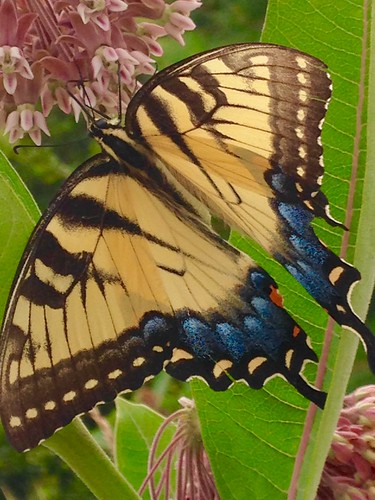 Magic Garden Butterfly. Photo by Bob Kirchman.
I
Magic Garden Butterfly. Photo by Bob Kirchman.
In the scientific region of her duty of which we speak, the Imagination cannot have her perfect work; this belongs to another and higher sphere than that of intellectual truth--that, namely, of full-globed humanity, operating in which she gives birth to poetry--truth in beauty. But her function in the complete sphere of our nature, will, at the same time, influence her more limited operation in the sections that belong to science. Coleridge says that no one but a poet will make any further great discoveries in mathematics; and Bacon says that "wonder," that faculty of the mind especially attendant on the child-like imagination, "is the seed of knowledge." The influence of the poetic upon the scientific imagination is, for instance, especially present in the construction of an invisible whole from the hints afforded by a visible part; where the needs of the part, its uselessness, its broken relations, are the only guides to a multiplex harmony, completeness, and end, which is the whole. From a little bone, worn with ages of death, older than the man can think, his scientific imagination dashed with the poetic, calls up the form, size, habits, periods, belonging to an animal never beheld by human eyes, even to the mingling contrasts of scales and wings, of feathers and hair. Through the combined lenses of science and imagination, we look back into ancient times, so dreadful in their incompleteness, that it may well have been the task of seraphic faith, as well as of cherubic imagination, to behold in the wallowing monstrosities of the terror-teeming earth, the prospective, quiet, age-long labour of God preparing the world with all its humble, graceful service for his unborn Man. The imagination of the poet, on the other hand, dashed with the imagination of the man of science, revealed to Goethe the prophecy of the flower in the leaf. No other than an artistic imagination, however, fulfilled of science, could have attained to the discovery of the fact that the leaf is the imperfect flower.
When we turn to history, however, we find probably the greatest operative sphere of the intellectuo-constructive imagination. To discover its laws; the cycles in which events return, with the reasons of their return, recognizing them notwithstanding metamorphosis; to perceive the vital motions of this spiritual body of mankind; to learn from its facts the rule of God; to construct from a succession of broken indications a whole accordant with human nature; to approach a scheme of the forces at work, the passions overwhelming or upheaving, the aspirations securely upraising, the selfishnesses debasing and crumbling, with the vital interworking of the whole; to illuminate all from the analogy with individual life, and from the predominant phases of individual character which are taken as the mind of the people--this is the province of the imagination. Without her influence no process of recording events can develop into a history. As truly might that be called the description of a volcano which occupied itself with a delineation of the shapes assumed by the smoke expelled from the mountain's burning bosom. What history becomes under the full sway of the imagination may be seen in the "History of the French Revolution," by Thomas Carlyle, at once a true picture, a philosophical revelation, a noble poem.
There is a wonderful passage about Time in Shakespere's "Rape of Lucrece," which shows how he understood history. The passage is really about history, and not about time; for time itself does nothing--not even "blot old books and alter their contents." It is the forces at work in time that produce all the changes; and they are history. We quote for the sake of one line chiefly, but the whole stanza is pertinent.
Time's glory is to calm contending kings,
To unmask falsehood, and bring truth to light,
To stamp the seal of time in aged things,
To wake the morn and sentinel the night,
To wrong the wronger till he render right;
To ruinate proud buildings with thy hours,
And smear with dust their glittering golden towers."
To wrong the wronger till he render right. Here is a historical cycle worthy of the imagination of Shakespere, yea, worthy of the creative imagination of our God--the God who made the Shakespere with the imagination, as well as evolved the history from the laws which that imagination followed and found out.
In full instance we would refer our readers to Shakespere's historical plays; and, as a side-illustration, to the fact that he repeatedly represents his greatest characters, when at the point of death, as relieving their overcharged minds by prophecy. Such prophecy is the result of the light of imagination, cleared of all distorting dimness by the vanishing of earthly hopes and desires, cast upon the facts of experience. Such prophecy is the perfect working of the historical imagination.
In the interpretation of individual life, the same principles hold; and nowhere can the imagination be more healthily and rewardingly occupied than in endeavouring to construct the life of an individual out of the fragments which are all that can reach us of the history of even the noblest of our race. How this will apply to the reading of the gospel story we leave to the earnest thought of our readers.
We now pass to one more sphere in which the student imagination works in glad freedom--the sphere which is understood to belong more immediately to the poet.
We have already said that the forms of Nature (by which word forms we mean any of those conditions of Nature which affect the senses of man) are so many approximate representations of the mental conditions of humanity. The outward, commonly called the material, is informed by, or has form in virtue of, the inward or immaterial--in a word, the thought. The forms of Nature are the representations of human thought in virtue of their being the embodiment of God's thought. As such, therefore, they can be read and used to any depth, shallow or profound. Men of all ages and all developments have discovered in them the means of expression; and the men of ages to come, before us in every path along which we are now striving, must likewise find such means in those forms, unfolding with their unfolding necessities. The man, then, who, in harmony with nature, attempts the discovery of more of her meanings, is just searching out the things of God. The deepest of these are far too simple for us to understand as yet. But let our imagination interpretive reveal to us one severed significance of one of her parts, and such is the harmony of the whole, that all the realm of Nature is open to us henceforth--not without labour--and in time. Upon the man who can understand the human meaning of the snowdrop, of the primrose, or of the daisy, the life of the earth blossoming into the cosmical flower of a perfect moment will one day seize, possessing him with its prophetic hope, arousing his conscience with the vision of the "rest that remaineth," and stirring up the aspiration to enter into that rest:
Thine is the tranquil hour, purpureal Eve!
But long as godlike wish, or hope divine,
Informs my spirit, ne'er can I believe
That this magnificence is wholly thine!
From worlds not quickened by the sun
A portion of the gift is won;
An intermingling of Heaven's pomp is spread
On ground which British shepherds tread!"
Even the careless curve of a frozen cloud across the blue will calm some troubled thoughts, may slay some selfish thoughts. And what shall be said of such gorgeous shows as the scarlet poppies in the green corn, the likest we have to those lilies of the field which spoke to the Saviour himself of the care of God, and rejoiced His eyes with the glory of their God-devised array? From such visions as these the imagination reaps the best fruits of the earth, for the sake of which all the science involved in its construction, is the inferior, yet willing and beautiful support.
From what we have now advanced, will it not then appear that, on the whole, the name given by our Norman ancestors is more fitting for the man who moves in these regions than the name given by the Greeks? Is not the Poet, the Maker, a less suitable name for him than the Trouvère, the Finder? At least, must not the faculty that finds precede the faculty that utters?
But is there nothing to be said of the function of the imagination from the Greek side of the question? Does it possess no creative faculty? Has it no originating power?
Certainly it would be a poor description of the Imagination which omitted the one element especially present to the mind that invented the word Poet.--It can present us with new thought-forms--new, that is, as revelations of thought. It has created none of the material that goes to make these forms. Nor does it work upon raw material. But it takes forms already existing, and gathers them about a thought so much higher than they, that it can group and subordinate and harmonize them into a whole which shall represent, unveil that thought.
[Footnote: Just so Spenser describes the process of the embodiment of a human soul in his Platonic "Hymn in Honour of Beauty."
"She frames her house in which she will be placed
Fit for herself....
And the gross matter by a sovereign might
Tempers so trim....
For of the soul the body form doth take;
For soul is form, and doth the body make."]
The nature of this process we will illustrate by an examination of the well-known Bugle Song in Tennyson's "Princess."
First of all, there is the new music of the song, which does not even remind one of the music of any other. The rhythm, rhyme, melody, harmony are all an embodiment in sound, as distinguished from word, of what can be so embodied--the feeling of the poem, which goes before, and prepares the way for the following thought--tunes the heart into a receptive harmony. Then comes the new arrangement of thought and figure whereby the meaning contained is presented as it never was before. We give a sort of paraphrastical synopsis of the poem, which, partly in virtue of its disagreeableness, will enable the lovers of the song to return to it with an increase of pleasure.
The glory of midsummer mid-day upon mountain, lake, and ruin. Give nature a voice for her gladness. Blow, bugle.
Nature answers with dying echoes, sinking in the midst of her splendour into a sad silence.
Not so with human nature. The echoes of the word of truth gather volume and richness from every soul that re-echoes it to brother and sister souls.
With poets the fashion has been to contrast the stability and rejuvenescence of nature with the evanescence and unreturning decay of humanity:--
Yet soon reviving plants and flowers, anew shall deck the plain;
The woods shall hear the voice of Spring, and flourish green again.
But man forsakes this earthly scene, ah! never to return:
Shall any following Spring revive the ashes of the urn?"
But our poet vindicates the eternal in humanity:--
O Love, they die in yon rich sky,
They faint on hill or field or river
Our echoes roll from soul to soul,
And grow for ever and for ever.
Blow, bugle, blow, set the wild echoes flying;
And answer, echoes, answer, Dying, dying, dying."
Is not this a new form to the thought--a form which makes us feel the truth of it afresh? And every new embodiment of a known truth must be a new and wider revelation. No man is capable of seeing for himself the whole of any truth: he needs it echoed back to him from every soul in the universe; and still its centre is hid in the Father of Lights. In so far, then, as either form or thought is new, we may grant the use of the word Creation, modified according to our previous definitions.
This operation of the imagination in choosing, gathering, and vitally combining the material of a new revelation, may be well illustrated from a certain employment of the poetic faculty in which our greatest poets have delighted. Perceiving truth half hidden and half revealed in the slow speech and stammering tongue of men who have gone before them, they have taken up the unfinished form and completed it; they have, as it were, rescued the soul of meaning from its prison of uninformed crudity, where it sat like the Prince in the "Arabian Nights," half man, half marble; they have set it free in its own form, in a shape, namely, which it could "through every part impress." Shakespere's keen eye suggested many such a rescue from the tomb--of a tale drearily told--a tale which no one now would read save for the glorified form in which he has re-embodied its true contents. And from Tennyson we can produce one specimen small enough for our use, which, a mere chip from the great marble re-embodying the old legend of Arthur's death, may, like the hand of Achilles holding his spear in the crowded picture,
Stand for the whole to be imagined."
In the
"History of Prince Arthur," when Sir Bedivere returns after hiding Excalibur the first time, the king asks him what he has seen, and he answers--
Sir, I saw nothing but waves and wind."
The second time, to the same question, he answers--
Sir, I saw nothing but the water[1] wap, and the waves wan."
[Footnote: The word wap is plain enough; the word wan we cannot satisfy ourselves about. Had it been used with regard to the water, it might have been worth remarking that wan, meaning dark, gloomy, turbid, is a common adjective to a river in the old Scotch ballad. And it might be an adjective here; but that is not likely, seeing it is conjoined with the verb wap. The Anglo-Saxon wanian, to decrease, might be the root-word, perhaps, (in the sense of to ebb,) if this water had been the sea and not a lake. But possibly the meaning is, "I heard the water whoop or wail aloud" (from Wópan); and "the waves whine or bewail" (from Wánian to lament). But even then the two verbs would seem to predicate of transposed subjects.]
This answer Tennyson has expanded into the well-known lines--
I heard the ripple washing in the reeds,
And the wild water lapping on the crag;"
slightly varied, for the other occasion, into--
I heard the water lapping on the crag,
And the long ripple washing in the reeds."
But, as to this matter of creation, is there, after all, I ask yet, any genuine sense in which a man may be said to create his own thought-forms? Allowing that a new combination of forms already existing might be called creation, is the man, after all, the author of this new combination? Did he, with his will and his knowledge, proceed wittingly, consciously, to construct a form which should embody his thought? Or did this form arise within him without will or effort of his--vivid if not clear--certain if not outlined? Ruskin (and better authority we do not know) will assert the latter, and we think he is right: though perhaps he would insist more upon the absolute perfection of the vision than we are quite prepared to do. Such embodiments are not the result of the man's intention, or of the operation of his conscious nature. His feeling is that they are given to him; that from the vast unknown, where time and space are not, they suddenly appear in luminous writing upon the wall of his consciousness. Can it be correct, then, to say that he created them? Nothing less so, as it seems to us. But can we not say that they are the creation of the unconscious portion of his nature? Yes, provided we can understand that that which is the individual, the man, can know, and not know that it knows, can create and yet be ignorant that virtue has gone out of it. From that unknown region we grant they come, but not by its own blind working. Nor, even were it so, could any amount of such production, where no will was concerned, be dignified with the name of creation. But God sits in that chamber of our being in which the candle of our consciousness goes out in darkness, and sends forth from thence wonderful gifts into the light of that understanding which is His candle. Our hope lies in no most perfect mechanism even of the spirit, but in the wisdom wherein we live and move and have our being. Thence we hope for endless forms of beauty informed of truth. If the dark portion of our own being were the origin of our imaginations, we might well fear the apparition of such monsters as would be generated in the sickness of a decay which could never feel--only declare--a slow return towards primeval chaos. But the Maker is our Light.
 Photo by Bob Kirchman.
O
Photo by Bob Kirchman.
One word more, ere we turn to consider the culture of this noblest faculty, which we might well call the creative, did we not see a something in God for which we would humbly keep our mighty word:--the fact that there is always more in a work of art--which is the highest human result of the embodying imagination--than the producer himself perceived while he produced it, seems to us a strong reason for attributing to it a larger origin than the man alone--for saying at the last, that the inspiration of the Almighty shaped its ends.
We return now to the class which, from the first, we supposed hostile to the imagination and its functions generally. Those belonging to it will now say: "It was to no imagination such as you have been setting forth that we were opposed, but to those wild fancies and vague reveries in which young people indulge, to the damage and loss of the real in the world around them."
And," we insist, "you would rectify the matter by smothering the young monster at once--because he has wings, and, young to their use, flutters them about in a way discomposing to your nerves, and destructive to those notions of propriety of which this creature--you stop not to inquire whether angel or pterodactyle--has not yet learned even the existence. Or, if it is only the creature's vagaries of which you disapprove, why speak of them as the exercise of the imagination? As well speak of religion as the mother of cruelty because religion has given more occasion of cruelty, as of all dishonesty and devilry, than any other object of human interest. Are we not to worship, because our forefathers burned and stabbed for religion? It is more religion we want. It is more imagination we need. Be assured that these are but the first vital motions of that whose results, at least in the region of science, you are more than willing to accept." That evil may spring from the imagination, as from everything except the perfect love of God, cannot be denied. But infinitely worse evils would be the result of its absence. Selfishness, avarice, sensuality, cruelty, would flourish tenfold; and the power of Satan would be well established ere some children had begun to choose. Those who would quell the apparently lawless tossing of the spirit, called the youthful imagination, would suppress all that is to grow out of it. They fear the enthusiasm they never felt; and instead of cherishing this divine thing, instead of giving it room and air for healthful growth, they would crush and confine it--with but one result of their victorious endeavours-- imposthume, fever, and corruption. And the disastrous consequences would soon appear in the intellect likewise which they worship. Kill that whence spring the crude fancies and wild day-dreams of the young, and you will never lead them beyond dull facts--dull because their relations to each other, and the one life that works in them all, must remain undiscovered. Whoever would have his children avoid this arid region will do well to allow no teacher to approach them--not even of mathematics--who has no imagination.
But although good results may appear in a few from the indulgence of the imagination, how will it be with the many?"
We answer that the antidote to indulgence is development, not restraint, and that such is the duty of the wise servant of Him who made the imagination.
But will most girls, for instance, rise to those useful uses of the imagination? Are they not more likely to exercise it in building castles in the air to the neglect of houses on the earth? And as the world affords such poor scope for the ideal, will not this habit breed vain desires and vain regrets? Is it not better, therefore, to keep to that which is known, and leave the rest?"
Is the world so poor?" we ask in return. The less reason, then, to be satisfied with it; the more reason to rise above it, into the region of the true, of the eternal, of things as God thinks them. This outward world is but a passing vision of the persistent true. We shall not live in it always. We are dwellers in a divine universe where no desires are in vain, if only they be large enough. Not even in this world do all disappointments breed only vain regrets.
[Footnote:
"We will grieve not, rather find
Strength in what remains behind;
In the primal sympathy
Which, having been, must ever be;
In the soothing thoughts that spring
Out of human suffering;
In the faith that looks through death,
In years that bring the philosophic mind."]
And as to keeping to that which is known and leaving the rest--how many affairs of this world are so well-defined, so capable of being clearly understood, as not to leave large spaces of uncertainty, whose very correlate faculty is the imagination? Indeed it must, in most things, work after some fashion, filling the gaps after some possible plan, before action can even begin. In very truth, a wise imagination, which is the presence of the spirit of God, is the best guide that man or woman can have; for it is not the things we see the most clearly that influence us the most powerfully; undefined, yet vivid visions of something beyond, something which eye has not seen nor ear heard, have far more influence than any logical sequences whereby the same things may be demonstrated to the intellect. It is the nature of the thing, not the clearness of its outline, that determines its operation. We live by faith, and not by sight. Put the question to our mathematicians--only be sure the question reaches them--whether they would part with the well-defined perfection of their diagrams, or the dim, strange, possibly half-obliterated characters woven in the web of their being; their science, in short, or their poetry; their certainties, or their hopes; their consciousness of knowledge, or their vague sense of that which cannot be known absolutely: will they hold by their craft or by their inspirations, by their intellects or their imaginations? If they say the former in each alternative, I shall yet doubt whether the objects of the choice are actually before them, and with equal presentation.
What can be known must be known severely; but is there, therefore, no faculty for those infinite lands of uncertainty lying all about the sphere hollowed out of the dark by the glimmering lamp of our knowledge? Are they not the natural property of the imagination? there, for it, that it may have room to grow? there, that the man may learn to imagine greatly like God who made him, himself discovering their mysteries, in virtue of his following and worshipping imagination?
All that has been said, then, tends to enforce the culture of the imagination. But the strongest argument of all remains behind. For, if the whole power of pedantry should rise against her, the imagination will yet work; and if not for good, then for evil; if not for truth, then for falsehood; if not for life, then for death; the evil alternative becoming the more likely from the unnatural treatment she has experienced from those who ought to have fostered her. The power that might have gone forth in conceiving the noblest forms of action, in realizing the lives of the true-hearted, the self-forgetting, will go forth in building airy castles of vain ambition, of boundless riches, of unearned admiration. The imagination that might be devising how to make home blessed or to help the poor neighbour, will be absorbed in the invention of the new dress, or worse, in devising the means of procuring it. For, if she be not occupied with the beautiful, she will be occupied by the pleasant; that which goes not out to worship, will remain at home to be sensual. Cultivate the mere intellect as you may, it will never reduce the passions: the imagination, seeking the ideal in everything, will elevate them to their true and noble service. Seek not that your sons and your daughters should not see visions, should not dream dreams; seek that they should see true visions, that they should dream noble dreams. Such out-going of the imagination is one with aspiration, and will do more to elevate above what is low and vile than all possible inculcations of morality. Nor can religion herself ever rise up into her own calm home, her crystal shrine, when one of her wings, one of the twain with which she flies, is thus broken or paralyzed.
The universe is infinitely wide,
And conquering Reason, if self-glorified,
Can nowhere move uncrossed by some new wall
Or gulf of mystery, which thou alone,
Imaginative Faith! canst overleap,
In progress towards the fount of love."
The danger that lies in the repression of the imagination may be well illustrated from the play of
"Macbeth." The imagination of the hero (in him a powerful faculty), representing how the deed would appear to others, and so representing its true nature to himself, was his great impediment on the path to crime. Nor would he have succeeded in reaching it, had he not gone to his wife for help--sought refuge from his troublesome imagination with her. She, possessing far less of the faculty, and having dealt more destructively with what she had, took his hand, and led him to the deed. From her imagination, again, she for her part takes refuge in unbelief and denial, declaring to herself and her husband that there is no reality in its representations; that there is no reality in anything beyond the present effect it produces on the mind upon which it operates; that intellect and courage are equal to any, even an evil emergency; and that no harm will come to those who can rule themselves according to their own will. Still, however, finding her imagination, and yet more that of her husband, troublesome, she effects a marvellous combination of materialism and idealism, and asserts that things are not, cannot be, and shall not be more or other than people choose to think them. She says,--
These deeds must not be thought
After these ways; so, it will make us mad."
The sleeping and the dead
Are but as pictures."
But she had over-estimated the power of her will, and under-estimated that of her imagination. Her will was the one thing in her that was bad, without root or support in the universe, while her imagination was the voice of God himself out of her own unknown being. The choice of no man or woman can long determine how or what he or she shall think of things. Lady Macbeth's imagination would not be repressed beyond its appointed period--a time determined by laws of her being over which she had no control. It arose, at length, as from the dead, overshadowing her with all the blackness of her crime. The woman who drank strong drink that she might murder, dared not sleep without a light by her bed; rose and walked in the night, a sleepless spirit in a sleeping body, rubbing the spotted hand of her dreams, which, often as water had cleared it of the deed, yet smelt so in her sleeping nostrils, that all the perfumes of Arabia would not sweeten it. Thus her long down-trodden imagination rose and took vengeance, even through those senses which she had thought to subordinate to her wicked will.
But all this is of the imagination itself, and fitter, therefore, for illustration than for argument. Let us come to facts.--Dr. Pritchard, lately executed for murder, had no lack of that invention, which is, as it were, the intellect of the imagination--its lowest form. One of the clergymen who, at his own request, attended the prisoner, went through indescribable horrors in the vain endeavour to induce the man simply to cease from lying: one invention after another followed the most earnest asseverations of truth. The effect produced upon us by this clergyman's report of his experience was a moral dismay, such as we had never felt with regard to human being, and drew from us the exclamation, "The man could have had no imagination." The reply was, "None whatever." Never seeking true or high things, caring only for appearances, and, therefore, for inventions, he had left his imagination all undeveloped, and when it represented his own inner condition to him, had repressed it until it was nearly destroyed, and what remained of it was set on fire of hell.
[Footnote: One of the best weekly papers in London, evidently as much in ignorance of the man as of the facts of the case, spoke of Dr. MacLeod as having been engaged in "white-washing the murderer for heaven." So far is this from a true representation, that Dr. MacLeod actually refused to pray with him, telling him that if there was a hell to go to, he must go to it.]
Man is
"the roof and crown of things." He is the world, and more. Therefore the chief scope of his imagination, next to God who made him, will he the world in relation to his own life therein. Will he do better or worse in it if this imagination, touched to fine issues and having free scope, present him with noble pictures of relationship and duty, of possible elevation of character and attainable justice of behaviour, of friendship and of love; and, above all, of all these in that life to understand which as a whole, must ever be the loftiest aspiration of this noblest power of humanity? Will a woman lead a more or a less troubled life that the sights and sounds of nature break through the crust of gathering anxiety, and remind her of the peace of the lilies and the well-being of the birds of the air? Or will life be less interesting to her, that the lives of her neighbours, instead of passing like shadows upon a wall, assume a consistent wholeness, forming themselves into stories and phases of life? Will she not hereby love more and talk less? Or will she be more unlikely to make a good match----? But here we arrest ourselves in bewilderment over the word good, and seek to re-arrange our thoughts. If what mothers mean by a good match, is the alliance of a man of position and means--or let them throw intellect, manners, and personal advantages into the same scale--if this be all, then we grant the daughter of cultivated imagination may not be manageable, will probably be obstinate. "We hope she will be obstinate enough.
[Footnote: Let women who feel the wrongs of their kind teach women to be high-minded in their relation to men, and they will do more for the social elevation of women, and the establishment of their rights, whatever those rights may be, than by any amount of intellectual development or assertion of equality. Nor, if they are other than mere partisans, will they refuse the attempt because in its success men will, after all, be equal, if not greater gainers, if only thereby they should be "feelingly persuaded" what they are.] But will the girl be less likely to marry a gentleman, in the grand old meaning of the sixteenth century? when it was no irreverence to call our Lord
"The first true gentleman that ever breathed;"
or in that of the fourteenth?--when Chaucer teaching
"whom is worthy to be called gentill," writes thus:--
The first stocke was full of rightwisnes,
Trewe of his worde, sober, pitous and free,
Clene of his goste, and loved besinesse,
Against the vice of slouth in honeste;
And but his heire love vertue as did he,
He is not gentill though he rich seme,
All weare he miter, crowne, or diademe."
Will she be less likely to marry one who honours women, and for their sakes, as well as his own, honours himself? Or to speak from what many would regard as the mother's side of the question--will the girl be more likely, because of such a culture of her imagination, to refuse the wise, true-hearted, generous rich man, and fall in love with the talking, verse-making fool, because he is poor, as if that were a virtue for which he had striven? The highest imagination and the lowliest common sense are always on one side.
For the end of imagination is harmony. A right imagination, being the reflex of the creation, will fall in with the divine order of things as the highest form of its own operation; "will tune its instrument here at the door" to the divine harmonies within; will be content alone with growth towards the divine idea, which includes all that is beautiful in the imperfect imaginations of men; will know that every deviation from that growth is downward; and will therefore send the man forth from its loftiest representations to do the commonest duty of the most wearisome calling in a hearty and hopeful spirit. This is the work of the right imagination; and towards this work every imagination, in proportion to the rightness that is in it, will tend. The reveries even of the wise man will make him stronger for his work; his dreaming as well as his thinking will render him sorry for past failure, and hopeful of future success.
To come now to the culture of the imagination. Its development is one of the main ends of the divine education of life with all its efforts and experiences. Therefore the first and essential means for its culture must be an ordering of our life towards harmony with its ideal in the mind of God. As he that is willing to do the will of the Father, shall know of the doctrine, so, we doubt not, he that will do the will of THE POET, shall behold the Beautiful. For all is God's; and the man who is growing into harmony with His will, is growing into harmony with himself; all the hidden glories of his being are coming out into the light of humble consciousness; so that at the last he shall be a pure microcosm, faithfully reflecting, after his manner, the mighty macrocosm. We believe, therefore, that nothing will do so much for the intellect or the imagination as being good--we do not mean after any formula or any creed, but simply after the faith of Him who did the will of his Father in heaven.
But if we speak of direct means for the culture of the imagination, the whole is comprised in two words--food and exercise. If you want strong arms, take animal food, and row. Feed your imagination with food convenient for it, and exercise it, not in the contortions of the acrobat, but in the movements of the gymnast. And first for the food.
Goethe has told us that the way to develop the aesthetic faculty is to have constantly before our eyes, that is, in the room we most frequent, some work of the best attainable art. This will teach us to refuse the evil and choose the good. It will plant itself in our minds and become our counsellor. Involuntarily, unconsciously, we shall compare with its perfection everything that comes before us for judgment. Now, although no better advice could he given, it involves one danger, that of narrowness. And not easily, in dread of this danger, would one change his tutor, and so procure variety of instruction. But in the culture of the imagination, books, although not the only, are the readiest means of supplying the food convenient for it, and a hundred books may he had where even one work of art of the right sort is unattainable, seeing such must he of some size as well as of thorough excellence. And in variety alone is safety from the danger of the convenient food becoming the inconvenient model.
Let us suppose, then, that one who himself justly estimates the imagination is anxious to develop its operation in his child. No doubt the best beginning, especially if the child be young, is an acquaintance with nature, in which let him he encouraged to observe vital phenomena, to put things together, to speculate from what he sees to what he does not see. But let earnest care be taken that upon no matter shall he go on talking foolishly. Let him be as fanciful as he may, but let him not, even in his fancy, sin against fancy's sense; for fancy has its laws as certainly as the most ordinary business of life. When he is silly, let him know it and be ashamed.
But where this association with nature is but occasionally possible, recourse must be had to literature. In books, we not only have store of all results of the imagination, but in them, as in her workshop, we may behold her embodying before our very eyes, in music of speech, in wonder of words, till her work, like a golden dish set with shining jewels, and adorned by the hands of the cunning workmen, stands finished before us. In this kind, then, the best must be set before the learner, that he may eat and not be satisfied; for the finest products of the imagination are of the best nourishment for the beginnings of that imagination. And the mind of the teacher must mediate between the work of art and the mind of the pupil, bringing them together in the vital contact of intelligence; directing the observation to the lines of expression, the points of force; and helping the mind to repose upon the whole, so that no separable beauties shall lead to a neglect of the scope--that is the shape or form complete. And ever he must seek to show excellence rather than talk about it, giving the thing itself, that it may grow into the mind, and not a eulogy of his own upon the thing; isolating the point worthy of remark rather than making many remarks upon the point.
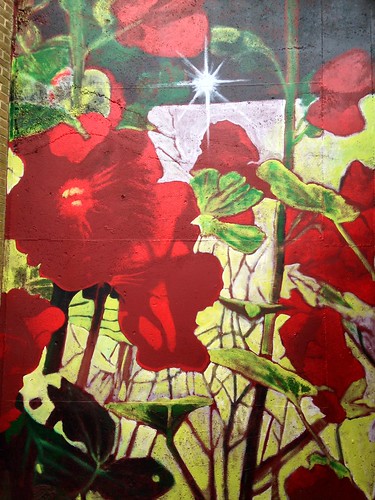 'Heaven's Hollyhocks' Mural. Painting by Bob Kirchman.
E
'Heaven's Hollyhocks' Mural. Painting by Bob Kirchman.
Especially must he endeavour to show the spiritual scaffolding or skeleton of any work of art; those main ideas upon which the shape is constructed, and around which the rest group as ministering dependencies.
But he will not, therefore, pass over that intellectual structure without which the other could not be manifested. He will not forget the builder while he admires the architect. While he dwells with delight on the relation of the peculiar arch to the meaning of the whole cathedral, he will not think it needless to explain the principles on which it is constructed, or even how those principles are carried out in actual process. Neither yet will the tracery of its windows, the foliage of its crockets, or the fretting of its mouldings be forgotten. Every beauty will have its word, only all beauties will be subordinated to the final beauty--that is, the unity of the whole.
Thus doing, he shall perform the true office of friendship. He will introduce his pupil into the society which he himself prizes most, surrounding him with the genial presence of the high-minded, that this good company may work its own kind in him who frequents it.
But he will likewise seek to turn him aside from such company, whether of books or of men, as might tend to lower his reverence, his choice, or his standard. He will, therefore, discourage indiscriminate reading, and that worse than waste which consists in skimming the books of a circulating library. He knows that if a book is worth reading at all, it is worth reading well; and that, if it is not worth reading, it is only to the most accomplished reader that it can be worth skimming. He will seek to make him discern, not merely between the good and the evil, but between the good and the not so good. And this not for the sake of sharpening the intellect, still less of generating that self-satisfaction which is the closest attendant upon criticism, but for the sake of choosing the best path and the best companions upon it. A spirit of criticism for the sake of distinguishing only, or, far worse, for the sake of having one's opinion ready upon demand, is not merely repulsive to all true thinkers, but is, in itself, destructive of all thinking. A spirit of criticism for the sake of the truth--a spirit that does not start from its chamber at every noise, but waits till its presence is desired--cannot, indeed, garnish the house, but can sweep it clean. Were there enough of such wise criticism, there would be ten times the study of the best writers of the past, and perhaps one-tenth of the admiration for the ephemeral productions of the day. A gathered mountain of misplaced worships would be swept into the sea by the study of one good book; and while what was good in an inferior book would still be admired, the relative position of the book would be altered and its influence lessened.
Speaking of true learning, Lord Bacon says:
"It taketh away vain admiration of anything, which is the root of all weakness."
The right teacher would have his pupil easy to please, but ill to satisfy; ready to enjoy, unready to embrace; keen to discover beauty, slow to say,
"Here I will dwell."
But he will not confine his instructions to the region of art. He will encourage him to read history with an eye eager for the dawning figure of the past. He will especially show him that a great part of the Bible is only thus to be understood; and that the constant and consistent way of God, to be discovered in it, is in fact the key to all history.
In the history of individuals, as well, he will try to show him how to put sign and token together, constructing not indeed a whole, but a probable suggestion of the whole.
And, again, while showing him the reflex of nature in the poets, he will not be satisfied without sending him to Nature herself; urging him in country rambles to keep open eyes for the sweet fashionings and blendings of her operation around him; and in city walks to watch the
"human face divine."
Once more: he will point out to him the essential difference between reverie and thought; between dreaming and imagining. He will teach him not to mistake fancy, either in himself or in others for imagination, and to beware of hunting after resemblances that carry with them no interpretation.
Such training is not solely fitted for the possible development of artistic faculty. Few, in this world, will ever be able to utter what they feel. Fewer still will be able to utter it in forms of their own. Nor is it necessary that there should be many such. But it is necessary that all should feel. It is necessary that all should understand and imagine the good; that all should begin, at least, to follow and find out God.

 Journey to Jesus, a mural depicting the nations coming to Jesus in the New Heaven and New Earth described in Revelation 21. Mural by Kristina Elaine Greer and Bob Kirchman.
The glory of God is to conceal a thing, but the glory of the king is to find it out,"
Journey to Jesus, a mural depicting the nations coming to Jesus in the New Heaven and New Earth described in Revelation 21. Mural by Kristina Elaine Greer and Bob Kirchman.
The glory of God is to conceal a thing, but the glory of the king is to find it out," says Solomon.
"As if," remarks Bacon on the passage,
"according to the innocent play of children, the Divine Majesty took delight to hide his works, to the end to have them found out; and as if kings could not obtain a greater honour than to be God's playfellows in that game."
One more quotation from the book of Ecclesiastes, setting forth both the necessity we are under to imagine, and the comfort that our imagining cannot outstrip God's making.
I have seen the travail which God hath given to the sons of men to be exercised in it. He hath made everything beautiful in his time; also he hath set the world in their heart, so that no man can find out the work that God maketh from the beginning to the end."
Thus to be playfellows with God in this game, the little ones may gather their daisies and follow their painted moths; the child of the kingdom may pore upon the lilies of the field, and gather faith as the birds of the air their food from the leafless hawthorn, ruddy with the stores God has laid up for them; and the man of science
May sit and rightly spell
Of every star that heaven doth shew,
And every herb that sips the dew;
Till old experience do attain
To something like prophetic strain." [2.]
 Photo by Bob Kirchman.
____________________________________
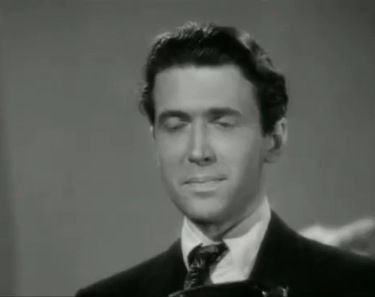 Jimmy Stewart's classic film: Mr.Smith Goes to Washington.
Everyone Should See This Film
Jimmy Stewart's classic film: Mr.Smith Goes to Washington.
Everyone Should See This Film
[click to read]
This Classic Tale [click to watch] of a man of integrity who finds himself in the United States Senate, and who ultimately has to fight for that integrity, is one that we would do well to heed today!
“Capra was able to make this film so good because he both believed in the American ideal, and understood how easily it could be co-opted and undermined by the unscrupulous and the greedy. America, he's telling us, should be celebrated because it’s the kind of country that can produce a Jefferson Smith; but at the same time, we must always be on our guard, because it’s also capable of destroying one.” -- Gina Dalfonzo [2.] [read more]
The Spirit of Esther
[click to read]
Then Esther bade them return Mordecai this answer,
Go, gather together all the Jews that are present in Shushan, and fast ye for me, and neither eat nor drink three days, night or day: I also and my maidens will fast likewise; and so will I go in unto the king, which is not according to the law: and if I perish, I perish. -- Esther 4:15,16
There is an old bit of wisdom about how bank employees are trained to recognize counterfeit bills. One's first thought is that they would obviously have to spend a lot of time examining the phony money... not so! They instead spend a great deal of time handling and examining the
REAL THING. I am told that after a long period of handling real money, they don't need to be told how to spot a counterfeit bill because the measure of the true bill is embedded in their minds.
(read more)