Wednesday, March 14, 2018

JOSIAH Chapter Eleven, The Art of Restoration

JOSIAH013
Volume XIV, Issue XI

Josiah
By Bob Kirchman
Copyright © 2018, The Kirchman Studio, all rights reserved

Chapter 11: Taking in Confidence

Ben-Gurion was wrestling. In the end he decided to take young Zimmerman into his confidence. Though the events on Mars were at the moment shrouded in secrecy, it would soon enough be time to let relatives of those who had survived know the fate of their loved ones.

He began, “Do you remember the Mars Mission before you were born? I was the pilot.”

Yes, a sad one, to be sure. No one survived on the planet’s surface. It must be painful for you to remember.”

Abiyah leaned closer, “We just sent an unmanned ship to the colony. There were survivors and we’ve been in conversation with them!”

The young man gasped.

Survivors – but HOW?!”

Ben-Gurion related the events that had transpired over the last year. He described the condition of the colony and the quandary it presented. “You see,” the professor concluded, “they see themselves, wretched as their lives are, as quite severed from Earth.”

So, am I to understand,” said Josiah, “that they have just enough technology to consider themselves self-sustaining, though they lack for so much we would consider basic essentials?”

Exactly, and MY quandary is what do we do next. They’re always on the verge of killing each other yet they fear us back on Earth more. APOLLONIUS taught them well, but he left out the most important lessons. They could stand to read Moses! Even though he killed the Egyptian, he thought better of it.”

Abiyah continued, “I am wrestling, my young friend – wrestling with making of you a most unusual request. Jon Greene and I are aware of your unique – gift, and your quandary as to how to use it. Obviously it would make more sense for ME to go to Mars, but I am a man of family. The other astronauts are largely technicians. They love their job. They man the defense platforms and in practice they get to blow stuff up, but they communicate in monotonous bursts. I am thinking we need someone gifted to ‘build the bridge,’ as it were.”

In Shalom, the Biosphere community on Big Diomede, as in the whole Zimmerman Organization, ‘Building the Bridge’ carried great meaning. It was a term not spoken lightly.
(to be continued)

The Art of Restoration
The Tabernacle Presbyterian Church Art Show

Tabernacle001
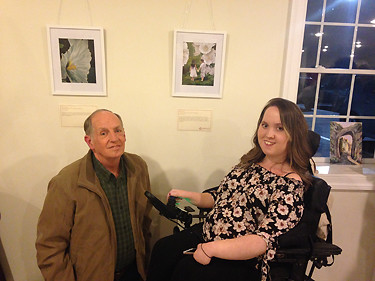
Bob Kirchman and Savhanna Herndon at the Second Annual Tabernacle Presbyterian Church Art Show. The theme was Restoration.

And the Lord spake unto Moses, saying, See, I have called by name Bezaleel the son of Uri, the son of Hur, of the tribe of Judah: And I have filled him with the spirit of God, in wisdom, and in understanding, and in knowledge, and in all manner of workmanship, To devise cunning works, to work in gold, and in silver, and in brass, And in cutting of stones, to set them, and in carving of timber, to work in all manner of workmanship. And I, behold, I have given with him Aholiab, the son of Ahisamach, of the tribe of Dan: and in the hearts of all that are wise hearted I have put wisdom, that they may make all that I have commanded thee;” – Exodus 31:1-6

Could there be anything to indicate more exquisitely God’s love of the beautiful than His instructions to crown the capitals of the temple pillars with “lily-work”? We can imagine Him adding in His directions, “Now David, don’t forget the lily-work decorations to be carved at the top of those pillars. And be sure to get them large enough to show up well.” Does it not suggest the artistic delight God must have experienced when with His own fingers he shaped man and woman into forms replete with comeliness?” – Clyde S. Kilby, The Arts and the Christian Imagination, p154.

In 2010, with the construction industry in the doldrums of recession, I teamed up with artist Kristina Elaine Greer to paint a mural of the New Heaven and the New Earth. The mural, titled ‘Journey to Jesus’ [1.] was indeed a statement of ultimate restoration. It referenced Isaiah 60, Revelation 21 and 22. Through this project I found a renewed joy in art as an expression of Divine purpose – especially in restoration. After we finished ‘Journey to Jesus’ I spoke with an Egyptian woman named Zipporah (same as Moses’s wife’s name) and she described Heaven in this way, “Jesus is in Heaven surrounded by children!” I was thrilled. We had just painted that. I begged her to tell me more: “The flowers there are ENORMOUS!” “Like sunflowers?” I asked – “No, more like TREES!”

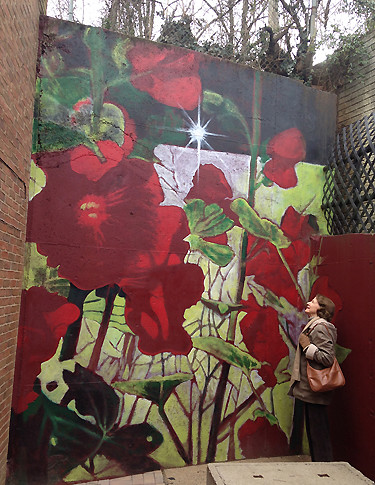
That became the inspiration for the “Heaven’s Hollyhocks” paintings. Hollyhocks already represented a legacy in my way of thinking so now they became a Spiritual legacy. The Fifeville mural and a proposal for Bethesda’s Metro Station sprang from that vision. That vision is why participation in a show who’s theme was “The Restoration of All Things” meant so much to me. Hopefully that theme will find new and exciting expression in the future. Finding Redemption and Restoration in the midst of Recession is certainly a good thing!

Tabernacle002
Team Savhanna!

Hollyhocks
“Heaven’s Hollyhocks,” Painted by Bob Kirchman, inspired by the Springhill Hollyhocks planted by Kristina Elaine Greer’s Great-Great Grandmother, brightens an alleyway in front of a beauty shop in Charlottesville, Virginia’s Fifeville Community.

Restoration and Basketball
Tony Bennett’s Teaching Moment

The question seemed at first like one of those uncomfortable ones by a sports writer attempting to interject ‘greater significance’ into his reporting. “What does your victory mean to Charlottesville in light of all the recent news surrounding her?” UVA Coach Tony Bennett’s answer was a good one though. He said that the victory did indeed mean a lot to Charlottesville in that the team truly was a great example of “Unity in Diversity.” The team’s unselfish play and acknowledgement of the less-celebrated defense (controlling turnovers was key to their victory) made for a great lesson.

We still have our issues.” Bennett continued. But the example of these young men working it out and working together is indeed right up there with the message of “Remember the Titans.” If you remember, that story is about how the T. C. Williams football team brought a community together in the turbulent days of court-ordered integration. The Titans came together and showed their town just what they could accomplish by working together.

In the post-game interview you saw true humility and Bennett acknowledged his Faith. They took their teaching moment seriously. They played a beautiful unselfish game and showed us something we can carry into our own lives.

LateSnow
A March snow creates a Winter Wonderland. Photo by Bob Kirchman.

A Capital Vision
Harry Weese's Metro Design

Weese001_web
Harry Weese

Weese002_web
Harry Weese

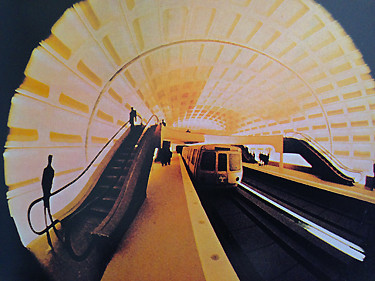
Harry Weese’s original design for Washington’s Metro system did indeed create a ‘crypt’ for the Federal City. It was meant to be somewhat devoid of ornamentation, depending on allusion to Classical vaults to tie it to the design of the city above. But there has always been some argument about the other spaces – the above-ground portions, for example. Did Weese intend them to be some stark brutalist viaduct? I found the above rendering by Weese’s office that shows a raised portion of the Metro at Reagan International Airport.

The Trains float on raised tracks supported by the ubiquitous round columns, but note that in the rendering the columns are integrated with the vegetation of the site – in this case the artist has placed them among the hydrangeas (going by scale and color), admitting that natural colors and forms of landscaping were to have softened the brutalism – especially in the vicinity of the airport and Arlington’s Cemetery.

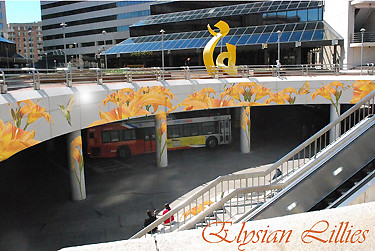
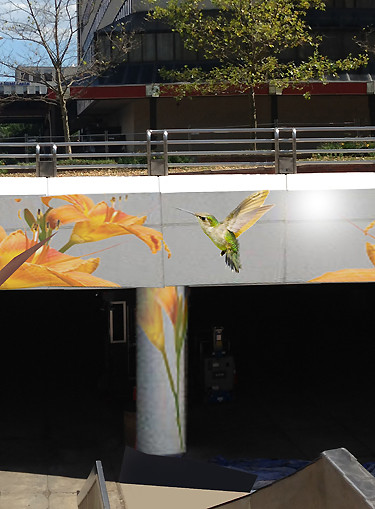
Below are my concepts for a mural that would have been painted in the bus bay of the Bethesda Metro Station. I like to think that Weese himself would be OK with the design.

Bethesda0002

Bethesda0003

Bethesda0001
Concept by Bob Kirchman.

Elysian Lilies, it is a variation on the theme of Heaven’s Hollyhocks seen in last week’s issue. Passing through the asphalt and concrete bus bay descending to the Metro, the large lilies would have perhaps added a ‘touch of Heaven’ to Bethesda’s workaday world.

Mountain Roads


Bejewelled Clover
Bejeweled Clover. Photo by Bob Kirchman.

PontifusBANNER

Wednesday, March 7, 2018

JOSIAH Chapter Ten, Fresh Visions of Heaven

JOSIAH014
Volume XIV, Issue X

Josiah
By Bob Kirchman
Copyright © 2018, The Kirchman Studio, all rights reserved

Chapter 10: Quandry

Young Josiah Zimmerman knocked on the office door of Abiyah Ben-Gurion. “Come in.” Professor Ben-Gurion said. “I am deep in a quandary.” The young man said.

Ben-Gurion loved young Zimmerman. The young man had originally arrived at the school to study Aerospace Engineering but after a stirring talk by Dr. Greene in chapel, he experienced what the old-timers call the ‘Burning Bosom.’ Persuasive and articulate, the young man saw his gifts most applicable to some sort of evangelism, but he still loved the sciences. As with many young people who are so blessed, young Zimmerman struggled with his calling and his passion, and that is why he sought out Ben-Gurion. Abiyah was a deeply rational man, but he seemed to understand that man was more than a rational machine. The professor’s walls were filled with amazing floral photography that he had taken. He was quiet about his faith, but it was well known that he always left his office on Fridays long before Sundown. He often slipped over to Wales in time to be there when it was Saturday so he could worship in the manner of his Fathers. His voice reading the Holy scrolls was known only to a few people, but they knew it was beautiful.

What his students saw was the strength of his character. He was tough, but fair. He met you at eye level and would listen. He was downright reluctant to give up on a student. He had helped Josiah Zimmerman understand that his heartfelt need to study Spiritual matters was a good thing. “The Divine will see to it that you have opportunity. You, my friend, must keep your eyes open and learn to recognize it.”

Ben-Gurion, at the moment, was wrestling too. He had just received the latest transcript of West and Josiah’s conversation on Mars. “Those Martians are like sheep without a shepherd,” he thought to himself. Peering at the young man seated across the desk from him he wondered, “Could this man be the answer.”

The reassimilation proposal had been floated with Josiah of Mars. He in turn had visited the Council with it. Not surprisingly, the APOLLONIUS faction was against it. Those closer to Josiah and Allison were cautiously interested in hearing more. As a group, they met the repatriation proposal with a resounding sentiment of “Not so fast.”

Ten spaces sat waiting in the lander. No one would step up to be first to go. Josiah might have been tempted but there were a few things that stopped him cold. First of all, he sensed that the volatile colony might indeed disintegrate upon his departure. More than once, he and Allison had defused some tense situations in the new colony with some old fashioned thinking. Josiah shuddered as he thought of how close the colony had come to chaos. He didn’t love his job, but he feared the vacuum.

He and Allison had children. If everyone dear to Josiah returned with him there would be room for only a couple of other colonists. Josiah would not leave his family, especially to an uncertain future. Their children knew nothing else than the red world they inhabited now with its green biospheres. If more landers were available in the future it would be fine but that would require some negotiations and some guarantees.
(to be continued)

Visions of Heaven
The Restoration of All Things

Paintings by Bob Kirchman

Renewal
Heaven's Hollyhocks I.

God is making good on His promise to restore all things. Despite the brokenness around us and in us, we put our hope in God. Please help us visualize this promise through your artwork.” That was the call for works to be included in Tabernacle Presbyterian Church’s second annual art show. It is a great event which brings together the Christian creative community and the theme of restoration is hard to resist. The images are taken from hand painted cards that expressed the theme as promised by the New Heaven and New Earth.

Heaven’s Hollyhocks I presents a visualization of a legacy of restoration. Every year the hollyhocks bloom along Springhill Road in Staunton, Virginia. They are the Legacy of a gardener who long ago planted them in her front yard. The house is long gone, but the hollyhocks return, promising another season of restoration. That gardener ‘just happened’ to be the great-great grandmother of my assistant Kristina, who shared the story with me. We were painting the mural ‘Journey to Jesus’ [1.] at the time and that too was a visualization of the vision of restoration in Isaiah 60 and Revelation 21,22.

Last year a reproduction of ‘Journey to Jesus’ was shown at the Tabernacle annual art show. It features children around the world coming to Jesus. This year the ‘Heaven’s Hollyhocks’ paintings expound on the vision of a lady named Zipporah, an Egyptian, who had lived through a time of terrible persecution for the Christian Church there. She said she had had dreams of Heaven. I asked her to describe it: “Jesus is in Heaven surrounded by children!” she said. “Tell me more!” I said. She continued: “The flowers there are enormous… like trees!” That became the inspiration for this series.

The boy and girl in the painting below – they are Indian, but they are meant to represent the hope of restoration for all of us. Surrounded by colossal hollyhocks, holding hands, they make their way to Jesus. My thought was that we all become as little children in the presence of the Master, losing nothing in the way of wisdom. Thus the couple could indeed represent the reuniting of a husband and wife who had been separated by death – or a brother and a sister. Let it represent both!, for Heaven is indeed a place of joyous reuniting and restoration!

I plan to explore the subject further. The initial images are white – inspired by a beautiful white hollyhock on Springhill Road, but Heaven is full of color – possibly far more color than we can perceive now. My plan is to introduce that in subsequent paintings. We sort of expect white images of Heaven – heavy on clouds and gold harps, but I believe that has diminished the true promise of the place. Humanity itself presents itself in a beautiful range of colors. Free from prejudice, we see our brothers and sisters like many varieties of fine woods in their coloration and characteristics. All tell us something of IMAGO DEI!

The show will be open March 9, from 7:00-9:00pm in the fellowship hall at Tabernacle Presbyterian Church, 1301 Red Top Orchard Road in Waynesboro, Virginia.

Renewal 2
Heaven's Hollyhocks II.

Portrait of Restortation
Painting and Description by Savhanna Herndon

The Bible speaks of restoration in the sense of our heart’s reaction to Christ. To restore something is to return it to its former owner, place, or condition. I believe color is the language of emotion and art is to reflect its maker’s heart. Therefore, art should reflect the light of the maker’s maker and restore something broken in it is beholder. As for the artist, he is restored to heavenly glory when using his God given talent, stroke by stroke.

Psalm 23:3: “He restores my soul. He leads me in paths of righteousness for his name’s sake.”

Herndon
Savhanna Herndon.

Restoring Their Lost Voices
A Proposal for the World Trade Center Memorial Site

wtc
Xaver Wilhelmy's Design for a memorial at the World Trade Center site in New York. The memorial features a 3000 pipe organ to give a voice to everyone who's voice was lost on that terrible day. Rendering by Bob Kirchman

The History of New York's Bridges


A Tribute to Billy Graham
I Can Only Imagine


Emerging Crocus
Springtime Promise of Restoration

Crocus
Photo by Bob Kirchman.

I Can Only Imagine
Bart Millard's True Story of Restoration


It’s the song that brings ultimate hope to so many … often in the midst of life’s most challenging moments. Amazingly, the song was written in mere minutes by MercyMe lead singer Bart Millard. In reality, those lyrics took a lifetime to craft.

Although he found faith at a young age, life wasn’t easy for Bart. He leaned into an active imagination and his love of music as escapes from a troubled home life. As he grew older, Bart turned to football in hopes of somehow connecting with his abusive father. But a career-ending injury—combined with the vision of a teacher who saw unlimited potential—set Bart on a musical pathway.

Chasing a dream while running from broken relationships with his father and Shannon, his childhood sweetheart, Bart hits the road in an old, decrepit tour bus with his new band MercyMe—named for his grandmother’s favorite expression. With the guidance of a grizzled music-industry insider, the band begins a journey none of them could ever have imagined.

Directed by the Erwin Brothers (October Baby, Moms' Night Out, and Woodlawn), I CAN ONLY IMAGINE stars J. Michael Finley, Madeline Carroll, Trace Adkins, Priscilla Shirer, with Cloris Leachman and Dennis Quaid.

A gripping reminder of the power of forgiveness, I CAN ONLY IMAGINE beautifully illustrates that no one is ever too far from God’s love—or from an eternal home in Heaven.

PontifusBANNER

Wednesday, February 28, 2018

JOSIAH Chapter Nine, Well Done, Billy Graham

JOSIAH00009
Volume XIV, Issue IX

Josiah
By Bob Kirchman
Copyright © 2018, The Kirchman Studio, all rights reserved

Chapter 9: Spoiling the Garden

As Josiah related it to West on Earth, it was not so clear how it started. He began with a bit of background, “You know, we now were ready to create a new evolution of human institutions so we intentionally cast off a lot of the ‘archaic’ rules of the past. Our society became a pragmatic one. We don’t force monogamy, for instance, insisting only that the society as a whole take responsibility for the needs of the children. Well, most of the settlers simply paired off like in the old days. They raised their own kids. They lived quiet lives. But there were some of the APOLLONIUS faction that were not content to stay within the lines. Human jealousy, I’m afraid, is still very real and when a man lies dead and another stands with a bloody stone in his hands asserting his boundaries, the institution’s response is not so clear anymore.”

What did you do next?” West asked.

Well, we don’t believe in capital punishment, so the question was how to deal with the crime. The killer was simply restricted to his portion of the greenhouse and was informed that if he ventured forth he would simply be forcibly returned. It was an answer, but it was not a good one. Over the years you can see the tension between his people and the people of the victim. Our society, I fear, is a very fearful and unsettled one at the moment. I’m beginning to wonder if we can actually achieve the vision APOLLONIUS left us with and I don’t say that lightly. Mr. West.”

So, should we begin to evacuate you? We can only move ten out in the transport that just landed, but we can send others. We can resupply the colony as we gradually get you home.”

But there are those who see this as home, and the life they’ve fled so wretched, that I believe they will not come.”

Think about it, Josiah, and we will formulate a plan for your evacuation and reassimilation.”

I will discuss it with the Counsel.”
(to be continued)

The Tomorrowland Problem
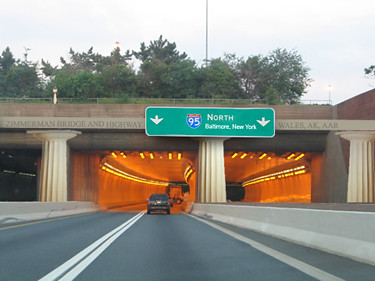
Study for a Fictitious Future Road
ZBH_web
Classical columns mark the entrance to this Tunnel. [click to view]. Here is a graphic of a possible project by Zimmerman Bridge and Highway to complete a 'gap' in the United States Interstate System. Graphic by Bob Kirchman.
Leon Krier
Leon Krier's 'City of Tomorrow'

Building on the Past
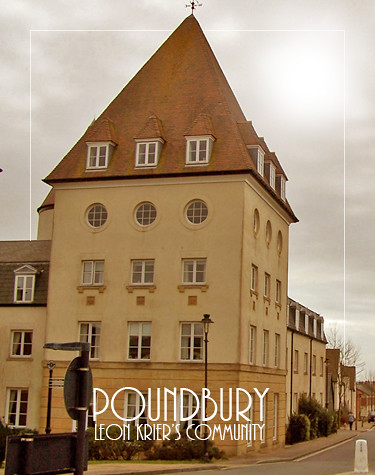
Poundbury, Leon Krier's Future City

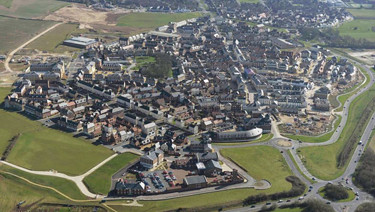
Poundbury is based on some of the timeless principles that have enabled many places around Britain to endure and thrive over the centuries. It is a high density urban quarter of Dorchester which gives priority to people, rather than cars, and where commercial buildings are mixed with residential areas, shops and leisure facilities to create a walkable community. The result is an attractive and pleasing place, in keeping with the character of Dorchester, in which people live, work, shop and play. Commissioned by the Prince of Wales and designed by Leon Krier, Poundbury offers a vision for the future returning to a more human scale in its design. Therefore, Poundbury, in its mission, overcomes the ‘Tomorrowland Problem’ by specifying an architecture that transcends a small contemporary period. In many ways it creates a timeless place for its inhabitants. Even more important, the people love it.

An economic assessment completed by Dorset County Council has concluded that the Poundbury development has already contributed over £330million in demand for goods and services to the local economy and will contribute a further £500million by 2025. Poundbury is an urban extension to the Dorset county town of Dorchester, built on Duchy of Cornwall land, according to timeless principles of architecture and urban planning as advocated by HRH The Prince of Wales. It is currently home to 1,500 people in different types of housing, including social housing, as well as providing employment for some 1,000 people. The report estimates that the construction activity that has taken place in Poundbury since 1994, when the development began, has created the equivalent of 1,877 person-years in employment and 1,049 business-years of work for firms including the self-employed. These figures will grow over the next 15 years as the development is completed. The assessment indicates that when Poundbury is completed it will be supporting over 430 new full-time equivalent jobs and 121 new businesses in the local area on a long-term basis. This means a contribution of around £40million per annum in increased demand for local goods and services and a net equivalent of about £20million per annum added to the local economy.

Simon Conibear, Poundbury Development Manager said: “We have always been aware that Poundbury has been a major source of employment and economic activity, for Dorchester particularly, but it is interesting to have this quantified. The important thing is the legacy we leave, and it is encouraging that even after construction activity ceases in 15 years time, there will be a continuing major economic benefit to the Dorset sub-region.”Anne Gray of Dorset County Council said: “Poundbury has already had a positive economic impact and there is more to come. A long-lived project such as this is really important to the area both throughout the construction phase and in terms of the permanent impacts which will be felt in the sub-region.”

Over the course of the development, Poundbury is expected to increase the population of Dorchester by about one-quarter, by approximately 5,000 people. By early 2010, there were 931 completed dwellings, with more than 25 per cent social housing, and a population of around 1,820 . More than 1,100 people were employed in businesses located at Poundbury. Poundbury is now more than a third built with plans for 2,466 homes by 2025. Poundbury has proved increasingly influential, attracting international interest and generating hundreds of organised tours every year from architects, town planners and others. The success of Poundbury has now been recognised far beyond Dorset and many of the principles have been incorporated into the Government’s Planning Guidance Note (PPG3). Poundbury was also highlighted as an exemplar in “Living Working Countryside. The Taylor Review of Rural Economy and Affordable Housing” a report by Matthew Taylor MP, published in July 2008 and commissioned by the Government.

IMG_4426b
Human-scaled Poundsbury.

IMG_4429a

IMG_4428a

IMG_4431

pb_4427

pb_4432

pb_4434

A Royal Revolution
Is Prince Charles’s Poundbury Vision Having Last Laugh

[click to read]

In a room of raw concrete block walls and exposed steel beams, a man with a long hipster beard takes an order on his iPad and froths up a flat white. Young mums and retired couples sit at long communal tables among Wi-Fi workers. It could be a trendy east London cafe in a repurposed industrial space, but this is the centre of Poundbury, the Prince of Wales’s traditionalist model village in Dorset. And there’s not a doily or tweed jacket in sight. (read more)

Loving the Arab and the Israeli
A Loving Understanding of the Middle East's Peoples

[click to read]

Two narratives exist today in Christendom about the Middle-East. Depending on your church affiliation, you may hear one or the other. If you attend a mainline Presbyterian Church, say in the PCUSA, you are likely to hear a narrative such as this: “The poor Palestinians have been oppressed by the Jewish ‘occupiers’ of their homeland.” In that point of view, the Palestinians are the victims, the state of Israel is a ‘modern invention’ and has nothing to do with the work of God today. Visit a more Evangelical branch of the church and you may find what seems quite the opposite, a devotion to the modern state of Israel as fulfillment of Prophecy. In this scenario the Arab population often seems to be portrayed as the villain. So, you ask, “Who is ‘right?’” Michael Onifer and Joshua Charles take on this complex and often confusing question in their book: God, Israel and You. Rather than present a pre-selected narrative and plug in Scripture to affirm it, the authors approach the subject with a very open study of history and Scripture, acknowledging the warts and wrinkles. You will emerge from this book loving the Arab people. You will emerge from this book loving the Jew. (read more)

On Calling and IMAGO DEI
Discerning the Strokes of the Master

O Master Maker! Thy exultant art
Goes forth in making makers.”
—George MacDonald

If George MacDonald is correct in asserting that all wickedness tends to destroy individuality, then the Christian should have more individuality than anyone else. Purged of the encumbering weight of the wicked self and knighted by the accolade of the All-Sufficient, he should demonstrate daily the abundance that is repeatedly declared to be in Christ. Macdonald says of the white stone with the new name in the Book of Revelation that it is given because it expresses “the character, the nature, the meaning of the person who bears it. It is the man’s own symbol—his soul’s picture, in a word—the sign which belongs to him and no one else.” The great Creator Artist wants to render not only a Christian in His image but at the same time produce a portrait of the real qua man (for it is man and not the angels who are saves) relieved of the debilitation and devilish self.

Among devoted young Christians seeking the fullest possible service of God, the personality is frequently weighed in precisely the wrong manner, or perhaps we should say ignored. Urged to “empty the self” and submit to God’s consuming fire their most prized possession, they sometimes tragically withdraw from the very talent that God has uniquely given. This in part accounts for the number of failures in Christian service. It is as if a man with obvious talents—let us say in bridge building—should convince himself that bridge building is the one thing not to undertake but rather that he must become a poet. Christian young people ask with a soul-stirring devotion to God, what shall I do with my life? And are told in effect to become a missionary, become a minister, or become a Christian businessman or housewife. What a tragic dearth of imagination. Not, of course, that there is not room for a great variety in these categories, but that the method itself is constrictive.

One suggestion is that we spend less time telling young Christians and more inquiring of them with a view of entering, and having them honestly enter, the crepuscular (dim) world of their motives and talents. Then we need to remind young people often that patterning their life after another—a common practice in all men—has some advantages and other decided disadvantages. I had the privilege of talking with Grandma Moses, the primitive painter, and she told me her agents disliked for her to go down to New York City and particularly for her to go to art galleries. They were afraid she would lose the delightful naiveté which makes up her native genius. Young people should be similarly cautioned to look for God-given uniqueness in themselves and when discovered (and I feel there is much more of it than now appears) warned to guard and cherish it.”
—Clyde S. Kilby, Arts and the Christian Imagination

A Little Inconvenient History
by George, from WashingtonsBlog [2.]

[click to read]

George writes: “I was raised to be against guns. My parents hated guns, and believed that they only lead to crime and accidental shootings. I was raised in a blue state, and I have long been deeply influenced by leading voices for non-violence, such as Gandhi and King. So – until recently – I was pro gun-control. As such, I was stunned to learn about the historical background behind gun control campaigns.” (read more)

Well Done
Good and Faithful Servant

Someday you will read or hear that Billy Graham is dead. Don’t you believe a word of it. I shall be more alive than I am now. I will just have changed my address. I will have gone into the presence of God.”

At 99 years of age, Billy Graham has stepped into the presence of the Lord. He has heard the words: “Well done, good and faithful servant!” from the Master’s lips. I do not think it is coincidental that the great man has left us at this time. Remembering the Spirit that drove his life is exactly what we need right now.

Our world is a mess. We have serious problems. No amount of brilliant engineering or institutional solutionism will renew the human heart. Graham’s life work was bringing people to God. God changed the hearts. In Graham’s heyday, secular society at least nodded to the positive influence of Faith. Today the hosts of a major network TV show call Vice President Pence’s devotion to his Faith a “mental illness.” The secular academy largely promotes that notion as well – and yet, when we breathe our last or face challenges beyond our comprehension, that academy and that popular culture fails us. All they can offer us is comfort in accepting the present. They can offer us no life beyond this one and they can offer us no help beyond our own strained resources.

Graham ministered to a succession of Presidents. The leaders who had to forge earthly solutions looked to the friendship of a man who’s citizenship was Heavenly. The fact that Graham was a trusted friend to so many Presidents says volumes about the true stature of a man of Faith in the halls of power. Like Pence, Graham made sure his dealings with women were above reproach. It is said that when Graham travelled he was never alone. Upon entering his hotel, his aides would enter his room first lest someone be hiding there with the intention of creating a sordid story. He knew the stories of other men’s fallings and did not think himself better than them. Rather, he made sure his life on the road was an open book.

He considered himself a simple preacher of the Gospel and usually avoided political issues. Still, in the days of Watergate, he was sharply criticized for standing by his friend Richard Nixon. He clearly taught the Scriptures and in that way he did indeed comment on the issues of his day. His son Franklin is more direct in applying those same Scriptures to the issues of our day, but this is a different time and we perhaps need that directness as popular culture and the academy seek to deny the power of Divine Principle. Thankfully Reverend Graham’s passing gives us as a people the opportunity to look at the great gift that Faith is to us – and that most Americans still acknowledge. I see a race…

It is a relay. The baton has been passed. It has not been passed to Franklin, but to us. Each one of us is called to run our ‘Anchor Lap’ in this great race. Before Billy Graham ran his lap, there was Paul. He put it this way: “Brethren, I count not myself to have apprehended: but this one thing I do, forgetting those things which are behind, and reaching forth unto those things which are before, I press toward the mark for the prize of the high calling of God in Christ Jesus.” – Phillipians 3:13,14
Men of God
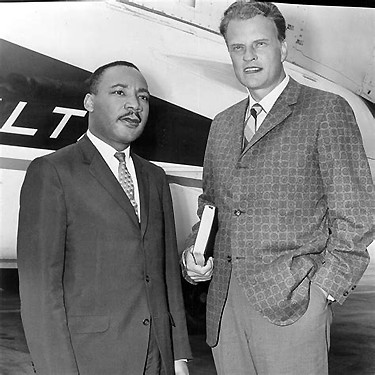
Martin Luther King and Billy Graham.

“Removing the Ropes of Racism”
Billy Graham Integrated Crusades in the 1950s

In 1957 the Reverend Billy Graham invited Dr. Martin Luther King to pray at his 1957 Crusade and later to speak at a ministry retreat to help his staff better understand America’s racial divide. In the 1950’s Graham insisted that his crusades be integrated. It was often customary to divide audiences comprised of black and white people with a rope. Graham removed the rope. He made it quite clear that we were equal before God and that at a Billy Graham Crusade, that meant equal access.

We must remember that this was the America of the South, struggling out of its Jim Crow past toward Civil Rights, Massive Resistance and Affirmative Action. In such context, Graham’s friendship with Dr. King can be seen as a true step forward. Modern observers say Graham didn’t go far enough. In the 1960s he personally bailed King out of prison but did not join him in his Washington rally. In retrospect Graham himself lamented “missing the mark” here.

He chose to focus on his work of evangelism, feeling that true reform would spring forth out of true revival. While his son Franklin is often criticized for political involvement, his father is criticized for holding back. I think it is clear that Billy Graham felt the causes were important though. When he went to South Africa, he insisted the crusades be integrated their as well. It was but a beginning. The great task of true reconciliation has become ours, but Billy Graham showed us how to take the first steps.

PontifusBANNER

Wednesday, February 21, 2018

JOSIAH Chapter Eight, Billy Graham Dies at 99

JOSIAH00008
Volume XIV, Issue VIII

Josiah
By Bob Kirchman
Copyright © 2018, The Kirchman Studio, all rights reserved

Chapter 8: Déjà Vu All Over Again

That ship never came. For decades the little band struggled on. Josiah struggled to lead them. A small core of APOLLONIUS devotees were always perturbed that the collective mindset originally prescribed was not adhered to. They were led by Mark and Sergey, who had barely made it through Elizabeth Zimmerman’s vetting process. Though the group as a whole dispensed rapidly with addressing each other by number, Mark and Sergey resisted that change to the bitter end. Finally it was only them referring to each other by number anyway. Then they gave it up.

The problem was that the two of them brooded together privately and stirred up some dissention publicly. Sergey would often interrupt Josiah with the statement, “that’s not by the book.” He was committed to restoring the purity of the original colony mission as he saw it. Josiah’s leadership was necessary now but in the long run it would have to go.

The two doctors gravitated to this mindset. They arrived at the colony both expecting and when their babies came they attached themselves to some men of the APOLLONIUS faction. APOLLONIUS was not the only person on Earth pushing for colonization, they reasoned. Others would follow and they would be the charter village of the new order when the latecomers arrived. Josiah had inventoried the remaining stores and they were actually not in any immediate danger of depleting resources. The doctors, for their part, did not strongly resist the change to home education. They considered their children the rightful heirs of APOLLONIUS and intended to raise them as such. Combined education might indeed get in the way of that.

Then there was the Allison/Josiah faction. They held rule of the colony by necessity and because of Josiah’s giftedness in that area. Even their enemies acknowledged this. The loss of APOLLONIUS had left most of the colonists quite rudderless if the truth be known. Steeped in the Progressive thought that had been overshadowed by a rebirth of Faith in the North Country, they were quite capable of creating institutions but clueless as to the deeper stirring of human nature that seemed to make them run so wretchedly.

The new colony was to have no prisons, but it became clear over the years that the folly that necessitated them was still present in humankind. Though they had cast off all of the antiquated beliefs and institutions, they were surprised at the dark shadows that had followed them across the solar system. Josiah dealt with the raft of petty crimes within the community with an application of something very much resembling the old ‘Golden Rule.’ When thievery was discovered, restitution was expected. Abusive and violent situations were not so easy. Initially mandatory separation of the aggressive parties seemed to work, but then there was the murder.
(to be continued)

Billy Graham Dies at 99
America's Pastor Now in Glory

billygraham
Many of us thank Billy Graham for introducing us to the Kingdom of Heaven. At 99 years of age, he has now tasted it in its fullness.

Winter at Wrightsville Beach
Nineteenth Century North Carolina Ocean Playground

Wrightsville Beach, NC
In 1853 the Carolina Yacht Club, currently the second oldest east coast yacht club (NY Yacht Club established in 1844), was founded on The Banks, which later became Wrightsville Beach. Here an azalea blooms in February on the leeward side of the Yacht Club building.

Wrightsville Beach, NC
A Winter morning dawns over the dunes of Wrightsville Beach, North Carolina.

Nineteenth Century beachgoers flocked to the shore on a streetcar line that ran from Wilmington, North Carolina to the beach. In 1889 A trestle across Banks Channel was constructed and by 1906 there was direct Pullman service from Atlanta, Georgia to Wrightsville Beach. In 1901 Consolidated Railways, Light and Power Company was formed. Not only did they power the trolleys, they provided free electricity to the residents of the beach. It remained free until 1917!

In 1905, Lumina, the “Beautiful Place of Lights” was built by the power company as an entertainment destination. The three story pavilion featured a magnificent ballroom with the first scientifically designed band shell on the East coast. It became known as the “Showplace of the Atlantic.” It was damaged substantially in 1954 by Hurricane Hazel and was demolished in 1973.

Wrightsville today is a community of beautiful beach cottages and some nice hotels, but the name of Lumina Avenue recalls a day when Wrightsville was an ‘Electrical Prototype Community of Tomorrow!’ [1.]

Moonlight Bathing
Guests Enjoying Moonlight Bathing, from a turn of the century tinted postcard, at Wrightsville Beach’s Seashore Hotel. The Seashore Hotel, considered an early showplace on the island, opened with 180 rooms (150 with fireplaces) on the current site of the Blockade Runner Hotel. The Seashore Hotel was destroyed by fire in 1919, but rebuilt in 1922…

BlockadeRunnerSmall
…the Contemporary Blockade Runner Hotel replaced it in 1964, becoming the largest hotel on Wrightsville Beach.

BlockadeRunnerGardens
The Gardens of the Blockade Runner Hotel in Wrightsville Beach, North Carolina.

26489028328_8ecc472bd9_b
The space under a porch on Wrightsville Beach's Lumina Avenue becomes a special place for children, touched by the hand of an unnamed muralist.

lumina-daze
The Lumina Pavilion, from an old post card.

42557661a8b34e5443828169733cdfd9--vintage-travel-posters-vintage-maps
Direct Pullman Service from Atlanta.

AtlanticinWinter_small
The Atlantic Ocean on a Winter Morning. Photo by Bob Kirchman.

The ‘Tomorrowland Problem’
by Bob Kirchman

gyfyid78944-613x766
Disney's Tomorrowland in 1955.

Basically, when you create a detailed vision of the future—it’s the PRESENT! That, in a nutshell, is the ‘Tomorrowland Problem.’ In 1955 Walt Disney opened the ‘Tomorrowland’ portion of Disneyland, complete with a ‘TWA’ passenger rocket that resembled a German V2. It was exciting in its day but a mere 15 years later man had walked on the moon. The exhibit was dated. Epcot’s futuristic ‘permanent world’s fair’ created a similar problem. Tomorrowlands all too quickly became deco visions of the past attempts to visualize the future.

columbiad
Disney Paris's Jules Verne Imagery.

For Disney Paris, a wonderful solution presented itself. Harper Goff had created a Jules Verne submarine for 20,000 Leagues Under the Sea which was a wonderful study in what Victorian and Edwardian engineers might have come up with (Verne’s own illustrations of the Nautilus were of a sleek and simple boat). In Disney Paris, the huge canon from From the Earth to the Moon launches riders on a variation of Disney’s popular Space Mountain. The whole Jules Verne concept was intriguing and quite successful.

Now Disney Imagineers looked to Tomorrowland in Disney World, Florida. They saw the glow coming off of that park’s iconic Space Mountain and so they painted over the white sculptural mountain in greens and browns. It was an awkward modification—eventually reversed, but it taught us something about the soul of the architecture.

2ad04c314014ec006900c17d4b370cd8
Chicago's 1893 World's Fair.

In 1893, Chicago hosted its world’s fair and presented an America bouncing back from a devastating Civil War a pristine ‘White City’ based on classical forms. Here the past was invoked to influence the future. Chicago kept some of the classical buildings as public structures and inspired a great building of classical architecture across the nation. This continued well into the early decades of the Twentieth Century and enriched many an American small town and city!

But in those same decades, a modern architecture developed. Some of it, unfortunately was sparse at best and at times brutally ugly. Even Albert Speers’s ‘Germania,’ though classical, was brutally scaled and diminished the human inhabitant. A dark, monolithic vision for the future emerged. With the defeat of the National Socialists, Europe rebuilt herself with the help of the Marshall Plan. A lot of Europe’s beautiful architecture was rebuilt, but a lot of charming neighborhoods, destroyed by war, were rebuilt in Le Corbusier style apartment blocks. (Thank HEAVEN the Nazis did not burn Paris)! In the United States, the same design was applied to public housing.

In 1964, the New York World’s Fair became a vision for the future as well. The buildings were bold and some of them seem quite outlandish today. Those who remembered the 1939 New York fair might find it quite similar to the 1955 Tomorrowland in the way its imagery has aged.

When I started creating the future world of Big Diomede for the PONTIFUS series, I purposely looked to the past—a lot like the architects who built the ‘White City.’ The Disney Corporation never built EPCOT as an inhabitable city like Disney originally envisioned it. They later created ‘Celebration,’ a decidedly more traditional community. Even in Brazil’s futuristic capital, traditional style homes have popped up in its outlying neighborhoods while in the center workers struggle to maintain the ultramodern government buildings.

The lessons to be learned are probably that the future arrives all to quickly and overshadows our attempts to render it and that the past is always a good resource as we seek to go forward.

DiomedeChapel_UC
The Chapel in the Big Diomede Biosphere under construction.

PontifusBANNER

Wednesday, February 14, 2018

JOSIAH Chapter Seven, Ash Wednesday, Lent

JOSIAH00007
Volume XIV, Issue VII

Josiah
By Bob Kirchman
Copyright © 2018, The Kirchman Studio, all rights reserved

Chapter 7: Generations

Having quite likely spared the colonists the agony of the Pilgrims’ first year, Josiah and Allison divided the greenhouses into plots. They encouraged the building of mud houses on one’s own section and the mere expediency of being on the land gave each settler a sense of purpose when he or she awoke in the morning. There even developed a bit of healthy competition in keeping one’s rows straighter than that of her neighbor. The result was, of course, a better yield than the original collective method might have produced.

The artisans who ran machines that wove cloth, the repairers of pressure suits, the makers of fired pottery and plates all collected in houses close to one another and although this was to have been a cashless society, a simple accounting and currency system emerged nonetheless. Eventually a little cookhouse developed into a tavern. The owners fermented a bit of grain for ‘personal use’ at first but as the years passed, they made enough to share and then sell. Their skill in preparing food did not go unnoticed and soon they were a regular stop for the settlers. There much discussion and business would be transacted.

There were no movies. There was no radio. All of the really high technology had been destroyed in the explosion, but somehow the noisy engines of agriculture and production had been relegated to the fringe… and that is why they survived. Evenings were quiet and the settlers eventually produced children. Although APOLLONIUS was originally planning to raise them in collective nurseries, the simple life of the settlers made it more logical for small family groups to raise their own children. In the decades that followed, those children had children. That is why the colony now had 122 souls. Obviously that part of colonization worked pretty much as planned.

As the years passed, youthful Josiah found his hair tinged with grey. He now watched grandchildren play in the yard of the much enlarged mud house. He vaguely remembered a phenomenon that someone in the Zimmerman Organization had referred to as ‘White Dog Thinking.’ It seems that in his younger days, Zimmerman had known a couple who were so convinced that the world was so awful that they decided to have no children. Instead, they lavished their affections on a series of large white dogs. The colonists, for their part, were so steeped in the mindset that they needed to be fruitful that as bad as things seemed, they never succumbed to ‘White Dog Thinking.’ Surely another ship would come and the colony would go on. The world they had left was really a bad place, they reasoned. It was only a matter of time until Mars became what APOLLONIUS had envisioned – a new home and hope for humanity!
(to be continued)

Stones of Remembrance
Remembering G-d's Mighty Works in Our Lives

AngusDei_web
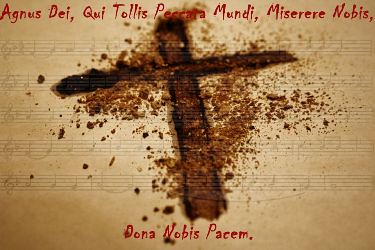
Angus Dei (Lamb of G-d), by Kristina Elaine Greer. [1.]

One of the greatest challenges to our Faith is our forgetfulness. Pastor Seth Hankee preached our sermon one Sunday about how the people were instructed to remember the great things G-d had done for them. G-d separated the Jordan, as He had the Red Sea, for the people to walk across and gave them the following command:

And it came to pass, when all the people were clean passed over Jordan, that the Lord spake unto Joshua, saying, Take you twelve men out of the people, out of every tribe a man, And command ye them, saying, Take you hence out of the midst of Jordan, out of the place where the priests' feet stood firm, twelve stones, and ye shall carry them over with you, and leave them in the lodging place, where ye shall lodge this night.

Then Joshua called the twelve men, whom he had prepared of the children of Israel, out of every tribe a man: And Joshua said unto them, Pass over before the ark of the Lord your G-d into the midst of Jordan, and take you up every man of you a stone upon his shoulder, according unto the number of the tribes of the children of Israel: That this may be a sign among you, that when your children ask their fathers in time to come, saying, What mean ye by these stones?

Then ye shall answer them, That the waters of Jordan were cut off before the ark of the covenant of the Lord; when it passed over Jordan, the waters of Jordan were cut off: and these stones shall be for a memorial unto the children of Israel for ever. And the children of Israel did so as Joshua commanded, and took up twelve stones out of the midst of Jordan, as the Lord spake unto Joshua, according to the number of the tribes of the children of Israel, and carried them over with them unto the place where they lodged, and laid them down there.

And Joshua set up twelve stones in the midst of Jordan, in the place where the feet of the priests which bare the ark of the covenant stood: and they are there unto this day." -- Joshua 4:1-9

The Passover meal had already been instituted as testimony to G-d's redemption, so that a child would ask: "Why is this Night Different from all Other Nights?" The story in a meal gave illustration to the miracle that had carried the people out of Egypt.

For the Christian, remembering deliverance from sin is the greatest miracle. In preparation for Easter, the Church observes Lent, reminding us of the deliverance Jesus brought us by way of the cross: 

Ash Wednesday emphasizes two themes: our sinfulness before G-d and our human mortality. The service focuses on both themes, helping us to realize that both have been triumphed through the death and resurrection of Jesus Christ.

During some Ash Wednesday services, the minister will lightly rub the sign of the cross with ashes onto the foreheads of worshipers. The use of ashes as a sign of mortality and repentance has a long history in Jewish and Christian worship. Historically, ashes signified purification and sorrow for sins."-- —Adapted from The United Methodist Book of Worship

So it is very important to tell our stories of redemption, using reminders that will stir our minds to recall times when we were vividly aware of the Divine reaching out to touch our lives. Pastor Seth showed us a little children's book he had saved from his first house... on closer examination you could see the tire print on the page, a reminder of how when a car careened into his living room, it had narrowly missed hitting his wife and young child. Certainly G-d had protected his young family and that little book now told a much bigger story!

So now it is time to commit ourselves to the telling of the great stories, the ones that end in redemption and deliverance from our present condition. The Book of Judges follows the Book of Joshua and gives a sober warning: "And Joshua the son of Nun, the servant of the Lord, died, being an hundred and ten years old.

And they buried him in the border of his inheritance in Timnathheres, in the mount of Ephraim, on the north side of the hill Gaash.

And also all that generation were gathered unto their fathers: and there arose another generation after them, which knew not the Lord, nor yet the works which he had done for Israel." -- Judges 2:8-10

The importance of stories and their redemptive narrative cannot be emphasized enough. Passing the torch must always be a priority in every generation.

1. "I did this with a sheet of 8.5"x11" computer paper some ashes from my fireplace and canola oil. I mixed up some of the oil and ashes similar to how they are mixed on Ash Wednesday and painted them on the paper in a cross then sprinkled the rest of the dry ashes on top. I then found one of the music compositions for "Agnus Dei," Latin for Lamb of G-d, on www.hymnary.org [click to read] and cut out strictly the music overlaying it and changing the opacity over the picture of my ash cross. Then I added the Latin words meaning, "Lamb of G-d, who takes away the sins of the world, have mercy upon us, grant us peace." This piece is to remind us that we are sinners made up of dust, but G-d loved us so much, he took mercy on us sending His son as a sacrificial lamb, to take away our sins. If we believe and accept his sacrifice we are granted this eternal peace and life with Him. May the Lord bless you all and lead you closer to Him during this season of Lent, looking forward to the promise of Easter. Amen." -- Kristina Elaine Greer

Ash Wednesday and Lent
A Time For Reflection and Redirection

sunset
Sunset in the Blue Ridge Mountains.

Guest Post by M. K. Hand

You might notice people walking around with cross-shaped smudges on their foreheads. There is no "mystical" attribute assigned to this practice. The ashes are a physical reminder of our need for repentance, and a symbol of the dependency of humans on G-d's mercy through Jesus Christ.

Why ashes? The Bible speaks of man returning to dust and ashes (from whence he came), and Job smeared himself with dust and ashes as a symbol of atonement. Also, in the Old Testament, animals were sacrificed to G-d for atonement, and they were burnt to ashes. When Jesus came as a living sacrifice, the Law was no longer applicable, and animal sacrifices were no longer needed for atonement. Jesus was the final sacrifice...He ushered us into a time of Grace through Faith, once and for all.

Lent, the season leading up to Easter, is a time of increased attention to charity (love), prayer, and fasting for Christians. It is a special time to reflect, repent and rejoice. It prepares our hearts to fully take in and celebrate the sacrifice, atonement, and grace made possible by Jesus' crucifixion, and the restoration of our relationship, broken by our sin, with the Father. Many people fast, give up something meaningful to them, or turn away from a sin that has taken hold of their life; fasting is also a way to identify with the sacrifice made by Jesus at Calvary. May this time leading up to Easter be a time of reflection, repentance, and rejoicing for you!

Therefore also now, saith the Lord, turn ye even to me with all your heart, and with fasting, and with weeping, and with mourning: And rend your heart, and not your garments, and turn unto the Lord your G-d: for he is gracious and merciful, slow to anger, and of great kindness, and repenteth him of the evil." ~ Joel 2:12-13

The Real Saint Valentine

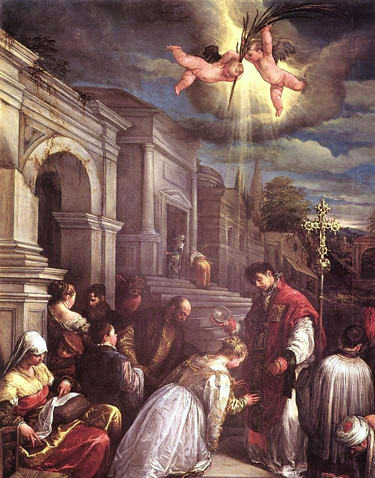
St-valentine-baptizing-st-lucilla-jacopo-bassano_web
Saint Valentine baptizing St. Lucilla, Jacopo Bassano, 1500s

Valentine or Valentinus, is a Christian martyr. The most common story is told that Valentine was a priest in third century in Rome. When Emperor Claudius II decided that single men made better soldiers than those with wives and families, he outlawed marriage for young men. Valentine, realizing the injustice of the decree, defied Claudius and continued to perform marriages for young lovers in secret. When Valentine’s actions were discovered, Claudius ordered that he be put to death in 270 AD. While in prison, Valentine is said to have sent the first “valentine,” a letter that he signed “From your Valentine.”

Sherando Lake Winter Scene
Photo by Bob Kirchman

Sherando
Reflected trees by the spillway of Sherando Lake Dam.

PontifusBANNER