Showing posts with label Apollo 13. Show all posts

Saturday, April 4, 2020

Apollo Thirteen, The 'Successful Failure' Public Art

Apollo13
Volume XVIII, Issue VII: Apollo Thirteen

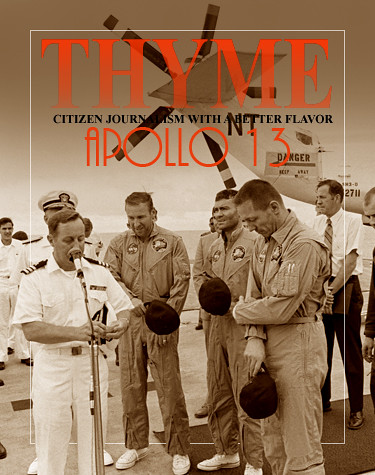
Commander Philip Eldredge Jerauld (at microphone), ship's chaplain for U.S.S. Iwo Jima, offers a prayer of thanks for the safe return of the Apollo 13 crew members soon after they arrived aboard the recovery ship. Standing in the center of the picture, from the left, are astronauts James A. Lovell Jr., Commander; Fred W. Haise Jr., Lunar Module Pilot; and John L. Swigert Jr., Command Module Pilot. The Apollo 13 Command Module "Odyssey" splashed down at 12:07:44 p.m. (CST), April 17, 1970, to conclude safely a perilous space flight. The three astronauts were picked up by helicopter and flown to the U.S.S. Iwo Jima.

1200px-Apollo_13_Service_Module_-_AS13-59-8500_(cropped)
The damaged service module of Apollo 13 as photographed by the astronauts. NASA

“Failure is the Best Teacher”
“The greatest teacher, failure is.” – Yoda in The Last Jedi

For a just man falleth seven times, and riseth up again” – Proverbs 24:16a

Thomas Edison invented the microphone, the phonograph, the incandescent light, the storage battery, talking movies, and more than 1000 other things. December 1914 he had worked for 10 years on a storage battery. This had greatly strained his finances. This particular evening spontaneous combustion had broken out in the film room. Within minutes all the packing compounds, celluloid for records and film, and other flammable goods were in flames. Fire companies from eight surrounding towns arrived, but the heat was so intense and the water pressure so low that the attempt to douse the flames was futile. Everything was destroyed. Edison was 67. With all his assets going up in a whoosh (although the damage exceeded two million dollars, the buildings were only insured for $238,000 because they were made of concrete and thought to be fireproof), would his spirit be broken? The inventor’s 24-year old son, Charles, searched frantically for his father. He finally found him, calmly watching the fire, his face glowing in the reflection, his white hair blowing in the wind. “My heart ached for him,” said Charles. “He was 67—no longer a young man—and everything was going up in flames. When he saw me, he shouted, ‘Charles, where’s your mother?’ When I told him I didn’t know, he said, ‘Find her. Bring her here. She will never see anything like this as long as she lives.’” The next morning, Edison looked at the ruins and said, “There is great value in disaster. All our mistakes are burned up. Thank God we can start anew.” Three weeks after the fire, Edison managed to deliver the first phonograph” – Erwin W. Lutzer, Failure, the Backdoor to Success, Moody Press, Chicago, 1975, 1984, p. 17

Edison, you will recall, had worked on the filament for his electric light bulb, famously stating that he had found scores of materials that didn’t work. Finally, his persistence prevailed.

When the United States embarked on the space program that would send the first humans to the moon, it enjoyed an incredible success rate. Mercury and Gemini launched repeatedly and always brought their crews safely home. Some of the near-misses like the early space-walks were forgotten. Then came ‘The Fire.’ As the first moonship, Apollo 1, was going through a routine test on the pad a spark ignited the oxygen atmosphere in the spacecraft. Astronauts Gus Grissom, Ed White and Roger Chaffee perished in seconds! Although NASA wrote the book on safety engineering in many ways, in their haste to fly Apollo they overlooked some wiring issues. “Go Fever” had resulted in three astronauts dying. Many observers look at that disaster as a defining moment for NASA. Nothing was to be taken for granted anymore. “Tough and Competent” became the guidelines for what became essentially a new mission. Apollo would go on to take men to the moon. Apollo 11 and 12 landed there.

The news media actually became bored with spaceflight. Apollo 13 rolled out to minimal press coverage. Fifty years ago astronauts: Jim Lovell, Jack Swigert, and Fred Haise took off to explore the Fra Mauro highlands of the moon. As the craft was on the way to their destination an electrical spark caused an explosion on the system that handled oxygen and power generation. The craft was crippled. Had this explosion occurred on the Apollo 8 mission, the crew would have died. Apollo 8 flew around the moon with no Lunar Module, the separate craft used to land on the moon because the team at Grumman Aircraft was struggling to get the Lunar Module ready to fly. Grumman airplanes had a reputation for always bringing their crews safely home and Tom Kelly, lead engineer of the LM project, was not going to rush the process of assuring that this craft was ready.

Inventing the process as they went along, the astronauts and mission control were able to use Apollo 13’s LM as a ‘lifeboat’ for the stricken star voyagers. They looped around the moon in a free-return trajectory not unlike that described in Jules Verne’s From the Earth to the Moon. They splashed down safely after 5 days in space and the spacecraft was substantially redesigned before the mission of Apollo 14.

In this day and time many of us know the feeling of failure. It is tempting to say that that must be the end of the story; But look at Scripture. Time and time again we see very ordinary people do amazing things empowered and led by the Divine. Last week we looked at the story of Boaz, the Kinsman Redeemer. His mother was a lady named Rahab. If you read the Biblical account of Rahab you will meet a woman who probably felt like a failure. As a practitioner of ‘the oldest profession,’ she would not likely have felt herself a Matriarch of the community. She may have made a number of bad choices in her life – up to the point where she chose the way of the Divine. She helped the nation of Israel in a time of need. In choosing Israel she became a part of Israel. Her child Boaz would marry Ruth. Their son Obed would father Jesse, the father of King David. The moral of the story is that today brings the opportunity for good decision. Good decision, enlightened by the Divine, holds the promise of great success. We must never forget that.

The Public Art Archive
Local Works in National Searchable Archive

IMG_7927
Watering Can [click to visit] by Willy Ferguson.

IMG_7928
Sunflowers [click to visit] by Madeline Maas and Augusta Christian Educators Studio Students.

While looking for art resources to pass the time during isolation, I discovered the Public Art Archive [click to visit], a searchable database of the nation’s public art. Since I always enjoy seeing public art in my travels, and am always in wonder at the works my cousin Page Jordan finds in her travels around Portland, Oregon, this was a great find. Portland is rich in murals. You can also find a lot of the art in Charlotte, North Carolina’s LYNX stations here. In any case, the site will provide you with many fine works to enjoy across the country. Here are some local works that have been added to the archive.

IMG_7915
Crozet Trestle Mural [click to visit] by Bob Kirchman, John Pembroke, Kristina Elaine Greer, Meg West and Western Albemarle High School Students.

IMG_7913
Hollyhocks [click to visit] by Bob Kirchman.

The First Passover

Foster_Bible_Pictures_0062-1_The_Angel_of_Death_and_the_First_Passover
Engraving by C. Schönherr

The angel is going through King Pharaoh's land. He is going through it in the night. The angel will go into King Pharaoh's house and make his son to die. He will go into all the people's houses and make their sons to die because they have been so cruel to the Israelites. But the angel will not go into the houses where the Israelites live, to make their sons die. G-d told the Israelites that the angel was coming, and he told them to kill a lamb, and take its blood and sprinkle it over the doors of the houses. And when the angel saw the blood, G-d said, he would not come into the house to hurt them. In the picture we see the blood sprinkled over the door and at each side of it. The angel sees the blood. He will pass over this house and not harm any one in it. We can see the family inside. They are eating the Feast of the Passover.
Illustration from the 1897 Bible Pictures and What They Teach Us

Entry Into Jerusalem
Palm Sunday

Entry-into-Jerusalem-Hippolyte-Flandrin-1842
Entry into Jerusalem, Hippolyte Flandrin, 1842.

The Stations of the Cross
Bishop Robert Barron



CS_Lewis_Banner

Tuesday, November 20, 2018

Special Thanksgiving Edition, Verne's 'Lost' Novel

THYMEthanks
Volume XV, Issue XXI

A Repeat of One of Our Favorite Issues

Thanksgiving is Good for You

Enter his gates with thanksgiving and his courts with praise; give thanks to him and praise his name. For the LORD is good and his love endures forever; his faithfulness continues through all generations.” -- Psalm 100:4-5 NIV

The 'other' Weekly News Magazine [click to read] once featured the story: "Why ANXIETY is Good for You." We at THYME see this one a bit differently. In the Bible, Philippians 4:6 exhorts us NOT to be anxious. Rather we are to view our needs in light of our relationship to a loving G-d. Indeed, our requests are presented in light of the gratitude we feel as we consider the goodness and provision to be found in the Divine.

Not be anxious? In today's world? That is precisely the direction given the believer. We live in a stress-filled world and we are not commanded to shut ourselves away but rather to interact with it... becoming a conduit for G-d's Love to reach it. Indeed History shows us people of Faith fighting plagues, caring for the helpless and generally DOING things, often navigating the best course we can in unclear situations. We are NOT helpless, though we often seem to labor in insufficient light.

Fitting thoughts as we celebrate the feast of Thanksgiving. These are indeed anxious times, and it is easy to become overwhelmed by the general angst of the period we live in. History tells us of Divine promise and fulfillment. The Patriarchs piled up stones to remind them of G-d's faithfulness in the past and to keep them faithful as they waited to see His faithfulness in their present lives.

And it shall be on the day when ye shall pass over Jordan unto the land which the LORD thy God giveth thee, that thou shalt set thee up great stones, and plaister them with plaister: And thou shalt write upon them all the words of this law, when thou art passed over, that thou mayest go in unto the land which the LORD thy God giveth thee, a land that floweth with milk and honey; as the LORD God of thy fathers hath promised thee." -- Deuteronomy 27:2-3

Indeed, one must recount the stories of how G-d met needs in times past. One must also tell of the promises of G-d. Faith needs fuel, and Gratitude is the substance that makes our faith burn bright, even in the darkest of times.

Standing on the Promises [1.]

Standing on the promises of Christ my King,
through eternal ages let his praises ring;
glory in the highest, I will shout and sing,
standing on the promises of G-d.
Refrain:
Standing, standing,
standing on the promises of Christ my Savior;
standing, standing,
I'm standing on the promises of G-d.

Standing on the promises that cannot fail,
when the howling storms of doubt and fear assail,
by the living Word of G-d I shall prevail,
standing on the promises of G-d.
(Refrain)

3. Standing on the promises of Christ the Lord,
bound to him eternally by love's strong cord,
overcoming daily with the Spirit's sword,
standing on the promises of G-d.
(Refrain)

4. Standing on the promises I cannot fall,
listening every moment to the Spirit's call,
resting in my Savior as my all in all,
standing on the promises of G-d.
(Refrain)


The staff of THYME wish you a most blessed Thanksgiving!

The 'Common Course and Condition' 
America's First Experiment with Socialism

When the Pilgrims first set up their economic system in Plymouth they opted for a system where all the results of their labor were held in common. All of the colonists then drew from the common store what they lived on. The Common Course and Condition, as this system was called, resulted in some bad feelings on the part of those who produced effectively and some lack of initiative on the part of those who were happy to have the food without the work.

The system produced constant shortages and a man who rose early and worked diligently came quite naturally to resent his neighbor who slept in and contributed less effort. Friction was high among the colonists and in 1623 Governor William Bradford declared the common course a failure.

The colonists were next assigned plots by families. Larger families were given larger plots. Everyone was responsible for the production of his own land and growing food for his own family. The results were notable. Far more crops were planted and tended. There was plenty instead of shortage and all in response to this new sense of ownership.

Church Found where 
Pocahontas was Married

pocohantis_3
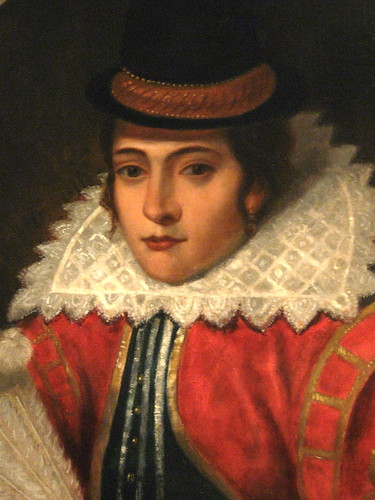
Her eyes meet yours as you enter the Virginia Executive Mansion. A young girl from days long ago, yet her presence in the foyer immediately captured my attention. There are two portraits of Pocahontas in the room, one in English clothing (below) and the more familiar rendering seen above.

pocohantis
Pocahontas's formal names were Matoaka (or Matoika) and Amonute. Pocahontas is a childhood name that perhaps referred to her playful nature. After her marriage to John Rolfe, she was known as Rebecca Rolfe.

Archeologists say that they have Discovered the Church [click to read] where Pocahontas married Jamestown planter John Rolfe.

Harvest Hymn Written 
in 1844 by Henry Alford

hymn2
“Come, Ye Thankful People, Come” is a harvest hymn written in 1844 by Henry Alford. It is often sung to the tune “St. George's Windsor” by George Job Elvey. So I created this in light of Thanksgiving to remind us of what we should really be thankful for. Two of my photos are overlayed with the text of the hymn added." -- Kristina Elaine Greer Photo Graphic by Kristina Elaine Greer

View Larger Image [click to view]

The First Thanksgiving... in VIRGINIA!

It wasn't a grand feast, but rather a time of giving thanks! on December 4, 1619, almost 2 years before the pilgrims held the feast with their Native American benefactors, Captain John Woodlief came ashore near the present site of the Berkeley Plantation. He had sailed from Bristol, England in the Good Ship Margaret with 35 men. They had survived a harrowing storm on November 29th and felt great gratitude for their deliverance. Here is Their Story [click to read].


Lessons from Squanto for Today

The Man Who Taught the Pilgrims Offers Wisdom

Squanto teaching
In this 1911 illustration, Tisquantum teaches the settlers how to plant maize.

Here is an interesting ebook: Squanto's Garden [click to read] from Off the Grid News. Most of us know some snippets of Squanto's story... how he taught the settlers how to successfully cultivate the soil of their new home, but Bill Heid actually shares some practical gardening tips and garden layouts that Squanto might have shared with the Pilgrims. He also fills out Tisquantum's story, giving us insight into a man who's unusual life uniquely equipped him to teach others.

IMG_0425
The Sun burns through a morning mist on Thanksgiving Eve.

A Native American's Amazing Story

" ... a special instrument sent by God for their good beyond their expectations ..." -- William Bradford

Today millions of Americans will dine on turkey and celebrate Thanksgiving. Most people will realize that it has some connection to the Pilgrims in Massachussetts, but the story of G-d's provision and the reason for the celebration seem to have faded in our collective memories.

The Pilgrims came to the New World for their kids. They were a Christian group who sought to live for G-d rather than be seduced by the culture around them. They lived in Holland for a while but they saw their children falling away from the faith.

So they moved. They sought passage on a ship bound for Virginia. The ship went off course and they landed in Massachussetts instead. They had a rough time of it their first winter and almost half of them died. Still, when offered the chance to return to Europe, they declined. Then one of the indigenous people walked into camp and spoke to them in English!

The man's name was Samoset, and he introduced the Pilgrims to Squanto, who taught the Pilgrims many things to help them survive in the new world. Squanto spoke even better English than Samoset. His story is amazing.

Squanto had first met Europeans around 1605 when Captain John Smith made his famous voyage. He travelled to England with him but when he returned to America he was captured into slavery and returned to Europe. Spanish monks bought his freedom and sent him to England where he found passage back to America. Sadly, his village was now gone, the people wiped out by disease. He found people nearby to live with but one day heard that a new group of people were living where his old village had stood. What's more, they spoke that funny new language that he had learned.

Samoset made the introduction and the rest, you might say, is history. Thanks to Squanto the Pilgrims survived and began to do quite well in the new world. Their relations with the Native people were quite good and their Thanksgiving was for the amazing provision they found in Squanto, of whom it was said:

" ... He desired honor, which he loved as his life and preferred before his peace ..."

Jules Verne’s ‘Lost’ Novel
Imagine a World without Art

By Bob Kirchman

IMG_3444

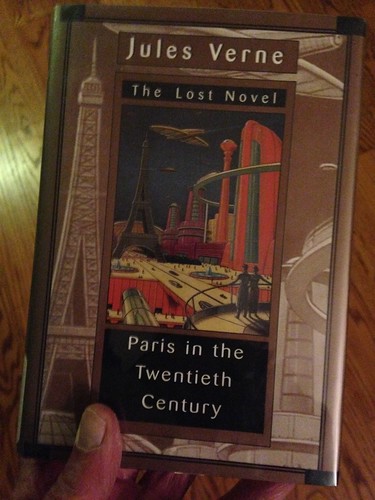
Jean Verne is the great-grandson of the famous author and futurist Jules Verne. In 1989 Jean was getting ready to sell a family home and made an amazing discovery. There was a huge bronze safe that the keys to had long since been lost. Although it was believed to be empty, the young Verne opened it with a blowtorch anyway. There in the safe was a manuscript. It was a novel called ‘Paris in the Twentieth Century,’ which Verne had submitted to his publisher Jules Hetzel right after the success of his first novel: Five Weeks in a Balloon.’ Hetzel had rejected it in 1863 saying “It’s a hundred feet below ‘Five Weeks in a Balloon.’ Hetzel went on to say “No one today will believe your prophecy!”

Verne’s vision of a modern Paris in 1960 indeed predicts skyscrapers and technology that came to be, but it is even more amazing to note that Verne’s dystopia predicts a future world where the great art, literature and music – the rich fruits of centuries of Western culture – have been all but forgotten! Instead, the culture of the day celebrates technology and commerce. ‘Old’ things have nothing to say to us anymore! The hero of the story, young Michel Dufrénoy, goes into a modern bookstore and asks if they have anything by Victor Hugo. The clerk responds by asking “what did he write?”

Jules Verne predicts most damningly our society’s modern intoxication with ugliness. Go to any modern art school or venue and you find more of a cold mechanical sort of art aimed more at ‘expression.’ Roger Scruton has written on this phenomenon and how the great works of the past have been pushed aside. [2.] Scruton opines: “The current habit of desecrating beauty suggests that people are as aware as they ever were of the presence of sacred things. Desecration is a kind of defense against the sacred, an attempt to destroy its claims. In the presence of sacred things, our lives are judged, and to escape that judgment, we destroy the thing that seems to accuse us.”

Thus Michel and his friends, artists of the ‘old’ school, are faced with the challenge of preserving the old and instructive culture in the face of a modern world that distains it. Verne’s work finds itself specifically troubling in its prediction of modern society’s distaste for a past that would inform it! And so, much like Dufrénoy’s friend and colleague Quinsonnas, we find ourselves as artists frustrated by the modern culture. We long, as he did to somehow ‘astound the age!’

Early industrialization did not of itself produce bad art. The Brooklyn Bridge, the Eiffel Tower and classicized ironfront buildings all carried forward a certain sense of beauty and proportion. The revolt against the traditions of the past was more intentional as in 1917 when Marcel Duchamp sought to parody traditional art’s over-concern with technique. He signed a plumbing fixture ‘R. Mutt’ and entered it in an exhibition. What he meant as a paradoxical statement, however, the art intelligentsia took for a serious movement. Ever since Duchamp’s urinal the world of art has itself destroyed the place of beauty.

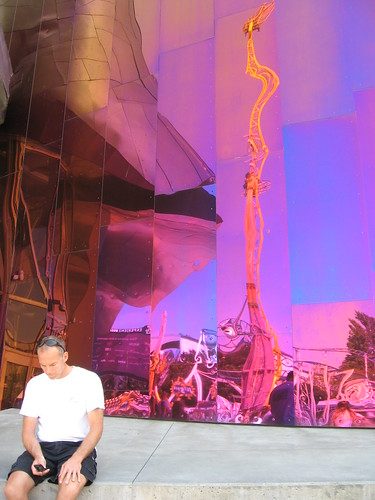
For its part, industrialization has had a mixed effect. The 1962 Seattle World’s Fair’s ‘Hall of Science’ is as beautiful as the Eiffel Tower. It is in its own right quite a contrast to Frank Gehry’s ‘Experience Music Project.’ The 1964 New York World’s Fair was the ‘great cathedral’ of modern progress. In fact, it featured a ‘Carousel of Progress’ which had its own hymn: “Great Big Beautiful Tomorrow.” Men were headed to the moon. Technology was indeed going to end want and darkness.

But this new world, secured by ‘mutually assured destruction,’ created questions of its own. Technology created pollution. The promise faded into disillusionment and forced upon us a new conundrum. We had discarded ‘antiquated’ notions such as EX NIHILO creation – science was still our new god – but now science informed us that technology was a source of evil. Thus the Twentieth Century inherited a new Cosmology and has found it wanting!

The problem is that we have discarded the Wisdom of Centuries, even as we lean unapologetically on ‘modern’ science to inform us. We seek naturalistic answers or philosophical ones. We shun the truly transcendent ones. Indeed, Paris in the Twentieth Century looks at our present time and asks the hard questions.

EMP

Counting on Katherine
How the Brilliant Mathematician Saved Apollo 13

IMG_4662
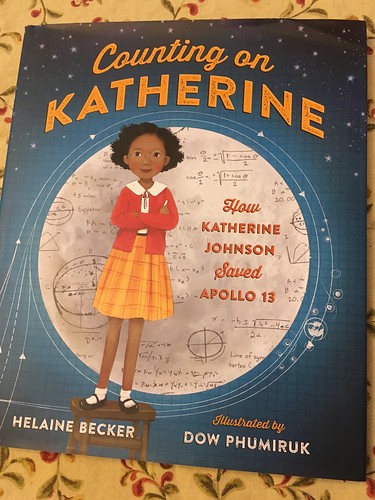
Helaine Becker's children's book tells more of the Katherine Johnson story. 

The Woman with the ‘Right Stuff’
[click to read]

Katherine Johnson Plotted the Way
By Steven J. Niven

Get the girl to check the numbers.” These words came from astronaut John Glenn in February 1962 as he prepared to become the first American to orbit the Earth. The trajectory of his orbit had been calculated by NASA’s new state-of-the-art computers, but Glenn did not trust the machines. Mercury 7 astronauts had always relied on “computers in skirts,” women who were mathematicians at NASA’s Langley Research Center in Hampton, Va., for such flight data. So before he made his historic voyage into space, Glenn called on Katherine Johnson to recheck the computer’s analysis, knowing that she had provided similar calculations for Alan Shepard, the first American in space. Johnson, one of the few African-American women then working for NASA, calculated and confirmed the data for Glenn’s orbit. The launch went ahead and Glenn became the first American to orbit the Earth, 10 months after the Soviet Union’s Yuri Gagarin was the first human being to make that journey. Johnson’s role was little recognized at the time, but she would go on to play a significant—though, again, largely hidden—role in the first moon landing and in U.S. space exploration in the 1970s and 1980s. She did so by doing what she had always loved: math. (read more)

Truth Behind Moon Landings
Debunking the Conspiracy Theorists


Simple explanations for the most common conspiracy explanations.

Icy Fence in Virginia
Photo by Karen Brookshire

IMG_4730
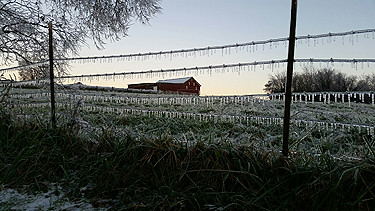
Ice on barbed wire after the November 15th ice storm in Virginia.

Philippians 4:19
Photo by Bob Kirchman

IMG_4705

But my God shall supply all your need according to his riches in glory by Christ Jesus.” – Philippians 4:19

PontifusBANNER