Volume XVIII, Issue II: February, 2020
New Life for Old Spaces
Remaking our (Private) Public Spaces
Where there is no vision, the people decay: but he that keepeth the law is blessed.” – Proverbs 29:18 (GNV)
Vision, it is an important thing. Most of the great advances we enjoy today began with a dream. The dream became an idea. The idea was presented in a picture. That is how we begin to change our world. As a new decade begins it seems quite appropriate to present some such visions. Are they practical? That is a question for us to ponder. Surely the owners of the properties mentioned below would need to ‘catch the vision’ if they are to ever come to fruition. Patience is necessary. I’m not a big proponent of eminent domain unless it is necessary to complete continuous infrastructure projects and even then, it should be exercised with a great deal of respect for individual rights. Still, a vision must begin somewhere, and so I offer these concepts, hopeful that they might lead us in the future.
Staunton Mall Renaissance
A New Vision for an Older Mall
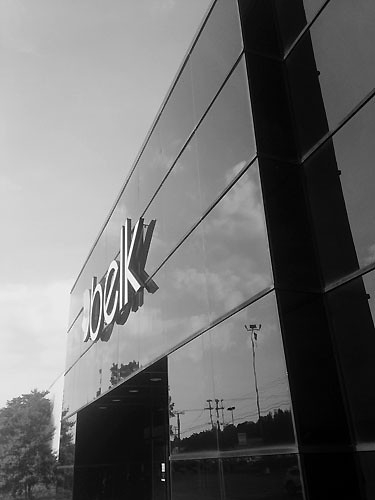
Strong anchor stores position the mall for future vitality...
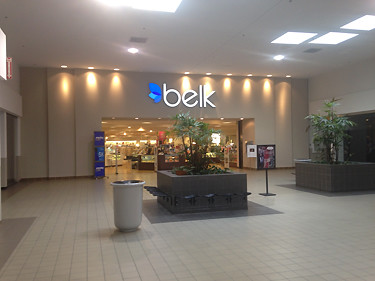
...as the central mall becomes a place for concerts, tea dances...
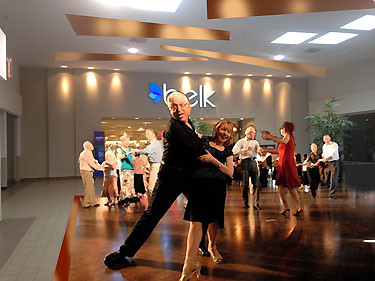
...and a lively expression of Staunton's community life!
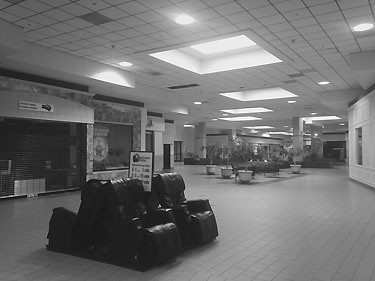
The large open spaces...
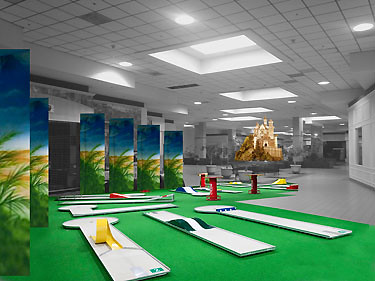
...now invite a variety of recreational options in all seasons.
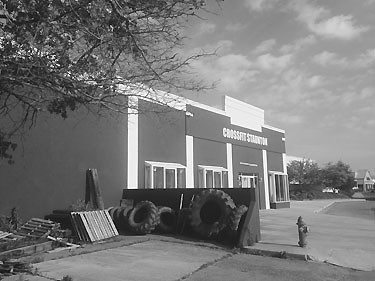
Existing spaces can become more inviting...
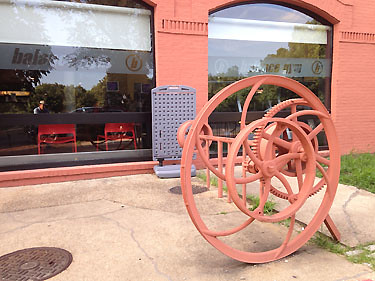
...through invigorating design.

Exterior walls enlivened by...

...a proposed Legacy Theater Mural. Bob Kirchman.

The interior spaces might be re-purposed to house medical/professional offices...

...as well as new housing for seniors.

The attractiveness of the space is increased...
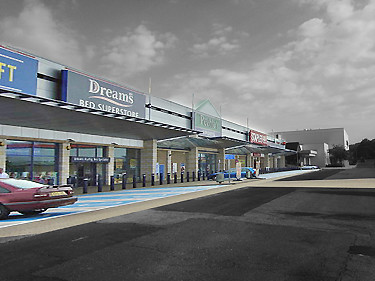
...by a phased opening out of the retail units to meet today's demands.
Concept Renderings by Bob Kirchman.
Malls are Evolving
[click to read]
Today’s shoppers are looking for more than just what’s just available on a website. They want an experience. Malls have always been a destination, but the concept of a ‘mallrat’ no longer exists. The days of meeting friends at the mall and shopping all day are gone. Malls are still considered a destination, but it’s because they now offer amenities, experiences and entertainment to enhance the shopping experience. They are now not only anchored by department stores but with popular restaurants, bars, salons, cinemas, and fitness centers. (read more)
Retail Resurrection
[click to read]
Even as retail tastes and habits evolve, the closure of a mall is rarely something to celebrate for the surrounding community; it means the loss of hundreds (sometimes thousands) of local jobs and the unsightly deterioration of a sprawling, abandoned building in the middle of town. Some cities are getting creative with how they repurpose these giant structures, bringing new life into their surrounding areas. Some malls have been transformed into churches, some have become tech company headquarters, and one has even been given new life as an award-winning library. (read more)

The plan of the Staunton Mall offers many possibilities.
Rockfish Gap Tyrolean Village
A World-Class Entrance to Shenandoah National Park,
The Blue Ridge Parkway, Waynesboro and the Valley

Today...
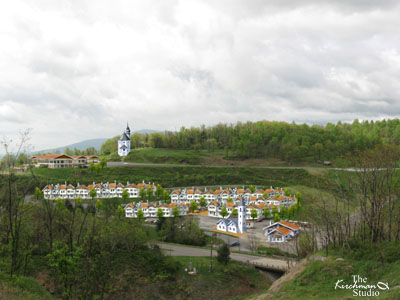
...tomorrow!
In earlier times it was the site of a busy Howard Johnsons and a Holiday Inn. Exit 99 on Interstate 64 was actually the preferred exit for Wintergreen before the road up the mountain was upgraded. Indeed one would have predicted a bright future for businesses located at the Southern entrance to Shenandoah National Park, the Northern terminus of the Blue Ridge Parkway and the gateway to the beautiful Valley of Virginia. Today the area has fallen into ruin. Even the Afton Convenience Store is closed and the Visitors' Center went away to a modular trailer. With the 85th anniversary of the Skyline drive approaching in 2021, it is time to think about revitalizing this important place.
So imagine the fog lifting one morning to reveal a new 'Village at Afton.' A bit of Tyrolean culture in Rockfish Gap. It is not so out of the question.
The Village Economy

Bright Cafes, Cobblestones, Fine Accommodations and Shopping!
The model for this is the Village at Stratton Mountain [click to view] in Vermont, although the Village at Afton would be on a smaller scale. Guests would be able to stay in rooms and suites above the retail spaces.
The residential units above the retail space could also be for year-round living. You'd have the views like you were living in Wintergreen but you'd be living in a village. Also you would have an easy drive to Charlottesville, Waynesboro or Staunton.
So What Do You Do with the Water Tower Again?

The water tower encased in a baroque chapel.
I love those villages in Europe where the church spire is the identifying landmark. It is also the tallest building in the village. Why not disguise the rusty water tower as such a church and use the spire as a cellular tower?
New Travel Center/Market/Camp Store

A new travel center.
Where the Afton Mountain Convenience Store sits now a new travel center should be constructed. The center should reflect the Tyrolean theme of the village and would be similar to the Market type stores in Charlottesville. There should be an expanded camp store and a Subway type sandwich shop for quick meals. This would be the only franchise food in the village and would be primarily aimed toward the through traveler.
Renovated Inn at Afton

Renovations to the Inn at Afton.
Once one of Holiday Inn's choicest properties, the Inn at Afton could be renovated to provide clean economical accomodations and the excess capacity allows for housing seasonal staff for the village. Many resorts recruit college students to expand their Summer staff and the village should consider such a program.
Appalachian Trail hikers could also be accommodated in an economy section. The skating rink might be rebuilt if it proves feasible.
New Visitors' Center

Today...

...Tomorrow!
The Visitors' Center should be located close to the highway and be an easily recognizable feature of the village. The Campanile is designed to attract the arriving visitor. Think of Luray Caverns before the bypass and you'll likely remember the bell tower.
The mission of the Visitors' Center would simply be an expanded version of the services they now offer. Displays could be included to give visitors a taste of destinations such as the Frontier Culture Museum and the American Shakespeare Center.
The 'City of Tomorrow' in 1939
Envisioning the future can be dangerous. In a world mired in the drabness of the Depression, city planners created Greenbelt, Maryland. The open spaces and cleanliness are a wonderful contrast to the often polluted and overcrowded world of the present, but it is worth noting that some of the ‘industrial’ solutions presented in the movie have created problems of their own.

Bicycles in the 1939 movie 'The City' speed through Greenbelt, Maryland.
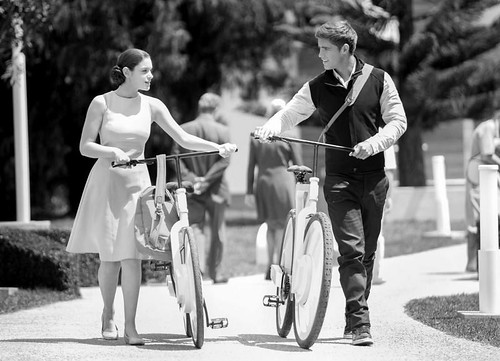
Fiona and Jonas with bicycles in the screen adaptation of 'The Giver.'
Democracity, Greenbelt, ‘The Community.’ All citizens needed to do, according to the planners, was “assent democratically to the centralization of planning.” It sounds real good in the midst of prolonged depression or the stagnation of the Wiemar Republic. But what is the true result of such centralization. Greenbelt kids are shown riding bicycles, painting pictures and playing at life situations such as a miniature post office. In actuality education itself was being ‘centralized.’ The Baby Boom had resulted in overcrowded classrooms (my first grade class was over fifty). Creative Wonder had to be sacrificed as we sat in orderly rows and learning itself became ‘industrialized.’
So what is the answer? I suspect it has less to do with urban design and more to do with humanity than planners would imagine. Decades later, the planners are now decrying the automobile suburbs and celebrating the grid cities they once liberated us from. Would that they would look at the wonderful ‘streetcar suburbs’ and urban open spaces that we actually enjoy – giving us a certain amount of messy freedom while organizing infrastructure and preserving openness – actually preserving ‘color!’ We like cul-de-sacs. We love our gardens. We like to choose the color of our dwelling. We like driving in open spaces.
We need to embrace the richness in our human expression of design. My children had a book in which two urban settings were presented as illustrations. One was ‘sameness,’ a very Soviet modernist city of tall bland buildings. The other – ‘uniqueness’ was – Paris! It was a very compelling argument!
C. S. Lewis on Free Will
God created things which had free will. That means creatures which can go wrong or right. Some people think they can imagine a creature which was free but had no possibility of going wrong, but I can't. If a thing is free to be good it's also free to be bad. And free will is what has made evil possible. Why, then, did God give them free will? Because free will, though it makes evil possible, is also the only thing that makes possible any love or goodness or joy worth having. A world of automata -of creatures that worked like machines- would hardly be worth creating. The happiness which God designs for His higher creatures is the happiness of being freely, voluntarily united to Him and to each other in an ecstasy of love and delight compared with which the most rapturous love between a man and a woman on this earth is mere milk and water. And for that they've got to be free.
Of course God knew what would happen if they used their freedom the wrong way: apparently, He thought it worth the risk. (...) If God thinks this state of war in the universe a price worth paying for free will -that is, for making a real world in which creatures can do real good or harm and something of real importance can happen, instead of a toy world which only moves when He pulls the strings- then we may take it it is worth paying.” ― C.S. Lewis, The Case for Christianity
The 2014 movie adaptation of Lois Lowery’s The Giver[2.] is a very instructive portrayal of what Lewis is saying. If you are not familiar with this novel, it is the story of a future world where security and freedom from want is secured by an enforced sameness. Gone are the joys of color and music. People see in black and white. Art is decorative but uninspired. Climate is regulated and people live in a community reminiscent of the ideal New Deal City, Greenbelt, Maryland.[3.] Greenbelt was Eleanor Roosevelt’s experiment in creating a ‘garden city’ to replace the hodgepodge of sometimes chaotic architecture of the time. Americans living in the Depression and Dust Bowl days were quick to embrace such a vision. Down the road from Greenbelt was the Beltsville Agricultural Research Center. Modern chemical-dependent farming and methods were being developed there.[4.]
In The Giver, emotion is carefully suppressed with drugs and ‘precision of language’ is used to eliminate Love, Anger and any sort of emotion.
But as the film unfolds, the elimination of pain and struggle has come at a cost. Elimination of Love also comes with the elimination of Faith and Hope. Mankind is deprived of those three qualities that Scripture says are the three things that last! Though the book and the film adaptation are classified as ‘young adult’ dystopian fiction the film adaptation is worth note on a higher level. I do not think Lowery set out to write a book about deep truth (she herself says that it is simply an idea that came to her visiting her father in a nursing home – that memories are important) but that makes it all the more intriguing as it explores the value of life and the question of what gives life value. The movie ending is less confusing than that of the original novel in that it suggests that Lewis’s thoughts on what is really important are worth the risk and suggests a remedy. It is a thoughtful message for all.
Ravi Zacharias [click to read] explores the subject further.
Zach Dawes Explores Love, Human Choice and C. S. Lewis [click to read]
The references to free will in Lewis’s books are one of the most prominent features the reader encounters. Indeed, even a cursory reading of a number of his works would reveal his belief in God’s gift to humanity of a free will to choose between two equally available choices. That is, to choose between good and evil, right and wrong.” – Zach Dawes
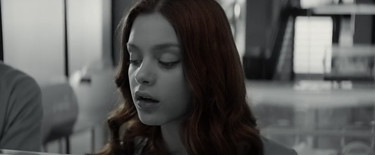
'Seeing color' in The Giver.
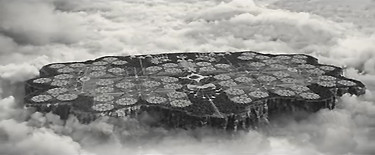
Future 'sameness.'
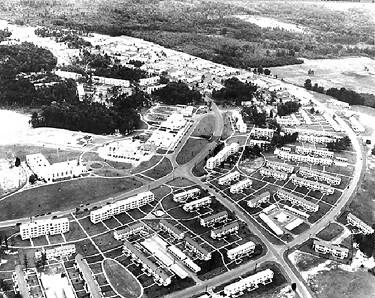
Greenbelt, Maryland.
Everyday Life in Modern Coruscant
Asian Megacities as Political Theater
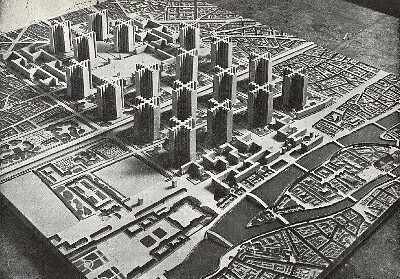
What Le Corbusier would have wrought in Paris has become the new reality of Bejing and Shanghai.
Le Corbusier once wrote of his Plan Voisin for Paris: “Since 1922 [for the past 42 years] I have continued to work, in general and in detail, on the problem of Paris. Everything has been made public. The City Council has never contacted me. It calls me ‘Barbarian’!” -- Le Corbusier’s writings, p. 207.
Fast forward to the Twenty-first Century and Shanghai [Le Corbusier on steroids]. It all seems like the realization of the fictional Coruscant from Star Wars... a completely urban environment that stretches as far as the eye can see. The entire planet of Coruscant is one continual city.
Guy Sorman discusses the rise of Asian 'Super Megagopolises' [click to read] in City Journal. Looking at the Mega-model of Shanghai, one could begin to wonder: "can Coruscant be that far off." Sorman points out, however, that Shanghai is largely a political creation...designed to create the impression that China is ready for business with the world. [5.]
Every day the city teems with life and every night the workers necessary to make it function vacate the pristine city. It is like Disney World, where the 'cast members' descend into 'Utilidor,' remove their costumes, and disappear to homes elsewhere.
For Shanghai workers, 'homes elsewhere' often means crowded and substandard. Just as China's factories are seldom seen by Westerners, those who maintain the stage for world commerce live in a vastly different world than the one they 'portray' in their 'day jobs.'
Or perhaps, the Death Star in Star Wars is a better analogy. Its scale is way beyond human. It is intended to convey a sense of awe. Might we be looking at the work of some latter day Nimrod, seeking to elevate himself to the heavens?
Sorman points out how the mad rush into the 21st Century has obliterated the traditional spaces of Shanghai and Beijing, which were much more human in size and scate. Again Star Wars comes to mind. Green beautiful planets like Naboo and Alderon risk elimination as the Empire expands its grasp.
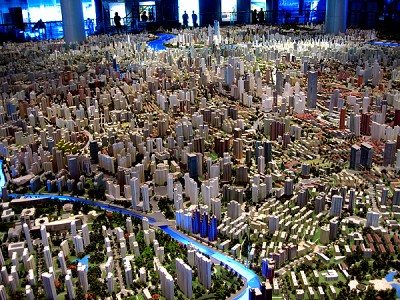
This scale model of Shanghai dwarfs the people in the room...
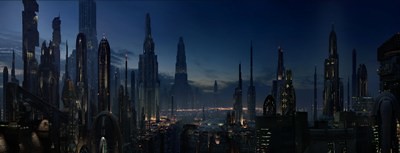
...and calls to mind the fictional city of Coruscant.
In the 'Sixties America sought to 'remake' her major cities. Le Corbusier style housing blocks were constructed to elevate the urban poor. Many of these 'projects' have since been torn down. While we were building them Moscow was building similar blocks of apartments. Today in Moscow, urban youths flock to the rooftops. [6.] Called 'Roofers,' these young people seek the rooftops simply for the openness and the view.
How to Return to the Village
Returning Government to the People in the 'Audience'
Nineteenth Century America was a nation of villages. Great centers of commerce existed, but they were fed by a vibrant countryside. When Thomas Jefferson created his ideal 'Academic Village' to house the University of Virginia he purposefully left one side open to the surrounding agricultural land. From the steps of the Rotunda one could look upon the rolling hills of Albemarle County.
Architect Stanford White convinced the University to fill the void with Old Cabell Hall a long time ago. The recently completed South Lawn attempts to recreate a space leading off into the trees of Charlottesville. The challenge of getting back to the garden is ever before us. Rooftop Gardens [click to read] offer one method of getting people and open spaces together. Reclaiming existing environments is another. Aging strip malls could be recycled into village centers for the surrounding suburban homes, offering a place residents could walk or bicycle to. Vacant lots and neglected riverfronts can become parks and gardens.
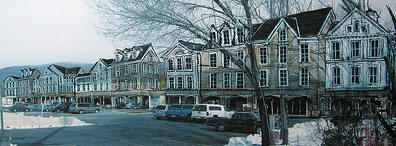
Proposed Renewal of the Crozet Shopping Center.
Drawing created by the Kirchman Studio.
Suburb bashing has always been a fashionable intellectual pastime.That is one reason I like Robert A. M. Stern. He sees the reasons people seek out single family dwellings of a traditional form. I have a friend who lives on the upper West side and his penthouse with a view of the Hudson is very nice but give me my gardens.People put up with the wretched infrastructure overload and strip centers because the village is still appealing. The residential areas become landscaped oasis for their residents. Kids play outside the house in view of the kitchen window. People visit at the back fence. Moreover the suburbs are seen by their dwellers as affirming opportunity and safety. If people had no emotion for their homes they would be fine with Le Courbusier type high rises but that is simply not the case.The problem is really one of infrastructure and public space [or lack therof]. Strip malls and box stores create a sterile wasteland but they may become the village centers of the future.
Time magazine once featured a piece called 'Repurposing Suburbs' which shows some fine examples of recreating this type of public space. This Crozet project turns a tired strip mall into a village center. One cannot wait for Crozet's redesigner to get his creative hands on some of the new "Town Center" projects which are now just collections of big box stores. Some time ago I drew a concept where the CSX tracks between Staunton and Charlottesville became a light rail line connecting Staunton, Fishersville, Waynesboro, Crozet, Ivy, The University of Virginia Medical Center and Downtown Charlottesville. The result would be a series of village centers and a better utilization of existing infrastructure.
City Journal's writers draw conflicting conclusions. Houston is touted as encouraging its middle class while Gotham offers limited options. Dense urban areas do tend to create energy efficiency. The trick is to see opportunities to improve the communities we have already created.That would certainly involve offering condominiums and a pedestrian friendly center to suburban communities and reclaiming all those wonderful old low density neighborhoods of our cities.
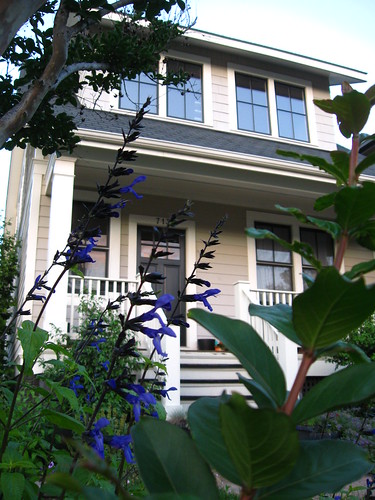
Front Yard garden, Arlington, Virginia. Photo by Bob Kirchman.

Front Porch, Arlington, Virginia. Photo by Bob Kirchman.
For I know the plans I have for you, declares the Lord, plans for welfare and not for evil, to give you a future and a hope.” – Jeremiah 29:11
Blind to the Prosperity Around Us
[click to read]
By Alyssa Ahlgren
My generation is being indoctrinated by a mainstream narrative to actually believe we have never seen prosperity. (read more)
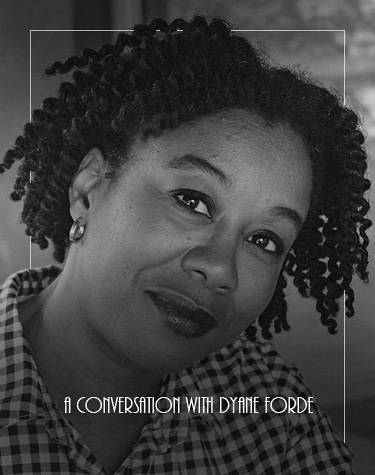
Volume XVIII, Issue Ia:
The Creative Mind Behind Lost Pen Magazine
Interview [click to listen]
Nurture and Young Imagination
By Bob Kirchman
Published in Lost Pen Magazine [click to read]
Here is Dyane Forde’s Lost Pen Magazine. I am very pleased to be a part of it! (Link will be active on February 3rd).
Issue I [click to read]
Issue II [click to read]
Welcome to my new venture and the realization of a dream: the creation of the Lost Pen Magazine, a free, digital Christian literary and arts magazine!
For a long time, I struggled to find a place for my writing which often straddled genre and literary fiction. As book clubs and magazines began popping up for Christian romance, speculative fiction, and fantasy it seemed there wasn’t much out there for writers and readers of short fiction and poetry that dealt with Christian themes in a thoughtful, reflective manner that didn’t involve aliens, zombies, or two starry-eyed lovers trying to find their way to each other against all odds. Also, digital magazines are easy to distribute, which appealed to my desire to feature and share top-quality writing pieces and visual art.
So, I decided to create my own digital magazine to provide a platform for the ‘lost voices’ of Christian literary fiction writers and artists. I hope you’ll join this journey with me and support me as I put this project together. – Dyane Forde
Greater Montreal, June 3, 2019—The Christian Creative Nexus (CCN), an online support and promotional resource for Christian creatives, and Focus Writing Services (FWS), a freelance writing and editing service dedicated to enabling writers, businesses, and organizations to produce exceptional written content, are publishing their first digital Christian arts and fiction magazine, Lost Pen Magazine. The publication will be free and available on Issuu and Mailchimp (PDF version).
The CCN and FWS hold that God expects His people to excel at producing good work, as what His people create is a reflection of Him. Lost Pen Magazine originated from the need to take supporting and promoting Christian Creatives to a higher level than what was possible via a website, and a desire to produce a wide-reaching publication with a reputation for excellence—evidence that Christians are highly creative and capable of producing top-notch, quality written and visual work. Ultimately, Lost Pen Magazine hopes to build up and motivate local and global Christian creative communities while reaching non-believers for Christ.
For more information about Lost Pen Magazine, the Christian Creative Nexus, or Focus Writing Services, please contact founder and editor Dyane Forde at fwritingservices@gmail.com.
The Cottingley Fairies and Credentialism
Two girls' attempt to explain getting wet became a major story.
We live in an era where ‘experts’ are constantly invoked as having the definitive word on any given subject. Obviously training and experience count for something when it comes to understanding, but what if the ‘expert’ is motivated more by prejudice than observation? The whole phenomenon of ‘fake news’ implies just that – that the trained journalist is not reporting objective findings and spinning the story to fit their beliefs.
In 1917 a pair of English cousins, Elsie Wright and Frances Griffiths, 16 and 9 years old, respectively, created a series of photographs that created quite a stir and became an example of credentialism. Frances and her mother came to live at the Wright’s home from South Africa. Frances’s father was off fighting in the great war. It was Summer and the draw of the nearby woods through which flowed Cottingley Beck led the girls to spend their days playing there. Though sternly admonished to stay out of the water, the two young adventurers would often return sodden and soiled from their sorties. Upon one scolding for returning home sopping wet, the girls said that they had gone to the beck to ‘see the fairies.’
When that excuse only got them in more trouble, Elsie borrowed her father’s Midg quarterplate camera and the two girls went again to the creek. Arthur Wright, Elsie’s father, was a skilled amateur photographer. He had his own state of the art darkroom and the girls begged him to develop the plate they had taken. In the photo Frances is gazing off to the right of the photographer as a group of winged fairy figures dance in front of her. Arthur was suspicious. Elsie was already quite an artist (later she would work for a greeting card company) and she knew quite a bit about photography. Arthur Wright was sure Elsie had set up some paper cut-outs that she had painted and that was the end of it…
Until Elsie’s mother Polly, who was interested in the Theosophical movement, attended a lecture at the Theosophical Society in Bradford on ‘fairy life.’ She showed the photos to one of the society’s leading members, Edward Gardner. Photographic expert Harold Snelling examined the photographs and said they were authentic. He published the images in a spiritualist magazine where they caught the attention of none other that Sir Arthur Conan-Doyle (yes, the creator of master sleuth Sherlock Holmes)! Conan-Doyle published the images in an article for The Strand Magazine. It was an article that he wrote about fairies.
Doyle, like so many in the frightening days of World War I, was searching for a different world. His own son had died in the war. It seems that many in that time were looking for a supernatural experience they could ‘reach out and touch.’ He participated in séances in an attempt to communicate with his dead son, ignoring the Biblical wisdom that such things are not to be meddled with. In the end, many fairy ‘believers,’ Doyle included, would miss glaring clues as to the photographic trickery. Ultimately, two girls’ attempt to explain falling in the creek would become, in the hands of ‘experts,’ one of the greatest hoaxes of the past Century.
Charles and Ray Eames
The Way of the Amateur
Merriam Webster says “The earliest sense of amateur ("one that has a marked fondness, liking, or taste") is strongly connected to its roots: the word came into English from the French amateur, which in turn comes from the Latin word for “lover” (amator).” Thus the earliest meaning of the word is simply doing something “for the love of it.” Charles and Ray Eames exemplify that way of living.

Charles and Ray Eames designing the IBM Pavilion for the 1964 New York World's Fair.
Ideas Not Character
[click to read]
By Lela Markham

Francis Collins MD was raised in Augusta County, Virginia. He was homeschooled for a time by his independently thinking parents before attending Robert E. Lee High School in Staunton.
What is it with today’s society that we believe it’s okay, even required, to attack the character of someone who we disagree with? Just judging from Twitter, but I encounter it on Facebook too, it appears to be an acceptable rhetorical maneuver to discredit specific arguments by effectively shutting down dialogue on important but controversial subjects by declaring the speaker to be evil, insane or stupid. The observed scenario goes something like this. Someone makes a valid point on a topic that we should be discussing because it matters in our society. Someone else will then start screeching that the writer or speaker made a questionable remark, sometimes taken out of context and sometimes spoken decades ago. Or they supported someone the critic finds distasteful. Or perhaps they suggested we pause until the full facts are known about something before condemning someone. Maybe all they did was engage in a casual conversation with someone the critic disapproves. Occasionally, the critic is dealing in “fake news”, creating scenarios that didn’t actually happen or didn’t happen in the way the critic claims they did. (read more)

Mural Proposal by the Kirchman Studio. The design features images of Katherine Johnson and Francis Collins. #StauntonMural
This is a proposal I worked up for a competition for a tourism mural in downtown Staunton. Although it was not selected for this location, I would love to find a home for this work honoring Francis Collins and Katherine Johnson. My wife, Pam, came up with a better name for this project than I had – “Virginia is for Science Lovers.”
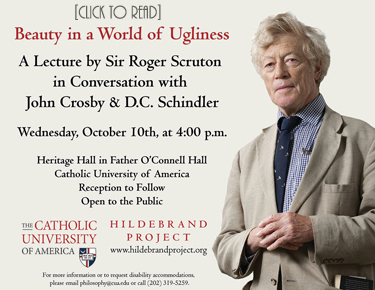
Lights Lost: Tolkien, Scruton
[click to read]
This past month the world lost two great men, Christopher Tolkien and Roger Scruton. Christopher Tolkien gave us more of his father’s famous worlds of imagination as he prepared so much J.R.R. Tolkien material for publication. Scruton gave us strong arguments for the concept of objective beauty and cultural treasures in art, architecture and philosophy. Together they can be said to have given the world new insight into Truth, Beauty and Wonder. We are the poorer for their passing. (read more)

Lothlórien Staircase, a tribute to Christopher Tolkien. Bob Kirchman.
The Silencing of Christian America
[click to read]
Christianity has been unfairly targeted by the progressive culture. Fortunately, more and more non-religious groups are coming to the defense of religious liberty. Dr. James Dobson sits down with popular conservative author and speaker, David Horowitz. The two discuss the origins of the hostility towards religion, while David explains his decision to walk away from a liberal mindset. (read more)
Pre-Born Lives Matter
[click to read]
Dr. William Lile
On January 22, 47 years ago, the U.S. Supreme Court legalized abortion through the infamous Roe v. Wade decision. This broadcast features Dr. Dobson's conversation with pro-life OB/GYN, Dr. William Lile. Dr. Lile makes strong arguments for the precious life inside a mother's womb and highlights the egregious effects abortion has on our culture. (read more)
[click to read]
It was an unseasonably cold morning in Richmond,Virginia as thousands came together to protest the Governor’s proposed legislation limiting Amendment II protected rights. As the legislature was turned over to the Democrats in the last election a number of troubling attacks on the rights of Life, Liberty and the Pursuit of Happiness have appeared in proposed bills in the legislature. Friends of mine outside the state have asked “what happened in Virginia?” It is a good question and one I shall briefly attempt to answer. (read more)
Four Pillars: Educating for America
[click to read]

Larry Arn in Imprimus
This Fall at Hillsdale College, we did something strange, stranger than if we had found a unicorn and built a zoo to show it off. We celebrated, with a whole heart, the founding of our College 175 years ago. Yes, most of our founders were white. Yes, most of them were male. All of them are now dead. What can we be thinking, to celebrate people like that in this day and age? There are two reasons, one particular and one general. (read more)
“Leaf by Laney”
The Nine Fruits of the Spirit
But the fruit of the Spirit is love, joy, peace, longsuffering, gentleness, goodness, faith, Meekness, temperance: against such there is no law.” – Galatians 5:22,23
For a mural in the community center in Staunton’s Farrier Court Apartments, Kristina Elaine Greer painted this heart-shaped tree and then invited children in the “Terrific Tuesdays” program to paint the ‘fruits’ on the leaves of the tree.


“Leaf by Niggle”
Proposal for a Bridge Mural
Before him stood the Tree, his Tree, finished. If you could say that of a Tree that was alive, its leaves opening, its branches growing and bending in the wind that Niggle had so often felt or guessed, and had so often failed to catch. He gazed at the Tree, and slowly he lifted his arms and opened them wide. "It's a gift!" he said. He was referring to his art, and also to the result; but he was using the word quite literally. He went on looking at the Tree. All the leaves he had ever laboured at were there, as he had imagined them rather than as he had made them; and there were others that had only budded in his mind, and many that might have budded, if only. he had had time. Nothing was written on them, they were just exquisite leaves, yet they were dated as clear as a calendar. Some of the most beautiful-and the most characteristic, the most perfect examples of the Niggle style-were seen to have been produced in collaboration with Mr. Parish: there was no other way of putting it.
The birds were building in the Tree. Astonishing birds: how they sang! They were mating, hatching, growing wings, and flying away singing into the Forest, even while he looked at them. For now he saw that the Forest was there too, opening out on either side, and marching away into the distance. The Mountains were glimmering far away. After a time Niggle turned towards the Forest. Not because he was tired of the Tree, but he seemed to have got it all clear in his mind now, and was aware of it, and of its growth, even when he was not looking at it. As he walked away, he discovered an odd thing: the Forest, of course, was a distant Forest, yet he could approach it, even enter it, without its losing that particular charm. He had never before been able to walk into the distance without turning it into mere surroundings. It really added a considerable attraction to walking in the country, because, as you walked, new distances opened out; so that you now had doubled, treble, and quadruple distances, doubly, trebly, and quadruply enchanting. You could go on and on, and have a whole country in a garden, or in a picture (if you preferred to call it that). You could go on and on, but not perhaps for ever. There were the Mountains in the background. They did get nearer, very slowly. They did not seem to belong to the picture, or only as a link to something else, a glimpse through the trees of something different, a further stage: another picture.” – Leaf by Niggle, J. R. R. Tolkien
This is proposed for the 262 overpass south of the Staunton Mall. It is similar to installations on VDOT structures at Barracks Road in Charlottesville, Virginia.

The mural would pay homage to J. R. R. Tolkien's short work: “Leaf by Niggle” which is a story about the creative process.