Tuesday, April 6, 2021

The Redemptive Power of Story II, Tiger Bay

HayleyMills
Volume XX, Issue XIX: The Redemptive Power of Story II

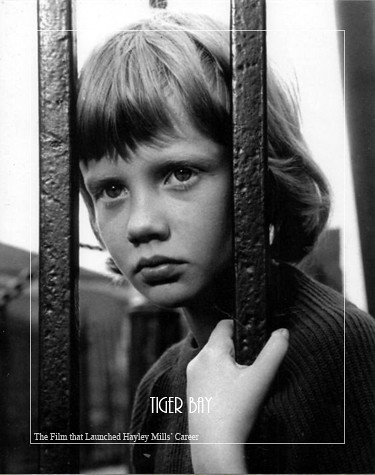
Hayley Mills in 'Tiger Bay'

When Walt Disney decided to make a film adaptation of the 1913 novel by Eleanor H. Porter, Pollyanna, he was concerned that the lead actor might be too much of a ‘Pollyanna.’ Fearing that the role would become way too saccharine, he considered it very carefully. Upon viewing the film debut of John Mills’ daughter Hayley in ‘Tiger Bay,’ Disney knew he had someone who could add a dimension of reality to the character.


Hayley Mills and her father star in this gripping film.

Tiger Bay (1959)
[click to read]

Tiger Bay, released in 1959, marked the film debut of 12-year-old Hayley Mills and few actresses have had such an extraordinarily impressive start to a film career. This is a crime thriller but it’s also a bit more than that - it’s a film about friendship and loyalty and duty and moral dilemmas. (read more)

Through the Eyes of a Child

Eleven year old Gillie lives in a world of troubles and dashed expectations. Her parents are gone and she deals with life in the care of her aunt, street bullies and the need to fend for herself. Wonderfully portrayed by Hayley Mills, Gillie is a study in the child who builds a world of lies to protect herself perhaps from the brutality of life. Mills is brilliant in her role, often saying volumes with facial expression and simply with her eyes. A lot of us fell in love with Hayley in Pollyanna. Here I came to fully appreciate her depth as an actor.

Though my childhood was in no way as bleak as Gillies,’ I remember my own response to leaving the idyllic world of home and backyard building of little paper houses with my sisters, and entering the world of endless waxed hallways – the industrial school of the mid-Twentieth Century! I did not fit in well there. Just like Gillie, I ‘created’ in my mind my means of escape. Adults would call it lying and some of them were not amused. I had one teacher who would not allow us to erase anything. I remember once making a childish mistake in the marbled copybook. In my anger and frustration I blacked out the entire page with my pencil! My dad came to the rescue with an Exacto knife and cut out that entire page so skillfully that it could not be detected. He cheered me on as I ‘recreated’ the work.

Next to the pencil, the eraser would become my favorite tool! Now you wouldn’t think that one destined to design could get in trouble with a pencil – think again! In first grade we were issued those fat pencils meant to fit our chubby hands. I unthinkingly picked up a regular #2 pencil (I had been drawing and writing with thinner pencils for some time) and the teacher saw me. She broke the pencil over my hand! I began to believe the true lie: “I was a BAD KID!”

Later, a teacher, no doubt frustrated with me, tore up a very nice drawing of a T rex that I had done. I began to hide my drawings in a box under the bed. Later, not being drawn to athletics, I became the target of school bullies. Life was a series of gauntlets to be navigated. I loved to escape by myself to the beauty of the woods. My mother had to ring a cowbell to get me home for dinner. Sometimes I didn’t hear it and returned to a plate of cold victuals. To this day I do not complain about cold food!

All this is to say that in the character of Gillie I saw a wonderful portrayal of how we as children handle the complex dilemmas that the world presents to us. We ‘create’ a narrative that helps us navigate things. Those of us who work with children would do well to study this creative mythology.

And they brought young children to him, that he should touch them: and his disciples rebuked those that brought them. But when Jesus saw it, he was much displeased, and said unto them, Suffer the little children to come unto me, and forbid them not: for of such is the kingdom of God. Verily I say unto you, Whosoever shall not receive the kingdom of God as a little child, he shall not enter therein. And he took them up in his arms, put his hands upon them, and blessed them.” – Mark 10: 13-15

proxy.duckduckgo

Teaching People to Dream

Sometime in our past Century, we ceased to see the people. We saw the poverty and despair and attempted to solve the problem institutionally. Government programs could muster so many resources and initially they could indeed create new housing and feed the multitudes. But the truth is that the same despairs followed people into their rebuilt communities. Excerpts from the Redemptive Compassion DVD present a biblical call to holistic help by Lois Tupyi.


San Donato Val di Comino
[click to read]

By Christopher F. Rufo

At six o’clock each morning, the alcoholics, addicts, and mentally ill residents of San Donato Val di Comino, Italy, emerge from their homes and congregate—sometimes together, but mostly alone—in the cafés around the town’s main square. Some of the hardened alcoholics order an espresso with a shot of liquor, then climb into work trucks and head out to farms and construction sites. The mentally ill—who suffer predominantly from depression, bipolar disorder, and schizophrenia—order cups of coffee or sit at the patio tables emptyhanded, an indication that they have run out of cash for the month. (read more)

The lesson for Americans: culture matters. If we want to reverse the destruction of human life through addiction, mental illness, homelessness, and violence, we must reimagine our moral and cultural possibilities and seek to reestablish familial and communal bonds that can prevent the most vulnerable from falling into the abyss. No doctor, pill, or public policy can replace a truly compassionate society—one that loves the mad and the addicted but restrains them from harming themselves and their neighbors.”

Panorama_di_San_Donato_Val_di_Comino
Photo by Samuele Tocci.

Further Up and Further In

By Bob Kirchman

Fiction inspired by The Chronicles of Narnia by C. S. Lewis.

NARNIA Print copy
A new painting by Kristina Elaine Greer captures the magic of a journey to Narnia!

Tearfully, she held the family photo close and remembered the happy times. Indeed, there had been joyous times with her three siblings in their small London home. Then followed the terrible sirens and explosions. Neighbors perished and gaping holes smouldered in once-quiet neighborhood's. The evacuation came next, which meant leaving Mum and Dad behind; we siblings boarded a train and headed for the safety of the countryside and extended family.

Don’t love anything too much,” she had whispered to herself back then. “It will be taken away from you.” She missed Mum and Dad terribly but held it in.

Gradually, she and her siblings found adventure in the great, countryside house— particularly, in one great, wondrous wardrobe—but a seed had been sown: people and the things you love go away. That held true many years later when, growing up way too fast, she had believed a young man loved her. But he, too, went away, taking a part of her with him.

Her teachers at school had told her that reason was a virtue and belief in unseen things was folly. She resisted at first, but, gradually, she embraced the notion that reality was composed of what could be seen. Reason was something one could get their hands around. Faith was fickle.

Is there a fine line between faith and foolishness?” she wondered.

Her thoughts went to the latest stir over the Cottingley Faeries. Two young girls had borrowed a camera and gone down to a creek where they photographed what they said were faeries. She’d seen the photographs. They looked like paper cut-outs to her. Sir Arthur Conan Doyle, creator of the master detective Sherlock Holmes, believed the faeries were real. Many other adults were fooled as well.

But what of her fantastic adventures with her siblings and that wardrobe? They could only have been the product of an elegant myth—one they had created as children to ease the stress of war.

Youth,” she mused, her thoughts turning to more contemporary events. “Joys are fleeting. Only life’s sorrows last.”

Indeed, what people in London simply referred to as “the wreck” had come as a shock. A signal malfunction had set two British Rail trains on the same track, destined for a horrible head-on collision. Coaches crumpled into one another, and many were killed. Susan had lost not only her parents in that wreck but all of her siblings as well.

The accident had left her quite alone. She caressed the photograph. Everything warm and wonderful in her home had been reduced to black and white. That, too, would fade with time.

A distant aunt had taken her in, but she soon went off to university. More logic and reason were taught in the lecture halls. She felt empty, but neither did she have an antidote.

She visited a church but found it dry. Yet, the new world developing around her offered different experiences, and a new myth would embrace her and bring true happiness. Myth, she would discover, was not an untrue fantasy so much as a vehicle for inexpressible concepts. She had ended up registering for Medieval Literature to fill her schedule. She had done so with an inward groan.

This stuff will be colossally boring,” she had confided to her friend Alastair.

He had readily agreed. “I’ll bet the professor is some horrid old goat who smells of tobacco and brandy!”

When the class commenced, the two freshmen were surprised. The “old goat” turned out to be a young woman who seemed not much older than they, but she must have been. She was the kind of teacher who brought her material to life. She painted book covers on the wall of her classroom and took her dog on long walks around the campus lake. Susan and Alastair met her one day, and they walked together. This became a regular thing. One day, Susan said to her professor, “It is a shame that all the great myths are just that. MYTHS! None of them are true!”

Oh, but they are, for they communicate great truths!”

How can that be?” Susan wondered. As they walked along, a bit of wind lifted some leaves, sending them spiraling in flight.

Unseen truths need a special language of their own,” the professor answered. Susan’s change of heart towards the world of the unseen was not quick, but, like many great thinkers, the change was gradual. Dying gods, heroism, and unconditional love were the stuff of things imagined. But her professor had said that if one could imagine something in this world, the possibility must necessarily exist for its fulfilment.

Her thoughts turned to lions and then the fact that, for one who was not so athletic, she was a fine archer. That puzzled her. The stories of her youth, though myth, still felt more real than the things she was chasing after in everyday life. But, were those youthful experiences, like the Cottingley Faeries Sir Doyle felt were only visible to virginal young girls, no longer possible for her?

Surely, it is too late. For me, truth must be simply that which I see before me. Reconciliation with the Divine cannot be possible.” The silence engulfed her. But, was that a growl she imagined? No, it was a voice, a kind, low voice!

The Lord is not slack concerning His promise, as some count slackness, but is longsuffering toward us, not willing that any should perish but that all should come to repentance” (2 Peter 3:9 NKJV).

She could choose the silence and loneliness. But, might there be the promise of another—hidden—path? Clearly, the truth was more complex than it seemed. Cracking it would require some hard examination.

Banner

Saturday, April 3, 2021

“He is Risen Indeed!” The Meaning of Miraculous

Easter
Volume XX, Issue VIIIa:

The Meaning of the Miraculous

For many Centuries man has acknowledged the miraculous. The Jewish community celebrates their deliverance from Egypt and the beginning of their journey to the Promised Land A dialogue set in a meals has all generations together consider the preservation of their people that could only be seen as a work of G-d. Previous generations always saw G-d, or some miraculous force as Creator. The Patriarchs saw Him as Provider and Deliverer! The relatively recent concept of Evolution (Charles Darwin in the Nineteenth Century) has created a philosophy of Naturalism that either outright rejects or quietly diminishes the Theistic explanation.

I once attended an Easter service at a large church in Richmond. The minister asserted that the Resurrection was not important! I don't remember anything else he said. I was astonished because Christ's Resurrection would seem to be a cornerstone of Christianity. Many voices today denounce Faith. They may not directly denounce it, but in the academy it is the subject of "open discourse" such as that experienced by Ryan Rotella at FAU [click to read]. Rotella was asked to leave a class. His "offense" was refusing to participate in an excercise where students were required to "stamp on Jesus." Dennis Prager [click to read] has more details. Though the school ultimately apologized to Rotella, it justified its so-called "open discourse" in doing so.

Running from the Resurrection

In fact, among many in academia today you are likely to hear some variation of the following: "There are other reasons why I consider Christianity to be an ill-chosen creed, such as the morals actually taught in the Bible, many of which are abhorrent to a compassionate and just man, or other details of its theology which run counter to observable facts." writes atheist Richard Carrier in introduction to his argument against Jesus' resurrection from the dead.

Here in his introduction, Carrier gives what I believe is his real reason for being uncomfortable with a physical resurrection. A G-d who can so control the laws of nature can ask 'unreasonable' things of us as well. A 'Compassionate and Just Man,' in Carrier's world can support abortion on demand because it is not 'abhorrent' to his viewpoint that abortion is a kind response to the needs of women with unplanned pregnancies. The beating heart of the unborn child need not be seen here as an 'observable fact.' Likewise, the 'restrictive' definition of marriage as a relationship defined by Scripture in specific terms may be viewed as archaic and discriminatory.If G-d didn't design it, He cannot write the specifications.

The elimination of Christianity as an authoritative source allows us to personalize moral decisions. In a culture that elevates self-actualization, this is virtue. It spares us the heavy lifting required to weigh moral absolutes with human frailty.

Jesus, meeting a Samaritan woman at a well, is a prime example of what I mean by this heavy lifting. Balancing compassion for the woman with his observation that she has not been a faithful wife, Jesus creates a constructive dialogue. He does not condemn her, nor does He overlook the complexity she has created in her relationships. He speaks truth and ultimately the dialogue that results sets her free. Here Absolute Love and Absolute Truth are in no way mutually exclusive. In the end her search for 'Living Water' trumps her desire to live as she pleases. [2.]

A G-d who can part the Red Sea, Create worlds and has power over death is pretty much to be respected. A G-d who changes human lives in intimate communion with his Creation is amazing.

Before Jesus appeared, the concept of Resurrection is found in Scripture. Sometimes it is very clear and other times it is a logical assumption consistent with the text.

Resurrection Foretold

And he made his grave with the wicked, and with the rich in his death; because he had done no violence, neither was any deceit in his mouth. Yet it pleased the Lord to bruise him; he hath put him to grief: when thou shalt make his soul an offering for sin, he shall see his seed, he shall prolong his days, and the pleasure of the Lord shall prosper in his hand. He shall see of the travail of his soul, and shall be satisfied: by his knowledge shall my righteous servant justify many; for he shall bear their iniquities. Therefore will I divide him a portion with the great, and he shall divide the spoil with the strong; because he hath poured out his soul unto death: and he was numbered with the transgressors; and he bare the sin of many, and made intercession for the transgressors." -- Isaiah 53:9-12

The famous Messianic text above talks of triumph after death. Other texts that may be seen as prophetic of Resurrection are: Genesis 3:15, Psalm 2:7, Psalm 16:9-11, Psalm 22:14-25, Psalm 30:29, Psalm 40:13, Psalm 110:1, Psalm 118:21-24, Hosea 5:15-6:3, Zechariah 12:10.

Resurrection Documented and Verified

I know of no one fact in the history of mankind which is proved by better, fuller evidence of every sort, to the understanding of a fair inquirer, than the great sign which God hath given us that Christ died, and rose again from the dead." says Dr. Thomas Arnold, formerly Professor of History at Rugby and Oxford Universities. Simon Greenleaf, one of the most skilled legal minds ever produced in this nation, top authority on the question of what constitutes sound evidence, developer of the Harvard Law School, after a thorough evaluation of the four Gospel accounts from the point of view of their validity as objective testimonial evidence, concluded:

It was therefore impossible that they could have persisted in affirming the truths they had narrated, had not Jesus actually risen from the dead, and had they not known this fact as certainly as they knew any other fact." [3.] Dr. Henry M. Morris PhD writes more on The Importance of the Resurrection [click to read]. His point is that the foundational truth of the Christian faith has plenty of evidence to support it.

A G-d who can part the Red Sea, Create worlds and has power over death is pretty much to be respected. A G-d who changes human lives in intimate communion with his Creation is amazing.

Butterfly_icon
A Caterpillar becomes a butterfly. Nature itself suggests the possibility of miraculous transformation and new life! Rice Paper Butterfly, or Paper Kite Butterfly, Idea leuconoe.
Illustration © 2016, by Kristina Elaine Greer for HOPE Publications, Pvt. ltd.

Leonardo da Vinci's Portable Bridge
A Message of Hope for the Youth of Our Community

Leonardo da Vinci's Bridge

Leonardo da Vinci's Bridge

Leonardo da Vinci's Bridge

Last year Augusta Christian Educators studio art classes built a model of Leonardo da Vinci’s portable fastenerless bridge. Amanda Riley and Bob Kirchman fabricated the pieces of the bridge structure which the students assembled. The piece calls to mind this poem by Will Allen Dromgoole:

The Bridge Builder
Poem by Will Allen Dromgoole


Bridges
Paintings by Savhanna Herndon

BridgeSavhanna

IMG_2823

But between them and the foot of the sky there was something so white on the green grass that even with their eagles’ eyes they could hardly look at it. They came on and saw that it was a Lamb. “Come and have breakfast,” said the Lamb in its sweet milky voice. Then they noticed for the first time that there was a fire lit on the grass and fish roasting on it. They sat down and ate the fish, hungry now for the first time for many days. And it was the most delicious food they had ever tasted. “Please, Lamb,” said Lucy, “is this the way to Aslan’s country?” “Not for you,” said the Lamb. “For you the door into Aslan’s country is from your own world.” “What!” said Edmund. “Is there a way into Aslan’s country from our world too?” “There is a way into my country from all the worlds,” said the Lamb; but as he spoke, his snowy white flushed into tawny gold and his size changed and he was Aslan himself, towering above them and scattering light from his mane. “Oh, Aslan,” said Lucy. “Will you tell us how to get into your country from our world?” “I shall be telling you all the time,” said Aslan. “But I will not tell you how long or short the way will be; only that it lies across a river. But do not fear that, for I am the great Bridge Builder. And now come; I will open the door in the sky and send you to your own land.” – C. S. Lewis, Voyage of the Dawn Treader

Page One | Page Two | Page Three
[Click to Read]

Jesus

Wednesday, March 31, 2021

Tongerlo's Treasure, Leonardo's Last Supper

Betrayal
SPECIAL EDITION: The Last Supper

Tongerlo's Treasure, Last Supper

save-image

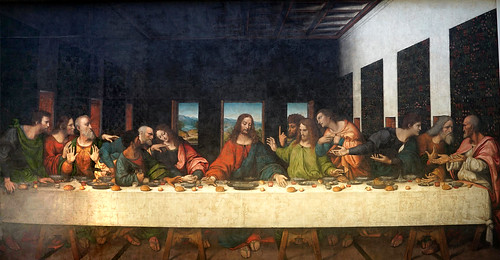
Everyone is familiar with Leonardo da Vinci’s famous painting The Last Supper which is a mural in the refectory of the Convent of Santa Maria delle Grazie in Milan, Italy. The subject of The Last Supper was actually a fairly common and oft requested subject for refectory murals. Usually the painting would celebrate the establishment of the Eucharist.

But Da Vinci was a creative genius and he often broke free from the constraints of convention. He chose to paint the moment that Jesus announces “one of you will betray me!” Leonardo’s mastery of composition and geometry creates a tension in the room you can cut with a knife. The figure of Judas is pulled into the drama by Leonardo’s chiaroscuro. The painting is amazing.

Unfortunately, the painting is mostly gone, destroyed by moisture from the kitchen behind it and desecrated with a doorway cut into it. Leonardo also departed from another convention; that of fresco, where an artist paints into wet plaster. Instead, he painted in the relatively new medium of oil. Leonardo loved oil. He developed his signature sfumato technique because oil allowed him to. Unfortunately there was little knowledge of surface adhesion. The paint eventually separated from the wall and now all that is left is a restoration of a fraction of Da Vinci’s original – or is it?

When King Louis XII of France invades Milan in the early 1500, he saw the recently completed mural on the refectory wall. He was so enamored of it that he made plans to crate the wall and carry it back to France. When that idea proved to be impractical he apparently commissioned Leonardo to create a copy and had it taken to the Chateau de Gallion. This time it was done on canvas. But it disappeared in the centuries that followed, only to be found again in Tongerlo Abbey in Belgium. An abbot had purchased it in 1645. Today it is in a small chapel on the grounds of Tongerlo Abbey.

Researchers Jean-Pierre Isabouts and Christopher Heath Brown researched the Tongerlo painting and found much evidence to suggest that this is indeed the painting that Louis XII commissioned. Though much of the work appears to have been done by Leonardo’s pupils, there are a few areas of the painting that reveal his sublime sfumato technique – notably in the face of John the Beloved Apostle.

LastSupper777
The Tongerlo Last Supper. Leonardo da Vinci and Students.

PontifusBANNER

Tuesday, March 30, 2021

The Redemptive Power of Story, Lewis and Tolkien

Moore
Volume XX, Issue XIII: The Power of Story

The Redemptive Power of Story
By Bob Kirchman

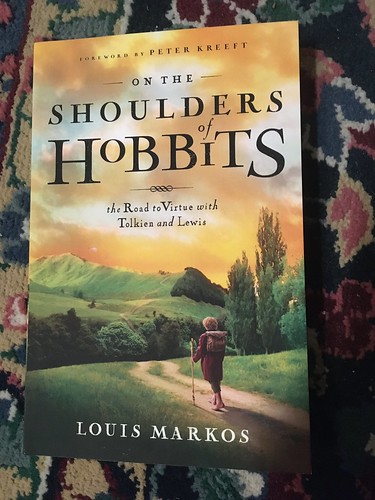
It has been very difficult, to say the least, watching so much of the America I grew up in crumble. It is easy to despair. Indeed, my default was trending towards escapism and simply forgetting the world around me – but then I remembered the message of Louis Markos in his book On the Shoulder of Hobbits. In a world that has lost its rudder, Markos presents “Stories to Steer By.” Remembering that J. R. R. Tolkien and C. S. Lewis lived through the horrors of trench warfare in World War I; the almost certain destruction of Britain by the National Socialist regime of Germany during World War II, and that Lewis and Tolkien both lamented the discarding of noble ideals by modern thinkers, Markos leads us very deliberately on the path that both authors sought to take us on back to those very values. The tales of Narnia and Middle Earth lead us to the great virtues of Courage, Love, Temperance, and Friendship – usually not included in such lists of virtues, but essential in that we understand that the Divine has created man for no less than relationship with Him!

The noble quest, the heroic journey, springs to life before us. There is in Frodo Baggins the immediate need to dispose of the evil ring of power but as Frodo meets displaced elves making their way to the Grey Havens a deeper quest is revealed – that of Abraham in Hebrews 11: 10: “For he looked for a city which hath foundations, who’s builder and maker is God.” The hobbits, Frodo Baggins and Samwise Gamgee, are swept into a mission greater than themselves. Likewise, Shasta in The Horse and His Boy senses a pull to a country he has never seen and yet is his true home. So with Reepicheep the mouse, who initially thinks no more of the heroic victory but when we meet him in The Voyage of the Dawn Treader he is a mouse on a far greater mission – to set foot in Aslan’s Country!

And so On the Shoulder of Hobbits presents a map for our journey in this life as we seek to redeem our culture, but it goes further, giving us a peek at the ultimate fulfillment of those virtues which guide us in our Heavenly Home.

IMG-5548

Redemptive Stories for Today

IMG-5553
Christina Fougnie in Clancy.

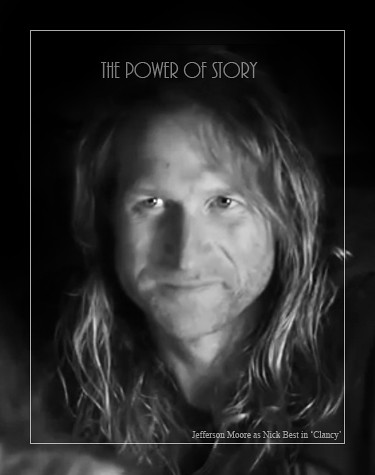
Film is often seen as the modern vehicle for story today. Many lament that the movies made by Hollywood are often dystopian threads of antihero themes. The ‘Christian’ genre is often dismissed as ‘second rate’ and prone to didacticism. Yet there are some notable storytellers in the indie Christian film world who are indeed taking the path of the redemptive journey. In Louisville Kentucky, filmmakers Jefferson Moore and Kelly Worthington have done just that with their studio, Kelly’s Filmworks [click to visit]. A recent project they collaborated on was Clancy, in which Moore stars along with Christina Fougnie in a film that is reminiscent of Haley Mills’ Tiger Bay. Both films feature an unlikely friendship, a heroic quest, and a redemptive story that rises out of the dark and present situation the characters find themselves in. Both films have quite a bit of suspense and the actors do a great job of bringing the audience into their redemptive struggle.

IMG-5554
The 'Redemptive Journey' in Clancy.

Page One | Page Two | Page Three
[Click to Read]

naturalbridgeadvert

Samuel and Nehemiah Build the Alcan Highway

Samuel
Volume XX, Issue XXIII: Samuel

Samuel and Nehemiah Build the Alcan Highway
[click to read]

Trust in the Lord and do good; so shalt thou dwell in the land, and verily thou shalt be fed.” – Psalms 37:2, 3

Samuel was a little bulldozer. He lived on a farm with his two cousins the big farm tractors. They did most of the heavy work but Samuel loved to build farm roads, silage trenches and even a round pen for the horses! His life on the farm was happy. But soon the country was at war. The men on the farm went away to fight. Samuel wanted to do his part too, but what could a little bulldozer do? Of course! He could help grow crops to feed the army. One day some men came and put him on a trailer. He was going away to help build a road the army needed to supply the far off territory of Alaska. The enemy intended to cut off ships from supplying Alaska. The army decided to build a road – the Alcan Highway. (read more)

Page One | Page Two | Page Three
[Click to Read]

PontifusBANNER 

Анна Каренина, Leo Tolstoy’s Greatest Work

Tolstoy
Volume XX, Issue XIII: Anna Karenina

Why Tolstoy’s Anna Karenina is a Masterpiece
[click to read]

By Benjamin McEvoy

Levin’s religious transformation throughout Anna Karenina was Tolstoy’s own, one that transcended him by the end of the novel – a novel, you might be interested to know, originally started as a short work after Tolstoy was witness to an adulteresses’ suicide by train trammelling and blossomed out to half-a-decade of artistic struggle. By the time Tolstoy had finished Anna Karenina, he had vowed never to write another work, thinking the form to be a transgression against God. And perhaps it might. In the hands of a Maupassant or Sterne, it might be. But in the hands of a man who set the foundation for omniscient narration in the novel? (read more)

Анна Каренина, by LeoTolstoy
[click to read]

Happy families are all alike; every unhappy family is unhappy in its own way.

Everything was in confusion in the Oblonskys’ house. The wife had discovered that the husband was carrying on an intrigue with a French girl, who had been a governess in their family, and she had announced to her husband that she could not go on living in the same house with him. This position of affairs had now lasted three days, and not only the husband and wife themselves, but all the members of their family and household, were painfully conscious of it. Every person in the house felt that there was no sense in their living together, and that the stray people brought together by chance in any inn had more in common with one another than they, the members of the family and household of the Oblonskys. The wife did not leave her own room, the husband had not been at home for three days. The children ran wild all over the house; the English governess quarreled with the housekeeper, and wrote to a friend asking her to look out for a new situation for her; the man-cook had walked off the day before just at dinner time; the kitchen-maid, and the coachman had given warning.

Three days after the quarrel, Prince Stepan Arkadyevitch Oblonsky—Stiva, as he was called in the fashionable world—woke up at his usual hour, that is, at eight o’clock in the morning, not in his wife’s bedroom, but on the leather-covered sofa in his study. He turned over his stout, well-cared-for person on the springy sofa, as though he would sink into a long sleep again; he vigorously embraced the pillow on the other side and buried his face in it; but all at once he jumped up, sat up on the sofa, and opened his eyes. “Yes, yes, how was it now?” he thought, going over his dream. “Now, how was it? To be sure! Alabin was giving a dinner at Darmstadt; no, not Darmstadt, but something American. Yes, but then, Darmstadt was in America. Yes, Alabin was giving a dinner on glass tables, and the tables sang, Il mio tesoro—not Il mio tesoro though, but something better, and there were some sort of little decanters on the table, and they were women, too,” he remembered. (read more)

The True Story of Amazing Grace


John Newton's story of redemption is riveting and well worth hearing again!

John Newton’s Dream of Redemption

The scene presented to my imagination was the harbour of Venice, where we had lately been. I thought it was night, and my watch upon the deck; and that, as I was walking to and fro by myself, a person came to me, I do not remember from whence, and brought me a ring, with an express charge to keep it carefully: assuring me, that while I preserved the ring I would be happy and successful: but if I lost or parted with it, I must expect nothing but trouble and misery.

I accepted the present and the terms willingly, not in the least doubting my own care to preserve it, and highly satisfied to have my happiness in my own keeping. I was engaged in these thoughts, when a second person came to me, and observing the ring on my finger, took occasion to ask me some questions concerning it. I readily told him all its virtues; and his answer expressed a surprise at my weakness, in expecting such effects from a ring. I think he reasoned with me for some time upon the impossibility of the thing; and at length urged me, in direct terms, to throw it away.

At first I was shocked with the proposal; but his insinuations prevailed. I began to reason and doubt myself, and at last plucked it off my finger, and dropped it over the ship’s side into the water; which it no sooner touched, than I saw, at the same instant, a terrible fire burst out from a range of mountains, a part of the Alos which appeared at some distance behind the city of Venice.

I saw the hills as distinctly as if awake, and they were all in flames. I perceived, too late, my folly; and my tempter, with an air of insult, informed me, that all the mercy of God in reserve for me was comprised in that ring, which I had wilfully thrown away. I understood that I must now go with him to the burning mountains, and that all the flames I saw were kindled on my account. I trembled, and was in great agony; so that it was surprising I did not then awake: but my dream continued; and when I thought myself upon the point of constrained departure, and stood, self-condemned, without plea or hope, suddenly, either a third person, or the same who brought the ring at first, came to me, (I am not certain which), and demanded the cause of my grief. I told him the plain case, confessing that I had ruined myself wilfully, and deserved no pity. He blamed my rashness; and asked, if I should be wiser supposing I had my ring again. I could hardly answer to this; for I thought it was gone beyond recall. I believe indeed, I had not time to answer, before I saw this unexpected friend go down under the water, just in the spot where I had dropped it; and he soon returned, bringing the ring with him. The moment he came on board, the flames in the mountain were extinguished, and my seducer left me.

Then was “the prey taken from the hand of the mighty, and the lawful captive delivered”. My fears were at an end, and with joy and gratitude I approached my kind deliverer to receive the ring again; but he refused to return it and spoke to this effect: ‘If you should be intrusted with this ring again, you would very soon bring yourself into the same distress; you are not able to keep it: but I will preserve it for you, and, whenever it is needful, will produce it in your behalf.’”

John Newton (1799 ?), The Life of the Rev. John Newton: “An Authentic Narrative” London: The Religious Tract Society, 20-21.

Glories of Your Name Are Spoken

Glories of your name are spoken, Zion, city of our God;
He whose word cannot be broken formed you for his own abode.
On the Rock of Ages founded, what can shake your sure repose?
With salvation’s walls surrounded, you may smile at all your foes.


See, the streams of living waters, springing from eternal love,
well supply your sons and daughters, and all fear of want remove.
Who can faint, while such a river ever will their thirst assuage?
Grace which, like the Lord, the giver, never fails from age to age.


Round each habitation hov’ring, see the cloud and fire appear
for a glory and a cov’ring, showing that the Lord is near.
Thus deriving from their banner light by night and shade by day,
safe they feed upon the manna which God gives them on their way.


Savior, since of Zion’s city I through grace a member am,
let the world deride or pity, I will glory in your name.
Fading are the worldlings’ pleasures, all their boasted pomp and show;
solid joys and lasting treasures none but Zion’s children know.


Text: John Newton, 1725-1807, alt. Tune: Austria, Franz Joseph Haydn

This hymn, based on ISAIAH 33 is a lesser known work of John Newton which is set to the tune of Hayden’s Austria or The German National Anthem.

Page One | Page Two | Page Three
[Click to Read]

PontifusBANNER 

Saturday, March 27, 2021

Special Palm Sunday Issue: How to Cure Conflict

THYME0515
Volume XX, Issue XIIa

How to Cure Conflict

For unto us a child is born, unto us a son is given: and the government shall be upon his shoulder: and his name shall be called Wonderful, Counsellor, The mighty G-d, The everlasting Father, The Prince of Peace." -- Isaiah 9:6

The world is a dangerous place today. As an American President faces a resolute Vladimir Putin, who is intent on reinvigorating the Soviet Empire, and Israel's Binyamin Netanyahu deals with hostilities on multiple borders, the problem of human conflict is on our minds. Indeed it seems like peace is beyond our grasp. Thousands of years of human history are filled with wars and strife.

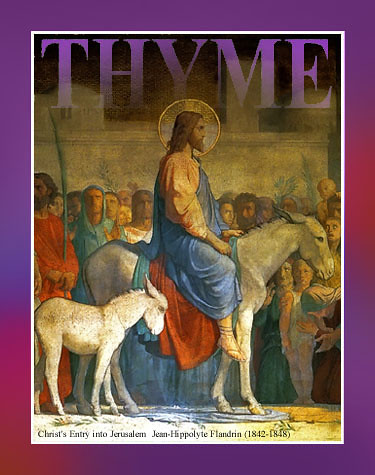
This coming Sunday Christians remember the time when the Prince of Peace [1.] (Isaiah 9:6) rode into Jerusalem on a donkey! The people lined the way spreading their cloaks and palm branches, expecting the return of the King in an earthly manifestation of the Heavenly Kingdom. [2.] Jesus, however, had greater plans in mind.

Jesus rode into town as the lambs were being brought into the homes in preparation for Passover, the remembrance of G-d's deliverance from Pharaoh centuries before. [3.] Instead of establishing an earthly kingdom, He would be tried by both religious and civil authorities. Although there was no crime committed on His part, He would be sentenced to die a most horrible death by crucifixion.

He ate the Passover meal with His disciples, one of whom betrayed Him. The Roman ruler Pilate could find no fault in Him, yet the religious leaders stirred up a mob to demand His death. He died on a cross on a hill called Golgotha, flanked by two thieves. Hardly the way to begin a movement to transform the world, but that is what history tells us.

His death conquered sin and death. [4.] "The day Jesus was crucified was the day of the Passover celebration and the day that the Passover lamb was to be sacrificed. For the previous 1,200 years, the priest would blow the shophar (ram's horn) at 3:00 p.m. - the moment the lamb was sacrificed, and all the people would pause to contemplate the sacrifice for sins on behalf of the people of Israel. At 3:00, when Jesus was being crucified, He said, "It is finished" - at the moment that the Passover lamb was sacrificed and the shophar was blown from the Temple. The sacrifice of the lamb of God was fulfilled at the hour that the symbolic animal sacrifice usually took place. At the same time, the veil of the Temple (a three-inch thick, several story high cloth that demarked the Holy of Holies) tore from top to bottom - representing a removal of the separation between G-d and man. Fifty days later, on the anniversary of the giving of the law (Pentecost), G-d left the earthly temple to inhabit those who call on the name of Jesus through His Holy Spirit." -- How the Passover Reveals Jesus Christ by Rich Deem [click to read].

But the story does not end there. In Revelation 21 Christians look to a New Heaven and a New Earth where a Heavenly Jerusalem descends to join the Earth. Here is a Kingdom that needs no temple, needs no sun to light it, for G-d Himself is the force that illuminates it! [5.]

And I saw a new Heaven and a new earth: for the first Heaven and the first earth were passed away; and there was no more sea. And I John saw the holy city, new Jerusalem, coming down from G-d out of heaven, prepared as a bride adorned for her husband. And I heard a great voice out of heaven saying, Behold, the tabernacle of G-d is with men, and he will dwell with them, and they shall be his people, and God himself shall be with them, and be their G-d." -- Revelation 21:1-3

West_web East_web
Journey to Jesus, a mural depicting the nations coming to Jesus in the New Heaven and New Earth described in Revelation 21. Mural by Kristina Elaine Greer and Bob Kirchman

Journey to Jesus [click to view larger images].

IMG_3253
The Journey is complete when you reach the kind face of Jesus!
"I judge all things only by the price they shall gain in eternity." —John Wesley

Miracles from Heaven Movie

This film is based on the true story of the Beam family. In these days the 'Supernatural' is often dismissed, even as there continue to be events that cannot be fully explained in the 'Natural.' This film recounts one such event. In the classic Miracles, [6.] C.S. Lewis, the most important Christian writer of the 20th century, argues that a Christian must not only accept but rejoice in miracles as a testimony of the unique personal involvement of G-d in his creation.


advert