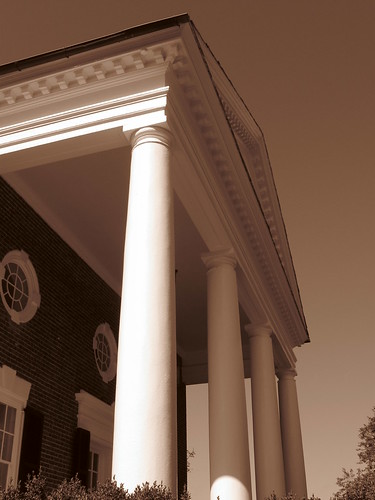
Sunday, July 28, 2019

When Young People Imagine the Future...

Imagining
Volume XVII, Issue IV

Young People Imagine the Future

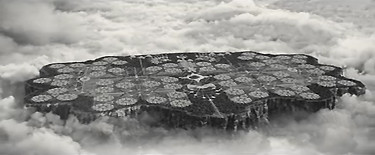
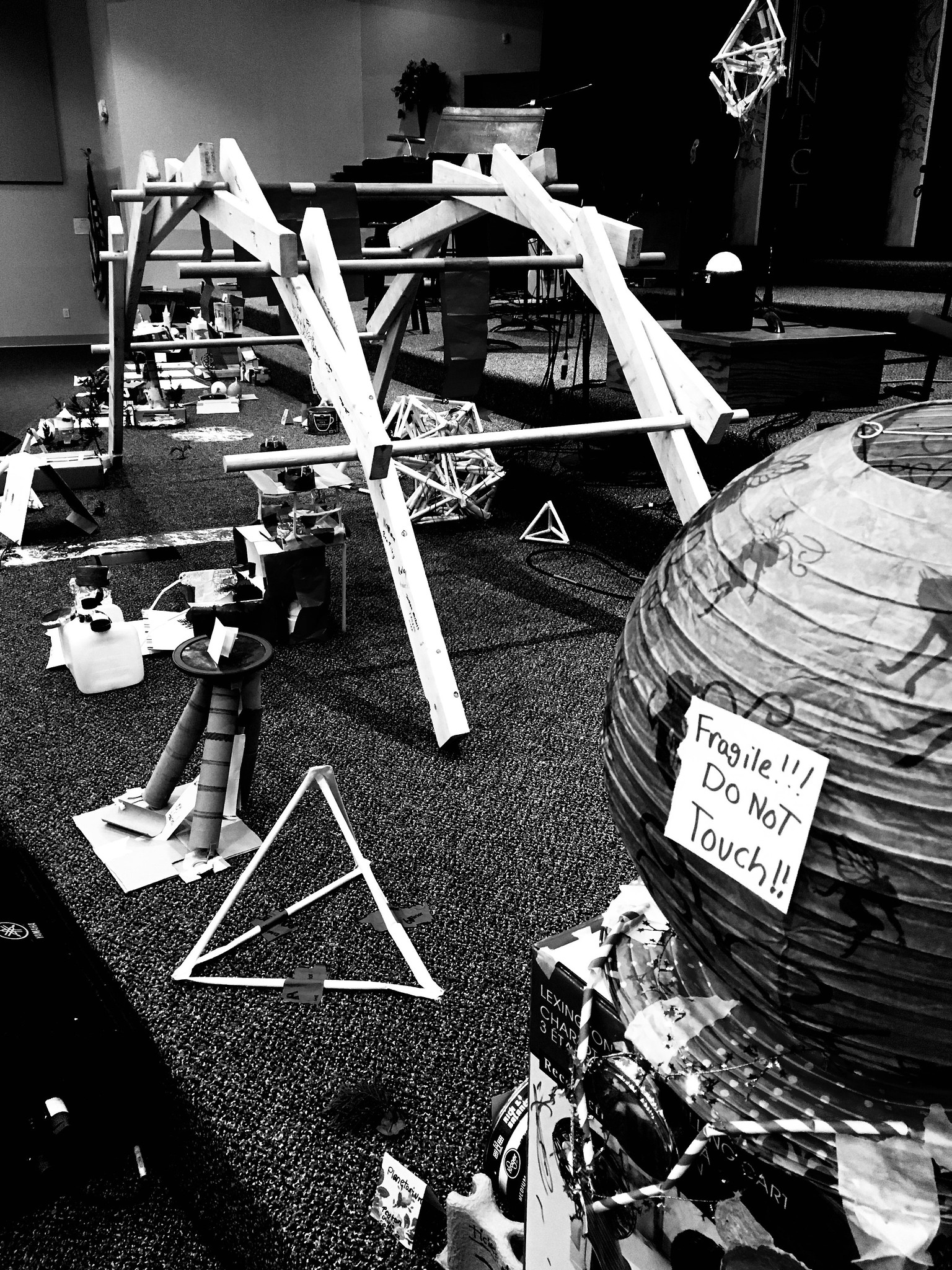
It was a week of wild creativity as students unleashed their imaginations to build the “World of Tomorrow.” We assembled Leonardo da Vinci’s Bridge, rolled paper into struts to build tetrahedrons, got mentioned by Michelle L. Mitchell [1.] in the News Virginian and most of all stretched our collective ability to imagine things we have not seen yet. We drew our ideas and then found ways to build what we imagined.
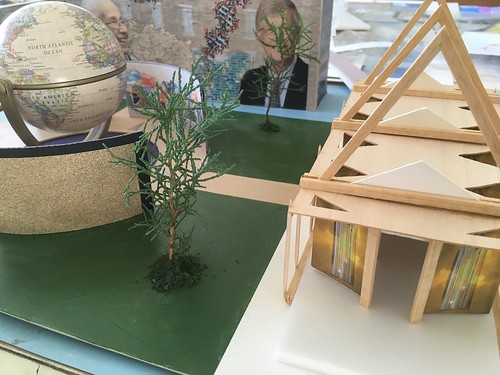
BSB Corporation Pavilion
Some 'example pavilions' that I created to help the creative juices flow...
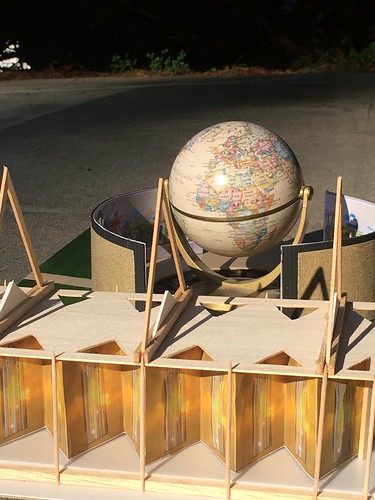
BSB Corporation Pavilion
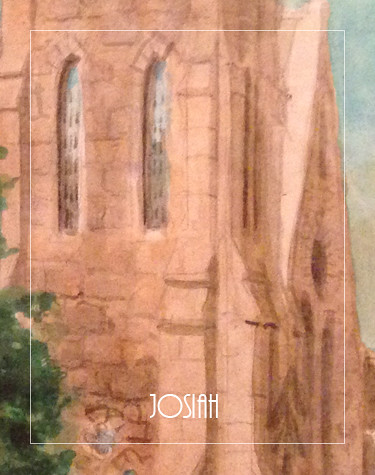
...included a Pavilion of Tyrol, complete with stained glass windows that have glass organ pipes embedded in them as designed by Xaver Wilhelmy...

BSB Corporation Pavilion
...and the Pavilion of the Bering Strait Bridge Corporation with a reproduction of a mural painted by myself and Kristina Elaine Greer of children of the world entitled Journey to Jesus.
IMG_0812

IMG_0811
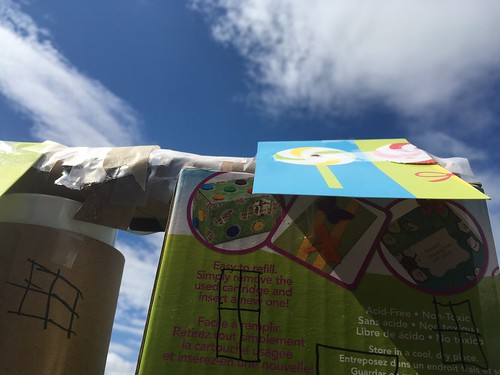
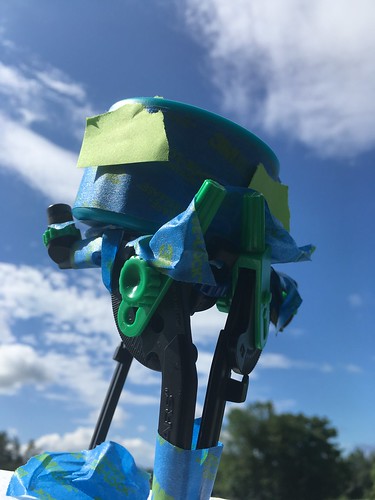
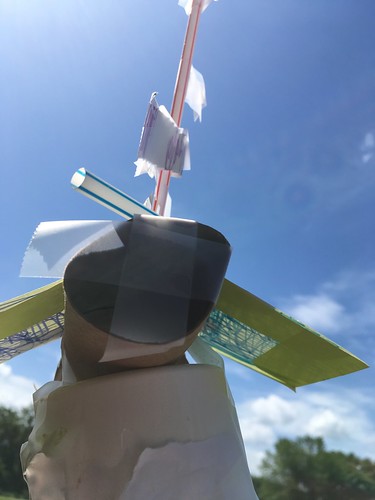
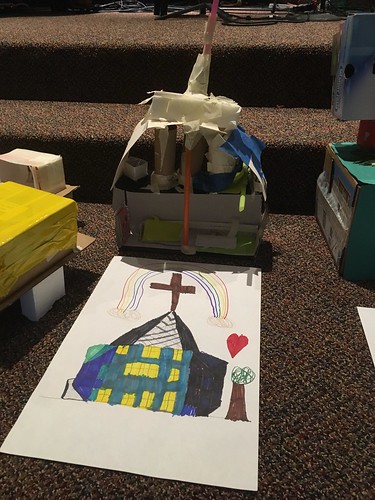
Our campers worked at architectural drawing and imagined buildings they would like to create. Then they built them!
IMG_0780

IMG_0786

IMG_0784

IMG_0782

IMG_0778

Waynesboro World's Fair

Waynesboro World's Fair

IMG_0747

IMG_0748

IMG_0746
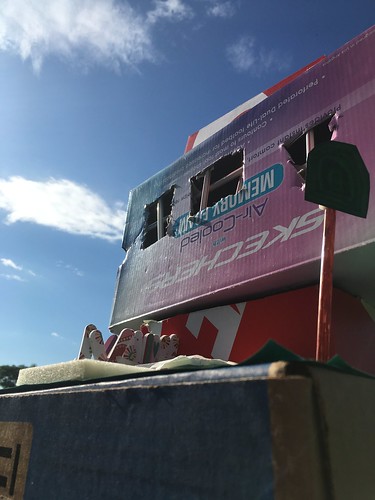
We photographed our finished pavilions against the sky to get a sense of the scale and presence they would have as actual buildings. Photos by Bob Kirchman.
Visit the Fair Via VA Highways

The 'City of Tomorrow' in 1939


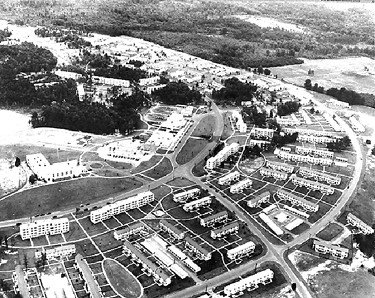
Envisioning the future can be dangerous. In a world mired in the drabness of the Depression, city planners created Greenbelt, Maryland. The open spaces and cleanliness are a wonderful contrast to the often polluted and overcrowded world of the present, but it is worth noting that some of the ‘industrial’ solutions presented in the movie have created problems of their own.

Greenbelt
Bicycles in the 1939 movie 'The City' speed through Greenbelt, Maryland.
the-giver
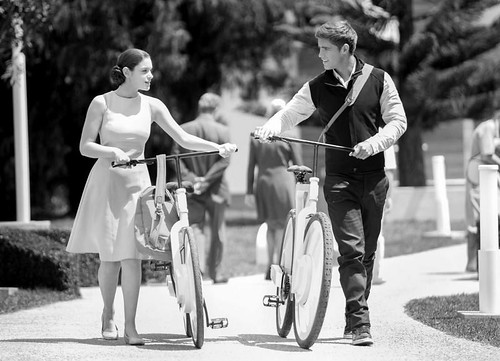
Fiona and Jonas with bicycles in the screen adaptation of 'The Giver.'

Democracity, Greenbelt, ‘The Community.’ All citizens needed to do, according to the planners, was “assent democratically to the centralization of planning.” It sounds real good in the midst of prolonged depression or the stagnation of the Wiemar Republic. But what is the true result of such centralization. Greenbelt kids are shown riding bicycles, painting pictures and playing at life situations such as a miniature post office. In actuality education itself was being ‘centralized.’ The Baby Boom had resulted in overcrowded classrooms (my first grade class was over fifty). Creative Wonder had to be sacrificed as we sat in orderly rows and learning itself became ‘industrialized.’

So what is the answer? I suspect it has less to do with urban design and more to do with humanity than planners would imagine. Decades later, the planners are now decrying the automobile suburbs and celebrating the grid cities they once liberated us from. Would that they would look at the wonderful ‘streetcar suburbs’ and urban open spaces that we actually enjoy – giving us a certain amount of messy freedom while organizing infrastructure and preserving openness – actually preserving ‘color!’ We like cul-de-sacs. We love our gardens. We like to choose the color of our dwelling. We like driving in open spaces.

We need to embrace the richness in our human expression of design. My children had a book in which two urban settings were presented as illustrations. One was ‘sameness,’ a very Soviet modernist city of tall bland buildings. The other – ‘uniqueness’ was – Paris! It was a very compelling argument!

C. S. Lewis on Free Will

God created things which had free will. That means creatures which can go wrong or right. Some people think they can imagine a creature which was free but had no possibility of going wrong, but I can't. If a thing is free to be good it's also free to be bad. And free will is what has made evil possible. Why, then, did God give them free will? Because free will, though it makes evil possible, is also the only thing that makes possible any love or goodness or joy worth having. A world of automata -of creatures that worked like machines- would hardly be worth creating. The happiness which God designs for His higher creatures is the happiness of being freely, voluntarily united to Him and to each other in an ecstasy of love and delight compared with which the most rapturous love between a man and a woman on this earth is mere milk and water. And for that they've got to be free.

Of course God knew what would happen if they used their freedom the wrong way: apparently, He thought it worth the risk. (...) If God thinks this state of war in the universe a price worth paying for free will -that is, for making a real world in which creatures can do real good or harm and something of real importance can happen, instead of a toy world which only moves when He pulls the strings- then we may take it it is worth paying.” ― C.S. Lewis, The Case for Christianity

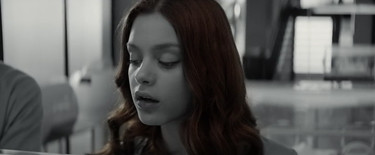
The 2014 movie adaptation of Lois Lowery’s The Giver[2.] is a very instructive portrayal of what Lewis is saying. If you are not familiar with this novel, it is the story of a future world where security and freedom from want is secured by an enforced sameness. Gone are the joys of color and music. People see in black and white. Art is decorative but uninspired. Climate is regulated and people live in a community reminiscent of the ideal New Deal City, Greenbelt, Maryland.[3.] Greenbelt was Eleanor Roosevelt’s experiment in creating a ‘garden city’ to replace the hodgepodge of sometimes chaotic architecture of the time. Americans living in the Depression and Dust Bowl days were quick to embrace such a vision. Down the road from Greenbelt was the Beltsville Agricultural Research Center. Modern chemical-dependent farming and methods were being developed there.[4.]

In The Giver, emotion is carefully suppressed with drugs and ‘precision of language’ is used to eliminate Love, Anger and any sort of emotion.

But as the film unfolds, the elimination of pain and struggle has come at a cost. Elimination of Love also comes with the elimination of Faith and Hope. Mankind is deprived of those three qualities that Scripture says are the three things that last! Though the book and the film adaptation are classified as ‘young adult’ dystopian fiction the film adaptation is worth note on a higher level. I do not think Lowery set out to write a book about deep truth (she herself says that it is simply an idea that came to her visiting her father in a nursing home – that memories are important) but that makes it all the more intriguing as it explores the value of life and the question of what gives life value. The movie ending is less confusing than that of the original novel in that it suggests that Lewis’s thoughts on what is really important are worth the risk and suggests a remedy. It is a thoughtful message for all.

Ravi Zacharias [click to read] explores the subject further.
Zach Dawes  Explores Love, Human Choice and C. S. Lewis [click to read]

The references to free will in Lewis’s books are one of the most prominent features the reader encounters. Indeed, even a cursory reading of a number of his works would reveal his belief in God’s gift to humanity of a free will to choose between two equally available choices. That is, to choose between good and evil, right and wrong.” – Zach Dawes
SamenessII_web
'Seeing color' in The Giver.

Sameness_web
Future 'sameness.'

Greenbelt-Maryland-circa-1938_web
Greenbelt, Maryland.

Everyday Life in Modern Coruscant
Asian Megacities as Political Theater
le-corbusier-paris_001
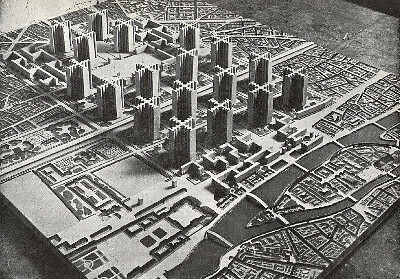
What Le Corbusier would have wrought in Paris has become the new reality of Bejing and Shanghai.

Le Corbusier once wrote of his Plan Voisin for Paris: “Since 1922 [for the past 42 years] I have continued to work, in general and in detail, on the problem of Paris. Everything has been made public. The City Council has never contacted me. It calls me ‘Barbarian’!” -- Le Corbusier’s writings, p. 207.

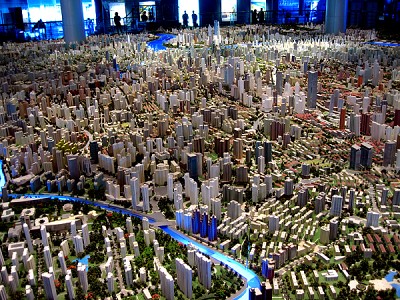
Fast forward to the Twenty-first Century and Shanghai [Le Corbusier on steroids]. It all seems like the realization of the fictional Coruscant from Star Wars... a completely urban environment that stretches as far as the eye can see. The entire planet of Coruscant is one continual city.

Guy Sorman discusses the rise of Asian 'Super Megagopolises' [click to read] in City Journal. Looking at the Mega-model of Shanghai, one could begin to wonder: "can Coruscant be that far off." Sorman points out, however, that Shanghai is largely a political creation...designed to create the impression that China is ready for business with the world. [5.]

Every day the city teems with life and every night the workers necessary to make it function vacate the pristine city. It is like Disney World, where the 'cast members' descend into 'Utilidor,' remove their costumes, and disappear to homes elsewhere.

For Shanghai workers, 'homes elsewhere' often means crowded and substandard. Just as China's factories are seldom seen by Westerners, those who maintain the stage for world commerce live in a vastly different world than the one they 'portray' in their 'day jobs.'

Or perhaps, the Death Star in Star Wars is a better analogy. Its scale is way beyond human. It is intended to convey a sense of awe. Might we be looking at the work of some latter day Nimrod, seeking to elevate himself to the heavens?

Sorman points out how the mad rush into the 21st Century has obliterated the traditional spaces of Shanghai and Beijing, which were much more human in size and scate. Again Star Wars comes to mind. Green beautiful planets like Naboo and Alderon risk elimination as the Empire expands its grasp.
shanghai-model_001
This scale model of Shanghai dwarfs the people in the room...

Coruscant_at_night_001
...and calls to mind the fictional city of Coruscant.

In the 'Sixties America sought to 'remake' her major cities. Le Corbusier style housing blocks were constructed to elevate the urban poor. Many of these 'projects' have since been torn down. While we were building them Moscow was building similar blocks of apartments. Today in Moscow, urban youths flock to the rooftops. [6.] Called 'Roofers,' these young people seek the rooftops simply for the openness and the view.

How to Return to the Village
Returning Government to the People in the 'Audience'

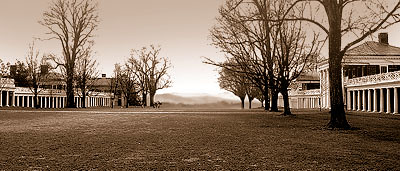
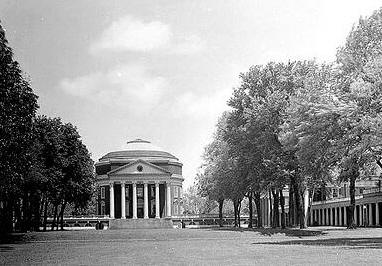
Nineteenth Century America was a nation of villages. Great centers of commerce existed, but they were fed by a vibrant countryside. When Thomas Jefferson created his ideal 'Academic Village' to house the University of Virginia he purposefully left one side open to the surrounding agricultural land. From the steps of the Rotunda one could look upon the rolling hills of Albemarle County.

Architect Stanford White convinced the University to fill the void with Old Cabell Hall a long time ago. The recently completed South Lawn attempts to recreate a space leading off into the trees of Charlottesville. The challenge of getting back to the garden is ever before us. Rooftop Gardens [click to read] offer one method of getting people and open spaces together. Reclaiming existing environments is another. Aging strip malls could be recycled into village centers for the surrounding suburban homes, offering a place residents could walk or bicycle to. Vacant lots and neglected riverfronts can become parks and gardens.
Crozet
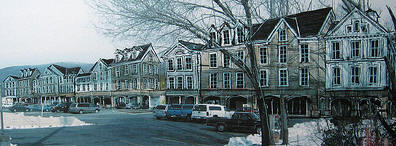
Proposed Renewal of the Crozet Shopping Center. 
Drawing created by the Kirchman Studio.

Suburb bashing has always been a fashionable intellectual pastime.That is one reason I like Robert A. M. Stern. He sees the reasons people seek out single family dwellings of a traditional form. I have a friend who lives on the upper West side and his penthouse with a view of the Hudson is very nice but give me my gardens.People put up with the wretched infrastructure overload and strip centers because the village is still appealing. The residential areas become landscaped oasis for their residents. Kids play outside the house in view of the kitchen window. People visit at the back fence. Moreover the suburbs are seen by their dwellers as affirming opportunity and safety. If people had no emotion for their homes they would be fine with Le Courbusier type high rises but that is simply not the case.The problem is really one of infrastructure and public space [or lack therof]. Strip malls and box stores create a sterile wasteland but they may become the village centers of the future.

Time magazine once featured a piece called 'Repurposing Suburbs' which shows some fine examples of recreating this type of public space. This Crozet project turns a tired strip mall into a village center. One cannot wait for Crozet's redesigner to get his creative hands on some of the new "Town Center" projects which are now just collections of big box stores. Some time ago I drew a concept where the CSX tracks between Staunton and Charlottesville became a light rail line connecting Staunton, Fishersville, Waynesboro, Crozet, Ivy, The University of Virginia Medical Center and Downtown Charlottesville. The result would be a series of village centers and a better utilization of existing infrastructure.

City Journal's writers draw conflicting conclusions. Houston is touted as encouraging its middle class while Gotham offers limited options. Dense urban areas do tend to create energy efficiency. The trick is to see opportunities to improve the communities we have already created.That would certainly involve offering condominiums and a pedestrian friendly center to suburban communities and reclaiming all those wonderful old low density neighborhoods of our cities.

IMG_8170
Front Yard garden, Arlington, Virginia. Photo by Bob Kirchman.

IMG_8157
Front Porch, Arlington, Virginia. Photo by Bob Kirchman.

For I know the plans I have for you, declares the Lord, plans for welfare and not for evil, to give you a future and a hope.” – Jeremiah 29:11

Blind to the Prosperity Around Us
[click to read]

By Alyssa Ahlgren

My generation is being indoctrinated by a mainstream narrative to actually believe we have never seen prosperity. (read more)

Laney’s Palette Art Show
Saturday September 14th, 2019 in Crozet, VA

Works by Kristina Elaine Greer will be on display at the gallery space of Tabor Presbyterian Church, 5804 Tabor Street, Crozet, Virginia 22932. There will be an opening reception on Saturday, September 14th, 2019 from 1:00 to 4:00pm at the church. All are invited. The show will feature Laney’s Acrylic Paintings and Pencil Drawings from 2004 – 2019.

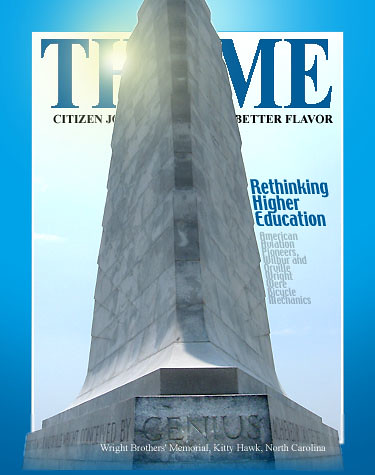
Banner

Sunday, July 21, 2019

Rethinking College (and Education), Einstein

THYME0444
Volume XVII, Issue III

A 'Best of THYMEs' Feature...

Rethinking College (and Education)

IMG_0713
My Dad, Ed Kirchman, did his part to help put men on the moon. He almost didn't make it through the education system.

The 'other' weekly news magazine's U. S. Edition presents The Class of 2025 [click to read]. They ponder what they will have learned... and how they will pay for it! Clearly changes are needed. The average US student graduates with $26,000 in college debt, with total college debt around one trillion dollars. Unfortunately the job market often presents a hostile reality, the field they have prepared five years to enter isn't hiring. TIME's Amanda Ripley looks at new trends, such as online learning and how the way we learn is already changing in a Previous Article [click to read].

The rise in online learning and for-profit colleges is challenging the traditional academy. Ostensibly this is the underlying tension behind recent events at Charlottesville's University of Virginia, where popular President Teresa Sullivan was forced to resign and then quickly reinstated.

College costs are rising at a rate outpacing the economy at large. At the same time many are questioning its value, even as it is being touted as "being as essential now as high school was in the 'Fifties." Many young men are foregoing college and entering fields such as technology, finding that to offer a more rapid path to a paycheck. The trades are experiencing a renaissance as young people rediscover the joy and purpose of skilled work.

My Father became an engineer in an era where Engineering schools did not bother to teach Literature. He struggled in high school, and framed a letter from a high school adviser stating bluntly that he should pursue a field other than Engineering. Undeterred, Dad enrolled in Junior College, then transferred to Notre Dame. He worked for Wright Aviation before taking a job at the Martin Company's Middle River Plant in Baltimore. He framed the letter.

Dad worked on the seaplanes that were used in WWII, then as Middle River closed down, he started his own test lab. He opened it in one of those buildings with spaces for contractors that had a garage door and an office. His neighbors were plumbers and HVAC companies. He hired a lot of his old colleagues from Martin. Then he was hired by NASA's Goddard Space Flight Center, where he wrote the procedures for testing spacecraft.

Though his education did not include great literature, Dad was a Renaissance man who built his own great library. He read the classics for the pure joy of learning, and was as knowledgeable about literature as many who teach it. When I was young he would read to me from great volumes such as the works of Rudyard Kipling. What magical moments those bedtime stories would become! Little did Dad know he was innoculating me to survive industrialized education.

My point? Learning can be more pragmatic, learning should be lifelong. More people need to read thick wonderful books to their kids. Making young minds cram great literature for exams may leave a bad tasteI  and leaves no room for rumination. Dad often let me work alongside him doing projects. He taught me how to work, how to design a greenhouse, and most importantly; Dad taught me how to teach others.

I was the right-brained child who struggled in school. Dad apprenticed me in the skills I needed to eventually overcome that. It is my sincere hope that Apprenticeship will experience a Renaissance as we seek to develop the G-d-given gifts of the generations to follow. Will we again find deep satisfaction in training our own replacements? It is my sincere hope that industry, the professions, and most importantly gifted individuals will step up to the challenge!

openlawn
The Lawn of the University of Virginia originally opened to the surrounding community and countryside. Photos and rendering overlay by Bob Kirchman.

The Genius of Albert Einstein


He was a master of Sitzfleisch, the ability to sit still and ponder or perform a task for a very long time. Here is a man who found genius in endurance!

The Genius of Benjamin Franklin


Unlocking Young Imaginations
[click to read]

From 3D pens, fluid art and model miniature World’s Fair projects, campers in the Fun’dudle Art Camp spent all week creating art. [read more]

IMG_0849
The 2019 Waynesboro World's Fair was created by campers at Tammy Hornek's FunDoodle Art Camp.

Baby Praying Mantis
Photos by Bob Kirchman

Baby Praying Mantis

Baby Praying Mantis

Moonwalk Montage
July 21, 1969, Apollo 11 Landed on the Moon


Neil Armstrong and Buzz Aldrin
The First Humans on the Moon

IMG_6623
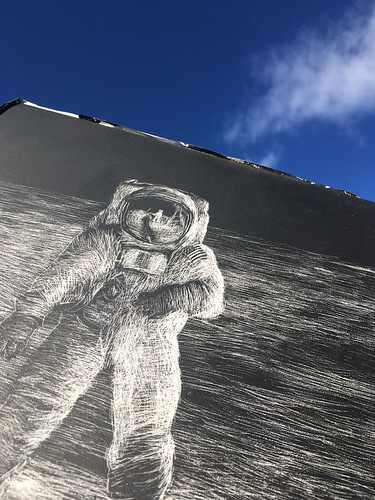
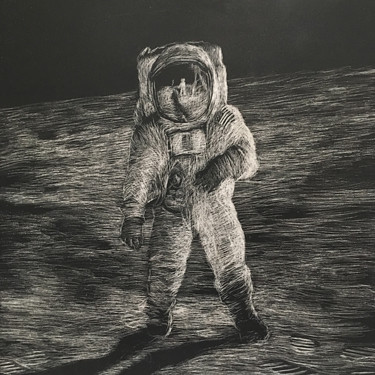
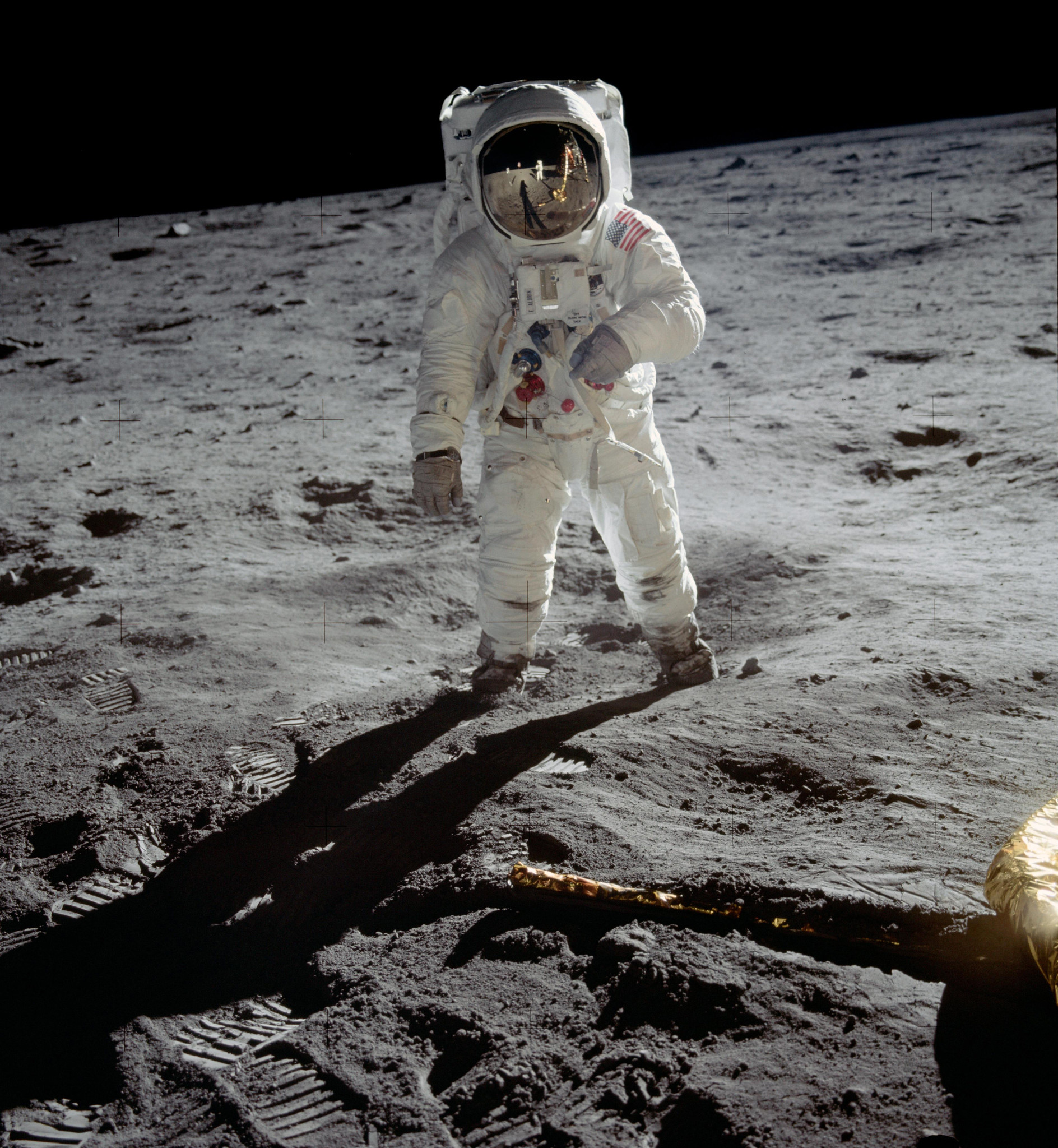
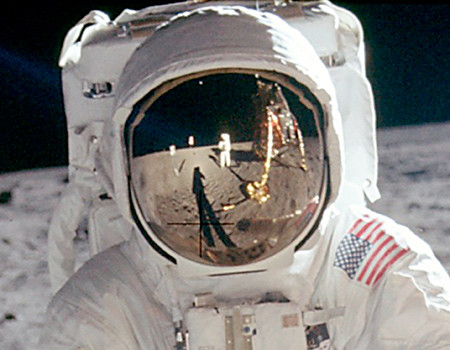
Neil Armstrong is reflected in the visor of Buzz Aldrin, the first two humans to walk on the moon. Scratchboard, 12" x 12" by Bob Kirchman.

Laney’s Palette Art Show
Saturday September 14th, 2019 in Crozet, VA

Works by Kristina Elaine Greer will be on display at the gallery space of Tabor Presbyterian Church, 5804 Tabor Street, Crozet, Virginia 22932. There will be an opening reception on Saturday, September 14th, 2019 from 1:00 to 4:00pm at the church. All are invited. The show will feature Laney’s Acrylic Paintings and Pencil Drawings from 2004 – 2019.
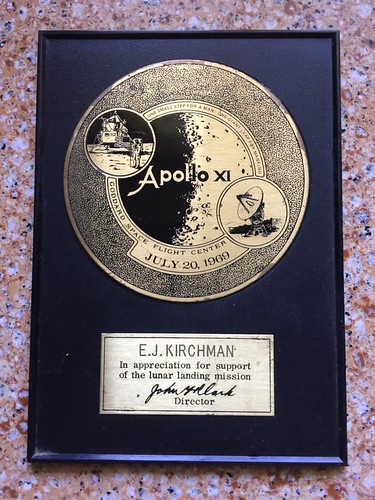
Banner

Sunday, July 14, 2019

Man on the Moon, Apollo 11, Fifty Years Ago!

apollo11
Volume XVII, Issue II

The First Humans on Another World

118692-050-194A0468
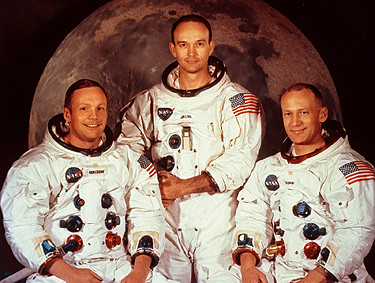
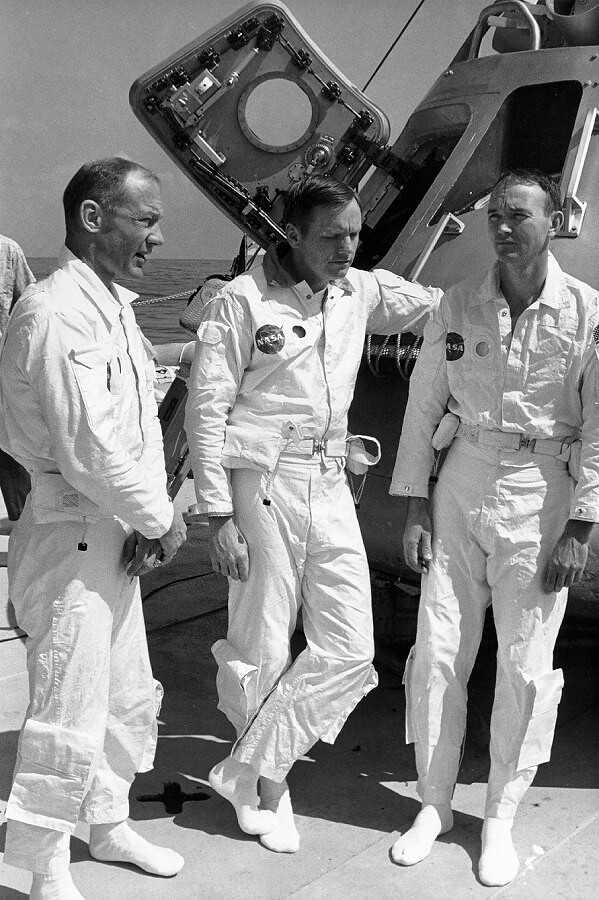
The crew of Apollo 11 (from left to right): Neil Armstrong, Michael Collins, and Edwin (“Buzz”) Aldrin. NASA Photo.

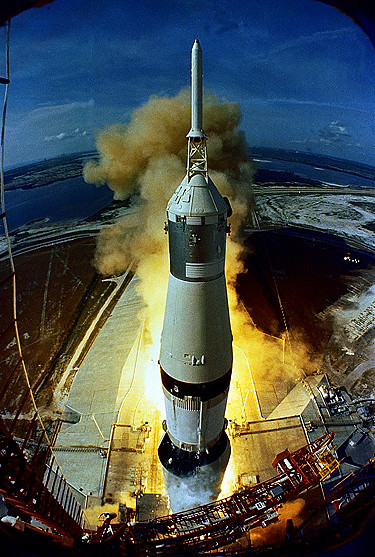
Fifty years ago on July 16th, the mighty Saturn V rocket carrying Apollo 11 lifted off from Cape Kennedy. Astronauts Neil Armstrong, Michael Collins and Edwin Aldrin flew with the first Lunar Module capable of actually landing. Though the astronauts had practiced this over and over in simulators, there was no way of knowing what their chances would be of actually landing. Armstrong even admits that he considered this to be merely the first attempt.

launch_apollo_11
Apollo 11 liftoff. NASA Photo.

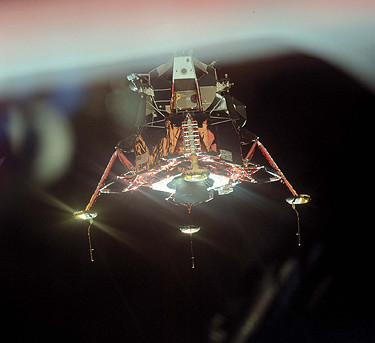
Armstrong and Aldrin would proceed to fly the Lunar Module toward the lunar surface. Their descent would not be an easy one. Their computer overloaded, almost prompting an abort. Then the computer guided them to a landing area strewn with boulders. Armstrong took manual control of the spacecraft and skimmed along until he saw a better landing sight. Running critically low on descent stage fuel, Armstrong pushed on and brought the Eagle down. With five percent fuel remaining he gently eased the lander down onto the moon. “The Eagle has Landed!”

418-050-613974C9
The Lunar Lander, Eagle. NASA Photo.

John F. Kennedy
Address at Rice University on the Space Effort

September 12, 1962

Speech Transcript

President Pitzer, Mr. Vice President, Governor, Congressman Thomas, Senator Wiley, and Congressman Miller, Mr. Webb. Mr. Bell, scientists, distinguished guests, and ladies and gentlemen:

I appreciate your president having made me an honorary visiting professor, and I will assure you that my first lecture will be very brief. I am delighted to be here and I'm particularly delighted to be here on this occasion.

We meet at a college noted for knowledge, in a city noted for progress, in a State noted for strength, and we stand in need of all three, for we meet in an hour of change and challenge, in a decade of hope and fear, in an age of both knowledge and ignorance. The greater our knowledge increases, the greater our ignorance unfolds.

Despite the striking fact that most of the scientists that the world has ever known are alive and working today, despite the fact that this Nation's own scientific manpower is doubling every 12 years in a rate of growth more than three times that of our population as a whole, despite that, the vast stretches of the unknown and the unanswered and the unfinished still far out-strip our collective comprehension.

No man can fully grasp how far and how fast we have come, but condense, if you will, the 50,000 years of man's recorded history in a time span of but a half century. Stated in these terms, we know very little about the first 40 years, except at the end of them advanced man had learned to use the skins of animals to cover them. Then about 10 years ago, under this standard, man emerged from his caves to construct other kinds of shelter.

Only 5 years ago man learned to write and use a cart with wheels. Christianity began less than 2 years ago. The printing press came this year, and then less than 2 months ago, during this whole 50-year span of human history, the steam engine provided a new source of power.

Newton explored the meaning of gravity. Last month electric lights and telephones and automobiles and airplanes became available. Only last week did we develop penicillin and television and nuclear power, and now if America's new spacecraft succeeds in reaching Venus, we will have literally reached the stars before midnight tonight. This is a breathtaking pace, and such a pace cannot help but create new ills as it dispels old, new ignorance, new problems, new dangers. Surely the opening vistas of space promise high costs and hardships, as well as high reward.

So it is not surprising that some would have us stay where we are a little longer to rest, to wait. But this city of Houston, this State of Texas, this country of the United States was not built by those who waited and rested and wished to look behind them. This country was conquered by those who moved forward-and so will space.

William Bradford, speaking in 1630 of the founding of the Plymouth Bay Colony, said that all great and honorable actions are accompanied with great difficulties, and both must be enterprised and overcome with answerable courage.

If this capsule history of our progress teaches us anything, it is that man, in his quest for knowledge and progress, is determined and cannot be deterred. The exploration of space will go ahead, whether we join in it or not, and it is one of the great adventures of all time, and no nation which expects to be the leader of other nations can expect to stay behind in this race for space.

Those who came before us made certain that this country rode the first waves of the industrial revolutions, the first waves of modern invention, and the first wave of nuclear power, and this generation does not intend to founder in the backwash of the coming age of space. We mean to be a part of it - we mean to lead it. For the eyes of the world now look into space, to the moon and to the planets beyond, and we have vowed that we shall not see it governed by a hostile flag of conquest, but by a banner of freedom and peace. We have vowed that we shall not see space filled with weapons of mass destruction, but with instruments of knowledge and understanding.

Yet the vows of this Nation can only be fulfilled if we in this Nation are first, and, therefore, we intend to be first. In short, our leadership in science and in industry, our hopes for peace and security, our obligations to ourselves as well as others, all require us to make this effort, to solve these mysteries, to solve them for the good of all men, and to become the world's leading space-faring nation.

We set sail on this new sea because there is new knowledge to be gained, and new rights to be won, and they must be won and used for the progress of all people. For space science, like nuclear science and all technology, has no conscience of its own. Whether it will become a force for good or ill depends on man, and only if the United States occupies a position of pre-eminence can we help decide whether this new ocean will be a sea of peace or a new terrifying theater of war. I do not say that we should or will go unprotected against the hostile misuse of space any more than we go unprotected against the hostile use of land or sea, but I do say that space can be explored and mastered without feeding the fires of war, without repeating the mistakes that man has made in extending his writ around this globe of ours.

There is no strife, no prejudice, no national conflict in outer space as yet. Its hazards are hostile to us all. Its conquest deserves the best of all mankind, and its opportunity for peaceful cooperation may never come again. But why, some say, the moon? Why choose this as our goal? And they may well ask why climb the highest mountain. Why, 35 years ago, fly the Atlantic? Why does Rice play Texas?

We choose to go to the moon. We choose to go to the moon in this decade and do the other things, not because they are easy, but because they are hard, because that goal will serve to organize and measure the best of our energies and skills, because that challenge is one that we are willing to accept, one we are unwilling to postpone, and one which we intend to win, and the others, too.

It is for these reasons that I regard the decision last year to shift our efforts in space from low to high gear as among the most important decisions that will be made during my incumbency in the Office of the Presidency.

In the last 24 hours we have seen facilities now being created for the greatest and most complex exploration in man's history. We have felt the ground shake and the air shattered by the testing of a Saturn C-1 booster rocket, many times as powerful as the Atlas which launched John Glenn, generating power equivalent to 10,000 automobiles with their accelerators on the floor. We have seen the site where five F-1 rocket engines, each one as powerful as all eight engines of the Saturn combined, will be clustered together to make the advanced Saturn missile, assembled in a new building to be built at Cape Canaveral as tall as a 48-story structure, as wide as a city block, and as long as two lengths of this field.

Within these last 19 months at least 45 satellites have circled the earth. Some 40 of them were "made in the United States of America" and they were far more sophisticated and supplied far more knowledge to the people of the world than those of the Soviet Union. The Mariner spacecraft now on its way to Venus is the most intricate instrument in the history of space science. The accuracy of that shot is comparable to firing a missile from Cape Canaveral and dropping it in this stadium between the 40-yard lines. Transit satellites are helping our ships at sea to steer a safer course. Tiros satellites have given us unprecedented warnings of hurricanes and storms, and will do the same for forest fires and icebergs.

We have had our failures, but so have others, even if they do not admit them. And they may be less public.

To be sure, we are behind, and will be behind for some time in manned flight. But we do not intend to stay behind, and in this decade we shall make up and move ahead. The growth of our science and education will be enriched by new knowledge of our universe and environment, by new techniques of learning and mapping and observation, by new tools and computers for industry, medicine, the home as well as the school. Technical institutions, such as Rice, will reap the harvest of these gains.

And finally, the space effort itself, while still in its infancy, has already created a great number of new companies, and tens of thousands of new jobs. Space and related industries are generating new demands in investment and skilled personnel, and this city and this State, and this region, will share greatly in this growth. What was once the furthest outpost on the old frontier of the West will be the furthest outpost on the new frontier of science and space. Houston, your City of Houston, with its Manned Spacecraft Center, will become the heart of a large scientific and engineering community.

During the next 5 years the National Aeronautics and Space Administration expects to double the number of scientists and engineers in this area, to increase its outlays for salaries and expenses to $60 million a year; to invest some $200 million in plant and laboratory facilities; and to direct or contract for new space efforts over $1 billion from this Center in this City.

To be sure, all this costs us all a good deal of money. This year's space budget is three times what it was in January 1961, and it is greater than the space budget of the previous 8 years combined. That budget now stands at $5,400 million a year-a staggering sum, though somewhat less than we pay for cigarettes and cigars every year. Space expenditures will soon rise some more from 40 cents per person per week to more than 50 cents a week for every man, woman, and child in the United States, for we have given this program a high national priority even though I realize that this is in some measure an act of faith and vision, for we do not now know what benefits await us. But if I were to say, my fellow citizens, that we shall send to the moon, 240,000 miles away from the control station in Houston, a giant rocket more than 300 feet tall, the length of this football field, made of new metal alloys, some of which have not yet been invented, capable of standing heat and stresses several times more than have ever been experienced, fitted together with a precision better than the finest watch, carrying all the equipment needed for propulsion, guidance, control, communications, food and survival, on an untried mission, to an unknown celestial body, and then return it safely to earth, reentering the atmosphere at speeds of over 25,000 miles per hour, causing heat about half that of the temperature of the sun - almost as hot as it is here today - and do all this, and do it right, and do it first before this decade is out, then we must be bold. I'm the one who is doing all the work, so we just want you to stay cool for a minute.

[Laughter]

However, I think we're going to do it, and I think that we must pay what needs to be paid. I don't think we ought to waste any money, but I think we ought to do the job. And this will be done in the decade of the sixties. It may be done while some of you are still here at school at this college and university. It will be done during the terms of office of some of the people who sit here on this platform. But it will be done. And it will be done before the end of this decade.

I am delighted that this university is playing a part in putting a man on the moon as part of a great national effort of the United States of America.

Many years ago the great British explorer George Mallory, who was to die on Mount Everest, was asked why did he want to climb it. He said, "Because it is there."

Well, space is there, and we're going to climb it, and the moon and the planets are there, and new hopes for knowledge and peace are there. And, therefore, as we set sail we ask God's blessing on the most hazardous and dangerous and greatest adventure on which man has ever embarked.

Thank you.

NOTE: The President spoke in the Rice University Stadium at 10 a.m. In his opening words he referred to Dr. K. S. Pitzer, President of the University, Vice President Lyndon B. Johnson, Governor Price Daniel of Texas, Representative Albert Thomas of Texas, Senator Alexander Wiley of Wisconsin, Representative George P. Miller of California, James E. Webb, Administrator, National Aeronautics and Space Administration., David E. Bell, Director of the Bureau of the Budget.

Source: Public Papers of the Presidents of the United States, v. 1, 1962, pp. 669-670.

Apollo 11, The Moon Mission
[click to read]

34882
The crew of Apollo 11 relaxes during a training exercise. NASA Photo.

(see more photos)

On Board Apollo Moonships
[click to read]

By Carlos Clarivan

On Board Apollo Moonships contains 100 pages and more than 200 3D-illustrations and images that show in detail the spacecrafts that allowed to travel to the Moon and explore it in the late 1960s and early 70s: from the mighty Saturn V rocket and the Apollo mothership up to the the Lunar Module and the revolutionary Moon Rover. (read more)

TLI
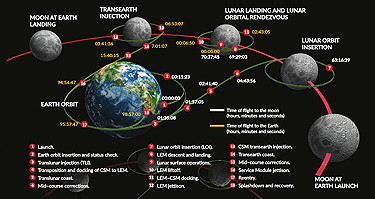
From the Earth to the Moon. Illustration by Carlos Clarivan.

Interview with Neil Armstrong!


The first man to set foot on the moon!

In this rare series of interviews, Neil Armstrong, the first man to set foot on the moon, tells the story of the historic mission from his own perspective. [1.] Alex Malley of Australia's EvoTV's The Bottom Line looks at the life and leadership of the lunar mission's commander. Fascinated by aircraft, even at a very early age, Armstrong obtained his pilot's license at the age of fifteen!

He went on to fly combat missions during the Korean War and later became a test pilot. He then became an astronaut as NASA geared up to meet President John F. Kennedy's challenge to put a man on the moon in the decade and return him safely to earth.

The Russians had already orbited the first satellite, Sputnik, on October 4, 1957 and subsequently orbited cosmonaut Yuri Gagarin as the Americans struggled to develop a dependable booster. After Alan Shepard's short suborbital flight in 1961, President Kennedy challenged the fledgeling space agency to go to the moon.

Armstrong is refreshingly honest in his discussion with Malley. The interview is presented in four parts and is worth watching to the very end. Neil Armstrong expresses very real concern that the space agency lacks the vision and sense of purpose it had in those early years. He ends with a challenge that we as a people would do well to heed and pursue in our own time!

The Full Interview may be found Here [click to listen].


Forty-seven years ago two human beings changed history by walking on the surface of the moon. But what happened before Buzz Aldrin and Neil Armstrong exited the Lunar Module is perhaps even more amazing, if only because so few people know about it.

The First Humans on the Moon
Neil Armstrong Reflected in Buzz Aldrin's Visor

Buzz

Apollo11_PhotoManOnMoon
NASA Photos

Neil Armstrong and Buzz Aldrin
The First Humans on the Moon

IMG_6623
Neil Armstrong is reflected in the visor of Buzz Aldrin, the first two humans to walk on the moon. Scratchboard, 12" x 12" by Bob Kirchman.

60 Years of NASA
[click to read]

Celebrating Where Art and Science Meet


To celebrate NASA’s 60th anniversary this year, the agency partnered with the National Symphony Orchestra to present a concert in Washington entitled “NSO Pops: Space, the Next Frontier.” NASA mission images complemented performances of space-inspired music in the Kennedy Center’s concert hall, including Claude Debussy’s “Clair de Lune” (“Moonlight”), with a video of the Moon created by NASA science visualizer Ernie Wright.

At NASA’s Goddard Space Flight Center in Greenbelt, Maryland, Wright works in the Scientific Visualization Studio, using NASA data to create accurate visuals of celestial bodies. Wright made the lunar imagery accompanying “Clair de Lune” with data from the Lunar Reconnaissance Orbiter (LRO). (read more)

MoonEarthrise
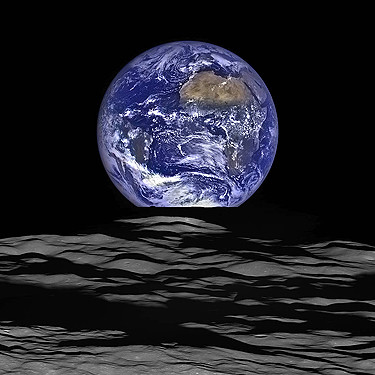
LRO Photo of Earthrise over the moon. NASA Photo.

The World of Tomorrow
Eighty Years Ago the World Came to the NY Fair

Model,_Theme_Center_-_New_York_World's_Fare_-_1939,_c._1938,_Harrison_&_Fouilhoux
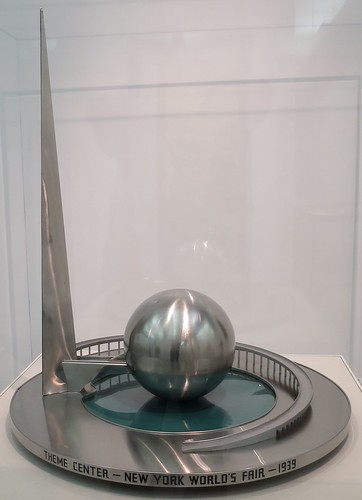
Model of the Trylon and Perisphere, symbols of the fair.

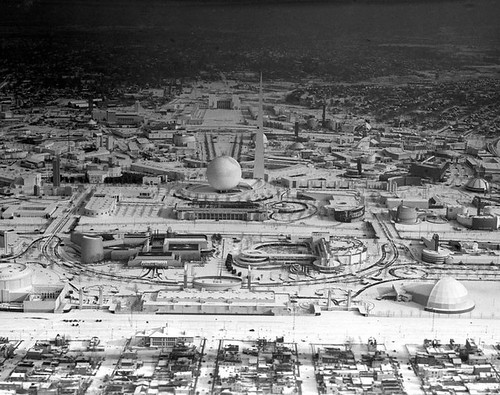
When Frank Baum wrote the Wizard of Oz he based the Emerald City on the 1893 Chicago Columbian Exposition – the Chicago World’s Fair. The fair’s colossal white classical buildings and those of many fairs to follow, would inspire the civic architecture of a young nation coming of age. Baum’s Emerald City was white – until you put on the green glasses! The 1939 World’s Fair, forged in the middle of the Great Depression, sought to bring a new vision for American life as well. It brought more central planning and a stark modernism in its architecture – adding a bit of Art Deco for good measure. The Emerald City of the movie version, made in 1939, looked to the New York fair for its inspiration. That fair was ‘a horse of a different color.’ The Trylon and Perisphere were white, but the buildings were many different colors as they were arranged around the central iconic building. The ‘World of Tomorrow’ is seen from the eyes of a ten year old boy who visited with his family in the Summer of 1939.


This week I will be working with students of Fundoodle Art Camp as they construct a miniature World’s Fair. Here is an introductory video I prepared for them.


IMG_0428

IMG_0429

The 1964 World's Fair
55 Years Ago, The World Came to New York Again!


Lift your vision high,
   we're in a way we've never been before.
Lift your vision higher,
   and you will see the glory of the Lord.

For without a progressive vision
   we dwell carelessly.
Without a progressive vision
   we dwell carelessly.
So lift your vision higher
   and you will see the glory of the Lord.”
– Unknown

IMG_0431
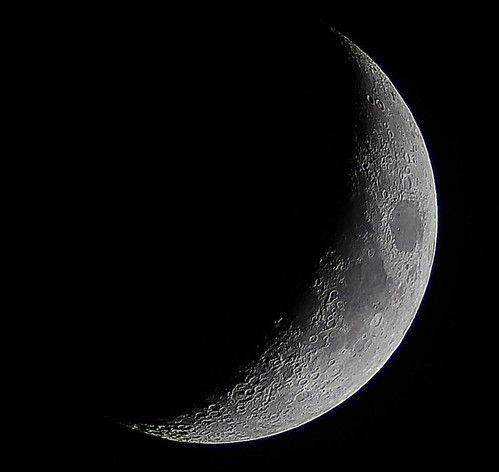
On Saturday, July 6, 2019 the moon was roughly the same waxing phase as it was on July 20, 1969. In honor of the 50th anniversary of Apollo 11, Michal Warzecha took 50 shots with his Canon T3i and 80mm Orion refractor and stacked the images with Autostakker. 
Photo by Michal Warzecha.

Banner

Sunday, July 7, 2019

Josiah, Intreat Me Not to Leave Thee, Mystery

JOSIAH013
Volume XVII, Issue I

Josiah
By Bob Kirchman
Copyright © 2019, The Kirchman Studio, all rights reserved

Chapter 13: Intreat Me Not to Leave Thee

West concluded the meeting saying “You must think it over. We must know that this is something you do of your OWN volition. We have reached out to those who might be your fellow crewmen. Of course, they and you are sworn to secrecy. Just think, if the news media in the ‘Lower 48’ get a hold of this, they’ll start making all sorts of statements and demands. You know how they love to paint the Alaska Republic as a ‘cold and uncaring’ entity. Even though APOLLONIUS destroyed his own colony, they’ll make us the villains. They’ll accuse us of marooning the settlers there. There will be any number of ‘conspiracy theories.’”

I… must pray, and let you know then.”

In the days that followed, Josiah Zimmerman sought the continued counsel of Greene and Ben-Gurion, who for their part, happily gave him all the time he needed. Of course, he wanted the adventure, and the purpose of the mission. What would his parents think? What about his fiancé, Adila? He understood the secrecy and its necessity, but he didn’t even know who he was crewing with. In the Twenty-first Century such commitment to the unknown was rare to ask of anyone. It was something out of another time. So Josiah Zimmerman screwed up his nerve and sought out Dr. Greene, spilling his fears and concerns. The good doctor said little, but said he’d arrange a meeting soon to help him through this.

A week or so later, Greene sent a message that Josiah should come to the chapel office that afternoon at 2:00pm, Big Diomede Time. The young man arrived freshly showered and somewhat out of breath. He was surprised to see his parents and Adila there! With them were Sarah and Abiyah Ben-Gurion and their son Adam. “We are the first three people to set foot on Mars.” Abiyah said, and he went on to explain that Greene was not going to be there as he had a granddaughter’s dance recital to go to that afternoon. “Besides, he told me he’s pretty much out of advice for you anyway. He WILL be present to counsel you about another step you might take in life – one that I think will come up in the discussion this afternoon.”

Ben-Gurion continued “I’ve invited Adila’s parents to this meeting as well. I think you know Sarah and my story. The secret marriage and all – and you know how Adam was already with us when we set foot on Mars. Sarah touched the planet slightly before me, but that is for the historians to sort out. In the Guiness Book of World Records, we’re tied at the moment. Since Adila is fluent in five languages and aerospace studies as well, she was also a logical choice for this mission.”

Since our mission,” Sarah chimed in, “Mission Control has written stricter policies about things such as our ‘secret marriage,’ if you get my drift. But, since you have already made it quite clear that you are committed to each other, we just want to make sure you know that you need not decide without the benefit of blessing. And we sure do not want you deciding in the dark without input from those who love you.”

Adila spoke next: “Intreat me not to leave thee, or to return from following after thee: for whither thou goest, I will go; and where thou lodgest, I will lodge: thy people shall be my people, and thy God my God: Where thou diest, will I die, and there will I be buried: the LORD do so to me, and more also, if ought but death part thee and me.” – the words of Ruth to Naomi, but also much referenced in marital loyalty as well.

The two of them would follow in the footsteps of Abiyah and Sarah. They set to work planning their wedding.

Chapter 14: Unto All Nations

The next few weeks were a whirlwind of activity as Big Diomede readied for the celebration! The little chapel on the island always seemed happiest when it rejoiced with the bride and bridegroom and Mrs. Greene spared nothing in decorating it. But all the while they wondered – who was third on their crew? Both were well trained in the work of spaceflight and balanced simulator time with getting fitted for wedding clothes. Abiyah Ben-Gurion was suspected, but he was getting older and didn’t visit the simulator rooms much anymore. He was, many people noted, taking lots of long walks with Adam now.

Adam had followed in the footsteps of his capable parents and was a great pilot in his own right. He was a loner like his dad had been and everyone assumed he must like it that way. He did seem to have a lot to discuss with dad these days. Was his dad in fact going back to Mars? He still passed the physical – with a few ‘look the other ways’ by the flight surgeons.

We’ll never know for sure, but if the truth be known, I doubt it was clear who would go; Abiyah or Adam, as they talked it out but clearly the father felt some responsibility for the colony and the son loved his father. He had rebelled some as a youth but he now saw how wonderful his upbringing had been. The virtue of gratitude – the only virtue Abiyah would lay claim to, had been passed from father to son!

Though the older Ben-Gurion was methodical in his attempts to discourage his son, he was also quite proud of him. In the end, it was Adam who begged his father for the chance to complete the work that he had begun. Sarah and Abiyah, of all people, were uniquely able to understand the drive of their son. Since they knew Josiah, Adila and Adam quite closely, seeing them work together at school, they saw a team that was every bit as capable as the team of Cohen – Ben-Gurion decades before them. Now they congregated frequently at the Ben-Gurion home for meals and conversation.

After the wedding, the three began training for the mission in dead earnest. All three of them expressed some disappointment that meeting the best launch window meant missing the World’s Fair in Fairgate, but that was a small concern. The Martians were waiting. Josiah and Adila also sought out the company of the Greenes and over macaroni and cheese, they discussed such things as the journeys of Paul in the First Century. Surely they were following in his footsteps. “What constitutes a nation in the eyes of the Divine?” Dr. Greene asked his pupil and his pupil’s wife as they supped together.

The dictionary says, ‘a large aggregate of people united by common descent, history, culture, or language, inhabiting a particular country or territory.’ Responded Josiah.

JOSIAHEpilogue

Josiah
By Bob Kirchman
Copyright © 2018, The Kirchman Studio, all rights reserved

Epilogue: The Bridge of God

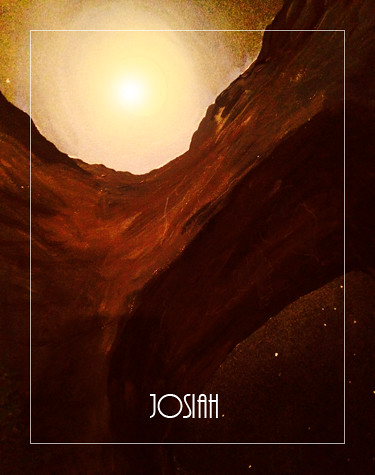
For decades it had simply been known as ‘The Great Mystery’ by the colonists. Indeed it was a wonder to them that the opening existed at all. Upon landing, the colonists had discovered the opening that gave entry into the little valley. The fine soil and natural protection had led them to place a substantial part of their greenhouse agriculture in that valley. That was why the colonists survived. Josiah the colonist and Josiah Zimmerman walked through the arch one afternoon in their spacesuits. Josiah the colonist told the story as they stared up at the 90’ wide archway that rose 215’ above them. Young Zimmerman found the whole scene strangely familiar.

Really, this looks just like a place I remember from my boyhood,” young Josiah mused. “It is the spitting image of the Natural Bridge in Rockbridge County. My grandfather would take me there. We would stand under the arch and look up at it. He would whisper “MOHOMONY.” That is what the Monacan Nation called it and it was a sacred place to their people. The name was alternately translated ‘Great Mystery’ or ‘The Bridge of God.’

The Monacans were a Souix people who lived in the Valley of Virginia. Once a band of Monacans were being pursued by a much larger army of Powhatans and in their distress they prayed. They had been pressed to the edge of a deep chasm, the valley of Cedar Creek. Escape was impossible. But looking up they saw the natural bridge that spanned the chasm. They hurried their women and children across it. Now the warriors turned and faced their enemy on the narrow bridge. The larger Powhatan force was reduced by the width of the bridge and that day the Monacans prevailed.” Grandfather never tired of telling that tale.

When the unmanned lander had sent its rover through the arch, no one thought to pan the camera up. It remained a secret until the relief shuttle crew walked through it.

Josiah Zimmerman thought of the Virginia colonists and how they had discovered a bend on the James River that looked just like the bend in the Thames River at a place called Richmond. Thus the capital of the new place took its name from its similarity to a place familiar. Here in a faraway and forbidding place was a scene familiar as well – and even more amazing, it too played in a story of Divine deliverance. In the times to come, it too would become known as ‘MOHOMONY.’

Then Joshua called the twelve men, whom he had prepared of the children of Israel, out of every tribe a man: And Joshua said unto them, Pass over before the ark of the Lord your God into the midst of Jordan, and take you up every man of you a stone upon his shoulder, according unto the number of the tribes of the children of Israel: That this may be a sign among you, that when your children ask their fathers in time to come, saying, What mean ye by these stones? Then ye shall answer them, That the waters of Jordan were cut off before the ark of the covenant of the Lord; when it passed over Jordan, the waters of Jordan were cut off: and these stones shall be for a memorial unto the children of Israel for ever. And the children of Israel did so as Joshua commanded, and took up twelve stones out of the midst of Jordan, as the Lord spake unto Joshua, according to the number of the tribes of the children of Israel, and carried them over with them unto the place where they lodged, and laid them down there. And Joshua set up twelve stones in the midst of Jordan, in the place where the feet of the priests which bare the ark of the covenant stood: and they are there unto this day.” – Joshua 4:4-9
THE END

MarNatBr
The HiRISE camera on the Mars Reconnaissance Orbiter took an image of a thin channel, and a portion of it contains a naturally occurring bridge over the chasm. Kelly Kolb from the HiRISE team says it is probably a remnant of the original surface, the rest of which has collapsed downward. NASA Photo.

Hacking the Program
A True Commencement Message

I have a cousin who went to Virginia Military Institute and graduated from the school. Today she is a commercial pilot. But here we will consider her experience at VMI. When she arrived on campus and joined the ‘rat line,’ she was subjected to the same physical exertion, mental and verbal abuse and general torture that first year students at that great school all endure. It is how she handled it that is instructive. She admitted to my uncle that she had a unique coping strategy. She made a game of it. As many of her fellow rats grew discouraged and packed it in, my cousin doubled down on her resolve. Later she confessed that at the end the hardest thing for her was to keep from laughing.

You see, she knew she needed to obtain knowledge and develop skills for her future life. Discipline was essential for this. She also knew that there was entwined in every institution of value a lot of culture and stress best left ignored. And so, as many high school students enjoy their Summer in anticipation of careers or further education towards careers, It is well to consider a few points.

Your True Education Began Long Ago

Do you remember when your Mom taught you to speak? Do you remember when Dad taught you how to build a birdhouse? Those are just the most observable lessons. You also learned some core values and how to work from your family. You also learned from them how to live. They may have led you into your Faith. These things are foundational to who you are. Oh yes, you will likely test the limits, but remember that there are good reasons behind them. Be suspicious of any university person who diminishes their value and importance.

Your Education Does Not End with a Degree

It is not possible to become a true ‘Master’ in four or five years. That will take much longer. Methodology will change. Ideas will change. You will change. Here it is important to learn how to discern Objective Truth from Subjective Truth. Yes, there really are things that don’t change. A rock released from the hand will always experience the effects of gravity. It will never fly away from the planet! When you apprehend an Objective Truth, let it comfort you. Don’t succumb to the intellectually lazy path of relativism!

Your Intuition is Valuable

You must always nurture your ability to “go to the source.” When someone tells you “the Bible says thus and so,” it is a necessary skill to be able to study for yourself. It is okay to disagree with ‘experts.’ It is okay to ask them hard questions. It is okay to use your imagination sometimes. When my Dad was in engineering school at Notre Dame, his professor stated with great authority that the atom could never be smashed. Ironically the physics department at Notre Dame had just built a machine for smashing atoms! Someone had imagined it could be done! Still, the teacher in the classroom promoted the now inaccurate idea that this was not possible.

Finally, it is well to learn the difference between constructive criticism and – well, just criticism. There is a lot of negativity around us in the world and it is quite possible your brilliant foray into the world of imagination will simply meet with a professor’s bad day. You won’t know that he fought with his wife that morning and nothing looks good to him right now. Never take input personally. It really isn’t about you anyway. The criticism you need to listen to comes with a genuine desire to see you get better at something. There will be the suggestion of a better way of doing it – or at least ANOTHER way. It may work for you, it may not. There may be the revelation of some true oversight on your part which might lead to unintended consequences. In any case, your critic will have the patience to explain. The goal of such criticism will be thought, clearly not aggravation. Thus you can sort out input rather quickly into that which is useful in your development and what is not. You can develop a thick skin and true sensitivity at the same time and both will serve you well.

Sometimes it will serve you well to try the suggested way in a class and then return to your method later if your intuition tells you to do so. There are atoms waiting to be split!

Commencement means ‘beginning.’ A true commencement message should become the prelude to learning, not the postscript so often delivered by celebrities or politicians. In the end, I’d rather simply hear ‘Nice Job,’ or something like that as I move to the challenges ahead.

It's Time to Refound Our Universities
They've Strayed from the Noble Purposes of their Founders

Rotunda
Jefferson's Rotunda, the center of his 'Academic Village.' Photo by Rufus Holsinger.

Did you know that Hamas enjoys more positive praise on some of our college campuses than it does on the West Bank? Just ask Khaled Abu Toameh, an Arab Muslim with Israeli citizenship who used to be with the Palestinian media but chose to move to the Israeli press where he was free to speak what was on his heart.

Toameh has observed a 'Pro Palestinian Junta' taking place on U.S. campuses as Middle-Eastern studies professors promote a pretty one-sided picture of a complex situation.

There is a problem here. Most of the kids attending 'Code Pink' antiwar presentations have never been to Israel and are swayed by the speech of people who conveniently ignore the nature of jihad and the refusal of Palestinian spokesmen to recognize Israel's right to exist. Playing on sympathy for the victims of this situation, they ignore the reality that many Hamas policies have continued the harm. They forget that the pullout from Gaza left the people there with beautiful greenhouses and the possibility of taking part in the 'miracle' agriculture that the region had enjoyed under Jewish control. The Palestinians trashed the facilities, shot rockets at Sderot and chose instead to live supplied through tunnels from Egypt.

Years ago, my sister-in-law was a young idealist who chose to go live with the Sandinistas for a bit, obviously inspired by some academic. Problem was when you actually got there you saw that the Sandinistas were not such idealists at all.

May I make the controversial statement that $20,000 a year is a bit much to be paying for such indoctrination.

Guardians of the Gate

Why do they get away with it? There is only one reason. They are the 'guardians of the gate' to a number of important and well paying careers. The computer revolution has begun to chip away at that as many young people have been able to bypass the four or five year path that was traditionally perscribed for success. That is not a bad thing, howls about lacking "well roundedness" aside.

In the Seventeenth Century colleges were founded in this land to train well read leaders and reach the Native population with the Gospel. That's why Dartmouth and William and Mary have Indians as mascots. A gentleman such as Thomas Jefferson was schooled in practical arts, such as Architecture, along with his Classical education.

Fast forward to the Twenty-first Century. Western Civilization has been effectively eliminated from the curriculum. Beauty and truth have been reduced to relative terms. They still exist, but not at the academy.

A Modest Proposal

Every year large corporations hire the graduates of such prestigious institutions and then lament that they are then required to actually train them for the work! To add insult to injury, they are cooerced through alumni associations and endowments to pony up to maintain the status quo.

Here is the modest proposal. Industry and medicine need to reinstate the apprenticeship system of old and take the money they are throwing into a failed system to found their own institutes of Art, Architecture, Engineering, Medicine [yes, Medicine]! Hospitals need to own and operate the training of physicians.

Building upon the existing Community College system, they can provide the well-rounded education that Seventeenth Century students received. Prolonged adolescence would be replaced by a productive young adulthood and knowledge would be acquired over a lifetime instead of in a four year attempt to "force feed" young people who are frankly more interested in other things.

Citizens would pursue continuing education in their field and also in arts and letters. My own Father is my perfect man as a model of the Citizen-Scholar. He barely made it through high school and his advisor wrote a letter saying that he could not recommend that my Father pursue Engineering as a career. Dad went to a junior college for a year before applying to Notre Dame where he did indeed pursue his Engineering degree. Upon graduation he went to Wright doing structural analysis on aircraft. Eventually he ended up at the Martin Company in Baltimore doing structural analysis on the seaplanes used in the Pacific Theatre during WWII.

He married his chief number cruncher and eventually left Martin to start his own lab. He had one of those shop/garage units that plumbing contractors rent and he built shock and vibration test equipment in there. Eventually he was hired to write the test procedures for NASA. He became a department head there, having created a lot of the quality assurance methodology for spacecraft. Wernher von Braun tapped him to become part of the group that developed the testing procedures.

But I've digressed. In Dad's day they really did train Engineers who couldn't read and Liberal Arts Scholars who couldn't count. Dad slowly aquired a magnificent library and schooled himself in letters. He read all the noble works of Western literature and probably could have taught the courses! He was equally at home reading Plato or dissecting a roto-tiller. My complete man!

When I was twelve, he said "build me a greenhouse" and offered more moral support than knowledge as I did my own research and drew plans for the thing. He gave me a budget and helped me place the rafters. When I secured a good price for a set of old storm windows I think he was pleased. The redwood structure didn't succumb to termites until Reagan was president.

Farmington
Thomas Jefferson designed this addition to Farmington as well as Monticello and the University of Virginia.

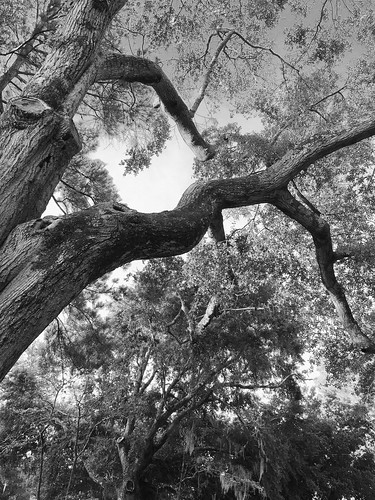
Live Oak, Wilmington, NC
Photos by Bob Kirchman

Live Oak

Live Oak

Live Oak

Live Oak

House, Wilmington, NC
Photo by Bob Kirchman

House

The Declaration of Independence
Reading at Frontier Culture Museum

IMG_0325
Ray Wright reads the Declaration of Independence at the American Frontier Culture Museum, Staunton, Virginia.

Read the Declaration of Independence Full Text [click to read] here. Also read What to the Slave is the Fourth of July [click to read] by Frederick Douglass in which he expounds on the principles put forth in the Declaration.

This, for the purpose of this celebration, is the 4th of July. It is the birthday of your National Independence, and of your political freedom. This, to you, is what the Passover was to the emancipated people of God. It carries your minds back to the day, and to the act of your great deliverance; and to the signs, and to the wonders, associated with that act, and that day. This celebration also marks the beginning of another year of your national life; and reminds you that the Republic of America is now 76 years old. I am glad, fellow-citizens, that your nation is so young. Seventy-six years, though a good old age for a man, is but a mere speck in the life of a nation. Three score years and ten is the allotted time for individual men; but nations number their years by thousands. According to this fact, you are, even now, only in the beginning of your national career, still lingering in the period of childhood. I repeat, I am glad this is so. There is hope in the thought, and hope is much needed, under the dark clouds which lower above the horizon. The eye of the reformer is met with angry flashes, portending disastrous times; but his heart may well beat lighter at the thought that America is young, and that she is still in the impressible stage of her existence. May he not hope that high lessons of wisdom, of justice and of truth, will yet give direction to her destiny? Were the nation older, the patriot’s heart might be sadder, and the reformer’s brow heavier. Its future might be shrouded in gloom, and the hope of its prophets go out in sorrow. There is consolation in the thought that America is young. Great streams are not easily turned from channels, worn deep in the course of ages. They may sometimes rise in quiet and stately majesty, and inundate the land, refreshing and fertilizing the earth with their mysterious properties.” – Frederick Douglass

declaration-of-independence

Allow me to say, in conclusion, notwithstanding the dark picture I have this day presented of the state of the nation, I do not despair of this country. There are forces in operation, which must inevitably work the downfall of slavery. “The arm of the Lord is not shortened,” and the doom of slavery is certain. I, therefore, leave off where I began, with hope. While drawing encouragement from the Declaration of Independence, the great principles it contains, and the genius of American Institutions, my spirit is also cheered by the obvious tendencies of the age. Nations do not now stand in the same relation to each other that they did ages ago. No nation can now shut itself up from the surrounding world, and trot round in the same old path of its fathers without interference. The time was when such could be done. Long established customs of hurtful character could formerly fence themselves in, and do their evil work with social impunity. Knowledge was then confined and enjoyed by the privileged few, and the multitude walked on in mental darkness. But a change has now come over the affairs of mankind. Walled cities and empires have become unfashionable. The arm of commerce has borne away the gates of the strong city. Intelligence is penetrating the darkest corners of the globe. It makes its pathway over and under the sea, as well as on the earth. Wind, steam, and lightning are its chartered agents. Oceans no longer divide, but link nations together. From Boston to London is now a holiday excursion. Space is comparatively annihilated. Thoughts expressed on one side of the Atlantic, are distinctly heard on the other. The far off and almost fabulous Pacific rolls in grandeur at our feet. The Celestial Empire, the mystery of ages, is being solved. The fiat of the Almighty, “Let there be Light,” has not yet spent its force. No abuse, no outrage whether in taste, sport or avarice, can now hide itself from the all-pervading light.” – Frederick Douglass

Americans Who Risked Everything


Sweatshops Behind the Swoosh
A Real Reason to be 'Offended'


“Believe in something.” – Jim Keady Does. [1.][2.]

Hollyhocks at the Museum
Photos by Bob Kirchman

Hollyhocks, Frontier Culture

Hollyhocks, Frontier Culture

Hollyhocks, Frontier Culture

Hollyhocks, Frontier Culture

Hollyhocks, Frontier Culture

Hollyhocks, Frontier Culture

Hollyhocks, Frontier Culture
Beautiful hollyhocks at the American Frontier Culture Museum, Staunton, Virginia.

Neil Armstrong and Buzz Aldrin
The First Humans on the Moon

IMG_6623
Neil Armstrong is reflected in the visor of Buzz Aldrin, the first two humans to walk on the moon. Scratchboard, 12" x 12" by Bob Kirchman.

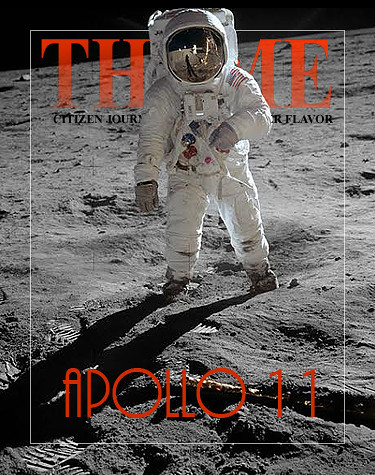
Next week THYME Magazine celebrates our journey to the moon fifty years ago. Special edition!

PontifusBANNER